© 2018, IRJET | Impact Factor value: 6.171 | ISO 9001:2008 Certified Journal | Page 377
A Critical Analysis on Network Layer Attacks in Wireless Sensor Network
Swathi B.H.
1, Gururaj H.L.
21
M.Tech, Dept. of Computer Science and Engineering, Vidyavardhaka College of Engg., Karnataka, India
2
Assistant Professor, Dept. of Computer Science and Engineering, Vidyavardhaka College of Engg,
Karnataka, India
---***---Abstract - There are several arriving trends in the field of
networks, among those Wireless Sensor Networks(WSNs) are gaining importance recent years due to its impact on cost, ability to cope up with node and communication failure, capability to withstand harsh environmental condition, mobility and ease of use. WSNs have widespread applications in the areas of medicine, environment monitoring, military, battlefield awareness, home application management etc. WSNs performs information gathering and processing in real time. In general, these networks are deployed in hostile and remote environment. Hence they are vulnerable to various security threats that adversely affect performance. The information in sensor network needs to be protected against various attacks. Attackers may employ various security threats making the WSN system vulnerable and unstable. A detailed analysis of Network Layer attacks are done. A comparative study of the attacks are made based on the vulnerability, nature of attacks and security services.
Key Words: Wireless Sensor Network, Sybil, Wormhole, Sinkhole, Selective Forwarding, HELLO flood, Black hole
1. INTRODUCTION
Wireless Sensor Networks(WSNs) have been an active research field over the last decade[1].Wireless Sensor Networks are generally formed by number of small sensor nodes and each node is capability of sensing and forwarding data. Each node is a combination of several components such as transceiver, microcontroller, memory , sender and receiver, power supply and sensor along with digital to analog converter (A/D Converter).The architecture of a sensor node is depicted in Fig- 1.
Fig-1 General architecture of sensor node
Sensor nodes gather the information from surrounding environment like sound, humidity, light, pressure, vibration, velocity, temperature and magnetism. When these sensor nodes are implemented in systematic way, these sensors organize themselves automatically and built a dedicated ad-hoc multi hop network and each node can communicate with other node within this network. At the sink, user remotely gives command to nodes via the wireless network and collect data after processing stored into a storage device. These nodes also receive the sensed data from the sink nodes.
Wireless sensor networks involved in certain applications like area monitoring, agriculture monitoring, earth sensing such as air pollution monitoring and fire detection, water quality monitoring, home appliance management ,industrial monitoring like data logging and data centre monitoring, Habitat monitoring and medical care etc[2]. Some application of the wireless sensor networks are shown in Fig-2.
© 2018, IRJET | Impact Factor value: 6.171 | ISO 9001:2008 Certified Journal | Page 378 With an increase in decentralized distributed system, the
malicious behavior presence is no more an exception as it becomes normal. Most designs, in order to counter the malicious behavior assume that only a fraction of sensor nodes are honest. To make wireless sensor networks usable for several applications, simple protocols for topology management, security and communication are required. Though security is the foremost issue in WSNs, not much work is available for securing a WSNs.
WSNs includes several characteristics which may lead them vulnerable to different types of attacks in hostile environment.
WSNs are Ad-hoc in nature. This poses attackers to launch several kinds of attacks ranging from active interfering to passive eavesdropping.
Sensor nodes in the WSN's are low-cost and resources constrained with limited memory, less computation power, less energy, low bandwidth, and limited communication range.
Most of the security protocols can degrade the performance due to these resource constraints. WSN's topology is dynamic in nature. They
deployed in unfriendly and unattended working environment without any fixed infrastructure. Thus WSN may face several kinds of attack.
Since WSNs have unique characteristics, the traditional network security mechanisms are less effective for WSNs.
A wireless network channel is open to all. Hence anyone can participate or monitor the communication channel in the WSNs.[3]
The above characteristics of WSNs make it vulnerable to different kinds of attacks including the Physical layer, Data link layer, Network layer, Transport layer attacks. Among them ,the Network layer attacks are typical, which is mainly against the network layer routing.
The paper is structured as follows. Section 2 explains the security goals of Wireless Sensor Networks. Section 3 gives the classification of attacks in WSNs. Section 4 describes the different types of Network Layer attack and its comparative study. Last section 5 draws the conclusion and the future enhancement.
2. Security goals of Wireless Sensor Networks
There are several security goals for protecting wireless transmissions against attacks. The major security goals for Wireless Sensor Networks are explored as follows [3][12].
2.1 Confidentiality of data
Maintaining the privacy of data is the most important goal in WSNs. Confidentiality ensures the protection of sensitive information. Hence the unauthorized
users do not get access to the sensitive information. It is the ability of the network to protect messages from a passive attackers so that the messages pass via sensor network remains confidential. Thus it does not reveal the sensitive information to the third party. Applications like surveillance of information, industrial secrets nodes communicate highly sensitive data. Hence they rely on confidentiality. The standard approach to maintain confidentiality by encrypting the data with secret keys.
2.2 Integrity of data
In remote environment data being transmitted can also changed by the attacker. The attacker can simply introduce radio interference to the packets. The whole packet stream of the network can be changed by adding or removing the packets. Integrity prevents the information from being altered or tampered during data transmission process in the sensor network. This is very important because, the receiver needs to know the accurate content of the data that is sending by the sender. The standard approach for ensuring integrity of data is through the use of message integrity code.
2.3 Availability
The availability of data is most important to maintain the networks. It enables the information and the services being accessible at any time if required. In WSNs, because of high computation, the Sensor nodes may run out of battery power and it may become unavailable. Availability assure the ability to provide expected services in advance . The node should be able to fully utilize the resources and the network should be available to move the packets. The standard approach for maintaining availability is through the use of multipath routing.
2.4 Non-Repudiation
Non-Repudiation refers to the facility to guarantee that a person cannot negate the authenticity of their signature.
3.Classifications of Attacks in Wireless Sensor
Networks
Attacks in WSNs can be categorized in different ways based on the attacker location, attacking devices used and the level of damage.[3][11]
General categories of attacks is given below.
3.1 Internal versus External attacks
© 2018, IRJET | Impact Factor value: 6.171 | ISO 9001:2008 Certified Journal | Page 379 In external attack, attack is not arranged by internal node.
Instead, external node is deployed in current network. They are not having access to cryptographic keys or rules as they are not from the internal network.
3.2 Passive versus Active attacks
Passive attacks are in the nature of eavesdropping on and they monitor the data transmissions. The aim of attacker is to gain information that is being transmitted. Neither the sender nor the receiver is aware that the third party has read the messages or observed the traffic pattern. Because passive attacks do not involve any alteration of data and they are very difficult to detect.
Active attacks involve some modification of the data stream. They can create false data stream during transmission. It is difficult to prevent active attacks.
3.3 Node capture attack/Physical attack
In this, attackers get the entire control on all the activities going through sensor node. Attackers capture the node itself by having full physical control, so called physical attacks. These attacks harm sensors permanently, hence the losses cannot be overcome.
4.Network Layer Attacks in Wireless Sensor
Networks
4.1 Sybil attack
Sybil attacks are considered as one of the most harmful types of attacks in Wireless Sensor Networks. A Sybil attack occurs when a node takes multiple identities by creating new identities that may not necessarily be lawful [4]. If such node gain access to the network, it can be characterized as a Sybil attack. It assumes the identity of another node, causing redundancies in the routing protocol. This makes the routing protocol vulnerable to Sybil attacks[3][13].
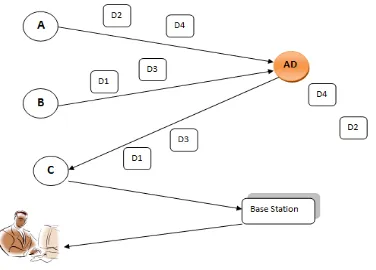
Fig-3 Sybil attack
In the above Fig-3, the node AD represents adversary node and it contains multiple identities. Here node B looks as node A for AD , node E looks as node D and node AD looks as node C.
James Newsome et al. have mentioned the classification of Sybil attack[15].Sybil attacks are classified into three forms on the basis of the manner of attack on the network.
Direct verses Indirect communication: In direct communication the Sybil node directly communicates with the genuine node. Where as in indirect communication no genuine node are able to communicate directly with the Sybil node, while message sent to a Sybil node are routed through one of the malicious node, which pretends to communicate directly with the Sybil node.
Fabricated Identities verses Stolen Identities: A Sybil node can get an identity by using fabricated identities or by stealing the identity. In fabricated identities, the attacker generates arbitrary new identities. In stolen identities, the attacker cannot fabricate new identities. Instead, the attacker assign other genuine identities to Sybil node.
Simultaneous verses non-simultaneous: In simultaneous attack Sybil node presents all its Sybil identities once at a time. In non-simultaneous attack, the attacker might present a large number of identities over a period of time, while acting as a small number of identities at any given time[16][17].
If the Sybil node gain access to the network using any of the above mentioned classification, it can serves as a gateway to other attacks, such as attacks on distributed storage, routing, voting, fair resource allocation, misbehavior detection.
Algorithm 1: Algorithm for Sybil attack Start
Step1: Let ‘N’ be the set of nodes in WSNs where N={S1
,S2 ,S3, …,Sn}
Step2:BS=Base Station, AD= Adversary node where AD is the subset of N and AD as multiple ID’s.
Step3: N-AD send packets to BS. Step4: IF
AD receives packets by using multiple ID’s. AD drops or modifies the packet.
ELSE
BS receives the packets ENDIF
Stop
4.2 Warm hole attack
© 2018, IRJET | Impact Factor value: 6.171 | ISO 9001:2008 Certified Journal | Page 380 traffic. Thus adversary can derive these advantages to
[image:4.595.334.534.124.314.2]launch a wide range of attacks such as dropping or deploying relayed packets. The adversary doesn't posses any valid network identity and can forward the communication stream along the warm holes without directly looking into the packets content. Using such warm hole links, adversary can launch protocol reveres engineering, cipher breaking, man-in-middle attacks, etc .This attack can be launched even when the cryptographic keys are absent. Thus warm hole attacks can pose serious threat to sensor to sensor network .[3]
Fig-4 Warm hole attack
The above Fig-4 depicts node A as source point and node J as destination point. The attacker X creates a low latency worm hole tunnel between these two points. Attacker node X tunnels packets between node A and node J, where node A and node B are not themselves within transmission range of each other. While transmitting the packets Node X can afterwards drop tunneled packets or break this link.
Algorithm 2: Algorithm for Warm hole attack Start
Step1: Let ‘N’ be the set of nodes in WSNs where N={S 1,S2
,S3 …,Sn}.
Step2: X= Adversary node ,Ssrc=Source node,
Sdsc= Destination node.
Step3: X creates tunnel between Ssrc and Sdsc.
Step 4: When Ssrc send data packets ‘X’ drop the packet.
Stop.
4.3 Sink hole Attack
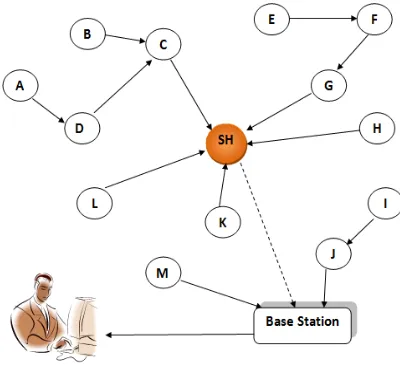
Sink hole attack is the variation of the black hole attack [6].In this, the compromised node is made attractive with respect to the routing algorithms by advertising its fake routing updates. As it is difficult to verify the routing information of the node, sink holes are difficult to detect and counter[3].It aims at preventing the Base Station from receiving a complete sensing data from sensor nodes. The malicious node send fake information to neighbor nodes about its link quality which used in routing to choose the best route during data transmission. Then all the packets from its neighbor node passes through the malicious node before reach to the Base Station. Sink hole attack prevents the Base Station from receiving accurate data from the
sensed nodes. It can easily combined with other attacks like selective forwarding attack, acknowledge spoofing attack that can cause greater damage to the network [7].
Fig-5 Sink hole attack
The above Fig-5 shows the Sink hole attack in WSNs, where node SH represents Sink hole .It looks more attractive to the other nodes and tries to attract all traffic from other nodes.
Algorithm3:Algorithm for Sinkhole Start
Step 1: Let ‘N’ be the set of nodes in WSNs, where N = {S1,S2,…..,Sn}
Step 2: SH = Sinkhole, where SH is a subset of N, BS = Base station
Step 3: Ssrc =Source node,
Step 4: V S1,S2,…..,Sn => BS
Step 5:IF
Ssrcsends data packets to SH
SH drops the packets or modify the packet. ELSE
Step 6: Ssrc sends packets to BS with successful
transmission. ENDIF Stop
4.4 Selective Forwarding (Gray hole attack)
[image:4.595.46.274.240.347.2]© 2018, IRJET | Impact Factor value: 6.171 | ISO 9001:2008 Certified Journal | Page 381 The selective forwarding attack can be of different types. In
the first type of selective forwarding, the malicious node can selectively drops the packet coming from a particular node. This behavior causes a Denial of Service attack for that particular node. Another form of selective forwarding attack is called as Neglect and Greed. Where the subverted node arbitrarily neglecting to transmit some messages. It acknowledge reception of data to the sender but it drops the messages randomly. When it gives higher priority to its own messages it is also called as Greedy. One more form of selective forwarding attack is referred to as Blind letter attack. Here the malicious node should be guaranteed that the node, to which the next hop node forwards the relaying packet, it really a neighbor of the next hop node.
Fig-6(i) AD drops selected packets from the node
Fig-6(ii)AD drops all packets from selected node
The Fig- 6(i) represents node A as source node and node C as destination. Node B forwards all the packets coming from node A. But the adversary node AD forwards only selected packets to the destination C and drops the other packets.
In Fig- 6(ii) an adversary node AD selectively drops all the packets that are coming from node A and forwards all the packets that are coming from node B to the destination node C.
Selective forwarding attack can affects number of multi-hop routing protocols. Such as, TinyOS beaconing, Directed diffusion and its multipath variant, Geographic routing, Minimum cost forwarding etc.
Algorithm 4: Algorithm for Selective Forwarding Start
Step 1: Let ‘N’ be the set of nodes in WSNs where N = {S1,S2,….., Sn}
Step 2: Let Ssrc=Source node, Sdes = Destination node, Sad
=Adversary node, Pk= Data
packets, BS=Base Station
Step 3 : Ssrc sends Pk through Sad to Sdes
Step 4: Sad drops the selective packets ,where selective
packets are the subset of Pk
Step 5:Remainig packets are send to BS Stop
4.5 HELLO Flood Attack
In Wireless Sensor Networks, many protocols require to send HELLO packets to each node in the network before sending actual packet to know if they are in the radio range or not. Hello flood attacks make use of such type of packets to perform malicious activities. In this form of attack, an adversary node keep sending HELLO request to the legitimate node to make the innocent assumption that, receiving such a packet means the sender is within the normal radio range and is therefore a neighbor[9]. Since these adversary nodes have high transmission power, they have capacity to transmit HELLO request to most nodes in network. When the sensor node wants to send any sensed information to the Base Station then they forward it towards the attacker node. Because they think that the attacker node is in their neighbor. So any information forwarded towards the Base Station can be easily accessible by the attacker. This makes the reason to break security of Wireless Sensor Networks. After sending the HELLO request if the received node doesn't reply in certain time it is detected as malicious node[2][14].
[image:5.595.62.261.272.391.2]Mohammad Abdus Salam et al.[18] defined that, HELLO flood attack can cause harm to the following protocols: TinyOS beaconing, directed diffusion and its multipath variant, minimum cost forwarding, clustering based protocols(LEACH,TEEN,PEGASIS) and energy conserving topology maintenance (SPAN,GAF,ECE,AFECA)[18].
[image:5.595.69.257.440.575.2] [image:5.595.329.541.588.745.2]© 2018, IRJET | Impact Factor value: 6.171 | ISO 9001:2008 Certified Journal | Page 382 The above Fig-7 represents the HELLO flood attack. The
adversary node AD sends the HELLO packets to all its surrounding nodes by using powerful transmitter. So that it try to show other nodes that it is neighbor of them.
Algorithm 5:Algorithm for HELLO flood attack Start
Step1: Let ‘N’ be the set of nodes in WSN where N= {S1 ,S2 ,S3
,……….,Sn }.
Step2: BS=Base Station, Smal=Malicious node, where Smal is
the subset of N.
Step3: Smal floods HELLO packets to N.
Step4: N-Smal nodes tries to send packets to BS.
Step5: Smal receives and alter the packets.
Stop.
4.6 Black hole attack
The black hole attack is one of the hazardous security attack in WSNs. Here the Black hole attacker claims itself to be the destination node or it acts as a nearest path to the destination node in order to attract traffic flow. The attacker absorbs all the data packets from the other nodes and it will discard all the packets without forward the packets to correct destination[19].When a node wants to send data packet to other nodes in the network, initially it multicast the Route Request(RREQ) packet. When the neighbor node receives RREQ packet, it will first find out whether itself is the target node or not. If itself is the target node it sends a Routing Response(RREP) packet to the source node. If not it continues forwarding the RREQ packet to find out the targeted node. Once the source node receives the RREP packets, it will immediately send the data packet. Black hole attack can be achieved by using a single Black hole attack or by Collaborative Black hole attack. In single black hole attack the malicious node replies the RREQ packet sent from source node and makes a false assumption that it has the quickest route to the destination. Where as in collaborate black hole attack malicious nodes collaborate together in order to attract the normal into their fabricated routing information.
[image:6.595.322.547.65.283.2]Usually, there are two kinds of black hole attacks. They are Passive black hole attack and Active Black hole attack. The Passive Black hole attacker discards all the packets it receives or passes through it without forwarding. It only affects the network topology without injection of false messages to the network. Active Black hole attacker is more dangerous than the previous. Because, after receiving the route request packet from the source, it will not forward it to destination, instead directly reply back to the source. It is hard to avoid the active Black hole attacks. This affects the normal communication and affects the network node[10][3].
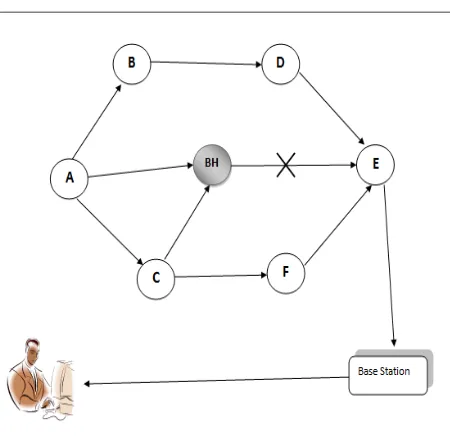
Fig-8 Black hole attack
In the above Fig-8 node BH represents the Black hole. Here node A and node C try to forward the data packet to the destination node E. But the node BH receives the data packets and discard all the packets.
Algorithm6:Algorithm for Black hole attack Start
Step1 : Let ‘N’ be the set of nodes in WSNs, where N = {S1,S2,S3..…,Sn}
Step 2: RREQ = Route request, RREP =Route response, Ssrc
=Source node,
Sdes = Destination node, BS= Base Station and BH = Black
Hole where BH is a subset of N.
Step 3: Ssrc sends RREQ to Sdes
IF
RREQ received node is the Sdes, it send RREP to Ssrc.
ELSE
Sdes further floods the RREQ
END IF
Step 4: Establish path between Ssrc and Sdes
Step 5: V S1,S2,…,Sn => BS
Step 6:IF
Ssrc sends packets to BH and BH drops the packet
ELSE
Ssrc sends packets to BS, with successful transmission
© 2018, IRJET | Impact Factor value: 6.171 | ISO 9001:2008 Certified Journal | Page 383
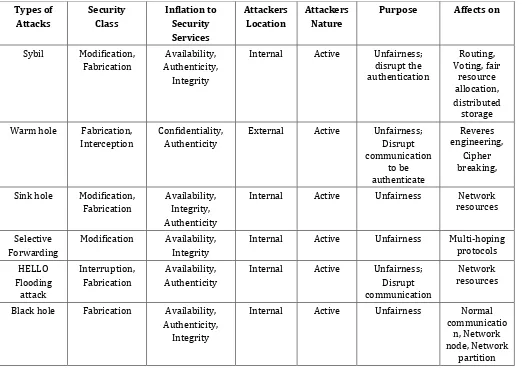
4.7 Comparison of Network layer attack
WSNs based on WSNs threat model, purpose and security services.
Types of Attacks
Security Class
Inflation to Security Services
Attackers Location
Attackers Nature
Purpose Affects on
Sybil Modification, Fabrication
Availability, Authenticity,
Integrity
Internal Active Unfairness; disrupt the authentication
Routing, Voting, fair
resource allocation, distributed
storage Warm hole Fabrication,
Interception
Confidentiality, Authenticity
External Active Unfairness; Disrupt communication
to be authenticate
Reveres engineering,
Cipher breaking,
Sink hole Modification, Fabrication
Availability, Integrity, Authenticity
Internal Active Unfairness Network
resources
Selective Forwarding
Modification Availability, Integrity
Internal Active Unfairness Multi-hoping
protocols HELLO
Flooding attack
Interruption, Fabrication
Availability, Authenticity
Internal Active Unfairness; Disrupt communication
Network resources
Black hole Fabrication Availability, Authenticity,
Integrity
Internal Active Unfairness Normal
communicatio n, Network node, Network
[image:7.595.41.563.156.525.2]partition
Table 1: Comparison of Network Layer attacks
5. CONCLUSIONS
Sensor nodes are deployed in remote environment and they are vulnerable to various types of attacks. Hence, security of such network is always important aspects. and security goals of WSNs. A critical analysis on existing network routing attacks such as Sybil attack, Worm hole attack, Sink hole attack, Selective forwarding attack, HELLO flood attack and Black hole attack are done. These attacks affect on routing, voting, network resources, Multi-hoping protocols and many other issues. A comparative study of the Network Layered attacks are made based on the security classes, security location, attacker nature. In future, based on analyzing these vulnerabilities, one can proceed to propose efficient intrusion detection mechanism to overcome most of these attacks.
REFERENCES
[1]. Ghazaleh Tahandowt, FatehmanGhasseuri, "An adaptive sinkhole algorithm in wireless neural networks", Elsevier,2017.
[2]. A.R Dhalene and P.N Chatur, "Detailed Survey on attacks in wireless sensor network", Proceedings of the International conference on data engineering and communication technology, Advances in Intelligent systems and computing 469,2017.
© 2018, IRJET | Impact Factor value: 6.171 | ISO 9001:2008 Certified Journal | Page 384 [4].Noor Alsaedi, Fazirul Hisyam Hashim, A.Sali, Fakheul Z
Rokhani,"Detecting sybil attacks in clustered wireless sensor network based on energy test system(ETS)", Elsevier ,2017
[5]. Jyothi Yadav and Mukhesh kuvrae, "Detection of wormhole attack in wireless server networks", Proceedings of International conference on ICT for sustainable development, Advances in intelligent system and computing 408, 2016.
[6].Manpreeth kaur, Amarvir singh," Detection and mitigation of sinkhole attack in wireless sensor networks", International conference on Micro-Electronics and telecommunications engineering, IEEE,2016.
[7]. Fang jino Zhang, Li-Dong Zhai, Jin-CuiYang,Xiang cui, "Sinkhole attack detection based on redundancy mechanism in wireless sensor networks", Information technology and Quantitative management, Elsevier,2014.
[8].Ju Rue, Yaoxue Zhang, Kuan zhang, Xuemin shen," Adaptive and channel aware detection of selective forwarding attacks in wireless sensor networks", IEEE Transactions on Wireless communications, Vol.15,100.5, May,2016.
[9]. Shikha Magotea, Krishan kumar," Detection of HELLO flood attack on LEACH protocols", IEEE,2014.
[10]. Huisheng gao, Ruping wu, Mingjing Cao and Cau Zhaung, "Detection and defence Technology of Black hole attacks in wireless sensor networks", Springer international publishing, Switzerland ,2014.
[11]. Hossei Jadidoleslancy, "A comprehensive comparison of attacks in wireless sensor networks", IJCCN International journal of computer communications and networks, Volume 4, Issue 1,2014.
[12]. P.Sergar, N.Bharadwaj, “A survey on security and various attacks in wireless sensor networks”, International Journal of Computer Sciences and Engineering, 2017.
[13]. Arpitha M. Bhise, Shailesh D. Kamble, “Review on detection and mitigation of sybil attack in the networks”, International conference of an information security and privacy, 2015.
[14]. H.Khosravi, R. Azmi and M.Sharghi, “Adaptive detection of hello flood attack in wireless sensor networks”, International journal of future computer and communication, volume 5, No.2, April,2016.
[15].James Newsome, Elaine Shi,Dawn Song,Adrian Perrig,"The sybil attack in sensor network: analysis and defence".
[16].Udaya Surya Raj Kumar Dhamodar and Rajamani Vayanaperumal, "Detecting and preventing sybil attacks in Wireless Sensor Networks Using Message Authentication and Pasing Method."2015.
[17].Mian Ahmad Jan,Priyadarsi Nanda,Xiangjian He,Ren Ping Liu,"A sybil attack detection scheme for a forest wildfire monitoring applications", Elsevier,2016.
[18].Mohammad Abdas Salam and Nayana
Halemani,"Performance evaluation of wireless sensor under HELLO flood attack",International Jouranal of Computer Network and Communication,2016.