© 2016, IRJET | Impact Factor value: 4.45 | ISO 9001:2008 Certified Journal | Page 741
Comparision of different Image Resolution
Enhancement techniques using wavelet transform
Mrs.Smita.Y.Upadhye Mrs. Swapnali.B.Karole
Assistant Professor, Electronics Dept Assistant Professor, EXTC Dept DKTE’s Textile & Engg. Institute DKTE’s Textile & Engg. Institute
Ichalkaranji, India. Ichalkaranji, India.
Prof. (Dr.) Mrs.L.S.Admuthe
H.O.D Electronics Dept.DKTE’s Textile & Engg. Institute Ichalkaranji, India.
Abstract—We propose an Image resolution
enhancement techniques based on interpolation of the high frequency subband images obtained from wavelet zero padding-cycle spinning, discrete, stationary and Dual tree Complex wavelet transform (DT-CWT). In this study, a comparison of three different image resolution enhancement techniques in wavelet domain is done. Each method is analyzed quantitatively and visually. Based on the analysis, the most efficient method is proposed. All the three algorithms uses low resolution image as the input image and then wavelet transform is applied to decompose the input image into different high and low frequency subbands. Then these subband images along with the input image are interpolated. Finally all these images are combined to generate a new resolution enhanced image by using inverse process.
Keywords— wavelet zero padding, discrete wavelet transform, stationary wavelet transform, Dual tree complex wavelet transform, interpolation.
I.
I
NTRODUCTIONResolution is the most important quality factor of images and videos. Image resolution enhancement is the process of manipulating an image so that resultant image is of good quality image. Image enhancement improves the quality (clarity) of images for human viewing. In recent year’s images with higher resolution is a prime requirement in many of the imaging applications, such as, medical imaging, video sequences and satellite imaging. A widely used technique for constructing higher resolution image is interpolation. Basically, the interpolation is the process of using known data to estimate values at
unknown locations. The interpolation technique has been used in many image processing applications such as super resolution [1-2].Facial reconstruction [3] and Multiple description coding [4]. To increase the resolution of image the best technique is bicubic interpolation with the help of DWT and SWT decomposition [5]. Image resolution enhancement in wavelet domain is relatively a new research topic. Discrete wavelet transform (DWT) [6] is one of the recent wavelet transforms used in image processing. DWT divides an input image into four different subband images, like low-low (LL), low-high (LH), high-low (HL), and high-high (HH). Another recent wavelet transform which has been used in many image processing applications is stationary wavelet transform (SWT) [7]. In short, SWT is similar to DWT but it does not use down-sampling due to this the subbands will have the same size as the input image.
© 2016, IRJET | Impact Factor value: 4.45 | ISO 9001:2008 Certified Journal | Page 742
II PROPOSED METHODS
A) WZP-CS technique
The generalised block diagram of this technique is as shown in figure 1.The proposed algorithm consists of three steps. In the first step, low resolution (LR) image is obtained by low pass filtering and down sampling of high resolution image. An initial high resolution image is obtained using wavelet domain zero padding. This high resolution image obtained from wavelet zero padding commonly exhibits artefacts like smoothing and ringing. To reduce these ringing artefacts, a cycle spinning methodology is applied in second step. Finally, all the images averaged to generate high resolution image.
Low resolution image(LR)
No. of LR images through spatial shifting,wavelet
transform & High Frequency (HF) component discarded Wavelet Zero Padding (WZP) Final High Resolution (HR) image through averaging 4X Enlargement
Figure1: Block diagram of Cycle spinning technique
B) DT-CWT technique
The DT-CWT was first introduced by Kingsbury to overcome drawback of DWT. DT-CWT is a combination of two real discrete WT (DWT). The ordinary DWT is shift variant because of the presence of decimation operation in the transform. As a result, a small shift in the input signal can produce a very different set of wavelet coefficients at the output. To avoid this drawback, Kingsbury introduced a new wavelet transform, called the DT-CWT
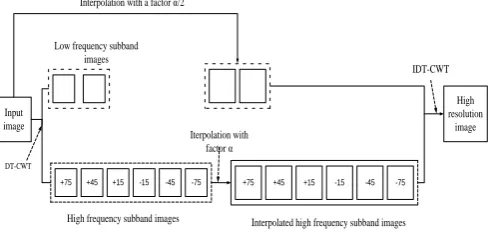
In this technique, DT-CWT has been employed in order to preserve edges (i.e.) high-frequency components of the image. The DT-CWT has good directional selectivity as compaired to discrete wavelet transform (DWT).The DT-CWT is approximately shift invariant, unlike the critically sampled DWT. The redundancy and shift invariance of the DT-CWT means that DT-CWT coefficients are inherently interpolable[8].In this method, DT-CWT is used to decompose an input image into different low and high frequency subband images. Six complex-valued high-frequency subband images contain the high-frequency components of the input image. An interpolation is applied to these high-frequency subband images. In the wavelet domain, the low-resolution image is obtained by low pass filtering of the high-resolution image [9]. i.e., low-frequency subband images are the low resolution of the original image. Therefore, instead of using low-frequency subband images, which contain less
information, we are using the input image for the interpolation. Hence, using the input image instead of the low-frequency subband images increases the quality of the high resolution image. The input image is interpolated with the half of the interpolation factor α used to interpolate the high-frequency subbands, as illustrated in Fig. 1. By interpolating the input image by α/2 and high-frequency subband images by α and then following inverse process by using IDT-CWT, gives output image which contain sharper edges than the output image obtained by interpolation of the input image directly. In short, the proposed technique interpolates both the input image and the high-frequency subband images obtained through the DT-CWT process. The final high-resolution output image is obtained by using the IDT-CWT of the interpolated subband images and the input image.
Input image
+75 +45 +15 -15 -45 -75 +75 +45 +15 -15 -45 -75
High resolution
image Low frequency subband
images
High frequency subband images Interpolated high frequency subband images Interpolation with a factor α/2
DT-CWT
IDT-CWT
Iterpolation with factor α
[image:2.595.309.557.291.407.2]Fig.2. Block diagram of DT-CWT
The real 2-D dual-tree DWT of an image x is implemented using two critically-sampled 2-D DWTs in parallel. Then for each pair of sub-bands sum and difference is calculated. The complex 2-D DT-DWT also gives wavelets in six distinct directions. The complex 2-D dual-tree is implemented as four critically-sampled separable 2-D DWTs operating in parallel as shown in figure(2).This 2-D structure uses four trees for analysis and synthesis. The pair of conjugate filters applied to two dimensional images (x, y) can be expressed as:
Tree a(hx, hy)
Tree c(hx, hy)
Tree d(hx, hy)
Tree b(hx, hy)
Tree a(hx, hy)
Tree d(hx, hy)
Tree c(hx, hy)
Tree b(hx, hy)
) (t
x ~x(t)
Imaginary tree Real tree
[image:2.595.311.553.561.701.2]Analysis Synthesis
© 2016, IRJET | Impact Factor value: 4.45 | ISO 9001:2008 Certified Journal | Page 743 C) DWT SWT technique
To increase the resolution of image, preserving the edges is important. Because image resolution enhancement using interpolation causes loss on its high frequency components, this is caused due to interpolation which smoothens the image hence it is essential to preserve the edges.
This proposed technique uses low resolution image (m×n) then one level DWT is applied to decompose an input image into four different sub bands like LL, LH, HL, and HH. In this technique DWT is used to preserve the high frequency component of image. The Low-High (LH), High-Low (HL), High- High (HH) subband contains high frequency component of input image. Due to down sampling in DWT there is loss of information in subbands hence to minimize this loss SWT is used. The SWT technique decomposes the input image using haar wavelet into four different sub bands i.e. LL, LH, HL, HH. The high frequency output i.e. LH, HL and HH of DWT technique is interpolated by using the bicubic interpolation technique with enlargement factor of 4. LH, HL and HH of SWT technique is interpolated by using the bicubic interpolation technique with enlargement factor of 2. Now three high frequency components i.e LH, HH, HL of both DWT and SWT technique have the same size hence they are added together to get estimated high frequency sub-bands. These estimated high frequency sub-bands are again interpolated by factor α/4. Finally output of this bicubic interpolation and the original image which is interpolated by factor α/2 are combined by using inverse DWT (IDWT) to get the high resolution image. Figure3 shows the block diagram of proposed image resolution enhancement technique. Final high resolution image contains sharper edges than interpolation of input image directly.
Low resolution Image (m × n)
DWT
LL LH HL HH LL LH HL HH
SWT
Estimated HH Estimated
HL Estimated
LH
IDWT
High resolution image (αm × αn)
+
+
+
Interpolation with factor 4
Interpolation with factor 4
Interpolation with factor 4
Interpolation with factor α/4 Interpolation
with factor 2 Interpolation with factor 2 Interpolation with factor 2
Interpolation with factor α/2
Fig3.Block diagram of DWT-SWT
The decomposition of image after applying one level DWT and SWT are shown in figure 4Low (L.L) Low-High (LH.), Low-High-Low(HL.), Low-High-Low-High (HH.) Frequency component.
HL1 LL1
HH1 LH1
LL2
First level Decomposition
Second level Decomposition
Image
HH2 HL2
LH2
HL1 HH1 LH1
Fig.4. Structure of Wavelet decomposition
III.
PERFORMANCE
PARAMETER
© 2016, IRJET | Impact Factor value: 4.45 | ISO 9001:2008 Certified Journal | Page 744 PSNR in DB given as
Where
M & N are the size of the images, M = no. of rows N= no. of columns and are the matrix element of the reconstructed image and the original image at (i,j)th pixel respectively. The result in table1 shows that proposed method1 is superior than method2.
Table1 .Observation Table
PSNR(dB) Method/Imag
e Proposed Method1 Proposed Method2 Proposed Method3
Lena 33.82 27.77 40.60
Elaine 33.68 26.59 41.67
Baboon 32.23 26.87 47.66
Pepper 34.04 26.90 41.96
IV. RESULTS AND DISCUSSION
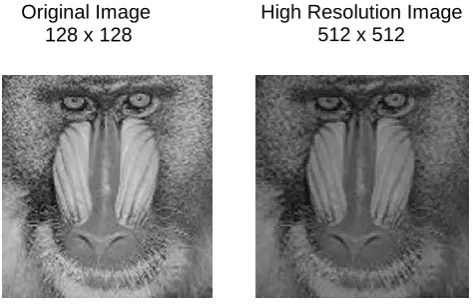
Figure7, Figure8 and Figure9 shows the low resolution input & high resolution output Baboon image of method1, 2, and 3 respectively. Table 1 compares the PSNR performance of all WZP-CS, DT-CWT & DWT, SWT technique. The result in table1 indicates that the DWT, SWT technique gives much better result as compared to WZP-CS and DT-CWT technique.
Fig.7. WZP-CS technique images
[image:4.595.313.550.321.475.2][image:4.595.34.274.580.714.2]
Fig.8. DT-CWT technique images
Fig.9. DWT, SWT technique images
VI.
CONCLUSION
This paper proposes three different methods to obtain high resolution images from low resolution images. Here all th three proposed methods are compared. PSNR table shows the superiority of proposed technique DWT,SWT .i.e The proposed technique DWT,SWT is much better than WZP-CS and DT-CWT technique. This work involves decomposition of low resolution image by using DWT which gives high frequency subbands. High frequency subbands are interpolated to increase their size. DWT loses some information due to interpolation process. This loss of information is corrected by SWT. Interpolated high frequency subbands and interpolated input image is combined by using inverse DWT(IDWT) to achieve the high resolution image. All these techniques tested on standard matlab images, where PSNR result shows that maximum PSNR value using DWT, SWT is 47.66.
Original Image 128 x 128
High Resolution Image 512 x 512 Original Image
128 x 128
High Resolution Image 512 x 512
Original Image 128 x 128
© 2016, IRJET | Impact Factor value: 4.45 | ISO 9001:2008 Certified Journal | Page 745
REFERENCES
[1] L. Yi-bo, X. Hong, and Z. Sen-yue, “The wrinkle generation method for facial reconstruction based on extraction of partition wrinkle line features and fractal interpolation,” in Proc. 4th Int. Conf. Image Graph., Aug. 22–24, 2007,pp. 933–937.
[2] H. Demirel, G. Anbarjafari, and S. Izadpanahi, “Improved motion based localized super resolution technique using discrete wavelet transform for low resolution video enhancement,” in Proc. 17th Eur. Signal Process. Conf., Glasgow, Scotland, Aug. 2009, pp. 1097– 1101.
[3] Y. Rener, J. Wei, and C. Ken, “Downsample-based multiple description coding and post-processing of decoding,” in Proc. 27th Chinese Control Conf., Jul. 16–18, 2008, pp. 253–256..
[4] C. B. Atkins, C. A. Bouman, and J. P. Allebach, “Optimal image scaling using pixel classification,” in Proc. Int. Conf. Image Process., Oct. 7–10, 2001, vol. 3, pp. 864–867. [5] Hasan Demirel and Gholamreza Anbarjafari “IMAGE Resolution Enhancement by Using Discrete and Stationary Wavelet Decomposition”, IEEE TRANSACTIONS ON IMAGE PROCESSING, VOL. 20, NO. 5, MAY 2011
[6] S. Mallat, A Wavelet Tour of Signal Processing, 2nd ed. New York: Academic, 1999.
[7] J. E. Fowler, “The redundant discrete wavelet transform and additive noise,” Mississippi State ERC, Mississippi State University, Tech. Rep. MSSU-COE-ERC-04-04, Mar. 2004.
[8] T. H. Reeves and N. G. Kingsbury, “Prediction of coefficients from coarse to fine scales in the complex wavelet transform,” in Proc. IEEE ICASSP, Jun. 5–9, 2000, vol. 1, pp. 508–511.
[9] A. Temizel, “Image resolution enhancement using wavelet domain hidden Markov tree and coefficient sign