Ionization–Time of Flight Mass Spectrometry System for Identification
of Blood Isolates of
Acinetobacter
Species
Po-Ren Hsueh,a,bLu-Cheng Kuo,bTsung-Chain Chang,cTai-Fen Lee,a,dShih-Hua Teng,eYu-Chung Chuang,bLee-Jene Teng,a,d Wang-Huei Shengb
Departments of Laboratory Medicineaand Internal Medicine,bNational Taiwan University Hospital, National Taiwan University College of Medicine, Taipei, Taiwan; Department of Medical Laboratory Science and Biotechnology, Medical College of National Cheng Kung University, Tainan, Taiwanc; Department and Graduate Institute of Clinical Laboratory Sciences and Medical Biotechnology, National Taiwan University, Taipei, Taiwand; Bruker Taiwan Co., Ltd., Taipei, Taiwane
Matrix-assisted laser desorption ionization–time of flight mass spectrometry (MALDI-TOF MS) (Bruker Biotyper) was able to accurately identify 98.6% (142/144) ofAcinetobacter baumanniiisolates, 72.4% (63/87) ofA. nosocomialisisolates, and 97.6% (41/42) ofA. pittiiisolates. AllAcinetobacter junii,A. ursingii,A. johnsonii, andA. radioresistensisolates (nⴝ28) could also be identified correctly by Bruker Biotyper.
I
solates ofAcinetobacterspecies causing human infectionspre-dominantly belong toAcinetobacter calcoaceticus(genospecies
1),A. baumannii(genospecies 2),A. pittii(genospecies 3), andA. nosocomialis(genospecies 13TU) (1–4). Because these isolates are phenotypically similar and difficult to distinguish using tradi-tional microbiological and biochemical tests, they are frequently
reported asA. calcoaceticus-A. baumanniicomplex (ACB
com-plex) (1–4). Although several commercially available
matrix-as-sisted laser desorption ionization–time of flight mass spectrome-try (MALDI-TOF MS) systems are rapidly emerging novel technology widely used in clinical microbiology laboratories for rapid identification of commonly encountered bacteria and fungi
(5–8), few studies have compared the accuracy of different
MALDI-TOF MS systems in identifyingAcinetobacterspecies to
the genospecies level (9–12).
A total of 286 blood isolates of ACB complex and 39 isolates of non-ACB complex that had been recovered from patients treated at the National Taiwan University Hospital from 2010 to 2012 were obtained. Conventional biochemical identification methods as well as the Phoenix bacterial identification system (NMIC/ ID-72 cards; Becton, Dickinson Diagnostic Instrument Systems, Sparks, MD) and Vitek 2 (GN cards; bioMérieux, Marcy l’Etoile,
France) were used for the identification of the isolates (4). We
sequenced the 16S-23S rRNA gene intergenic spacer (ITS) region
and a 350-bp highly variable zone of therpoBgene to identify the
isolates to the genospecies level (2,4). The sequences obtained
were compared with published sequences in the GenBank
data-base using the BLASTN algorithm (http://www.ncbi.nlm.nih.gov
/blast).
Bacteria were prepared for analysis by the MALDI Bruker
Bio-typer system as previously described (8,10). Identification scores
ofⱖ2.000 indicated species-level identification, scores of 1.700 to
1.999 indicated genus-level identification, and scores of⬍1.700
indicated no reliable identification (8,10). Clustering analysis of
Received29 April 2014Accepted1 June 2014 Published ahead of print4 June 2014 Editor:P. Bourbeau
Address correspondence to Wang-Huei Sheng, [email protected]. Copyright © 2014, American Society for Microbiology. All Rights Reserved.
[image:1.585.42.545.558.716.2]doi:10.1128/JCM.01233-14
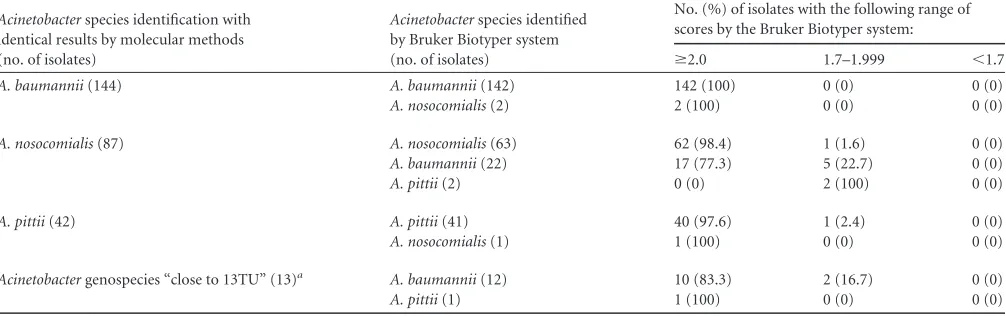
TABLE 1Comparison of the Bruker Biotyper MALDI TOF MS system with molecular methods in identifying 286 blood isolates ofAcinetobacter calcoaceticus-Acinetobacter baumanniicomplex
Acinetobacterspecies identification with identical results by molecular methods (no. of isolates)
Acinetobacterspecies identified by Bruker Biotyper system (no. of isolates)
No. (%) of isolates with the following range of scores by the Bruker Biotyper system:
ⱖ2.0 1.7–1.999 ⬍1.7
A. baumannii(144) A. baumannii(142) 142 (100) 0 (0) 0 (0)
A. nosocomialis(2) 2 (100) 0 (0) 0 (0)
A. nosocomialis(87) A. nosocomialis(63) 62 (98.4) 1 (1.6) 0 (0)
A. baumannii(22) 17 (77.3) 5 (22.7) 0 (0)
A. pittii(2) 0 (0) 2 (100) 0 (0)
A. pittii(42) A. pittii(41) 40 (97.6) 1 (2.4) 0 (0)
A. nosocomialis(1) 1 (100) 0 (0) 0 (0)
Acinetobactergenospecies “close to 13TU” (13)a A. baumannii(12) 10 (83.3) 2 (16.7) 0 (0)
A. pittii(1) 1 (100) 0 (0) 0 (0)
aNot included in Bruker Biotyper database (DB 5627).
on May 16, 2020 by guest
http://jcm.asm.org/
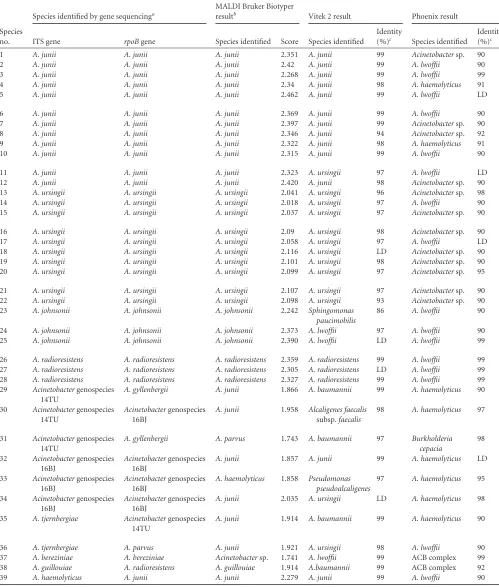
TABLE 2Results of identification of 39Acinetobacterspecies other thanAcinetobacter calcoaceticus-Acinetobacter baumanniicomplex isolates by different methods
Species no.
Species identified by gene sequencinga
MALDI Bruker Biotyper
resultb Vitek 2 result Phoenix result
ITS gene rpoBgene Species identified Score Species identified
Identity
(%)c Species identified
Identity (%)c
1 A. junii A. junii A. junii 2.351 A. junii 99 Acinetobactersp. 90
2 A. junii A. junii A. junii 2.42 A. junii 99 A. lwoffii 90
3 A. junii A. junii A. junii 2.268 A. junii 99 A. lwoffii 99
4 A. junii A. junii A. junii 2.34 A. junii 98 A. haemolyticus 91
5 A. junii A. junii A. junii 2.462 A. junii 99 A. lwoffii LD
6 A. junii A. junii A. junii 2.369 A. junii 99 A. lwoffii 90
7 A. junii A. junii A. junii 2.397 A. junii 99 Acinetobactersp. 90
8 A. junii A. junii A. junii 2.346 A. junii 94 Acinetobactersp. 92
9 A. junii A. junii A. junii 2.322 A. junii 98 A. haemolyticus 91
10 A. junii A. junii A. junii 2.315 A. junii 99 A. lwoffii 90
11 A. junii A. junii A. junii 2.323 A. ursingii 97 A. lwoffii LD
12 A. junii A. junii A. junii 2.420 A. junii 98 Acinetobactersp. 90
13 A. ursingii A. ursingii A. ursingii 2.041 A. ursingii 96 Acinetobactersp. 98
14 A. ursingii A. ursingii A. ursingii 2.018 A. ursingii 97 A. lwoffii 90
15 A. ursingii A. ursingii A. ursingii 2.037 A. ursingii 97 Acinetobactersp. 90
16 A. ursingii A. ursingii A. ursingii 2.09 A. ursingii 98 Acinetobactersp. 90
17 A. ursingii A. ursingii A. ursingii 2.058 A. ursingii 97 A. lwoffii LD
18 A. ursingii A. ursingii A. ursingii 2.116 A. ursingii LD Acinetobactersp. 90
19 A. ursingii A. ursingii A. ursingii 2.101 A. ursingii 98 Acinetobactersp. 90
20 A. ursingii A. ursingii A. ursingii 2.099 A. ursingii 97 Acinetobactersp. 95
21 A. ursingii A. ursingii A. ursingii 2.107 A. ursingii 97 Acinetobactersp. 90
22 A. ursingii A. ursingii A. ursingii 2.098 A. ursingii 93 Acinetobactersp. 90
23 A. johnsonii A. johnsonii A. johnsonii 2.242 Sphingomonas
paucimobilis
86 A. lwoffii 90
24 A. johnsonii A. johnsonii A. johnsonii 2.373 A. lwoffii 97 A. lwoffii 90
25 A. johnsonii A. johnsonii A. johnsonii 2.390 A. lwoffii LD A. lwoffii 99
26 A. radioresistens A. radioresistens A. radioresistens 2.359 A. radioresistens 99 A. lwoffii 99
27 A. radioresistens A. radioresistens A. radioresistens 2.305 A. radioresistens LD A. lwoffii 99
28 A. radioresistens A. radioresistens A. radioresistens 2.327 A. radioresistens 99 A. lwoffii 99
29 Acinetobactergenospecies 14TU
A. gyllenbergii A. junii 1.866 A. baumannii 99 A. haemolyticus 90
30 Acinetobactergenospecies 14TU
Acinetobactergenospecies 16BJ
A. junii 1.958 Alcaligenes faecalis subsp.faecalis
98 A. haemolyticus 97
31 Acinetobactergenospecies 14TU
A. gyllenbergii A. parvus 1.743 A. baumannii 97 Burkholderia
cepacia
98
32 Acinetobactergenospecies 16BJ
Acinetobactergenospecies 16BJ
A. junii 1.857 A. junii 99 A. haemolyticus LD
33 Acinetobactergenospecies 16BJ
Acinetobactergenospecies 16BJ
A. haemolyticus 1.858 Pseudomonas pseudoalcaligenes
97 A. haemolyticus 95
34 Acinetobactergenospecies 16BJ
Acinetobactergenospecies 16BJ
A. junii 2.035 A. ursingii LD A. haemolyticus 98
35 A. tjernbergiae Acinetobactergenospecies 14TU
A. junii 1.914 A. baumannii 99 A. haemolyticus 90
36 A. tjernbergiae A. parvus A. junii 1.921 A. ursingii 98 A. lwoffii 90
37 A. bereziniae A. bereziniae Acinetobactersp. 1.741 A. lwoffii 99 ACB complex 99
38 A. guillouiae A. radioresistens A. guillouiae 1.914 A.baumannii 99 ACB complex 92
39 A. haemolyticus A. junii A. junii 2.279 A. junii 99 A. lwoffii 90
a
Species are identified by maximal identification of gene sequencing.
bBruker Biotyper database (DB 5627) does not includeAcinetobactergenospecies 14TU,Acinetobactergenospecies 16BJ,A. bereziniae(Acinetobactergenospecies 10), andA.
gyllenbergi.
cLD, low discrimination.
on May 16, 2020 by guest
http://jcm.asm.org/
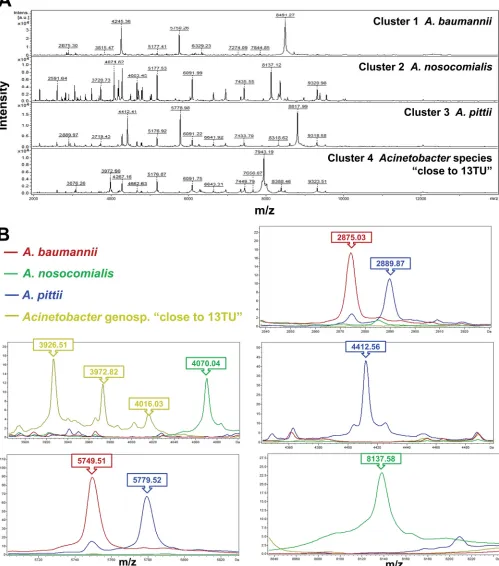
FIG 1Cluster analysis of spectra generated by the MALDI-TOF Bruker Biotyper system for 286A. baumanniicomplex (ACB complex) isolates. (A) Four clusters of spectra for ACB complex isolates, i.e., cluster 1 (A. baumannii), cluster 2 (A. nosocomialis), cluster 3 (A. pittii), and cluster 4 (Acinetobactergenospecies “close to 13TU”) were identified. (B) Clusters were based on the 10 peaks generated by ClinProTools with a genetic algorithm, i.e., 2875.03m/zand 5749.51m/z(A. baumannii)), 4070.04m/zand 8137.58m/z(A. nosocomialis); 2889.87m/z, 4412.56m/z, and 5779.52m/z(A. pittii); and 3926.51m/z, 3972.82m/z, and 4016.03 m/z(Acinetobactergenospecies “close to 13TU”). The absolute intensities of the ions are shown on theyaxis, and the masses (m/z) of the ions are shown on the xaxis. Them/zvalues represent the mass-to-charge ratios.
on May 16, 2020 by guest
http://jcm.asm.org/
[image:3.585.43.542.76.642.2]four genetically identified genospecies of ACB complex was per-formed using ClincProtools 3.0 (Bruker Daltonics GmbH,
Bre-men, Germany) (8). Characteristic peaks of the spectra of the four
genospecies of ACB complex were identified. Cluster analysis of
half of theA. baumanniiisolates identified by the Bruker Biotyper
system was also performed (8). The remaining half of theA.
bau-manniiisolates identified by the Bruker Biotyper system were used as external validation isolates.
Tables 1and2show the results of two molecular methods for identification of the 286 isolates of ACB complex and 39 non-ACB
complex isolates. No discrepant results were found for ACB
com-plex isolates by the two molecular identification methods (Table
1). The Phoenix and Vitek 2 systems identified all isolates of ACB
complex asA. baumannii(complex). The overall accuracy rate of
identifyingAcinetobacter species other than ACB complex was
higher in the Vitek 2 system (61.5% [24/39]) than in the Phoenix
system (0%). Vitek 2 had good identification results forA. junii
(91.7%),A. ursingii(100%), andA. radioresistens(100%). Of the
14 species (genospecies) ofAcinetobacterisolates evaluated in the
present study,Acinetobactergenospecies “close to 13TU,”
Acineto-FIG 2Spectra of 10 species (genospecies) ofAcinetobacterspecies other than ACB complex generated by the MALDI-TOF Bruker Biotyper system. The absolute intensities of the ions are shown on theyaxis, and the masses (m/z) of the ions are shown on thexaxis. Them/zvalues represent the mass-to-charge ratios.
on May 16, 2020 by guest
http://jcm.asm.org/
[image:4.585.40.546.66.575.2]bactergenospecies 14TU,Acinetobactergenospecies 16BJ,A. ber-eziniae(Acinetobactergenospecies 10), andA. gyllenbergiiare not included in the Bruker Biotyper database (DB 5627). Of the 286 isolates of ACB complex, the accuracy rate of genospecies
identi-fication by the Bruker Biotyper system was 98.6% (142/144) forA.
baumannii, 72.4% (63/87) forA. nosocomialis, and 97.6% (41/42) forA. pittii. Twelve of the 13 isolates ofAcinetobactergenospecies
“close to 13TU” were identified asA. baumannii, and 10 of these
isolates had score values ofⱖ2.000 (Table 1).
Of the 286 ACB complex isolates, 176 were identified asA.
baumanniiby the Bruker Biotyper system, and 142 (80.7%) were
genetically confirmed to beA. baumannii, 22 (12.5%) were
con-firmed to beA. nosocomialis, and 12 (6.8%) were confirmed to be
Acinetobactergenospecies “close to 13TU.” Of the 66 isolates ofA. nosocomialisidentified by the Bruker Biotyper, 63 (95.5%) were
identified correctly. Of the 44 isolates ofA. pittiiidentified by the
Bruker Biotyper, three (6.8%) were not correctly identified by
molecular methods as beingA. pittii. Of the 39 isolates of
Acineto-bacterspecies other than ACB complex, accurate identification by
the Bruker Biotyper was obtained for allA. junii,A. ursingii,A.
johnsonii, andA. radioresistensisolates (Table 2).
Cluster analysis of spectra generated by the Bruker Biotyper for 286 isolates of four genospecies of ACB complex isolates was per-formed. Four clusters of spectra for ACB complex isolates, i.e.,
cluster 1 (A. baumannii), cluster 2 (A. nosocomialis), cluster 3 (A.
pittii), and cluster 4 (Acinetobactergenospecies “close to 13TU”) were identified based on the 10 peaks generated by ClinProTools
with the genetic algorithm, i.e., 2875.03m/zand 5749.51m/z(A.
baumannii), 4070.04 m/z and 8137.58 m/z (A. nosocomialis);
2889.87m/z, 4412.56m/zand 5779.52m/z(A. pittii); and 3926.51
m/z, 3972.82 m/z, and 4016.03 m/z (Acinetobacter genospecies
“close to 13TU”) (Fig. 1A andB). The spectra of 10 species
(genospecies) ofAcinetobacterspecies other than ACB complex
generated by the MALDI-TOF Bruker Biotyper system are shown inFig. 2.
Of the 286 ACB complex isolates, 176 were identified asA.
baumanniiby Bruker Biotyper. Of these 176 isolates, 142 (80.7%)
were genetically confirmed to beA. baumannii, 22 (12.5%) were
confirmed to beA. nosocomialis, and 12 (6.8%) were confirmed to
beAcinetobactergenospecies “close to 13TU”. Cluster analysis of spectra generated by the Bruker Biotyper system for model
estab-lishment was performed for nearly half (n⫽89) of the 176 isolates
ofA. baumanniiidentified by the Bruker Biotyper system.
Genet-ically, 72 wereA. baumannii, 11 wereA. nosocomialis, and 6 were
Acinetobactergenospecies “close to 13TU”. The characteristic sig-nals generated using clustering analysis by ClinProTools with the genetic algorithm specific for separating the three genospecies of
ACB complex were 3091.35 m/z, 3926.18 m/z, 4070.04 m/z,
5749.51 m/z, and 8137.58m/z. Of the remaining 87 BioTyper
spectra ofA. baumanniiisolates used for external validation, 70
were genotypically confirmedA. baumanniiisolates, 11 wereA.
nosocomialisisolates, and 6 wereAcinetobactergenospecies “close to 13TU.” The overall correct validation rates by the established model were 98.8% for the three genospecies of the ACB complex (Table 3).
Several important findings were demonstrated. First, the over-all rate of the Bruker Biotyper in correctly identifying ACB
com-plex isolates to the species level (score values ⱖ2.0) was only
85.3%. This is partly becauseAcinetobacterspecies 13TU is not
included in the current database. Using cluster analysis of spectra from the 286 isolates of the ACB complex, 10 peaks were identified to be unique to the four genospecies and might be useful to
gen-erate a local database. Second, althoughA. nosocomialis is
in-cluded in the current database of the Bruker Biotyper system, the
correct identification rate was only 72.4%. Third, of the 176A.
baumanniiisolates identified by the Bruker Biotyper system (score
values ofⱖ1.700), about 80% were correctly identified to the
spe-cies level (score values ofⱖ2.000). Interestingly, using six
charac-teristic markers created by cluster analysis of spectra of the 176 isolates, nearly all (98.8%) could be reidentified correctly. Finally, compared with the Vitek identification system, the Phoenix
iden-tification system is not suitable for ideniden-tification ofAcinetobacter
species, particularly for species other than ACB complex isolates. Alvarez-Buylla et al. reported that the MALDI-TOF Bruker
Biotyper system is useful for identifyingA. baumanniiandA. pittii
but not for identifyingA. calcoaceticus,A. nosocomialis,A.
berezi-nae, orA. genospecies 14BJ (10). The total misidentification rate
by the MALDI-TOF Bruker Biotyper system was 16.4% for all
Acinetobacterspecies tested compared with the identification
re-sults byrpoBgene sequencing analysis. Espinal et al. analyzed 60
genotypically characterized ACB complex isolates, including 18A.
nosocomialisisolates, 17A. pittiistrains, 18A. baumanniisolates,
and 7 otherAcinetobacterspecies isolates against a local database
(inclusion of specific signature profiles forA. nosocomialiswithin
the Bruker database) and found that 98.3% of all isolates were
identified at the species level (log score⬎2.0), and only 1.7% (one
of seven otherAcinetobacterspecies) were identified at the
proba-ble genus level with a log score between 1.7 and 2.0 (9).
Our work documented high identification rates ofA.
bauman-nii,A. pittii, and non-ACB complex by the MALDI-TOF Bruker Biotyper system. However, further expansion and improvement
of the database, includingA. nosocomialisandAcinetobacter
geno-species “close to 13TU,” is mandatory to make MALDI-TOF MS
[image:5.585.40.544.89.179.2]an efficient method for identification of allAcinetobacterspecies.
TABLE 3Results of external validation of 87 spectra of the three genospecies of theA. baumanniicomplex (ACB complex) isolates by the Bruker Biotyper system
Acinetobacterspecies
No. of isolates
No. (%) of isolates with the following genospecies of ACB complex by external validationa:
A. baumannii A. nosocomialis
Acinetobactergenospecies 13TU
A. baumannii 70 69 (98.6) 1 (1.4) 0
A. nosocomialis 11 0 11 (100) 0
Acinetobactergenospecies “close to 13TU”
6 1 (3.3) 6 (100)
aThe rates of correct identification by external validation results are given in boldface type.
on May 16, 2020 by guest
http://jcm.asm.org/
REFERENCES
1.Chang HC, Wei YF, Dijkshoorn L, Vaneechoutte M, Tang CT, Chang TC.2005. Species-level identification of isolates of theAcinetobacter cal-coaceticus-Acinetobacter baumanniicomplex by sequence analysis of the 16S-23S rRNA gene spacer region. J. Clin. Microbiol.43:1632–1639.http: //dx.doi.org/10.1128/JCM.43.4.1632-1639.2005.
2.Gundi VA, Dijkshoorn L, Burignat S, Raoult D, La Scola B. 2009. Validation of partialrpoBgene sequence analysis for the identification of clinically important and emerging Acinetobacterspecies. Microbiology 155:2333–2341.http://dx.doi.org/10.1099/mic.0.026054-0.
3.Tien N, You BJ, Chang HL, Lin HS, Lee CY, Chung TC, Lu JJ, Chang CC.2012. Comparison of genospecies and antimicrobial resistance pro-files of isolates in theAcinetobacter calcoaceticus-Acinetobacter baumannii complex from various clinical specimens. Antimicrob. Agents Che-mother.56:6267– 6271.http://dx.doi.org/10.1128/AAC.01304-12. 4.Lee YC, Huang YT, Tan CK, Kuo YW, Liao CH, Lee PI, Hsueh PR.
2011.Acinetobacter baumanniiandAcinetobactergenospecies 13TU and 3 bacteraemia: comparison of clinical features, prognostic factors and out-comes. J. Antimicrob. Chemother.66:1839 –1846.http://dx.doi.org/10 .1093/jac/dkr200.
5.Dubois D, Grare M, Prere MF, Segonds C, Marty N, Oswald E.2012. Performances of the Vitek MS matrix-assisted laser desorption ioniza-tion–time of flight mass spectrometry system for rapid identification of bacteria in routine clinical microbiology. J. Clin. Microbiol.50:2568 – 2576.http://dx.doi.org/10.1128/JCM.00343-12.
6.Seng P, Abat C, Rolain JM, Colson P, Lagier JC, Gouriet F, Fournier PE, Drancourt M, La Scola B, Raoult D.2013. Identification of rare patho-genic bacteria in a clinical microbiology laboratory: impact of
matrix-assisted laser desorption ionization–time of flight mass spectrometry. J. Clin. Microbiol.51:2182–2194.http://dx.doi.org/10.1128/JCM.00492-13. 7.Murray PR.2010. Matrix-assisted laser desorption ionization time-of-flight mass spectrometry: usefulness for taxonomy and epidemiology. Clin. Microbiol. Infect.16:1626 –1630.http://dx.doi.org/10.1111/j.1469 -0691.2010.03364.x.
8.Teng SH, Chen CM, Lee MR, Lee TF, Chien KY, Teng LJ, Hsueh PR. 2013. Matrix-assisted laser desorption ionization–time of flight mass spectrometry can accurately differentiate betweenMycobacterium masil-liense(M. abscessussubspeciesbolletti) andM. abscessus(sensu stricto). J. Clin. Microbiol.51:3113–3116.http://dx.doi.org/10.1128/JCM.01239-13. 9.Espinal P, Seifert H, Dijkshoorn L, Vila J, Roca I. 2012. Rapid and accurate identification of genomic species from theAcinetobacter bau-mannii(Ab) group by MALDI-TOF MS. Clin. Microbiol. Infect.18:1097– 1103.http://dx.doi.org/10.1111/j.1469-0691.2011.03696.x.
10. Alvarez-Buylla A, Culebras E, Picazo JJ.2012. Identification of Acineto-bacterspecies: is Bruker biotyper MALDI-TOF mass spectrometry a good alternative to molecular techniques? Infect. Genet. Evol.12:345–349.http: //dx.doi.org/10.1016/j.meegid.2012.01.002.
11. Kishii K, Kikuchi K, Matsuda N, Yoshida A, Okuzumi K, Uetera Y, Yasuhara H, Moriya K.28 August 2013. Evaluation of matrix-assisted laser desorption ionization-time of flight mass spectrometry for species identification ofAcinetobacterstrains isolated from blood cultures. Clin. Microbiol. Infect.http://dx.doi.org/10.1111/1469-0691.12376.
12. Sedo O, Nemec A, Krizova L, Kacalova M, Zdrahal Z.2013. Improve-ment of MALDI-TOF MS profiling for the differentiation of species within theAcinetobacter calcoaceticus-Acinetobacter baumanniicomplex. Syst. Appl. Microbiol.36:572–578.http://dx.doi.org/10.1016/j.syapm.2013.08 .001.