Fuzzy Multi Objective Assignment Linear Programming
Problem based on L-R fuzzy Numbe
rs
Y.L.P.Thorani
Dept.of Applied Mathematics GIS,GITAM University
Visakhapatnam
N. Ravi Shankar
Dept.of Applied Mathematics GIS,GITAM University
Visakhapatnam
ABSTRACT
Transportation and assignment models play significant role in logistics and supply chain management for reducing cost and time, for better service. In this paper, a fuzzy multi objective assignment problem using linear programming model is developed. The reference functions of L-R fuzzy numbers of fuzzy multi objective assignment problem are considered being linear and non-linear functions. This paper develops a procedure to derive the fuzzy objective value of the fuzzy multi objective assignment problem, in that the fuzzy cost coefficients, the fuzzy time and fuzzy quality are L-R fuzzy numbers. The method is illustrated with an example by various cases.
Keywords
Multi objective assignment; Yager’s ranking index; L-R fuzzy numbers; linear programming.
1.
INTRODUCTION
Assignment problem is used worldwide in solving real world problems. It plays an important role in industry and is used very often in solving problems of engineering, management science and it has many other applications. Project management is designed to control organization resources on a given set of activities, within time, cost and quality. Therefore, the limited resources must be utilized efficiently such that the optimal available resources can be assigned to the most needed tasks so as to maximize and minimize the profit and cost respectively. The assignment problem is one of the most important problem in mathematical programming in which a number of jobs (tasks or works) assigned to an equal number of machines (persons), so as to perform the jobs depend on their efficiency. It can be viewed as a balanced transportation problem in which all supplies and demands equal to 1, and the number of rows and columns in the transportation matrix are identical.
Hiller and Libermann[1], Taha[2], Murthy[3] and Swarup et al.[4] discussed a single objective function in crisp environment for different type of assignment problems. Ravindran et al. [5] solved the assignment problem by using the transportation simplex method, but due to the high degree of degeneracy in the problem, it is often inefficient and not recommended to attempt to solve it by simplex method. Ravindran et al. [6] utilized another technique called Hungarian method to solve the minimizing assignment problem. The multi-objective assignment problem in crisp environment studied by Bao et al. [7]. Labeling algorithm to solve assignment problem with fuzzy interval cost proposed by Lin and Wen [8]. Chen [9] proposed fuzzy assignment model by considering that all the individuals involved have
the same skills and Wang[10] solved a similar model by graphical approach. Mukherjee and Basu [11] resolved an assignment problem with fuzzy cost by Yager’s ranking method [12] which transforms the fuzzy assignment problem into a crisp assignment problem. Geetha et al. [13] expressed the cost-time minimizing assignment as the multicriteria problem. The fuzzy programming technique with linear membership function applied to solve the multi-objective transportation problem by Bit et al. [14]. Tsai et al [15] solved a balanced multi-objective decision making problem which is related with cost, time and quality in fuzzy environment. The multi-objective assignment problem as a vector minimum problem was resolved by Kagade and Bajaj [16] using linear and non-linear membership functions. In the paper [17] the solution procedure to the multi-objective assignment problem where the cost coefficients of the objective functions are interval values and the equivalent transformed problem explained using fuzzy programming techniques. Verma et al. [18] worked out a multi-objective transportation problem by some non-linear (hyperbolic and exponential) membership functions using fuzzy programming method. Dhingra et al. [19] defined other types of the non-linear membership functions and relate them to an optimal design problem.
In this paper, we consider multi-objective assignment problem with fuzzy parameters for the case of construction process. Here, we let c~ij to be fuzzy payment to ith person for doing jth work, tij
~
to be fuzzy time for ithperson for doing jth work
and q~ to be fuzzy quality of iij th
person for doing jth work.
Here, the fuzzy cost coefficients, the fuzzy time and fuzzy quality are L-R fuzzy numbers. Due to different unit of fuzzy cost, fuzzy time, and fuzzy quality, itis not possible to merge each other until we normalize them. Therefore, for normalization purpose divide fuzzy cost, fuzzy time and fuzzy quality by their corresponding maximum ranking index. By assigning a weight to the objectives according to their priorities the single objective function is obtained. Then, by ranking method, transform a newly formed single objective fuzzy assignment problem to a crisp assignment problem in linearprogramming problem form and it can be solved by any conventional method.
fuzzy cost coefficients, the fuzzy time and fuzzy quality are L-R fuzzy numbers has been given. In section 4, the proposed method to find the total optimal fuzzy solution for fuzzy multi-objective assignment problem has been given. In section 5, we discuss the application of proposed method with a numerical example and total optimal fuzzy cost, fuzzy time and fuzzy quality for various cases are given. Finally, the conclusion is given in section 6.
2.
Preliminaries
In this section, L-R fuzzy numbers, -cut of L-R fuzzy number, reference functions and Yager’s ranking approach for various linear and non-linear functions using L-R fuzzy numbers are presented.
2.1 L-R fuzzy numbers and reference
functions
In this section, L-R fuzzy number, -cut of L-R fuzzy number, and reference functions are reviewed [20].
Definition 1 A fuzzy number A~
m,n,,
LR is said to be an L-R fuzzy number if
. ,
1
, 0 , ,
, 0 , ,
) (
~
otherwise n x n x R
m x x m L
x
A
where L and R are continuous, non-increasing functions that define the left and right shapes of ~(x)
A
respectively and L(0) = R(0) =1.
Linear reference functions and nonlinear reference functions with their inverses are presented in Table I.
Definition 2 Let A
m,n,,
LR ~be an L-R fuzzy number
and be a real number in the interval [0,1]. Then the crisp
set
:
[ 1
, 1
]~
xX x m L n R
A
A
is said to be
-cut of A~.2.2
Yager’s ranking approach to various
linear and non-linear functions for L-R
fuzzy numbers
In this section, Yager’s method [12] is presented for the ranking of L-R fuzzy numbers. This method involves a procedure for ordering fuzzy sets in which a ranking approach R(A~) is calculated for the fuzzy number A
m,n,,
LR~
from its
-cut [ 1(), 1()] m L n R
A according to
the following formula:
d R n d L m A
R
1
0
1 1
0
1
2 1 ~
.
The ranking indexes for L-R fuzzy number
R L n m
A( , , , )
~
with various linear and non-linear functions are:
Case (i) L (x) = R (x) = max
0,1-x
2 2 2
1
~
n m A R
Case (ii) L (x) = R (x) =
e
x
A
mn
R 2 1 ~
Case (iii) L (x) = max
0,1-x
and R (x) = xe
2 2
1 ~
n m A R
Case (iv) L (x) = x e and R (x) = max
0,1-x
.
2 2
1
~
n m A R
Case (v) L (x) = p x e and R (x) = max
0,1-xp
.
1 2
1 ~
p p p n m A
R
Case (vi) L (x) = max
0,1-xp
.and R (x) = p x
e
p p
p n m A
R
1 2
1 ~
Let A~ and B~ be two fuzzy numbers. Then (i) A~B~ if R
A~RB~ . (ii) A~B~ if R
A~ RB~ (iii)A~B~ if R
A~RB~3.
Linear programming model for fuzzy
multi objective assignment problem to
various linear and non-linear functions
with L-R fuzzy numbers
In a general assignment problem, n works to be performed by n persons depending on their efficiency to do the job in one to one basis such that the assignment cost is minimum or maximum. If the objective of an assignment problem is to minimize fuzzy cost, fuzzy time and fuzzy quality, then this type of fuzzy problem is treated as a fuzzy multi objective assignment problem. Here, we consider fuzzy assignment problem with three objectives in the following form of n n fuzzy matrix (Table II) where each cell having a fuzzy cost (
ij c
~ ), fuzzy time (t~ij) and fuzzy quality(~qij).
Mathematical formulation of fuzzy multi-objective assignment problem
Mathematically, the fuzzymulti-objective assignment problem in table II can be stated as:
Minimize z
p xij k n ni n
j k ij
k , 1,2,...,
~ ~
1 1
subject to
otherwise
work j assigned is
person i if x
th th
ij 0 1
. ,..., 2 , 1 , 1 1 n j x n i
ij
1, 1,2,..., .
1 n i x n j
ij
where ~ = {zk z~1,~z2,...,z~k} is a vector of k-objective functions. If the objective function 1
~z denotes the fuzzy cost function,
Minimize ~ ~ ,
1 1 1 ij n i n j ijx c z
If the objective function 2
~z denotes the fuzzy time function,
Minimize ~ ~ ,
1 1 2 ij n i n j ijx t z
If the objective function ~z3denotes the fuzzy quality function,
Minimize ~ ~ ,
1 1 3 ij n i n j ijx q z
Then it is a three objective fuzzy assignment problem. To convert this three objective fuzzy assignment problem into a single fuzzy objective problem, we first normalize the fuzzy cost
c~ , fuzzy time ij
t~ij and fuzzy quality
q~ij . The normalized data will not affect the assignment problem. Use weights to consider the priorities of the objective.Minimize z~ =
ijn i n j ij ij n i n j ij ij n i n j
ij x w t x w q x
c
w
1 1 3 1 1 2 1 1 1 ~ ~ ~ subject to otherwise work j assigned is person i if x th th ij 0 1
1, 1,2,..., .
1 n j x n i
ij
1, 1,2,..., .
1 n i x n j
ij
and w1 + w2 + w3 = 1.
where c~ =ij
mij,nij,ij,ij
LR : Fuzzy payment to i thperson
for doing jth work,
R L ij ij ij ij ij m nt , , , ~
: Fuzzy time for ith
person for doing jth work,
R L ij ij ij ij ij m nq~ , , , : Fuzzy quality of ithperson for doing jth work.
(i) L(x) = R(x) = max
0,1-x
, (ii) L(x) = R(x) = x e , (iii) L(x) = max
0,1-x
and R(x) = x,e (iv) L(x) = x e and R(x)=max
0,1-x
,(v)L(x)= p xe and R (x) = max
0,1-xp
.(vi) L (x) = max
0,1-xp
.and R (x) = px. e
L(x) = left shape function; R(x) = right shape function. All c~ ,ij t~ij, q~ , L(x) and R(x) denotes a non-negative L-R ij fuzzy numbers.
n i n j ij ij x c 1 1~ : Total fuzzy cost for performing all the works.
ij n i n j ij x t
1 1
~
: Total fuzzy time for performing all the works
ij n i n j ij x q
1 1
~ : Total fuzzy quality for performing all the
works.
4.
The total optimal fuzzy solution for fuzzy
multi-objective assignment problem
The proposed method is to solve the total optimal fuzzy cost, fuzzy time and fuzzy quality for fuzzy multi-objective assignmentproblem using linear programming as follows:
Step 1: First test whether the given fuzzy multi-objective assignment matrix is a balanced one or not. If it is a balanced one (i.e, number of persons is equal to the number of works) then go to step 3. If it is an unbalanced one (i.e., number of persons is not equal to the number of works) then go to step 2.
Step 2: Introduce dummy rows and/or columns with zero fuzzy costs, time and quality so as to form a balanced one.
Step 3: Consider the fuzzy linear programming model as proposed in section 3.
Step 4: Convert the fuzzy multi-objective assignment problem into the following crisp linear programming problem
Minimize z =
ijn i n j ij ij n i n j ij ij n i n j
ij x w Rt x w Rq x
c R
w
1 1 3 1 1 2 1 1 1 ~ ~ ~ subject to otherwise work j assigned is person i if x th th ij 0 1
1, 1,2,..., .
1 n j x n i
ij
1, 1,2,..., .
1 n i x n j
ij
and w1 + w2 + w3 = 1.
Step 5: Based on the case chosen in section 2.2, calculate the values of R
c~ ,ij R
tij~
and R
qij~ ,i,j by using the ranking procedure as mentioned in definition 2 and section 2.2 for the chosen fuzzy multi-objective assignment problem.
Step 6: For the values obtained in step 5, choose the maximum cost, time and quality. To normalize operation cost, time and quality, let the maximum cost = 1/k1 (say), the maximum time = 1/k2 (say), the maximum quality = 1/k3 (say).The objective of this assignment problem is to minimize cost, time, quality. Let a = w1k1, b = w2k2 and c = w3k3.
Step 7: Using the values of a, b and c obtained in step 6, the fuzzy multi-objective assignment problem is converted into the following crisp linear programming problem Minimize z =
ijn i n j ij ij n i n j ij ij n i n j
ij x b Rt x c Rq x
c R
a
1 1 1 1 1 1 ~ ~ ~ subject to otherwise work j assigned is person i if x th th ij 0 11, 1,2,..., .
1 n j x n i
ij
1, 1,2,..., .
1 n i x n j
ij
Step 9: Find the optimal total fuzzy assignment cost, total fuzzy assignment time and total fuzzy assignment quality by substituting the optimal solution obtained in step 8 in the objective function of step 3.
5. Numerical Example
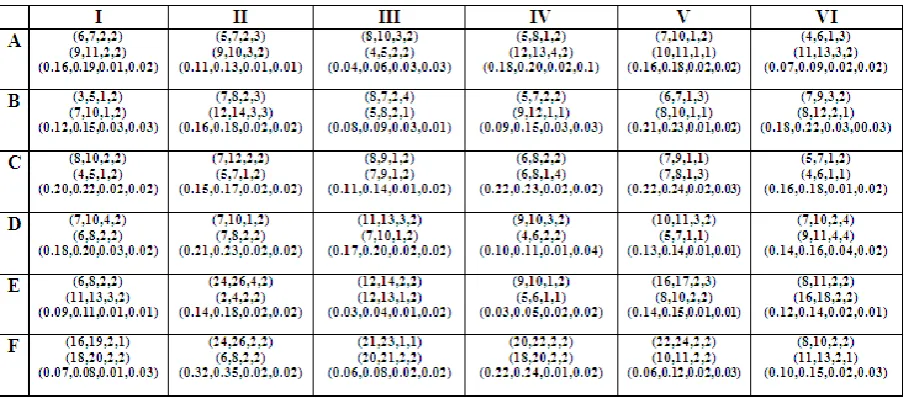
To illustrate the proposed model, consider a case of construction process with six persons and six works as a fuzzy multi objective assignment problem so as to minimize the fuzzy cost, fuzzy time and fuzzy quality. The fuzzy cost coefficients, the fuzzy time and the fuzzy quality in fuzzy multi objective assignment problem are considered as L-R fuzzy numbers for allocating each person. The fuzzy multi objective assignment problem with fuzzy cost, fuzzy the time and the fuzzy quality is shown in table III and it is solved by using various cases.
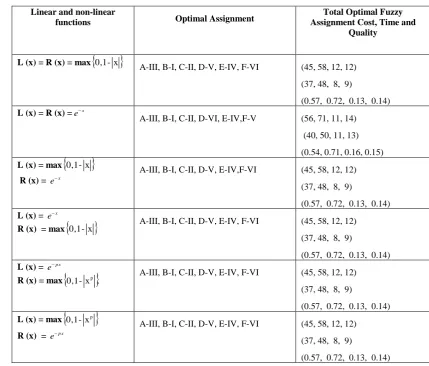
The total optimal fuzzy cost, fuzzy time and fuzzy quality for fuzzy multi-objective assignmentproblem using fuzzy linear programming for various cases as follows:
Case (i) L (x) = R (x) = max
0,1-x
Step 1: The given fuzzy multi-objective assignment problem is a balanced one.
Step 2: Using step3 of the proposed model, the given fuzzy multi-objective assignment problem is converted into a single fuzzy objective problem as follows
Minimize
~
z
=
iji j ij ij
i j ij ij
i j
ij x t x q x
c
6
1 6
1 6
1 6
1 6
1 6
1
~ 1 . 0 ~ 4 . 0 ~ 5 . 0
subject to
otherwise
work j assigned is
person i
if x
th th
ij 0 1
1, 1,2,...,6.
6
1
j x
i ij
1, 1,2,...,6.
6
1
i x
j ij
Here, w1 = 0.5, w2 = 0.4, w3 = 0.1.
Step 3: The fuzzy multi-objective assignment problem is converted into the following crisp linear programming problem
Minimize z =
iji j ij ij
i j ij ij
i j
ij x Rt x Rq x
c
R
6 1 6
1 6
1 6
1 6
1 6
1
~ 1
. 0 ~ 4
. 0 ~ 5
. 0
subject to
otherwise
work j assigned is
person i
if x
th th
ij 0 1
1, 1,2,...,6.
6
1
j x i
ij
1, 1,2,...,6.
6
1
x ij ij
Step 4: Using definition 2 and section 2.2, the values of
cij R~ , R
tij~
and R
q~ij ,i,j are calculated and given in Table IV.Step 5: Using step 6 of the proposed model highest cost, highest time and highest quality from table IV respectively are 25, 20.5 and 0.33. For w1= 0.5, w2 = 0.4 and w3 = 0.1, the values of a, b, and c are: a = 0.02, b = 0.01 and c = 0.303.
Step 6: Using step 7 of the proposed method convert the chosen fuzzy multi-objective assignment problem into the following crisp linear programming
Minimize: (0.28)x11 + (0.25)x12 + (0.23)x13 + (0.31)x14 + (0.33)x15 + (0.25)x16 + (0.21)x21 + (0.33)x22 + (0.24)x23 + (0.26)x24 + (0.29)x25 + (0.31)x26 + (0.29)x31 + (0.30)x32 + (0.29)x33 + (0.28)x34 + (0.31)x35 + (0.22)x36 + (0.28)x41 + (0.31)x42 + (0.37)x43 + (0.26)x44 + (0.30)x45 + (0.32)x46 + (0.28)x51 + (0.56)x52 + (0.39)x53 + (0.26)x54 + (0.46)x55 + (0.39)x56 + (0.55)x61 + (0.67)x62 + (0.66)x63 + (0.68)x64 + (0.59)x65 + (0.33)x66
subject to:
x11 + x12 + x13 + x14 + x15 + x16 = 1 ; x21 + x22 + x23 + x24 + x25 + x26 = 1; x31 + x32 + x33 + x34 + x35 + x36 = 1 ; x41 + x42 + x43 + x44 + x45 + x46 = 1; x51 + x52 + x53 + x54 + x55 + x56 = 1 ; x61 + x62 + x63 + x64 + x65 + x66 = 1; x11 + x21 + x31 + x41 + x51 + x61 = 1 ; x11 + x22 + x32 + x42 + x52 + x62 = 1 ; x13 + x23 + x33 + x43 + x53 + x63 = 1; x14 + x24 + x34 + x44 + x54 + x65 = 1; x15 + x25 + x35 + x45+ x55 + x65 = 1 ; x16 + x26 + x36 + x46 + x56 + x66 = 1. where xij ≥0, for all i=1,2,3,4,5,6 and j=1,2,3,4,5,6.
Step 7: Solve the crisp linear programming problem, obtained in step 6, the optimal solution obtained is: x13 = 1, x21 = 1, x32 = 1, x45 = 1, x54 = 1, x66 = 1.
Step 8: Using step 9 of the proposed model,the minimum fuzzy assignment cost, the fuzzy assignment time and the
fuzzy assignment quality respectively are, (45, 58, 12, 12) ,
(37, 48, 8, 9) and (0.57, 0.72, 0.13, 0.14).
Case (ii) L (x) = R (x) =ex
Step 1: The given fuzzy multi-objective assignment problem is a balanced one.
Step 2: Using step3 of the proposed model, the given fuzzy multi-objective assignment problem is converted into a single fuzzy objective problem as follows :
Minimize
~
z
=
iji j ij ij
i j ij ij
i j
ij x t x q x
c
6
1 6
1 6
1 6
1 6
1 6
1
~ 1 . 0 ~ 4 . 0 ~ 5 . 0
subject to
otherwise
work j assigned is
person i
if x
th th
ij 0 1
1, 1,2,...,6.
6
1
j x i
ij
1, 1,2,...,6.
6
1
x ij ij
Here, w1 = 0.5, w2 = 0.4, w3 = 0.1.
Step 3: The fuzzy multi-objective assignment problem is converted into the following crisp linear programming problem
Minimize z =
iji j ij ij
i j ij ij
i j
ij x Rt x Rq x
c
R
6
1 6
1 6
1 6
1 6
1 6
1
~ 1
. 0 ~ 4
. 0 ~ 5
. 0
subject to
otherwise
work j assigned is
person i
if x
th th
ij 0 1
. 6 ,..., 2 , 1 , 1
6
1
j x
i ij
1, 1,2,...,6.
6
1
i x
j ij
Step 4: Using definition 2 and section 2.2, the values of
cij R~ , R
tij~
and R
q~ij ,i,j are calculated and given in Table V.Step 5: Using step 6 of the proposed model highest cost, highest time and highest quality from table V respectively are 25, 20.5 and 0.33. For w1= 0.5, w2 = 0.4 and w3 = 0.1, the values of a, b, and c are: a = 0.02, b = 0.01 and c = 0.303.
Step 6: Using step 7 of the proposed method convert the chosen fuzzy multi-objective assignment problem into the following crisp linear programming
Minimize z = (0.28)x11 + (0.25)x12 + (0.23)x13 + (0.31)x14 + (0.33)x15 + (0.25)x16 + (0.22)x21 + (0.34)x22 + (0.25)x23 + (0.26)x24 + (0.30)x25 + (0.30)x26 + (0.29)x31 + (0.30)x32 + (0.30)x33 + (0.29)x34 + (0.31)x35 + (0.23)x36 + (0.27)x41 + (0.32)x42 + (0.37)x43 + (0.26)x44 + (0.30)x45 + (0.33)x46 + (0.28)x51 + (0.55)x52 + (0.40)x53 + (0.26)x54 + (0.47)x55 + (0.39)x56 + (0.55)x61 + (0.67)x62 + (0.66)x63 + (0.68)x64 + (0.59)x65 + (0.33)x66
subject to: x11 + x12 + x13 + x14 + x15 + x16 = 1 ; x21 + x22 + x23 + x24 + x25 + x26 = 1; x31 + x32 + x33 + x34 + x35 + x36 = 1 ; x41 + x42 + x43 + x44 + x45 + x46 = 1; x51 + x52 + x53 + x54 + x55 + x56 = 1 ; x61 + x62 + x63 + x64 + x65 + x66 = 1; x11 + x21 + x31
+ x41 + x51 + x61 = 1 ; x11 + x22 + x32 + x42 + x52 + x62 = 1; x13 + x23 + x33 + x43 + x53 + x63 = 1 ; x14 + x24 + x34 + x44 +
x54 + x65 = 1; x15 + x25 + x35 + x45+ x55 + x65 = 1 ; x16 + x26 + x36 + x46 + x56 + x66 = 1. xij 0, for all i=1,2,3,4,5,6 and j=1,2,3,4,5,6.
Step 7: Solving the crisp linear programming problem, obtained in step 6, the optimal solution obtained is: x13 = 1, x21 = 1, x32 = 1, x46 = 1, x54 = 1, x65 = 1.
Step 8: Using step 9 of the proposed model,the minimum fuzzy assignment cost, the fuzzy assignment time and the
fuzzy assignment quality respectively are ,(56, 71, 11, 14) ,
(40, 50, 11, 13) and (0.54, 0.71, 0.16, 0.15).
Case (iii) L (x) = max
0,1-x
and R (x) = exStep 1: The given fuzzy multi-objective assignment problem is a balanced one.
Step 2: Using step3 of the proposed model the given fuzzy multi-objective assignment problem is converted into a single fuzzy objective problem as follows
Minimize ~ = z
iji j ij ij
i j ij ij
i j
ij x t x q x
c
6
1 6
1 6
1 6
1 6
1 6
1
~ 1 . 0 ~ 4 . 0 ~ 5 . 0
subject to
otherwise
work j assigned is
person i
if x
th th
ij 0 1
1, 1,2,...,6.
6
1
j x i
ij
1, 1,2,...,6.
6
1
i x j
ij
Here, w1 = 0.5, w2 = 0.4, w3 = 0.1.
Step 3: The fuzzy multi-objective assignment problem is converted into the following crisp linear programming problem
Minimize z =
iji j ij ij
i j ij ij
i j
ij x Rt x Rq x
c
R
6
1 6
1 6
1 6
1 6
1 6
1
~ 1
. 0 ~ 4
. 0 ~ 5
. 0
subject to
otherwise
work j assigned is
person i
if x
th th
ij 0 1
1, 1,2,...,6.
6
1
j x i
ij
1, 1,2,...,6.
6
1
i x j
ij
Step 4: Using definition 2 and section 2.2, the values of
cij R~ , R
tij~
and R
q~ij ,i,j are calculated and given in Table VI.Step 5: Using step 6 of the proposed model highest cost, highest time and highest quality from table VI respectively are 25.5, 21 and 0.34. For w1= 0.5, w2 = 0.4 and w3 = 0.1, the values of a, b, and c are: a = 0.019, b = 0.018 and c = 0.2941.
Step 6: Using step 7 of the proposed method, convert the chosen fuzzy multi-objective assignment problem into the following crisp linear programming
Minimize z = (0.37)x11 + (0.34)x12 + (0.28)x13 + (0.41)x14 + (0.42)x15 + (0.36)x16 + (0.29)x21 + (0.46)x22 + (0.31)x23 + (0.35)x24 + (0.38)x25 + (0.39)x26 + (0.33)x31 + (0.36)x32 + (0.37)x33 + (0.36)x34 + (0.38)x35 + (0.27)x36 + (0.35)x41 + (0.38)x42 + (0.45)x43 + (0.32)x44 + (0.35)x45 + (0.43)x46 + (0.39)x51 + (0.58)x52 + (0.50)x53 + (0.31)x54 + (0.54)x55 + (0.54)x56 + (0.70)x61 + (0.71)x62 + (0.82)x63 + (0.82)x64 + (0.67)x65 + (0.43)x66
subject to: x11 + x12 + x13 + x14 + x15 + x16 = 1 ; x21 + x22 + x23 + x24 + x25 + x26 = 1; x31 + x32 + x33 + x34 + x35 + x36 = 1 ; x41 + x42 + x43 + x44 + x45 + x46 = 1; x51 + x52 + x53 + x54 + x55 + x56 = 1 ; x61 + x62 + x63 + x64 + x65 + x66 = 1; x11 + x21 + x31 + x41 + x51 + x61 = 1 ; x11 + x22 + x32 + x42 + x52 + x62 = 1; x13 + x23 + x33 + x43 + x53 + x63 = 1 ;x14 + x24 + x34 + x44 + x54 + x65 = 1; x15 + x25 + x35 + x45+ x55 + x65 = 1 ; x16 + x26 + x36 + x46 + x56 + x66 = 1. xij 0 , for all i=1,2,3,4,5,6 and j=1,2,3,4,5,6.
Step 7: Solving the crisp linear programming problem, obtained in step 3, the optimal solution obtained is x13 = 1, x21 = 1, x32 = 1, x45 = 1, x54 = 1, x66 = 1.
Step 8: Using step 9 of the proposed model,the minimum fuzzy assignment cost, the fuzzy assignment time and the
fuzzy assignment quality respectively are, (45, 58, 12, 12) ,
(37, 48, 8, 9) and (0.57, 0.72, 0.13, 0.14)
Case (iv) L (x) = ex and R (x) = max
0,1-x
.Step 2: Using step3 of the proposed model the given fuzzy multi-objective assignment problem is converted into a single fuzzy objective problem as follows
Minimize ~ = z
iji j ij ij i j ij ij i j
ij x t x q x
c
6 1 6 1 6 1 6 1 6 1 6 1 ~ 1 . 0 ~ 4 . 0 ~ 5 . 0 subject to otherwise work j assigned is person i if x th th ij 0 11, 1,2,...,6.
6 1
j x i ij1, 1,2,...,6.
6 1
i x j ijHere, w1 = 0.5, w2 = 0.4, w3 = 0.1.
Step 3: The fuzzy multi-objective assignment problem is converted into the following crisp linear programming problem
Minimize z =
iji j ij ij i j ij ij i j
ij x Rt x Rq x
c
R
6 1 6 1 6 1 6 1 6 1 6 1 ~ 1 . 0 ~ 4 . 0 ~ 5 . 0 subject to otherwise work j assigned is person i if x th th ij 0 11, 1,2,...,6.
6 1
j x i ij1, 1,2,...,6.
6 1
i x j ijStep 4: Using definition 2 and section 2.2, the values of
cij R~ , R
tij~
and R
qij~ ,i,j are calculated and given in Table VII.
Step 5: Using step 6 of the proposed model highest cost, highest time and highest quality from table VII respectively are 27.5, 22 and 0.35. For w1= 0.5, w2 = 0.4 and w3 = 0.1, the values of a, b, and c are: a = 0.018, b = 0.018 and c = 0.285.
Step 6: Using step 7 of the proposed method convert the chosen fuzzy multi-objective assignment problem into the following crisp linear programming
Minimize z = (0.40)x11 + (0.38)x12 + (0.32)x13 + (0.46)x14 + (0.42)x15 + (0.39)x16 + (0.30)x21 + (0.49)x22 + (0.33)x23 + (0.37)x24 + (0.38)x25 + (0.44)x26 + (0.35)x31 + (0.37)x32 + (0.37)x33 + (0.37)x34 + (0.38)x35 + (0.28)x36 + (0.41)x41 + (0.39)x42 + (0.48)x43 + (0.35)x44 + (0.38)x45 + (0.47)x46 + (0.43)x51 + (0.62)x52 + (0.51)x53 + (0.31)x54 + (0.56)x55 + (0.57)x56 + (0.73)x61 + (0.72)x62 + (0.80)x63 + (0.84)x64 + (0.68)x65 + (0.46)x66
subject to: x11 + x12 + x13 + x14 + x15 + x16 = 1 ; x21 + x22 + x23 + x24 + x25 + x26 = 1; x31 + x32 + x33 + x34 + x35 + x36 = 1 ; x41 + x42 + x43 + x44 + x45 + x46 = 1; x51 + x52 + x53 + x54 + x55 + x56 = 1 ; x61 + x62 + x63 + x64 + x65 + x66 = 1; x11 + x21 + x31
+ x41 + x51 + x61 = 1 ; x11 + x22 + x32 + x42 + x52 + x62 = 1; x13 + x23 + x33 + x43 + x53 + x63 = 1 ; x14 + x24 + x34 + x44 + x54
+ x65 = 1; x15 + x25 + x35 + x45+ x55 + x65 = 1 ; x16 + x26 + x36 + x46 + x56 + x66 = 1, xij 0, for all i=1,2,3,4,5,6 and j=1,2,3,4,5,6.
Step 7: Solving the crisp linear programming problem, obtained in step3, the optimal solution obtained is: x13 = 1, x21 = 1, x32 = 1, x45 = 1, x54 = 1, x66 = 1.
Step 8: Using step 9 of the proposed model,the minimum fuzzy assignment cost, the fuzzy assignment time and the
fuzzy assignment quality respectively are, (45, 58, 12, 12) ,
(37, 48, 8, 9) and (0.57, 0.72, 0.13, 0.14).
Case (v) L (x) = ep x and R (x) = max
. x -1 0, pStep 1: The given fuzzy multi-objective assignment problem is a balanced one.
Step 2: Using step3 of the proposed model the given fuzzy multi-objective assignment problem is converted into a single fuzzy objective problem as follows
Minimize
~
z
=
iji j ij ij i j ij ij i j
ij x t x q x
c
6 1 6 1 6 1 6 1 6 1 6 1 ~ 1 . 0 ~ 4 . 0 ~ 5 . 0 subject to otherwise work j assigned is person i if x th th ij 0 11, 1,2,...,6.
6 1
j x i ij1, 1,2,...,6.
6 1
i x j ijHere w1 = 0.5, w2 = 0.4, w3 = 0.1.
Step 3: The fuzzy multi-objective assignment problem is converted into the following crisp linear programming problem. Minimize Z=
iji j ij ij i j ij ij i j
ij x Rt x Rq x
c
R
6 1 6 1 6 1 6 1 6 1 6 1 ~ 1 . 0 ~ 4 . 0 ~ 5 . 0 subject to otherwise work j assigned is person i if x th th ij 0 11, 1,2,...,6.
6 1
j x i ij1, 1,2,...,6.
6 1
i x j ijStep 4: Using definition 2 and section 2.2, the values of R
c~ ij , R
tij~
and R
qij~ ,i,j are calculated and given in Table VIII.
Step 5: Using step 6 of the proposed model highest cost, highest time and highest quality from table VIII respectively are 25.25, 20.75 and 0.33. For w1= 0.5, w2 = 0.4 and w3 = 0.1, the values of a, b, and c are: a = 0.0195, b = 0.0192 and c = 0.2857.
Step 6: Using step 7 of the proposed method convert the chosen fuzzy multi-objective assignment problem into the following crisp linear programming
(0.55)x56 + (0.73)x61 + (0.72)x62 + (0.85)x63 + (0.85)x64 + (0.68)x65 + (0.44)x66
subject to: x11 + x12 + x13 + x14 + x15 + x16 = 1 ; x21 + x22 + x23 + x24 + x25 + x26 = 1; x31 + x32 + x33 + x34 + x35 + x36 = 1 ; x41 + x42 + x43 + x44 + x45 + x46 = 1; x51 + x52 + x53 + x54 + x55 + x56 = 1 ; x61 + x62 + x63 + x64 + x65 + x66 = 1; x11 + x21 + x31 + x41 + x51 + x61 = 1 ; x11 + x22 + x32 + x42 + x52 + x62 = 1; x13 + x23 + x33 + x43 + x53 + x63 = 1 ; x14 + x24 + x34 + x44 + x54 + x65 = 1; x15 + x25 + x35 + x45+ x55 + x65 = 1 ; x16 + x26 + x36 + x46 + x56 + x66 = 1, xij0, for all i=1,2,3,4,5,6 and j=1,2,3,4,5,6.
Step 7: Solving the crisp linear programming problem, obtained in step3, the optimal solution obtained is: x13 = 1, x21 = 1, x32 = 1, x45 = 1, x54 = 1, x66 = 1.
Step 8: Using step 9 of the proposed model, the minimum fuzzy assignment cost, the fuzzy assignment time and the
fuzzy assignment quality respectively are, (45, 58, 12, 12) ,
(37, 48, 8, 9) and (0.57, 0.72, 0.13, 0.14).
Case (vi) L (x) = max
p
x -1
0, and R (x) =
e
pxStep 1: The given fuzzy multi-objective assignment problem is a balanced one.
Step 2: Using step3 of the proposed model the given fuzzy multi-objective assignment problem is converted into a single fuzzy objective problem as follows
Minimize
~
z
=
iji j ij ij
i j ij ij
i j
ij x t x q x
c
6
1 6
1 6
1 6
1 6
1 6
1
~ 1 . 0 ~ 4 . 0 ~ 5 . 0
subject to
otherwise
work j assigned is
person i if x
th th
ij 0 1
1, 1,2,...,6.
6
1
j x i
ij
1, 1,2,...,6.
6
1
i x j
ij
Here, w1 = 0.5, w2 = 0.4, w3 = 0.1.
Step 3: The fuzzy multi-objective assignment problem is converted into the following crisp linear programming problem
Minimize z =
iji j ij ij
i j ij ij
i j
ij x Rt x Rq x
c
R
6
1 6
1 6
1 6
1 6
1 6
1
~ 1
. 0 ~ 4
. 0 ~ 5
. 0
subject to
otherwise
work j assigned is
person i
if x
th th
ij 0 1
1, 1,2,..., .
6
1
n j
x i
ij
1, 1,2,..., .
6
1
n i
x j
ij
Step 4: Using definition 2 and section 2.2, the values of R
c~ ij , R
t~ij and R
q~ij ,
i
,
j
are calculated and given in Table IX.Step 5: Using step 6 of the proposed model highest cost, highest time and highest quality from table IX respectively are 53.33, 43 and 0.69. For w1= 0.5, w2 = 0.4 and w3 = 0.1, the values of a, b, and c are: a = 0.009, b = 0.0092 and c = 0.144.
Step 6: Using step 7 of the proposed method convert the chosen fuzzy multi-objective assignment problem into the following crisp linear programming
Minimize z = (0.38)x11 + (0.36)x12 + (0.30)x13 + (0.44)x14 + (0.41)x15 + (0.37)x16 + (0.29)x21 + (0.47)x22 + (0.32)x23 +(0.36)x24 + (0.36)x25 + (0.42)x26 + (0.33)x31 + (0.36)x32 + (0.36)x33 + (0.35)x34 + (0.37)x35 + (0.27)x36 + (0.38)x41 + (0.38)x42 + (0.46)x43 + (0.33)x44 + (0.37)x45 + (0.44)x46 + (0.41)x51 + (0.60)x52 + (0.50)x53 + (0.30)x54 + (0.54)x55 + (0.56)x56 + (0.72)x61 + (0.71)x62 + (0.82)x63 + (0.83)x64 + (0.67)x65 + (0.45)x66
subject to: x11 + x12 + x13 + x14 + x15 + x16 = 1 ; x21 + x22 + x23 + x24 + x25 + x26 = 1; x31 + x32 + x33 + x34 + x35 + x36 = 1 ; x41 + x42 + x43 + x44 + x45 + x46 = 1; x51 + x52 + x53 + x54 + x55 + x56 = 1 ; x61 + x62 + x63 + x64 + x65 + x66 = 1; x11 + x21 + x31 + x41 + x51 + x61 = 1 ; x11 + x22 + x32 + x42 + x52 + x62 = 1; x13 + x23 + x33 + x43 + x53 + x63 = 1 ; x14 + x24 + x34 + x44 + x54 + x65 = 1; x15 + x25 + x35 + x45+ x55 + x65 = 1 ; x16 + x26 + x36 + x46 + x56 + x66 = 1, xij0, for all i=1,2,3,4,5,6 and j=1,2,3,4,5,6.
Step 7: Solving the crisp linear programming problem, obtained in step3, the optimal solution obtained is: x13 = 1, x21 = 1, x32 = 1, x45 = 1, x54 = 1, x66 = 1.
Step 8: Using step 9 of the proposed model,the minimum fuzzy assignment cost, the fuzzy assignment time and the
fuzzy assignment quality respectively are, (45, 58, 12, 12) ,
(37, 48, 8, 9) and (0.57, 0.72, 0.13, 0.14).
6. Conclusion
Table I : Reference functions and their inverses
Table II: Fuzzy assignment with fuzzy cost, fuzzy time, fuzzy quality Works
1 2 … j … n
1 11 11 11 ~ ; ~ ; ~ t q
c 12 12 12
~ ; ~ ; ~ t q
c … c~1j;~t1j;q~1j … c1n t1n q1n ~ ; ~ ; ~
2 21 21 21
~ ; ~ ; ~ t q
c 22 22 22
~ ; ; ~ t q
c … c2j t2j q2j
~ ; ;
~ …
n n n t q c2 2 2
~ ; ; ~
Persons
. . .
. . .
. . .
. . .
. . .
. . .
. . .
i 1 1 1
~ ; ; ~
i i i t q
c 2 2 2
~ ; ; ~
i i i t q
c … cij tij qij
~ ; ;
~ …
in in in t q c ; ;~ ~
. . .
. . .
. . .
. . .
. . .
. . .
. . .
n c~n1;tn1;q~n1 c~n2;tn2;q~n2 … c~nj;tnj;q~nj … c~nn;tnn;q~nn
TABLE III: Fuzzy assignment problem with fuzzy cost, fuzzy time and fuzzy quality Function Name Reference Function (RF) Inverse of Reference
function
0,1
Linear RF
x max
0,1-x
p
1
1
x RFp
Exponential
, 1p e x
RF px
p RFp
x In /p1
Power RF
x max
0,1xp
, p1p
p p x
RF1 1
Exponential power
, 1p e x
RF xp
p
p
p x In
RF1
Rational RF
x 1
1xp
, p1p RFp
x p
1
[image:8.595.66.519.552.752.2]TABLE IV: Ranks of Fuzzy Cost, Fuzzy Time and Fuzzy Quality for case (i)
TABLE V: Ranks of Fuzzy Cost, Fuzzy Time and Fuzzy Quality for case (ii)
TABLE VI: Ranks of Fuzzy Cost, Fuzzy Time and Fuzzy Quality for case (iii) I II III IV V VI A 6.5
10 0.1775
6.2 9.25 0.12
8.75 4.5 0.05
6.75 12 0.1875
8.75 10.75
0.17
5.5 11.75
0.08
B 4.25
8.75 0.135
7.75 13 0.17
8 6.25 0.08
6 10.5 0.12
7 9 0.2225
7.75 9.75 0.2
C 9 4.75 0.21
9.5 6.25 0.16
8.75 8.25 0.1275
7 7.75 0.225
8 8 0.2325
6.25 5 0.1725
D 8 7 0.1875
8.75 7.5 0.22
11.75 8.75 0.185
9.25 5 0.1125
10.25 6 0.135
9 10 0.145
E 7 11.75
0.1
24.5 3 0.16
13 12.75 0.0375
9.75 5.5 0.04
16.75 9 0.145
9.5 17 0.1275
F 17.25
19 0.08
25 7 0.335
22 20.5 0.075
21 19 0.2325
23 10.5 0.0925
9 11.75 0.1275
I II III IV V VI A 6.5
10 0.1775
6.2 9.25 0.12
8.75 4.5 0.05
6.75 12 0.1875
8.75 10.75
0.17
5.5 11.75
0.08
B 4.25
8.75 0.135
7.75 13 0.17
8 6.25 0.08
6 10.5 0.12
7 9 0.2225
7.75 9.75 0.2
C 9 4.75 0.21
9.5 6.25 0.16
8.75 8.25 0.1275
7 7.75 0.225
8 8 0.2325
6.25 5 0.1725
D 8 7 0.1875
8.75 7.5 0.22
11.75 8.75 0.185
9.25 5 0.1125
10.25 6 0.135
9 10 0.145
E 7 11.75
0.1
24.5 3 0.16
13 12.75 0.0375
9.75 5.5 0.04
16.75 9 0.145
9.5 17 0.1275
F 17.25
19 0.08
25 7 0.335
22 20.5 0.075
21 19 0.2325
23 10.5 0.0925
9 11.75 0.1275
I II III IV V VI A 7
10.5 0.1825
7 9.75 0.1225
9.25 5 0.0575
7.25 12.5 0.19
9.25 10.75 0.175
6.25 12.25 0.085
B 4.75
9.25 0.1425
8.5 13.75 0.175
9 6.5 0.0825
6.5 10.75 0.1275
7.75 9.25 0.2275
8.25 10 0.2075
C 9.5 5.25 0.215
10 6.75 0.165
9.25 8 0.225
7.5 8.75 0.23
8.25 8.75 0.24
6.75 5.25 0.1775
D 8.5 7.5 0.1925
9.25 8 0.225
12.25 9.25 0.19
9.75 5.5 0.1225
10.75 6.25 0.1375
10 11 0.15
E 7.5 12.25 0.1025
25 3.5 0.165
13.5 13.25 0.0425
10.25 5.75 0.045
17.5 9.5 0.1475
10 17.5 0.13
F 17.5
19.5 0.0875
25.5 7.5 0.34
22.25 21 0.075
21.5 19.5 0.2375
23.5 11 0.1
[image:9.595.109.490.562.768.2]TABLE VII: Ranks of Fuzzy Cost, Fuzzy Time and Fuzzy Quality for case (iv)
TABLE VIII: Ranks of Fuzzy Cost, Fuzzy Time and Fuzzy Quality for case (v)
TABLE IX: Ranks of Fuzzy Cost, Fuzzy Time and Fuzzy Quality for case (vi)
I II III IV V VI A 8
11.5 0.185
7.75 11.5 0.1275
11 6 0.0725
7.5 15 0.2025
9.5 11.25 0.185
6.25 14 0.095
B 5 9.5 0.1575
9.25 15.25 0.185
9.5 7.75 0.1025
7.5 11.25 0.1425
7.75 9.75 0.23
10 11.25 0.2225
C 10.5
5.5 0.225
11 7 0.175
9.5 9 0.135
8.5 8.5 0.24
8.75 8.75 0.2475
7 5.75 0.18
D 11 8.5 0.21
9.5 9 0.235
14 9.5 0.2
11.5 6.5 0.12
12.5 6.75 0.1425
10.5 13 0.175
E 8.5 14 0.1075
27.5 4.5 0.175
14.5 13.5 0.045
10.5 6.25 0.055
18.25 10.5 0.1525
11 18.5 0.1425
F 18.75
20.5 0.0875
26.5 8.5 0.35
22.75 22 0.085
22.5 20.5 0.24
24.5 12 0.1075
10.5 13.25 0.1425
I
II
III
IV
V
VI
A 6.75 10.25
0.18
6.625 9.5 0.12125
9 4.75 0.05375
7 12.25 0.18875
9 10.625 0.1725
5.875 12 0.0825
B 4.5
9 0.13875
8.125 13.375 0.1725
8.5 6.375 0.08125
6.25 10.625 0.12375
7.375 9.125 0.225
8 9.875 0.20375
C 9.25 5 0.2125
9.75 6.5 0.1625
9 8.5 0.13
7.25 8.25 0.2275
8.125 8.375 0.23625
6.5 5.125 0.175
D 8.25 7.25 0.19
9 7.75 0.2225
12 9 0.1875
9.5 5.25 0.1175
10.5 6.125 0.13625
9.5 10.5 0.1475
E 7.25 12 0.10125
24.75 3.25 0.1625
13.25 13 0.04
10 5.625 0.0425
17.125 9.25 0.14625
9.75 17.25 0.12875
F 17.375 19.25 0.08375
25.25 7.25 0.3375
22.125 20.75 0.0725
21.25 19.25 0.235
23.25 10.75 0.09625
9.25 11.875 0.13125
I II III IV V VI
A 15 22 0.3633
14.3333 21.66667
0.25
20.66 11 0.13
14.3333 28.33 0.3966
18.3333 22 0.36
11.6666 26.6666 0.18
B 9.3333
18.3333 0.3
17.3333 29 0.36
17.66 14.66 0.1933
14 22 0.27
14.6666 19 0.4533
18.6666 21.6666 0.43
C 20 10.3333
0.44
21 13.3333
0.34
18.33 17.33 0.2633
16 16 0.47
17 16.6666
0.4833
13.3333 11 0.3533
D 20.3333
16 0.4066
18.3333 17 0.46
26.66 18.33 0.39
21.66 12 0.23
23.6666 13 0.28
19.6666 24 0.3333
E 16 26.66
0.21
53.33 8 0.34
28 26.33 0.0833
20.33 12 0.1
35.33 20 0.3
21 36 0.2766
F 36.66
40 0.1666
52 16 0.69
45 43 0.16
44 40 0.4733
48 23 0.2033
20 25.6666
[image:10.595.82.534.558.767.2]TABLE X: Total Optimal Fuzzy Assignment Cost, Time and Quality
7. REFERENCES
[1] Hiller, S.F., Liberman, J.G. (2001). Introduction to Operation Research, 7th ed., Mcgraw Hill, Boston.
[2] Taha, A.H. (1992). Operation Research, an introduction, 5th ed., Macmillan, Basingstoke Hampshire.
[3] Murthy, P.R. (2007). Operation Research, 2nded., New Age International Limited, New Delhi.
[4] Swarup, K., Gupta, P.K., and Mohan, M. (2003). Operation Research, 11th ed., Sultan Chand and sons, New Delhi.
[5] Ravindran, A., Don T. Phillips and Tames J. Solberg. (1987). Operation Research 2nd edition, John Wiley and Sons.
[6] Ravindran, A. and Ramaswamy,V. (1977). On the bottleneck assignment problem, Journal of Optimization Theory and Applications, 21, 451-458.
[7] Bao, C.P., and Tasi, M. (2007). A new approach to study the multi objective assignment problem. WHAMPOA-An Interdisciplinary Journal, 53, 123-132.
[8] Lin, J.C., Wen, P.U. (2004). A labeling algorithm for the fuzzy assignment problem. Fuzzy Sets and Systems, 142, 373-391.
[9] Chen, M.S. (1985). On a fuzzy assignment problem. Tamkang Journal, 22, 407-411.
[10] Wang, X. (1987) Fuzzy optimal assignment problem. Fuzzy Mathematics, 3,101-108.
[11] Mukherjee, S., Basu, K. (2010). Application of fuzzy ranking method for solving assignment problem with fuzzy costs. International Journal of Computational and Applied Mathematics, 5(3), 359-368.
[12] Yager, R.R. (1981). A procedure for ordering fuzzy subsets of the unit interval.Information Sciences, 24, 143- 161.
[13] Geetha, S., Nair, K.P.K. (1993). A variation of assignment problem. European Journal of Operation Research, 68, 422-426.
[14] Bit, A.K., Biswal, M.P. and Alam, S.S. (1992).Fuzzy programming approach to multi criteria decision making transportation problem, Fuzzy Sets and Systems, 50, 135-141.
[15] Tsai, C.H., Wei, C.C., and Cheng, C.L. (1999). Multi objective fuzzy deployment of manpower. International Journal of the Computer, the Internet and Management, 7(2), 1-7.
Linear and non-linear
functions Optimal Assignment
Total Optimal Fuzzy Assignment Cost, Time and
Quality
L (x) = R (x) = max
0,1-x
A-III, B-I, C-II, D-V, E-IV, F-VI (45, 58, 12, 12)
(37, 48, 8, 9)
(0.57, 0.72, 0.13, 0.14)
L (x) = R (x) = x
e
A-III, B-I, C-II, D-VI, E-IV,F-V
(56, 71, 11, 14)
(40, 50, 11, 13)
(0.54, 0.71, 0.16, 0.15)
L (x) = max
0,1-x
R (x) = xe
A-III, B-I, C-II, D-V, E-IV,F-VI
(45, 58, 12, 12)
(37, 48, 8, 9)
(0.57, 0.72, 0.13, 0.14)
L (x) = ex
R (x) = max
0,1-x
A-III, B-I, C-II, D-V, E-IV, F-VI (45, 58, 12, 12) (37, 48, 8, 9)(0.57, 0.72, 0.13, 0.14)
L (x) = p x e
R (x) = max
0,1-xp
. A-III, B-I, C-II, D-V, E-IV, F-VI(45, 58, 12, 12)
(37, 48, 8, 9)
(0.57, 0.72, 0.13, 0.14)
L (x) = max
p
x -1
0,
R (x) = p x
e
A-III, B-I, C-II, D-V, E-IV, F-VI
(45, 58, 12, 12)
(37, 48, 8, 9)
[16] Kagade, K.L., Bajaj, V.H. (2009). Fuzzy approach with linear and some non-linear membership functions for solving multi-objective assignment problems. Advances in Computational Research, 1(2), 14-17.
[17] Kagade, K.L., Bajaj, V.H. (2010). Fuzzy method for solving multi objective assignment problem with interval cost. Journal of Statistics and Mathematics, 1(1), 01-09.
[18] Verma , R., Biswal M.P. and Biswas, A. (1997).Fuzzy programming technique to solve multi-objective transportation problems with some non-linear
membership functions, Fuzzy Sets and Systems, 91,37-43.
[19] Dhingra A.K. and Moskowitz H. (1991).Application of fuzzy theories to multiple objective decision making in system design, European Journal of Operational Research, 55, 348-361.