A Scheme to Improve Network Lifetime for
Wireless Adhoc Networks
Kiran Kumar V1, Deepak kumar2, Ganashree A3, Madushree s4, Chaitra G5, 1Assistant Professor, Dept. of ISE, SJBIT
2,3,4,5 Student, Dept. of ISE, SJBIT
Abstract- Transmission game plan for perfect essentialness utilization, despite topology control, coordinating, and MAC traditions, can accept a key part in creating framework lifetime.Numerical results show liberal changes similar to framework lifetime and essentialness utilize transport over existing methodologies . Considering cocentric rings around the sink, we break down the transmission separation of customary plan into two sections: ring thickness and bounce estimate, examine the activity and vitality utilization dispersion among nodes and decide how vitality use fluctuates and basic ring shifts with jump measure. In light of abov e problems , we propose a plotting and choose the thickness of ring by specifying framework lifetime as a headway issue Numerical outcomes indicate liberal changes like system lifetime and vitality use transport over existing strategies. Two different varieties of this strategy are likewise exhibited by rethinking the advancement issue considering: 1) associative jump measure variety by nodes over lifetime alongside ideal obligation cycles, and 2) a particular arrangement of bounce sizes for nodes in each ring. Both varieties carry progressively uniform vitality use with lower basic vitality and further enhances lifetime. A heuristic for disseminated execution of every arrangement is additionally displayed.
Index Terms—Adhoc , energy efficiency,Thickness,lifetime.
I. INTRODUCTION
Remote nodes arrange (AN) alludes to a gathering of spatially scattered and committed nodes for checking and recording the physical states of nature and sorting out the gathered information at a focal area. In addition, nodes hubs have restricted and, much of the time, crucial or irrechargable power sources, consequently proficient utilization of vitality is the key for longer system lifetime and maintained scope of conveyed region. To address this issue, most reviews in ANs [1], [2], [3], [4], [5], [6] have focused on the plan of vitality productive steering conventions, medium get to control conventions, bunching methods, and topology control systems. Notwithstanding these methods, transmission arrangement assumes a vital part , much consideration has been given to enhance general system lifetime, a transmission strategy ought to have taking after components:
Multihop: Single-bounce transmission of information to the sink causes quick consumption of vitality for long range applications. Along these lines, a vitality proficient transmission strategy is fundamentally multihoping.
Variable transmission go: Multihop transmission with settled transmission run makes problem areas Varying transmission run after some time achieves more uniform activity and vitality use appropriation among nodes.
Vitality adjusted obligation cycles: a transmission arrangement ought to ideally decide obligation cycles for every transmission run with the target to augment general system lifetime.
Consistency: Scheduling nodes dodging impedance needs a lot of exertion [17]. The transmission extends and related obligation cycles to be utilized by nodes ought to keep up certain example so that an arrangement of noninterfering hubs can be planned together.
In this paper, association as takes after: In Section 2, We survey Single Hop, Multi Hop, and their half and half transmissions. in Section 3, examine the framework models and formally. In Section 4, we propose our characterize transmission strategy as an issue. Segment 5 introduces the algorithm.In Section 6, talk about the usage part. The execution of the proposed strategies has been illustrated in Section 7, and Section 8 concludes the paper.
II. RELATED WORK
A. Transmission distance measurement
To find the optimal transmission distance at each hop that minimizes the total energy usage along the path, a data link between a radio transmitter and a receiver separated by D meters are divided into K subpaths by introducing (K - 1) intervening relay nodes. The authors have shown that, for given D and the number of hops K, the overall energy dissipation along the path is minimum when length of all the subpaths are made equal to D/K and the optimal number of hops is given by
Kopt=[distance/achar]
where the distance achar, called the characteristic distance, is independent of distance.The above study assumes uniform relay traffic on the intermediate nodes along the multihop path which is not valid in AN.
B. Requirement for energy data
Vitality adjusted information engendering in remote nodes systems has been contemplated in where the normal per nodes vitality dispersal amid the whole lifetime is the same for every one of the nodes in the system. Once created, a nodes sends information it is possible that one bounce nearer to the sink or straightforwardly to the sink.
The creators expect the system region as a cycle division with the sink at the middle. The cycle segment is partitioned into ring areas or "cuts" with each cut having thickness r. For adjusting burden and spreading vitality scattering uniformly amongnodes, a nodes in ring area Ti advances information to Ti-1 (i.e., the following segment toward the sink) with likelihood pi, while with likelihood 1 - pi it transmits information specifically to the sink. There is an exchange off for picking pi:
if pi expands then transmissions have a tendency to happen locally, hence vitality utilization per transmission is low; nonetheless, nodes near the sink have a tendency to be abused since more information go through them, and
then again, if pi diminishes, removed transmission by a nodes increments bringing about higher vitality seepage by a nodes for each transmission.
Despite the way that the arrangement achieves balanced imperativeness use among nodes, usage of either direct transmission to the sink or only a solitary ring forward toward the sink realizes general essentialness wastefulness.C. Single Hop, Multihop, and Hybrid Transmissions
The creators broke down the SH, MH, and their half breed transmission approaches. The creators expected a heterogeneous AN isolated into groups and each bunch area is round with the bunch head (sink) at the middle. The entire group is isolated into cocentric rings around the sink and nodes send their information toward the sink utilizing single jump or multihop or blend of them. In SH transmission, a nodes sends information specifically to the sink. It is found that, in SH transmission, a lot of vitality stays unused in nodes dwelling in rings C1 to Cl-1 while nodes in the most remote ring Cl is out of vitality. A nodes in ring Ci needs to send information to a separation of iw by and large to achieve the sink specifically.
In MH correspondence , information are handed-off by various moderate hubs in transit from the source hub to the sink with one ring forward toward the sink at each jump. Here, hubs near the sink (in C1) need to transfer all information originating from the nodes in the external rings (C2 to Cl) and accordingly expend vitality speedier than nodes of whatever other rings, subsequently are the basic hubs.
Albeit half breed transmission arrangement makes vitality waste in both ring C1 and Cl equivalent to the basic vitality, vitality utilization by nodes still falls exponentially from ring C2 (and from Cl-1) to the center ring. This leaves generous residualenergy in l - 2 number of rings out of aggregate l rings and hence the strategy neglects to accomplish great vitality use dispersion. Besides, the system lifetime change is extremely immaterial.
III. PROBLEM DEFINITION
Due to the energy constraint of individual nodes node, lifetime of a AN is bounded by a finite number of data cycles. Ideally, we require that almost all the nodes in the network expire at about the same time. This ensures that very little residual energy is left when the system becomes unusable, i.e., when coverage/connectivity is lost. But achieving uniform distribution of energy usage among nodes nodes with improved network lifetime still remains a challenge. Nodes having the highest rate of energy usages per data cycle, denoted as critical nodes, limit the overall network lifetime. In this paper, we formulate transmission policies with the aim to achieve extended network lifetime through increasingly uniform distribution of energy usage among nodes.
nodes “s” over data cycles to send self-generated as well as relay traffic while using ring thickness ŵ and hop size ῆ. Here and in subsequent formulations, the subscript “s” refers to parameters related to a single node. Then the total energy consumed by the nodes under the transmission policy is defined as
IV. SYSTEM MODEL
A. Network Model
We consider a AN where a number of nodes are randomly and uniformly deployed over the network area. Let Einit be the initial energy storage in a nodes node. We formulate our transmission policies for a circle sector having radius R and angle θ at the sink as
shown in Fig. 1 and consists of n nodes. The motivation behind such consideration is that, any polygonal-shaped network area could be approximated by such circle sectors. Moreover, in clustered network, a cluster can be approximated by one or more circle sectors. We divide the whole nodes field into a set of w(=l/u) cocentric circular ring areas having ring thickness ofw.
A nodes “s” having distance ds from the sink is located in ring Ci, if and only if (i-1)w<ds≤iw. Since the number of nodes in a
certain region is proportional to the size of the area, the number of nodes located in ring Ci, denoted by N(i,w), and the number of nodes located in rings Ci+1 to Cl, i.e., at the outer rings relative to ring Ci, denoted by are given by (1) and (2), respectively,
N(d,e) = (2id- 1)ne2/ R2 (1)
N(d,e) = s2 – d / R2 (2)
The amount of data generated depends on the event detected and we assume that pk is the probability that a nodes senses kth event (among m events) within its vicinity during a data cycle and once detected generates &k amount of data. During network lifetime, which is a significantly long stretch, occasions happen consistently over the system range and the by and large information era by a hubs for each information cycle can be assessed as
We decay the transmission separation of conventional multihop correspondence into ring thickness and bounce measure. The bounce estimate, signified by ɳ {1,2,....,l}, is the greatest number of rings a hub advances its information in a solitary transmission toward the sink. The transmission separation of a hubs in ring Ci, meant by x(i,w,ɳ), is an indispensable numerous of ring thickness w and will be controlled by its ring file i and bounce estimate ɳ.
B. Energy Consumption Model
The energy model specifies the energy consumption by nodes node during various operations such as radio transmission, reception, sensing, and computing. The energy spent for sensing and computing is relatively small, periodic, and same for all nodes in a particular AN. Therefore, for simplicity, we adopt the energy model as in considering the energy spent for radio transmission and reception that has direct impact on the choice of transmission policy. Let t and r be the amount of energy consumptions to
transmit (to a distance d) and receive one bit of data, respectively, and are defined as E=e-dr
Dr=d
where 2 ≤ d ≤ 4 is the path loss factor, dr is the energy/bit needed to run the transceiver circuit, and db is the energy consumed in amplifier circuit to transmit data.
C. Network metrics
Two important metrics for ANs are connectivity and coverage. Deterministic nodes deployment may not often be feasible due to environmental constraint and thus network coverage and connectivity are probabilistic measures. For the nodes to successfully use multihop communication, it is necessary to ensure that at least the condition for node connectivity is met. Sufficient condition for node connectivity (with and without having coverage) considering random deployment of nodes nodes has been studied. For n nodes nodes randomly deployed over a unit area, each having transmission range rðnÞ, the probability of node connectivity.
V. PROPOSED TECHNIQUES
A. Traffic Model
In this section, we present an analytical model for the distribution of relay traffic among the nodes nodes. We assume the network model as described in Section 2.1. LetI(I,w,η,)cumulative incoming traffic in each data cycle on allN(i,w) nodes in ringCifor given
Ci+ηand the total data generated by all nodes in ringCi+η.Note that, data sent by nodes of ring Clare received by nodes in ring C
l-hence, there is no incoming traffic on nodes located in rings Cl-η+1to Cl. Thus, we can defineI(I,w,η,)as the following recurrence
relation:
I+n=(i+n,w)
The total incoming traffic would be distributed amongN(i,w) nodes in ring Ci. So the average incoming trafficon each individual nodes of ring Ci per data cycle is
1) Performance Evaluvation
a) Distribution of Energy Usage among Nodes
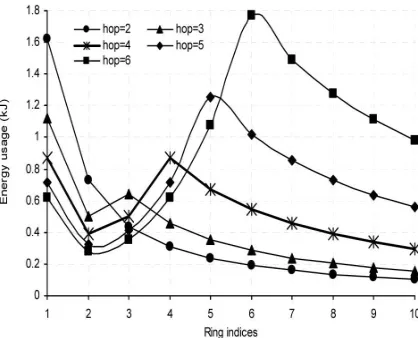
Fig.6.1(a). Energy usage vs nodes
B. Comparison of Optimal Lifetime and Energy Usage
Fig. 6.(a) compares lifetime achievable in different transmission policies for varying initial nodes energy. the proposed transmission policies are employed, improvement in lifetime over MH is significant; above 130 percent for FHS, above 150 percent for SVHS,
and above 200 percent for AVHS transmission policies for γ= 4.
VI. CONCLUSION
Two imperative measurements for ANs are network and scope. Deterministic hubs arrangement may not frequently be attainable because of natural limitation and in this way organize scope and network are probabilistic measures. For the hubs to effectively utilize multihop correspondence, it is important to guarantee that in any event the condition for hub network is met. Adequate condition for hub availability (with and without having scope) considering irregular organization of hubs has been contemplated. For n hubs arbitrarily conveyed over a unit territory, each having transmission go rðnþ, the likelihood of hub availability.
REFERENCES
[1] K. Akkaya and M. Younis, “A Survey on Routing for Wireless Nodes Networks,” Ad Hoc Networks, vol. 3, no. 3, pp. 325-349, 2005
[2] W. Ye, J. Hiedemann, and D. Estrin, “Medium Access Control with Coordinated Adaptive Sleeping for Wireless Nodes Networks,” IEEE/ACM Trans. Networking, vol. 12, no. 3, pp. 493-506, June 2004
[3] I. Demir, C. Ersoy, and F. Alagoz, “MAC Protocols for Wireless Nodes Networks: A Survey,” IEEE Comm. Magazine, vol. 44, no. 4, pp. 115-121, Apr. 2006 [4] I. Rhee, A. Warrier, M. Aia, J. Min, and M.L. Sichitiu, “Z-MAC: A Hybrid MAC for Wireless Nodes Networks,” IEEE/ACM Trans. Networking, vol. 16, no.
3, pp. 511-524, June 2008.
[5] W. Choi and S.K. Das, “A Novel Framework for Energy- Conserving Data Gathering in Wireless Nodes Networks,” Proc. IEEE INFOCOM, pp. 1985-1996, Mar. 2005
[6] O. Younis and S. Fahmy, “HEED: A Hybrid, Energy-Efficient, Distributed Clustering Approach for Ad Hoc Nodes Networks,” IEEE Trans. Mobile Computing, vol. 3, no. 4, pp. 366-379, Oct.-Dec. 200
[7] F. Sivrikaya and B. Yener, “Time Synchronization in Nodes Networks,” IEEE Network, vol. 18, no. 4, pp. 45-50, July/Aug. 2004
[8] R. Madan, S. Cui, S. Lal, and A.J. Goldsmith, “Modeling and Optimization of Transmission Schemes in Energy-Constrained Wireless Nodes Networks,” IEEE/ACM Trans. Networking, vol. 15, no. 6, pp. 1359-1372, Dec. 2007
[image:5.612.70.224.202.377.2] [image:5.612.298.507.206.375.2]302-317, 2007
[10] P. Leone, S. Nikoletseas, and J. Rolim, “Stochastic Models and Adaptive Algorithms for Energy Balance in Nodes Networks,” Theory of Computing Systems, vol. 47, no. 2, pp. 433-453, 2009.
[11] Opyrchal et al., “Exploiting IP Multicast in Content-Based Publish-Subscribe Systems,” Proc. Second IFIP/ACM Int’l Conf. Distributed Systems Platforms and Open Distributed Processing (Middleware), 2000.
[12] Luca Mottola, Gianpaolo Cugola, and Gian Pietro Picco, “A Self-Repairing Tree Topology Enabling Conte
[13] nt-Based Routing in Mobile Ad Hoc Networks. IEEE Transactions on Mobile Computing, VOL. 7, NO. 8, AUGUST 2008K. Jain, J. Padhye, V.N. Padmanabhan, and L. Qiu, “Impact of Interference on Multi-Hop Wireless Network Performance,” Proc.ACM MobiCom, 2003.
[14] M. Kodialam and T. Nandagopal, “Characterizing the Capacity Region in Multi-Radio Multi-Channel Wireless Mesh Networks,” Proc. ACM MobiCom, pp. 73-87, 2005.