http://dx.doi.org/10.4236/ojs.2015.56059
How to cite this paper: Chen, Y., Fei, Y. and Pan, J.X. (2015) Statistical Inference in Generalized Linear Mixed Models by Joint Modelling Mean and Covariance of Non-Normal Random Effects. Open Journal of Statistics, 5, 568-584.
http://dx.doi.org/10.4236/ojs.2015.56059
Statistical Inference in Generalized Linear
Mixed Models by Joint Modelling Mean and
Covariance of Non-Normal Random Effects
Yin Chen1, Yu Fei2, Jianxin Pan3*1School of Insurance, University of International Business and Economics, Beijing, China
2School of Statistics and Mathematics, Yunnan University of Finance and Economics, Kunming, China 3School of Mathematics, University of Manchester, Manchester, UK
Email: [email protected], [email protected], *[email protected] Received 8 September 2015; accepted 20 October 2015; published 23 October 2015 Copyright © 2015 by authors and Scientific Research Publishing Inc.
This work is licensed under the Creative Commons Attribution International License (CC BY).
http://creativecommons.org/licenses/by/4.0/
Abstract
Generalized linear mixed models (GLMMs) are typically constructed by incorporating random ef-fects into the linear predictor. The random efef-fects are usually assumed to be normally distributed with mean zero and variance-covariance identity matrix. In this paper, we propose to release random effects to non-normal distributions and discuss how to model the mean and covariance structures in GLMMs simultaneously. Parameter estimation is solved by using Quasi-Monte Carlo (QMC) method through iterative Newton-Raphson (NR) algorithm very well in terms of accuracy and stabilization, which is demonstrated by real binary salamander mating data analysis and si-mulation studies.
Keywords
Generalized Linear Mixed Models, Multivariate t Distribution, Multivariate Mixture Normal Distribution, Quasi-Monte Carlo, Newton-Raphson, Joint Modelling of Mean and Covariance
1. Introduction
Generalized linear mixed models (GLMMs) are very helpful and widely used for analyzing discrete data and data from exponential family distributions. Statistical inference of GLMMs is challenging due to the incorpora-tion of random effects, especially for example, the marginal likelihood has the form of analytical intractable high dimensional integration. The existing and popular statistical methods include: 1) analytical Laplace ap-proximation: the uncorrelated penalized quasi-likelihood (PQL) by Breslow and Clayton (1993) [1] and corre-lated PQL by Lin and Breslow (1996) [2]; hierarchical generalized linear models (HGLM) procedure by Lee and
Nelder (2001) [3]; 2) numerical technique: Bayesian approach with sampling by Karim and Zeger (1992) [4]; MCEM algorithm by Booth and Hobert (1999) [5]; Gauss-Hermite quadrature (GHQ) by Pan and Thompson (2003) [6]; Quasi-Monte Carlo (QMC) and Randomized QMC method by Pan and Thompson (2007) [7] and Aleid (2007) [8].
One common idea in above literatures is random effects in GLMMs, which represent latent effects between individuals, follow normal distribution with mean zero and identity covariance matrix. However, these assumptions are not always valid in practice because individual has its own special natures and may not be normal distributed. To address this issue, multivariate t distribution and multivariate mixture normal distribution will be assumed for random effects in GLMMs. Quasi-Monte Carlo (QMC) method through iterative Newton- Raphson (NR) algorithm solves the high-dimensional integration problem in the marginal likelihood under the non-normal assumptions.
Review of GLMMs and the marginal Quasi-likelihood will be proposed in Section 2. QMC approximation, the simplest Good Point set (square root sequence) and analytical form of maximum likelihood estimates (MLEs) in GLMMs will be discussed in Section 3. The idea of modified cholesky decomposition and joint modelling of mean and covariance structure will be explained in Section 4. In Section 5, the salamander data will be analyzed as an example under the assumption of multivariate t distribution of random effects, then simulation study with same design protocol as salamander data followed in Section 6. Discussions on the related issues and further studies are given in Section 7.
2. Generalized Linear Mixed Models
The generalized linear mixed models (GLMMs) are typically constructed by incorporating random effects into the linear predictor of a conditionally independent exponential family model (McCulloch, 2003, [9]).
(
)
|
| i |
i Y i
Y b∼ f b y b ;
(
)
( )
( )
(
)
| | exp ,
i
i i i
Y i i
i
y d
f y c y
a
ϑ ϑ
ϕ ϕ
−
= +
b b ;
(
i|)
iE Y b=b =µb;
( )
i i i ig µb =ηb=x′β+z b′ ;
( )
f b
∼ b
b ;
where Yi denotes the observed response, i=1, 2,,n, xi′ is the th
i row of design matrix; β is p×1
fixed effect parameter; zi′ is the th
i row of the second design matrix; b is q×1 random effect.
(
|)
( )
b
i E Y bi b d i
µ = = = ′ ϑ and var
(
i |)
( )
i( )
ibi i
Y b b d v
a a
ϕ ′′ ϑ ϕ µ
= = = , where ai is a prior weight, ϕ is a
known overdispersion scalar, ϑi is the natural parameter, and v
( )
⋅ is variance function (McCulloch andNelder, 1989, [10]).
In this definition we see the usual ingredients of a generalized linear model. First, the distribution of Yi from
an exponential family (in this case the distribution is assumed to hold conditional on the random effect b). Second, a link function, g
( )
. is applied to the conditional mean of Yi given b to obtain the conditionallinear predictor ηi
b
. When ηi
b
is identical to the ϑi, GLMMs is said to have canonical to link function.
Finally, the linear predictor is assumed to consist of two components, the fixed effects portion, described by
i′β
x and random effects portion, z bi′ , for which a distribution is assigned to b. e.g. if b is said to follow a
q-dimensional t distribution, denote by b∼Tq
(
µ ν, ,Σ)
, and its density function is given by( )
( )
(
)
T 1(
)
21 2
2 2
1 2
q q
q
Y Y
f b
ν ν
µ µ
ν πν ν
+ − −
− +
Γ − Σ −
= Σ +
Γ
with the mean of b is µ ν >
(
1)
and the covariance matrix of b is(
2)
2ν ν
ν
Σ >
− respectively, where µ is a q×1 vector, Σ is a q q× symmetric positive definite matrix, ν is the degree of freedom. If b is said to follow a q-dimensional mixture normal distribution F
(
1)
1 ,(
1)
(
1 ,)
q q q q
F=πN − −π λ Σ + − π N πλ Σ (2)
with mean 0q×1, covariance matrix Σ +π
(
1−π)
1 1q q′ where π ∈[ ]
0,1 , 1q =(
1,,1)
′ is q×1 vector, Σ is a q q× symmetric positive definite matrix.In GLMMs, statistical inferences of β and θ are estimated in most literatures, β is p×1 fixed effect parameter, θ is a vector parameter in covariance matrix of random effect, Σb
( )
θ . Quasi-likelihood functionof
(
β θ,)
in GLMMs is also called the marginal quasi-likelihood function which expressed by(
)
{
(
)
}
(
)
( )
1
, exp , exp , | d ;
n i i
L β θ β θ β θ F bθ
=
= =
∑
∫
b , (3)
where
(
, |)
(
( )
)
db i i
i i
i y
a y u
u v u µ
β θ
φ
−
∝
∫
b ,
(
)
(
)
(
)
( )
1
, log , log exp , | d ;
n i i
L F b
β θ β θ β θ θ
=
= =
∑
∫
b , (4)
determinates the conditional log quasi-likelihood of β and θ given b (Breslow and Clayton, 1993, [1]).
( )
;F bθ is cumulative distribution function (CDF) of random effect b.
It is extremely challenging to obtain the maximum likelihood estimates (MLEs),
( )
β θˆ ˆ, , which maximize (3) or (4). Although the integration involves an analytical expression, the computational problems are magnified when the specified model contains a large number of random effects and random effects have a crossed designed according to data description.3. Quasi-Monte Carlo Integration and Estimation
3.1. Quasi-Monte Carlo IntegrationQuasi-Monte Carlo (QMC) sequences are a deterministic alternative to Monte Carlo (MC) sequences (Niederreiter, 1992, [11]). For the q-dimensional unit cube domain Cq =
[
0,1)
q, the Quasi-Monte Carlo approximation is
( )
( )
1
1 d
K
q k
C
k
f x x f x
K =
≈
∑
∫
,where sample points x x1, 2,,xK should be selected to minimize the error of the integral quadrature.
If the integrand f has finite variation, then the error of the quasi-Monte Carlo quadrature can be bounded using the Koksma-Hlawka inequality
( )
( )
( ) (
*)
1 2 1
1
d , , ,
q
K
k K
C
k
f x x f x V f D x x x
K =
−
∑
≤∫
, (5)where V f
( )
is variation of f x( )
in the sense of Hardy and Krause (Fang and Wang, 1994, [12]) and(
)
*
1, 2, , K
D x x x is the star discrepancy of sample points, which is a measure of uniformity of distribution of a finite point set
{
xk:1≤ ≤k K}
, defined by(
)
( )
( )
*
1, 2, , K sup A
m A
D x x x V A
K
= −
,
where A is an arbitrary q-dimensional subcube parallel to the coordinate axes and originating at the centre,
( )
V A is its volume, and m A
( )
is the number of sample points inside this subcube.ences (Niederreiter, 1992, [11]) can be in the order of
(
(
)
1 1)
log qO K − K− , which is much better than
(
1 2)
O K− the probabilistic error bound of Monte Carlo methods (Fang and Wang, 1994, [12]). Moreover, quasi-Monte Carlo methods guarantee this accuracy in a deterministic way, unlike Monte Carlo methods where the error bound is also probabilistic.In the QMC approach, there exist precise construction algorithms for generating the required points. These algorithms can be divided into two families, the Lattice rule and Digital-net. Only the good point set, which is belong to lattice rule (Fang and Wang, 1994, [12]) will be used and discussed in following sections.
3.2. The Good Point (GP) Set
A good point
(
1, 2, ,)
qq C
ν = ν ν ν ∈ , where Cq =
[
0,1)
qis a hypercube. The set Pk consists of the first K
points of the set
{
(
{ } { }
ν1k ,ν2k ,{ }
νqk)
,k=1, 2,,K}
, where{ }
y represents the fractional part of the valuey. In practice, the following forms of the good point ν are recommended as square root sequence
{ } { } { }
(
p1 , p2 , , pq)
ν = ,
where pi, 1≤ ≤i q, is a series of prime numbers, for example, the first q primes pi≠ pjif i≠ j.
3.3. MLE in GLMMs by QMC Estimation
When QMC method applied to marginalquasi-likelihood function (4)
(
)
12( )
1( )
1 1
1
, log exp , |
K n
i b k
k i
F c
K
β θ β θ θ −
= =
= Σ
∑
∑
, (6)
where F−1
( )
. is the inverse of CDF of b and( )
1 2b θ
Σ is the square root of Σb, for example, it can be taken
as the Cholesky decomposition of Σb or eigenvalue-eigenvector decomposition.
Let 12 1
( )
k b k
b = Σ F− c , bk T T T T 12 1
( )
ik xi z bi k xi zi bF ck
η = β+ = β+ Σ −
,
{
ck:k=1, 2,,K}
is a good point set( )
k k
b b
ik h ik
µ = η , h
( )
. is the inverse function of g( )
. . The global maximum of (
β θ,)
with respect to β and θ is the solution of the score equations(
)
(
)
( ) ( )
1 1
,
0 k
k k
b K n
i i ik
k b b i
k i ik ik
a y
w x
v g
µ β θ
β = = φ µ µ
−
∂
= ⋅ =
∂
∑ ∑
, (7)
(
)
(
)
( ) ( )
( )
1
2 1
1 1
,
0 k
j
k k
b K n
i i ik
k b b i k
k i ik ik
a y
w z F c
v g θ
µ β θ
θ φ µ µ
−
= =
−
∂ ′
= ⋅ Σ =
∂
∑ ∑
, (8)
where
1 2 1 2
j
b j
θ θ
∂Σ Σ =
∂
, wk is a weight for the kth point in the ith subject and it has the following form
(
)
(
)
1
1 1
exp , |
exp , |
n
i k i
k K n
i k k i
b w
b
β θ β θ =
= =
=
∑
∑
∑
. (9)
The weight wk given in (9) is a function of β and θ, i.e. wk ≡wk
(
β θ,)
, which must be taken intoaccount when calculating the second-order derivatives.
( ) ( )
( ) ( )
1
2 2
2 2
1
m m
m m
β β β β β θ β
θ θ
θ θ β θ θ
−
+
∂ ∂ ∂
∂ ∂ ′ ∂ ∂ ′
= + ∂
∂
∂ ∂
∂ ∂ ′ ∂ ∂ ′ ∂
, (10)
where β
∂
∂ and θ ∂ ∂
are score function of log likelihood,
2 2
2 2
β β β θ
θ β θ θ
∂ ∂
∂ ∂ ′ ∂ ∂ ′
∂ ∂
∂ ∂ ′ ∂ ∂ ′
is Hessian matrix of log like-
lihood.
Calculation of the Hessian matrix is difficult and its computation is intensive. When the difference between
( )m
β and β(m−1) and the difference between θ( )m and θ(m−1) are both sufficient small, the maximum like- lihood estimates are confirmed, that is, the convergence is reached. The calculation process of Hessian matrix is given in Appendix A, which is an extension of Hessian matrix in Pan and Thompson (2007) [7]. At convergence, the MLEs,
( )
β θ ′ˆ ˆ, and asymptotic variance-covariance matrix of( )
β θ ′ˆ ˆ, can be obtained.4. Modified Cholesky Decomposition and Covariance Modelling for Random
Effects
Modified Cholesky decomposition of 1
b
−
Σ , rather than Σb, and joint modelling of mean and covariance matrix
were published by Pourahmadi (1999, 2000) [13] [14], to obtain a statistically meaningful unconstrained pa- rameterization of covariance. The remarkable advantages are: 1) it guarantees covariance matrix is positive definite; 2) it reduces the number of parameters so that it makes computation efficient; 3) it has very clear statistical interpretation. The main idea of modified cholesky decomposition is that a q q× symmetric matrix
b
Σ is positive definite if and only if there exist a unique unit lower triangular matrix T, with 1 as diagonal entries, and unique diagonal matrix D with positive diagonal entries such that
b
TΣT′=D, where
2 1
21 2
2
31 32
2
1 2 3
1 0 0 0
0 0
1 0 0
0 0
1 0 and
0 0
1 q
q q q
T D
σ φ
σ
φ φ
σ
φ φ φ
−
− −
= =
− − −
.
It offers a simple unconstrained and statistically meaningful reparametrization of the covariance matrix. So
( )
1 1b T D T
−
− ′
Σ = and 1 1
b T D T
− ′ −
Σ = . T and D are easy to compute and interpret statistically: the below-diagonal entries of T are the negatives of the autoregressive coefficients (ACs), φjk, in the autoregressive model.
(
)
1
1
ˆ j 1
j jk k
k
b φ b k j q
−
=
=
∑
≤ < ≤ , (11)where bj is a 1 1× number, which index the jth dimension of random effect b. That is, the linear least squares
predictor of bj based on its predecessors bj−1,,b1. On the other hand, the diagonal entries of D are the innovation variances (IVs), σ2j =Var
( )
ej , where ej =bj−bˆj with ˆbj given by (11). Obviously we have(
)
Cov e ej, k =0 if j≠k
(
1≤ j k, ≤q)
. Denote e(
e1, ,eq)
′
2 log
jk jk j j
c
h
φ γ
σ λ
′ =
′
=
(12) where c′jk
(
1×q1*)
and(
)
* 2
1
j
h′ ×q are covariates, and γ and λ are low-dimensional parameter vectors. The choice of covariate vectors cjk and hj are flexible in some senses.
5. Salamander Data Analysis
The famous salamander interbreeding data set was published by McCullagh and Nelder (1989), which came from three repeated same protocol design experiments. The salamanders originally lived in two geographically isolated populations, Roughbutt (RB) and Whiteside (WS). Each experiment involved in two closed groups and each group involved 5 females and 5 males from each population. In a fixed period, each female mated with 6 males, 3 from each population. So 60 correlated binary observations were created in each closed group, and totally, 360 binary observations (1 for successful interbreeding, 0 for failed interbreeding) were in three ex- periments. The primary two objectives of experiment are to study whether the successful mating rate is sig- nificant between populations and if heterogeneity between individuals in the mating probability exists. This binary data set is challenging because it is block crossed, correlated, balanced (as each female mated with a total of six males and vice verse) and incomplete (as each female mated with just three out of a possible five males, and vice verse).
In a closed group, 5 females and 5 males from each population involved, so total 20 salamander were indexed by i or j. Denoting by yij the outcome for the mating of the ith female with the jth male, the logit mixed model
for each experiment
( )
(
)
logit log , 1, , 20
1
b ij
b f m
ij b ij i j
ij p
p x b b i j
p β
′
= = + + =
−
, (13)
where the conditional probability pijb=Pr
{
yij =1 |bif,bmj}
is used to model the correlated binary responses.(
)
T1, f, m, f m
ij i j i j
x = ws ws ws ×ws , (14) 1
f i
ws = if the th
i female comes from WS, otherwise 0. Similarly, wsmj =1 if the
th
j male comes from WS, otherwise 0.
Here the random effect is not assumed as normal distribution but multivariate t distribution with degree of freedom ν =3, 7,10,15, b∼T20
(
0, ,Σν)
.Note that each experiment includes two closed groups and involves 40 salamanders so that the log-likelihood for each experiment involves a 40-dimensional integrals. The dimensionality for each experiment can be further reduced to the sum of two 20-dimensional integrals due to the block design of two closed groups, see Karim and Zeger (1992) [4] and Shun (1997) [15] for more details about the design. When the three experiments data are pooled as in model (13), the log-likelihood is a sum of six 20-dimensional integrals so that the MLEs of the fixed effects β and variance components θ become extremely difficult to obtain.
Modelling Σb for salamander mating data, q=20,
* 1 4
q = and * 2 4
q = . The autoregressive coefficients (ACs) model is reordered as
21 1 1 2,1
31 2 2 3,1
32 3 3 3,2
20,1 172 172 20,1
20,2 173 173 20,2
20,19 190 190 20
c c
c c
c c
c c
c c
c c
φ φ γ γ
φ φ γ γ
φ φ γ γ
φ φ γ γ
φ φ γ γ
φ φ γ
′ ′
′ ′
′ ′
= = = = ′ ′
′ ′
′ ′
Φ
(
1 2)
( ) ( )
(
1 2)
,19
, ,
d d i ci cd d
γ
γ
φ φ γ γ
=
′ ′
= = = =
C
where Φ is a 190 1× vector, C is a 190 4× matrix, ci′ is the th
i row of C, i=1,,190.
(
)
1, 2 1, 1,2, 1, 2, 1,2 1, 2
i d d d d d d d d d d
c′=c′ = G D G ×D ,
where
(
1)
20 1 2 2
i= + + + + d − +d ,
1,2 1
d d
G = if 1
th
d and 2
th
d salamander come from different genders, otherwise 0. Similarly, Dd d1, 2 =1 if 1
th
d
and 2
th
d salamander come from different districts (populations), otherwise 0. The logarithms of innovation variances (IVs) model is
2
1 1 1
2 2
20 20 3
log
log
h
h
σ λ
λ λ
σ λ
′
= = =
′
H
Ω
where H is a 20 3× matrix, λ is a 3 1× vector, σj2
(
j=1,, 20)
describes the variance of theth
j sala- mander
(
1, Gender , District)
1, , 20j j j
h′ = j= ,
where Genderj =1, if the jth salamander is female, otherwise 0. Similarly, Districtj =1 if the jth sala- mander comes from WS, otherwise 0.
In the logarithms of innovation variances (IVs) model, originally there were 4 covariates including the item
Genderj×Districtj with interaction parameter λ4. But the results showed that λ4 approximately equals zero and has smaller order of magnitude than λ2 and λ3. The hypothesis test also showed that there is no evidence to reject λ =4 0.
The salamander data is now analyzed by using QMC approach to calculate the MLEs of the fixed effects and variance components involved in the model. Specifically, we implement the simplest QMC point, square root sequences to estimate the parameters for the modelling of the pooled data. A set of 20-dimensional points on the unit cube C20=
[
0,1)
20 were generated for the six 20-dimensional integrals. Then the points are modified through using transformation, 12 1( )
.bF
−
Σ , where F
( )
. is the cumulative distribution function of the multi- variate t distribution, 12b
Σ is the modified Cholesky decomposition for 12
( )
12b b b
′
Σ = Σ ⋅ Σ . After that, we approxi- mate the integrated log-likelihood, then we use the Newton-Raphson algorithm (10) to maximize the appro- ximated log-likelihood function.
The covariance modelling for Σ =b Cov
( )
b , the covariance matrix of random effect, uses 4 parameters for autoregressive coefficients of bi and bj, 1≤i j, ≤20, (i and j index the dimension of b while bi means theth
i salamander’s latent effect) and plus 3 parameters for innovation variances of bj−bˆj, var
(
bj−bˆj)
,1, , 20
j= . Using this joint modelling method to analyze the real world data can estimate Σb more to the true
one because of no factitious assumption on it, instead, only the data tells us what is Σb. Another advantage is
the parameter is reduced from 20
(
20 1)
2
× +
to 7 in Σb. This reduction of number of parameters makes the
computation easier. Note that, the higher the dimension q, the more significant this advantage. Third, the modified Cholesky decomposition confirms that unconstrained parameters lead to strict condition that is the Σb
is a symmetric positive definite matrix.
Table 1. MLEs of the parameters by covariance modelling for the pooled salamander data using square root sequence points
when varying K, the number of square root sequence points (standard errors in parentheses) (random effect-multivariate t3).
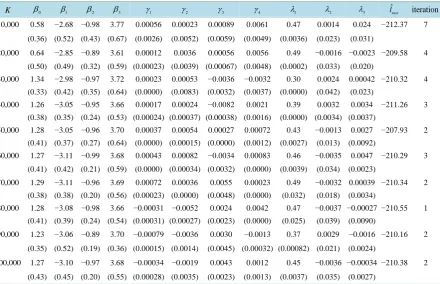
K β0 β1 β2 β3 γ1 γ2 γ3 γ4 λ1 λ2 λ3 lˆmax iteration
10,000 0.98 −2.92 −0.94 3.69 0.00042 0.00035 0.0061 0.0024 0.26 −0.038 0.0084 −220.14 9 (0.50) (0.65) (0.23) (0.31) (0.0043) (0.0018) (0.0048) (0.0040) (0.0017) (0.043) (0.053)
20,000 0.72 −2.93 −0.89 3.72 0.00069 0.0028 −0.0078 0.0054 0.18 0.0019 0.0089 −219.48 3 (0.42) (0.60) (0.36) (0.59) (0.0029) (0.0094) (0.0028) (0.0058) (0.0042) (0.072) (0.043)
30,000 1.23 −3.03 −0.82 3.84 0.000017 0.0059 −0.0028 −0.0026 0.28 0.0046 0.00029 −218.29 5 (0.37) (0.48) (0.29) (0.62) (0.00038) (0.0028) (0.0000) (0.0029) (0.0000) (0.031) (0.036)
40,000 1.26 −2.98 −0.94 3.69 0.00043 0.00060 −0.0035 0.0043 0.39 0.0042 0.0013 −219.63 2 (0.32) (0.50) (0.22) (0.53) (0.0000) (0.00016) (0.00053) (0.0013) (0.0025) (0.0028) (0.034)
50,000 1.28 −3.02 −0.92 3.73 −0.00053 0.00028 0.00073 −0.00023 0.42 −0.0028 0.0046 −218.94 3 (0.30) (0.44) (0.25) (0.67) (0.0000) (0.00019) (0.0000) (0.0000) (0.0038) (0.045) (0.027)
60,000 1.23 −2.99 −0.91 3.69 0.00043 0.00039 −0.0072 0.00034 0.43 −0.0028 0.0028 −216.42 2 (0.30) (0.46) (0.24) (0.68) (0.00035) (0.0000) (0.0022) (0.0000) (0.0027) (0.048) (0.0075)
70,000 1.27 −3.04 −0.92 3.73 0.00054 0.00047 0.0082 0.0041 0.41 −0.0039 0.00046 −216.21 2 (0.34) (0.44) (0.10) (0.64) (0.00048) (0.0000) (0.0035) (0.0027) (0.081) (0.023) (0.037)
80,000 1.28 −3.02 −0.94 3.76 −0.00037 −0.0027 0.0083 0.0029 0.42 −0.00022 −0.00056 −216.65 2 (0.39) (0.52) (0.19) (0.65) (0.0025) (0.0000) (0.0028) (0.0027) (0.034) (0.052) (0.030)
90,000 1.21 −2.92 −0.88 3.77 −0.00029 −0.0026 0.0078 −0.0036 0.37 0.0064 −0.0023 −216.96 1 (0.23) (0.43) (0.24) (0.62) (0.0073) (0.0073) (0.0076) (0.00058) (0.00028) (0.055) (0.029)
100,000 1.29 −3.05 −0.93 3.72 −0.00094 −0.0018 0.0089 0.0032 0.42 −0.0029 −0.00041 −216.34 2 (0.40) (0.48) (0.17) (0.55) (0.0031) (0.0026) (0.0065) (0.0089) (0.0097) (0.046) (0.033)
Table 2. MLEs of the parameters by covariance modelling for the pooled salamander data using square root sequence points
when varying K, the number of square root sequence points (standard errors in parentheses) (random effect-multivariate t7).
K β0 β1 β2 β3 γ1 γ2 γ3 γ4 λ1 λ2 λ3 lˆmax iteration
10,000 0.58 −2.68 −0.98 3.77 0.00056 0.00023 0.00089 0.0061 0.47 0.0014 0.024 −212.37 7 (0.36) (0.52) (0.43) (0.67) (0.0026) (0.0052) (0.0059) (0.0049) (0.0036) (0.023) (0.031)
20,000 0.64 −2.85 −0.89 3.61 0.00012 0.0036 0.00056 0.0056 0.49 −0.0016 −0.0023 −209.58 4 (0.50) (0.49) (0.32) (0.59) (0.00023) (0.0039) (0.00067) (0.0048) (0.0002) (0.033) (0.020)
30,000 1.34 −2.98 −0.97 3.72 0.00023 0.00053 −0.0036 −0.0032 0.30 0.0024 0.00042 −210.32 4 (0.33) (0.42) (0.35) (0.64) (0.0000) (0.0083) (0.0032) (0.0037) (0.0000) (0.042) (0.023)
40,000 1.26 −3.05 −0.95 3.66 0.00017 0.00024 −0.0082 0.0021 0.39 0.0032 0.0034 −211.26 3 (0.38) (0.35) (0.24) (0.53) (0.00024) (0.00037) (0.00038) (0.0016) (0.0000) (0.0034) (0.0037)
50,000 1.28 −3.05 −0.96 3.70 0.00037 0.00054 0.00027 0.00072 0.43 −0.0013 0.0027 −207.93 2 (0.41) (0.37) (0.27) (0.64) (0.0000) (0.00015) (0.0000) (0.0012) (0.0027) (0.013) (0.0092)
60,000 1.27 −3.11 −0.99 3.68 0.00043 0.00082 −0.0034 0.00083 0.46 −0.0035 0.0047 −210.29 3 (0.41) (0.42) (0.21) (0.59) (0.0000) (0.00034) (0.0032) (0.0000) (0.0039) (0.034) (0.0023)
70,000 1.29 −3.11 −0.96 3.69 0.00072 0.00036 0.0055 0.00023 0.49 −0.0032 0.00039 −210.34 2 (0.38) (0.38) (0.20) (0.56) (0.00023) (0.0000) (0.0048) (0.0000) (0.032) (0.018) (0.0034)
80,000 1.28 −3.08 −0.98 3.66 −0.00031 −0.0052 0.0024 0.0042 0.47 −0.0037 −0.00027 −210.55 1 (0.41) (0.39) (0.24) (0.54) (0.00031) (0.00027) (0.0023) (0.0000) (0.025) (0.039) (0.0090)
90,000 1.23 −3.06 −0.89 3.70 −0.00079 −0.0036 0.0030 −0.0013 0.37 0.0029 −0.0016 −210.16 2 (0.35) (0.52) (0.19) (0.36) (0.00015) (0.0014) (0.0045) (0.00032) (0.00082) (0.021) (0.0024)
[image:8.595.96.537.435.719.2]Table 3. MLEs of the parameters by covariance modelling for the pooled salamander data using square root sequence points
when varying K, the number of square root sequence points (standard errors in parentheses) (random effect-multivariate t10).
K β0 β1 β2 β3 γ1 γ2 γ3 γ4 λ1 λ2 λ3 lˆmax iteration
10,000 0.72 −2.99 −0.82 3.66 0.0003 0.0004 0.0036 0.0020 0.24 −0.046 −0.0098 −212.32 2 (0.49) (0.78) (0.39) (0.07) (0.0042) (0.0037) (0.0034) (0.0029) (0.0051) (0.056) (0.046)
20,000 0.68 −2.93 −0.68 3.61 0.00082 0.0039 −0.0098 0.0047 0.098 0.0093 0.0085 −209.67 3 (0.34) (0.61) (0.67) (0.61) (0.0072) (0.0087) (0.0078) (0.0070) (0.044) (0.067) (0.034)
30,000 1.27 −2.89 −1.02 3.68 −0.000017 0.0027 −0.0023 −0.0042 0.47 0.0064 0.00039 −211.24 4 (0.23) (0.53) (0.27) (0.57) (0.00082) (0.0092) (0.0000) (0.0000) (0.0000) (0.024) (0.027)
40,000 1.24 −2.88 −0.93 3.68 −0.0004 0.00063 −0.0013 0.0029 0.39 0.0041 0.0061 −212.36 2 (0.31) (0.58) (0.33) (0.51) (0.00094) (0.00067) (0.00036) (0.00083) (0.0036) (0.0065) (0.035)
50,000 1.23 −2.87 −0.92 3.72 0.00025 0.00087 0.000023 −0.00021 0.44 0.00026 0.0052 −211.04 2 (0.30) (0.52) (0.29) (0.59) (0.00067) (0.0000) (0.0000) (0.0000) (0.0000) (0.034) (0.018)
60,000 1.20 −2.85 −0.97 3.69 0.00019 0.00093 −0.000026 0.00029 0.48 −0.00038 0.0038 −211.32 2 (0.32) (0.49) (0.31) (0.63) (0.0000) (0.0000) (0.0000) (0.0000) (0.0024) (0.062) (0.0087)
70,000 1.20 −2.86 −0.98 3.72 0.00032 0.00072 0.0015 −0.0031 0.51 −0.00022 0.0063 −211.34 3 (0.33) (0.51) (0.092) (0.62) (0.00031) (0.0000) (0.00035) (0.0000) (0.052) (0.035) (0.043)
80,000 1.22 −2.97 −0.94 3.75 −0.00051 −0.0023 0.0046 −0.0025 0.56 0.00097 −0.00026 −211.89 1 (0.40) (0.52) (0.25) (0.65) (0.0024) (0.00071) (0.0000) (0.0034) (0.028) (0.027) (0.031)
90,000 1.19 −2.96 −0.89 3.73 −0.00062 −0.0042 0.0031 −0.0076 0.51 −0.0028 −0.0033 −211.83 2 (0.28) (0.47) (0.24) (0.63) (0.0026) (0.0075) (0.0083) (0.00045) (0.00039) (0.052) (0.025)
100,000 1.27 −3.04 −0.90 3.70 −0.00071 −0.0034 0.0051 −0.0024 0.46 −0.0025 −0.00034 −211.52 3 (0.40) (0.52) (0.23) (0.65) (0.0031) (0.0023) (0.00054) (0.0089) (0.077) (0.055) (0.023)
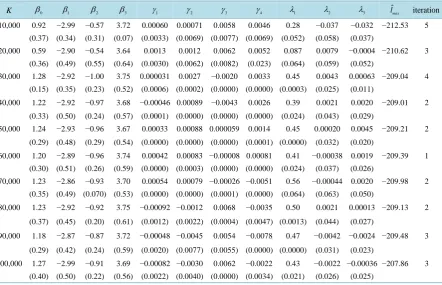
Table 4. MLEs of the parameters by covariance modelling for the pooled salamander data using square root sequence points
when varying K, the number of square root sequence points (standard errors in parentheses) (random effect-multivariate t15).
K β0 β1 β2 β3 γ1 γ2 γ3 γ4 λ1 λ2 λ3 lˆmax iteration
10,000 0.92 −2.99 −0.57 3.72 0.00060 0.00071 0.0058 0.0046 0.28 −0.037 −0.032 −212.53 5 (0.37) (0.34) (0.31) (0.07) (0.0033) (0.0069) (0.0077) (0.0069) (0.052) (0.058) (0.037)
20,000 0.59 −2.90 −0.54 3.64 0.0013 0.0012 0.0062 0.0052 0.087 0.0079 −0.0004 −210.62 3 (0.36) (0.49) (0.55) (0.64) (0.0030) (0.0062) (0.0082) (0.023) (0.064) (0.059) (0.052)
30,000 1.28 −2.92 −1.00 3.75 0.000031 0.0027 −0.0020 0.0033 0.45 0.0043 0.00063 −209.04 4 (0.15) (0.35) (0.23) (0.52) (0.0006) (0.0002) (0.0000) (0.0000) (0.0003) (0.025) (0.011)
40,000 1.22 −2.92 −0.97 3.68 −0.00046 0.00089 −0.0043 0.0026 0.39 0.0021 0.0020 −209.01 2 (0.33) (0.50) (0.24) (0.57) (0.0001) (0.0000) (0.0000) (0.0000) (0.024) (0.043) (0.029)
50,000 1.24 −2.93 −0.96 3.67 0.00033 0.00088 0.000059 0.0014 0.45 0.00020 0.0045 −209.21 2 (0.29) (0.48) (0.29) (0.54) (0.0000) (0.0000) (0.0000) (0.0001) (0.0000) (0.032) (0.020)
60,000 1.20 −2.89 −0.96 3.74 0.00042 0.00083 −0.00008 0.00081 0.41 −0.00038 0.0019 −209.39 1 (0.30) (0.51) (0.26) (0.59) (0.0000) (0.0003) (0.0000) (0.0000) (0.024) (0.037) (0.026)
70,000 1.23 −2.86 −0.93 3.70 0.00054 0.00079 −0.00026 −0.0051 0.56 −0.00044 0.0020 −209.98 2 (0.35) (0.49) (0.070) (0.53) (0.0000) (0.0000) (0.0001) (0.0000) (0.064) (0.063) (0.050)
80,000 1.23 −2.92 −0.92 3.75 −0.00092 −0.0012 0.0068 −0.0035 0.50 0.0021 0.00013 −209.13 2 (0.37) (0.45) (0.20) (0.61) (0.0012) (0.0022) (0.0004) (0.0047) (0.0013) (0.044) (0.027)
90,000 1.18 −2.87 −0.87 3.72 −0.00048 −0.0045 0.0054 −0.0078 0.47 −0.0042 −0.0024 −209.48 3 (0.29) (0.42) (0.24) (0.59) (0.0020) (0.0077) (0.0055) (0.0000) (0.0000) (0.031) (0.023)
[image:9.595.95.538.438.723.2]20-dimensional unit cube so that even if the number of the QMC points is chosen as K =100000, it is still small in such a space. Nevertheless, the numerical results show that the QMC points approximation based estimation in the GLMMs performs very well in terms of accuracy and stabilization. When using 100,000 QMC points, our Fortran code takes about 50 minutes to obtain the results. Furthermore, the convergence of our algorithm is usually made between the 3th and 5th iterations. On the other hand, increasing the number of points may lead to less iterations.
For mean model, the estimators for fixed effects, β are similar when K increases over 30,000. For autoregressive coefficients (ACs) model, the estimations of γ, including γˆ1, γˆ2, γˆ3 and γˆ4 are very close to zero. For logarithms of innovation variances (IVs), only γˆ1 is not close to zero. It needs to be noted that some of standard deviations are 0.0000 for ˆγ and ˆλ, which means those values are less than 10−7.
A criteria easy to be executed to decide which covariate is significant is if the estimator is greater than twice of standard error. So the four fixed effect parameters of ˆβ are significant; four parameters for ˆγ are not; λˆ1 is significant, but λˆ2 and λˆ3 are not. The conclusion is that γˆ1, γˆ2, γˆ3, γˆ4 λˆ2 and λˆ3 can be regarded as zero. In other words, T is an identity matrix and D is a diagonal matrix with the same element. So Σ =ˆb σˆ2Iq, it can be said that every dimension of random effect of each salamander is independent of others. Also, the effects of female and male salamanders are independent and no heterogeneity between female and male.
Another point is why the random effect is not assumed as multivariate mixture normal distribution for the salamander data because Newton-Raphson algorithm does not achieve convergency until the mixture normal distribution degenerates to normal distribution.
6. Simulation
We conducted a simulation study to assess the efficiency of the QMC estimation in the GLMMs, in particular, to assess the performance of the GP set point when the distribution of random effect is multivariate t distribution (1) and multivariate mixture normal distribution (2). Based on the logistic model in (13), we simulate the sala- mander pooling data, which have 360 correlated binary observations. In the simulation study, we run 100 simulations. The same protocol design as the salamander mating experiment is adopted for the simulated data and the log-likelihood function for each simulated data set thus involves six 20-dimensional integrals that are analytically intractable.
When using the QMC approximation, we generate K =50000 integration nodes on the cube C20 using the square roots of the first 20 prime numbers (the GP set method). Then, we use Equation (6) to approximate the integrated log-likelihood when random effect followed multivariate t distribution. When random effect followed multivariate mixture normal distribution, the log-likelihood changes to
(
)
(
)
(
)
( )
( )
(
)
( )
( )
(
)
{
1 1}
2 2
1 1
1 1
1 2
1 1
1
, log , log exp , |
1
log exp , |
K n
i k k i
K n
i k k
k i
L b
K
c I U c I U
K
β θ β θ β θ
β θ θ µ π θ µ π
= =
− −
= =
= =
= Σ Φ + ≤ + Σ Φ + >
∑
∑
∑
∑
. (15)
The Newton-Raphson algorithm (10) is used to maximize the approximated log-likelihood function. The true values are chosen to be (1.20, −2.80, −1.00, 3.60) for the fixed effects,
(
−1.2, 0.6,−0.1, 0.4)
for ACs para- meters and(
−2, 1, 0.5)
for IVs parameters. ACs parameters and IVs parameters build variance components. The starting values for the algorithm are chosen to be the estimators as for the real data analysis. The convergence criterion is set to be 210− for the successive iterated values. The algorithm stops after 20 iterations and is considered to be non-convergent. The simulation studies are conducted and coded in FORTRAN language and this programme was run on a PC Pentium (R) 4 PC (CPU 3.20 GHz). A summary of the simulation results is presented in Table 5 for multivariate t distribution and Table 6 for multivariate mixture normal distribution. The results given are the average parameter estimates based on 100 replications and their standard errors.
Table 5. The average of the 100 parameter estimates in the simulation study, where the QMC approximation uses 50000
K= points implemented using the gp set for random effect of multivariate t3, t7, t10 and t15 distribution (si- mulated standard errors are given in parentheses).
0
β β1 β2 β3 γ1 γ2 γ3 γ4
True 1.20 −2.80 −1.00 3.60 −1.20 0.60 −0.10 0.40 3
t 1.22 −2.95 −0.98 3.72 −1.20 0.60 −0.10 0.40 StD 0.055 0.101 0.0950 0.179 −0.0000 −0.0003 0.0000 0.0000
7
t 1.18 −2.75 −0.88 3.51 −1.22 0.59 −0.11 0.43 StD 0.05 0.10 0.10 0.19 −0.0001 0.0019 0.0053 0.0000
10
t 1.22 −2.86 −1.07 3.80 −1.20 0.61 −0.12 0.39 StD 0.043 0.065 0.083 0.12 0.0000 −0.0007 0.0004 −0.0042
15
t 1.19 −2.84 −0.99 3.64 −1.20 0.62 −0.086 0.39 StD 0.049 0.103 0.086 0.187 0.0001 −0.0067 0.0035 0.0072
1
λ λ2 λ3 ˆmax
True −2.00 −1.00 0.50 3
t −2.00 −1.00 0.50 −211.00 StD −0.0000 −0.0000 −0.0000
7
t −1.99 −1.02 0.52 −210.47 StD −0.0001 0.0002 −0.0001
10
t −1.98 −0.97 0.52 −211.36 StD −0.0000 0.0014 0.0001
15
t −2.01 −0.99 0.51 −209.93 StD 0.0024 0.0024 0.0026
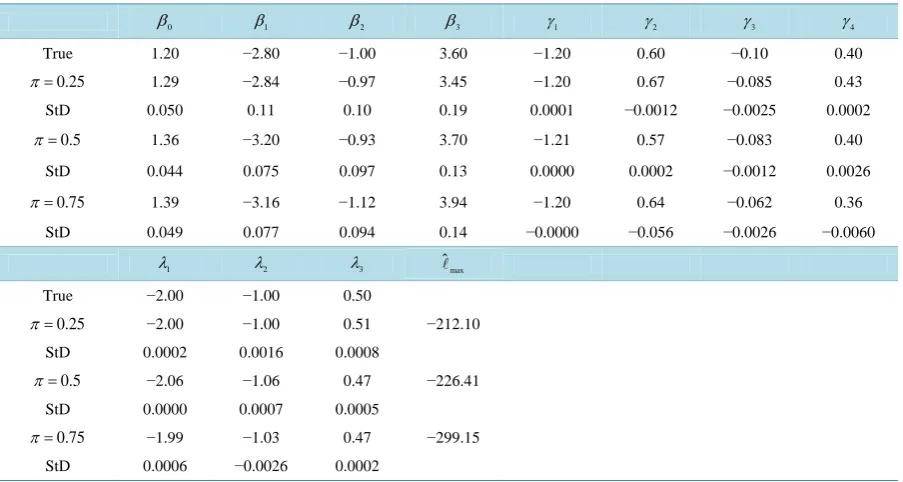
Table 6. The average of the 100 parameter estimates in the simulation study, where the QMC approximation uses 50000
K= points implemented using the gp set for random effect of multivariate mixture normal distribution by π =0.25, 0.5
π = and π =0.75 (simulated standard errors are given in parentheses).
0
β β1 β2 β3 γ1 γ2 γ3 γ4
True 1.20 −2.80 −1.00 3.60 −1.20 0.60 −0.10 0.40
0.25
π= 1.29 −2.84 −0.97 3.45 −1.20 0.67 −0.085 0.43 StD 0.050 0.11 0.10 0.19 0.0001 −0.0012 −0.0025 0.0002
0.5
π= 1.36 −3.20 −0.93 3.70 −1.21 0.57 −0.083 0.40 StD 0.044 0.075 0.097 0.13 0.0000 0.0002 −0.0012 0.0026
0.75
π= 1.39 −3.16 −1.12 3.94 −1.20 0.64 −0.062 0.36 StD 0.049 0.077 0.094 0.14 −0.0000 −0.056 −0.0026 −0.0060
1
λ λ2 λ3 ˆmax
True −2.00 −1.00 0.50
0.25
π= −2.00 −1.00 0.51 −212.10 StD 0.0002 0.0016 0.0008
0.5
π= −2.06 −1.06 0.47 −226.41 StD 0.0000 0.0007 0.0005
0.75
[image:11.595.84.542.121.434.2] [image:11.595.88.540.479.720.2]Cholesky decomposition of covariance modelling with QMC approach is quite useful and effective. When the random effects followed by multivariate mixture normal distribution (Table 6), the estimates of regression fixed effects are acceptable although bigger bias, especially for fixed effects. The estimates of variance components are quite accurate. That is, when random effects change to two peaks distribution, the accuracy need to be en- hanced.
7. Conclusion and Discussion
It is quite common in the literatures that random effects are independent identically distributed normal variables in generalized linear models (GLMMs). In longitudinal study, the covariance-variance matrix of random effects for individuals are usually assumed to be homogeneous. However, this assumption may not be valid in practice. In this article, the assumption extends to random effects follow multivariate t and mixture normal distribution. Approximation of marginal quasi-likelihood and parameter estimation in GLMMs is very difficult and challenging because they involve integral on random effects, especially for high-dimensional problems.
In this article, we have used Quasi-Monte Carlo (QMC) sequence approximation to calculate the maximum likelihood estimates and marginal log quasi-likelihood in GLMMs. The key idea of QMC sequences is to generate integration points which are scatted uniformly in the integration domain. The good point, one simple QMC point, is used through this article. Newton-Raphson (NR) algorithm is the iterative method to obtain op- timum. QMC-NR method converges very quickly and performs very well in terms of accuracy and stabilization. In longitudinal studies, the covariance structure plays a crucial role in statistical inferences. The correct modelling of covariance structure improves the efficiencies of the mean parameters and provides much more reliable estimates (Ye and Pan, 2006, [16]). The joint modelling (JM) for mean and for covariance-variance components for random effects reduces the number of parameters and has a clear statistical meaning. QMC-NR method with joint modelling can be called as QMC-NR-JM method. Although QMC-NR-JM method performs well in stability and produces accurate estimation of the parameters in GLMMs, there is no way to avoid intensive computation in real data analysis and simulation study. Particularly, the binary cross-designed sala- mander dataset, involving six 20-dimensional integrals in the log quasi-likelihood function, has been analyzed and the same protocol design is adopted for simulations.
Note that a practical issue is how to select of the number of integration points? My solution is increasing the number of QMC points gradually until the MLEs become stable. It correspondingly leads to increasing the computational time and efforts. This problem is quite obvious for simulation study, especially when the number of parameters increases. Another worth noting issue is that a range of starting values for the fixed effects and variance components have been tried and we find that the different starting values almost can’t change the results when algorithm reaches convergency.
In the QMC-NR-JM approximation method, the estimators of random effects cannot be calculated at the same time when estimating MLEs for fixed effects and variance components. Pan and Thompson (2007) [7] proposed an iterative method to predict of the random effects, implying that an initial value of b substituted into the equation to yield a new prediction of b. This process is then repeated until the convergence of ˆb, but this method cannot guarantee convergence for arbitrary data. So how to estimate the random effects is still a open question in QMC-NR-JM method.
Acknowledgements
We thank the editors and the reviewers for their comments. This research is funded by the National Social Science Foundation No. 12CGL077, National Science Foundation granted No. 71201029, No.71303045 and No. 11561071. This support is greatly appreciated.
References
[1] Breslow, N.E. and Clayton, D.G. (1993) Approximate Inference in Generalized Linear Mixed Models. Journal of the
American Statistical Association, 88, 9-25.
[2] Lin, X. and Breslow, N.E. (1996) Bias Correction in Generalized Linear Mixed Models with Multiple Components of
Dispersion. Journal of the American Statistical Association, 91, 1007-1016.
[3] Lee, Y. and Nelder, J.A. (2001) Hierrarchical Generalized Linear Models: A Synthesis of Generalized Linear Models, Random Effect Models and Structured Dispersions. Biometrika, 88, 987-1006.
http://dx.doi.org/10.1093/biomet/88.4.987
[4] Karim, M.R. and Zeger, S.L. (1992) Generalized Linear Models with Random Effects; Salamnder Mating Revisited.
Biometrics, 48, 681-694. http://dx.doi.org/10.2307/2532317
[5] Booth, J.G. and Hobert, J.P. (1999) Maximizing Generalized Linear Mixed Model Likelihoods with an Automated
Monte Carlo EM Algorithm. Journal of the Royal Statistical Society, 61, 265-285.
http://dx.doi.org/10.1111/1467-9868.00176
[6] Pan, J. and Thompson, R. (2003) Gauss-Hermite Quadrature Approximation for Estimation in Generalized Linear
Mixed Models. Computational Statistics, 18, 57-78.
[7] Pan, J. and Thompson, R. (2007) Quasi-Monte Carlo Estimation in Generalized Linear Mixed Models. Computational
Statistics and Data Analysis, 51, 5765-5775. http://dx.doi.org/10.1016/j.csda.2006.10.003
[8] Al-Eleid, E.M.O. (2007)Parameter Estimation in Generalized Linear Mixed Models Using Quasi-Monte Carlo
Me-thods. PhD Dissertation, The University of Manchester, Manchester.
[9] McCullouch, C.E. (2003) Generalized Linear Mixed Models. NSF-CBMS Regional Conference Series in Probability
and Statistics Volume 7.Institution of Mathematical Statistics and the American Statistical Association, San Francisco. [10] McCulloch, P. and Nelder, J.A. (1989)Generalized Linear Models. 2nd Edition, Chapman and Hall, London.
http://dx.doi.org/10.1007/978-1-4899-3242-6
[11] Niederreiter, H. (1992)Random Number Generation and Quasi-Monte Carlo Methods. SIAM, Philadelphia.
http://dx.doi.org/10.1137/1.9781611970081
[12] Fang, K.T. and Wang, Y. (1994)Number-Theoretic Methods in Statistics. Chapman and Hall, London.
http://dx.doi.org/10.1007/978-1-4899-3095-8
[13] Pourahmadi, M. (1999) Joint Mean-Covariance Models with Applications to Longitudinal Data: Unconstrained
Para-meterization. Biometrika, 86, 677-690. http://dx.doi.org/10.1093/biomet/86.3.677
[14] Pourahmadi, M. (2000) Maximum Likelihood Estimation of Generalized Linear Models for Multivariate Normal
Co-variance Matrix. Biometrika, 87, 425-435. http://dx.doi.org/10.1093/biomet/87.2.425
[15] Shun, Z. (1997) Another Look at the Salamander Mating Data: A Modified Laplace Approximation Approach. Journal
of the American Statistical Association, 92, 341-349. http://dx.doi.org/10.1080/01621459.1997.10473632
[16] Ye, H. and Pan, J. (2006) Modelling Covariance Structures in Generalized Estimating Equations for Longitudinal Data.
Appendix A. Second-Order Derivatives of Log-Likelihood Newton-Raphson
Algorithm
( ) ( ) ( ) ( ) 1 2 2 2 2 1 m m m mβ β β β β θ β
θ θ
θ θ β θ θ
− + ∂ ∂ ∂ ∂ ∂ ′ ∂ ∂ ′ = + ∂ ∂ ∂ ∂ ∂ ∂ ′ ∂ ∂ ′ ∂ where β ∂ ∂ and θ ∂ ∂
are score function of log likelihood,
2 2
2 2
β β β θ
θ β θ θ
∂ ∂ ∂ ∂ ′ ∂ ∂ ′ ∂ ∂ ∂ ∂ ′ ∂ ∂ ′
is Hessian matrix of log
likelihood.
The second-order derivatives of log likelihood
(
)
( ) ( )
( ) ( )
(
)
(
)
( ) ( )
( ) ( )
(
)
2 T T1 1 1
T
1 1 1 1
1 1
k k
k k k k
k k
k k k k
b b
K n n
i i ik i i ik
k b b i b b i
k i ik ik i ik ik
b b
K n K n
i i ik i i ik
k b b i k b b i
k i ik ik k i ik ik
K
k
k i
a y a y
l
w x x
g g
a y a y
w x w x
g g
w
µ µ
β β φν µ µ φν µ µ
µ µ
φν µ µ φν µ µ
= = = = = = = = = − − ∂ = ∂ ∂ − − − −
∑ ∑
∑
∑ ∑
∑ ∑
∑
( ) ( )
( ) ( ) ( ) ( )
( ) ( )
(
)
1 2 T T 2 3 1 1 k kk k k k
k
k k
n
b b
i
ik ik i i
b b b b
K n
ik ik ik ik b
i
k b b i ik i i
k i ik ik
a
g x x
g g
a
w y x x
g
ν µ µ
φ
ν µ µ ν µ µ
µ
φ ν µ µ
− = = + − −
∑
∑ ∑
(
)
( ) ( )
( )
( ) ( )
(
)
( )
(
)
( ) ( )
( )
1 1 2 2 1 2 2T 1 T 1
1 1 1
2
T 1
1 1 1 1
k k
j j
k k k k
k
j
k k
b b
K n n
i i ik i i ik
k b b i k b b i k
k i i
j j ik ik ik ik
b
K n K n
i i ik i b
k b b i k k ik
k i ik ik k i
a y a y
l
w z F c z F c
g g
a y a
w z F c w
g
θ θ
θ
µ µ
θ θ φν µ µ φν µ µ
µ
ν µ φ φν µ µ
− − = = = − = = = = − − ∂
= Σ Σ
∂ ∂
−
− Σ −
∑ ∑
∑
∑ ∑
∑ ∑
( ) ( )
( ) ( ) ( ) ( )
( ) ( )
(
( )
)
( ) ( )
(
)
( )
1 1 2 2 1 2 2T 1 T 1
2 3
1 1
k k
k k k k k
j j
k k k k
b ik
b b b b b
K n
ik ik ik ik i i ik
i k k i k
b b b b
k i
ik ik ik ik
g
g g a y
z F c w z F c
g θ g θ
µ
ν µ µ ν µ µ µ
ν µ µ φν µ µ
− − − = = + −
+ Σ + Σ
∑ ∑
(
)
( ) ( )
( )
( ) ( )
(
)
( )
(
)
( ) ( )
( )
(
)
1 1 2 2 1 2 2T 1 T 1
1 1 1
T 1
1 1 1 1
k k
j k
k k k k
k k
j
k k
b b
K n n
i i ik i i ik
k b b i k b b i k
k i i
j k ik ik ik ik
b b
K n K n
i i ik i i ik
k b b i k k
k i ik ik k i
a y a y
l
w z F c z F c
g g
a y a y
w z F c w
g
θ θ
θ
µ µ
θ θ φν µ µ φν µ µ
µ µ
φν µ µ
− −
= = =
−
= = = =
− −
∂ = Σ Σ
∂ ∂ − − − Σ
∑ ∑
∑
∑ ∑
∑ ∑
( ) ( )
( )
( ) ( )
( ) ( ) ( ) ( )
( ) ( )
(
( )
)
(
)
( ) ( )
1 2 1 2 T 1 2 12 T 1
2 3 1 1 T 1 1 k k k
k k k k
k k j k k k k k i k b b ik ik
b b b b
K n
ik ik ik ik
b b
i
k ik ik b b i k
k i ik ik
b
K n
i i ik
k b b i
k i ik ik
z F c
g
g g
a
w g z F c
g a y w z g θ θ φν µ µ
ν µ µ ν µ µ
ν µ µ
φ ν µ µ
µ φν µ µ
−
− −
= =
= =
Σ
+
− + Σ
− +
∑ ∑
∑ ∑
( )
1 2 1j kF ck
θ θ −
Σ