© 2015, IRJET ISO 9001:2008 Certified Journal Page 464
An Efficient Routing Algorithm for Lifetime Enhancement in Wireless
Sensor Network using Artificial Bee Colony Algorithm
Prof. S. D. Chavan
,
Ph.D. Research Scholar,
Sinhagad college of Engineering,
Pune, Maharashtra, India
[email protected]
Dr. A. V. Kulkarni
Professor, Dept. Electronics &
Telecommunication, Dr. D Y
Patil Institute of Engineering
and Technology Pimpari, Pune,
Maharashtra, India
[email protected]
Mrs. Tejashree S. Khot
,
PG Student, Dept. Electronics
and Telecommunication,
Dr. D Y Patil Institute of
Engineering and Technology,
Pimpri, Pune , Maharashtra, India
[email protected]
Abstract—
As technology emerges over the decades, WSN has come to the limelight for its unattained potential and significance. A natural disaster scenario is highly convoluted and vibrant. Communications systems are most likely to be damaged in disaster scenarios. Our main objective is to provide technological solutions for managing disaster using wireless sensor networks (WSN) via disaster detection and alert for the immediate rescue operation for significant improvement of disaster management. Artificial Bee Colony (ABC) Algorithm is used for maintaining connectivity even in disaster conditions. We also analyze the WSN protocol based on metrics such as Energy efficiency, throughput, end to end delay, network lifetime. NS2 simulator is proposed for simulation.Keywords—
Disaster Prediction, Wireless Sensor
Networks, Disaster Management, Artificial Bee
Colony algorithm, Optimization, Throughput, End to
End Delay, Network Lifetime, NS2 Simulator etc.
I.
INTRODUCTION
The natural disasters usually occur abruptly and suddenly, resulting in loss of life as well as harsh damage to property and the surrounding environment. Therefore, it is important to execute effective emergency plans to tackle natural disasters. Rescue team should take action rapidly in order to reduce further risk and losses in disaster response scenarios. Cataclysmic natural disasters such as earthquake, flood, hurricane, typhoon, tsunami, landslide, etc the world are experienced in recent years. Emergency communication modules in large-scale disaster struck areas is deployed by using wireless ad-hoc networks which requires no centralized networks.
In most real-time exploitation solutions, they demand self-organizing capabilities to keep track of the vibrant domain. The main benefits of such a configuration is the spatial multiplicity they provide, enabling applications such as target detection & tracking as it moves
throughout the sensor field; for a wide variety of applications such as surveillance, precision agriculture, smart homes, automation, vehicular traffic management, habitat monitoring, disaster detection, smart grids, etc [1]. Bio-inspired ethics have found their way into Wireless Sensor Network R & D due to the pleasing analogies between biological systems and large network. The dynamics of many biological systems and the laws governing them are based on a surprisingly small number of simple rules, yielding concerted & effective mechanisms for resource management, task allocation, and synchronization with no any central controlling element.
Swarm Intelligence systems are typically made up of a population of self-organized individuals interacting locally with one another and with their surroundings. Although there is normally no centralized control structure dictating how each individual should behave, local interactions between all individuals often lead to the emergence of global behaviour [20]. Artificial Bee Colony Algorithms give simple solutions to WSN Deployment problems is one such. Characteristic of Biological system:
Adaptive to the changing environmental circumstances.
Capable to resolve difficult actions even if the task is not clearly defined.
Able to learn, adapt and take an action when needed.
Able to self organize in completely distributed manner.
Many natural systems of the most creatures in the world are very rich topics for the scientific researchers and developers. However, a simple individual behaviour can collaborate to create a system able to solve a real complex problem and perform very sophisticated tasks. In real scenario there are many patterns of such systems like ant colonies, bird flocking, fish shoaling, animal herding, bacterial growth, bee colonies, swarm intelligence and human neuron system.
© 2015, IRJET ISO 9001:2008 Certified Journal Page 465 parameters. The use of NS-2 to evaluate the fitness
function is very interesting since it allows the designer to model the communication layers and the signal propagation models. The implemented topology control was able to calculate the suitable node’s coverage area to minimize the energy consumption and enhance network lifetime. The network simulator NS-2is useful to model the communication layers of ad hoc network [19]. This paper is organized as follows. The proposed approach to solve the connectivity problem is in Part II. In Part III, the paper describes the implementation of the Artificial Bee Colony algorithm. The simulation results are presented in Part IV. Finally, conclusion and future aspects are in Part V.
II.
PROPOSED APPROACH
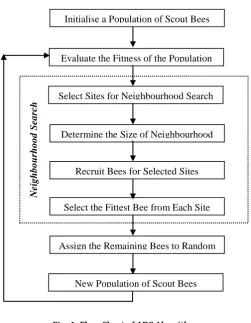
Due to the complexity of the problem and the number of parameters to be considered, an Artificial Bee Colony algorithm combined with the network simulator NS-2 is proposed for managing a disaster. Artificial Bee Colony (ABC) algorithm is subset of swarm intelligence algorithm. It is widely used by researcher and academics in order to replicate both wired and wireless networks. NS-2 is used for evaluating fitness function. Bonn motion is liberally available mobility generator. A flowchart of artificial bee colony (ABC) system has been proposed an algorithm as seen below in Fig. 2. This paper proposes a new optimization algorithm that uses the honey bee behavior in food forging as the functions to be used by the processing engine. In the following subsections present these two scenarios:
[image:2.595.311.563.97.421.2] The Behaviour of Scout Scenario The Behaviour of Forger Scenario
Fig -1: Flow Chart of ABC Algorithm.
III.
ARTIFICIAL BEE COLONY (ABC)
ALGORITHM IMPLEMENTATION
There is a trend in the scientific community to model and solve complex optimization problems by employing natural metaphors. This is done mainly due to inefficiency of traditional optimization algorithms in solving larger scale combinatorial and/or highly non-linear problems. A given problem is modeled in such a way that a conventional algorithm like simplex algorithm can manage it. This generally requires making several assumptions which might not be easy to authenticate in many situations. In order to overcome these limitations more flexible and adaptable general purpose algorithms are needed. Based on this motivation many nature inspired algorithms were developed in the literature like genetic algorithms, simulated annealing and taboo search. This algorithms can provide far better solutions in comparison to conventional algorithms. Ant colony optimization, firefly optimization, particle swarm optimization, swap nets etc. are some of the well known algorithms that mimic insect behavior in problem modeling and solution. Some of the essential merits of bio-inspired approaches are: Flexibility Scalability Performance
Flexibility in decision making
Neig
hb
o
ur
ho
o
d
Sea
rch
Initialise a Population of Scout Bees
Evaluate the Fitness of the Population
New Population of Scout Bees Assign the Remaining Bees to Random
Search
Select the Fittest Bee from Each Site Recruit Bees for Selected Sites
(more Bees for the Best Sites) Select Sites for Neighbourhood Search
© 2015, IRJET ISO 9001:2008 Certified Journal Page 466 Enhancement scope and novelty
Artificial Bee Colony (ABC) is a relatively very new member of swarm intelligence. Artificial Bee Colony (ABC) tries to mold natural behavior of real honey bees in food foraging. Honey bees use several mechanisms like waggle dance to optimally locate food sources and to search new ones. It has been found that Artificial Bee Colony (ABC) is a exceptional kind of optimization technique having characterization of Swarm Intelligence which is highly suitable for finding the adaptive routing for such type of networks. Artificial Bee Colony (ABC) is a probabilistic technique for solving computational problems which can be reduced to finding good paths through graphs. ABC is used because they are more strong, consistent, and scalable than other conventional routing algorithms.
Each bee at the low-level component works through a swarm at the global level of component to form a system. Thus, the system global behaviour is determined from it is individual's local behaviour where the different interactions and coordination among individuals lead to an organized teamwork system. This system is characterized by the interacting collective behaviour through labour division, distributed simultaneous task performance, specialized individuals, and self- organization.
The formation of a tuned collective knowledge is lead by exchanging of information among bees. A colony of honey bees consists of a queen, many drones (males) and thousands of workers (non- reproductive females). The queen's job is to lay offspring and to start new colonies. The one and only one function of the drones is to mate with the queen and during the fall they are ejected from the colony. The worker bees build honeycomb, and they lead to clean the colony, feed the queen and drones, guard the colony, and collect food.
As nectar is the bees' energy source, scout bees and forager bees are two kinds of worker bees which are responsible for food. A bee does many things in its life history, and does not become a scout/work bee until late in its life [3]. While scout bees carry out the searching process, forager bees control the management process. However, searching and utilization processes must be carried out together by the colony’s explorers and colony’s exploiters. As the increase in the number of scouts encourages the searching process, the increase of foragers encourages the utilization and management process.
Studying the foraging behaviour leads to optimal foraging theory that directs activities towards achieving goals [4]. This hypothesis states that organisms forage in such a way as to maximize their intake energy per unit time [4]. In other words, the swarm of bees behaves to find and capture the food that containing the most energy while expending the possible smallest amount of time in real variables. There are two forms of scenarios
readily available for any bee in forging process which is either scout or forager.
Movement of the Scouts
• The movement of the scout bees follows equation.
– r : A random number and
Movement of the Onlookers
• Probability of Selecting a nectar source:
Pi : Probability of selecting the ith employed bee S : Number of employed bees
θi : Position of the ith employed bee : Fitness value
Movement of the Forgers
• Calculation of the new position:
: Position of the onlooker bee
t : Iteration number
: Randomly chosen employed bee.
j : Dimension of the solution
: A series of random variable in the range [-1,1]
IV.
SIMULATION SETUP AND RESULTS
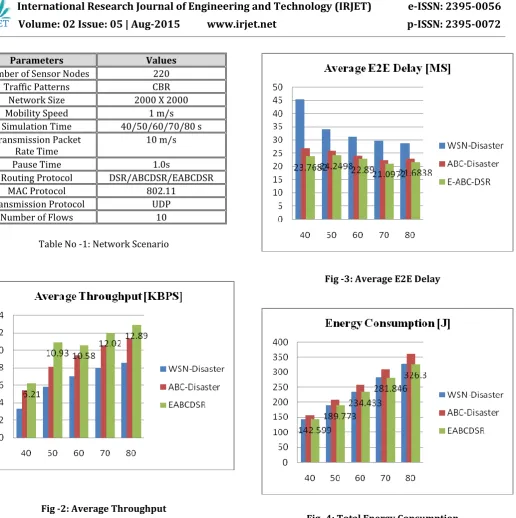
The experiments for the evaluation of the proposed scheme have been carried out using the network simulator ns-2. For this we have used Dynamic Source Routing (DSR) routing protocol and consider various number of nodes like 20,40,60,80,100. The scenarios developed to carry out the using these parameters (i) Throughput Vs. Number of Sensors (ii) End Delay Vs. Number of Sensors (iii) Energy Consumption Vs. Number of Sensors. From all these result we are able to analyzed effectiveness of proposed method. Finally compare the performances of DSR/ABCDSR/EABCDSR. Network Scenario will be as follows:
0,1 r
i x
t
t
t
t
x
ij
1
ij
ij
kj
S k k i i F F P 1
iF
max min
min j j
j
ij
r
k
© 2015, IRJET ISO 9001:2008 Certified Journal Page 467
Parameters Values
Number of Sensor Nodes 220
Traffic Patterns CBR
Network Size 2000 X 2000
Mobility Speed 1 m/s
Simulation Time 40/50/60/70/80 s Transmission Packet
Rate Time
10 m/s
Pause Time 1.0s
Routing Protocol DSR/ABCDSR/EABCDSR
MAC Protocol 802.11
Transmission Protocol UDP
[image:4.595.54.571.48.567.2]Number of Flows 10
[image:4.595.313.568.334.547.2]Table No -1: Network Scenario
Fig -2: Average Throughput
Fig -3: Average E2E Delay
Fig -4: Total Energy Consumption
V.
CONCLUSION
© 2015, IRJET ISO 9001:2008 Certified Journal Page 468 these techniques to present more efficiency to network
changes and external factors which could affect our approach such as node mobility, obstacles and other issues while implementing these techniques.
REFERENCES
[1] Alina Rakhi Ajayan, Prof. S. Balaji, “A Modified ABC Algorithm & Its Application to Wireless Sensor Network Dynamic Deployment”, Volume 4, Issue 6 Feb. 2013.
[2] H. R. Karkvandi, E. Pecht, and O. Yadid, “Effective lifetime-aware routing in wireless sensor networks,” IEEE Sensors J., vol. 11, no. 12, pp. 3359–3367, Dec. 2011.
[3] Von Frisch, Karl, “Decoding the Language of the Bee”, Science, Volume 185, Issue 4152, pp. 663- 668, 1974.
[4] Kamil, Alan C., John R. Krebs and H. Ronald Pulliam, “Foraging Behavior”, Plenum Press, New York and London, 1987.
[5] Corbet, S.A., Kerslake, C.J.C., Brown, D. & Morland, N.E., “Can bees select nectar-rich flowers in a patch?”, Journal of Apicultural Research, 23, pp. 234–242, 1984.
[6] Harminder Kaur, Ravinder Singh Sawhney, Navita Komal, “ Wireless Sensor Networks for Disaster Management”, International Journal of Advanced Research in Computer Engineering & Technology, Volume 1, Issue 5, July 2012. [7] R. V. Rao and V. J. Savsani, “Mechanical Design
Optimization Using Advanced Optimization Techniques”, Springer Series in Advanced Manufacturing, DOI: 10.1007/978-1-4471-2748-2_2, _ Springer-Verlag London 2012. [8] Vassilios Vescoukis and Nikolaos D. Dulamis,
“Disaster Management Evaluation and Recommendation”, Third International Conference on Games and Virtual Worlds for Serious Applications 2011.
[9] Sunar Arif Hussain and K. E. Sreenivasa Murthy, “Efficient And Reliable Routing Protocol For Wireless Sensor Networks (Wsns)”, International Journal of Computer Science and Communication Vol. 2, No. 2, July-December 2011.
[10] Levi Bayde Ribeiro, Miguel Franklin de Castro, “BiO4SeL: A Bio-Inspired Routing Algorithm for Sensor Network Lifetime
Optimization”, 17th International Conference on Telecommunications, Group of Computer Networks, Software Engineering and Systems (GREat) Computer Science Department, Federal University of Ceara, Brazil, 2010.
[11] Karaboga and B. Basturk, “On The Performance Of Artificial Bee Colony (ABC) Algorithm”, Applied Soft Computing 8, pp.687-697, 2008.
[12] M. Farooq, G.D. Caro, “ Routing Protocols Inspired By Insect Societies”, C. Blum, D. Merkle (Eds.), Swarm Intelligence, Introduction And Applications, Natural Computing Series, Springer-verlag, 2008. [13] Falko Dressler_,a, Ozgur B. Akanb “A
Survey on Bio-inspired Networking”, Springer Science Business Media B.V.13 April 2007. [14] Karaboga, “An Idea Based On Honey Bee
Swarm For Numerical Optimization”, Technical Report-TR06, Erciyes University, Engineering Faculty, Computer Engineering Department, 2005.
[15] B. Babar and A. Crăciunescu, “Comparison of Artificial Bee Colony Algorithm with other Algorithms used for Tracking of Maximum Power Point of Photovoltaic Arrays”, International Conference on Renewable Energies and Power Quality (ICREPQ’14) Cordoba (Spain), 8th to 10th April, 2014.
[16] Apurva Saoji, P.D.Lambhate, “Trusted Clustering Based Event Detection for aDisaster Management in Wireless Sensor Network”, International Journal of Computer Science and Information Technologies, Vol. 5 (4), 2014. [17] Naveed Ahmad, Mureed Hussain,
Naveed Riaz, Fazli Subhani, Sajjad Haider, Khurram. S. Alamgir, Fahad Shinwari, “Flood Prediction and Disaster Risk Analysis using GIS based Wireless Sensor Networks, A Review” J. Basic. Appl. Sci. Res., 3(8)632-643, 2013.
[18] Alina Rakhi Ajayan, S. Balaji, “A Modified ABC Algorithm & Its Application to Wireless Sensor Network Dynamic Deployment”, IOSR Journal of Electronics and Communication Engineering (IOSR-JECE), e-ISSN: 2278-2834, p- e-ISSN: 2278-8735, Volume 4, Issue 6, Jan. - Feb. 2013.
© 2015, IRJET ISO 9001:2008 Certified Journal Page 469 connectivity in Disaster Response Scenarios” in
Applied Soft Computing Elsevier journal pp no. 833–845 nov. 2012.
[20] Saif Mahmood Saab, Dr. Nidhal Kamel Taha El-Omari,“ Developing Optimization Algorithm Using Artificial Bee Colony System”, Ubiquitous Computing and Communication Journal, Volume 4 Number 5.
BIOGRAPHIES
Prof. S. D. Chavan, working as Associate Professor M. E. (Electronics), PhD (Research scholar) Electronics. He has experience consists of 14 years of Academics and 5 years of Industrial experience. Professional Body membership includes LMISTE, MIETE.
Dr. A. V. Kulkarni currently working as professor of E&TC and Dean-R&D, PG & Ph.D at Dr. D.Y.P.I.E.T Pimpri, Pune, India. She has overall teaching experience 25 years.
Tejashree S. Khot, received the B.E degree in Electronics Engineering from Shivaji University,Kolhapur,