Reduction of renal mass is lethal in mice
lacking vimentin. Role of endothelin-nitric oxide
imbalance.
F Terzi, … , P Briand, G Friedlander
J Clin Invest.
1997;
100(6)
:1520-1528.
https://doi.org/10.1172/JCI119675
.
Modulation of vascular tone by chemical and mechanical stimuli is a crucial adaptive
phenomenon which involves cytoskeleton elements. Disruption, by homologous
recombination, of the gene encoding vimentin, a class III intermediate filament protein
mainly expressed in vascular cells, was reported to result in apparently normal phenotype
under physiological conditions. In this study, we evaluated whether the lack of vimentin
affects vascular adaptation to pathological situations, such as reduction of renal mass, a
pathological condition which usually results in immediate and sustained vasodilation of the
renal vascular bed. Ablation of 3/4 of renal mass was constantly lethal within 72 h in mice
lacking vimentin (Vim-/-), whereas no lethality was observed in wild-type littermates. Death
in Vim-/- mice resulted from end-stage renal failure. Kidneys from Vim-/- mice synthesized
more endothelin, but less nitric oxide (NO), than kidneys from normal animals. In vitro, renal
resistance arteries from Vim-/- mice were selectively more sensitive to endothelin, less
responsive to NO-dependent vasodilators, and exhibited an impaired flow (shear
stress)-induced vasodilation, which is NO dependent, as compared with those from normal
littermates. Finally, in vivo administration of bosentan, an endothelin receptor antagonist,
totally prevented lethality in Vim-/- mice. These results suggest that vimentin plays a key
role in the modulation of vascular tone, possibly via the tuning of endothelin-nitric oxide
balance.
Research Article
Find the latest version:
J. Clin. Invest.
© The American Society for Clinical Investigation, Inc. 0021-9738/97/09/1520/09 $2.00
Volume 100, Number 6, September 1997, 1520–1528 http://www.jci.org
Reduction of Renal Mass Is Lethal in Mice Lacking Vimentin
Role of Endothelin–Nitric Oxide Imbalance
Fabiola Terzi,* Daniel Henrion,‡ Emma Colucci-Guyon,§ Pierre Federici,* Charles Babinet,§ Bernard I. Levy,‡ Pascale Briand,*
and Gérard Friedlanderi
*INSERM U 380, Institut Cochin de Génétique Moléculaire, Paris, France; ‡INSERM U 141, Biologie Vasculaire, Hôpital Lariboisière,
Paris, France; §URA 1960 CNRS, Biologie du Développement, Institut Pasteur, Paris, France; and iINSERM U 426 and Département Physiologie, Faculté X. Bichat, Paris, France
Abstract
Modulation of vascular tone by chemical and mechanical stimuli is a crucial adaptive phenomenon which involves cy-toskeleton elements. Disruption, by homologous recombina-tion, of the gene encoding vimentin, a class III intermediate filament protein mainly expressed in vascular cells, was re-ported to result in apparently normal phenotype under physiological conditions. In this study, we evaluated whether the lack of vimentin affects vascular adaptation to logical situations, such as reduction of renal mass, a patho-logical condition which usually results in immediate and sustained vasodilation of the renal vascular bed.
Ablation of 3/4 of renal mass was constantly lethal within 72 h in mice lacking vimentin (Vim2/2), whereas no lethality
was observed in wild-type littermates. Death in Vim2/2 mice
resulted from end-stage renal failure. Kidneys from Vim2/2
mice synthesized more endothelin, but less nitric oxide (NO), than kidneys from normal animals. In vitro, renal re-sistance arteries from Vim2/2 mice were selectively more
sensitive to endothelin, less responsive to NO-dependent va-sodilators, and exhibited an impaired flow (shear stress)-induced vasodilation, which is NO dependent, as compared with those from normal littermates. Finally, in vivo admin-istration of bosentan, an endothelin receptor antagonist, to-tally prevented lethality in Vim2/2mice.
These results suggest that vimentin plays a key role in the modulation of vascular tone, possibly via the tuning of en-dothelin–nitric oxide balance. (J. Clin. Invest. 1997. 100: 1520–1528.) Key words: knockout mice • cytoskeleton •
en-dothelin • nitric oxide • shear stress
Introduction
Adaptation of vascular tone to physiological and pathological situations is a key process in the maintenance of organ
func-tion. The vascular response to chemical or mechanical stimuli in terms of constriction or dilation is an integrative phenome-non that requires participation of endothelial and smooth mus-cle cells, and involves cytoskeleton elements among which in-termediate filament proteins play a central role (1–4). The prominent reorganization of F-actin stress fibers, intermediate filaments, and microtubules to external forces (flow and/or pressure) implicates the cytoskeleton as a principal force trans-mission element in endothelial cells (5–7). Furthermore, the observation that filament disruption changes endothelial cell synthesis of bioactive molecules, such as endothelin-1 (ET-1),1
nitric oxide (NO), or prostaglandins, argues in favor of a role of cytoskeleton in signal transduction (1). On the other hand, extracellular signals induce rearrangement of cytoskeleton through the activation of the small GTP-binding protein of the Rho family (8–10).
Vimentin is a class III intermediate filament protein mainly expressed in mesenchyme-derived cells including endothelial and vascular smooth muscle cells (11). This expression pattern suggests that vimentin should participate in the regulation of vascular tone. Indeed, it has been reported that mechanical stresses induce reorganization of vimentin filaments in endo-thelial cells (5, 12), whereas hormones, such as ET-1 and an-giotensin II, induce vimentin protein phosphorylation in vas-cular smooth muscle cells (13). However, the role of vimentin in vascular responses remains to be elucidated. Recently, a strain of mice bearing a null mutation of vimentin gene has been established (14). Surprisingly, these animals develop and reproduce without an obvious phenotype.
Since vimentin is strongly expressed in normal kidneys, in both vessels and glomeruli, we evaluated, in a previous work (15), the function and structure of kidneys from mice lacking vimentin, and found that they did not differ from those of wild-type littermates. These findings prompted us to ask whether vimentin is involved in the vascular adaptation to pathological situations, such as nephron reduction. Indeed, reduction of re-nal mass is known to induce an immediate and sustained va-sodilation which is paralleled by an increase of glomerular fil-tration in remaining glomeruli, in order to maintain renal function (16).
In this study, we used homozygous mice bearing a null mu-tation of vimentin gene to investigate: (a) in vivo, the conse-quences of a surgical reduction of renal mass; and (b) in vitro, the ability of renal resistance arteries to respond to chemical (contractile and relaxing agents) and mechanical (flow and pressure) stimuli.
We show that (a) reduction of renal mass is lethal in 100%
Part of this work was presented at the 29th Annual Meeting of the American Society of Nephrology (New Orleans, November 1996) and published in abstract form (1996. J. Am. Soc. Nephrol. 5:1574).
Address correspondence to Fabiola Terzi, INSERM U 380, Insti-tut Cochin de Génétique Moléculaire, 22, Rue Méchain, 75014 Paris, France. Phone: 33-1-40-51-64-93; FAX: 33-1-40-51-77-49; E-mail: [email protected]
Received for publication 28 March 1997 and accepted in revised form 30 July 1997.
1. Abbreviations used in this paper: ET, endothelin; MAP, mean arte-rial blood pressure; NADPH-d, NADPH diaphorase; NO, nitric ox-ide; L-NOARG, Nw
of mice lacking vimentin, but not in wild-type littermates, a phenotype which is accounted for by ET-1–NO imbalance and by impairment of flow-induced vasodilation; and (b) lethality in mutant mice subjected to reduction of renal mass is totally prevented by infusion of an ET receptor antagonist.
Methods
Mice lacking vimentin. The details of targeted inactivation of vimen-tin gene in mice have been reported previously (14). All experiments were performed on Vim1 knockout mice, in which the endogenous vi-mentin gene has been disrupted by an in-frame insertion of Escheri-chia colib-galactosidase coding sequences into exon 1 of vimentin gene. Therefore, X-gal staining, which reveals b-galactosidase activity (see below), could permit analysis of the pattern of renal vimentin ex-pression after reduction of renal mass.
To identify wild-type (Vim1/1) and homozygous (Vim2/2) mice of
different crosses, DNA from mouse tail was extracted, and the pres-ence of targeted vimentin alleles was detected using PCR, as previ-ously described (15).
Experimental protocol. Adult (3–4 mo) Vim1/1 and Vim2/2 mice,
originating from the same litter, were studied. Subtotal nephrectomy was performed as previously described (17). Briefly, in 2,2,2 tribro-moethanol (Janssen, Beerse, Belgium; 37 mg/g of body weight) anes-thetized mice, 75% of total renal mass was removed by excision of the right kidney and the two poles of the left kidney.
In a first set of experiments, we evaluated the survival rate in 15 Vim2/2 mice and 10 Vim1/1 littermates subjected to subtotal
nephrec-tomy. The surviving animals were killed after 21 d after surgery. In a second step, because of the early and massive lethality observed in Vim2/2 mice, time controls were performed in Vim1/1 mice which
were killed between 24 and 72 h after surgery for morphological anal-ysis and renal vimentin expression (n5 6 for each group). For deter-mination of ET-1 mRNA and protein content and of NADPH dia-phorase (NADPH-d), a marker of NO synthesis (18, 19), in kidney from Vim2/2 and Vim1/1 mice, 16 animals of each group were killed
24 h after surgery. Nonoperated kidneys, removed at time of subtotal nephrectomy, were compared with remnant kidneys removed at time of killing.
In eight Vim2/2 mice subjected to subtotal nephrectomy,
bosen-tan (F. Hoffmann-La Roche Laboratories, Basel, Switzerland) (10 mg/kg/d) was infused continually via osmotic minipumps (Alzet; Alza Corp., Palo Alto, CA) (0.5 ml/h) from the day of surgery to day 14. Surviving animals were killed 21 d after surgery. Three Vim2/2 mice
were treated with placebo in the same conditions, and died within 48 h after surgery.
Mean arterial blood pressure (MAP) was measured 24 h before and after surgery in conscious Vim1/1 mice and Vim2/2 mice treated
with or without bosentan (n5 5 in each group), by the tail-cuff method using an electrosphygmomanometer (Phymep, Paris, France). Plasma creatinine and electrolyte concentrations were determined on blood samples obtained by intracardiac puncture 24 h after surgery in each of these three groups of animals. Values were compared with those obtained from five normal, nonoperated Vim1/1 and Vim2/2
mice and from five Vim1/1 binephrectomized mice. At time of killing,
heart, lung, and kidney weights were measured in each animal. Lung dry weight was measured after overnight dehydration of lungs in ace-tone/dyethylether (1:1, vol/vol) solution. Lung water content was cal-culated as the difference between wet and dry weights.
All animal procedures were conducted in accordance with French government regulations (Services Vétérinaires de la Santé et de la Production Animale, Ministère de l’Agriculture).
Renal function. Plasma creatinine and electrolyte concentrations were determined with a multiparametric autoanalyzer (Hitachi 717; Boehringer-Mannheim, Melun, France).
Localization of b-galactosidase activity. X-gal staining was per-formed as previously described (15). Briefly, renal tissue was frozen
in 2-methylbutane, kept at 2808C, and cut on cryostat (Shandon, Dublin, Ireland) to obtain 7-mm-thick sections. Sections were fixed in fresh 2% formaldehyde/0.2% glutaraldehyde, then incubated over-night at 358C in a staining solution containing 2 mM MgCl2, 4 mM
K3Fe(CN)6, 4 mM K4Fe(CN)6, and 0.4 mg/ml
4-chloro-5-bromo-3-indo-lyl-b-d-galactopyranoside (X-gal; GIBCO BRL, Cergy Pontoise, France) buffered with PBS. The slides were counterstained with eosin and mounted in Eukitt (Labonord, Villeneuve d’Ascq, France).
Immunohistochemistry. Immunostaining was performed using the ABC procedure (20) as modified by Maunoury et al. (21). Briefly, kidneys were fixed in Kryofix (Merck, Nogent-sur-Marne, France), ethanol dehydrated, and paraffin embedded. 5-mm-thick sections were incubated first with 10% donkey nonimmune serum for 30 min, then with a rabbit polyclonal anti–rat vimentin antiserum (kindly pro-vided by Dr. A.M. Hill, Orsay, France), diluted 1:2,000 overnight at room temperature, and finally with a biotinylated donkey anti–rabbit antibody (Jackson ImmunoResearch Laboratories, Inc., West Grove, PA) diluted 1:200 for 30 min. This was followed by incubation with the avidin–biotin–peroxidase complex (Vector Laboratories, Inc., Burlingame, CA) and then with 0.05% 3.39 -diamino-benzidine-tetra-hydrochloride (DAB; Fluka, Mulhouse, France) and 0.01% freshly prepared hydrogen peroxide (Perydrol; Merck). The sections were counterstained with alcian blue and mounted in Eukitt (Labonord).
Negative controls were obtained by replacing specific antisera with normal nonimmune sera; no labeling was observed, indicating that all the procedures and reagents used resulted in specific labeling. Renal morphology. Serial sections, processed as for immunohis-tochemistry, were stained with hematoxylin and eosin and periodic acid Schiff (PAS).
Northern blot analysis. Total RNA was extracted from kidneys using the RNAzol kit (Bioprobe, Montreuil-sous-Bois, France). RNA (20 mg/lane) was fractionated on a 1.2% agarose-formaldehyde gel and transferred onto nylon membrane (Zetabind; CUNO, Inc., Meri-den, CT). Prehybridization, hybridization, and washing were carried out according to the manufacturer’s recommendations. RNA was quantified by densitometric computer analysis in a series 400 Phos-phorImager (Molecular Dynamics, Inc., Sunnyvale, CA). cDNA probes were labeled by a random priming method (Boehringer-Mann-heim) using [a-32P]dCTP. The following probes were used: the human
pre-pro-ET-1, kindly provided by Dr. F. Pinet (Paris, France) and the murine GAPDH. The GAPDH probe was used in order to quantify the RNA loading on the gel and to compare the intensity of hybrid-ization obtained in the different lanes.
ET-1 enzyme immunoassay. Renal ET-1 was extracted according to the method of Matsumoto et al. (22) with minor modifications. Briefly, kidneys were homogenized with a polytron homogenizer in 10 vol of 1 M acetic acid containing 10 mg/ml pepstatin for 60 s and immediately boiled for 10 min. The homogenates were centrifuged at 14,000 rpm for 35 min at 48C and the supernatants were applied to Sep-Pak plus C18 cartridges (Waters, Milford, MA), and the ab-sorbed peptides were eluted with methanol/water/trifluoroacetic acid (90:10:0.1) and then lyophilized. ET-1 concentration was assessed by ELISA, using the ET-1 (human) enzyme immunoassay kit (Cayman Chemical, Ann Arbor, MI).
Vascular responses to chemical stimuli. Renal resistance arteries and aortas were obtained from Vim2/2 mice and from Vim1/1
litter-mates. Arterial rings were prepared as previously described (23). Briefly, second order renal arteries were dissected, and segment rings (2 mm) were prepared and mounted on nylon filaments in a myo-graph for resistance arteries (24). Segments of thoracic aorta (3 mm) were dissected and mounted on stainless steel wires in a classic myo-graph (25). Isometric tension was recorded using a force displace-ment transducer (MP 100; BioPac Systems, Inc., La Jolla, CA). After equilibration, the tissue contractility was assessed by exposure to KCl (125 mM). Subsequently, the concentration–response curves to phe-nylephrine, serotonin, angiotensin II, ET-1, and phorbol dibutyrate were obtained by cumulative addition of the drug to the bath solu-tion. For the relaxing agents (acetylcholine and sodium nitroprus-side), these curves were conducted after preconstriction with a con-centration of phenylephrine sufficient to reach 50% of the maximal response as determined with KCl (125 mM). EC50, IC50, and EMAX
were calculated individually for each concentration–response curve as previously described (23). Drugs were purchased from Sigma Chemical Co. (Saint Quentin Fallavier, France).
Vascular responses to mechanical stimuli. The responses of seg-ments from renal resistance arteries to pressure and flow were deter-mined as previously described (26). Briefly, second order renal arter-ies were dissected, and segments were cannulated at both ends and mounted in a video monitor perfusion system (Living System Instru-mentation Inc., Burlington, VT). Arterial diameter was measured and recorded continuously. Pressure and flow rate could be changed independently. Arteries were submitted to different pressure steps (from 25 to 125 mmHg) with (100 ml/min) and without intraluminal flow and this was subsequently repeated after addition of either Nw
-nitro-l-arginine (L-NOARG, 10 mM; Sigma Chemical Co.), either alone or combined with indomethacin (10 mM; Sigma Chemical Co.). Active and passive diameters were determined as previously reported (27). Myogenic tone was calculated as percentage of passive diameter (measured diameter/passive diameter 3 100), whereas flow-induced dilation was expressed as increases in diameter induced by flow.
Expression of data and statistical analysis. Data are expressed as means6SEM. Differences between the experimental groups were evaluated using one-way ANOVA, which was followed, when signifi-cant, by Bonferroni test. Two-way ANOVA for repeated measures was used to compare the concentration–response curves. Paired t test was used to compare the effect of surgery on blood pressure.
Results
All the experiments described hereafter were performed on animals from intercrosses between Vim1/2 mice, which bear a
mutated allele of vimentin gene from which bacterial b -galac-tosidase was expressed in place of vimentin.
Reduction of renal mass was lethal in vimentin-null mice. Reduction of renal mass resulted in 100% mortality of Vim2/2
mice within 72 h, whereas no lethality was observed in Vim1/1
littermates (Fig. 1). To investigate a possible role of anesthe-sia, renal bleeding, or lack of tissular compensatory growth in death of Vim2/2 nephrectomized mice, we performed sham
operation, hemorrhage, or two-thirds hepatectomy in vimen-tin-null mice. We observed no lethality in these three experi-mental conditions (data not shown).
To explore in detail the cause of death in Vim2/2 mice
sub-jected to subtotal nephrectomy, three approaches were con-ducted. First, biochemical data were recorded: they showed that plasma creatinine concentration was similar in normal nonoperated Vim1/1 and Vim2/2 mice (Table I) and increased
24 h after surgery to a value which was higher in Vim2/2
ani-mals than in Vim1/1 littermates (Table I). At that time,
creati-nine concentration in Vim2/2 mice was comparable to that
[image:4.612.316.555.56.248.2]ob-tained from wild-type animals in which both kidneys have been removed (20162 mmol/liter). Plasma sodium, potassium, and chloride concentrations were not significantly different in
Figure 1. Survival rate of vimentin-null mice (Vim2/2) and wild-type
littermates (Vim1/1) subjected to reduction of renal mass. Subtotal
nephrectomy was lethal in 100% of mice lacking vimentin within 72 h, but not in Vim1/1 littermates. Lethality in nephrectomized Vim2/2
mice was totally prevented by treatment with bosentan, an ET recep-tor antagonist (Vim2/21 bos). Surviving animals were killed 21 d
af-ter surgery.
Table I. Effect of Lack of Vimentin on Cardiovascular and Renal Status in Mice Subjected to Reduction of Renal Mass
Vim1/1 Vim2/2 Vim2/2 1 bos
MAP (mmHg)
Before Nx 13062 13764 13562
After Nx 12863 11664* 12464
Heart weight (mg) 10865 9768 106613 Lung weight (mg)
Wet weight 14669 151613 134615
Dry weight 2961 3161 3062
Remnant kidney weight (mg) 13865 11667 123611 Plasma creatinine (mmol/liter)
Before Nx 2965 3064 ND
After Nx 100615 181611‡ 8464
All parameters were determined 24 h after subtotal nephrectomy (Nx)
in vimentin-null mice treated (Vim2/2 1 bos) or not (Vim2/2) with
bosen-tan and in wild-type littermates (Vim1/1) (n 5 5 for each group). MAP
was measured by tail-cuff method in conscious animals before and after surgery. Plasma creatinine before Nx was determined in five normal
nonoperated Vim1/1 and Vim2/2 mice. ND, Not determined. No
signifi-cant differences were observed in cardiovascular status and in compen-satory growth of remnant kidney between the three experimental groups. By contrast, plasma creatinine was dramatically increased after subtotal nephrectomy in mice lacking vimentin as compared to wild-type littermates. This increment was totally prevented by treatment with
bosentan. Data are means6SEM. ANOVA, followed by Bonferroni
test: Vim2/2 vs. Vim1/1 and Vim2/2 1 bos; ‡P , 0.005; *significantly
[image:4.612.314.556.440.594.2]the two groups of animals (data not shown). Second, the car-diovascular status was evaluated: heart weight and wet and dry lung weight was comparable in Vim2/2 and Vim1/1 mice 24 h
after surgery (Table I), indicating the absence of evident heart
failure. MAP, which was recorded in conscious animals by the tail-cuff method, did not differ between Vim2/2 and Vim1/1
mice before surgery (Table I), and was slightly but significantly decreased only in Vim2/2 animals 24 h after nephrectomy
(Ta-Figure 2.Renal morphology and vimentin expression in control nonoperated kidneys (a, c, and e) and in remnant kidneys (b, d, and f), 48 h after surgery. (a and b) Renal morphology of Vim2/2 kidneys; (c and d) vimentin immunostaining of Vim1/1 kidneys; (e and f) X-gal staining of Vim2/2
[image:5.612.59.556.108.693.2]ble I). Third, extensive histological analysis was performed. No evident hemorrhage or infarction was observed in heart, lung, intestine, or spleen. In regard to kidney size, the weight of the right kidney, removed at time of surgery, was comparable in Vim1/1 (178617 mg) and Vim2/2 (170622 mg) mice. As shown
in Table I, compensatory growth of remnant kidney did not differ significantly between Vim1/1 and Vim2/2 animals, at
least 24 h after surgery.
Morphology of the Vim2/2 remnant kidneys was
compara-ble to that of normal, nonoperated kidneys (Fig. 2, a and b). To assess whether reduction of renal mass modified vimentin expression in renal tissue, immunohistochemistry was per-formed on control and remnant kidneys from Vim1/1 and
Vim2/2 animals. As expected from the original study (14)
re-porting the establishment of the vimentin-null mice strain, vi-mentin protein could not be detected by antivivi-mentin antibod-ies in any structure of both control and remnant kidneys from Vim2/2 mice (data not shown). In contrast, vimentin was
re-vealed in glomeruli, vessels, and interstitial cells of kidneys from Vim1/1 mice (Fig. 2 c). Vimentin labeling was
compara-ble, in terms of distribution and intensity, in control and rem-nant kidneys, at least until 72 h after surgery (Fig. 2, c and d). In kidneys from Vim2/2 mice, X-gal staining showed the same
pattern of expression of the reporter gene b-galactosidase as that of vimentin in Vim1/1 animals (Fig. 2, e and c). Nephron
reduction did not affect X-gal staining in vimentin-null mice (Fig. 2, e and f).
Response to chemical and mechanical stimuli was altered in renal resistance arteries from vimentin-null mice.Since the re-sults reported above were consistent with the possibility that
renal failure in Vim2/2 mice resulted from increased arterial
vasoconstriction and/or reduced arterial vasodilation, we ana-lyzed in vitro the ability of renal resistance arteries from mu-tant mice and from wild-type littermates to respond to chemi-cal and mechanichemi-cal stimuli. In isolated rings of second order renal arteries, arterial segment length, width, external diame-ter, internal diamediame-ter, wall thickness, applied tension, wall/lu-men ratio, and contractile response to KCl-induced depolar-ization did not differ between Vim1/1 and Vim2/2 mice (data
not shown). Contractile response to phenylephrine, serotonin, and angiotensin II was similar in arteries from Vim1/1 and
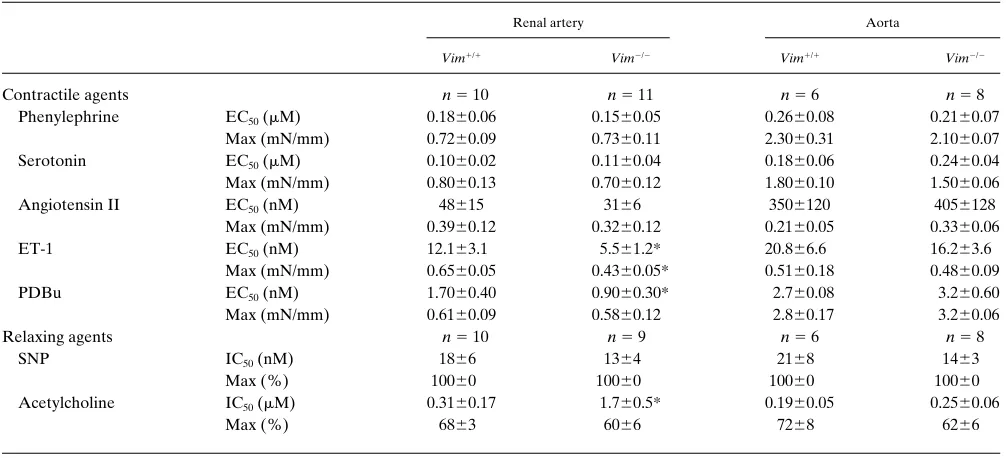
Vim2/2 mice (Table II). By contrast, mutant mice showed an
altered response to ET-1. Indeed, sensitivity to ET-1 was higher (lower EC50 values) in Vim2/2 renal arterial rings than
in Vim1/1 controls (Table II) and maximal contraction,
in-duced by pharmacological concentrations of ET-1, was re-duced in Vim2/2 renal rings (Table II). Similarly, sensitivity of
renal arteries to phorbol dibutyrate was increased in mice lack-ing vimentin (Table II). Regardlack-ing the response to relaxlack-ing agents, the sensitivity of renal arteries to acetylcholine, an en-dothelium-dependent relaxing agent, which acts through the release of NO, was lower (higher IC50 values) in Vim2/2 mice
than in Vim1/1 littermates (Table II). In contrast, the response
to sodium nitroprusside, an NO donor, was comparable in re-nal arteries from Vim2/2 and Vim1/1 mice (Table II). To verify
[image:6.612.56.559.436.665.2]whether the abnormal responses to contractile and relaxing agents were specific to renal resistance arteries, we investi-gated the ability of aortas to respond to the same chemical stimuli. As shown in Table II, no difference was detected be-tween Vim2/2 and Vim1/1 mice.
Table II. Effect of Lack of Vimentin on Vascular Responses to Contractile and Relaxing Agents in Renal Resistance Arteries and in Aortas
Renal artery Aorta
Vim1/1 Vim2/2 Vim1/1 Vim2/2
Contractile agents n 5 10 n 5 11 n 5 6 n 5 8
Phenylephrine EC50 (mM) 0.1860.06 0.1560.05 0.2660.08 0.2160.07
Max (mN/mm) 0.7260.09 0.7360.11 2.3060.31 2.1060.07
Serotonin EC50 (mM) 0.1060.02 0.1160.04 0.1860.06 0.2460.04
Max (mN/mm) 0.8060.13 0.7060.12 1.8060.10 1.5060.06
Angiotensin II EC50 (nM) 48615 3166 3506120 4056128
Max (mN/mm) 0.3960.12 0.3260.12 0.2160.05 0.3360.06
ET-1 EC50 (nM) 12.163.1 5.561.2* 20.866.6 16.263.6
Max (mN/mm) 0.6560.05 0.4360.05* 0.5160.18 0.4860.09
PDBu EC50 (nM) 1.7060.40 0.9060.30* 2.760.08 3.260.60
Max (mN/mm) 0.6160.09 0.5860.12 2.860.17 3.260.06
Relaxing agents n 5 10 n 5 9 n 5 6 n 5 8
SNP IC50 (nM) 1866 1364 2168 1463
Max (%) 10060 10060 10060 10060
Acetylcholine IC50 (mM) 0.3160.17 1.760.5* 0.1960.05 0.2560.06
Max (%) 6863 6066 7268 6266
The concentration required to obtain 50% of the maximal excitatory and inhibitory response (EC50 and IC50) and the maximal response (Max) to
con-tractile [phenylephrine, serotonin, angiotensin II, ET-1, and phorbol dibutyrate (PDBu)] and relaxing [sodium nitroprusside (SNP) and
acetylcho-line] agents were determined in segments of second order renal arteries and of aortas from vimentin-null mice (Vim2/2) and from wild-type littermates
(Vim1/1). The lack of vimentin in renal arterial rings causes a higher sensitivity to ET-1 (lower EC
50 value) and a lower sensitivity to acetylcholine
(higher IC50 value), suggesting a tendency to increased vasoconstriction. It also results in a higher sensitivity to PDBu and in a reduction of maximal
response to ET-1. By contrast, no significant differences were observed for all parameters between aortas from Vim1/1 and those from Vim2/2 mice.
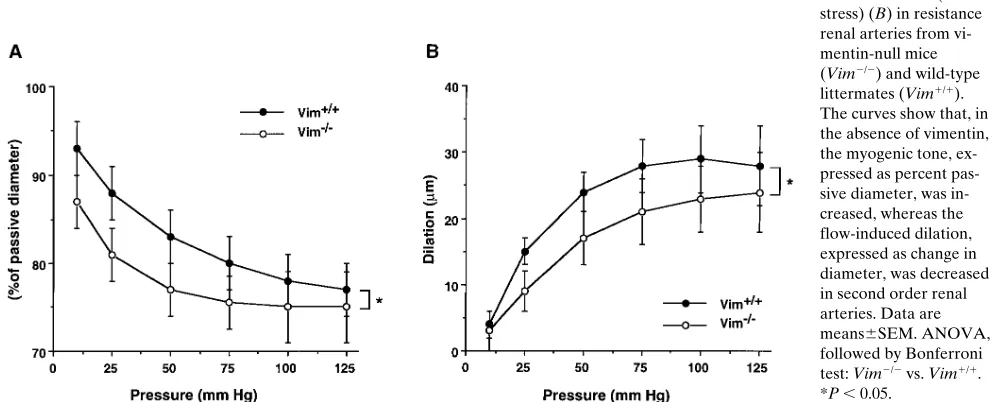
We next evaluated the pressure (myogenic)-induced tone and the flow (shear stress)-induced dilation in second order re-nal arteries. As shown in Fig. 3 A, myogenic tone (active tone in the absence of flow) was higher in renal resistance arteries from Vim2/2 mice than in those from Vim1/1 littermates.
Addi-tion of L-NOARG (10 mM), an NO synthase inhibitor, and in-domethacin (10 mM) did not affect the pressure-induced tone in both groups (data not shown). Flow-induced dilation was decreased in Vim2/2 arteries as compared with those from
Vim1/1 mice (Fig. 3 B). Addition of L-NOARG (10 mM) to
the perfusate and to the superfusate significantly reduced flow-induced dilation in both groups (Fig. 4). Addition of indo-methacin (10 mM) together with L-NOARG further reduced significantly flow-induced dilation exclusively in Vim2/2 renal
arteries (Fig. 4).
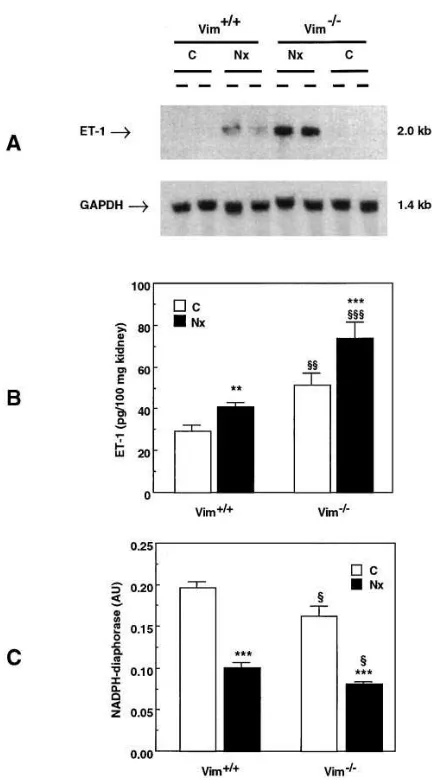
Renal synthesis of ET and NO was modified in vimentin-null mice. Since in vitro studies evidenced a link between vi-mentin and ET-1 and NO, two pivotal factors in control of re-nal blood flow (28), we next investigated the ability of kidneys to synthesize these agents in response to increased blood flow in our model of renal mass reduction. For this purpose, we measured the renal ET-1 mRNA and protein content as well as the renal NADPH-d activity, a marker of NO synthase (18, 19), in normal nonoperated kidneys and in remnant kidneys 24 h after surgery. ET-1 protein was more abundant in nonop-erated kidneys from Vim2/2 mice compared with those from
Vim1/1 mice (Fig. 5 B), while ET-1 mRNA was undetectable
in kidneys from either animal (Fig. 5 A). ET-1 mRNA and protein increased in remnant kidneys of both Vim1/1 and
Vim2/2 animals. However, this increase was larger in vimentin-Figure 3. Pressure-induced tone (myogenic tone) (A) and flow-induced dilation (shear stress) (B) in resistance renal arteries from vi-mentin-null mice (Vim2/2) and wild-type
littermates (Vim1/1).
The curves show that, in the absence of vimentin, the myogenic tone, ex-pressed as percent pas-sive diameter, was in-creased, whereas the flow-induced dilation, expressed as change in diameter, was decreased in second order renal arteries. Data are means6SEM. ANOVA, followed by Bonferroni test: Vim2/2 vs. Vim1/1.
[image:7.612.55.555.97.298.2]*P , 0.05.
Figure 4. Flow-induced dilation (shear stress) in resistance renal arteries from Vim1/1 (A) and
Vim2/2 (B) mice. In each
group, artery segments were treated with L-NOARG (10 mM), ei-ther alone or combined with indomethacin (10 mM), and with the vehicle of indomethacin (ethanol 0.1%) as con-trol. The curves show that addition of L-NOARG reduced flow-induced dilation in both Vim1/1
and Vim2/2 arteries,
whereas addition of in-domethacin induced a further reduction in flow-induced dilation, exclusively in Vim2/2 arteries. Data are means6SEM. ANOVA, followed by Bonferroni test: control
[image:7.612.58.551.517.714.2]null animals (Fig. 5, A and B). NO generation, as judged from NADPH-d activity, was decreased in remnant kidneys of Vim1/1 and Vim2/2 mice, but the reduction was greater in
Vim2/2 mice (Fig. 5 C). NADPH-d activity was lower in
non-operated kidneys from Vim2/2 mice compared with those from
Vim1/1 mice (Fig. 5 C).
Treatment with an ET receptor antagonist prevented lethal-ity in nephrectomized vimentin-null mice. Finally, we tested the hypothesis that the increased ET-1/NO ratio could be respon-sible for impaired vascular response and, therefore, for
lethal-ity after the reduction of renal mass in mice lacking vimentin. To address this issue, bosentan, an ET-A/ET-B receptor an-tagonist (29), was infused in Vim2/2 mice undergoing
reduc-tion of renal mass. Infusion of bosentan via osmotic mini-pumps resulted in 100% survival of these mice up to time of killing, which was performed at 21 d after surgery (Fig. 1). In Vim2/2 nephrectomized mice treated with bosentan, plasma
creatinine concentration, evaluated 24 h after surgery, was sig-nificantly lower than in untreated mice and was comparable to the value obtained in Vim1/1 nephrectomized animals (Table
I). As shown in Table I, no cardiovascular parameters were af-fected by this treatment.
Discussion
In this work we showed that, in mice lacking vimentin: (a) vas-cular response to chemical and mechanical stimuli was im-paired; (b) reduction of renal mass, a pathological situation re-quiring vascular adaptation to survival, was lethal in 100% of mice; and (c) infusion of bosentan, an ET receptor antagonist, prevented lethality after reduction of renal mass. Furthermore, we provided evidence that ET-1 and NO production was al-tered in mutant mice. Altogether, these results indicate that vi-mentin plays a key role in the modulation of vascular tone, possible via the tuning of ET-1/NO balance.
Vimentin, the most widely distributed intermediate fila-ment, is expressed in all mesenchyme-derived cells, including vascular endothelial and smooth muscle cells (11). The lack of an obvious phenotype in mice lacking vimentin, recently re-ported by Colucci-Guyon et al. (14), was enigmatic and raised the question of the evolutionary advantages of high conserva-tion of vimentin sequence. Our present observaconserva-tions shed light on this apparent paradox by showing that vimentin plays a key role under pathological conditions which require vascular ad-aptation, such as reduction of renal mass, a situation which in-duces an immediate and sustained vasodilation in order to maintain renal function.
Regarding the cause of lethality in mice lacking vimentin subjected to renal ablation, the 100% survival observed after sham operation, hemorrhage, or two-thirds hepatectomy in vi-mentin-null mice rules out a major role for anesthesia, renal bleeding, or lack of tissular compensatory growth in death of these animals. According to these data, compensatory growth was comparable in Vim2/2 and Vim1/1 remnant kidneys, at
least 24 h after nephron reduction. Along the same line, MAP was not different in vimentin-null mice as compared with wild-type littermates, and was not increased after surgery. Further-more, the absence of cardiac hypertrophy, as judged from heart weight, and/or of lung edema, as judged from lung water content, argues against a major cardiovascular dysfunction. By contrast, the severe alteration of renal function associated with a normal renal morphology suggests that death was the conse-quence of a lack of vascular adaptation to nephron reduction, resulting in end-stage renal failure. Indeed, it is noteworthy that plasma creatinine concentration and survival time were comparable to those observed in Vim1/1binephrectomized
an-imals. Furthermore, treatment with bosentan, which totally prevented lethality in Vim2/2 mice, restored renal function in a
range comparable to that observed in wild-type littermates. Altogether, these results were consistent with the possibility that renal failure in Vim2/2 mice resulted from increased
[image:8.612.56.272.54.444.2]arte-rial vasoconstriction and/or reduced artearte-rial vasodilation. This
Figure 5. ET-1 mRNA and protein and NADPH-d activity in nonop-erated control kidneys (C) and in remnant kidneys (Nx) from Vim2/2
and Vim1/1 mice, 24 h after nephrectomy. (A) Northern blot analysis
shows that the ET-1 mRNA, undetectable in the kidneys of both Vim1/1 and Vim2/2 control mice, increased markedly after
nephrec-tomy. The increase was greater in Vim2/2 mice (threefold, P , 0.001).
These results were confirmed in two additional independent experi-ments. (B) The changes of ET-1 mRNA correlate with those of the protein, which increased after nephron reduction, particularly in Vim2/2 mice (P , 0.001). (C) NADPH-d activity, an NO synthase
isozyme-independent marker, decreased after nephrectomy. The de-crease was greater in Vim2/2 mice (P , 0.05). Data are means6SEM.
ANOVA, followed by Bonferroni test: C vs. Nx: *P , 0.05, **P , 0.01, ***P , 0.001; Vim2/2 vs. Vim1/1: §P , 0.05, §§P , 0.01, §§§P ,
hypothesis was confirmed by the observation that pressure-induced tone was enhanced while flow-pressure-induced dilation was reduced in renal resistance arteries lacking vimentin.
ET-1 and NO are two pivotal factors in the control of renal blood flow (28) and the imbalance between these factors is likely to result in hemodynamic abnormalities. The enhanced production of ET-1, a potent renal vasoconstricting agent (30), in kidneys from Vim2/2 mice together with the observation
that infusion of bosentan, an ET-1 receptor antagonist, pre-vented lethality in 100% of Vim2/2 nephrectomized mice
strongly supports the functional involvement of ET-1 incre-ment in death of mutant mice. On the other hand, the reduc-tion of the maximal contracreduc-tion induced by pharmacological concentrations of ET-1 in renal resistance arteries may be ac-counted for by a downregulation of ET-1 receptors and argues in favor of a role for increased ET-1 concentrations in Vim2/2
tissues. The enhanced sensitivity of renal arteries to phorbol dibutyrate in Vim2/2 mice suggests that protein kinase C may
participate in the downregulation of ET-1 receptors, as previ-ously reported in other systems (31, 32). Along the same line, increased sensitivity to phorbol esters in Vim2/2 arteries is
con-sistent with the observation that myogenic tone, which de-pends, in part, upon activation of protein kinase C (33), was in-creased in renal arteries from vimentin-null mice.
In regard to NO, a potent renal vasodilating agent (34), our observations that its synthesis is decreased after subtotal ne-phrectomy are in agreement with a recent study performed in the rat, which evidenced, by various biochemical and immuno-histochemical approaches, a dramatic impairment of NO gen-eration in the remnant kidney from 7 d after nephron reduc-tion (35). In this work, we provide evidence that (a) the decrease of NO synthesis is detected as early as 24 h after sur-gery and is even more pronounced in kidney tissue and in re-nal resistance arteries lacking vimentin and (b) this decrease resulted in impaired vasodilation. Indeed, both acetylcholine-and flow-induced vasodilation, which depend mainly on endo-thelial NO synthesis (1, 36, 37), were reduced in mice lacking vimentin. In contrast, the response of renal arteries to sodium nitroprusside, an NO donor, was similar between Vim2/2 and
Vim1/1 mice, suggesting that vimentin disruption impaired
en-dothelial NO generation but did not affect the vasodilatory ef-fect of NO on vascular smooth muscle cells.
From our observations of an impaired ET-1/NO ratio in Vim2/2 mice, we reasoned that pharmacologic interventions
aiming to minimize this imbalance should either limit ET-1 synthesis or action, or provide NO, which is lacking in mutant mice. Because infusion of NO donors raised difficulties in terms of pharmacokinetics and bioavailability of the drugs, we chose to infuse animals with a stable, well-known, nonspecific ET-A/ET-B receptor antagonist (29). The efficiency of this treatment, which suppressed lethality and restored the ability of Vim2/2 kidneys to adapt to nephron loss, illustrates the
ex-tent to which ET-1/NO ratio is crucial in maintenance of renal function.
The fact that the enhanced ET-1/NO ratio in normal tissues (nonoperated kidneys) did not lead to a pathological pheno-type in Vim2/2 mice under physiological conditions is
intrigu-ing. Further investigations are required to investigate whether morphology of renal arteries and/or synthesis of other vasoac-tive molecules, which could compensate for the ET-1/NO im-balance, were modified in vimentin-null mice. It must be noted that in Vim2/2 mice, at variance with Vim1/1 littermates, a
component of flow-induced dilation in renal arteries depended upon prostaglandin production, since it was significantly re-duced by indomethacin.
The molecular mechanism(s) responsible for vascular dys-function in mice lacking vimentin remain speculative. Cyto-skeletal proteins are thought to participate in the mechan-otransduction of both flow-induced dilation (shear stress) and pressure-induced tone (myogenic tone) into a biochemical sig-nal (1–3, 38). Both inhibition of microtubule polymerization by nocodazole (1) and stabilization of F-actin with phalloidin (39) abolished the flow-mediated upregulation of NO synthase. Data on shear stress-induced ET-1 modifications (1, 40, 41) re-main contradictory, likely because of differences in intensity of shear stress from one study to another. Davies has reported re-cently that depolymerization of microtubules with nocodazole or colchicine prevented the shear stress–induced ET-1 down-regulation (1). Along the same line, actin filament disruption resulted in changes of stretch-activated ion channel activity (42). The involvement of vimentin in mechanotransduction has not been investigated previously, although a rearrange-ment of virearrange-mentin filarearrange-ments in endothelial cells subjected to mechanical stress (5), including shear stress (5, 12), has been reported. In this study, we demonstrated that vimentin is in-volved in the mechanotransmission and/or mechanotransduc-tion of shear and tensile stress. Since Remuzzi (43) has pro-vided evidence recently for a flow-induced dilation of renal arteries after reduction of renal mass, we propose that, in mu-tant mice, the lack of vimentin network impaired the nephrec-tomy-induced shear stress transmission and therefore induced the ET-1/NO imbalance.
In conclusion, our study provides the first evidence that vi-mentin is essential for (a) vascular response to contractile and relaxing agents and to mechanotransduction of shear stress and myogenic tone in renal resistance arteries; and (b) survival after reduction of renal mass, a pathological condition charac-terized by dramatic adaptive vasodilation. These results strongly suggest that vimentin is a key element in vasomotor adapta-tion, and that it seems to be necessary for both endothelial and smooth muscle cell function. The observation that the lack of vimentin differentially affects the vascular response to several contractile agents argues against a constitutive defect in the smooth muscle contractile apparatus in Vim2/2 cells. Rather,
in view of recent reports (8–10, 44) showing a relationship be-tween cytoskeleton elements and signal transduction, it is likely that the lack of vimentin impairs the transduction of chemical and mechanical stimuli in the vessel wall. The pheno-type described in this report raises the possibility that vimentin might be involved in human vascular disorders.
Acknowledgments
We are deeply grateful to Marie-Claire Gubler for histological analy-sis, Roger Maunoury for immunohistochemical study, Joëlle Benes-siano for biochemical determinations, Martine Burtin, Habib Karam and Wei Huang for help in recording arterial blood pressure, Flo-rence Pinet for pre-pro-ET 1 cDNA, and Sébastien Roux (F. Hoff-mann-La Roche Laboratories) for providing bosentan. We thank Marco Pontoglio and Jonathan Weitzman for critical advice.
References
1. Davies, P.F. 1995. Flow-mediated endothelial mechanotransduction.
Physiol. Rev. 75:519–560.
2. Osol, G. 1995. Mechanotransduction by vascular smooth cells. J. Vasc. Res. 32:275–292.
3. Malek, A.M., and S. Izumo. 1994. Molecular aspect of signal transduction of shear stress in the endothelial cells. J. Hypertens. 12:989–999.
4. Janmey, P.A., U. Euteneuer, P. Traub, and M. Schliwa. 1991. Viscoelastic properties of vimentin compared with other filamentous biopolymer networks.
J. Cell Biol. 113:155–160.
5. Thoumine, O., T. Ziegler, P.R. Girard, and R.M. Nerem. 1995. Elonga-tion of confluent endothelial cells in culture: the importance of fields of force in the associated alterations of their cytoskeletal structure. Exp. Cell Res. 219:427– 441.
6. Kim, D.W., A.I. Gotlieb, and B.L. Langille. 1989. In vivo modulation of endothelial F-actin microfilaments by experimental alterations in shear stress.
Arteriosclerosis. 9:439–445.
7. Wechezak, A.R., T.N. Wight, R.F. Viggers, and L.R. Sauvage. 1989. En-dothelial adherence under shear stress is dependent upon microfilament reor-ganization. J. Cell. Physiol. 139:136–146.
8. Ridley, A.J., and A. Hall. 1992. The small GTP-binding protein rho regu-lates the assembly of focal adhesions and actin stress fibers in response to growth factors. Cell. 70:389–399.
9. Nobles, C.D., and A. Hall. 1995. Rho, rac, and cdc42 GTPases regulate the assembly of multimolecular focal complexes associated with actin stress fi-bers, lamellipodia, and filopodia. Cell. 81:53–62.
10. Zigmond, S.H. 1996. Signal transduction and actin filament organiza-tion. Curr. Opin. Cell Biol. 8:66–73.
11. Fuchs, E., and K. Weber. 1994. Intermediate filaments: structure, dy-namics, function, and disease. Annu. Rev. Biochem. 63:345–382.
12. Cucina, A., A.V. Sterpetti, G. Pupelis, A. Fragale, S. Lepidi, A. Caval-laro, Q. Giustiniani, and L. Santoro d’Angelo. 1995. Shear stress induces changes in the morphology and cytoskeleton organisation of arterial endothe-lial cells. Eur. J. Vasc. Endovasc. Surg. 9:86–92.
13. Tsuda, T., K.K. Griendling, J.D. Ollerenshaw, B. Lassègue, and R.W. Alexander. 1993. Angiotensin II and endothelin induced protein phosphoryla-tion in cultured vascular smooth muscle cells. J. Vasc. Res. 30:241–249.
14. Colucci-Guyon, E., M.M. Portier, I. Dunia, D. Paulin, S. Pournin, and C. Babinet. 1994. Mice lacking vimentin develop and reproduce without an obvi-ous phenotype. Cell. 79:679–694.
15. Terzi, F., R. Maunoury, E. Colucci-Guyon, C. Babinet, P. Federici, P. Briand, and G. Friedlander. 1997. Normal tubular regeneration and differentia-tion of post-ischemic kidney in mice lacking vimentin. Am. J. Pathol. 150:1361– 1371.
16. Meyer, T.W., K. Baboolal, and B.M. Brenner. 1996. Nephron adapta-tion to renal injury. In The Kidney. B.M. Brenner, editor. W.B. Saunders Co., Philadelphia. 2011–2048.
17. Terzi, F., H. Beaufils, D. Laouari, M. Burtin, and C. Kleinknecht. 1992. Renal effect of anti-hypertensive drugs depends on sodium diet in the excision remnant kidney model. Kidney Int. 42:354–363.
18. Hope, B.T., G.J. Michael, K.M. Knigge, and S.R. Vincent. 1991. Neu-ronal NADPH diaphorase is a nitric oxide synthase. Proc. Natl. Acad. Sci. USA.
88:2811–2814.
19. McKee, M., C. Scavone, and J.A. Nathanson. 1994. Nitric oxide, cGMP, and hormone regulation of active sodium transport. Proc. Natl. Acad. Sci. USA.
91:12056–12060.
20. Hsu, S., L. Raine, and H. Fanger. 1981. Use of avidin-biotin-peroxidase complex (ABC) in immunoperoxidase techniques: a comparison between ABC unlabeled antibody (PAP) procedure. J. Histochem. Cytochem. 29:577–580.
21. Maunoury, R., S. Robine, E. Pringault, N. Léonard, J.A. Gaillard, and D. Louvard. 1988. Villin expression in the visceral endoderm and in the gut an-lage during early mouse embryogenesis. EMBO (Eur. Mol. Biol. Organ.) J. 7: 3321–3329.
22. Matsumoto, H., N. Suzuki, H. Onda, and M. Fujino. 1989. Abundance of endothelin-3 in rat intestine, pituitary gland and brain. Biochem. Biophys.
Res. Commun. 164:74–80.
23. Dowell, F.J., D. Henrion, M. Duriez, and J.B. Michel. 1996. Vascular re-activity in mesenteric resistance arteries following chronic nitric oxide synthesis inhibition in Wistar rats. Br. J. Pharmacol. 117:341–346.
24. Mulvany, M.J., and W. Halpern. 1977. Contractile properties of small arteries resistance vessels in spontaneously hypertensive and normotensive rats. Circulation. 41:19–26.
25. Henrion, D., and I. Laher. 1993. Potentiation of norepinephrine-induced contractions by endothelin-1 in rabbit aorta. Hypertension (Dallas). 22:78–83.
26. Halpern, W., G. Osol, and G.S. Coy. 1984. Mechanical behavior of pres-surized in vitro prearteriolar vessels determined with a video system. Ann.
Biomed. Eng. 12:463–479.
27. Falcone, J.C., H.J. Granger, and G.A. Meininger. 1993. Enhanced myo-genic activation in skeletal muscle arterioles from spontaneously hypertensive rats. Am. J. Physiol. 265:H1847–H1855.
28. Hunley, E.T., S. Iwasaki, T. Homma, and V. Kon. 1995. Nitric oxide and endothelin in pathophysiological settings. Pediatr. Nephrol. 9:235–244.
29. Clozel, M., V. Breu, K. Burri, J.M. Cassal, W. Fischil, G.A. Gray, G. Hirth, B.M. Löffler, M. Müller, W. Neidhart, and H. Ramuz. 1993. Pathophysi-ological role of endothelin revealed by the first orally active endothelin recep-tor antagonist. Nature (Lond.). 365:759–761.
30. Simonson, M.S. 1993. Endothelins: multifunctional renal peptides. Phys-iol. Rev. 73:375–411.
31. Resink, T.J., T. Scott-Burden, E. Weber, and F.R. Buhler. 1990. Phorbol ester promotes a sustained down-regulation of endothelin receptors and cellu-lar responses to endothelin in human vascucellu-lar smooth muscle cells. Biochem.
Biophys. Res. Commun. 166:1213–1219.
32. Xuan, Y.T., O.L. Wang, and R. Whorton. 1994. Regulation of endothe-lin-induced Ca21mobilization in smooth muscle cells by protein kinase C. Am.
J. Physiol. 266:C1560–C1567.
33. Laher, I., and J.A. Bevan. 1989. Staurosporine, a protein kinase C inhib-itor, attenuates Ca21-dependent stretch-induced vascular tone. Biochem.
Bio-phys. Res. Commun. 158:58–62.
34. Raij, L. 1993. Nitric oxide and the kidney. Circulation. 87:V26–V29. 35. Aiello, S., M. Noris, M. Todeschini, S. Zappella, C. Foglieni, A. Benigni, D. Corna, C. Zoja, D. Cavallotti, and G. Remuzzi. 1997. Renal and systemic ni-tric oxide synthesis in rats with renal mass reduction. Kidney Int. 52:171–181.
36. Kuo, L., M.J. Davis, and W.M. Chillian. 1992. Endothelial modulation of arteriolar tone. News Physiol. Sci. 7:5–9.
37. Hecker, M., A. Mulsch, E. Bassenge, and R. Busse. 1993. Vasoconstric-tion and increased flow: two principal mechanisms of shear stress-dependent endothelial autacoid release. Am. J. Physiol. 265:H828–H833.
38. Banes, A.J., M. Tsuzaki, J. Yamamoto, T. Fischer, B. Brigman, T. Brown, and M. Miller. 1995. Mechanoreception at the cellular level: the detec-tion, interpretation and diversity of responses to mechanical signals. Biochem. Cell. Biol. 73:349–365.
39. Hutcheson, I.R., and T.M. Griffith. 1996. Mechanotransduction through the endothelial cytoskeleton: mediation of flow- but not agonist-induced EDRF release. Br. J. Pharmacol. 118:720–726.
40. Morita, T., H. Kurihara, K. Maemura, M. Yoshizumi, and Y. Yazaki. 1993. Disruption of cytoskeletal structures mediates shear stress-induced en-dothelin-1 gene expression in culture porcine aortic endothelial cells. J. Clin. Invest. 92:1706–1712.
41. Malek, A.M., and S. Izumo. 1995. Control of endothelial cell gene ex-pression by flow. J. Biomechanics. 28:1515–1528.
42. Sachs, F. 1988. Mechanical transduction in biological systems. CRC Crit. Rev. Biomed. Eng. 16:141–169.
43. Remuzzi, A. 1996. Shear stress as a modulator of renal function and structure. J. Am. Soc. Nephrol. 7:115P.