S T U D Y P R O T O C O L
Open Access
More Active Mums in Stirling (MAMMiS): a
physical activity intervention for postnatal
women. Study protocol for a randomized
controlled trial
Alyssa S Gilinsky
1,2, Adrienne R Hughes
1and Rhona J McInnes
2*Abstract
Background:Many postnatal women are insufficiently physically active in the year after childbirth and could benefit from interventions to increase activity levels. However, there is limited information about the efficacy, feasibility and acceptability of motivational and behavioral interventions promoting postnatal physical activity in the UK.
Methods:The MAMMiS study is a randomized, controlled trial, conducted within a large National Health Service (NHS) region in Scotland. Up to 76 postnatal women will be recruited to test the impact of two physical activity consultations and a 10-week group pram-walking program on physical activity behavior change. The intervention uses evidence-based motivational and behavioral techniques and will be systematically evaluated using objective measures (accelerometers) at three months, with a maintenance measure taken at a six-month follow-up. Secondary health and well-being measures and psychological mediators of physical activity change are included.
Discussion:The (MAMMiS study will provide a test of a theoretical and evidence-based physical activity behavior change intervention for postnatal women and provide information to inform future intervention development and testing within this population.
Trial registration:Current Controlled Trials ISRCTN79011784
Keywords:Physical activity, Postnatal, Health behavior change, Accelerometers, Consultations, Pram-walking, Randomized controlled trial
Background
During the year following childbirth there are physical and psychological benefits associated with participation in regular physical activity [1,2]. A gradual increase to a physically active lifestyle following the early postnatal period (six weeks after delivery) has been shown to have positive implications for mood, fatigue, cardiovascular fitness and weight management [3-6]. As seen in the general population, physical activity reduces long-term mortality and morbidity risk for a range of health condi-tions, including coronary heart disease (CHD), Type II
diabetes, obesity, cancer and depression [7,8]. Women with young children have increasingly been targeted through physical activity promotion interventions [4,5,9-18]; however, relatively few studies have focused specific-ally on postnatal women in the year following childbirth, despite these known health and well-being benefits [4,5,12-18]. There is evidence that many women are in-sufficiently active during the postnatal period [19-24], suggesting postnatal women represent a target popula-tion for physical activity promopopula-tion intervenpopula-tions.
To date there has been limited research on the deter-minants of participation in physical activity among
post-natal women. Women’s confidence (self-efficacy) that
they can be active in the face of barriers (for example, lack of childcare, tiredness) are important; as are * Correspondence:[email protected]
2
Maternal and Child Health Research Group, School of Nursing, Midwifery and Health, University of Stirling, Stirling, Scotland FK9 4LA, UK Full list of author information is available at the end of the article
enablers to activity, such as“feeling better”, and the abil-ity to commence and sustain self-regulatory effort to-wards an active lifestyle [24-26]. Research with mothers of young children has also shown a positive effect of self-efficacy and partner support on mediating change in physical activity participation [11]. Commonly, physical activity promotion efforts in postnatal populations have focused on enhancing motivation for activity, problem solving barriers to participation and teaching behavioral strategies associated with commencing and sustaining self-regulatory effort towards an active lifestyle (for
ex-ample, setting goals, planning and self-monitoring
activ-ity). Three small-scale studies, conducted in the USA, Canada and Australia, recruited healthy women in the year following childbirth and successfully used such approaches to change participation in physical activity [12,14,17]. One study, which was conducted among women meeting criteria for postnatal depression (PND), found no change in physical activity in a UK setting [16]. Other studies have attempted to overcome common bar-riers by promoting activity that can be performed with-out the need for childcare. In this regard, pram-walking interventions have been developed and tested, originally among Australian postnatal women [18,26]. Pram-walking interventions are appealing as they can be adopted in the local community, provide an opportunity for demonstrating appropriate moderate physical activ-ity, allow women to be active with their babies and pro-vide group support for behavior change. Also, time spent walking appears most resistant to decline during the postnatal period [21,24]; therefore, pram-walking may be an appropriate form of physical activity for this group. However, one evaluation study of pram-walking found no evidence of its effectiveness as an isolated intervention when comparing activity levels between pram-walking mothers and mothers taken from a matched control community. There are also potential issues about transferability to the UK-context and lim-ited information on the acceptability of pram-walking among postnatal women [27].
Most postnatal physical activity intervention trials to date have had methodological weaknesses, including in-sufficient power [17], no control group [12] or matched controls only [18], reliance on self-report measures of physical activity behavior change and only measuring immediate post-intervention effects [12,14,16,17]. With the exception of Cramp and Brawley [25], there is little information regarding whether interventions effectively changed proposed psychological mediators of physical activity behavioral change. Such considerations are cru-cial for understanding intervention effectiveness (or inef-fectiveness) in order to optimize future interventions [28]. In this article, we describe the rationale and meth-odological design of the More Active MuMs in Stirling
(MAMMiS) study: a randomized, controlled trial testing the efficacy of physical activity consultations using mo-tivational and behavioral techniques, alongside group pram-walking, on participation in physical activity in women who have given birth in the last year (postnatal women).
Aim
The aim of this study was to test the hypothesis that a motivational and behavioral intervention is more effect-ive than a leaflet for promoting participation in physical activity at three months follow-up among insufficiently active postnatal women. Secondary aims are:
1. To test efficacy at six months follow-up (three months post-intervention),
2. Identify the potential impact of the intervention on physical and psychological health and well-being, 3. Examine the utility of psychological mediators for
predicting change in physical activity participation, 4. Assess acceptability of the intervention.
Methods/design
Study design
The MAMMiS study is a single-site randomized, con-trolled trial (RCT) investigating the efficacy of a motiv-ational and behavioral intervention consisting of two physical activity consultations and a 10-week group pram-walking program on physical activity behavior change. Participants are recruited over a one-year period from a National Health Service (NHS) region within
Central Scotland through a variety of strategies
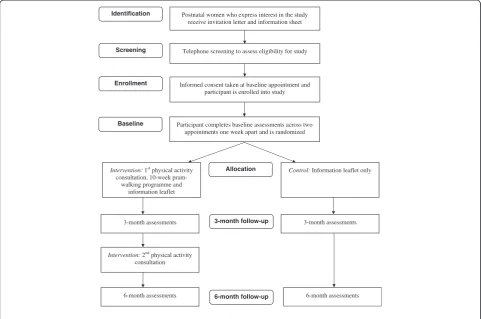
(described below). Following eligibility screening, partici-pants give informed consent and complete baseline out-come assessments. These assessments are repeated at three and six months follow-up (Figure 1). The primary outcome is weekly participation in physical activity
mea-sured via accelerometers. The trial is conducted and
reported according to Consolidated Standards of Report-ing Trials (CONSORT) guidelines [29] and includes psy-chological mediators to identify whether change in physical activity occurs through changes to the hypothe-sized determinants. Acceptability of the intervention is evaluated in a separate study through interviews with participants.
Recruitment
Participants are recruited from two Community Health Partnership (CHP) areas within a larger NHS region. This region provides primary healthcare services for a population of approximately 185,000 adults and the live birth rate within the targeted region is in line with the Scottish average [30]. The two CHPs targeted cover
including a city, suburban towns and villages and more rural regions. Several different recruitment strategies are used in this study, with advice, support and permission from NHS and local government contacts being used to determine allocation of recruitment resources.
Recruitment strategies
In Scotland, every woman with a child under five has a named health visitor. Contact with health visitors usually occurs in the early period after birth (for example,first at 10 to 14 days), at 6 to 8 weeks postnatal and at 3, 4 and 12 months. In this study, health visitors are provided with ad-vertising materials (study leaflet and posters) to give to po-tential participants during routine postnatal care. Popo-tential participants are invited to provide contact details to the Chief Investigator (CI) and request further information
via a postpaid envelope, email or telephone. There is a
study website (www.mammis.weebly.com) and other strat-egies include targeting baby and toddler groups, breast-feeding groups, baby reading sessions within local libraries and baby sensory classes (locally-run franchises running private classes for infants and toddlers, available across the recruitment regions). The CI will also conduct on-site recruitment during baby clinics in specific demographic
areas. This is used in order to encourage participation from less affluent postnatal women who are traditionally less likely to take part in research studies [31]. Other re-cruitment strategies include advertisements in local media, participant recommendations and research staff attending local community-based events.
Eligibility
After women have had the opportunity to review the study information sheet, eligibility is determined through a telephone screening call (Figure 1).
Inclusion criteria
i) Aged 18 years or older
ii) Have given birth in the last year
iii) Have had a six- to eight-week postnatal check-up with a suitable health professional
iv) Insufficiently active at the level required to promote and maintain health (activity levels are assessed using the Stages of Change questionnaire [32]). Participants are advised that regular physical activity means“accumulating at least 30 minutes of
moderate-intensity activity at least five times a week” 3-month assessments 3-month assessments
6-month assessments
Intervention:2nd physical activity consultation
3-month follow-up
6-month follow-up
Identification Postnatal women who express interest in the study receive invitation letter and information sheet
Screening Telephone screening to assess eligibility for study
Enrollment Informed consent taken at baseline appointment and participant is enrolled into study
Participant completes baseline assessments across two appointments one week apart and is randomized Baseline
Intervention:1st physical activity consultation, 10-week
pram-walking programme and information leaflet
Allocation Control: Information leaflet only
[image:3.595.57.539.90.409.2]6-month assessments
[33] and are eligible for inclusion if they are in contemplation (not regularly active but thinking about starting to be in the next six months) or preparation stages (participate in some activity but not enough to be considered regularly physically active).
Exclusion criteria
i) Insufficient English
ii) Pregnancy or those planning to become pregnant in the next six months.
iii) Medical contraindications to physical activity, assessed using the Physical Activity Readiness Questionnaire (PAR-Q) [34].
iv) Stage of physical activity is assessed as precontemplation (not regularly active and no intention to become active in the next six months), action (regularly active in line with guidelines but only began this in the past six months) or maintenance stage (regularly active in line with guidelines and has been so for longer than six months) according to the Stages of Change questionnaire [32]).
No exclusions were made based on characteristics of the baby, that is, women with infants that had been delivered prematurely, had spent time in a special care baby unit and/or had delivered twins or multiple births were eligible for inclusion.
Sample size
Based on calculations carried out by an independent sta-tistician, 31 participants per group are required in order to detect an effect of 63.83 minutes/week of moderate-vigorous physical activity participation. This assumes power of 90%, 5% significance level with a two-sided
un-paired t-test to detect change from pre- to post-test
be-tween the intervention and control group using a pooled standard deviation of 75 minutes/week. This sample size calculation is based on data from a previous study com-paring a 12-week physical activity intervention in insuffi-ciently active breast cancer survivors with usual care [35]. Comparable to the present study, the main out-come in that study was change in weekly minutes of moderate-vigorous intensity physical activity from base-line to three months measured using accelerometers [35]. This study was used as no previous reports of post-natal physical activity promotion interventions had used accelerometers to measure change in physical activity behavior. An increase of 60 minutes of moderate-vigorous physical activity (for example, brisk walking) per week is clinically significant for cardiovascular health
[36]. Assuming a 20% dropout (in line with similar stud-ies [14,17]) up to 76 postnatal women will be sought.
Randomization
Participants are allocated to groups using simple randomization from a computer-generated sequence with block sizes of 4 and 6, generated by an independent per-son. Following sequence generation, group identifier cards were placed into envelopes alongside a piece of card to block the research team from identifying group allocation. Envelopes were sealed and stacked and participants will be assigned an envelope in the order in which they enroll into the study. This is known as sequentially numbered, opaque, sealed envelopes (SNOSE) [37].
Intervention
The intervention consists of a face-to-face physical activ-ity consultation (approximately 45 minutes in length) delivered at the start of a 10-week group pram-walking program. Participants receive a second face-to-face con-sultation (approximately 25 minutes in length) following the three-month assessments. Consultations are struc-tured and individualized counseling sessions that aim to enhance motivation for physical activity and teach parti-cipants self-regulatory strategies associated with adop-tion and maintenance of an active lifestyle [38]. Consultations are structured as they involve a set of standardized techniques but individualized as a
discus-sion focusing on each participant’s personal benefits,
barriers, activity goals and plans, and so on. Exercise
(now described as physical activity) consultations were developed from well-established theoretical models of physical activity change, in particular the Transtheoreti-cal Model (TTM) [38]). Several RCTs have shown indi-vidual and group-based consultations to be effective in the promotion and maintenance of physical activity in non-clinical and clinical groups [39-42]. These studies provided two physical activity consultations, 12 weeks apart, alongside support between consultations, often in the form of telephone support. In the present study, the specific motivational and behavioral intervention techni-ques used have been chosen with reference to research on determinants of postnatal physical activity [24-26] and are drawn from an empirically developed taxonomy of behavior change techniques [43], alongside the many cognitive and behavioral processes of change from the TTM [44] (for example, consciousness raising, stimulus control, and so on.)
The consultations will be conducted at the local
univer-sity or at participants’ homes, depending on preferences,
benefits of increasing physical activity, specific short- and long-term goal-setting, action planning, self-monitoring through weekly diaries and a pedometer and coping plan-ning. Throughout the process of planning and problem-solving barriers to physical activity, participants will dis-cuss suitable local opportunities for activity and be intro-duced to the importance of individual-level environmental restructuring (for example, making plans to meet friends on a day when the car is unavailable) and planning social support for behavior change (for example, ask their part-ner to look after their baby to attend a fitness class). Parti-cipants are also invited to attend one group pram-walking session in their local area each week for 10 weeks. A trained walk leader facilitates these and routes have been mapped and risk-assessed as suitable for mothers with prams. Walks are conducted at a moderate-intensity (for example, brisk pace) for 30 to 55 minutes, plus a five-minute warm up and cool down at the start and end of each session. The pram-walking group provides an oppor-tunity to demonstrate a moderate walking pace, provides further social support and prompts for weekly activity. Participants who anticipate difficulties attending are encouraged during the physical activity consultation, to plan alternative physical activity opportunities in line with their personal activity goals. This allows for mothers with difficulties attending walks (for example, due to childcare commitments for older children, transport difficulties or personal preferences). Participants who do not attend the pram-walking group in the first two weeks will receive a 10-minute support phone call encouraging efforts towards being more active and offering an opportunity for problem solving barriers to adopting their activity plan. Following the three-month follow-up period a second consultation will provide personalized feedback on changes in physical activity participation and use relapse prevention strategies to encourage participants to continue with an active lifestyle.
Further details regarding intervention content and ap-proach to development are available elsewhere (A Gilinsky, unpublished submission). Finally, the interven-tion and control group will both receive a leaflet after
baseline assessments. The“Active living during and after
pregnancy” leaflet was developed by NHS Health
Scotland and provides information on the physical activ-ity guidelines and suitable activities (for example, brisk walking and swimming). The control group will receive no further intervention but will receive standard postna-tal management.
Outcomes
The CI conducts assessments over two appointments during each measurement period (baseline, three and six months), normally a week apart. These take place either
at the university or in participants’homes, depending on
participant preference. The usual order of assessments is demographic details, psychological well-being and fa-tigue, cardiovascular fitness, height (baseline only), weight and body composition, followed by instructions on wearing the accelerometer (appointment one). Parti-cipants return their accelerometer at appointment two where they also complete a questionnaire regarding psy-chological mediators of physical activity and physical ac-tivity participation is assessed using the Seven Day Physical Activity Recall (7-Day PAR) interview.
Physical activity
Physical activity change is measured using Actigraph GT3X and GT3X + accelerometers (Actigraph, Pensa-cola, Florida, USA) Accelerometers are worn during waking hours for seven consecutive days (excluding bathing and swimming) on the right hip, with movement assessed using sampling intervals (epochs) of 60 seconds. Accelerometers have been shown to be reliable and valid measures of physical activity participation in community samples, including overweight or obese adults [45]. Dur-ing the measurement week, participants record wearDur-ing times using a diary. This aids with identifying non-wear periods; defined in this study as a consecutive string of 0 counts for 45 minutes (drop-time tolerance of three minutes). These criteria were developed following testing with a subset of data generated from study participants and is aligned with criteria used in other studies and best practice guidelines [46-48]. Participants with at least four valid days of data monitoring will be considered as having a valid dataset. A second measurement week is used if wear time criteria has not been met during the first measurement week. In this study, percentage wear-time is used for assessing a valid day. Specifically, a day is considered‘valid’if non-missing data are available for at least 70% of common wear-time hours (standardized for the hours each day where at least 70% of participants are found to be wearing the monitor). The benefits of this approach (compared with a more traditional
ap-proach including only days with >10 hours data
recorded [49]) are that incomplete hours can be counted towards total wear-time. Furthermore, women with infants may keep different waking hours from the gen-eral population and may take the accelerometer off and on more frequently (for example, due to sleeping during the day). This approach was used in a recent accelero-metry study conducted among pregnant and postnatal women [47].
Previous research has found that this is a reliable and valid method for measuring habitual physical activity [51]. The 7-Day PAR provides information regarding ac-tivity that is not assessed by the acac-tivity monitors (for
example,swimming). Participants are also asked whether
the activity levels during the previous week were “less
than”,“more than” or“about the same”as the last three months and provide reasons for deviations from normal activity. This explanatory data will aid in interpretation of trial data.
Secondary outcomes
Psychological well-being and fatigue
Psychological well-being is measured using the Adapted General Well-being Index (AGWI) [52]. The original General Well-being Index was developed in the United States and has been adapted for use in the UK. The AGWI consists of 22 items to assess positive well-being, self-control, anxiety and depression, vitality and general health concerns. Each statement is assessed using a
five-point Likert response scale in relation to “the past two
weeks” and a total well-being score is created by
sum-ming questions (negatively worded questions are reverse coded). The AGWI has been shown to have good reli-ability and validity with the Montgomery-Asberg De-pression Rating Scale [53]. It has also been validated within a GP practice sample in the UK against several relevant criterion measures of subjective well-being, in-cluding global health status, reporting of ongoing psy-chological health problems (for example, depression), contact with health professionals, use of antidepressant medicine, tranquillizers or sleeping pills, common psy-chosocial worries or difficulties and having been un-employed in the last year [53]. Fatigue is measured using one question through a visual analogue scale (VAS). Visual analogue scales are a commonly used uni-dimensional method of assessing health status [54]. Par-ticipants place a mark on a 100 mm line to indicate their fatigue levels where no fatigue = 0 and worst pos-sible fatigue = 100. The response category will be whether
or not participants have been “affected by fatigue in the
past two weeks”.
Cardiovascular fitness
Cardiovascular fitness is measured using the Chester Step Test [55]. The Chester Step Test is a sub-maximal fitness test that involves asking participants to step up and down on and off of a standardized step repeatedly in two-minute slots up to a maximum of ten minutes. Stepping rate is determined by a beep that increases after each slot. Participants wear a heart rate monitor (Polar Wearlink WIND chest transmitter, Polar Electro Inc., Lake Success, NY, USA with readings transmitted to a wrist-watch (Polar RS800, Polar Electro Inc., Lake
Success, NY, USA) Heart rate is recorded at the end of each slot and the Rating of Perceived Exertion (RPE)
scale [56] is used to indicate participants’ perception of
activity intensity. The test continues until the participant reaches a heart rate (HR) that is 80% of their age-predicted maximum HR (220-participants age) or until they report an RPE of 14 or above (corresponding to perceiving the activity to be at least “hard”). Cardiovas-cular fitness (aerobic capacity) is predicted using a stan-dardized equation using the number of slots completed and heart rate at termination of the test. The Chester Step Test has good validity as a predictor of cardiovas-cular fitness, measured against a maximal fitness test and it can be used with adults of all ages, including par-ticipants who are sedentary and overweight [55]. The test is conducted according to the Chester Step Test
manual [57] and by using a step size of (8”/20 cm) as
this is recommended for participants aged 40 and under undertaking little regular exercise. Prior to commencing the first test, participants take part in a two-minute familiarization period to avoid them experiencing a learning effect. Standardized encouragement was pro-vided during the test.
Weight, BMI and body composition
Height is measured in centimeters (to the nearest cm) using a stadiometer (Leicester Portable Height Measure, Seca GmBH & Co Kg, Hamburg, Germany). Height readings are taken twice and averaged at the first base-line appointment. Weight and body composition (% fat mass) are measured using the Tanita portable bioelec-trical impedance monitor (Tanita 300MA Tanita Europe B.V., Amsterdam, The Netherlands) according to the
measurement protocol specified in the handbook
(Tanita, technical notes). Weight is measured in kilo-grams (to the nearest 0.1 kg) and BMI computed as the
participant’s weight in kilograms divided by their height
in meters squared (kg/m2).
Psychological mediators
Psychological mediators are measured via a
self-completion questionnaire that has been developed for this study from adapted measures used in previous studies [58-62]. The reliability of all questionnaire items will be
tested in the study using Cronbach’s alpha for each
pro-posed mediator, which are measured using 4 to 7-point Likert scales (for example, very unlikely–very likely,
com-pletely untrue - comcom-pletely trueetc.). Mediators measured
in this study are specifically those targeted by the
inter-vention methods (for example, outcome expectancies,
I’m tired”, and so on.) and outcomes expectancy measures (“If I were regularly physically active during the next three months. . .I would be healthier”and so on.) were sensitive to the most frequent barriers and enablers to activity cited by postnatal women; taken from a survey 667 postnatal women [63]. Intentions are operationalized using one
item:“During the next three months do you intend to be
regularly physically active?”[58]. Action planning is
mea-sured using four items following the stem:“I have made a
detailed plan about being regularly physically active during
the next three months. . .” (for example, how/when/
where/how often). Coping planning, in contrast, asks par-ticipants to rate three items; for example, the extent to which they“have a detailed plan about what to do if things get in the way of them being regularly physically active
during the next three months”. Planning measures have
been validated in previous studies [61]. Six items are used to measure self-regulatory effort, adapted from the action
control questionnaire used by Sniehotta et al. [62].
Ex-ample statements are: “During the last three months. . .I have been aware of how much physical activity I should be doing to meet my personal standards. I have made sure
to monitor how much physical activity I’ve done and I
have tried really hard to be physically active.”
Process measures
In line with CONSORT [29], trial process information will be reported to include information on the number of post-natal women who expressed an interest in joining the study, the numbers who were eligible and drop-outs at each trial stage. Demographic details collected from trial participants will be compared with decliners and ineligible women to assess representativeness in terms of their age,
infant’s age, physical activity stage of change and
deprivation status as measured by the Scottish Index of Multiple Deprivation (SIMD) [64]. To identify whether the intervention is delivered as intended, attendance at pram-walking groups and consultations will be logged and
participants’ use of strategies from the consultations
(intervention group only) will be assessed at three and six months. Approximately 20% of the consultations will be recorded and reviewed by another researcher to assess consistency and fidelity of the intervention delivery. Add-itionally, qualitative in-depth interviews will be used to as-sess the acceptability of the intervention to the target group and assess possible control contamination. A re-searcher who is not involved in the main trial will conduct interviews and participants will be made aware that their comments will be anonymized to avoid the primary re-search team identifying them.
Blinding
Blinding of the CI and participants is carried out at baseline since outcomes are taken prior to group allocation. At
three- and six-month follow-ups, steps have been taken to minimize potential bias from a lack of blinding of the CI. This includes using objective measures to assess physical activity, fitness weight and body composition according to standardized protocols. Other secondary outcomes are assessed through self-administered questionnaires.
Data analysis
Actilife 5 will be used to analyze accelerometer data in
the following ways: ‘raw’ accelerometry output (that is,
counts per minute (cpm) averaged over the measure-ment period), time (minutes) spent in moderate to vigor-ous intensity physical activity per week, continuvigor-ous bouts of at least 10 minutes of moderate-vigorous phys-ical activity (MVPA) and, percentage of time spent in MVPA. The calculation of MVPA is based on accepted cut-points for adult women in free-living conditions [65-67]. However, there is wide variation in the ability of cut-point equations to accurately assess physical activity in different intensity zones. Cpm is, therefore, an im-portant measure as it provides an estimate of change in total physical activity and has been validated in free-living conditions against criterion methods, such as en-ergy expenditure [68].
Trial data will be analyzed according to intention-to-treat principles with all participants included according to initial group allocation. To minimize the number of statistical tests conducted, Analysis of Covariance (ANCOVA) will be used with a repeated measures de-sign and group allocation as a between groups factor. Covariates, which have been shown to influence physical activity participation, will be included (for example,
par-ticipant’s age, participant’s BMI and physical activity
stage of change). Population-specific covariates (for
ex-ample, infant’s age and number of children, and so on)
will also be added to the model. Bonferroni post-hoc
Ethical approval
This study received favorable ethical approval from NHS Fife and Forth Valley Research Ethics Committee and from the School of Nursing, Midwifery and Health Re-search Ethics Committee, University of Stirling.
Discussion
Results from this study will be available by the end of 2012. The strengths of this study include the use of a ran-domized, controlled design, objective measures of physical activity change and a three-month post-intervention follow-up point (six months from baseline). Using this ap-proach, the MAMMiS study will address many of the methodological shortcomings of previous trials. Results from this study may also provide valuable information to inform future physical activity promotion studies with postnatal women. In particular, this trial will provide ten-tative evidence on the efficacy of a motivational and be-havioral intervention including group pram-walking in a UK-setting. As the intervention techniques used in this study have been defined according to previously published taxonomies [43,44] (for specific details on intervention techniques please contact A Gilinsky), the intervention will be easily reproducible. The intervention is potentially generalizable as two physical activity consultations and a 10-week group pram-walking program conducted locally, once per week is at a reasonably low intensity and the intervention could be delivered by a suitably trained per-son. However, as the present study tests the efficacy of the intervention at a single-site (assessments and interven-tions are carried out by a single investigator), further test-ing across multiple sites would be required to address intervention effectiveness in other contexts (for example, different populations, delivery by different researchers/ practitioners).
Other strengths of this study include: conducting me-diation analysis to help identify whether psychological constructs targeted through the intervention were in fact responsible for changes in physical activity behavior; in-cluding health and well-being measures enabling infor-mation to be gathered on the potential impact of physical activity change, which may aid in sample size calculations for future studies interested in these out-comes; and finally, the inclusion of a qualitative arm at the end of the trial will help assess intervention accept-ability among postnatal women. These features, along-side outcome and process data, will help advance our understanding of physical activity behavior change in postnatal populations.
Conclusions
Physical activity is important for postnatal health and well-being as well as helping to tackle preventable deaths and improve morbidity outcomes and quality of life
through preventing or postponing onset of chronic ical and psychological health conditions. Positive phys-ical activity habits adopted during the postnatal period may also go some way to addressing age-related decline in physical activity found among young and middle-aged women [71]. Thus, the findings from the MAMMiS study will be of great interest to policy makers, health
professionals and intervention program planners
involved in promoting participation in physical activity, particularly among women in the year after childbirth.
Trial status
This is an active trial. At the date of submission 65 parti-cipants were successfully enrolled.
Abbreviations
7-Day PAR: Seven day physical activity recall; AGWI: Adapted general well-being index; ANCOVA: Analysis of covariance; CI: Chief Investigator; CHD: Coronary heart disease; CHP: Community health partnership; CONSORT: Consolidated standards of reporting trials; HR: Heart rate; MAMMiS: More active mums in Stirling; MVPA: Moderate-vigorous physical activity; NHS: National health service; PAR-Q: Physical activity readiness questionnaire; PND: Postnatal depression; RCT: Randomized controlled trial; RPE: Rating of perceived exertion; SIMD: Scottish index of multiple deprivation; VAS: Visual analogue scale.
Competing interests
The authors declare no competing interests.
Authors’contributions
ASG is a PhD student and CI for the MAMMiS study with responsibility for the development, conduct and reporting of study. ARH and RJMcI are supervisors to ASG. ARH conceived the original idea and secured funding for the original study proposal. All authors read and approved the final version of the manuscript.
Acknowledgements
The authors would like to gratefully acknowledge the funding provided for the MAMMiS trial by the School of Nursing, Midwifery and Health and the School of Sport, both University of Stirling. The costs relating to post-trial interviews have been funded by the Chief Scientist’s Office, Scotland. Also the CI received walk-leader training and support with risk assessment through Paths for all: www.pathsforall.org.uk and Active Stirling: www. activestirling.org.uk.
Author details
1Sport, Health and Exercise Sciences Research Group, School of Sport,
University of Stirling, Stirling, Scotland FK9 4LA, UK.2Maternal and Child Health Research Group, School of Nursing, Midwifery and Health, University of Stirling, Stirling, Scotland FK9 4LA, UK.
Received: 27 March 2012 Accepted: 28 June 2012 Published: 20 July 2012
References
1. Pivarnick JM, Chambliss HO, Clapp JF, Dugan SA, Hatch MC, Lovelady CA, Mottola MF, Williams MA:Impact of physical activity during pregnancy and postpartum on chronic disease risk. Roundtable Consensus Statement.Med Sci Sports Exerc2006,38:989–1006.
2. Artal R, O’Toole M:Guidelines of the American College of Obstetricians and Gynecologists for exercise during pregnancy and the postpartum period.Br J Sports Med2003,37:6–12.
3. Sampselle CM, Seng J, Yeo S, Killion C, Oakley D:Physical activity and postpartum well-being.J Obstet Gynecol Neonatal Nurs1999,28:41–49. 4. Armstrong K, Edwards H:The effectiveness of a pram-walking exercise
5. Drista M, Da Costa D, Dupuis G, Lowensteyn I, Khalife S:Effects of a home-based exercise intervention on fatigue in postpartum depressed women: results of a randomized controlled trial.Ann Behav Med2008,35:175–187. 6. Amorim AR, Linne YM, Lourenco PMC:Diet or exercise, or both, for weight
reduction in women after childbirth.Cochrane Database Syst Rev2007: CD005627.
7. Danaei G, Ding EL, Mozaffarian D, Taylor B, Rehm J, Murray CJ, Ezzati M:The preventable causes of death in the United States: comparative risk assessment of dietary, lifestyle, and metabolic risk factors.PLoS Med
2009,6:e1000058. Erratum in:PLoS Med2011, 8(1).
8. Hardman AE, Stensel DJ:Physical Activity and Health: The Evidence Explained. 2nd edition. London: Routledge, Taylor and Francis; 2009.
9. Clarke KK, Freeland-Graves J, Klohe-Lehman DM, Milani TJ, Nuss HJ, Laffrey S:
Promotion of physical activity in low-income mothers using pedometers.
J Am Diet Assoc2007,107:962–976.
10. Farenwald NL, Atwood JR, Walker SN, Johnson DR, Berg K:A randomized pilot test of“Moms on the Move”: a physical activity intervention for WIC mothers.Ann Behav Med2004,27:82–90.
11. Miller YD, Stewart BA, Trost SG, Brown WJ:Mediators of physical activity behavior change among women with young children.Am J Prev Med
2002,23:98–103.
12. Albright CL, Maddock JE, Nigg CR:Increasing physical activity in postpartum multiethnic women in Hawaii: Results from a pilot study.
BMC Womens Health2009,9:4.
13. Armstrong K, Edwards H:The effects of exercise and social support on mothers reporting depressive symptoms: a pilot randomized controlled trial.Int J Ment Health Nurs2003,12:130–138.
14. Cramp AG, Brawley LR:Moms in motion: A group-mediated cognitive-behavioral physical activity intervention.Int J Behav Nutr Phys Act2006,
3:23.
15. Da Costa D, Lowensteyn I, Abrahamowicz M, Ionescu-Ittu R, Dritsa M, Rippen N, Cervantes P, Khalifé S:A randomized clinical trial of exercise to alleviate postpartum depressed mood.J Psychosom Obstet Gynaecol2009,
30:191–200.
16. Daley AJ, Winter H, Grimmett C, McGuinness M, McManus R, MacArthur C:
Feasibility of an exercise intervention for women with postpartum depression: a pilot randomized controlled trial.British J Gen Pract2008,
58:178–183.
17. Fjeldsoe BS, Miller YD, Marshall AL:MobileMums: a randomized controlled trial of an SMS-based physical activity intervention.Ann Behav Med2010,
39:101–111.
18. Watson N, Milat AJ, Thomas M, Currie J:The feasibility and effectiveness of pram walking groups for postpartum women in western Sydney.Health Promot J Austr2005,16:93–99.
19. Symons Downs D, Hausenblas HA:Women's exercise beliefs and behaviors during their pregnancy and postpartum.J Midwifery Womens Health2004,49:138–144.
20. Wilkinson S, Huang CM, Walker LO, Sterling BS, Kim M:Physical activity in low-income postpartum women.J Nurs Scholarsh2004,36:109–114. 21. Albright C, Maddock JE, Nigg CR:Physical activity before pregnancy and
following childbirth in a multiethnic sample of healthy women in Hawaii.Women Health2005,42:95–110.
22. Treuth MS, Nutte NF, Puya M:Pregnancy-related changes in physical activity, fitness and strength.Med Sci Sports Exerc2005,37:832–837. 23. Cramp AG, Bray SR:Pre- and postpartum women’s leisure time physical
activity patterns: a multilevel longitudinal analysis.Res Q Exerc Sport2009,
80:403–411.
24. Pereira MA, Rifas-Shiman SL, Kleinman KP, Rich-Edwards JW, Peterson KE, Gillman MW:Predictors of change in physical activity during and after pregnancy: Project Viva.Am J Prev Med2007,32:312–219.
25. Cramp AG, Brawley LR:Sustaining self-regulatory efficacy and psychological outcome expectations for postnatal exercise: Effects of a group-mediated cognitive behavioural intervention.Br J Health Psychol
2009,14:595–611.
26. McIntyre CA, Rhodes RE:Correlates of leisure-time physical activity during transitions to motherhood.Women Health2009,49:66–83.
27. Currie J, Boxer E, Devlin E:Pramwalking as postpartum exercise and support: an evaluation of the Stroll Your Way To Well-Being program and supporting resources in terms of individual participation rates and community group formation.Aust J Midwifery2001,14:21–25.
28. Michie S, Abraham C:Interventions to change health behaviors: evidence-based or evidence-inspired?Psychol Health2004,19:29–49. 29. Moher D, Hopewell S, Schulz KF, Montori V, Gotzsche PC, Devereaux PJ,
Elbourne D, Egger M, Altman DG:CONSORT 2010 explanation and elaboration: updated guidelines for reporting parallel group randomized trials.BMJ2010,340:c869.
30. ScotPho:Health and wellbeing profiles. Forth Valley Health Summary: ScotPho; 2008.
31. Goodman A, Gatward R:Who are we missing? Area deprivation and survey participation.Eur J Epidemiol2008,23:379–387.
32. Marcus BH, Simkin LR:The stages of exercise behavior.J Sport Med Phys Fit
1993,33:83–88.
33. Haskell WL, Lee I, Pate RR, Powell KE, Blair SN, Franklin BS, Macera CA, Heath GW, Thompson PD, Bauman A:Physical activity and public health: updated recommendations for adults from the American College of Sports Medicine and the American Heart Association.Med Sci Sports Exerc
2007,39:1423–1434.
34. Thomas S, Reading J, Shephard RJ:Revision of the Physical Activity Readiness Questionnaire (PAR-Q).Can J Sport Sci1992,17:338–345. 35. Rogers LQ, Hopkins-Price P, Vicari S, Markwell S, Pamenter R, Courneya KS,
Hoelzer K, Naritoku C, Edson B, Jones L, Dunnington G, Verhulst S:Physical activity and health outcomes three months after completing a physical activity behavior change intervention: Persistent and delayed effects.
Cancer Epidemiol Biomarkers Prev2009,18:1410–1418.
36. Manson JE, Hu FB, Rich-Edwards JW, Colditz GA, Stampfer MJ, Willett WC, Speizer FE, Hennekens CH:A prospective study of walking as compared with vigorous exercise in the prevention of coronary heart disease in women.New Engl J Med1999,26:650–658.
37. Doig GS, Simpson F:Randomization and allocation concealment: a practical guide for researchers.J Crit Care2005,20:187–191.
38. Loughlan C, Mutrie N:Conducting an exercise consultation: guidelines for health professionals.Int J Health Res1995,33:78–82.
39. Lowther M, Mutrie N, Scott EM:Promoting physical activity in a socially and economically deprived community: a 12 month randomized control trial of fitness assessment and exercise consultation.J Sports Sci2002,
20:577–588.
40. Baker G, Gray SR, Wright A, Fitzsimons C, Nimmo M, Lowry R, Mutrie N:The effect of a pedometer-based community walking intervention "Walking for Wellbeing in the West" on physical activity levels and health outcomes: a 12-week randomized controlled trial.Int J Behav Nutr Phys Act2008,5:44.
41. Kirk A, Mutrie N, MacIntyre PD, Fisher M:Effects of a 12-month physical activity counselling intervention on glycaemic control and on the status of cardiovascular risk factors in people with type 2 diabetes.Diabetologia
2004,47:821–832.
42. Hughes AR, Mutrie N, MacIntyre PD:Effect of an exercise consultation on maintenance of physical activity after completion of phase III exercise-based cardiac rehabilitation.Eur J Cardio Prev Rehabil2007,14:114–121. 43. Michie S, Ashford S, Sniehotta FF, Dombroawski SU, Bishop A, French DP:A
refined taxonomy of behaviour change techniques to help people change their physical activity and healthy eating behaviours: the CALO-RE taxonomy.Psychol Health2011,26:479–498.
44. Hughes AR, Mutrie N:Maintaining physical activity in cardiac rehabilitation. InExercise Leadership in Cardiac Rehabilitation. An Evidence-Based Approach. Edited by Thow M. Chichester: Wiley; 2006:195–219. 45. Tudor-Locke C, Brashear MM, Johnson WD, Katzmarzyk PT:Accelerometer
profiles of physical activity and inactivity in normal weight, overweight, and obese U.S. men and women.Int J Behav Nutr Phys Act2010,7:60. 46. Sharpe PA, Wilcox S, Rooney LJ, Strong D, Hoplins-Campbell R, Butel J,
Ainsworth B, Parra-Medina D:Adherence to accelerometer protocols among women from economically disadvantaged neighborhoods.J Phys Act Health2011,8:699–706.
47. Evenson KR:Towards an understanding of change in physical activity from pregnancy through postpartum.Psychol Sport Exerc2011,12:36–45. 48. Trost SG, McIver KL, Pate RR:Conducting accelerometer-based activity
assessments in field-based research.Med Sci Sports Exerc2005,
37:S531–543.
49. Centers for Disease Control and Prevention:National Health and Nutrition Examination Survey (NHANES); http://www.cdc.gov/nchs/nhanes.htm. 50. Sallis JF, Haskell W, Wood P:Physical activity assessment methodology in
51. Jacobs DR, Ainsworth BE, Hartman TJ, Leon AS:A simultaneous evaluation of 10 commonly used physical activity questionnaires.Med Sci Sports Exerc2003,25:81–91.
52. Hunt SM, McKenna SP:A British adaptation of the general well-being index: A new tool for clinical research.J Med Econ1992,2:49–60. 53. Hopton JL, Hunt SM, Shiels C, Smith C:Measuring psychological
well-being. the adapted general well-being index in a primary care setting: A test of validity.Fam Pract1995,12:452–460.
54. Bowling A:Measuring Health: A Review of Quality of Life Measurement Scales. Berkshire: Open University Press; 2005.
55. Sykes K, Roberts A:The Chester Step Test - a simple yet effective tool for the prediction of aerobic capacity.Physiotherapy2004,90:183–188. 56. Borg GAV:Borg’s Rating of Perceived Exertion and Pain Scales. Champaign, IL:
Human Kinetics; 1998.
57. Sykes K:The Chester Step Test.: ASSIST Creative Resources Limited; 1999. 58. Ajzen I:The theory of planned behavior.Organ Behav Hum Dec Process
1991,50:179–211.
59. Marcus BH, Rakowski W, Rossi JS:Assessing motivational readiness and decision making for exercise.Health Psychol1992,11:257–261. 60. Marcus BH, Selby VC, Niaura RS, Rossi JS:Self-efficacy and the stages of
exercise behavior change.Res Q Exerc Sport1992,63:60–66.
61. Sniehotta F, Schwarzer R, Scholz U, Schuz B:Action planning and coping planning for long-term lifestyle change: theory and assessment.Eur J Soc Psychol2005,35:565–576.
62. Sniehotta F, Scholz U, Schwarzer R:Bridging the intention-behavior gap: planning, self-efficacy, and action control in the adoption and maintenance of physical exercise.Psychol Health2005,20:143–160. 63. Evenson KR, Moos MK, Carrier K, Siega-Riz AM:Perceived barriers to
physical activity among pregnant women.Matern Child Health J2009,
13:364–375.
64. Scottish Government:Scottish Index of Multiple Deprivation (SIMD); http:// www.scotland.gov.uk/Topics/Statistics/SIMD.
65. Freedson PS, Melanson E, Sirard J:Calibration of the Computer Science and Applications, Inc accelerometer.Med Sci Sports Exerc1998,
30:777–781.
66. Swartz A, Strath S, Bassett S, O'Brien W, King G, Ainsworth B:Estimation of energy expenditure using CSA accelerometers at hip and wrist sites.
Med Sci Sports Exerc2000,32:S450–S456.
67. Troiano R, Berrigan D, Dodd K, Masse L, Tilert T, McDowell M:Physical activity in the United States measured by accelerometer.Med Sci Sports Exerc2008,40:181–188.
68. Crouter SE, Churilla JR, Bassett JR:Estimating energy expenditure using accelerometers.Eur J Appl Physiol2006,98:601–612.
69. Preacher KJ, Hayes AF:SPSS and SAS procedures for estimating indirect effects in simple mediation models.Behav Res Methods Instrum Comput
2004,36:717–731.
70. Baron RM, Kenney DA:The moderator-mediator variable distinction in social psychological research: conceptual, strategic and statistical considerations.J Pers Soc Psychol1986,51:1173–1182.
71. Corbett J, Dobbie F, Doig M, D'Souza J, Given L, Gray L, Leyland A, MacGregor A, Marryat L, Maw T, Miller M, Mindell J, Ormston R, Marilyin Roth M, Sharp C:Scottish Health Survey 2009.: Scottish Government; 2010.
doi:10.1186/1745-6215-13-112
Cite this article as:Gilinskyet al.:More Active Mums in Stirling (MAMMiS): a physical activity intervention for postnatal women. Study
protocol for a randomized controlled trial.Trials201213:112.
Submit your next manuscript to BioMed Central and take full advantage of:
• Convenient online submission
• Thorough peer review
• No space constraints or color figure charges
• Immediate publication on acceptance
• Inclusion in PubMed, CAS, Scopus and Google Scholar
• Research which is freely available for redistribution