ISSN: 1992-8645 www.jatit.org E-ISSN: 1817-3195
EFFECT OF AVERAGE-THROUGHPUT WINDOW SIZE ON
PROPORTIONAL FAIR SCHEDULING FOR RADIO
RESOURCES IN LTE-A NETWORKS
SAMEH MUSLEH1, MAHAMOD ISMAIL2, AND ROSDIADEE NORDIN3
Faculty Of Engineering And Built Environment, National University Of Malaysia, 43600, Bangi, Selangor, Malaysia.
[email protected], [email protected], [email protected]
ABSTRACT
The Proportional Fair (PF) scheduling technique is well known technique that is used to schedule radio resources at the mobile base station to the end-users. An efficient scheduling for radio resources in the physical layer of LTE-A base stations is challenging due to the high demand for various types of 4G wireless services such as VOIP calls, online gaming, HDTV, etc. In this paper, we derive the average-throughput window size (TPF) formulas for LTE-A PF Scheduler, and then we investigate the effect of TPF size on the performance and fairness of PF Scheduler for LTE-A network. Both of downlink system-level (SL) simulator and link-level (LL) simulator are used to evaluate the scheduler performance for different TPF configurations. The simulation results showed that the long TPF improves both of UE (User Equipment)
throughput and cell (eNodeB) throughput, however the achieved scheduler fairness in this case is low. On the other hand, the short TPF showed degradation in both of UE and cell throughput, but offers higher fairness values for the PF scheduler.
Keywords: 4G cellular networks, wireless communications, LTE-A, scheduling algorithms
1.INTRODUCTION
The development of information and communication technology is growing rapidly; similarly, the demand on technology is increasing every year. In recent years, many mobile data services such as mobile HDTV, video and file sharing, location-based services and worldwide social networking have grown very fast. End user requirement and demand for higher download and upload speeds are increasing. The investment by the top 25 worldwide operators in LTE and LTE-A infrastructure is estimated to be $14 billion USD in 2015 [1]. LTE-A is the 4G technology that is proposed by 3GPP to fulfil the demand and requirements of end users [1].
The peak user throughput requirement for LTE (Release 8), as the 3GPP standard, is a minimum of 100 Mbps for downlink and 50 Mbps for uplink using channel bandwidth of 20 MHz [2]. The new standard of LTE technology is the LTE-Advance (LTE-A). It is initiated in 3GPP Release 10, and provides peak user throughput of 1 Gbps for downlink and 500 Mbps for uplink. The LTE-A
ISSN: 1992-8645 www.jatit.org E-ISSN: 1817-3195
The average-throughput window size (TPF) is used by the eNodeB scheduler to average the end-user throughput. The eNodeB scheduler updates the new end-user throughput reading every 1 ms, and use it to decide whether to allocate more RBs to the end-user or not to allocate. TPF is explained in previous publications [5-7]; however, none clearly analyzed or investigated the configuration of TPF for LTE-A specifically. In this paper, the formulas of TPF (measured in TTIs or milliseconds) for PF scheduling algorithm will be derived in section IV. As well, the performance of PF scheduling algorithm for LTE-A with focus on TPF size will be analyzed in section V and section VI.
2. PROPORTIONALFAIRSCHEDULER
BASEDAPPROACH
The PF scheduler in Eq.1 pursues the maximum throughput for each user equipment (UE), while maintaining fair allocation of resource blocks (RBs) for all UEs[1].
1
1 , ,
1 , ! (1)
where: k: UE index
n: Resource Block (RB) index
: Past average throughput of UEk , : Estimated throughput of UEk and RBn
The UEs are assigned a portion of the available bandwidth by the scheduler according to the value of in the priority function which is shown in Eq. 2. The assignment of RBs continues until the downlink bandwidth is completely used or all the required RBs have been assigned and the UEs become satisfied.
arg %&
'(,) *'( *
(2)
The processes of assigning resource blocks (RBs) to UEs by the PF scheduler are summarized as follows:
1: For UEs (1: Total number of active UEs) and RBs (1: Total number of RBs )
2: Calculate priority ( i ) based on Equation 2 3: For k= 1: Total number of active UEs 4: Pick UEk with maximum (i)
5: Assign RBn to UEk
6: Update the throughput for UEk
7: If UEk hasn’t maximum (i)
8: Check (i) for UEk+1
9: Assign RBn to UEk+1
10: Update the throughput + for UEk+1
11: End If 12: End For
13: If all active UEs are satisfied or all RBs are assigned 14: Stop scheduling RBs for current time slot (TTI) 15: Else
16: Repeat step 2 17: End If 18: End For
Fig. 1. Proportional Fair Scheduling Algorithm
The fairness of PF scheduler is calculated based on the end-user throughput, it aims to provide the same throughput to all end-users and can be adjusted by configuring appropriate TPF size which should be in reasonable range. The scheduler fairness is defined by the Fairness Index (J) as follows [8]:
Fairness Index (J)
=
,∑/.01'.234 ∑/.01'.3
(3)
where:
w: Total number of UEs. R: Instant UE throughput.
3. DEFINITION OF
AVERAGE-THROUGHPUTWINDOWSIZE(TPF)FOR LTE-APFSCHEDULER
The TPF is PF scheduler feature which is used by the eNodeB in order to estimate the average throughput for each UE. A previous study [9] mentioned that the average-throughput window size (TPF) should have large value in comparison with the scheduling period (1 ms). However, the large TPF will not fulfil the real-time system purposes because the scheduling priority (i) for PF scheduler is defined as the ratio of the instant UE throughput and the achieved UE throughput to date.
In [7], both of finite and infinite TPF have been discussed and simulated with different SINR values for limited-interference OFDMA network. The results showed different values of data rate that are achieved by changing the scheduler TPF size.
ISSN: 1992-8645 www.jatit.org E-ISSN: 1817-3195 LTE-A frame which is 10 ms. If the downlink
scheduler takes few seconds to adjust the fairness among all users, then it should be sufficient[10]. This rule in scheduling will allow the scheduler to utilise the time variation in order to increase the end-user throughput and fairness.
4. DERIVATION OF
AVERAGE-THROUGHPUTWINDOWSIZE(TPF)
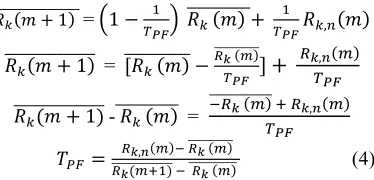
There are two formulas for TPF that we derived from Eq.1. The first formula is applied when the scheduler selects user k in order to be assigned specific resource block (RB). In this case, the derivation of TPF will be as follows:
1 = 1 ,
1 = , '( *
]
'(,) *
1 - = 5'( * + '(,) *
678 ' '((,)*+ 5 '* 5 '( ( **
(4)
In Eq.5 is the second derived formula for TPF which is applied when user k is not requesting any more bandwidth (RBs). In this case, the PF scheduler will continue to update the user k throughput according to the past throughput reading , and without considering any new throughput reading , . As a result, the formula of 678 in this case will be different from the first formula in Eq.4 and it is derived as follows:
R< m 1 = 1 >
?@ R< m
1 -
=
'( *6AB ' '( *
( * 5'(*+
(5)
5. SIMULATION SCENARIOS OF THE
DERIVED AVERAGE-THROUGHPUT
WINDOWSIZE(TPF)
In order to show the PF scheduler’s performance with different TPF configurations for LTE-A, both of Vienna link-level (LL) and system-level (SL) simulators are used [11-13]. In the first simulation scenario, a link-level simulation is configured with
single eNodeB station. The eNodeB has 500 meters radius, comprises three sectors with bandwidth of 5 MHz for each sector. The number of UEs at each sector is 10, all of them are stationary and distributed randomly within the sector. The purpose of this scenario is to simulate LTE-A downlink with Proportional Fair scheduler that uses two different sizes of TPF. The rest of simulation parameters are explained in Table 1.
The second simulation scenario is a system-level (SL) simulation which consists of one cluster of seven eNodeBs. The effect of inter-cell interference and co-channel interference is considered and simulated for LTE-A cluster. Each sector at each eNodeB is configured with bandwidth of 20 MHz and Winner channel model. The other system parameters for the second scenario are explained in Table 1.
The TPF is configured in both scenarios with two sizes; 20 ms and 70 ms, which is equivalent to 20 and 70 TTIs consecutively. This configuration were chosen based on [9] where it is shown that in multi-user multi carrier systems, the TPF values which are lower than 40 ms is giving low outage probability, while the TPF values in the range of 40 ms to 100 ms is showing higher outage probability.
6. RESULTSANDDISCUSSION
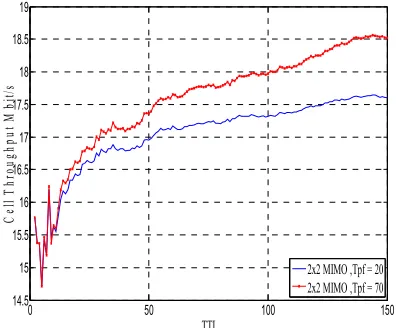
Our simulation results showed improved throughput rate that is achieved from all simulation scenarios when TPF is configured to have 70 ms length. The PF scheduler was able to maximise the cell throughput for both of 2x2 and 4x4 MIMO channels as shown in Fig. 2 and Fig. 3.
TABLE 1. SIMULATION PARAMETERS FOR SCENARIO 1 AND 2
Parameter Name Parameters of scenario 1 Parameters of scenario 2
Number of eNodeBs 1 7
Number of UEs 10 15
Bandwidth 5 MHz 20 MHz
Channel type Flat Rayleigh Winner
Simulation length 150 Sub-frames 1000 Sub-frames
Transmission mode CLSM with 2x2 and 4x4 MIMO Channel
Scheduler Type Proportional Fair
TPF Size 20 and 70 TTIs
[image:3.612.111.298.299.389.2]ISSN: 1992-8645 www.jatit.org E-ISSN: 1817-3195 Our derived equations, Eq.4 and Eq.5, are
[image:4.612.317.526.55.261.2]supporting the simulation results. Let us assume in Eq.4 that the throughput for one Resource Block , equals to 1.008 Mbps, the previous UE throughput reading equals to 10 Mbps, and the TPF is 20 ms. Then, the calculated UE throughput 1 for user k will be equal to 9.55 Mbps. On the other hand, if the TPF is assumed to have 70 ms length, the calculated new UE throughput 1 for user k will be equal to 9.87 Mbps, which is higher than the first case where 20 ms TPF is used. By comparing both cases, we find that the eNodeB is reading higher UE throughput 1 with TPF length of 70 ms as calculated above, and the higher UE throughput will contribute to increase the cell throughput towards higher values as shown in Fig. 2 and Fig. 3. The resulted cell throughput from the simulation which is shown in Fig. 2 and Fig. 3, is matching our conclusion here, it is showing higher cell throughput when TPF of 70 ms length is configured.
Fig. 2. Cell Throughput For Two TPF Configurations, 20 And 70 Ttis With 2x2 MIMO Channel
Fig. 3. Cell Throughput For Two TPF Configurations, 20 And 70 Ttis With 4x4 MIMO Channel
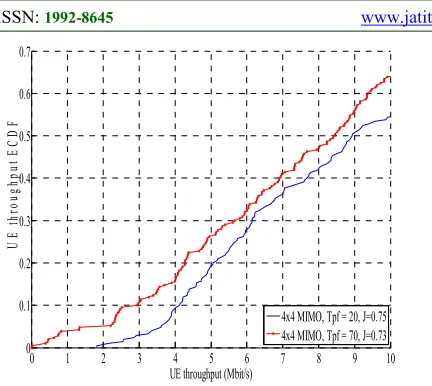
[image:4.612.96.294.349.513.2]The scheduler fairness (J) has been analysed in Fig. 4 and Fig. 5, it showed higher fairness index (J) for TPF length of 20 ms, meanwhile it showed lower fairness index (J) for TPF length of 70 ms.
Fig. 4. Scheduler Fairness-Index (J) For Two TPF Configurations; 20 And 70 Ttis With 2x2 MIMO Channel
0 50 100 150
14.5 15 15.5 16 16.5 17 17.5 18 18.5 19
TTI
C
el
l
T
h
ro
u
g
h
p
u
t
M
b
it
/s
2x2 MIMO ,Tpf = 20 2x2 MIMO ,Tpf = 70
0 50 100 150
25.6 25.8 26 26.2 26.4 26.6 26.8 27 27.2 27.4
TTI
C
el
l
T
h
ro
u
g
h
p
u
t
M
b
it
/s
4x4 MIMO ,Tpf = 20 4x4 MIMO ,Tpf = 70
0 1 2 3 4 5 6 7 8 9 10
0 0.2 0.4 0.6 0.8 1
UE throughput (Mbit/s)
U
E
t
h
ro
u
g
h
p
u
t
E
C
D
F
[image:4.612.320.515.356.521.2]ISSN: 1992-8645 www.jatit.org E-ISSN: 1817-3195
Fig. 5. Scheduler fairness-index (J) for two TPF
configurations; 20 and 70 TTIs with 4x4 MIMO channel
It is concluded from the fairness results that configuring the PF scheduler with short TPF will make the scheduler aware about the current throughput for each UE in a shorter time. As a result, the PF scheduler will make faster decisions in increasing the throughput for the UEs who have poor throughput by allocating more RBs to them, so the scheduler will be able to provide better fairness in allocating the available bandwidth for the users (UEs) instantly once they need it. The fairness results are summarized in Table 2.
TABLE 2.TABULAR SIMULATION RESULTS FOR THE SCHEDULER FAIRNESS-INDEX (J)
7.CONCLUSION
In this paper, we derived the average-throughput window size (TPF) formulas for PF scheduler of LTE-A eNodeB. The effect of TPF size on the fairness and the throughput of LTE-A PF scheduler has been analysed. There was trade-off between maximising the end-user or cell throughput and improving the fairness of PF scheduler.
The results showed that LTE-A PF scheduler with large TPF size, is able to maximise the end-user and cell throughputs much better than PF scheduler with small TPF size. On the other hand, the fairness of PF scheduler showed improvement when small TPF size is utilized.
REFERENCES:
[1] Z. Tang, "Traffic Scheduling for LTE Advanced," Linköpings university, 2010.
[2] I. Toufik, M. Baker, and S. Sesia, “LTE – The UMTS Long Term Evolution” vol. 1, 2009. [3] 3GPP, "Evolved Universal Terrestrial Radio
Access (E-UTRA): Radio Resource Control (RRC) (Release 9),” 3GPP, TS 36.331, V9.14.1 ed, 2013. [4] H. Bang, T. Ekman, and D. Gesbert, "A channel
predictive proportional fair scheduling algorithm," in Signal Processing Advances in Wireless Communications, 2005 IEEE 6th Workshop on, 2005, pp. 620-624.
[5] K. Shanmugam and G. Caire, "Wireless downloading delay under proportional fair scheduling with coupled service and requests: An approximated analysis," in Information Theory Proceedings (ISIT), 2012 IEEE International Symposium on, 2012, pp. 2841-2845.
[6] A. Seongwoo, L. Seokwon, K. Kyungho, and H. Daesik, "Analysis of proportional fair scheduling in OFDMA systems with delay QoS constraints," in Communications (APCC), 2010 16th Asia-Pacific Conference on, 2010, pp. 255-260. [7] D. Parruca, S. G¨ortzen, and J. Gross, "Analytical
Model of Proportional Fair Scheduling in Interference-limited OFDMA/LTE Networks," 2013.
[8] D. Chiu, J. Rajendra, and W. Hawe, "A Quantitative Measure of Fairness and Discrimination for Resource Allocation in Shared Computer Systems," 1984.
[9] L. Yeol, K. Mingyu, S. Jin, and K. Soon, "The modified proportional fair scheduling algorithms for real-time applications in multiuser multicarrier systems," in Military Communications Conference, 2009. MILCOM 2009. IEEE, 2009, pp. 1-6. [10] T. Girici, C. Zhu, J. Agre, and A. Ephremides,
"Proportional fair scheduling algorithm in OFDMA-based wireless systems with QoS constraints," Journal of Communications and Networks, vol. 12, pp. 30-42, 2010.
[11] Y. Zaki, N. Zahariev, T. Weerawardane, C. Görg, and A. Timm-Giel, "Vienna LTE/LTE-A System Level Simulator," Institute of Telecommunications, Vienna, v1.7r1119, 2013. [12] Y. Zaki, N. Zahariev, T. Weerawardane, C. Görg,
and A. Timm-Giel,, "Vienna LTE/LTE-A Link Level Simulator," Institute of Telecommunications, Vienna, v1.2r1546, 2012. [13] D. Mannani, "Modeling and Simulation of
Scheduling algorithms in LTE Networks," January 2012.
0 1 2 3 4 5 6 7 8 9 10
0 0.1 0.2 0.3 0.4 0.5 0.6 0.7
UE throughput (Mbit/s)
U
E
t
h
ro
u
g
h
p
u
t
E
C
D
F
4x4 MIMO, Tpf = 20, J=0.75 4x4 MIMO, Tpf = 70, J=0.73
TPF Size
Fairness Index (J)
2x2 MIMO Channel 4x4 MIMO Channel
20 0.81 0.75