165
OFF-LINE SIGNATURE VERIFICATION SYSTEM BASED
ON DWT AND COMMON FEATURES EXTRACTION
1HAZEM HIARY,RAJA ALOMARI, THAEER KOBBAEY, RADI Z. AL-KHATIB,
(MOHAMMAD AIHAM) AL-ZU’BI, HASHEM HASAN
King Abdullah II School for Information Technology, The University of Jordan, Amman, Jordan
E-mail: 1[email protected]
ABSTRACT
This paper presents an off-line signature verification system that aims at verifying Arabic and Persian signatures. Arabic and Persian signatures have commonality in shapes, fine and general details. Moreover, both have unique general features that distinguish them from other signatures. The proposed system is based on Discrete Wavelet Transform (DWT) to extract common features to aid the verification step. This system consists of four steps: preprocessing, signature registration, feature extraction, and signature verification. Results show that the proposed system achieved good verification measures with low false acceptance rate (FAR) of 1.56%, and low average error rate of 6.23%, and false rejection rate (FRR) of 10.9%. The proposed system proved to be beneficial when compared to other works.
Keywords: Off-line Signature Verification, Arabic Signatures, Discrete Wavelet Transform (DWT)
1. INTRODUCTION
Digital signature verification and validation is the process of identifying signatures and validating them to distinguish genuine from forged ones, using mathematical data, generated by some pattern recognition algorithm [1].
Unlike passwords and PIN codes, signatures are hard to be forgotten or even replicated by others; for that reason, authentication using signature has been extensively used by people as a secure way of identification.
During information technology era, where fast retrieving information is obtained using computer networking and communication technologies, the traditional identification method (signatures) is used in many information retrieval applications, such as banking systems and border security.
Signature verification methods can be off-line and on-line. Off-line verification methods depend on the features that can be extracted from still images already available. On the other hand, in the on-line methods, the signature is verified in real time while the person is signing [2].
The challenge of accepting or rejecting an off-line signature, by a computer system, is how to verify signatures with lowest error rate. Basically, there are two approaches for off-line signature
verification: pseudo dynamic and static [3]. Pseudo dynamic approach involves imperceptive characteristics, therefore it is hard to reproduce, while static approach involves perceptive characteristics, and therefore it is easy to reproduce it. Many approaches are used for signature verification, including elastic image matching [4], Neural Networks [5] and Euclidean Distance Classifiers [6].
This research proposes an off-line signature verification and validation system for Arabic handwritten signatures; based on Discrete Wavelet Transform (DWT). This system starts with image preprocessing. In this step the noise is removed to eliminate unwanted information that negatively influences accuracy of verification and validation.
Next, we perform a registration step where the signature is scaled into an appropriate form to gain better and accurate result, after that, the shifting operation invoked using center of gravity (COG) to determine the centric of the signature. After applying shifting operation, the rotation is performed to align the signature to the correctly position.
166 The rest of this paper is organized as follow: Section 2 discusses the background and related works of the research, Section 3 details the proposed work, followed by the experimental results in Section 4, conclusions and suggested future plans are finally presented in Section 5.
2. BACKGROUND AND RELATED WORKS
Arabic and Persian signatures verification is hard due to the shapes and letters combination used in the signatures. This area of research has been heavily addressed and many techniques and methods were suggested over the years. Recently, many methods were introduced to verify such types of signatures. Next, we review the major existing efforts in this area.
Pourshahabi et al. [7] proposed an off-line handwritten signature verification and identification system based on Contourlet Transform (CT). They used CT to extract features, a noise removal filter is used in this system to enhance images, and furthermore, they normalized the size of images. The proposed system was tested for both English and Persian signatures.
Fasihfar and Haddadnia [8] proposed a fuzzy Neural Networks based system to recognize Persian signatures. They used Zernike Moments (ZM) and Principle Component Analysis (PCA) to extract features. They tested their system on a database of signatures containing 200 signatures and obtained results with low error rate.
Nguyen and Blumenstein [9] proposed a signature verification technique based on feature extraction, they described a grid-based feature extraction technique which utilizes the directed information extracted for signature, they applied 2D Gaussian filter on their signatures database then ran their system with a fairly acceptable error rate.
Huang and Yan [10] proposed an off-line signature verification method using a model-based technique. In this technique, statistical paradigms were built for both structural layout and pixel distribution. Besides simple geometric handwriting features, they proposed this technique to use the directional frontier feature as a structural descriptor of the signature. The statistical methods were used to accept signatures which are closely similar to original samples.
Shanker and Rajagopalan [11] proposed a signature verification system based on Dynamic Time Warping (DTW). This technique works by extracting the vertical projection feature from
signature images then comparing it to a reference. This was done using an elastic matching mechanism. The modified version of DTW, which they proposed, was built on the basic algorithm to account the stability of the various components of signatures. Both of them, basic and the modified DTW techniques, were tested on large data set of signatures. The modified algorithm had less error rate than the basic algorithm.
Kumar et al. [12] proposed an off-line signature verification system for writer-independent and based on signature morphology. They introduced a set of morphological features extracted from signature input images. Multilayer perception based feature analysis technique is configured in order to extract features. To examine the performance and effectiveness of this technique, they used a publicly available signature database, namely CEDAR.
Zafar and Qureshi [13] proposed an off-line signature verification system by using structural features. They used each pixel belonging to a signature to define end points. A polygonal forming closed shape is extracted by linking these endpoints together. A mixture of structural features from the polygonal form including area, minimum enclosing rectangle, and circularity measure and form factors are calculated. These features were joined to build a verification method, which was evaluated using statistical measures.
Ghandali and Moghaddam [14] presented a Persian signature verification method based on Discrete Wavelet Transform (DWT) and image fusion, this work had many problems in the fusion stage due to image alignment, in [15] they presented a modification to their method to improve the image fusion in order to increase the common features, the suggested modifications mainly concentrated on the registration stage to fix the problems of scaling and alignment.
Vargas et al. [16] proposed a technique for off-line handwritten signature verification based on grayscale image features using the histogram displacement; they used the co-occurrence matrix and local binary pattern to extract the features. Ismail and Gad [17] proposed a technique to recognize and verify Arabic signatures using a multistage classifier and a combination of global and local features. They used fuzzy logic for verification.
167 statistical parameters like mean and variance. Ferrer et al. [19] proposed a method that is based on geometric features for off-line signatures by analyzing the signature envelope and the interior stroke distribution in polar and Cartesian coordinates.
Sarihari et al. [20] proposed two methods for signature verification; Thresholding; and Nave Bayes (NB) classifier that is based on distance probability distribution. Tian et al. [21] proposed an off-line signature verification technique that is based on DWT and Fuzzy net; they tested their technique on English and Chinese signatures.
A detailed comparison of the proposed work with some of related works is presented in Section 4.
3. PROPOSED SYSTEM
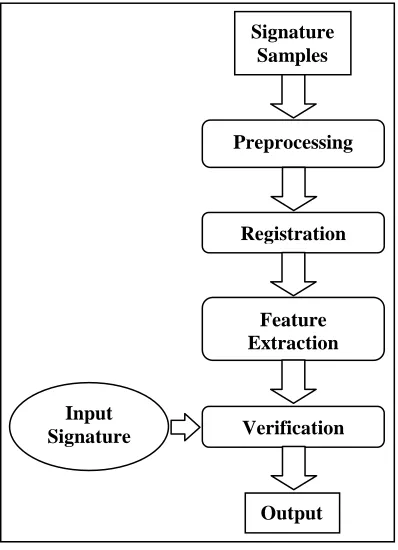
[image:3.612.340.491.197.413.2]Our proposed system is mainly divided into four steps which are summarized in Figure 1.
Figure 1: Stages of proposed work
3.1.Preprocessing
In this stage, we perform noise removal and cropping. Noise removal operation is used to remove unwanted information such as salt and pepper, or small dots, while the cropping operation
determine the boundaries of the signature eliminating unnecessary areas around it.
3.1.1. Noise removal
We apply the median filter on the image; this filter preserves edges while removing noise, if any [22]. Figure 2 shows this step.
(a)
(b)
Figure 2: Noise removal; (a) input image, (b) image after median filtering
3.1.2. Cropping
Cropping is used to remove outer parts of image to signature boundaries, this step is necessary for calculating the center of gravity (COG) and shifting steps, cropping example is shown in Figure 3.
(a)
(b) Preprocessing
Registration
Feature Extraction
Verification Input
Signature
Signature Samples
[image:3.612.96.295.353.628.2]168
(c)
(d)
Figure 3: Cropping, (a, c) input images, (b, d) images after cropping
3.2.Registration
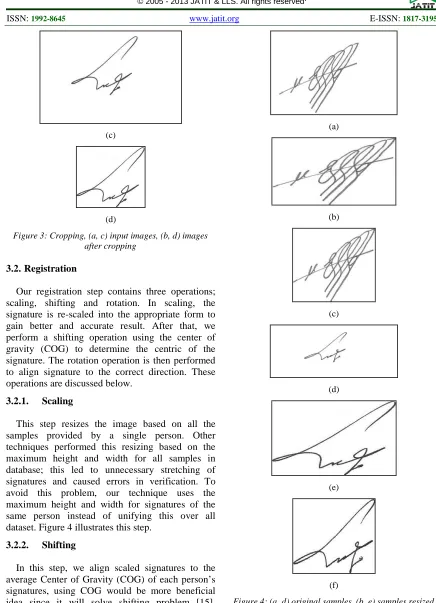
Our registration step contains three operations; scaling, shifting and rotation. In scaling, the signature is re-scaled into the appropriate form to gain better and accurate result. After that, we perform a shifting operation using the center of gravity (COG) to determine the centric of the signature. The rotation operation is then performed to align signature to the correct direction. These operations are discussed below.
3.2.1. Scaling
This step resizes the image based on all the samples provided by a single person. Other techniques performed this resizing based on the maximum height and width for all samples in database; this led to unnecessary stretching of signatures and caused errors in verification. To avoid this problem, our technique uses the maximum height and width for signatures of the same person instead of unifying this over all dataset. Figure 4 illustrates this step.
3.2.2. Shifting
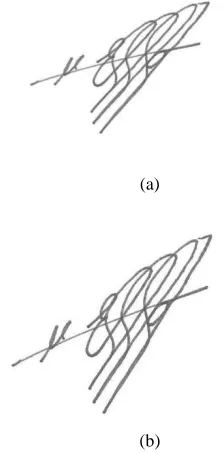
In this step, we align scaled signatures to the average Center of Gravity (COG) of each person’s signatures, using COG would be more beneficial idea since it will solve shifting problem [15]. Shifting is illustrated in Figure 5.
(a)
(b)
(c)
(d)
(e)
(f)
Figure 4: (a, d) original samples, (b, e) samples resized to maximum width and height of all persons, (c, f) samples resized to maximum height and width of the
[image:4.612.84.520.63.666.2]169
(a)
(b)
(c)
[image:5.612.87.509.66.511.2](d)
Figure 5: Shifting using COG, (a, c) before shifting, and (b, d) after shifting
3.2.3. Rotation
This step is to reduce the difference between the samples and to solve the problem of signature slope. The rotation step also decreases the common features between the database (training) samples and the tested signature input.
For each signature sample, the distance between the center of the image and signature edges is measured, the average of distances is used to determine the slope of the signature sample stored in database.
In verification step the same process will be applied on the tested image, the slope obtained earlier will be used to determine the rotation angle of the tested image. See Figure 6 for a sample output after applying this operation.
(a)
[image:5.612.343.455.198.425.2](b)
Figure 6: Rotation step, (a) before rotation, (b) the result after rotation
3.3.Feature Extraction
Discrete Wavelet Transform (DWT), reduction method, and common features method are applied in this step to extract the features before the verification step. This is exhibited in the following sections.
3.3.1. Discrete wavelet transform (DWT)
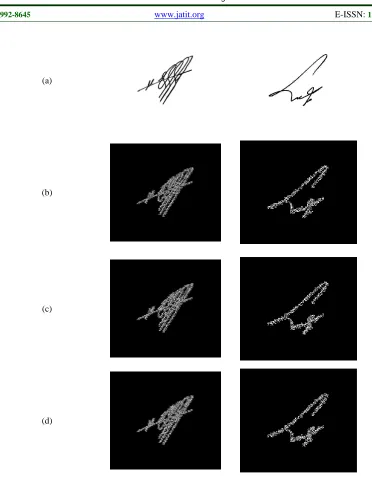
Each sample is decomposed using DWT into four images [22], the first image represents the low pass values, while the other three images represent the high pass in vertical, diagonal and horizontal directions, respectively, as shown in Figure 7.
170
(a)
(b)
(c)
[image:6.612.119.491.67.547.2](d)
Figure 7: DWT, (a) intermediate results, (b) vertical, (c) horizontal, and (d) diagonal high pass results
3.3.2. Reduction
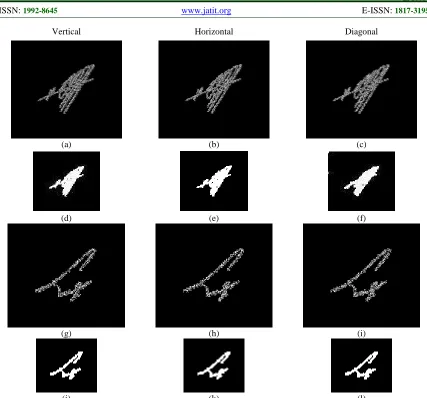
The high pass information collected from DWT is reduced to a feature matrix that represents the main bone of the signature as shown in Figure 8. The reduction is done by dividing the high pass images to (5 x 5) blocks and taking the maximum value in each block. The reduction is used to reduce the information in a small area to simplify the calculations, without affecting the results.
3.3.3. Common features
171
Vertical Horizontal Diagonal
(a) (b) (c)
(d) (e) (f)
(g) (h) (i)
[image:7.612.92.519.71.469.2](j) (k) (l)
Figure 8: Reduction step, (a, b, c, g, h, i) images before reduction, (d, e, f, j, k, l) after reduction
(a) (b) (c)
(d) (e) (f)
[image:7.612.120.493.504.689.2]172
3.4.Verification
This is the final phase where the tested input signature is verified against the sample signature stored in the database. We perform this using an XOR operation. The difference between the two images decides the verification percentage. There are three formulae to verify the signature. The results from these formulae indicate the matching percentage.
where VF denotes Vertical Features, VDF: Vertical Difference Features (difference between features of the tested input and the database sample), HF: Horizontal Features, HDF: Horizontal Difference Features, DF: Diagonal Features, DDF: Diagonal Difference Features, T: Threshold, VCFR: Vertical Common Features Ratio, HCFR: Horizontal
Common Features Ratio, DCFR: Diagonal Common Features Ratio, CFR: Common Features Ratio, and m and n are the length and width of the signature image respectively. After calculating the CFR, the signature will be verified if the CFR ≥
85%, otherwise it is not verified. This percentage was reached by experiments.
4. EXPERIMENTAL RESULTS
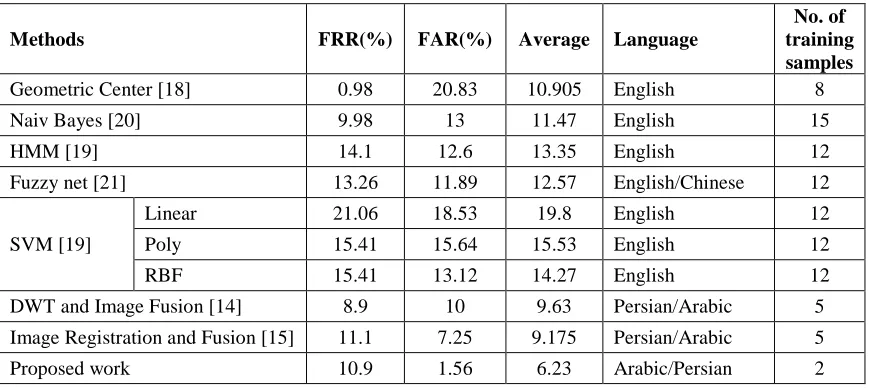
Verification results are reported in terms of False Acceptance Rate (FAR), which means a fake signature is considered as a real signature, False Rejection Rate (FRR), which means a real signature is considered as a fake signature, and Average Error Rate (Average) which is the average of the FAR and FRR.
[image:8.612.90.529.509.703.2]The high FRR percent does not reflect the proposed technique efficiency, unlike the FAR which is the most significant factor in the process as seen in the Table 1. The proposed technique has the lowest FAR percentage when compared to other methods. Image registration and fusion technique presented in [15] scaled images based on the maximum height and maximum width for all samples in database, moreover, when a new sample is added into database and the height and width are larger than all samples then the system will resize all samples in the database again. Moreover, their technique used multi-level DWT and it takes long processing time, however, in the proposed technique, only one DWT level was used, which saves processing time.
Table 1: Comparison of proposed method with other works
Methods FRR(%) FAR(%) Average Language
No. of training samples
Geometric Center [18] 0.98 20.83 10.905 English 8 Naiv Bayes [20] 9.98 13 11.47 English 15 HMM [19] 14.1 12.6 13.35 English 12 Fuzzy net [21] 13.26 11.89 12.57 English/Chinese 12
SVM [19]
Linear 21.06 18.53 19.8 English 12 Poly 15.41 15.64 15.53 English 12 RBF 15.41 13.12 14.27 English 12 DWT and Image Fusion [14] 8.9 10 9.63 Persian/Arabic 5 Image Registration and Fusion [15] 11.1 7.25 9.175 Persian/Arabic 5 Proposed work 10.9 1.56 6.23 Arabic/Persian 2
173 As shown in Table 1, the proposed technique has the lowest FAR (1.56%) with an average of (6.23%) using only two signature samples for training; the number of samples was enough to reach these results and to decrease processing time.
5. CONCLUSIONS AND FUTURE WORK
In this paper, we proposed an off-line Arabic and Persian signature verification system. The proposed technique is mainly divided into four steps: preprocessing, image registration, feature extraction, and finally signature verification. Preprocessing operations were performed to increase accuracy and decrease processing time. The system then used DWT to extract features from the signature image, and used logical operations with mathematical formulae to verify signatures. The experimental results were satisfactory and showed improvements over many recent works. Our system decreases the number of DWT levels and the number of required trainings, with a low FAR percentage of 1.56% and FRR of 10.9%. Future plans include enhancing the proposed technique to raise verification accuracy, and testing the technique with various shapes and types of signatures.
REFRENCES
[1] R. Larkins and M. Mayo, “Adaptive Feature Thresholding for offline signature verification”, In: Image and Vision Computing, New Zealand, 2008, pp. 1-6.
[2] D. Guru and H. Prakash, “Online Signature Verification and Recognition: An Approach Based on Symbolic Representation”, IEEE
Transactions on Pattern Analysis and Machine Intelligence, Vol. 31, No. 6, 2009, pp.
1059-1073.
[3] R. Sabourin, G. Genest, and F. Prêteux, “Off-line Signature Verification by Local Granulometric Size Distributions”, IEEE Transactions on Pattern Analysis and Machine Intelligence, Vol. 19, No. 9, 1997, pp. 976-988.
[4] P. Bruyne and R. Forré, “Signature Verification with Elastic Image Matching”, Proceedings of
the International Carnahan Conference on Security Technology, Gothenburg, Sweden,
1986, pp. 12-14.
[5] K. Huang and H. Yan, “Off-line Signature Verification Based on Geometric Feature Extraction and Neural Network Classification”,
Pattern Recognition, Vol. 30, No. 1, 1997, pp.
9-17.
[6] Q. Yingyong and B. Hunt, “Signature Verification Using Global and Grid Features”,
Pattern Recognition, Vol. 22, No. 12, 1994, pp.
1621-1629.
[7] M. Pourshahabi, M. Sigari, and H. Pourreza, “Offline Handwritten Signature Identification and Verification Using Contourlet Transform”,
Proceedings of the International Conference of Soft Computing and Pattern Recognition, IEEE
Computer Society, Malacca, Malaysia, 2009, pp. 670-673.
[8] Z. Fasihfar and J. Haddadnia, “Designing a Fuzzy RBF Neural Network with Optimal Number of Neuron in Hidden Layer and Effect of Signature Shape for Persian Signature Recognition by Zernike Moments and PCA”,
Proceedings of the International Conference on Web Information Systems and Mining, IEEE
Computer Society, Sanya, China, 2010, Vol. 1, pp. 188-192.
[9] V. Nguyen and M. Blumenstein, “An Application of the 2D Gaussian Filter for Enhancing Feature Extraction in Off-line Signature Verification”, Proceedings of the
International Conference on Document Analysis and Recognition (ICDAR), Beijing, China,
2011, pp. 339-343.
[10] K. Huang and H. Yan, “Off-line signature verification using structural feature correspondence”, Pattern Recognition, Vol. 35, No. 11, 2002, pp. 2467–2477.
[11] A. Shanker and A. Rajagopalan, “Off-line signature verification using DTW”, Pattern
Recognition Letters, Vol. 28, No. 12, 2007, pp.
1407-1414.
[12] R. Kumar, L. Kundu, B. Chanda, and J. Sharma, “A writer-independent off-line signature verification system based on signature morphology”, Proceedings of the International
Conference on Intelligent Interactive
Technologies and Multimedia, Allahabad, India,
2010, pp. 261-265.
[13] S. Zafar and R. Qureshi, “Off-line signature verification using structural features”,
Proceedings of the International Conference on
Frontiers of Information Technology,
Abbottabad, Pakistan, 2009, pp. 72.
[14] S. Ghandali and M. Moghaddam, “A Method for Off-line Persian Signature Identification and Verification Using DWT and Image Fusion”,
Proceedings of the International Symposium on Signal Processing and Information Technology,
174 [15] S. Ghandali and M. Moghaddam, “Off-Line
Persian Signature Identification and Verification Based on Image Registration and Fusion”, Journal of Multimedia, Vol. 4, No. 3, 2009, pp. 137-144.
[16] J. Vargas, M. Ferrer, C. Travieso, and J. Alonso, “Off-line signature verification based on grey level information using texture features”, Pattern Recognition, Vol. 44, No. 2, 2011, pp. 375-385.
[17] M. Ismail and S. Gad, “Off-line Arabic signature recognition and verification”, Pattern
Recognition, Vol. 33, No. 10, 2000, pp.
1727-1740.
[18] D. Jena, B. Majhi, and S. Jena, “Improved offline signature verification scheme using feature point extraction method”, Journal of
Computer Science, Vol. 4, No. 2, 2008, pp.
111-116.
[19] M. Ferrer, J. Alonso, and C. Travieso, “Off-line Geometric Parameters for Automatic Signature Verification Using Fixed point Arithmetic”,
IEEE Transactions on Pattern Analysis and Machine Intelligence, Vol. 27, No. 6, 2005, pp.
993-997.
[20] S. Srihari, A. Xu, and M. Kalera, “Learning Strategies and Classification Methods for Off-Line Signature Verification”, Proceedings of
the International Workshop on Frontiers in Handwriting Recognition, IEEE Computer
Society, Tokyo, Japan, 2004, pp. 161-166. [21] W. Tian, Y. Qiao, and Z. Ma, “A New Scheme
for Offline Signature Verification Using DWT and Fuzzy Net”, Proceedings of the
International Conference on Software
Engineering,Artificial Intelligence, Networking, and Parallel/Distributed Computing, IEEE
Computer Society, Qingdao, China, 2007, Vol. 3, pp. 30-35.