ERP PERFORMANCE AS INTERVENING VARIABLE
TO FINANCIAL PERFORMANCE FOR ERP
IMPLEMENTATION, ADHERENCE TO COSO, AND GCG
IMPLEMENTATION
JULISAR
Senior Faculty Member, School of Information System, Bina Nusantara University, Jakarta, Indonesia
E-mail: [email protected]
ABSTRACT
The objective of this study is to make a conceptual framework for testing the correlation hypothesis of ERP implementation, adherence to COSO, and GCG implementation. Then, the writer will test the effect of ERP implementation, adherence to COSO, and GCG implementation to ERP implementation and its implications to financial performance. This conceptual framework will use ERP performance as intervening variable. This writing is aimed at manufacturing industries in Indonesia which have implemented ERP, guided by COSO, and applied GCG as well. From the previous studies, there are spaces to do a research relating to ERP implementation, adherence to COSO, and GCG implementation to ERP implementation and its implications to financial performance. This research is still a literature study, so that the concept written here is still a conceptual framework which has to be tested empirically.
Keywords: ERP, COSO, GCG, Financial Performance
1. INTRODUCTION
Economic activities in Indonesia are supported by a variety of business activities in several sectors. They are (1) the main sector which is industries of raw material producer consisting of agriculture and mines, (2) the second sector which is processing or manufacturing industries, and (3) the third sector which is service industries.
Manufacture, based on Letter of the Head of the Capital Market Supervisory Board No. SE-02/PM/2002, December 27th 2002, is an activity which processes resources into finished products through a manufacturing process. So that, the company's activities classified in the manufacturing industry group have at least three major activities, namely (1) activities to obtain or to keep input or
raw materials, (2)
processing/manufacturing/assembling the raw
materials into finished materials, and (3) activities to store or to market their finished products. In terms of the products, manufacturing activities today include various types of business.
Performance Management System is an
enterprise performance measurement conducted as the study on company’s strategic objectives in responding to the marketplace needs nationally and internationally. In relation to the Performance
Management System, Wibisono (2011) wrote that performance of the company is assessed at three
main factors: financial performance (70%),
operational performance (15%), and administrative performance (15%).
From Wibisono (2011) it is clear that financial performance has considerable factor as one of the Performance Management System measurement (70%). It is because one of the aspects assessed by the public to make an investment (especially for a company that has sold its shares on the Stock Exchange) is to look at the company’s financial performance. A company which has already sold its shares on the Stock Exchange is obliged to publish its financial statements, so that investors or potential investors can find out the company's financial performance and prospects of the company in the future. In other words, the financial statements may be considered by investors or prospective investors to make an investment.
data acquired, then they are processed and analyzed to obtain information from the results of the analysis. The purpose of the financial performance analysis is to take policies, decisions on the operations, and financial activities faced by the company.
Letter of the Head of the Capital Market Supervisory Board No. SE-02/PM/2002, December 27th 2002, for Presentation and Disclosure Guidelines for Issuers’/Public Companies’ for Manufacturing Industry Financial Statements, states that the objective of financial statements is to provide information that arise of the financial position, performance, and changes in financial position of an enterprise that is useful for a large number of users in making economic decisions and to demonstrate accountability (stewardship) of the management over the use of resources entrusted to them. The letter states that the Issuer or Public Company Management is responsible for the preparation and presentation of financial statements. Financial statements presented consist of Balance Sheet, Income Statement, Statement of Changes in Equity, Cash Flow Statement, and Notes to the Financial Statements.
ERP Software is the backbone of major companies in this era (Alshawi et al., 2004). Momoh (2010) wrote that the package offered by ERP provides a seamless integration of all business processes in the company, including the integration of the accounting and financial information, human resources information, supply chain information, and customer information.
Stratman (2002) wrote competence of ERP is a
portfolio of the managerial, technical, and
organizational skills and expertise hypothesized as an antecedent to improve business performance after the implementation of ERP system and the system has been running stable. In ERP software, there are 3 (three) elements which are (1) a single central database as the system foundation, (2) application modules to process transactions and to perform data maintenance in the database, and (3) application modules to generate data thus allowing users to be able to see multiple views of the enterprise’s data.
In relation to the importance of internal control whose primary audience is management; internal control viewed as a process; objectives of internal control on the effectiveness and efficiency of the operations, reliability of financial statements, and compliance with laws and regulations forced in any state; focusing on all entities that exist in the
company; and who is responsible is the
management, this research will use COSO as the internal control measurement in accordance with the
principles of administration issued by Wren et.al (2002), in which there are responsibility and control-centered management. In ERP implementation, the
primary audience is management because
management plays a fairly important role for successful and unsuccessful ERP implementation. ERP implementation depends on full support of the
management because it controls over the
implementation of ERP which includes planning, organizing, leading, and controlling (Vijayakumar, 2009).
Financial statements are information generated by the operations of the company. From the financial statements, corporate leaders will be able
to do the planning, organizing, ordering,
coordinating, and supervising. Therefore,
information generated according to Hall (2008, pp14) should follow the five characteristics: relevance, timeliness, accuracy, completeness, and
summarization. In addition to the five
characteristics, to produce the financial statements that can be used for planning, controlling, and/or decision-making, the company must also implement internal control in the company's operations.
To implement internal control within the company applying Information Technology, COSO requires at least 2 (two) types of control: general control and application control. General control is the control covering all aspects of the competerized business process, which are all the company's operations using a computer. Application control is the control covering the use of software applications that exercises control over the transaction processing as well as in terms of data storage.
COSO (2011, i) issued a framework for business
activities and operating environments: (1)
expectation for governance oversight, (2)
globalization of markets and operations, (3) changes in business models, (4) demands and complexities in laws, rules, regulations, and standards, (5) expectations for competencies and accountabilities, (6) use of, and reliance on, evolving technologies, and (7) expectations relating to preventing and detecting corruption.
adherence to laws and regulations to which the entity is subject.
Relevant with the compliance objectives issued by COSO no. 3, Grant et.al (2008) wrote that governance implementation in the implementation of Information Technology (IT governance) is absolutely necessary, because IT governance plays an important role to produce financial statements. Moreover, deficiencies in Information Technology control can also eliminate important issues relating to the financial statements produced through
Information Technology. To implement the
adherence to laws and regulations which are applicable in a state as required by COSO in terms of the internal control, this study will be guided by the Indonesian Good Corporate Governance.
Code of Indonesian Good Corporate Governance (2006) via the Minister for Economic Affairs,
Decree No. KEP/49/M.EKON/11/2004, has
approved the establishment of the NCGP (National Committee of Governance Policy) consisting of Public Committees and Corporation Sub-Committees. NCGP provides GCG guidance to all companies in Indonesia, including companies that operate on the basis of sharia, companies whose shares have been listed on the stock exchange, state enterprises, regional companies, companies that raise and manage public funds, and companies whose products or services are widely used by the public, as well as companies that have a broad impact on environmental sustainability.
In the implementation of internal control that has a relationship with corporate governance and the implementation of ERP system, using agency
theory, Morris (2011) described that the
implementation of ERP system can facilitate monitoring and audit activities to obtain information that can be used by the principal about agent behavior, according to the second proposition written by Eisenhardt (1989): “when the principal has information to verify agent behavior, the agent is more likely to behave in the interest of the principal.” The argument of the proposition is if information system can provide information to the principal (shareholders) about the behavior of the agent (management), the agent cannot commit fraud or deceive the principal.
Hadibroto (2004), chairman of the Association of Indonesian Accountants, stated three things that need to do in building public trust: first, increase the effectiveness of corporate governance; second, increase shareholder values and protect other stakeholder interests; third, go back to the basics of professional ethics and standards.
2. LITERATURE REVIEW
2.1 ERP Implementation
It needs a paradigm that ERP implementation is a business project compared to the installation of a new software technology (Presley, 2006, Parr and Shanks, 2000). In the ERP implementation, because it is a business project, it will require the attention of the stakeholders, such as management, information system professionals, line workers, counsultant, and trading partner (Sambamurthy and Kirsch, 2002). Based on Muscatello, et.al (2003), Enterprise Resource Planning (ERP) systems are widely implemented as the backbone of many manufacturing and service firms. They are designed
to address the problem of information
fragmentation or “island of information” in business organization.
Rainer (2011:292) wrote that ERP systems take a business process view of the overall organization to integrate the planning, management, and use of all of an organization’s resources, employing a common software platform and database. Business process according to Rainer (2011:7), a business process is a collection of related activities that produce a product or a service of value to the organization, its business partners, and/or its customers. A process has inputs and outputs, and its activities can be measured.
When a company is going to implement ERP, it is necessary to pay attention to the stages of ERP
implementation, because each project in
implementing ERP has different phases that will also provide different benefits for each company. It is in accordance with Elragal, et.al (2011): “ERP system implementation projects have got different phases which need to be considered when analyzing the benefits achieved by ERP adopting companies. The concept of business performance can
operationalized as financial gains by the
organization, operational improvement for the
organization or intangible gains for the
organization.”
Phases in implementing Information
Technology, in this case, as they were written by Kwon and Zmud (1987): “that IT implementation follows six-stages or phases as initiation, adoption, adaptation, acceptance, routinization and infusion”.
In addition to considering such things, ERP implementation should be flexible so that the implementation of ERP can provide significant benefits for the company as well as the competitive advantage (Gupta, 2006).
implementation is expected to provide qualified ERP performance. It is relevant to the research done by Elragal, et.al (2011), that ERP implementation should contribute a good ERP performance in order to give benefits in terms of qualified financial performance. Nevertheless, to get qualified ERP performance, it is not only determined by ERP implementation but also influenced by other factors, such as those written by Grabski (2007), it needs complementary controls to control the implementation of ERP.
For companies that implement ERP, ERP is an operational activity for the company, in which according Wibisono (2011), contributing 15%; and according to Ke et.al (2008): “ERP (Enterprise Resource Planning) systems, a type III information system (IS) innovation, have strategic relevance because their integration into core business processes or strategies can directly impact firms’ performance.” However, as Poston (2001) said, ERP implementations are often performed along with business process reengineering. Some firms wanting to reengineering use ERP as the vehicle to accomplish the business process. While this study focuses on the effect of ERP on firm’s performance, the separate effect to reengineering business process cannot be disentangled. An ineffective and unsuccessful process reengineering project could also contribute to lost performance gains including negative financial returns.
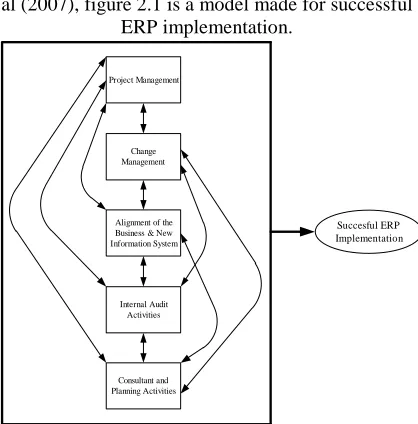
To see the explanation given by Grabski et al (2007), figure 2.1 is a model made for successful
ERP implementation.
Project Management
Consultant and Planning Activities
Internal Audit Activities Alignment of the Business & New Information System Change Management
[image:4.612.91.300.454.666.2]Succesful ERP Implementation
Figure 2.1 Model of Control Factors for Successful ERP Implementation. Source: Grabski et.al (2007)
Critical Success Factors to implement ERP, according to Muscatello (2008), are strategic
initiatives, executive commitment, human
resources, project management, information
technology, business process, training, project
support and communications, and software
selection and support. Issues related to the implementation are alignments. There are some alignments in relation to the implementation, which are strategic alignment, system and process alignment, and knowledge alignment (Chen, 2001).
Gupta (2000) finds that the keys to successful ERP implementation are relating to securing top management commitment, forming cross-functional task forces to link project management with business units, carrying out an assessment exercise of hardware requirements, making deployment a step-by-step introduction rather than all at once, starting early planning on user training and support,
streamlining decision making to move
implementation quickly, and being patient, as ERP implementation takes time.
When the company is going to conduct ERP
implementation, it needs to consider the
correspondence between business model and competitive capabilities, as Beheshti (2006) said: “Such systems must be designed with their impact on the company’s business model and competitive capabilities in mind, and their implementation requires the alignment of IT and corporate strategies, and often also entails major changes to organizational structure and culture (Presley, 2006). ERP systems are also dynamic and continuously evolving (Bititci et.al, 2000).”
Besides the correspondence between business model and competitive capabilities, Muscatello (2008) states things need to consider are strategic
initiatives, executive commitment, human
resources, project management, information
technology, business process, training, project support and communication, and software selection and support. In business process activities the firm will focus on identifying and improving the efficiency of critical operations, on restructuring important non-value adding operations, and on eliminating inefficient processes. Reengineering should be undertaken to insure that the strategic objectives mentioned earlier are feasible. The reengineering effort should create a uniform response from all aspects of the business.
because without control, ERP implementation will be difficult and risky, as examples in Davenport (2000), Grabski, et.al (2007).
In connection with the need of internal control implementation, companies must also have a complementary relationship among the factors associated with operations, such as flexible
manufacturing systems, marketing strategies,
control systems, information systems, relationships with customers and suppliers. All of those factors are called complementary factors required, so that they fit in each other to form a coherent operational system and to maximize profitability. Then to obtain successful ERP implementation, companies must understand the risks, so that the companies must conduct a control associated with these risks (Grabski et.al, 2007). The risks mentioned are risks due to the absence of correspondence between organizational strategy, organizational structure and process, as well as the selection of ERP applications.
[image:5.612.88.299.438.552.2]Ho, et.al (2004) argues for ERP implementation with the model in figure 2.2: “that system implementation is a challenging management issue and is no less important than system research and development and a successful implementation will benefit from the application of all three dimensions, and not a single one.”
Figure 2.2 Adaptation Framework of ERP Source: Ho et.al (2004)
In the ERP performance model made by Ho et al. (2004), there is no compelementary control as outlined by Grabski (2007). Therefore in this study, complementary control will be conducted; Good Corporate Governance using Agency Theory, and adherence to COSO using Control Theory. Control theory or cybernetic theory explains about
self-regulating systems, both mechanistic and
humanistic (Cannon, 1929). Wiener (1948) stated that control theory is generally attributed with establishing as a distinct body of thought. Control theory is widely used in several scientific studies in the area of management, engineering, applied
mathematics, economics, and medics. In the context of ERP implementation and to obtain ERP performance, control is necessary in conducting
ERP implementation. It is because ERP
implementation is significantly different with tradisional implementation system (Grabski, 2007). Control in ERP implementation is something important, as stated by Kirsch, L.J; Sambamurthy, V; Ko, D-G; Purvis, R.L. (2002). Hence for ERP is a project, in this study control theory will be used to obtain the ERP performance. To make a project needs control, so that the project made will be in precise purposes and objectives which have been defined.
Diffusion of Innovations consists of 2 (two) words: diffusion and innovations. Diffusion is the process of an innovation communicated through channels among members within a social system; while innovations are ideas, practices, or objects displayed by an individual or adoptions of other units (Rogers, 2003). Bradford, et.al (2003) uses the Diffusion of Innovations Theory to carry out the development and testing of a model that can support successful ERP implementation.
Information System Success Theory issued by DeLone and McLean (1992) consists of 6 (six) dependent variables to obtain success information system. The 6 (six) dependent variables are system quality, information quality, use, user satisfaction, individual impact, and organizational impact. To determine whether the system made reaches goals
or objectives (success), there should be
measurements to measure whether the system has reached the target created to provide value to Information System Management and Information System Investment (DeLone et.al, 1992, Figure 2.3). This is to provide a positive impact to the company.
Figure 2.3 D & M Success Model Source: DeLone, et.al (1992)
The central theme of Structural Theory is that every individual is a member of a social structure, and that structure supports sustainable performance every time (Giddens, 1976, 1979, 1984). In the theory issued by Giddens, there are 2 (two) topics, which are about (1) human behavior that creates
ERP system
Integration Process
Reengineering Process -System specification -Solution for integrating
legacy systems
-Suggested management
mechanism
-Change management -MIS role -Top management support -Trainning of staff
-IT-enabled process
integration
-Change management
approach
[image:5.612.317.520.533.652.2]and forms the social structure (agency) and (2) the degree to which a social structure is formed, forcedly formed, and the behavior of an individual, which is said by Giddens the duality of structure and action. Number (2) is the most incisively criticized of Giddens. He strongly criticized the idea of a relationship is always attached to dualism as a basic sociological analysis in many theories.
According to Giddens, social analysis should emphasize on aspect of duality (circumstances or special natures as an individual or characteristics that distinguish her/him from other people, such as character or personality), not on dualism (a notion in this life that there are reciprocal conflicts or two-faced states). It means that the relationship between actors (agents) and structure cannot be denied. However, the issue is how the actors (agents) and the structure can be interconnected to social behavior? Are actors (agents) and the structure associated by putting forward differences (tension or conflict) or duality (reciprocal)? Social sciences, according to Giddens, have been dominated by Vis a Vis dualism. Actors and structure should be reciprocal or rely on each other. This is the duality meant to lie on the structure which demands the actors as a means (medium and resources) and becomes social practice guidelines in various places.
To Giddens, actors (agents) are concrete people who are in continuous activities; while structure is rules and resources formed of (and form to) social practices looping. Duality of actors (agents) and structure is the result and, at the same time, a means of social practices. By this sense, structuration theory is formed. Structuration theory presupposes an ongoing process and allows looping to form social behavior.
There are 3 (three) main things that commonly occur in structure as explained in Gidden’s structuration theory. They are (1) designation structure or signification, relating to symbolic schemata, meaning, addressing, and discourse; (2) domination structure which involves the mastery of political and economic context; (3) justification or legitimation structure relating to normative rules in legal system.
2.2 Adherence to COSO
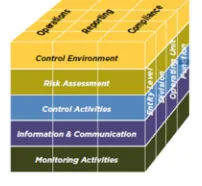
COSO (2011) issued a framework that shows the relationship between the goals (objectives), the components of internal control, and the structural form of the organization. In Figure 2.4, there are 3 (three) objective categories of internal control implementation in the form of a column; 5 (five)
components of internal control in the form of lines; and the forms of organizational structure including entities, divisions, subsidiaries, operating units or functions of which are business process, such as sales, purchasing, production and marketing.
Considering those things, internal control
implementation is absolutely necessary, is
presented in three dimensions in a cube.
[image:6.612.367.468.296.389.2]Research has been carried out for successful implementation of information system project (Cafasso, 1984; Ives et.al, 1984, Jiang and Klein, 1999; Jiang et al 1996; McFarlan, 1981), but the research conducted still has risks of failure in the implementation. Therefore, to support successful ERP implementation, one must understand the risks, so that by knowing the risks it will be conducted control over them.
Figure 2.4 The COSO Framework Source: COSO (2011)
A process consists of ongoing tasks and activities. It is a means to an end, not an end in itself (COSO, 2011, 1). Business process, which are conducted within or across operating units or functional areas, are managed through the fundamental management activities of planning, executing, and checking. Internal control is integrated with these processes. Internal control is most effective when it is embedded in the entity’s infrastructure and its ongoing activities (COSO, 2011, 2).
Table 2.2 Administrative Principles
Fayol’s Administrative Theory Developed to be 10 Principles by Wren
1.
Unity of Command
2.
Hierarchical transmission of orders
(“chain-of-command”)
3.
Separation of Powers – authority,
subordination,
responsibility
and
control
4.
Centralization
5.
Order
6.
Discipline
7.
Planning
8.
Organization Chart
9.
Meetings and reports
10.
Accounting
Source: Wren, et.al (2002)
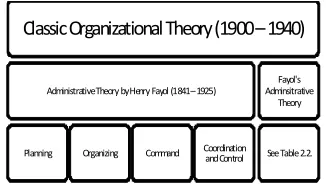
[image:7.612.330.505.140.307.2]From Fayol’s Management Theory which was developed to be 10 (ten) principles by Wren, this study will use those ten Wren’s administrative principles. One part of the principles is Separation of Power – authority, subordination, responsibility, and control which is an elaboration of internal control.
Figure 2.5 Digram of the Classic Organizational Theory (data processed)
For internal control implementation in the company, there are some internal controls can be implemented by the company after conforming them to the company's needs. In relation to internal control, Morris (2011) stated internal control is considered an “internal issues” and public
companies were not required to disclose
information about internal control procedures. Carton (2010) argued in relation to the ERP and internal control, which is one of these essential dichotomies in the planning and management of routine activities is the trade-off between control and flexibility. With the ERP systems, the
interdependence between control and other
structuring attributes (such as formalization,
centralization, specialization) is configured in the software. In Figure 2.6, Noovre (2006) describes how to do an assessment to internal control.
Figure 2.6 Quantitative assessment of Internal Control Source: Noorvee (2006)
Relating to financial statements, which function for planning, control, and/or decision-making should avoid the risks of both long-term (strategic),
medium term (tactical), and short-term
(operational) planning, the implementation of internal control can avoid risk management. This risk management is known as Enterprise Risk Management (ERM). This is in line with Drew et.al (2006) that provides the understanding of Enterprise Risk Management (ERM), which refers to the existence of a comprehensive approach to risk management within a company. Risk management has received attention from COSO that develops an internal control framework.
2.3 GCG Implementation
Corporate Governance is a term used in formulating governance for the company. Basically, corporate governance is rules, principles, or practices that set the direction of the company. NCGP (2006) provides a definition of Good Corporate Governance through an opening speech by Dr. Boediono (Coordinating Minister for Economic Affairs of the Republic of Indonesia) is one of the pillars of the market economy system. It is closely associated with the trust of the company applying it and the business climate in one country.
Corporate governance is sometimes viewed as a business culture fostering economic growth by building up confidence of investors (The HIH Royal Commision Report, 2003). Risks that occur directly or indirectly may be associated with the performance of the company, because these risks
Classic Organizational Theory (1900 –1940)
Administrative Theory by Henry Fayol (1841 – 1925)
Planning Organizing Command Coordination and Control
Fayol's Adminsitrative
Theory
See Table 2.2.
C ho o se th e ri gh t co nt ro l framewo rk
COSO, CoC o, S AC. ..
Doc umen t co nt ro l s ag ain st th e se lec te d mo d el
Appr oach, Deployment, As s es sm ent of appr oach ef fici ency
De vel o p a q ua nt it at iv e sc orin g p ro cess
S ix categories
Assemb le a g ro u p of ex ami ne rs
Individuals with appr opriate s kills and knowledge
Sco re th e i nt erna l c on t ro l app l ic ati o n
[image:7.612.116.279.428.520.2]affect corporate policies and regulations. Paper written by Poletti-Hughes suggested that corporate governance practices for the company and the country in which these two things provide value for the company. Risks can be managed by giving better attention to the implementation of internal
control and corporate governance structure
(governance structure) to provide value for the company. (Bhimani, 2009).
Associated with the implementation of internal control, a study conducted by Uhlaner (2007) for private firms, that the implementation of corporate governance should be implemented in all companies, especially companies that are included in public company. It is as has been outlined by NCGP which provides GCG guidance to all companies in Indonesia, including companies that operate on the basis of sharia, companies whose shares has been listed on the stock exchange, state enterprises, regional companies, companies that raise and manage public funds, and companies whose products or services are widely used by the community, as well as companies that have a broad impact on environmental sustainability. Figure 2.7 is a picture given by Uhlaner (2007) for corporate governance in private firms.
Ownership
Composition (Family vs. non-family, external owners (VC, private equity, individual), overlap with
management, number , etc.) Attitude and behaviors
Board of Directors
Composition Attitude and behaviors
Other governance mechanism Financial reporting Executive remuneration
(Quality of) Governance Functions Monitoring / accountability
Enterprising function Service function Ownership structuring
function
Firm performance Organization Effectiveness Financial performance
Strategic change
[image:8.612.89.303.402.518.2]Figure 2.7 Framework for the Special Issue on Governance in the Privately-held Firm
Source: Uhlaner (2007)
Agency theory is a theory that examines the relationship between Principal and Agent (Jensen and Meckling, 1976). It describes the relationship of cooperation based on managerial behavior, agency costs, and capital structure. In this case, Jensen and Meckling stated that the relationship between the Principal and the Agent is based on contract in which the Principal binds the Agent to conduct activities on behalf of the Principal and giving authorities to do the work and make certain decisions. Eisenhardt (1989) states, similar to Jesen and Meckling in relation to the Principal and Agent, the Principal will issue a supervision fee while the Agent must pay the royalty fee which is an
economic bonding cost. This is to reduce the possibility of the Principal disadvantaged by the Agent or otherwise.
Within these conditions, the two sides, the Principal and Agent, have different motivations and agents do not always act as expected by the the Principal (Shapiro, 2005). Jensen (1983) divides agency theory into two major parts (1) the positivist agency theory and (2) the principal-agency theory. Both of the theories use the same unit of analysis, which is the contract between the Principal and the Agent. The difference is the positivist agency theory focuses on the relationship between owners and managers generally in public organizations; while the principal-agency theory can be used more widely in the relationship of Principal and Agent, such as the relationship between employers and employees, sellers and buyers. Einsenhardt (1989) adds that both theories are complementary, and assumptions used in the two theories are same in the uncertainty of the results, the possibility of risks and information. In the application, agency theory has been widely used by researchers in various disciplines, such as accounting, marketing, political science, and organizational behavior.
Contract based on agency theory, according to Shapiro (2005), includes two things: (1) the agency problem arising from the difference of interest between the principal and the agent in the condition of asymmetric information, (2) the risk problem, which reflects different behavior between each party to the risks that must be borne.
The problem magnitude lies on the ability of the principal in monitoring the agent’s activities. The problem arises because of the adverse selection and moral hazard which result in the difference of interest between the two sides that leads to the difference between expected performance and actual performance. To the principal primary goal is to maximize profits through cooperation undertaken, whereas to the agent the main concern is to maximize compensation obtained. In this case the agent cooperates with the compensation she/he earns, so it may arise, of which is called shirk costs, costs that arise because the agent does not work as expected.
overcome. In line with the principle, Kamus (2008, a, pp19) wrote that the basis for determining the measurement of performance is the principal’s
relationship with the agent (principal-agent
concept). According to the concept, owners of the company or the shareholders are the principal (Top Management positions: Chief Executive Officer, Chief Finance Officer, Chief Operating Officer), those who have real wealth of the company. Without the principal, company is none. The agent or agency is a party designated by the principal to run the company.
In this study, for the principal categories
(Top Management), will be added Chief
Information Officer; for the agent categories are Finance Manager, Accounting Manager, Human
Resource Manager, Marketing Manager,
Production and Operations Manager, and Internal Auditor. However, in this study categorized as the agent are Finance Manager, Accounting Manager and Internal Auditor.
2.4 ERP Performance
In connection with Performance Management System, Wibisono (2011) assessed the performance of the company from three main factors: Financial performance (70%), Operational (15%) and
Administrative (15%). Resulting financial
performance may provide an overview of the state of the company as a whole and is a very important study for the sake of maintaining the sustainability of the company. Kamus Besar Bahasa Indonesia (KBBI) (2010-2011) defines performance as a noun (n = noun) which has meaning: (1) something achieved, (2) demonstrated achievement, (3) ability to work (tt equipment).
Performance Assessment according to Mulyadi (1997, pp 419) is a periodical determination of operational effectiveness of an organization, part of the organization and its employees by objectives, standards, and criteria set previously. In ERP implementation, one needs to know the resulting performance by implementing the ERP. To this, Elragal, et.al (2011) said: “The concept of business performance can be generalized as financial gains by the orgnizaiton, operational improvements for the organization of intangible gains for the organization.”
Some researchers suggested that the
implementation of ERP should provide a significant impact on operational performance (Cottelleer & Bendoly, 2006; Cottelleer, 2006; Gattiker & Goodhue, 2004, 2005). Relating to the advice given, Madapusi (2012) wrote the ERP System
Implementations result in improvements in
operational performance. Therefore, in ERP
implementation it needs to measure the
performance of ERP. Things measured are
information availability, information quality,
standardization, inventory management, on-time delivery.
Financial performance is the overall picture of financial activities in the company that gives information about the value of the company. For a public company, financial performance generated will provide information about share price. The higher share price is the higher of the shareholders' wealth; the higher shareholder value, the higher value of the company. Only in deviant conditions, the two are not aligned (Djohanputro, 2008, a, pp20-21).
2.5 Financial Performance
Financial Performance determines specific measurements that could measure the success of a company in generating profits (Sucipto, 2003). Financial performance is calculated by using financial ratios. The ratios are the results of a comparison between numbers of one financial figure and other financial figures. The figures contain in the financial statements consisting of balance sheet, profit / loss, cash flows, and changes in equity positions. There are several categories of the ratio that can be used as a measurement of financial performance: profitability, liquidity, solvency, turn-over, efficiency, and effectiveness (Djohanputro, 2008, a, pp23-34).
2.5.1 Profitability ratio
2.5.2 Liquidity Ratio
This ratio indicates company's ability to meet the payment obligations to third parties in a timely manner. The higher availability of short-term assets is the better of company's ability to meet its obligations. Liquidity ratio consists of (1) Current Ratio, which indicates the availability of current assets to tackle current liabilities of the company. Current assets are all wealth that is easy to become cash in a short time, less than one year. Current liabilities are all liabilities of the company maturing less than one year; (2) Quick Ratio or Acid Test Ratio, which shows company's ability to meet short-term obligations, or its current liabilities, with the assets of the company that is ready to pay; (3) Ratio of Operating Cash Flow to Current Liabilities, which demonstrates company's ability to generate cash from normal business operations to meet its current liabilities.
2.5.3 Turnover Ratio
This ratio shows management's ability in using its managed wealth to produce income. Turn over ratio consists of Asset Turn-over, Fixed Asset Turn-over, Net Working Capital Turn-over, Account Receivable over, Inventory Turn-over, Account Payable Turn-Turn-over, Operating Cycle, Cash Convertion Cycle.
2.5.4 Solvency Ratio
This ratio shows companies' ability in fulfilling obligations in the form of payments of long-term interest and principal loan. Solvency ratio consists of (1) Leverage Ratio or Gearing Ratio, consisting of the ratio of long-term loan, the ratio of long-term loan to equity, the ratio of long-term loan to total assets; (2) Interest Coverage Ratio; (3) Fixed Charge Coverage Ratio; (4) Cash Fixed Charge Coverage Ratio.
Modern companies, which their operational activities use Information Technology called Enterprise System or better known as Enterprise Resource Planning, requires internal control to
protect the confidentiality, integrity, and
availability of all information produced by the company. The information produced can be used by top management for planning, organizing, comand, coordination, and control. Activities of planning, organizing, command, coordination, and control impact the company in supporting the company's activities and performance of the company (Sutton (2006; Mathrani, 2009; Davenport, 2000; Hedman & Borell, 2002; Markus & Tanis, 2000; Stoel, 2011; the ISO / IEC, 2005; ITGI, 2005).
Galbraith (1974) wrote that Organizational Information Processing Theory explains the reasons in every execution in the company giving uncertain results. This is because the system is a set of objects or elements in iteraction to achieve a specific goal. An example is a system will change or process energy, information, or material into a product or output that can be used by the system itself or outside the system (environment) or both. Therefore, within a system, the results given may be different from one part and other parts.
From research conducted by Hunton et.al (2003) in 63 companies by a comparison between the companies that implement ERP and do not implement ERP, it is found that there are differences in financial performance for companies that implement ERP and do not implement ERP. Companies that implement ERP have better financial performance than companies that do not implement ERP.
Challenges faced by the company are the company should be able to implement internal control specifically for ERP implementation of which should also measure the performance of ERP. Yet, in the implementation of ERP and to get qualified ERP performance, the company also dealing with laws and rules as expressed by Garber (2010), Hare (2011).
3. DISCUSSION
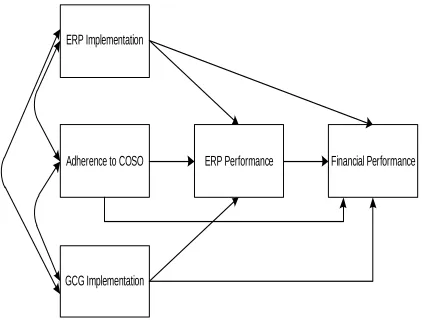
Based on the literature review, then model of this study is as following.
ERP Implementation
Adherence to COSO
GCG Implementation
[image:10.612.317.528.486.652.2]ERP Performance Financial Performance
3.1 Correlation between ERP Implementation,
Adherence to COSO, and GCG
Implementation
ERP (Enterprise Resource Planning) is a software that integrates planning, management, and the use all available resources within the company. It contains a series of applications that automate routine works of the company in back-end categories (such as finance, inventory management, scheduling, and other back-end activities) that help the company handle the jobs in functional areas (Turban, 2010; 379).
The main objective of ERP implementation is to conduct the integration in all functional areas exist in the company and to allow information to flow seamlessly in all functional areas (Rainer, 2011). Nevertheless, in practices there are companies succed and fail in ERP implementation and there is a notion that if a company has implemented ERP, there is no problem in the company.
Structuration theory (Giddens, 1976) suggests that each individual is a member of a social structure and the structure supports sustainable performance at all times. Therefore, successful and unsuccessful ERP implementation depends on the individual in the structure. Hence it needs control in
accordance with Complementary Control
Procedures (Grabski et.al, 2007), that is adherence to complementary control procedures. This is for conducting internal control (internal control) in ERP implementation. In addition to adherence to complementary control procedures, successful ERP implementation must consider the determinant factors of successful ERP implementation. Those are strategic initiative, commitmen executive, human resources, project management, information technology, business process, training, project
support and communications, and software
selection and support (Muscatello, 2008).
In line with the Structuration Theory (Giddens, 1976) and Complementary Control Procedures (Grabski et.al, 2007), COSO (2011) requires the existence of internal control which is defined: “Internal control is a process, effected by an entity’s board of directors, management, and other
personnel, designed to provide reasonable
assurance regarding the achievement of objectives in the following categories: (1) effectiveness and efficiency of operations (2) reliability of reporting; and (3) compliance with applicable laws and regulations.”
To implement the objectives outlined by COSO, then every company must implement laws and regulations prevailing. In this case NCGP (2006) issued a policy that every company in Indonesia,
including companies that operate on the basis of sharia, companies whose shares have been listed on the stock exchange, state enterprises, regional companies, companies that raise and manage public funds, and companies whose products or services are widely used by the public, as well as companies that have a broad impact on environmental
sustainability must implement GCG (Good
Corporate Governance).
3.2 Effects of ERP Implementation, Adherence to COSO, and GCG Implementation on ERP Performance
3.2.1 ERP implementation – ERP performance
In ERP implementation, it needs to know the operations performance produced by the ERP implementation. Elragal, et.al (2011) stated: “The concept of business performance can be generalized as financial gains by the organization, operational improvements for the organization of intangible gains for the organization.” Some researchers suggested the implementation of ERP should provide a significant impact on operational
performance (Cottelleer & Bendoly, 2006;
Cottelleer, 2006; Gattiker & Goodhue, 2004, 2005). To obtain a qualified ERP performance that affects the financial (operations) performance, during the implementation process, it needs attention from management and performance measurement to be achieved should be set (Nicolau, 2004b).
3.2.2 Adherence to COSO – ERP performance
For companies in the modern era which the operation activities use information technology, the implementation of internal control is something very important. With a good internal control, it will produce a good performance management system. For companies applying information technology,
they will utilize COSO as a standard
implementation of internal control which has management as primary audience, internal control seen as a process, and internal control objectives which are effective and efficient operations, reliability of financial statements, adherence to laws and regulations, focus to all corporate entities, responsibility of the management
3.2.3 GCG Implementation – ERP Performance
Code of Indonesian Good Corporate
Governance (2006) via the Minister for Economic Affairs, Decree No. KEP/49/M.EKON/11/2004, has approved the establishment of the NCGP (National Committee of Governance Policy)
Corporation Sub-Committees. NCGP provides GCG guidance to all companies in Indonesia, including companies that operate on the basis of sharia, companies whose shares have been listed on the stock exchange, state enterprises, regional companies, companies that raise and manage public funds, and companies whose products or services are widely used by the public, as well as companies that have a broad impact on environmental sustainability.
Financial statements produced by the company applying Information Technology, in this case is the ERP, then ERP performance is important. The ERP therefore should show good performance. Thus, it may give information needed by the company through the financial statements produced that will be used to measure financial performance.
Financial statements produced by functional area (accounting and finance), which would result in financial statements that would ultimately show company's performance in this regard is financial performance, should have a high level of accuracy, which can be reliable and of a good quality (Morris,
2011). Due to financial statements, Top
Management (Chief Financial Officer, Chief Information Officer, Chief Executive Officer, and others) will perform the functions of Administrative Theory in the Classic Organizational Theory Stream of Management as proposed by Henry Fayol (1841 - 1925) which are planning, organizing, command, coordination, and control.
Nevertheless, in its implementation in
functional area, the Functional Area Manager could commit cheating, fraud to Top Management or otherwise, as Classic Organizational Theory issued by Henry Fayol, one of the functions of top management is command, so there are possibilities, Top Management gives orders to the Functional Area Manager to commit fraud by manipulating existing operations in the functional area. This can lead to performance in the functional area (ERP performance) does not reflect real situation which will have implications to financial statements. At the same time, financial statements will be used to
measure financial performance. If financial
performance does not reflect real situation, Top Management will be wrong in performing one of the managerial functions such as planning, organizing, command, coordination, and control.
3.3. Implications of ERP Implementation to Financial Performance
ERP (Enterprise Resource Planning) is a system integrating all functional areas (research and development, production, marketing, finance and
human resources) that exist in the company to a systematic system and managerial approach. Besides, the implementation of ERP is also the core
strategy to Information Technology-based
companies, providing value for the company, and is a key role in competitive advantage. One of the reasons for implementing ERP is to improve company performance and deliver value to the company in terms of information flow, integration in all management functions, accuracy in the completion of reports and procurement of information (Su, et.al, 2013).
Research conducted by Hunton, et.al (2003) found that companies that implement ERP give the same results in financial performance, while companies that do not implement ERP show poor financial performance. Results of the research conducted by Poston, et.al (2000, 2001) gave mixed results as well as the controversy that there was no difference in financial performance between companies that implement ERP and companies that do not implement ERP. Companies that implement ERP did not show better results than before implementing ERP, while companies that do not implement ERP gave increased performance.
3.4 Implications of Adherence to COSO to Financial Pperformance
Financial statements produced by the company can be used to calculate financial performance. Financial performance is calculated by using financial ratios. Financial ratios are the result of a comparison between numbers of one financial figure and other financial figures. The figures contain in the financial statements consisting of balance sheet, profit / loss, cash flows, and changes in equity positions. Relating to financial statements, which function for planning, control, and/or decision-making should avoid the risks of both long-term (strategic), medium term (tactical), and
short-term (operational) planning, the
implementation of internal control can avoid risk management.
obedient to laws and regulations. Financial statements should provide an assessment of the effectiveness of internal control structure, and the company must obey the laws and regulations prevailing in any state to ensure guarantee on the financial statements at the end of the period. The financial statements which have been prepared
should be audited by independent public
accountant. The statements include validation with the assertion from management including in the management report. In addition, annual financial statements must be audited by independent public accountant.
3.5 Implications of GCG Implementation to Financial Performance
Abdo, et.al (2007) wrote that good corporate governance can be a tool to attract investors’ attention to invest their money in the company.
Well implementation of Good Corporate
Governance is connected with well company's performance compared to the company that has poor good corporate governance.
Research conducted by Shleifer and Vishny (1997) presented a study that effective corporate
governance reduces control rights of the
shareholders and creditors confer on managers, increases managers’ chances to invest in net present value project; and the implementation of good corporate governance increases a market premium as well.
Good financial performance will increase value of the company, that is to increase investor confidence (Fama and French, 1993) and better protection to shareholders relating to rising assessment of the assets of the company (La Porta; Lopez-de-Silanes, Shleifer and Vishny, 2003 )
3.6 Implications of ERP Performance to Financial Performance
ERP implementation will affect financial performance. With qualified ERP performance,
identified by Nicolau (2004b), financial
performance gives improving results (having competitive position or processing more efficient or effective) compared to companies having poor ERP performance.
4. CONCLUSION
Based on the literature sources mentioned, it has been developed a conceptual model which
describes the correlation between ERP
implementation, adherence to COSO, and GCG
implementation with financial performance using ERP performance as intervening variable. This model is expected to be able to describe the relationship between the variables exist.
This research should be conducted in
manufacturing industries regarding that ERP
implemention was initially carried out in
manufacturing industries. Manufacturing industries implement COSO, that is, as a form of internal control compliance. Moreover, intenal control is a basis of the preparation to financial statements. Financial statements issued, then, will be used for measuring financial performance. One condition required by COSO is that a company implementing COSO should obey the law and regulations in the country. In relation to the company, obedience to law and regulations prevailing is in accordance to GCG.
REFERENCES:
[1] Abdo, A; Fisher, G.. “The impact of reported corporate governance disclosure on the financial performance of companies listed on the JSE”.
Investment Analysts Journal. No. 66. (2007). Pp
43-56.
[2] Al-Mashari, M.. “Enterprise resource planning (ERP) systems: a research agenda”. Industrial
Management and Data Systems. Vol. 102. No.
3. (2002). Pp. 165-170
[3] Alshawi,S; Themistocleus, M and Almadani, R.. “Integrating diverse ERP systems: a case study”. The Journal of Enterprise Information
Management. Vol. 44 No. 6. (2004).
Pp.454-462.
[4] Altamuro, Jennifer; Beatty, Anne. (2010). “How does internal control regulation affect financial
reporting?” Journal of Accounting and
Economics. Vol. 49. Pp58-74.
[5] Beheshti, HM.. “What managers should know about ERP / ERP II”. Management Research
News. Vol. 29. No. 4. (2006). Pp. 184-193.
[6] Bhimani, Alnoor.. “Risk Management,
corporate governance and management
accounting: Emerging interdependencies”.
Management Accounting Research. Vol. 20.
(2009). Pp2-5.
[7] Bititci, US, Turner, T. And Begemann, C.. “Dynamics of performance measurement systems”. International Journal of Operations
& Production Management. Vol. 20. No. 6.
[8] Bradford, Marianne; Juan Florin.. “Examining the role of innovation diffusion factors on the implementation success of enterprise resource planning system”. International Journal of
Accounting Information Systems. Vol. 4.
(2003). Pp.205-225.
[9] Cafasso, R.. “How to control risk and effectively reduce the chance of failure”.
Management Review. Vol. 73. No. 6. (1984).
Pp.50-4
[10] Cannon, W.B.. “Organization for physiological homeostasis”. Physiological Review. Vol. 9. (1929). Pp.399-431.
[11] Carton, F; Adam, F.. “Towards a Model for Determining the Scope of ICT Integration in the Enterprise: the Case of Enterprise Resource Planning (ERP) Systems”. The
Electronic Journal Information Systems
Evaluation. Vol. 13. Issue 1. (2010). Pp.
17-26.
[12] Chen. I.J.. “Planning for ERP systems: Analysis and future trend”. Business Process
Management Journal. Vol. 5. No. 7. (2001).
Pp. 374-386.
[13] Committee of Sponsoring Organizations of the
Treadway Commision (COSO). (1994).
Internal Control – Integrated Framework. The Committee of Sponsoring Organizations of the Treadway Commission. New York. NY.
[14] COSO (Committee of Sponsoring
Organizations of the Treadway Commision).
(2011). Internal Control – Integrated
Framework. www.ic.coso.org
[15] Cottelleer, M.J (2006). “An empirical study of
operational performance convergence
following enterprise systems deployment.
Production and Operations Management.Vol.
15. No. 1. (2006). Pp. 74-87.
[16] Cottelleer, M.J ; Bendoly. E.. Order lead time improvement following enterprise information technology implementation: An empirical study. MIS Quaterly. Vol. 30. No. 3. (2006). Pp643-660.
[17] Davenport, T.H.. “Transforming the Practice of Management with Enterprise Systems. In Mission Critical”. Harvard Business School
Press. Boston MA. (2000). Pp.203-235.
[18] DeLone, W.H and McLean ER.. Information Systems success: The quest for dependent variable. Information Systems Research. Vol. 3. No. 1. (1992). Pp.60-95
[19] Djohanputro, Bramantyo. (2008, a).
Manajemen Keuangan Korporat. Penerbit PPM. Jakarta.
[20] Djohanputro, Bramantyo. (2008, b).
Manajemen Resiko Korporat. Penerbit PPM. Jakarta.
[21] Drew, Stephen A; Patricia C. Kelley; Terry
Kendrick. “CLASS: Five elements of
corporate governance to manage strategic risk”. Business Horizons. Vol. 49. (2006). Pp 127-138.
[22] Eisenhardt, Kathleen, M.. “Agency Theory: An Assessment and review”, The Academy of
Management Review. Vol. 14. No. 1. (1989).
Pp. 57-74.
[23] Elragal, Ahmed A; Ayman M. Al-Serafi.. “The Effect of ERP System Implementation on Business Performance: An Exploratory Case-Study”. IBIMA Publishing. Vol. 2011. Article ID 670212. (2011). Pp. 1-20.
[24] Fama, EF; French, K.. “Common risk factors in the return on stocks and bonds”. Journal of
Financial Economics. Vol. 33. (1993). Pp.
3-56.
[25] Galbraith, Jay, R.. “Organization Design: an Information Processing View”. Interfaces. Vol. 4. No.3. (1974). Pp.28-36.
[26] Garber, Mike.. “A Higher Level of
Governance – Monitoring IT Internal
Control”. ISACA Journal. Vol. 6. (2010). Pp. 1-5.
[27] Gattiker. T.F; Goodhue, D.L. Understanding the local-level costs and benefits of ERP through organizational information processing theory. Information and Management. Vol. 41. No. 4. (2004). Pp. 431-443.
[28] Giddens, A.. New rules of sociological
method: A positive critique of interpretative sociologies. (1976). London: Hutchinson.
[29] Giddens. A.. Central problem in social theory:
Action, structure, and contradiction in social analysis. (1979). London. Macmillan.
[30] Giddens, A.. The Constitution of Society:
Outline of the Theory of Structuration. Cambridge: (1984). Policy Press.
[31] Grabski, Severin. V; Stewart A. Leech.
“Complementary controls and ERP
implementation success”. International
Journal of Accounting Information Systems.
Vol. 8. (2007). Pp.17-39.
[32] Grant, Gerry. H; Karen C. Miller; Fatima Alali.. “The effect of IT controls on financial reporting”. Managerial Auditing Journal. Vol. 23. No. 8. (2008). Pp. 803-823.
[33] Gupta, Atul.. “Enterprise resource planning: the emerging organizational value system”.
Industrial Management & Data System. Vol.
[34] Gupta, Mahesh; Kohli, Amarpreet.. “Enterprise resource planning systems and its
implications for operations function”.
Technovation. Vol. 26. (2006).Pp. 687-696.
[35] Hadibroto, Ahmadi.. “Membangun Kembali
Kepercayaan Publik”. (2004). Media
Akuntansi.
[36] Hall, James A.. “Accounting Information
System”. Sixth edition. International Student
Edition. (2008). South Western. Cengage Learning. ISBN – 13: 978-0-324-56093-0; ISBN – 10: 0-324-56093-1
[37] Hare, Jeffrey T.. “Risk Management When Implementing ERP System”. ISACA Journal. Vol. 1. (2011). Pp. 1-5.
[38] Hedman. J; Borell, A.. “The Impact of Enterprise Resource Planning Systems on Organizational Effetiveness: An Artificial Evaluation”. In F.F-H. Nah (Ed). Enterprise
Resource Planning Solutions & Management.
Hershey. London. IRM Press. (2002). Pp.125-142.
[39] Ho, Chin Fu; Wen-Hshiung Wu; Yi-Ming Tai.. “Strategies for the adaptation of ERP systems”. Industrial Management & Data
Systems. Vol. 104. No. 3. (2004). Pp234-251.
[40] Hunton, James E; Barbara Linppincott; Jacquiline L. Reck.. “Enterprise resource
planning systems: comparing firm
performance of adopters and nonadopters”.
International Journal of Accounting
Information Systems. Vol. 4. (2003). Pp.
165-184.
[41] ISO/IEC (International Organization for
Standardization / International
Electrotechnical Commission. ISO/IEC 27002 standard; information technology – security techniques – code of practice for information security management. Geneva. Switzerland; 2005.
[42] ITGI (IT Governance Institute). COBIT 4th
edition. December 2005. http://www.isaca.org
[43] Indeje, Wanyama G; Qin Zheng..
“Organizational Culture and Information Systems Implementation: A Structuration Theory Perspective”. Sprouts: Working Papers on Information Systems. Vol. 10. No. 27. (2010). Pp. 1-14.
[44] Ives, B; Margrethe H. Olson.. “User involvement and MIS success: a review of research”. Management Science. Vol. 30. N0. 5. (1984). Pp. 19-29.
[45] Jack, L; Ahmed Kholeif. “Enterprise Resource Planning and a contest to limit the role of
management accountants: A Strong
structuration perspective”. Accounting Forum. Vol. 32. (2008). Pp.30-45.
[46] Jensen, M.C.. Organization theory and methodology. Accounting Review. Vol. 58. (1983). Pp. 319-339.
[47]. Jensen, M; Meckling, W.. “Theory of the firm: Managerial behavior, agency cost, and ownership structure”. Journal of Financial
Economics. Vol. 3. (1976). Pp. 305-360.
[48] Jiang, James J; Gary Klein.. “Risks to different aspects of system success”. Information &
Management. Vol. 36. No. 5. (1999). Pp.
263-272.
[49] Jiang, James J; Gary Klein; Joseph Balloun.. “Ranking of system implementation success factors”. Project Management Journal. Vol. 27. No.4. (1996). Pp. 50-55.
[50] Kamus Besar Bahasa Indonesia (2010-2011). http://pusatbahasa.kemdiknas.go.id/kbbi/
[51]. Ke, Weiling; Kwok Kee Wei..
“Organizational culture and leadership in ERP implementation”. Decision Support System. Vol. 45. (2008). Pp. 208-218.
[52] KNKG (Komite Nasional Kebijakan
Governance). (2006). Pedoman Umum Good Corporate Governance Indonesia. [53] Kwon. T; Zmud R.. “Unifying the Fragmented
Models of Information Systems
Implementation, in Boland, Hirschheim
(Eds)”. Critical Issues in Information Systems
Research. (1995). Wiley. New York.
[54] La Porta, R; Lopez-de-SilanesF, Shleifer, A and Vishny, R.. “Investor protection and corporate valuation”. Journal of Finance. Vol. 57. (2002). Pp. 1147-1170.
[55] Ma, Junhai; Chunyong Ma.. Factor analysis based on the COSO framework and the Government Audit Performance of Control Theory. Procedia Engineering. Vol. 15. (2011). Pp 5584-5589.
[56] Madapusi, Arun; Derrick D’Souza.. The influence of ERP system implementation on
the operational performance of an
organization. International Journal of
Information Management. Vol. 32. (2012). Pp.
24-34.
[57] McFarlan.. “Portfolio approach to information systems”. Harvard Business Review. Vol. 59. No. 5. (1981) Pp. 142-150.
[58] Mathrani, Sanjay; Rashid, Muhammad A; Vichland, Dennis.. “Enterprise Systems in Small and Medium-Sized Enterprises”. IGI
Global. (2009). Pp170-183.