ORIGINAL RESEARCH ARTICLE
ANALYSIS OF PHYSICAL ACTIVITY AS AN INTEGRAL ELEMENT OF ACTIVE AGING
*Silvia López Alonso
Doctoral School, Catholic University Saint Vincent Martyr of Valencia, Spain
ARTICLE INFO ABSTRACT
Lifestyle can accelerate or slowdown the involution and deterioration of the different abilities. This research shows that if people over sixty five years old (EA 65+) practice physical activity on a regular basis, the progressive and generalised deterioration of bodily functions, the onset of dementia and degenerative diseases can slow down, while extending autonomy and reducing limitations in daily life. Objectives: 1. Study and analyse experts’ opinion regarding physical activity (PA) practice so that aging remains active. 2. Analyse the PA characteristics in terms of volume, intensity, density, frequency and duration for it to become part of an active aging. 3. Design a basic PA programme. Method: Evaluation and synthesis review of the sources considered most relevant at international level. Study the research work of doctors Gerard D. Cohen and Robert M. Kaiser. Results: All the sources consulted affirm that EA 65+ practising PA (at least two or three days per week) improve their mood, stay active, foster interpersonal relationships and enjoy a greater autonomy. Conclusion: The sources studied show that practicing PA on a regular basis guarantees the quality of life and autonomy, as well as the delay in the onset of dementia for EA 65+.
Copyright © 2019,Silvia López Alonso. This is an open access article distributed under the Creative Commons Attribution License, which permits unrestricted use, distribution, and reproduction in any medium, provided the original work is properly cited.
INTRODUCTION
Individuals turning grey do not find it easy to accept the aging process due to the multiple and complex factors associated with it (Cohen, 1979). World Health Organization (WHO) states that anxiety, depression, insomnia and cardiovascular problems (CVD) typical of this stage, are signs indicating that something is not right (WHO, 2015,). Brown, Kaiser and Gellis, (2007) point out an imperious need to detect depression at an early stage due to the disastrous consequences it causes in the elderly individual, such as increased morbidity, suicidal risk and mortality due to other causes. Sedentary or inactivity lifestyle could also cause dementia (British Heart Foundation
(BHF, 2012; Cadar, Hackett, Mischie et al., 2017; School of
Sport, Exercise and Health Sciences, SSEHS, 2011). The rise in life expectancy and the evident fertility decline registered in the population since 2015, increase the number of older adults
(WHO, 2015). Kingston, Wohland, Wittenberg et al. (2017)
report that, as life expectancy increases, the disease levels will rise and, in general terms, they will restrict elderly people’s abilities and independence. Consequently, the demand for healthcare, social assistance, and specialised care
*Corresponding author: Silvia López Alonso
Doctoral School, Catholic University Saint Vincent Martyr of Valencia, Spain.
services will increase. The aging process is a complex situation involving individuals in all their dimensions. Its progress limits their independence, conditions their quality of life and, therefore, that of those around them (Cohen, 1979; Spanish Society of Geriatric and Gerontology (SEGG, 2014; Kingston et al., 2017). Several experts agree when stating that aging is a multifactorial complex, which involves more than one process, acting together to contribute to aging, leading to different degrees depending on the individual (Craig and Baucum, 2009; Delgado, 2015; Lipsky and King, 2015; Ozbolt, Paniagua and Kaiser, 2008; Stassen, 2009). Indeed, it is a complex process that forces doctors to acquire an excellent training in order to act optimally. At the University of Miami Miller School of Medicine (UMMSM), for students to meet specific performance standards in the practice routine skills, van Zuilen, Kaiser and Mintzer, (2012) explain how this university’s medical education, based on competencies, had to be developed and extended with the aim of addressing three geriatric syndromes: dementia, falls and deliriums from 61 learning objectives. Considering the unanimous testimony of the sources consulted, it is necessary that physical activity becomes part of active aging due to its capacity to extend the EAs autonomy and reduce their daily life limitations.
The individual growing old: Aging encompasses the last stage of a person’s life cycle. It is a biological regression
ISSN: 2230-9926
International Journal of Development Research
Vol. 09, Issue, 01, pp.25330-25336, January, 2019
Article History:
Received 18th October, 2018
Received in revised form 06th November, 2018
Accepted 09th December, 2018
Published online 30th January, 2019
Available online at http://www.journalijdr.com
Key Words:
Elder Physical Activity, Falls, Sedentary, Successful Aging.
Citation: Silvia López Alonso, 2019.“Analysis of physical activity as an integral element of active aging”, International Journal of Development Research, 9, (01), 25330-25336.
process also known as senescence or "involutive stage of the life cycle" (Delgado, 2009). It is a "universal phenomenon" (Craig and Baucum, 2009). It includes underlying change trends whose functioning impact is difficult to predict (WHO, 2015). Biological changes result from different molecular and cellular damage that promote the decrease of physiological reserves, favouring the risk of diseases and predisposing
individuals to a reduction of their abilities (Cilerdzic et al.,
2013; Cohen, 1999). Although an important section of authors states that aging starts at 45 years old, others confirm that symptoms start to be more noticeable after 60 years old (BHF, 2012; Craig and Baucum, 2009). Evidence of this are osteoarthritis and sight and hearing impairments (SEGG, 2015). It should be taken into account that this process does not take place equally in all living beings, as its pace varies from one person to another, even between organs in the same living being, as each one does so at a different rate (Delgado, 2015; Lipsky and King, 2015; Stassen, 2009). Authors of degenerative diseases specialised literature state that the longer the lifetime, the higher is the possibility of suffering degenerative diseases such as Alzheimer (Benlloch, 2016; Craig and Baucum, 2009; Hokkanen, 2015; ILC, 2011; Lipsky and King, 2015), causing elderly individuals to be the ones taking the most prescription drugs. SEGG (2015) states that 93% of people over seventy five years old take some sort of drug. And Kaiser (2007) publishes: “The majority of our patients are over sixty five years of age. All are veterans of the US armed forces. Most have a long list of medical problems, with a list of medications to match”. Sensory organs are less effective, visual and auditory acuity are also affected. Sleep /wakefulness cycle slows down their activity due to neuronal
aging (Cilerdzic et al., 2013) and telomeres (Rizvi, Tasleem
and Mahdi, 2014). Voluntary movements require more processing time, as well as: head and neck turns, ability to react, reflexes, position and direction changes, and driving, which becomes slower (Delgado, 2015, p. 291; Hughes, Ueda and Casey, 2015). After sixty five, short-term and fluid memory start failing significantly; individuals find it difficult to maintain o divide their attention in a conversation or to get across the message that has just been heard (Delgado, 2015, p. 291). Even verbal and thinking fluency deteriorates (Benlloch, 2016; Cohen, 1999). Lee, Chi and Palinkas, (2018) manifest that leisure activities can help individuals better adjust to life after significant life transitions as a the retirement.
In aging, cardiac stress problems and consequences leading to deficiency in different vital organs such as the kidneys, liver, pancreas or lungs, are frequent. Likewise, cardiovascular
diseases (CVD), diabetes (El Assar et al., 2016), asthma or
disorders that have their origin in infectious diseases (Carlson, 2014) are frequent while aging. Muscle fibres scarcely regenerate or do not regenerate at all and muscle mass is lost (sarcopenia), (López, 2017; Stassen, 2009). Consequently, falls become more likely. In this regard, Marking (2018) states that the main causes of hospitalisation or admission to nursing homes are falls due to muscle weakness. Physic frailty is an important medical manifestation in which several causes and factors intervene, all of them involved in the physiological and muscular function wear, such as loss of strength, resistance, stability, orientation, etc. (Morley et al., 2013) predicting falls, disability and mortality; a common condition characterised by the deterioration of the skeletal and cognitive system, and the insufficiency to cope with stress elements (Watts, Webb and
Netuveli, 2017). Morley et al., (2013) define it as a medical
manifestation in which several causes and factors intervene, all
of them involved in the physiological and muscular function wear, such as loss of strength, resistance, stability, orientation, etc., that make the individual more likely to depend on others or more prone to death. In this sense, Alexandre, Corona, Nunes et al. (2014) suggest that, encouraging physical activity must be one of the strategies“to avoid, delay, or even remedy frailty”.
Active Aging: WHO (2015) defines active aging as “the process of optimizing opportunities for health, participation and security in order to enhance quality of life as people age”. Aiming “to optimize opportunities for health, participation and security in order to enhance quality of life as people age” (WHO, 2002). In this sense, the literature reviewed agrees in that, people aging actively take less medication, promote changes in their immune system, in terms of control and find greater social support (Cohen, 2009; BHF, 2012; SSEHS,
2011; Sumic, Michael, Carlson et al., 2007). On the other
hand, a full active aging requires that people growing old have a positive attitude, accept the limitations related to their age and, based on those limitations, enjoy a healthy and involved life (SEGG, 2014). Marking (2012) explains that, from the first Aging Survey that the insurance company General conducted in Germany to approximately 2,000 people between 65 and 85 years old, the findings revealed that the average number of respondents said they felt ten years younger because they were living active, satisfying and varied lives. Marking states that health for EA 65+ is interpreted as the most relevant condition for an independent life. Yamashita, Bardo and Liu, (2018) reveal the results of a study among active and non-active people over 65, which allow matching physically active leisure with general subjective well-being due to its correlation with higher levels of experienced happiness, and lower levels of sadness. Adam and Carlson, (2018) confirm that “the vast majority of older adults in the United States (80 percent) suffer from at least one chronic condition (e.g., diabetes, hypertension, heart disease). Many of these health conditions are associated with physical inactivity”.
Physical Activity as an integral element of active aging: The American College of Sports Medicine (ACSM, 2011) confirms the scientific evidence proving that the positive effects of PA are unquestionable and its benefits exceed the risks for most adults. In order to improve and maintain an optimal state of fitness and health, ACSM recommends most adults, beyond the activities they perform on a daily basis, to regularly practice PA, including cardio respiratory work, resistance training, flexibility and neuromotor exercises. In this regard, BHF states that regularly practicing PA improves physical and psychological health and it is associated with the maintenance of functional activity and independence of life (2012). Indeed, practicing PA throughout life increases healthy life expectancy while also providing a positive mental health, reducing the total time spent in sedentary activities as well as the disability stage. It also reduces blood pressure, improves insulin sensitivity, preserves bone mass and reduces the risk of developing breast and colon cancers. Elderly people practicing PA regularly improve their positive energy, well-being, quality
of life and cognitive function (ACSM, 2011; Bento-Torres et
al., 2017; BHF, 2012; Herrera, 2005; WHO, 2015), they are
exposed to a lower risk of cognitive impairment and dementia
(ACSM, 2011; BHF, 2012; Cadar et al., 2017; Olanrewaju,
sign of good health (2002). Fragility, that can be due to several reasons, is one of the main medical symptoms of lack of fitness and health (ACSM, 2011). Sarcopenia or loss of muscle fibre is one of its main causes and, even though it is debilitating, it can be treated. Strength training with weights promotes muscle fibre regeneration, which wears out with age (Marking, 2018). Physical weakness also involves fragility, however, Morley et al. (2013) state that it can be successfully prevented or treated with specific actions. They recommend practicing physical activity, eating a diet rich in protein, calories and vitamin D, and reducing drug intake. Watts et al. (2017) highlight the importance of sports clubs in promoting and helping to live an active life based on PA reducing fragility levels in elderly adults and promoting social relationships (SSEHS, 2012; WHO, 2015). Staying active improves balance, helps to improve strength, state of mind and depression. Cohen (2009) states that at the end of life, more than at any other stage of the life cycle, the death of beloved ones may lead to major depressions. PA, such as walking fast, bicycle riding, dancing, undertaking house maintenance works, gardening, walking up and down stairs, bowling, playing non-aggressive team games and swimming should be part of the daily life of the elderly adult. National Institute on Aging and Health (NIA and NIH) in Go4Life program defends that elderly adults should look for activities they like to do and include them in their daily life as something natural (BHF, 2012; Go4Life, 2017; SSEHS, 2011). Among the PA benefits, Richards (2015) emphasises that it improves joint movement, facilitates pain control, increases strength, promotes body stability, prevents against the risk of suffering chronic diseases and controls them, facilitates coping with incontinence and
maintaining weight. Rodrigues, Vrinceanu, Berryman et al.
(2017)manifestthatstrength,aerobic,muscular endurance and
skill exercises improve the executive functions of EA, and the interruption of training can offer results of loss of physiological benefits.
WHO (2015) in a recent analysis states that moderate PA reduces mortality by 31% vs. individuals who are less active, and that the benefit is greater for those over 60 years old (p.70). Cohen (2009) ratifies that PA optimises physical and mental abilities of EAs because it maintains muscle strength and the cognitive function. Other literature states that it reduces anxiety, stress, improves self-esteem, prevents and delays CVD (by 11-22%), acts on diabetes, osteoporosis and cardiovascular accidents (WHO, 2015, p. 70; Go4Life, 2017). It also improves intergenerational and social relationships of the elderly. Conversely, older inactive people are exposed to the risk of suffering dementia by 20%, and it is estimated that 10 million new cases could be avoided if the elderly population practiced the PA suggestions (WHO, 2015). To this end, it is suggested to work on aerobic activity, strength and balance (neuromotor apparatus), which must be prior to the aerobic in a progressive training. This type of training develops muscle strength, physical capacity, prevents against the risk of falling and CVD, and improves metabolic and coronary function. This will be the basis of cardio-vascular aerobic activity (WHO, 2015, p.71).The research from Fontvieille, Parent-Roberge, Langlois et al. (2017) suggest that aerobic and resistance training reduces cancer-related fatigue in oncogeriatric patients. And Brown, Riddell, Macpherson et
al. (2013) show us that the active elder has a lower mortality
risk compared to inactive adult. On the one hand, ACSM recommends that EAs 65+ years old inform their doctor about their intention to perform PA. The exercise programme must
be adapted to the individual according to his/her state of health and physical condition and in order meet the established objectives. ACSM recommends finishing the exercises stretching and relaxing in order to avoid musculoskeletal injuries, and advises that a pleasant PA can improve the affective response of the individual to exercise and improve their participation in the long term (2011). All consulted sources agree that 1. PA should be practiced on a daily basis and include cardio-respiratory and resistance exercises for each of the main muscle groups, flexibility for each of the major muscle groups and tendons, and neuromotor exercises (balance, agility and coordination); 2. The intensity should be moderate in general, although cardio respiratory work should be combined with vigorous intensity exercises, 3. Each session should be progressive from less to more effort, being the intensity activity stronger in the central part. 4. It is important to stay active beyond 65 years old as well as to foster social relationships. It should be noted that Go4Life or BHF have created outreach campaigns in order to promote interest for an active life regularly practicing PA. They suggest that the plan must be creative, with varied activities that motivate a regular participation (BHF, 2012), wear comfortable clothes and recommend drinking lots of water even if not thirsty (Go Life, 2018). Harada, Sugisawa, Sugihara et al. (2017) suggest that a social environment of the neighborhood where young and old practice PA outdoor correlates with the active participation of elder adults in the PA (Laforest et al., 2009).
DISCUSSION
After analysing all the bibliography, and in order to suggest a daily PA programme for elder adults 65+, the following sources have been selected ACSM, NIA and NIH, SSEHS and WHO since they have more content related to PA for elder adults 65+ and because they are the most prestigious in the international arena (NIA and NIH and WHO), the United States of America (ACSM) and the United Kingdom (SSEHS).
Conclusion
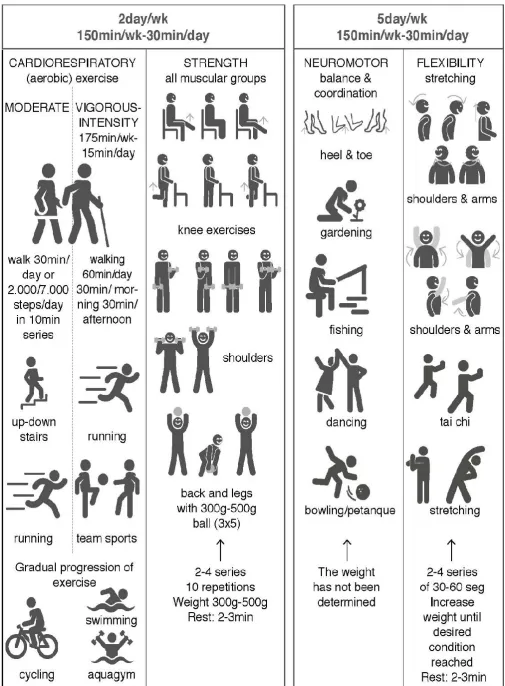
All selected sources unanimously agree when affirming that PA for elder adults 65+ should be practiced 150 minutes per week (150min./wk.); i.e. 30 minutes per day (30min./day) of moderate activity and 75min./wk.); i.e. 15min./day of strenuous work. It should include cardiovascular or aerobic work, balance, coordination, flexibility and strength. Except for the aerobic and strength work that will be practiced 2day/wk., the rest must be practiced daily. They state that stretching is highly advisable to improve flexibility and that aerobic and strength exercise should be preceded by a previous preparation or warming up (ACSM, 2011, p. 1342). All sources insist on the need to avoid a sedentary lifestyle and to walk at least 30min/day. Only SSEHS advises to walk 30min/morning and another 30min./evening. All sources also promote dancing and tai chi as better activities for balance and
coordination and that interventions at personal and
environmental level are necessary. Only ACSM breaks down the volume, intensity, resting time, and energy consumption of the exercises of a PA programme for EA 65+ and states that PA must be intended for adults of all ages. It recommends that, where possible, it should be personalised for EA 65+. Elder adults 65+ with certain chronic disabilities should also be able to participate, provided they are evaluated by a healthcare professional and with the pertinent modifications.
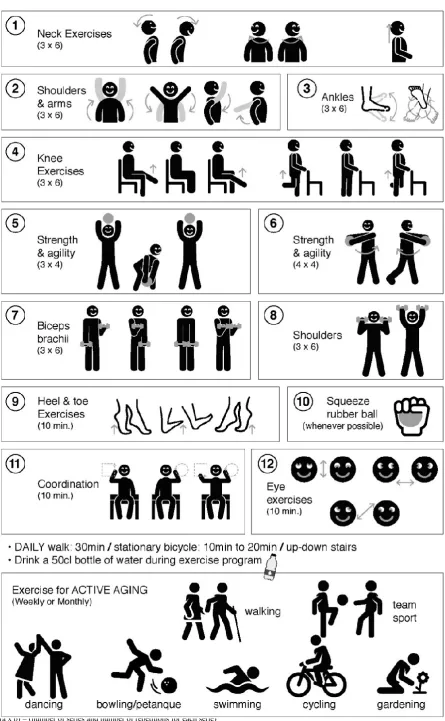
(a x b) = (number of series and number of repetitions for each serie).
(a x b) = (number of series and number of repetitions for each serie)
Figure 2. Proposal for a daily exercise program (exercises 1-12) and weekly and monthly recommendations for people over 65, by Author
Suggestion of a basic and general PA plan for elder adults 65+: Taking into consideration the urgent need for aging to be active, the regular practice of PA as an integral element of active aging, the lack of motivation of EA 65+ to follow healthy habits in general and the regular practice of PA in particular, and of the time that can elapse since the moment in
which the healthcare professional suggests these
recommendations until the EA 65+ implements them, in case he/she does, and also noting that PA at home is more frequent when a medical referral is not required (WHO, 2015, p.106). A basic and general PA programme for elder adults 65+ is suggested below and is presented in infographic format (Figure 1). In addition, a proposal is presented for a daily exercise program with weekly and monthly recommendations (Figure 2).
REFERENCES
ACSM, 2011. Quantity and Quality of Exercise for Developing and Maintaining Cardiorespiratory, Musculoskeletal, and Neuromotor Fitness in Apparently Healthy Adults: Guidance for Prescribing Exercise. Medicine and Science in Sports and
Exercise, 43(7) 1334-1359. doi: 10.1249/MSS.0b013e318213
fefb
Adam, A., and Carlson, M. 2018. Modeling the economic and health impact of increasingelderly physical activity in the
United States. Innovation in Aging, 2(S1) 741-742. doi:
10.1093/geroni/igy023.2735
Alexandre, S., Corona, L. P., Nunes, D. P., Santos, J. L. F., Duarte, Y. A. O. and Leräo, M. L. 2014. Similarities Among Factors Associated With Components of Frailty in Elderly:
SABE Study. Journal of Aging and Health, 26(3) 441-457.
doi.10.1177/0898264313519818
Benlloch, J. 2016. Diagnóstico “précoz” y monitorizacióndel
Alzhéimermedianteimagen (Chair. Cycle of scientific
symposiums. Symposium conducted at the meeting of the
Catholic University Saint Vincent Martyr or Valencia, Valencia, Spain.
Bento-Torres, N. V., Bento-Torres, J., Tomás, A., Costa, V., Correa, T. and Picanço-Diniz, C. 2017. Physical activity, cognitive decline, platelet changes in alzheimer’s disease and
healthy old adults. Innovation in Aging, 1(S1) 224.
doi.org/10.1093/geroni/igx004.836
BHF. 2012. Older adults in transition. Interpreting the UK physical activity guidelines for older adults(65+. Retrieved
from http://www.ssehsactive.org.uk/userfiles/Documents/
active-olderadults.pdf.
Brown, E., Kaiser, R. M. and Gellis, D. 2007. Screening and assessment of late-life depression in home healthcare: issues
and challenges. Annals of Long-Term Care, 15(10. Retrieved
from https://www.managedhealthcareconnect.com/article/
7853/page/0/1
Brown, R. E., Riddell, M. C., Macpherson, A. K., Canning, K. L., and Kuk, J. L. 2013. The Association between Frequency of Physical Activity and Mortality Risk Across the Adult Age
Span. Journal of Aging and Health, 25(5), 803-814.
doi.10.1177/0898264313492823
Cadar, C., Hackett, R. A., Mischie, M., Llewellyn, D., Batty, G. D. and Steptoe, A. 2017. Association of physical activity as a distinctive feature of clustering of lifestyle behaviours with dementia risk: evidence from the English Longitudinal Study
of Ageing. TheLancet, 390, S29. doi:
10.1016/S0140-6736(17)32964-1
Carlson, N. R. 2014. Fisiología de la Conducta. 11thed.. Madrid,
Spain: Pearson
Cilerdzic, J., Stajic, M., Vukojevic, J. and Duletic-Lausevic, S. 2013. Oxidative Stress and Species of Genus Ganoderma
(Higher Basidiomycetes. International Journal of Medicinal
Muschrooms, 15(1), 21-28. doi: 10.1615/IntJMedMushr.v15. i1.30
Cohen, G. D. 1979. Research on Aging: A piece of the Puzzle. The Gerontologist, 19(5) 1, 503-508. doi: 10.1093/geront/19.5 _Part_1.503
Cohen, G. D. 1999. The Aging Brain vs. The Aging Body. The
American Journal of Geriatric Psychiatry, 7(2), 93-95. doi: 10.1097/00019442-199905000-00001
Cohen, G. D. 2009. Watch your assumptions about the brain, mind and behaviour with aging. Historical lessons to watch your assumptions about aging: relevance to the role of International Psychogeriatrics, 21(3) 426-429. doi: 10.1017/ S1041610209008540
Craig, G. J. and Baucum, D. 2009. Desarrollo psicológico.(9thed..
México: Pearson.
Delgado, M. L. 2014. Fundamentos de Psicología. Madrid, Spain: Médica Panamericana.
El Assar, M., Angulo, J., and Rodríguez-Mañas, L. 2016. Diabetes
and ageing-induced vascular inflammation, The Journal of
Physiology, 594(8), 2125-2146.doi: 10.1113/JjP270841 Fontvieille, A., Parent-Roberge, H., Langlois, M., Fülöp, T.,
Pavic, M. and Riesco, E. 2017. Aerobic and resistance training to reduce cancer-related fatigue: efficacy in oncogeriatric
patients. Innovation in aging, 1(S1) 224. doi.10.1093/
geroni/igx004.836
Go4Life. 2017. NIA and NIH. Exercise and Physical Activity: Getting Fit for Life. Retrieved from www.go4life.nia.nih.gov Go4Life. 2018. NIA and NIH. 11-4258. Retrieved from
www.go4life.nia.nih.gov
Guillén del Castillo, M., Linares, D. 2002. Bases biológicas y
fisiológicas del movimiento humano. Madrid, Spain: Panamericana.
Harada, K., Sugisawa, Y., Sugihara, S., Yanagisawa, M. and Shimmel, M. 2017. Perceived neighborhood environment, social support, and physical activity among elderly Japanese. Innovation in Aging, 1(S1), 516-517. doi.10.1093/geroni/ igx004.1830
Herrera, A. P. 2005. Adultos mayores: Envejecer sin miedo. Journal Vivir MásClínica Las Condes.October, Chile. Retrieved from http://www.clinicalascondes.com/ver_articulo .-cgi? cod=1130515354
Hokkanen, S. R. K. September, 2015. Neuropathology of old-age
dementia. Healthy and Active Ageing Seminar. Adelaide.
Australian Association of Gerontology (AAG. Retrieved from https://www.aag.asn.au/documents/item/785
Hughes, W. E., Ueda, K., Treichler, D. P., and Casey, D. P. 2015. Rapid onset vasodilation with single muscle contractions in
the leg: influence of age. Physiological Reports, 3 (8).doi:
10.14814/phy2.12516
Kaiser, R. M. 2007. A Day in the Life of a Home Care Physician. Journal of the American Medical Directors Association, 8 (9), 617. doi: 10.1016/j.jamda.2007.08.004
Kingston, A., Wohland, P., Wittenberg, R., Robinson, L., Brayne, C., Fatthews, F., and Jagger, C. 2017. Is late-life dependency increasing or not? A comparison of the Cognitive Function
and Ageing Sudies. The Lancet 390, 1676-84. doi:
10.1016/S0140-6736(17)31575-1
Laforest, S., Pelletier, A., Gauvin, L., Robitaille, Y., Fournier, M., (…), Filiatrault, J. 2009. Impact of a Community-Based Falls Prevention Program on Maintenance of Physical Activity
Among Older Adults. Journal of Aging and Health, 21(3),
480-500. https://doi.10.1177/0898264308328988
Lee, Y., Chi, I. and Palinkas, L. A. 2018. Retirement, Leisure Activity Engagement, and Cognition Among Older Adults in
the United States. Journal of Aging and Health. doi.10.1177/
Lipsky, M. S. and King, M. 2015. Biological theories of aging. Disease a month,61(11), 460-466. doi: 10.1016/j.disamonth. 2015.09.005
López, J. A. 2017, February. Sarcopenia. Chair), Comprehensive attention to debate. 5th Congress of the Valencian Society of Geriatrics and Gerontology, Valencia, Spain. www.geyseco. es/svgg
Marking, C. 2012. German survey on well-being in old age. European Geriatric Medicine Society. News.Retrieved from http://www.eugms.org/news/read/article/german-survey-on-well-being-in-old-age.html
Marking, C. 2018. Lifting the burdem of old age. European
Geriatric Medicine Society. Nature 555, S15. Retrieved from https://www.nature.com/magazine-assets/d41586-018-02479-z/d41586-018-02479-z.pdf.
Morley J. E., Vellas B., Abellan van Kan G., Anker S. D., Bauer J. M., Bernabei R., Cesari M., (...), Walston J. 2013. Frailty
Consensus: A Call to Action. Journal of the American
Medical Directors Association, 14(6), 392-397. doi: 10.1016/ j.jamda.2013.03.022
Olanrewaju, O., Kelly, S., Cowan, A. and Brayne, C. 2016. Physical activity in community-dwelling older people: a review of systematic reviews of interventions and context. The Lancet, 388, S83. doi: 10.1016/S0140-6736(16)32319-4 Ozbolt, L. B., Paniagua, M. A., and Kaiser, R. M. 2008. Atypical
Antipsychotics for the Treatment of Delirious Elders. Journal of the American Medical Directors Association, 9(1), 18 – 28. doi: 10.1016/j.jamda.2007.08.007
Richards, J. September, 2015. Strength for Life. Health and
Active Ageing. Australian Asssociation of Gerontology.
Adelaide. Retrieved from https://www.aag.asn.au/documents/ item/788
Rizvi, S., Tasleem-Raza, S., and Mahdi, F. 2014. Telomere Length Variations in Aging and Age-Related Diseases. Current Aging Science, 7, 3. doi: 10.2174/1874609-808666150 122153151
Rodrigues, L., Vrinceanu, T., Berryman, N., Bosquet, L, Kergoat, T. and Bherer, L. 2017. The effects of physical training cessation on executive functions in older adults. Innovation in Aging, 1(S1) 224. doi.10.1093/geroni/igx004.836
SEGG. 2014, December 17. Promoción de la autonomía personal y Prevención de la dependencia. Manual de
Recomendaciones. Sociedad Española de Geriatría y
Gerontología. Retrieved from https://www.segg.es/actualidad-segg
SEGG. 2015, June 15. El 93% de los mayores de 75 años consume algún medicamento. Sociedad Española de Geriatría
y Gerontología. Retrieved from https://www.segg.es/publica
ciones/2015/06/15/el-93-por-ciento-de-los-mayores-de-75-a%C3%B1os-consume-algun-medicamento
SSEHS. 2011, July 11. Start active, Stay active.The Chief Medical
Officers of UK. Retrieved from https://assets.publishing.
service.gov.uk/government/uploads/system/uploads/attachmen t_data/file/216370/dh_128210.pdf
SSEHS. 2012, March 22. Physical activity for older adults 65+
years. Evidence briefing. The Chief Medical Officers of
UK.Retrieved from
http://www.ssehsactive.org.uk/older-adults-resources-and-publicationsitem/40/313/index-.html
Stassen, K. 2009. Psicología del desarrollo: Adultez y Vejez (7th
ed.. Madrid: MédicaPanamericana. [Googlebooks]. Retrieved from https://books.google.es/-books?isbn=8498351936 Sumic, A., Michael, Y. L., Carlson, N. E., Howieson, D. E., and
Kaye, A. J. 2007. Physical Activity and the Risk of Dementia
in Oldest Old. Journal of Aging and Health, 19(2), 242-259.
doi.10.1177/0898264307299299
Van Zuilen, M. H., Kaiser, R. M. and Mintzer, M. J. 2012. A Competency-Based Medical Student Curriculum: Taking the Medication History in Older Adults”. Journal of the American Geriatrics Society, 60(4). doi: 10.1111/j.1532-5415.2011. 03871.x
Watts, P., Webb, E. and Netuveli, G. 2017. The role of sports clubs in helping older people to stay active and prevent frailty:
a longitudinal mediation analysis. International Journal of
Behavioral Nutrition and Physical Activity, doi: 10.1186/ s12966-017-0552-5
WHO. 2002. Active ageing: a policy framework. Retrieved from
WHO/NMH/NPH/02.8.pdf
WHO. 2015. World report on ageing and health. ISBN 978 92 4 069481 1.pdf
Yamashita, T., Bardo, A. R. &Liu, D. 2018. Experienced Subjective Well-Being During Physically Active and Passive Leisure Time Activities Among Adults Aged 65 Years and Older. The Gerontologist, 106. doi: 10.1093/geront/gny106