3616
IMPROVING THE TASK SCHEDULING IN CLOUD
COMPUTING WITH ANALYTIC HIERARCHY PROCESS
1NAOUFAL ER-RAJI, 2FAOUZIA BENABBOU, 3NAWAL SAEL
1,2,3 Laboratory of Modeling and Information Technology, Department of Computer Science and Mathematics, Faculty of Sciences Ben M’SIK, University Hassan II, Casablanca, Morocco E-mail: 1[email protected], 2[email protected], 3[email protected]
ABSTRACT
Cloud Computing has been recently considered as the most demanded technology. It is a new technology that aims to provide computing resources through a network (mostly internet) with an easy use. However, since it is a new technology, it is struggling with some difficulties, one of which is Task Scheduling. The latter, not only has an important role in the Quality of Service (QoS) but also has a big impact regarding the Service Level Agreement (SLA). In this paper, we strive to use Analytic Hierarchy Process (AHP) in order to improve and give more precision for Task Scheduling in Cloud Computing environment through improving the tasks classification in the tasks priority queues. The results of this paper demonstrate that AHP can be used to give more precision for the tasks priority queues instead of the use of the traditional algorithms.
Keywords: Cloud Computing, Task Scheduling, Analytic Hierarchy Process, Priority Queues.
1. INTRODUCTION
Nowadays, Cloud Computing is one of the most used technology in the majority of the Information Technology (IT) solutions. It is one of the most demanded technologies for its enormous advantages in terms of availability, the number of resources, rapidity and so on. It can be used for many fields like data storage, data analytics and Internet of Things (IoT) applications. Cloud Computing is a type of paralleled and distributed system consisting of a collection of interconnected and virtualized computers that are dynamically provisioned and presented as one or more unified computing resource. In Cloud Computing, the services are provided through (infrastructure as a service, software as a service, and platform as a service, etc.). In each one of these services, Cloud service consumers submit their request (tasks) through a network (generally internet) [1]. In fact, this new technology is based on other technologies that grant it more performance and rapidity, the most important of which is virtualization. It is the creation of multiple virtual machines that share the same physical resources and act as real machines. These virtual machines are managed by Virtual Machine Manager (VMM) as specific software which can give them the ability to share resources without any conflict [2]. However, every technology in its first stages is challenged by some
difficulties that affect its performance such as security, task scheduling, load balancing, migration and so on.
3617 mathematics. It starts by creating a hierarchy that contains all information about the problem, then evaluating its elements by comparing them to each other two by two, taking into consideration the elements following in the hierarchy. One of the decision situations to which the AHP can be applied are: choice, ranking, prioritization, resource allocation, benchmarking, quality management and conflict resolution [10, 11, 12]. In this paper, our objective is to improve our work in which we proposed a priority task scheduling strategy for a heterogeneous multi-data-center in Cloud Computing environment [13]. In our previous paper, especially in the part of the task classification, we used multi priority queues and in each one of them we applied First In First Out (FIFO) algorithm as a task classifier, after a main classification which was the main contribution. In this paper, our intention is to improve our strategy through updating this part by the use of AHP instead of FIFO in the main priority queue, which can give more precision in the choice of the tasks to be executed in the last step of the task scheduling process. In the cloud computing, the tasks have different characteristics: such as the task deadline, the task length, the bandwidth requirement, .etc. Moreover, the tasks must be scheduled in the real time and executed on different resources with different capacities. Thus, there are many criteria that could be used to define the tasks priority either for the tasks scheduling or for the tasks classification. Furthermore, there are some criteria that change in the time (waiting time in the queue or the task age). In fact, in the literature, there are many works that propose tasks scheduling algorithms. However, the majority of them didn’t propose a real tasks scheduling strategy taking into account the change over time of the tasks characteristics and the importance of increasing the tasks priority for those who have lower priority in order to respect their deadlines. Most of the works are based on one parameter (often the Makespan) [3] and others didn’t specify exactly what the priority is and let the choice to the users to define it [5]. Hence, the motivation behind this work is to improve the task classification inside the highest priority queue in order to prevent tasks from exceeding their deadline. The remaining part of this paper is organized as follow: in the following section we shall present some related works that have a relationship with priority and AHP. In section 3 we shall demonstrate our contribution; and finally, the last section is the conclusion and an overview on our future research work.
2. RELATED WORK
In the literature, we found out that many researchers tried to use AHP in different subjects to solve their problems either for IT (Information Technology) field or other fields. However, in the task scheduling contributions, we didn’t find any work that uses the automatic classification beside the experts’ opinion. While our contribution is a new classification model which benefits of the automatic classification and the experts’ opinions for task classification. In the following some work that use AHP in their contribution.
3618 order to evaluate the load task, based on the criteria: CPU, Memory, hard disk I/O and network bandwidth. Besides AHP, they used the neural network to predict energy consumption. In [24], the authors used AHP for ranking application in order to serve resources, relying on the criteria: reliability, bandwidth, completion time and cost level analysis during the application prioritization. In [25] the authors used AHP as well as a multi-objective optimization algorithm CNSGA to propose a multiple-criteria decision mechanism for the automatic test task scheduling problem, adopting the criteria: Makespan and mean workload. In this proposition AHP is used most of all for the final decision making process and chooses a best schedule from the solutions obtained by CNGSA. In [26] the authors used AHP besides practical swarm optimization (PSO) algorithm to propose an efficient dynamic priority-queue (DPQ) algorithm for task scheduling in the cloud computing environment. In [27] the authors used AHP to propose a priority-based job scheduling algorithm. The proposition is divided in two steps: in the first step, they assigned priority according to the importance of the task. In the second one, the task is allocated to the optimal resource (VM) by the AHP algorithm calculation, using as criteria: response time, system load and cost. In [28], the authors classified the (QoS) factors into four classes, after that, they used AHP to be the weight deciding method in order to help users to decide the class weight and avoid judgment logical error. After that, they improved PSO scheduling by using of AHP, based on different (QoS) classes to make practical swarm optimization (PSO) so as to have (QoS) preference awareness ability.
3. TASK SCHEDULING USING THE
ANALYTIC HIERARCHY PROCESS
In Cloud Computing environment, there are many tasks that keep coming to the CSP resources to be executed as soon as possible in the available of them. On the one hand, the tasks have different criteria, and on the other, the resources have different capacity. Hence, task scheduling is known as a complicated process due to the complexity of assigning multiple different tasks criteria to different capacity resources. Thus, in this paper and as an improvement for the task scheduling in Cloud Computing, we use the AHP algorithm for optimizing the final priority queue because it can give us the possibility to make the tasks classifications better with the benefit of the experts’ opinions. Moreover, in our previous work [13], FIFO just manage the arrived tasks without
[image:3.612.318.515.210.350.2]any constraints, while AHP take in consideration the tasks constraints and benefit from the experts opinions which can give better queue management. Furthermore, the task scheduling constraints can be change from one client to another according to the type of request. In this paper, we have taken the most used constraints in the literature, which represents for us the opinion of experts. In the following, there is the framework used in the task scheduling process:
Figure 1 : Task Scheduling Framework
In the proposed framework, the tasks are classified into different priority queues. The first is the most important one as a result of its being the only queue by which the tasks are going to the final resources (VMs), which means that it is the last step of the task scheduling process. In this paper, our contribution is manifested in the optimization of this queue through using the AHP to give more precision to the final tasks classification.
In fact, there are different criteria that can be used to choose tasks according to their importance. However, there are some criteria that have a bigger impact than others in terms of specific measurements and requirements, especially for the measurements that have a relationship with the QoS and the response time.
3619 longer time to be executed than a task that has a small length. Finally, we have chosen the age as an important parameter because it has a big impact on the waiting time in the queues.
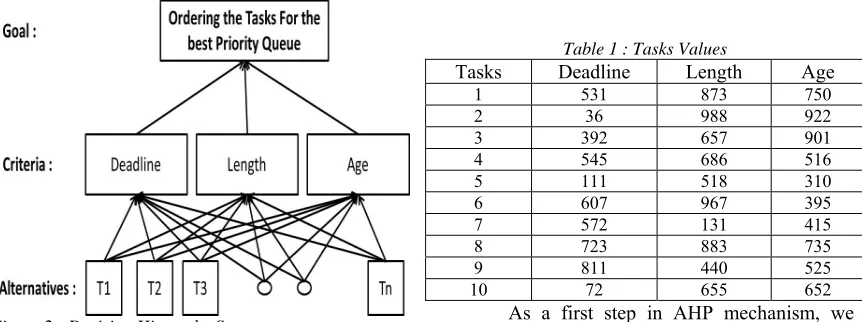
[image:4.612.95.526.235.396.2]According to Saaty, for using AHP, there are a number of steps that have to be followed. The first one is the creation of the hierarchy, which is very important for having a global view of the whole problem and its challenges. In the following, there is the decision hierarchy structure:
Figure 2 : Decision Hierarchy Structure
By the end of making the decision hierarchy structure, we have to pass to the second step, which is the determination of priorities for the tasks (Alternatives) and for the criteria (parameters). Thus, we have to make a Pair wise comparison between alternatives (Tasks) depending on each criterion and comparison between criteria (parameters) depending on the final objective. After the comparison is finished, we have to enter all the results into a matrix, which is processed mathematically to derive the priorities for tasks and criteria. As a final step, we have to check the consistency. This latter is very important in terms of the coherence and the logic in the decisions. It is a measurement that indicates if each comparison matrix has a logically reasonable value which has to be less than 0.1 in order to guarantee a good coherence [10, 11, and 12].
In order to put AHP on the task scheduling process, we applied AHP in an illustrative example where we started by comparing the alternatives (tasks), then we compared the criteria and finally we made the decision matrix.
2.1 Alternative Comparison
As an illustrative example for this experiment, we supposed that the first priority queue gets ten classified tasks with different parameters and needs to be reclassified so to have a more precise classification before the final assignment to the resources (VMs).
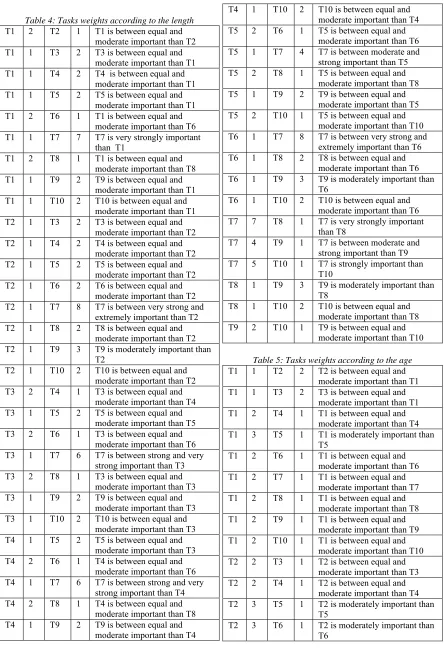
The tasks’ values used in this example are taken through a random system; and the obtained tasks’ values are summarized in the table below:
Table 1 : Tasks Values
Tasks Deadline Length Age
1 531 873 750
2 36 988 922
3 392 657 901
4 545 686 516
5 111 518 310
6 607 967 395
7 572 131 415
8 723 883 735
9 811 440 525
10 72 655 652
[image:4.612.312.526.580.725.2]As a first step in AHP mechanism, we have to compare each task value to the other. Then, we have to judge which task is weaker according to the criterion in consideration. If after the judgment, we find the weakest task, we have to determine the relative importance between the two compared tasks. In this step, there is a need to the AHP fundamental scale to give the suitable relative importance [10, 11, and 12]. The fundamental scale is composed of nine intensity importance elements, and the choice between them has to be framed by a logic judgment. As a result of this, we used a number of constraints to determine the most suitable intensity importance that we can have. In the following, there is the proposed relative importance table:
Table 2: the relative importance
Criteria Priority Intensity important
Tb = Ts Normal 1
1 < Tb/Ts<=2 Between Equal and normal
2
2 <Tb/Ts<=3 Normal 3 3 <Tb/Ts<=4 Between Normal
and Moderate importance
4
4 <Tb/Ts<=5 Moderate importance
5
5 <Tb/Ts<=6 Between Moderate
3620
Importance and strong importance
6 <Tb/Ts<=7 Strong importance 7 7 <Tb/Ts<=8 Between Strong
importance and extreme importance
8
8 <Tb/Ts Extreme
importance 9
Tb= The biggest task in term of the comparison parameter.
Ts= The smallest task in term of the comparison parameter.
For the deadline and the length, the smallest parameter is the most important, and for the age the biggest parameter is the most important.
Using the relative importance table and the tasks value table, we completed the AHP tasks criteria weight. In the following the results according to each criterion:
Table 3: Tasks weights according to the deadline
T1 1 T2 9 T2 is extremely important than T1
T1 1 T3 2 T3 is between equal and moderate important than T1 T1 2 T4 1 T1 is between equal and
moderate important than T4 T1 1 T5 5 T5 is strongly important than T1 T1 2 T6 1 T1 is between equal and
moderate important than T6 T1 2 T7 1 T1 is between equal and
moderate important than T7 T1 2 T8 1 T1 is between equal and
moderate important than T8 T1 2 T9 1 T1 is between equal and
moderate important than T9 T1 1 T10 8 T10 is between very strong and
extremely important than T1 T2 9 T3 1 T2 is extremely important than
T3
T2 9 T4 1 T2 is extremely important than T4
T2 4 T5 1 T2 is between moderate and strong important than T5 T2 9 T6 1 T2 is extremely important than
T6
T2 9 T7 1 T2 is extremely important than T7
T2 9 T8 1 T2 is extremely important than T8
T2 9 T9 1 T2 is extremely important than T9
T2 3 T10 1 T2 is moderately important than T10
T3 2 T4 1 T3 is between equal and moderate important than T4 T3 1 T5 4 T5 is between moderate and strongly important than T3 T3 2 T6 1 T3 is between equal and
moderate important than T6 T3 2 T7 1 T3 is between equal and
moderate important than T7 T3 2 T8 1 T3 is between equal and
moderate important than T8 T3 3 T9 1 T3 is moderately important than
T9
T3 1 T10 6 T10 is between strong and very strong important than T3 T4 1 T5 5 T5 is strongly important than
T4
T4 2 T6 1 T4 is between equal and moderate important than T6 T4 2 T7 1 T4 is between equal and
moderate important than T7 T4 2 T8 1 T4 is between equal and
moderate important than T8 T4 2 T9 1 T4 is between equal and
moderate important than T9 T4 1 T10 8 T10 is between very strong and
extremely important than T4 T5 6 T6 1 T5 is between strong and very
strong important than T6 T5 6 T7 1 T5 is between strong and very
strong important than T7 T5 7 T8 1 T5 is very strongly important
than T8
T5 8 T9 1 T5 is between very strong and extremely important than T9 T5 1 T10 2 T10 is between equal and
moderate important than T5 T6 1 T7 2 T7 is between equal and
moderate important than T6 T6 2 T8 1 T6 is between equal and
moderate important than T8 T6 2 T9 1 T6 is between equal and
moderate important than T9 T6 1 T10 9 T10 is extremely important than
T6
T7 2 T8 1 T7 is between equal and moderate important than T8 T7 2 T9 1 T7 is between equal and
moderate important than T9 T7 1 T10 8 T10 is between very strong and
extremely important than T7 T8 2 T9 1 T8 is between equal and
moderate important than T9 T8 1 T10 9 T10 is extremely important than
T8
3621
Table 4: Tasks weights according to the length
T1 2 T2 1 T1 is between equal and moderate important than T2 T1 1 T3 2 T3 is between equal and
moderate important than T1 T1 1 T4 2 T4 is between equal and
moderate important than T1 T1 1 T5 2 T5 is between equal and
moderate important than T1 T1 2 T6 1 T1 is between equal and
moderate important than T6 T1 1 T7 7 T7 is very strongly important
than T1
T1 2 T8 1 T1 is between equal and moderate important than T8 T1 1 T9 2 T9 is between equal and
moderate important than T1 T1 1 T10 2 T10 is between equal and
moderate important than T1 T2 1 T3 2 T3 is between equal and
moderate important than T2 T2 1 T4 2 T4 is between equal and
moderate important than T2 T2 1 T5 2 T5 is between equal and
moderate important than T2 T2 1 T6 2 T6 is between equal and
moderate important than T2 T2 1 T7 8 T7 is between very strong and
extremely important than T2 T2 1 T8 2 T8 is between equal and
moderate important than T2 T2 1 T9 3 T9 is moderately important than
T2
T2 1 T10 2 T10 is between equal and moderate important than T2 T3 2 T4 1 T3 is between equal and
moderate important than T4 T3 1 T5 2 T5 is between equal and
moderate important than T5 T3 2 T6 1 T3 is between equal and
moderate important than T6 T3 1 T7 6 T7 is between strong and very
strong important than T3 T3 2 T8 1 T3 is between equal and
moderate important than T3 T3 1 T9 2 T9 is between equal and
moderate important than T3 T3 1 T10 2 T10 is between equal and
moderate important than T3 T4 1 T5 2 T5 is between equal and
moderate important than T3 T4 2 T6 1 T4 is between equal and
moderate important than T6 T4 1 T7 6 T7 is between strong and very
strong important than T4 T4 2 T8 1 T4 is between equal and
moderate important than T8 T4 1 T9 2 T9 is between equal and
moderate important than T4
T4 1 T10 2 T10 is between equal and moderate important than T4 T5 2 T6 1 T5 is between equal and
moderate important than T6 T5 1 T7 4 T7 is between moderate and
strong important than T5 T5 2 T8 1 T5 is between equal and
moderate important than T8 T5 1 T9 2 T9 is between equal and
moderate important than T5 T5 2 T10 1 T5 is between equal and
moderate important than T10 T6 1 T7 8 T7 is between very strong and
extremely important than T6 T6 1 T8 2 T8 is between equal and
moderate important than T6 T6 1 T9 3 T9 is moderately important than
T6
T6 1 T10 2 T10 is between equal and moderate important than T6 T7 7 T8 1 T7 is very strongly important
than T8
T7 4 T9 1 T7 is between moderate and strong important than T9 T7 5 T10 1 T7 is strongly important than
T10
T8 1 T9 3 T9 is moderately important than T8
T8 1 T10 2 T10 is between equal and moderate important than T8 T9 2 T10 1 T9 is between equal and
moderate important than T10
Table 5: Tasks weights according to the age
T1 1 T2 2 T2 is between equal and moderate important than T1 T1 1 T3 2 T3 is between equal and
moderate important than T1 T1 2 T4 1 T1 is between equal and
moderate important than T4 T1 3 T5 1 T1 is moderately important than
T5
T1 2 T6 1 T1 is between equal and moderate important than T6 T1 2 T7 1 T1 is between equal and
moderate important than T7 T1 2 T8 1 T1 is between equal and
moderate important than T8 T1 2 T9 1 T1 is between equal and
moderate important than T9 T1 2 T10 1 T1 is between equal and
moderate important than T10 T2 2 T3 1 T2 is between equal and
moderate important than T3 T2 2 T4 1 T2 is between equal and
moderate important than T4 T2 3 T5 1 T2 is moderately important than
T5
3622
T2 3 T7 1 T2 is moderately important than T7
T2 2 T8 1 T2 is between equal and moderate important than T8 T2 2 T9 1 T2 is between equal and
moderate important than T9 T2 2 T10 1 T2 is between equal and
moderate important than T10 T3 2 T4 1 T3 is between equal and
moderate important than T4 T3 3 T5 1 T3 is moderately important than
T5
T3 3 T6 1 T3 is moderately important than T6
T3 3 T7 1 T3 is moderately important than T7
T3 2 T8 1 T3 is between equal and moderate important than T8 T3 2 T9 1 T3 is between equal and
moderate important than T9 T3 2 T10 1 T3 is between equal and
moderate important than T10 T4 2 T5 1 T4 is between equal and
moderate important than T5 T4 2 T6 1 T4 is between equal and
moderate important than T6 T4 2 T7 1 T4 is between equal and
moderate important than T7 T4 1 T8 2 T8 is between equal and
moderate important than T4 T4 1 T9 2 T9 is between equal and
moderate important than T4 T4 1 T10 2 T10 is between equal and
moderate important than T4
T5 1 T6 2 T6 is between equal and moderate important than T5 T5 1 T7 2 T7 is between equal and
moderate important than T5 T5 1 T8 3 T8 is moderately important than
T5
T5 1 T9 2 T9 is between equal and moderate important than T5 T5 1 T10 3 T10 is moderately important
than T5
T6 1 T7 2 T7 is between equal and moderate important than T6 T6 1 T8 2 T8 is between equal and
moderate important than T6 T6 1 T9 2 T9 is between equal and
moderate important than T6 T6 1 T10 2 T10 is between equal and
moderate important than T6 T7 1 T8 2 T8 is between equal and
moderate important than T7 T7 1 T9 2 T9 is between equal and
moderate important than T7 T7 1 T10 2 T10 is between equal and
moderate important than T7 T8 2 T9 1 T8 is between equal and
moderate important than T9 T8 2 T10 1 T8 is between equal and
moderate important than T10 T9 1 T10 2 T10 is between equal and
moderate important than T9
Using an online AHP calculator [29], we got the following results. The comparison for the deadline is summarized in the table 6:
Table6: Deadline Comparison
Deadline T1 T2 T3 T4 T5 T6 T7 T8 T9 T10
T1 1.000000 0.111111 0.500000 2.000000 0.200000 2.000000 2.000000 2.000000 2.000000 0.125000
T2 9.000000 1.000000 9.000000 9.000000 4.000000 9.000000 9.000000 9.000000 9.000000 3.000000
T3 2.000000 0.111111 1.000000 2.000000 0.250000 2.000000 2.000000 2.000000 3.000000 0.166667
T4 0.500000 0.111111 0.500000 1.000000 0.200000 2.000000 2.000000 2.000000 2.000000 0.125000
T5 5.000000 0.250000 4.000000 5.000000 1.000000 6.000000 6.000000 7.000000 8.000000 0.500000
T6 0.500000 0.111111 0.500000 0.500000 0.166667 1.000000 0.500000 2.000000 2.000000 0.111111
T7 0.500000 0.111111 0.500000 0.500000 0.166667 2.000000 1.000000 2.000000 2.000000 0.125000
T8 0.500000 0.111111 0.500000 0.500000 0.142857 0.500000 0.500000 1.000000 2.000000 0.111111
T9 0.500000 0.111111 0.333333 0.500000 0.125000 0.500000 0.500000 0.500000 1.000000 0.111111
T10 8.000000 0.333333 6.000000 8.000000 2.000000 9.000000 8.000000 9.000000 9.000000 1.000000
Priority 0.042945 0.365176 0.053106 0.037357 0.157986 0.027581 0.032040 0.023666 0.019575 0.240568
Rank 5 1 4 6 3 8 7 9 10 2
Number of comparisons = 45,
Consistency Ratio CR = 4.0%=0.04<0.1,
Principal Eigen value = 10.530,
Eigenvector solution: 5
3623 The results of this table tell us that T2 is the best choice according to the criterion deadline followed by T10, T5, T3, T1, T4, T7, T6, T8 and finally T9. In addition, the consistency ratio is less
than 0.1 which is very acceptable and respectful to the AHP recommendation. After the evaluation of the deadline, we have to evaluate the length in the same way as the deadline. The comparison for the length is summarized in the following table:
Table7: Length Comparison
Length T1 T2 T3 T4 T5 T6 T7 T8 T9 T10
T1 1.000000 2.000000 0.500000 0.500000 0.500000 2.000000 0.142857 2.000000 0.500000 0.500000
T2 0.500000 1.000000 0.500000 0.500000 0.500000 0.500000 0.125000 0.500000 0.333333 0.500000
T3 2.000000 2.000000 1.000000 2.000000 0.500000 2.000000 0.166667 2.000000 0.500000 0.500000
T4 2.000000 2.000000 0.500000 1.000000 0.500000 2.000000 0.166667 2.000000 0.500000 0.500000
T5 2.000000 2.000000 2.000000 2.000000 1.000000 2.000000 0.250000 2.000000 0.500000 2.000000
T6 0.500000 2.000000 0.500000 0.500000 0.500000 1.000000 0.125000 0.500000 0.333333 0.500000
T7 7.000000 8.000000 6.000000 6.000000 4.000000 8.000000 1.000000 7.000000 4.000000 5.000000
T8 0.500000 2.000000 0.500000 0.500000 0.500000 2.000000 0.142857 1.000000 0.333333 0.500000
T9 2.000000 3.000000 2.000000 2.000000 2.000000 3.000000 0.250000 3.000000 1.000000 2.000000
T10 2.000000 2.000000 2.000000 2.000000 0.500000 2.000000 0.200000 2.000000 0.500000 1.000000
Priority 0.055175 0.034246 0.074128 0.064399 0.101508 0.039424 0.369589 0.046050 0.128915 0.086567
Rank 7 10 5 6 3 9 1 8 2 4
Number of comparisons = 45
Consistency Ratio CR = 3.2% = 0.032<0.1,
Principal Eigen value = 10.426,
Eigenvector solution: 4
Iterations, delta = 3.3E-8
The results of this table show that T7 is the best choice according to length followed by T9, T5, T5, T10, T3, T4, T1, T8, T6 and finally T2. In addition, the consistency ration is less than 0.1 which is very acceptable and respectful to the AHP recommendation. Once we finished the length evaluation, we have to evaluate the age. The comparison for the age is summarized in the following table:
Table8: Age Comparison
Age T1 T2 T3 T4 T5 T6 T7 T8 T9 T10
T1 1.000000 0.500000 0.500000 2.000000 3.000000 2.000000 2.000000 2.000000 2.000000 2.000000
T2 2.000000 1.000000 2.000000 2.000000 3.000000 3.000000 3.000000 2.000000 2.000000 2.000000
T3 2.000000 0.500000 1.000000 2.000000 3.000000 3.000000 3.000000 2.000000 2.000000 2.000000
T4 0.500000 0.500000 0.500000 1.000000 2.000000 2.000000 2.000000 0.500000 0.500000 0.500000
T5 0.333333 0.333333 0.333333 0.500000 1.000000 0.500000 0.500000 0.333333 0.500000 0.333333
T6 0.500000 0.333333 0.333333 0.500000 2.000000 1.000000 0.500000 0.500000 0.500000 0.500000
T7 0.500000 0.333333 0.333333 0.500000 2.000000 2.000000 1.000000 0.500000 0.500000 0.500000
T8 0.500000 0.500000 0.500000 2.000000 3.000000 2.000000 2.000000 1.000000 2.000000 2.000000
T9 0.500000 0.500000 0.500000 2.000000 2.000000 2.000000 2.000000 0.500000 1.000000 0.500000
T10 0.500000 0.500000 0.500000 2.000000 3.000000 2.000000 2.000000 0.500000 2.000000 1.000000
Priority 0.132209 0.187626 0.163028 0.072426 0.038601 0.050241 0.057822 0.114876 0.083355 0.099815
3624 Number of comparisons = 45,
Consistency Ratio CR = 3.3% = 0.033 < 0.1
Principal Eigen value = 10.441,
Eigenvector solution: 5,
Iterations, delta = 3.7E-9,
The results of this comparison tell us that T2 is the best choice according to the Age followed by T3, T1, T8, T10, T9, T4, T7, T6 and finally T5. In addition, the consistency ratio is less than 0.1
which is very acceptable and respectful to the AHP recommendation.
3 CRITERIA COMPARISON
Now, after we evaluated the alternatives (tasks) based on their criteria, we need to evaluate the criteria according to their importance to reach the final goal.
The comparison and the priorities for the criteria are shown in the following table:
Table9: the criteria pair wise comparison and their priorities
Criteria Deadline Length Age
Deadline 1.000000 4.000000 8.000000
Length 0.250000 1.000000 4.000000
Age 0.125000 0.250000 1.000000
Priority 0.707106 0.222740 0.070154
Number of comparisons = 3
Consistency Ratio CR = 5.6% = 0.056 <0.1
Principal Eigen value = 3.054
Eigenvector solution: 4
Iterations, delta = 8.8E-9
The results of this comparison show that the deadline is the most important criterion followed by the length and finally the age. In addition, the consistency ration is less than 0.1 which is very acceptable and respectful to the AHP recommendation.
3.1 Alternative Comparison
Once we have all the comparisons, we need to make the final priorities for all the items and finally make a decision on the tasks classification which will be gone to the resources. The final obtained results are shown in the following table which summarizes the priorities for the alternatives from all criteria:
Table 10: Decision Matrix
Tasks Deadline Length Age Goal
T1 0,0303 0,0122 0,0092 0,0517
T2 0,2582 0,0076 0,01316 0,27896
T3 0,0375 0,0165 0,0114 0,0654
T4 0,0264 0,0143 0,005 0,0457
T5 0,1117 0,0226 0,0027 0,137
T6 0,0195 0,0087 0,00352 0,03172
T7 0,0226 0,0823 0,004 0,1089
T8 0,0167 0,01025 0,00805 0,035
T9 0,0138 0,02871 0,00584 0,04835
T10 0,1701 0,01928 0,007 0,19638
As shown in the table 10, we found out that T2 has the biggest priority. Thus, the final classification according to AHP mechanism is T2, T10, T5, T7, T3, T1, T9, T4, T8, and T6.
4. DISCUSSION
3625 Considering that the experts’ opinion approves the choice of the three parameters to apply them to the highest priority queue. The obtained results show that the interest of this work lies in the respect of the tasks deadline which can give more reliability to the tasks scheduling.
5. CONCLUSION
Nowadays, the Cloud Computing is still one of the most developed fields. However, most of the researchers use some traditional algorithms either for managing their queues or for the task classification. In this paper, we proposed the use of the AHP as a solution for classifying the tasks in the highest priority queue to give more precision in the final tasks classification before their execution in the dedicated resources. As a result of our research, AHP gives good results in terms of classification for our multi-criteria scheduling problem. As a future work, we aim to build a decision support system based on similarity calculations in which the tasks will be automatically classified without repeating the whole AHP process. Also, we intend to extend our scheduling strategy to support multi-criteria (more or less than three parameters) which will be chosen by the experts depending on the priorities expressed by the customers.
REFRENCES:
[1] International Organization for Standardization, Information technology, Cloud computing— Overview and vocabulary, ISO/IEC 17788, 2014.
[2] Daniel A. Menascé, Virtualization: Concepts, Applications, And Performance Modeling, Dept. Of Computer Science George Mason University Fairfax, VA 22030, USA.
[3] Naoufal Er-Raji, Faouzia Benabbou And Ahmed Eddaoui, “Task Scheduling Algorithms in the Cloud Computing Environment: Survey and Solutions”, International Journal of Advanced Research in Computer Science and Software Engineering, Vol.6, No.1, 2016, pp.604-608.
[4] Abdul Razaque, Nikhileshwara Reddy Vennapusa, Nisargkumar Soni, “Task Scheduling in Cloud Computing”, Proceedings of Systems, Applications and Technology Conference (LISAT), Long Island, Farmingdale,
IEEE (USA), April 29-29, 2016, pp: 1-5.
[5] Varinder Kaur, Gurjot Kaur, “Cloud Computing Scheduling Algorithms: A Review”, International Journal of Computer Science and Network (IJCSN) Vol.4, No.2, 2015, pp.360-363.
[6] Arnav Wadhonkar , Deepti Theng, “A Survey on Different Scheduling Algorithms in Cloud Computing”, Proceedings of International Conference on Advances in Electrical, Electronics, Information, Communication and Bio-Informatics, IEEE (India), February 27-28,
2016.
[7] Vigindra, Sudhir Shenai, “Survey on Scheduling Issue in Cloud Computing”,
Proceedings of international conference on modeling optimization and computing, Elsevier
(India), April 10-11, 2012, pp : 2881-2888. [8] Nidhi Bansal, Dr. Maitreyee Dutta,
“Performance Evaluation of Task scheduling with priority and non-priority in cloud computing”, Proceedings of International Conference on Computational Intelligence and Computing Research, Coimbatore, IEEE
(India), December 18-20, 2014, pp: 1-4.
[9] G. Justy Mirobi , Dr. L. Arockiam, “Service Level Agreement In Cloud Computing. An Overview”, Proceedings of International Conference on Control Instrumentation, Communication and Computational Technologies (ICCICCT), IEEE (India),
December 18-19, 2015, pp: 753-758.
[10] Fernando Alves Leite, Fernando Ribeiro Guglielmetti, Marcus Eduardo Gonçalves
, Valério A. P. Salomon “Introducing The Analytic Hierarchy Process: A Mathematical Homework “ ,Proceedings of the 6th International Symposium on the Analytic Hierarchy Process, , (Switzerland), August 2-4,
2001, pp:255-259.
[11] Brunelli, Matteo. Introduction to the Analytic Hierarchy Process. Springerbriefs in Operations Research. Dept. of Mathematics & Systems Analysis, Aalto University, Aalto, Finland, 2015.
[12] Thomas L. Saaty, “Decision making with the analytic hierarchy process”, International Journal of Services Sciences, Vol.1, No.1, 2008, pp.83 – 98.
3626 [14] Ergu D, Kou G, Peng Y, Shi Y, Shi Y,
“The analytic hierarchy process: task scheduling and resource allocation in cloud computing environment”. The Journal of Supercomputing, Vol. 64, No. 3, 2013, pp: 835-848.
[15] Mahendra Bhatu Gawali, and Subhash K. Shinde, “Task scheduling and resource allocation in cloud computing using a heuristic approach”, Journal of Cloud Computing: Advances, Systems and Applications, vol. 7 No 1, 2018, pp.1-16.
[16] K. Durailingam, Dr.V.S. Prakash,”Task Scheduling and Resource Allocation Using a Heuristic Approach In Cloud Computing”, International Journal of Scientific Research in Computer Science, Engineering and Information Technology, Vol. 4, No 3, 2018, pp: 71-81.
[17] KAMALAKAR. M, MOULIKA.T , “A Priority Based Job Scheduling Algorithm in Cloud Computing”, international journal of innovative technologies, Vol.03, No.01, 2015, pp:19-21.
[18] Tahani Aladwani, “Improving Tasks Scheduling performance in Cloud Computing Environment by Using Analytic Hierarchy Process Model”, Proceedings of International Conference on Green Informatics. (China),
August 15, 2017, pp: 98-104.
[19] Zeng Wei ,”Task Scheduling Algorithm Based on The Analytic Hierarchy Process under Cloud Computing Environment”, Journal of Convergence Information Technology(JCIT) Vol. 8, No. 7, 2013, pp : 925-932.
[20] Aditya Makwe, Priyesh Kanungo, “Scheduling in Cloud Computing Environment Using Analytic Hierarchy Process Model”,
Proceedings of International Conference on Computer, Communication and Control. IEEE
(India), 2015. 10 – 12 September, 2015, pp: 1-4. [21] C. Revathy, G. Sekar , “Analytic Hierarchy Process for Resource Allocation in Cloud Environment”, Journal of Cyber Security, Vol. 7 No1, 2018, pp: 25–38.
[22] Suvendu Chandan Nayak, Chitaranjan Tripathy, “Deadline sensitive lease scheduling in cloud computing environment using AHP”, Journal of King Saud University – Computer and Information Sciences, Vol. 30, No 2, 2018, pp: 152–163.
[23] Qingyi Pan, “Task Schedule Algorithm for Green Center Based on Neural Network and Analytic Hierarchy Process”, Proceedings of International Conference on Wireless Communications, Signal Processing and Networking, Chennai, IEEE (India), March
22-24, 2017, pp: 2696-2698.
[24] Avtar Singh, Kamlesh Dutta , “Apply AHP for Resource Allocation Problem in Cloud”, Journal of Computer and Communications, Vol.03, No.10, 2015, pp:13-21,2015
[25] Hui Lu, Ruiyao Niu, Jing Liu, Zheng Zhu, “Multicriteria Decision Mechanism CNGSA-AHP for the automatic test task scheduling problem”, information technology journal, Vol.11, No 10, 2012, pp: 1449-1455.
[26] Hicham Ben Alla, Said Ben Alla, Abdellah Ezzati, Abdellah Touhafi ,”An efficient Dynamic Priority-Queue Algorithm based on AHP and PSO For task scheduling in cloud computing”, Proceedings of International conference on hybrid intelligence Systems, advanced in intelligent Systems and computing,
(Morocco), November 21-23, 2016, pp:134-143.
[27] Jeong-Won Kim,A “Job Scheduling Scheme based on Analytic Hierarchy Process in Cloud Computing”, Journal of The Korea Society of Computer and Information, Vol. 18, No. 8, 2013, pp:9-15.
[28] Juan Wang, Fei Li and Luqiao Zhang ,”QoS Preference Awareness Task Scheduling Based on PSO and AHP Methods”, International Journal of Control and Automation, Vol.7, No.4, 2014, pp.137-152. [29] https://bpmsg.com/academic/ahp_calc.php ,