Robust Component-based Face Detection Using
Color Feature
Ali Atharifard, and Sedigheh Ghofrani
Abstract—Face detection is an important topic in many applications. Variation of illumination and pose in addition to existence occlusion and orientation decrease the algorithm performance. These factors change global facial appearance. Using component-based methods, we can overcome the referred problems. Because of face components are less affected by these factors. In this paper, we propose a novel component-based face detection approach based on color features. At first, the skin color regions are segmented in transformed color spaces. Then the eyes and mouth are localized as necessary components in face candidate regions. Finally, face or faces are detected by verifying the geometric relations between the three facial components. Our proposed method is even able to localize occluded facial features. Furthermore we can detect not only single face but also multiple faces in an image.
Index Terms— Face detection, component-based method, skin color segmentation, eye detection, mouth detection, flexible geometric model.
I. INTRODUCTION
Human face detection is the first step of any face processing systems, computer vision and computational image analysis. The last decade has shown dramatic progress in this area, with emphasis on such applications as human computer interaction , biometric analysis, content-based coding of images and videos, content-content-based image retrieval systems, robotics vision and surveillance systems. Most face recognition algorithms assume that the face location is known. However, in reality, most images are complicated and may contain extraneous visual information or multiple faces. Given an image, the goal of a face detection algorithm is to identify the location and scale of all the faces in the image [1]. However, detecting faces from a single image is a challenging task because of variations in scale, location, orientation, and pose. Facial expression, occlusion like wearing sunglasses or wearing or growing a mustache and beard, and lighting conditions also significantly deform appearance of the face. In general, face detection approaches can be classified into four categories [2]. They are knowledge-based [3], feature invariant [4], template matching [5], and appearance-based [6] methods.
Recently, component-based approaches have produced better results than global approaches; since individual components vary little while the variation related to pose changes are mainly geometric [7]-[8]. Component detectors can accurately locate facial components, and
Manuscript received November 29, 2010; revised February 5, 2011. The authors are with the Electrical Engineering Department, Islamic Azad University, South Tehran Branch, Tehran, Iran (E-mail: [email protected]; [email protected]).
based approaches can be used to construct detectors that can handle partial occlusions [9]. The majority of the previously proposed component-based methods used gray level values to detect faces in spite of the fact that most images today are color. As a consequence, most of these methods are computationally expensive and some of them can only deal with frontal faces with little variations in size and orientation. To solve these problems, a color-based approach has been studied. It segments skin-like regions and then detects or verifies the presence of facial areas in these regions [10]. However, it is computationally expensive due to its complicated segmentation algorithm and time-consuming wavelet packet analysis. In color images, [1] proposed a component-based face detection algorithm that constructs eye, mouth, and boundary maps to verify candidate faces. The facial components were detected using feature maps derived from models based on skin color, and were combined based on the geometries and orientations of the detected components. Since this procedure used simple geometrical relations, the system may be limited in terms of flexibility.
In this paper, we propose a novel component-based face detection for nearly frontal face images. This approach is constructed by combination of knowledge-based and feature invariant methods. Color feature is able to handle a wide range of variations in static color images. Our approach models skin color using a parametric elimination in three components of transformed color spaces that are strong to separate the skin tones from non-skin pixels. This method extracts the facial features by using two new feature maps for the eyes and mouth. In addition, we propose a flexible geometric model to minimize the false alarm rate in facial feature detection.
The paper is organized as follow. Section II briefly describes the procedure of our face detection algorithm. Section III-VI discuss the process in detail. Detection result of our algorithm on a standard face database is shown in section VII. Conclusion is described in section VIII.
II. FACEDETECTIONALGORITHM
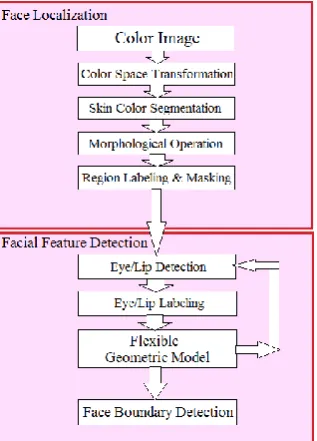
morphological operations, face candidates are grouped. By applying just skin color segmentation, the algorithm will have a big false alarm rate. To minimize this undesired factor, we extract the most important face components, the eyes and mouth. After localizing the eyes and mouth, and checking their geometric relation, the component-based algorithm automatically labels on the face candidates that contain the facial features with the correct relation and removes the other regions.
Fig. 1. Proposed face detection algorithm.
III. COLOR SPACE TRANSFORMATION
The RGB color space is the most common color space, but R, G and B are dependent on illumination conditions. For this reason skin detection with RGB color space can be unsuccessful when the illumination conditions change. YCbCr color model belongs to the family of television transmission color models, where Y is the luminance component and Cb and Cr are related to the blue and red chrominance components, respectively. The following nonlinear conversion is used to segment the RGB image into Y, Cb and Cr components:
Y Cb Cr
=
0.299 0.587 0.114
− 0.169 −0.331 0.5
0.5 −0.419 −0.081
R G B
+ 16 128 128
(1)
In HSV (Hue-Saturation-Value) color space, hue is generally related to the wavelength of the light, so it shows significant discrimination of skin color regions. The component named “Value” measures the colorfulness and shows illumination and saturation. Conversion between RGB and HSV color spaces is as follow:
H =
2 − cos−1 R − G + R − B
2 (R − G)2+ (R − B)(G − B) , B > 𝐺
cos−1 R − G + R − B
2 (R − G)2+ (R − G)(G − B) , otherwise
S = 1 − 3 ∗ min R, G, B I
V = max R, G, B (2)
YIQ color model also belongs to the family of television transmission color models. In this color model, luminance, Y, represents grayscale information, while hue, I, and saturation, Q, represent the color information. The following linear conversion is used to convert the RGB image into Y, I and Q components:
Y I Q
=
0.299 0.587 0.114 0.596 −0.274 −0.322 0.212 −0.523 −0.311
R G B
(3)
In our method, just the second row of (3) will be needed (section V).
Normalized RGB space is formed to achieve lower dependency on lighting variations. In other words, this color normalization automatically reduces much light dependency in the RGB color space. The red, green, and blue components of normalized RGB space can be obtained from the three components of RGB space using the simple following equation:
r = R
R + G + B , g = G
R + G + B , b = B R + G + B
r + g + b = 1 (4)
We will use r and g component to propose our new lip detection model.
IV. SKIN COLOR SEGMENTATION
Skin detection is an important first step in many intelligent systems such as face detection and recognition, face and hand tracking and other many recognition systems. In order to carry out skin detection, various skin color detection models such as skin color region, statistical diagram model and Gaussian model are proposed [11]-[13].
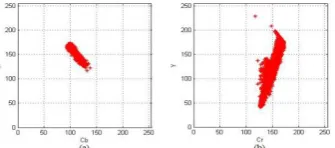
The basis of skin region model is that human skin color can be clustered in a limited region. In RGB space, the skin color region is not well distinguished in all 3 channels. A simple observation of its histogram shows that it is uniformly spread across a large spectrum of values. For this reason, in this paper the skin color images are analyzed in the HSV and YCbCr color spaces. Fig. 2 and Fig. 3 show the histogram of H, S, V and Y, Cb, Cr in order for a sample skin region. In addition, Cb-Cr and Y-Cr distributions are depicted in Fig. 4. Furthermore, by experiment, Chai et al. [13]-[15] found that any skin pixel satisfies (5) in YCbCr color space as follow:
77 < Cb < 127
133 < Cr < 177 (5)
Fig. 2. Comparison between compactness of H, S and V histograms for a sample skin region.
As it was mentioned, Cb, Cr and H components are able to separate skin and non-skin pixels. In this paper, we extract skin color pixels by using these three components from YCbCr and HSV color spaces. Then, we employ morphological filtering in order to remove existence noise and mask the skin color.
[image:3.595.313.544.96.268.2]Skin color segmentation omits non-skin regions from the images, so next processes are just performed on these regions including uncovered parts of the body and probably other skin-like regions. This segmentation leads to an effective computationally reduction.
Fig. 3. Y, Cb and Cr histograms for a sample skin region. Cb and Cr are suitable to segment the skin-like regions.
Fig. 4. (a) Cb-Cr and (b) Y-Cr distribution for a sample skin region. In skin color regions, Cr and Cb are more compact than Y component. Procedure of our skin color detection method on three selected images from CVL database [16] is shown in Fig. 5. They have been chosen because of existing beard and mustache (first photo), wearing glasses and make up
(second photo), and large amount of uncovered skin region (third photo). So there are challenges for detecting the face accurately.
Fig. 5. (a) selected sample images from CVL database, (b) face mask obtained from the proposed skin color model after applying morphological operations, (c) masked face.
V. EYE AND LIP DETECTION
According to our researches among previous methods, we found that implementing a robust face detection algorithm with high accuracy and low false alarm rate needs verification on candidate faces based on facial feature location. In addition, to find robust new eyes and lips detection models we studied a lot of color components in various color spaces. The achieved equations in order to extract the facial components are mentioned in next subsections.
A. Eye Detection
According to [1] the Cr color component has weak response around the eye regions. We found that around the eyes, value of I component also is less than the other face regions, so in this work, we propose a robust color based technique by using Cr and I components which are obtained from YCbCr and YIQ color space models, respectively. EyeMap is proposed as follow:
EyeMap = (1 − Cr2) ∗ (1 − I) (6)
[image:3.595.65.274.412.601.2] [image:3.595.313.546.564.755.2] [image:3.595.87.255.633.707.2]By using the morphological operation and considering reasonable position of eyes in the face (section VI), the false alarms are decreased. As it can be seen in Fig. 6, even under occlusion (wearing glasses) we have succeeded to localize the eyes.
B.
Lip Detection
Referring to previous researches, there are lack of mouth detection results specifically dealing with thick beard, mustache and open mouth. Lips color region contains a stronger red component and weaker blue and green component than the other facial regions. We found that lips color have a strong intensity in normalized R space while they have weak response in normalized G space, so we propose the following equation to locate mouth regions:
LipMap = r
r+g ∗ 1 − g r+g
2
(7)
Fig. 7(a) shows the result of our suggested equation. As it can be seen, the lips are masked after using morphological filtering. Our experimental results show that the proposed algorithm detects lips perfectly even for open mouth.
Fig. 7. (a) extracted mouth by proposed LipMap (Eq. 7), (b) segmented mouth after applying morphological operation and geometrical verification, (c) mouth labling on input image.
VI. FLEXIBLE GEOMETRIC MODEL
After finding candidate eyes and lips as components of a face, the algorithm uses a flexible component-based face model to detect faces based on their geometrical relations [16]. Fig. 8(a) shows a template for a frontal face, which was obtained by averaging components and relations. Fig. 8(c) shows flexible templates used for determining the relations of components containing averages and uncertainty areas, instead of only edges. Such a flexible component-based face model allows flexibility in terms of facial descriptions. Fig. 8(a–c) is an example for detection with two eyes, a lip, and their relations.
[image:4.595.313.545.50.129.2]The relationship between features can be presented by their relative distance and positions. In a frontal face image, a face often appears with two eyes that are symmetric to each other and a mouth that has located between eyes in the eyes axis and approximately in eyes distance downer than the eyes. In addition, the eyes are located in upper part and the mouth is located in downer part of the face region.
Fig. 8. Flexible component-based face model: (a) a schematic template of a frontal face with two eyes, a lip and their relations, (b) a frontal face in the image plane for face detection, (c) a flexible template of relations with uncertainty which a line means a center of the relation and uncertainty is shown with a gray area [16].
To detect components and check relations using a component-based approach, Comparing with [8] which used AdaBoost for training, our face detection model uses on-line learning that starts whenever a new data comes. Given a new image, after detecting components, the proposed algorithm detects faces using verification on its flexible geometric model. Such steps can be repeated to the sequence of images. Fig. 9 shows the final obtained results from our face detection algorithm on sample images.
Fig. 9. Final face detection results after implementing the flexible geometric model and verification to confirm the face candidate as a face.
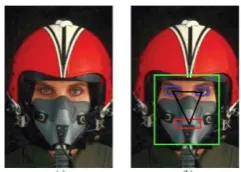
We also found that mentioned geometric relation can be used to find even occluded or missed facial features. In this way the detection accuracy in dealing with partial occlusion will be increased. Face and facial features detection in an occluded face are shown in Fig. 10. According to the flexible geometric model, our algorithm has found mouth region that had been occluded (Fig. 10(b)).
Fig. 10. (a) a sample partial occluded face, (b) localizing occluded mouth by using geometric relation between detected facial features.
VII. EXPERIMENTALRESULT
As mentioned before, we have used CVL database [17] in order to verify the accuracy of our proposed algorithm. The CVL face database includes pictures that have been taken from 114 subjects. The images are 640×480 pixels in size. All of them include just a single face. For each person there are 7 images captured with different poses and facial expressions (frontal, left profile, right profile, smiling, etc.), so CVL database includes 798 images in total and our experimental result is according to using 342 images (three nearly frontal faces with facial expressions available for
each person). Three sample images belonging to CVL
[image:4.595.309.550.303.364.2] [image:4.595.50.285.329.508.2] [image:4.595.367.488.480.566.2]eyes detection are reported in Table I. The overall performance of this algorithm in face detection on CVL database has achieved 96.8% while [18] had a 94.3% accuracy rate on whole CVL database (all poses). Also eye detection and lip detection rates of our method were 92.54% and 91.23%, respectively. Our new EyeMap shows better performance than [19] that achieved 86.06% accuracy rate on these 342 frontal faces from CVL database. Furthermore, false positive and false negative rates are two important factors to evaluate a detection system. As it can be seen in Table 1, in our method these factors also have appropriate values.
TABLE I
EXPERIMENTAL RESULT OF PROPOSED ALGORITHM ON CVL FACE DATABASE
Feature type
No. of features
Correctly detected features
False positive
False negative
Detection Accuracy
(%)
Face 342 331 3 11 96.8
Eye 684 633 81 51 92.54
Mouth 342 312 45 30 91.23
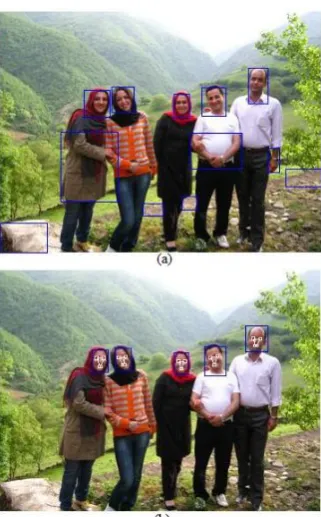
In addition to execute the algorithm on CVL database, we applied the procedure to detect faces in multi face images. Fig .11 demonstrates that our algorithm can successfully detect dark skin faces. These examples contain the faces with facial expression and open mouth. Fig. 11(a) shows the results in a multi face image containing a subject who is wearing glasses. In Fig. 11(b) there is a considerable amount of extra skin color region. After localizing the facial features and making triangle structure our algorithm could find the correct face boundary. Furthermore our method is robust in dealing with various real images with complex background. A sample image is shown in Fig. 12. As expected, detecting several faces in one image is more challenging. By using just skin color segmentation, some false regions are also extracted as human faces (Fig. 12(a)). The false alarm of algorithm is decreased (Fig. 12(b)) after using component-based detection (lips, eyes, and triangle structure). However the proposed method fails to find a face in case of detecting no components at all, but our algorithm manage to detect in the case that at least both eyes or just an eye and the mouth are detected in each face. In addition, in terms of detection time this algorithm is almost independent of the image size.
Fig. 11. Face detection examples containing dark skin faces. (a) a multi face image including facial expression and wearing glasses, and (b) an image including a large amount of skin like pixels. By using eye and lip maps and flexible geometric model the face is successfully detected.
Fig. 12. A sample of detected faces in a real image with complex background. (a) face detection result using skin color segmentation, (b) face detection using skin color segmentation and component-based verification.
VIII. CONCLUSION
In this paper, a robust component face detection algorithm based on color features was presented. Proposed algorithm has a big benefit due to its computationally reduction. By applying component detectors on only face candidates, our proposed method takes just about a second in order to detect face or faces in an image. The extra pixels including non-skin regions are removed before applying component detectors. We considered two novel models for extracting eyes and mouth as facial components. The proposed algorithm performs well even when an eye or the mouth is occluded and so is not detected. It means that, according to geometric relation between the facial features, the algorithm is able to localize missed or occluded facial components. The accuracy of proposed technique is better than the similar approaches.
ACKNOWLEDGMENT
The used CVL database in this paper, has been compiled in faculty of Computer and Information Science (FRI) in the University of Ljubljana, Slovenia.
REFERENCES
[1] R. L. Hsu, M. Abdel-Mottaleb, and A. K. Jain, "Face detection in color images," IEEE Transaction on Pattern Analysis and Machine Intelligence, vol. 24, no. 5, pp. 696–706, May 2002.
[2] M. H. Yang, D. J. Kriegman, and N. Ahuja, "Detecting faces in images: a survey," IEEE Transaction on Pattern Analysis and Machine Intelligence, vol. 24, no. 1, pp. 34-58, 2002.
[3] G. Yang and T. S. Yuang, "Human face detection in complex background," Pattern Recognition, vol. 27, no. 1, pp. 53-63, 1994. [4] J. Fang, G. A. Qiu, "Colour histogram based approach to human face
detection," Proc. Conf. on Visual Information Engineering, 2003. [5] G. J. Edwards, C, J. Taylor, and T. Cootes, "Learning to identify and
track faces in image sequences," Proc. Sixth IEEE Int'l Conf. Computer Vision, pp. 317-322, 1998.
[image:5.595.41.296.223.283.2] [image:5.595.51.290.572.741.2]parts," Adv. Neural Inform. Process. Syst. Vol. 14, no. 2, pp. 1239-1245, 2002.
[7] T. K. Leung, M. C. Burl, and P. Perona, "Finding faces in cluttered scenes using random labeled graph matching," Proc. Fifth Internat. Conf. on Computer Vision, 1995.
[8] P. Viola, and M. Jones, "Robust real-time face detection," Internat. J. Comput. Vision, vol. 57, no. 2, pp. 137-154, 2004.
[9] K. C. R. Cipolla, "Feature-based human face detection," Image Vision Computer, vol. 15, no. 9, pp. 713-735, 1997.
[10] C. Garcia, G. Tziritas, "Face detection using quantized skin color regions merging and wavelet packet analysis," IEEE Trans. on Multimedia vol. 1, no. 3, pp. 264–276, 1999.
[11] M. J. Jones, and J. M. Rehg, "Statistical color models with application to skin detection," Proc. IEEE Conf. Computer Vision and Pattern Recognition [C], Fort Collins, pp. 274-280, 1999.
[12] M. Yang, and N. Ahuja, "Gaussian mixture model for human skin color and its application in images and video databases," In Proc. of the SPIE99[C], pp. 458-466, 1999.
[13] S. L. Phung, A. Bouzerdoum, and D. Chai, "A novel skin color model in YCbCr color space and its application to human face detection," In IEEE International Image Processing, no. 1, pp. 289-292, 2002. [14] S. L. Phung, A. Bouzerdoum, and D. Chai, " Skin Segmentation Using
Color Pixel Classification: Analysis and Comparison," IEEE Transaction on Oattern Analysis and Machine Intelligence, vol. 27, no.1, pp.148-154, 2005.
[15] D. Chai, K. N. Ngan, "Face segmentation using skin color map in videophone applications," IEEE Transactions CAS for Video Technology, vol. 9, no. 4, pp. 551-564, 1999.
[16] K. M. Lee, "Component-based face detection and verification," Pattern Recognition Letters, vol. 29, pp. 200-214, 2008.
[17] CVL database is available at: http://www.lrv.fri.unilj.si/facedb.html. [18] K. Nasrollahi, and T. B. Moeslund, "Face quality assessment system
in video sequences," BIOID, pp. 10-18, 2008.