This research presents the fuzzy goal programming model for machine loading problem of a case study company which is a tire industry. Two main objectives are determined; minimization of an average machine error and the total setup time. Conventionally trial and error was done in selecting press and mold for each task due to complexity and constraints of the problem. So, both objectives may not satisfy. Then, in this research preemptive fuzzy goal programming model is developed for the problem of this company. The proposed model can obtain the appropriate results that the Decision Making (DM) is satisfied for both objectives. Moreover, alternative choice can be easily generated by varying the level of satisfaction. Numerical example is also illustrated to show the effectiveness of the proposed model.
Index Terms—Fuzzy Goal Programming (FGP), Machine Loading Problem, Die Shop, Integer Programming
I. INTRODUCTION
HE market conditions of a manufacturing industry are becoming more dynamic, more globalize and more customized driven. The manufacturing performance is no longer driven by the product price. On the other hand it affects by quality, flexibility, delivery and customer service which have become equally important [1]. Manufacturing needs to distinguish itself by increasing product quality, reducing manufacturing lead time and flexibility to adapt to changes in the market.
The case study company is one of the leading manufacturers of truck and bus tires. It needs to increase competitiveness by increasing product quality and reducing production time for responding to the dynamic and globalized market. The Curing department is a crucial department that should be emphasis because it is the process that high product quality can be produced. Moreover, it is also the bottleneck of the factory. Product quality is extremely important for the company because the product is related to customer safety and prestige of the company. Resources in Curing department are high-priced machines including tire curing machines or presses. They are limited.
Manuscript received on January 8, 2012. This work was supported by the Commission on Higher Education of Thailand and the Faculty of Engineering, Thammasat University, Thailand.
Paruang P. is a Graduate Student of Industrial Statistics and Operational Research Unit (ISO-RU) in Industrial Engineering Department, Faculty of Engineering, Thammasat University, Rangsit campus, Klongluang, Pathum-thani, 12120, Thailand. (e-mail: [email protected])
B. Phruksaphanrat is an Associate Professor, ISO-RU, Industrial Engineering Department, Faculty of Engineering, Thammasat University, Rangsit campus, Klongluang, Pathum-thani, 12120, Thailand (corresponding author; e-mail: [email protected]).
Therefore, selection of presses and molds for ordered products are very important because it can increase both quality of products and reduce setup time or production lead time of the factory.
Most of researchers are emphasis on machine loading problem of a Flexible Manufacturing System (FMS)[2]-[6]. Machine loading problem in particular deals with the allocation of jobs to various machines under technological constraints performance measures. It can be divided machine loading problem in to five sub-problems: machine grouping, part type selection, production rate determination, resource allocation and loading [5]. Formulation of all these problems in a single mathematical model may not be possible, it leads to a complex mathematical model whose solution may be difficult to determine. Normally, integer programming, mixed-integer programming, dynamic programming, branch and bound models were developed for such kind of the problem with different kind of objectives such as minimization of costs, minimization of times or minimization of total system unbalance and maximizing the sum of operations priorities [3],[5]-[7]. Most of them consider a single objective function. However, in some case multiple objective functions are also necessary. Heuristic methods were also presented due to the complex of the problem in finding the optimal solution [6],[3]. They are largely based upon rules and rely on empirical experiences. Therefore, one of the limitations of a heuristic approaches is in its difficulty to approximate results in a new or completely changed environment [7].
The case study company needs to increase competitiveness by increasing product quality and reducing production lead time. Most of waste time in production is setup time. So, two objective functions show be considered; minimization of an average errors of machines and minimization of the total setup time. To solve a Multiple Objective problem, there are several methods used in general such as fuzzy linear programming [8]-[15], compromise programming [16], [17], interactive approaches [13], [17], etc. However, the most popular one is Goal Programming (GP) [16]-[20]. In GP, a precise target is set for each objective as a goal. But, it is difficult for Decision Maker (DM) to clearly desire targets or goals. The Fuzzy Goal Programming (FGP) makes easiness by allowing vague aspirations of the DMs, which is suitable for the case study problem because target values of both objectives are unclear. Preemptive Fuzzy Goal Programming (P-FGP) has been applied to the problem. P-FGP is suitable for this problem since the first goal is extremely important than the second goal. Additionally, setting the membership function for each goal makes easiness for DM in adjustment and decision.
Fuzzy Goal Programming Model for
Press and Mold Selection Problem:
A Case Study of Tire Industry
Paruang C., Phruksaphanrat B., Member, IAENG
The remainder of this paper is organized as follows. The problem description is discussed in Section II. Then, model formulation is illustrated in Section III. A case study is shown in Section IV. Finally, the conclusion of this research is provided in Section V.
II. PROBLEMDESCRIPTION
The case study company is one of the leading of truck and bus tires manufacturers. The company is trying to increase product quality and its productivity. The main process which is also the bottleneck of the factory is the Curing Department. The process of this department can improve product quality and reduce production lead time if appropriate presses and molds are assigned to the jobs because each press and mold has different affect to the product quality. Therefore, the selecting of a press and molds for each task is very important.
There are many factors to be considered in the problem of the case study company.
Firstly availability of presses and molds for production are limited due to high-priced machines and molds.
Secondly, mold changing time depends on sequence of scheduling and size of mold.
Thirdly, rule of selecting mold for a double-press should be followed which is called Cure law. In Cure law, the rule mentions that the different of cure time of molds which are selected for double-press should be less than 2 minutes/time otherwise the high quality tire cannot be obtained. This rule is for preventing uncooked rubber.
Fourthly, cured tires quality depends on a uniformity of rubber in each press for each size and a geometry error of each press which lead to quality level of cured tires.
Presently, production planners need to consolidate all data and set a decision meeting every time the plan is changed due to limitations mentioned above. Information obtained from the Production planning department is customer demand, rough production plan and available molds and presses at that period. Main objective of the factory is a quality of curing which is related to assigning presses. Consequence of the changing molds plan may take time if the planner wants to reach an optimal quality. Setup time is compromise and acceptable using a combination of DM’s experience and decision-making team, which may not be effective. Therefore, the reduction of machine errors is uncertain and processing time is also unpredictable. So, it is necessary to have a model for selection suitable presses and molds in the Curing department which can control both quality and setup time.
In the case study factory, there are two types of press; single-press (Type A) and couple-press (Type B). Selection should be done for couple-press first because processing time can be reduced by producing two tires at one time and then the single-press is considered for producing one tire at a time. Molds that can be used for a press are couple-molds and a mold that can match with another single-mold with acceptable quality according to cure law. Molds that can be used for a single-press are single-molds. So, two models for couple-press and single-press are constructed.
III. MATHEMATICAL MODEL
In press and mold selection of the case study factory, two objectives have to be considered. Firstly, minimization of an average uniformity and geometry error of all tasks should be
considered to ensure high product quality. Secondly, minimization of the total setup time is set to reduce production lead time of a bottleneck process.
Notations of models can be represented as follows: Index
i : Couple-press, i = 1,…,m1
j : Product of couple-press, j = 1,…,n1
k: Couple-mold or a single-mold that can match with another single-mold with acceptable quality, k = 1,…,o1
l : Single-press, l = 1,…,m2
g : Product of single-press, g = 1,…,n2
s: Single-mold, s = 1,…,o2
Decision Variables
x = 1 if a couple-press i is assigned for product j, 0 otherwise.
y = 1 if a couple-mold k is assign for product j, 0 otherwise.
x = 1 if a single-press l is assigned for product g, 0 otherwise.
y = 1 if a single-mold s is assign for product g, 0 otherwise.
Parameters
Uniformity error of a couple-press i for product j. Uniformity error of a single-press l for product g. Average geometry error of a couple-press i.
Average geometry error of a single-press l.
The number of double-molds specified for changing.
The number of single-molds specified for changing. Size of a double-press i for product j.
Size of a single-press l for product g. Size of a double-mold k for product j. Size of a single-mold s for product g.
A. Multi objective Model for Couple-press and Single press
As mention above, the selections of presses and molds are based on types of press. The selection of double-presses should be done first in order to reduce production lead time because two molds can be assigned at the same time. Then, the selection of single-presses is made for the remaining jobs. Some information about available presses and molds in each period and production plan should be prepared before using the proposed models.
The integer programming model for a couple-press selection can be mathematically represented by
1 1
2
subject to
1, ∀j 4
2 , ∀j 5
, ∀j , ∀k 6
, ∀j 7
Two objectives of the model are represented by Eq.(1)-(2). The first objective is to minimize an average error of pressing that comes from uniformity errors and geometry errors of double-press. The second objective is to minimized total processing time. A press can be assigned to only one job but each job can assign to more than one press as shown in Eqs. (3)-(4). Two molds are used in a couple-press as shown in Eq.(5). Size of a press should larger than molds assigned to the press for all jobs and for all molds. This consideration is represented by Eq.(6). The number of couple-molds or couples of single-molds that can be matched with acceptable quality should be equal to the number of mold specified Eq.(7). By the same way, the integer programming model for single-press can be mathematically represented by 1 8
, 9
subject to 1, ∀l 10
1, ∀g 11
, ∀s 12
, ∀g , ∀s (13)
, ∀ 14
The first objective is to minimize average errors of pressing of single-presses represented by Eq.(8). The second objective is to minimized total processing time as shown in Eq.(9). A press can be assigned to only job but each job can be assigned to more than one press as shown in Eqs. (10)-(11). A mold is used in a single-press as shown in Eq.(12). Size of press should larger than molds assigned for all job and for all mold. This consideration is represented by Eq.(13). The number of single-mold should be equal to the number of mold specified Eq.(14). B. Preemptive fuzzy goal programming In the problem that has multiple objective functions, several conflicting objectives are considered. Such kind of the problem is called Multiple Objective Decision Making (MODM) problem. In many MODM problems, some goals are extremely important than the others. So, the DM cannot simultaneously consider the attainments of all goals. Differentiating goals into different levels of importance, in which the high level goal must firstly be satisfied before the low level goals get consideration, is called preemptive or lexicographic ordering. The fuzzy goal programming with a priority structure for ordering goals is called “Preemptive Fuzzy Goal Programming (P-FGP)” [19], [20]. The P-FGP model can be shown as follows, lex max [p= 1 f ( )1 ,p2 f ( )2 ,...,pt f ( )t ], (15)
subject to - += ,* k k k k for all k. (16)
0, - + k, k for all k. (17)
- + 0,
k k= for all k. (18)
k [0,1] for all k. (19) Wherekis the satisfactory level of goal k.
* k
is the acceptable satisfactory level of goal k. +kand k
are the positive and negative deviations of the satisfactory level of goal k.
In the P-FGP, with assumed triangular membership function and that there exist T priority levels (each priority may include mk goals for k = 1,2,...,K) that preemptive
weights are pt pt+1whereas f ( )t is the satisfactory function of priority t. The problem is then partitioned into T sub-problems or T fuzzy goal programming. For easiness, the goals are ranked in agreement with the following rule: if
r < s, then the goal set G (x)r has higher priority than the
goal set G (x)s [20].
In the case study both objective functions are imprecise depending on DM’s preference. However, the first objective (to minimize the average errors of pressing) is extremely more important than the second objective (to minimize the total processing time) because of customer safety, prestige of the company and high product cost so quality should be ensured. Then, P-FGP is applied in the proposed model. C. Membership functions
0 , if z Δ
z
1 , if Δ z
Δ
(z )
z
1 , if z +Δ
Δ
0 , if z +Δ
k k k
k k
k k k k
k k
k k
k k k k
k
k k k
(20)
where (z ) k is the membership function of kth goal. k is
the specified target for kth goal and assigned by the PIS. Δk PIS-NIS is the acceptable deviation of kth goal.
(z )k
zk k
1
0
k k
k k
k
k
Fig.2 The membership function of kth goal
D. Model formulation
As mentioned previously, the proposed model has two goals to be considered. In the P-FGP, we need to satisfy the satisfactory level (k) of each goal. These are the
satisfactory level of both goals. Moreover, the first goal is defined more important than the second goal. So, two priority levels are constructed. Fuzzy goal equations can be derived as follows,
∆ 1 (21)
∆ 2 (22)
Then, the Fuzzy Multiple Objective Decision Making (FMODM) model can be shown as, lex max [ , ],= 1 2 (23)
subject to - += ,* k k k k for all k. (24)
k (z ),k for all k. (25)
Then, FMODM model can be adapted for the multi objective problem of press and mold selection. Two models are constructed. They are solved consecutively. These models can be represented as follows: FMODM for double-press and mold selection
lex max [ , ],= 1 2 subject to k -k +k= ,*k k = 3,4. (26)
k (z ),k k = 3,4. (27)
1 ∆ 28
∆ 29
-k, +k 0, ∀ 30
0, - + k k = ∀ 31
[0,1], k ∀ 32
( 3 ) – ( 7 ) FMODM for single-press and mold selection
lex max = [3,4] subject to * = , - + k k k k
k = 3,4. (33)
(z ), k k k = 3,4. (34)
1 ∆3 3 3 35
∆ 36
∀ 37
∀ 38
∀ 39 ( 10 ) – ( 14 )
IV. A CASE STUDY
An example of press and mold selection of the case study company is solved by the proposed model. There are two plans from production planning department; entry plan as shown in Table I and the plan for exit molds that is used for determination of availability of presses and molds as shown in Table II.
TABLEI
NEW ENTRY PLAN
Job
No. Mold in No. of mold plan (A,B)
No .of mold in storage Type A Type B Total 1 Size 102 4 ( B ) 5 9 14
2 Size 141 2 ( B ) 0 2 2
3 Size 18 2 ( B ) 0 4 4
4 Size 138 1 ( A ) 1 8 9
Total 9 6 23 29
Mold for each job of the new entry plan is assigned according to type of product. Nine molds are considered to enter as shown in the new entry plan. New entry molds should match with available presses that molds of the previous period are exited. In this example, there are 4 couple-molds and 1 single-mold (totally 9 molds) to be assigned in this week. Two couple-molds for size 102, a couple-mold for size 141, a couple-mold for size 18 and a single-mold for size 138. These molds should efficiently assign to available presses in Table II according to technological constraints.
The available presses are listed in Table II. The number of entry mold of each size is firstly verified so there is not any problem about lack of entry size molds. There are 22 molds available which consist of 4 single-molds and 9 couple-molds (totally 22 couple-molds). Four couple-couple-molds and one single-mold are assigned to the new entry jobs of this week. Then, the remaining molds are 13 molds.
, 0,
- +
k k
0, - +
k k=
[0,1],
k
TABLEII
PLAN FOR EXIT MOLDS
Mold list in existing
Press name
No. of existing mold No. of exit mold
No. of remaining
mold Type A Type B
Size 25 D1-2 - 2 2 2
Size 25 D15-16 - 2 Size 132 D9-10 - 2
4 2
Size 132 I7-8 - 2
Size 132 K1-2 - 2
Size 133 C3-4 - 2 2 2
Size 133 C7-8 - 2
Size 137 I1-2 - 2
1 7
Size 137 J3-4 - 2
Size 137 F02 1 -
Size 137 F03 1 -
Size 137 F06 1 -
Size 137 G01 1 -
Total 4 18 9 13
Grand Total 22 9 13
In order to assign entry molds to presses, it is necessary to consider technological information about dimension of presses and entry molds, machines errors and mold changing time as constraints. Table III shown dimension of entry molds and dimension of available presses. Dimension of the selected mold should be less than the press. For example the entry mold size 102 cannot assign in press C3-4 and C7-8 because the dimension of mold size 102 is bigger than press dimension.
TABLEIII
DIMENSION OF PRESSES AND MOLDS
Press Type
Press name
Press Dimension
( Sij Slg,)
Dimension of mold for each size ( Zij ,Zlg,)
Size 18 Size102 Size 141 Size 25 A >301
B >55
A > 301 B >63.5
A >301 B >55
B
C3-4 55 / x / /
C7-8 55 / x / /
D1-2 65 / / / /
D9-10 63.5 / / / /
D15-16 63.5 / / / /
I1-2 63.5 / / / /
I7-8 63.5 / / / /
J3-4 63.5 / / / /
K1-2 63.5 / / / /
A
F02 401 / / / /
F03 401 / / / /
F06 301 / / / /
G01 301 / / / /
Note : (x )cannot assign ( /) can assign
TABLEIV
MOLD CHANGING TIME AND %ERROR OF EACH COUPLE –MOLD
ON EACH PRESS
Press name
Time to size change per each mold (Tij,)
%Error of each mold (
Size 18
Size 102
Size 141
Size 18
Size 102
Size 141
C3-4 460 560 520 0.04 0.09 0.08
C7-8 460 560 520 0.29 0.33 0.24
D1-2 440 520 460 0.07 0.115 0.02
D9-10 460 560 520 0.295 0.32 0.335
D15-16 440 520 460 0.26 0.365 0.29
I1-2 460 460 440 0.33 0.36 0.425
I7-8 460 560 520 0.22 0.28 0.295
J3-4 460 460 440 0.335 0.35 0.29
K1-2 460 560 520 0.05 0.03 0.085
TABLEV
MOLD CHANGING TIME AND %ERROR OF EACH SINGLE –MOLD
ON EACH PRESS
Press name A
Time to size change per each mold (Tlg,)
%Error of each mold (
Size 138 Size 138
F02 160 0.33 F03 160 0.27 F06 160 0.26 G01 160 0.16
Mold changing time and % error of each couple-mold on each press and each single-mold on each press are shown in Table IV and V, respectively. These constraints are considered in the proposed model as constraints.
Firstly, PIS and NIS of both objective functions are obtained by individually optimization of each objective. PIS and NIS of the average machine errors objective are 0.093% and 0.248%, respectively. PIS and NIS of the total setup time objective are 3,640 min/week and 4,120 min/week, respectively. The best answer of optimization only the first objective function is
Job#1: mold 102 is assigned to press I7-8 and K1-2 Job#2: mold 141 is assigned to press D1-2
Job#3: mold 18 is assigned to press C3-4 Job#4: mold 138 is assigned to press G01
On the other hand, if the total setup time (the second objective) is set to be the main objective then the optimal solution is
Job#1: mold 102 is assigned to press I1-2 and K1-2 Job#2: mold 18 is assigned to press D15-16 Job#3: mold 141 is assigned to press D1-2 Job#4: mold 138 is assigned to G01
These two objective needs to be compromise. Then, the proposed method is applied. Firstly, the selection of couple-presses for assigned molds is done in order to reduce processing time. After that the selection of single-presses for assigned molds is performed.
FMODM for double-press and mold selection lex max [ , ],= 1 2 subject to
0.87
1 .
.
1
1
8 0.155 0.093
480 3640
1, ∀
1 ∀
2 ∀
x y ∀ , ∀
, 0,
- +
k k
- + 0,
k k=
k [0,1], ∀
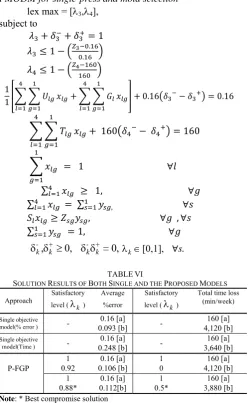
By the same way PIS and NIS of both objective functions are calculated for the single-press and mold selection model. Then, the model can be mathematically solved by the following model.
FMODM for single-press and mold selection lex max = [3,4],
subject to
1
1 .
.
1
1
1 0.16 0.16
160 160
1 ∀
∑ 1, ∀ ∑ ∑ , ∀
, ∀ , ∀ ∑ 1, ∀
∀s. TABLEVI
SOLUTION RESULTS OF BOTH SINGLE AND THE PROPOSED MODELS
Approach Satisfactory level (
k
)
Average %error
Satisfactory level (k)
Total time loss (min/week)
Single objective
model(% error ) -
0.16 [a]
0.093 [b] -
160 [a] 4,120 [b] Single objective
model(Time ) -
0.16 [a]
0.248 [b] -
160 [a] 3,640 [b]
P-FGP
1 0.92
0.16 [a] 0.106 [b]
1 0
160 [a] 4,120 [b] 1
0.88*
0.16 [a] 0.112[b]
1 0.5*
160 [a] 3,880 [b]
Note: * Best compromise solution
[a] : Press /Mold A type [b] : Press /Mold B type
The proposed P-FGP models can obtain the
[image:6.595.48.298.137.541.2]compromise solution which has average % error 0.112 and total set up time 3,880 at 0.88 satisfactory level as shown in Table VI. Then, presses and molds selection plan can be assigned.
Job#1: mold 102 is assigned to press I1-2 and K1-2 Job#2: mold 141 is assigned to press D1-2
Job#3: mold 18 is assigned to press C3-4 Job#4: mold 138 is assigned to press G01
The average % error 0.112 is acceptable for high product quality. Setup time from the proposed model can be reduced from 4,120 to 3,880 mins/week or 960 mins/month when comparing with optimization only the first objective.
V. CONCLUSION
This research proposed the preemptive fuzzy goal programming models for machine loading problem of a case study company which is a tire industry. Two main
objectives are determined; minimization of an average machine error and the total setup time. Conventionally trial and error was done in selecting press and mold for each task due to complexity and constraints of the problem which makes unpredictable quality and processing time. Then, in this research preemptive fuzzy goal programming model is developed for the problem of this company to compromise these two objectives. The proposed model can obtain the appropriate results that Decision Making (DM) is satisfied for both objectives. Moreover, alternative choice can be easily generated by varying the level of satisfaction.
Further research can be done by further determining limited equipment selection for each press.
REFERENCES
[1] F.T.S. Chan and R.Swarnkar, “Ant colony optimization approach to a fuzzy goal programming model for a machine tool selection and operation allocation problem in a FMS”, Robotics and
Computer-Integrated Manufacturing, vol. 22, 2006, pp.353-362
[2] S.Sujono, R.S.Lashkari, “A multi-objective model of operation allocation and material handling system selection in FMS design”, Int.
J. Production Economics, vol. 105, 2007,pp. 116-133.
[3] M.A.Gamila and S. Motavalli, “A modeling technique for loading and scheduling problem in FMS”, Robotics and Computer Integrated
Manufacturing, vol.19, 2003, pp.45-54.
[4] N. Nagarjuna, O. Mahesh and K. Rajagopal, “A heuristic based on multi-stage programming approach for machine-loading problem in a flexible manufacturing system”, Robotics and Computer-Integrated
Manufacturing, vol.22, 2006, pp.342-352.
[5] F.Guerrero, S. Lozano, T. Koltai and J. Larraneta, “Machine loading and part selection in flexible manufacturing systems”, Int.
J.Prod.Res., vol.37, no. 6, pp.1303-1317.
[6] A.M.Abazari, M. Solimanpur and H. Sattari, “Optimum loading of machines in a flexible manufacturing system using a mixed-integer linear mathematical programming model and generic algorithm”,
Computers & Industrial Engineering, Volume 62, Issue 2, March
2012, Pages 469-478.
[7] A.Kamar, Prakash, M.K. Tiwari, R. Shankar and A. Baveja, “Solving macine-loading problem of a flexible manufacturing system with constraint-based genetic algorithm”, European Journal of
Operational Research, vol.175, 2006, pp.1043-1069.
[8] T. F. Liang, “Integrating production-transportation planning decision with fuzzy multiple goals in supply chains,” International Journal of
Production Research, vol. 46, 2008, pp. 1477-1494.
[9] T. F. Liang, “Interactive multi-objective transportation planning decisions using fuzzy linear programming,” Asia-Pacific Journal of
Operational Research, vol. 25, 2008, pp. 11-31.
[10] H. J. Zimmermann, Fuzzy sets and systems 1. North Holland Publishing Company, 1978.
[11] H. J. Zimmermann, Fuzzy Set Theory and Its Applications. 2nd ed. Kluwer Academic Publishers, 1991.
[12] C. Romero, Handbook of Critical Issues in Goal Programming. Pergamon Press, 1990.
[13] M. Zeleny, Multiple criteria decision making. McGraw-Hill Book Company, 1982.
[14] J. P. Ignizio, Linear programming in single- & multiple-objective
system. Prentice-Hall, Inc., 1982.
[15] I. Giannikos, “A multiobjective programming model for locating treatment sites and routing hazardous wastes,” European Journal of
Operational Research, vol. 104, 1998, pp. 333-342.
[16] M. T. Tabucanon, Mutiple criteria decision making in industry. Elsevier Science Publishing Company, Inc., 1988.
[17] A. Charnes and W. W. Cooper, Elements of a Strategy for Making
Models in Linear Programing, in R. Macho et al., Ed. System
Engineering Handbook. New York: McGraw-Hill, 1965.
[18] E. L. Hannan, “On fuzzy goal programming,” Decision Sciences, 1981, pp. 522-531.
[19] Y. J. Li and C. L. Hwang, Fuzzy multiple objective decision making:
Methods and Applications. Springer-Verlag Berlin Heidelberg, 1994.
[20] K. P. Yoon and C. L. Hwang, Multiple attribute decision making: An
introduction. SAGE Publications, 1995.
, 0,
- +
k k
- + 0,
k k=