Evolving text classification rules with genetic
programming
HIRSCH, Laurence <http://orcid.org/0000-0002-3589-9816>, SAEEDI, Masoud and HIRSCH, Robin
Available from Sheffield Hallam University Research Archive (SHURA) at:
http://shura.shu.ac.uk/6620/
This document is the author deposited version. You are advised to consult the publisher's version if you wish to cite from it.
Published version
HIRSCH, Laurence, SAEEDI, Masoud and HIRSCH, Robin (2005). Evolving text classification rules with genetic programming. Applied Artificial Intelligence: An International Journal, 19 (7), 659-676.
Copyright and re-use policy
Article Title: Evolving Text Classification Rules with Genetic Programming
Authors:
1. Laurence Hirsch, School of Management
Royal Holloway University of London Egham
Surrey TW20 OEX
Email: [email protected]
2. Masoud Saeedi School of Management
Royal Holloway University of London Egham
Surrey TW20 OEX
3. Robin Hirsch
Department of Computer Science University College London Gower Street
London WC1E 6BT
Evolving Text Classification Rules with Genetic
Programming
Abstract.
We describe a novel method for using Genetic Programming to create compact
classification rules using combinations of N-Grams (character strings). Genetic
programs acquire fitness by producing rules that are effective classifiers in terms of
precision and recall when evaluated against a set of training documents. We describe
a set of functions and terminals and provide results from a classification task using
the Reuters 21578 dataset. We also suggest that the rules may have a number of
other uses beyond classification and provide a basis for text mining applications.
Key Words: text classification, Genetic Programming, N-Gram.
1
Introduction
Automatic text classification is the activity of assigning pre-defined category labels to
natural language texts based on information found in a training set of labelled
documents. In recent years it has been recognised as an increasingly important tool
for handling the exponential growth in available online texts and we have seen the
development of many techniques aimed at the extraction of features from a set of
training documents, which may then be used for categorisation purposes.
In the 1980’s a common approach to text classification involved humans in the construction of a classifier, which could be used to define a particular text category.
Such an expert system would typically consist of a set of manually defined logical
if {DNF formula} then {category}
A DNF (“disjunctive normal form”) formula is a disjunction of conjunctive clauses; the document is classified under a category if it satisfies the formula i.e. if it satisfies
at least one of the clauses. An often quoted example of this approach is the
CONSTRUE system (Hayes et al. 1990), built by Carnegie Group for the Reuters
news agency. A sample rule of the type used in CONSTRUE to classify documents in the ‘wheat’ category of the Reuters dataset is illustrated below.
if ((wheat & farm) or
(wheat & commodity) or
(bushels & export) or
(wheat & tonnes) or
(wheat & winter & ¬ soft))
then
WHEAT else ¬ WHEAT
Such a method, sometimes referred to as ‘knowledge engineering’, provides accurate rules and has the additional benefit of being human understandable. That is, the
definition of the category is meaningful to a human, thus producing additional uses of
the rule including verification of the category. However the disadvantage is that the
construction of such rules requires significant human input and the human needs some
knowledge concerning the details of rule construction as well as domain knowledge
(Apt´e et al. 1994).
Since the 1990’s the machine learning approach to text categorisation has become the dominant one. In this case the system requires a set of pre-classified training
documents and automatically produces a classifier from the documents. The domain
expert is needed only to classify a set of existing documents. Such classifiers, usually
1. the more times a word occurs in a document, the more relevant it is to the topic
of the document.
2. the more times the word occurs throughout the documents in the collection the
more poorly it discriminates between documents.
A well known approach for computing word weights is the term frequency inverse
document frequency (tf-idf) weighting (Salton and McGill 1983) which assigns the
weight to a word in a document in proportion to the number of occurrences of the
word in the document and in inverse proportion to the number of documents in the
collection for which the word occurs at least once, i.e.
i ik ik n N f a log
where aik is the weight of word i in document k, fik is the frequency of word i in
document k, N the number of documents in the collection and ni equal to the number
of documents in which aioccurs at least once. A classifier can be constructed by
mapping a document to a high dimensional feature vector, where each entry of the
vector represents the presence or absence of a feature (Salton et al. 1996; Joachims,
1998). In this approach, text classification can be viewed as a special case of the
more general problem of identifying a category in a space of high dimensions so as to
define a given set of points in that space. This is usually accompanied by some form
of feature reduction such as the removal of non-informative words (stop words) and
by the replacing of words by their stems, so losing inflection information. Such
sparse vectors can then be used in conjunction with many learning algorithms for
computing the closeness of two documents and quite sophisticated geometric systems
have been devised (Bennet et al. 2000; Anthony 2003).
Although this method has produced accurate classifiers there are a number of
drawbacks from the machine learning approach as compared to a rule based one.
2. The approach cannot normally identify word combinations, phrases or multi-word units e.g. ‘information processing’ (Pickens and Croft 2000).
3. If word stemming is used inflection information is also lost.
4. The classifier (the vector of weights) is not human understandable.
In this paper we describe a method to evolve compact human understandable rules
using only a set of training documents. The system uses genetic programming
(GP)(Koza 1992) to produce a synthesis of machine learning and knowledge
engineering with the intention of incorporating advantageous attributes from both.
The rules produced by the GPs are based on N-Grams (sequences of N letters) and are
able to use a wide variety of features including word combinations and negative
information for discrimination purposes. In the next section, we introduce GP and
review previous classification work with N-Grams and with phrases. We then
provide information concerning the implementation of our application and the initial
results we have obtained on a text classification task.
1.1 GP Background
GP is a widely used method for automatically producing computer programs based on
a high level specification of a particular problem known as the fitness test. Like the
Genetic Algorithm (GA) GP is based on the principle of natural selection namely
variation in reproductive success correlated with variation in a trait. Unlike GAs the
individuals in a GP population are in the form of executable computer programs. GP
works by iteratively applying genetic transformations, such as crossover and
mutation, to a population of individual programs with the intention of creating better
performing individuals as measured by the fitness test in subsequent generations.
Although GP has been used in a textual environment (Clack et al. 1997; Bergström et
al. 2000) it has not previously been used to evolve classifiers based on evolving
1.2 N-Grams
A character N-Gram is an N-character slice of a longer string. For example the word
INFORM produces the 5-grams _INFO, INFOR, NFORM, FORM_ where the
underscore represents a blank. The key benefit of N-Gram-based matching derives
from its very nature: since every string is decomposed into small parts any errors that
are present tend to affect only a limited number of those parts leaving the remainder
intact. The N-Grams for related forms of a word (e.g., ‘information’, ‘informative’, ‘informing’, etc.) automatically have a lot in common. If we count N-Grams that are common to two strings, we get a measure of their similarity that is resistant to a wide
variety of grammatical and typographical errors (Cavnar and Trenkle 1994;
Damashek 1995). The N-Gram representation has proven a robust alternative to word
stemming, having the further advantage of requiring no linguistic preparations (Biskri
and Delisle 2002). Since N-Grams are simply defined as sequences of characters they
constitute a valuable basis for a language-independent text classifier.
A further useful property of N-Grams is that the lexicon obtained from the analysis of
a text in terms of N-Grams of characters cannot grow larger than the size of the
alphabet to the power of N. Furthermore, because most of the possible sequences of
N characters rarely or never occur in practice for N>2, a table of the N-Grams
occurring in a given text tends to be sparse, with the majority of possible N-Grams
having a frequency of zero even for very large amounts of texts. For example, (Ebert
et al. 1997) found that 40 MB of text from the Wall Street Journal contained only
2.7*105 different 5-grams out of a possible 7.5*1018, based on an alphabet of 27
characters. Tauritz (2000) and later Langdon (2000) used this property to build an:
adaptive information filtering system based on weighted trigram (N=3) analysis in
which genetic algorithms were used to determine weight vectors. An interesting
modification of N-Grams is to generalise N-Grams to substrings which need not be
contiguous. Lodhi et al. (2002) define a learning algorithm that uses non-contiguous
substrings of N characters, but with a penalty for any gaps occurring between the N
1.3 Phrases
The notion of N-Grams of words i.e. sequences or occurrences of N contiguous and
non-contiguous words (with N typically equals to 2, 3, 4 or 5) has produced good
results both in language identification, speech analysis and in several areas of
knowledge extraction from text (Feldman et al. 1998; Ahonen-Myka 1999; Karanikas
et al. 2000; Merkel and Andersson 2000; Tan et al. 2002). Pickens and Croft (2000)
make the distinction between ‘adjacent phrases’ where the phrase words must be
adjacent and Boolean phrases where the phrase words are present anywhere in the
document. They found that adjacent phrases tended to be better than Boolean phrases
in terms or retrieval relevance but not in all cases. Restricting a search to only
adjacent phrases means that some retrieval information is lost. The implementation
described below is able to make use of both adjacent and Boolean phrases if they are
found to aid discrimination between documents.
2
Implementation
When building text classifiers there are usually a variety of options regarding
pre-processing of documents and particular parameters values. Examples include whether
to remove stop words, to stem words to a common form, to use words or N-Grams as
terms and whether to search for single terms, phrases or particular sequences of terms.
Where N-Grams or phrases are used the length of the phrase or N-Gram must also be
determined. Although many of these options have been researched (Berleant and Gu
2000) it is often the case that effects on the performance of the classifier will depend
on the particular classifier and the particular text environment (Sebastini 2002). We
have developed a GP system where many of these decisions are either made
redundant or are taken by the individual GPs.
We summarise the key features below:
The basic unit (or phrase unit) we use is an N-Gram (sequence of N characters).
Boolean functions such as EXISTS, AND, OR and NOT are included in the GP function set.
Each GP produces a rule, which evaluates to true or false for any document (or text unit).
A classification rule must be evolved for each category c. Fitness is then accrued for GPs producing classification rules which are true for training
documents in c but are not true for documents outside c. Thus the documents
in the training set represent the fitness cases.
2.1 Data Set
The task involved categorising documents selected from the Reuters-21578 test
collection which has been a standard benchmark for the text categorisation tasks
throughout the last ten years (Sebastiani 2002). Reuters-21578 is a set of 21,578 news
stories which appeared in the Reuters newswire in 1987, classified according to 135
thematic categories, mostly concerning business and economy. Generally researchers
have split the documents in the collection into a training set used to build a classifier
and a test set used to evaluate the effectiveness of that classifier. With reference to
this collection we should note that:
The distribution of the documents across the categories is highly skewed, in the sense that some categories have very few documents classified under them
while others have thousands.
There are several semantic relations among the categories (e.g. there is a category WHEAT and a category GRAIN), but there is no explicit hierarchy
defined on the categories.
The collection is also fairly challenging for text categorisation systems since several categories have (under any possible split between training and test
documents) very few training examples, making the inductive construction of
Unfortunately, the benefits to text classification research that Reuters-21578 has
brought about have been limited by the fact that different researchers have used
different sub-collections and tested their systems on one of these sub-collections only.
The most common direction for extracting a sub-collection out of Reuters-21578 has
been that of restricting the attention to a subset of categories only. The subsets that
have been most frequently used in text categorisation experimentation are:
The set of the 10 categories with the highest number of positive training examples (often referred to as the ‘Reuters top 10’).
The set of the 90 categories with at least one positive training example and one positive test example.
The set of the 115 categories with at least one training example.
Systems that have been tested on these different Reuters-21578 subsets or with
different test/train splits are thus not readily comparable (Yang and Liu 1999). In our experiments we use the “ModApt´e split”, a partition of the collection into a training set and a test set that has been widely adopted by text categorisation experimenters.
The top 10 categories are also widely used (for example (Lodhi et al. 2002)) and these
are the categories we adopt here. As an illustration of the problems of using different
subsets we found that the ‘wheat rule’ shown above is not an effective classifier for
the wheat category when used on the top 10 subset although it was reported as a
highly accurate classifier for the particular subset used by the CONSTRUE system.
2.2 Pre-Processing
Before we start the evolution of classification rules a number of pre-processing steps
are made.
1. All the text in the document collection is placed in lower case.
2. Numbers are replaced by a special character and non-alphanumeric characters
3. All the documents in the collection are searched for N-Grams which are then
stored in sets for size of N=2 to N=max_size. The size of these sets is reduced
by requiring that an N-Gram occur at least 4 times before being included in a
set.
The use of N-Grams as features makes word stemming unnecessary and the natural
screening process provided by the fitness test means that a stop list is not required.
Note that only step 3 is actually essential for the GP system to run. Including upper
case letters and numbers would significantly increase the search space of the GP
system but could provide useful features for discriminating between documents in
particular domains. Note also that it may be useful to separate training documents in
the category of the evolving classifier from all other documents in step 3. We can
then specify N-Grams to be used for positive information from those to be used for
negative information i.e. in conjunction with a NOT function (see below).
2.3 Fitness
GPs are set the task of assembling single letters into N-Gram strings and then
combining N-Grams with Boolean functions to form a rule. The rule is then
evaluated against the documents in the training set. Each rule can be tested against
any document and will return a Boolean value indicating whether the rule is true for
that document. An example of a rule produced by a GP evolving a classifier for the
crude category of the Reuters 21578 is
(AND (EXISTS crude) (EXISTS (OR nerg barr)))
the category. When evolving a rule for a particular category c the fitness depends on
the number of documents in the category where the rule is true and the number of
documents outside the category where the rule is true.
In information retrieval and text categorisation the F1 measure is commonly used for
determining classification effectiveness and has the advantage of giving equal weight
to precision and recall (Van Rijsbergen 1979). F1 is given by
, ) 2(, ) (
1 F
where:
Recall ()= the number of relevant documents returned/the total number of relevant documents in the collection
Precision ()= the number of relevant documents returned /the number of documents returned.
F1 also gives a natural fitness measure for an evolving classifier. The fitness of an
individual GP is therefore assigned in the following way:
1. evaluate the rule produced by the GP against all documents in the training set.
2. calculate precision, recall and F1 by counting the documents where the rule is
true in the category and outside the category for which the classifier is being
evolved.
3. compute standardised fitness as 1 – F1 so that 0 is given to the most fit
2.4 GP Types
We use a strongly typed tree based GP (Montana 1995) system with types shown in
Table 1:
A critical prerequisite of a GP system is that every program in the population is
executable i.e. will not crash. In most GP systems type mismatch errors are avoided
by requiring that all functions and terminals are of the same type (only one type is
allowed in any GP). In strongly typed GP a set of types can be allowed but when a
GP is created or perturbed it is necessary for the system to ensure that any function is
passed values of a legal type as arguments. In our system each GP will output a rule
returning a Boolean value when evaluated against a document but will include string
values as part of the rule.
2.5 GP terminals
Terminals in GP are the leaf nodes of a program tree and can be thought of as
functions of arity 0. For example in the program:
(OR (EXISTS aize) (EXISTS corn))
the values ‘aize’ and ‘corn’ are the GP terminals and OR and EXISTS are the functions. EXISTS takes a String argument and returns a Boolean value whilst OR
takes two Boolean values and returns a Boolean value. Terminals are most commonly
numeric in GP, however in our system we use the following character literals stored
as string values.
“^” meaning any non-alphanumeric character.
Note that for particular domains it may be useful to include numbers (still stored as
strings), upper case characters and other special characters although this will increase
the search space of the GP system.
2.6 GP Functions
The GPs are provided with protected string handling functions for combining
characters into N-Gram strings and concatenating N-Grams into a longer N-Gram.
Most combinations of letters above an N-Gram size of 2 are unlikely to occur in any
text, for example where N-Gram size =6 only 0.001% of possible N-Grams are found
in the Reuters 21578 (see Figure 1.).
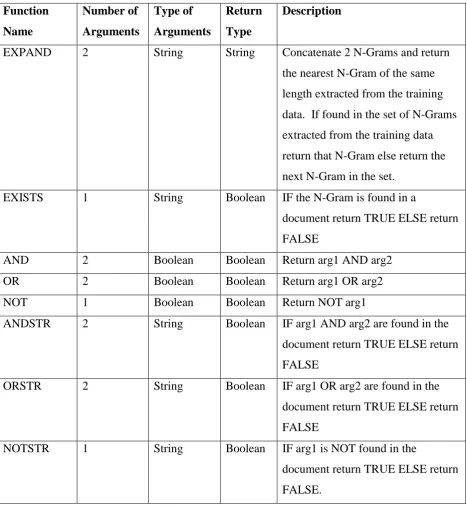
We therefore guide the GPs through the vast search space of possible N-Gram patterns by the provision of protected ‘EXPAND’ function. The function initially forms a new N-Gram by combining two N-Grams (N-Gram1 and N-Gram2). A new
N-Gram Gram is formed by appending N-Gram2 to N-Gram1. If the
NewN-Gram is of length l the EXPAND function checks if the NewN-Gram is in the set of
N-Grams of size l originally extracted from all the text in the all the training
documents used. If it is found in this set NewN-Gram is returned. If it is not found,
i.e. the N-Gram did not occur in the documents of the training set, the next N-Gram in
the set (in alphabetical order) is returned. If the set is empty the original Gram N-Gram1 is returned. Note that the ‘EXPAND’ function will not return an N-Gram consisting of a sequence of characters which never occurs in the training data. The
SetOfL-Grams = the set of N-Grams of length L found in documents from the training set
EXPAND (N-Gram1, N-Gram2)
NewN-Gram = (concatenate N-Gram1, N-Gram2) L = (sizeOf NewN-Gram)
IF (IsEmpty SetOfL-Grams) RETURN N-Gram1
ELSE IF (IsMember NewN-Gram SetOfL-Grams) RETURN NewN-Gram
ELSE
RETURN Next N-Gram in SetOfL-Grams
We found that using an unprotected concatenation function it was quite rare for
N-Grams of size greater than 2 to be evolved. However using the EXPAND function
long N-Grams and words are easily and commonly evolved by combining shorter strings. For example the string ‘wheat’ could be evolved in the following way
(EXPAND w (EXPAND (EXPAND h e) (EXPAND a b)))
The function initially creates the string ‘wheab’. This string is not found in the set of
N-Grams of size 5 originally extracted from the collection. The next N-Gram in the
set of 5-Grams is therefore returned (‘wheat’). The size of the N-Gram sets can be
reduced by extracting them only from the text of documents belonging to the category
for which the library is being evolved. This will greatly reduce the search space of
the GP system but some discriminating ability will be lost where a Boolean NOT
function is used in a GP produced rule.
Although the functions ANDSTR, ORSTR, and NOTSTR are not essential as they are
definable by the other operators, we include them as a way reducing tree sizes.
2.7 GP Parameters
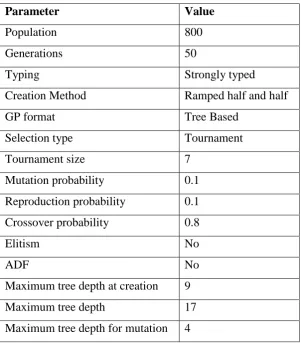
The GP parameters used in our experiments are summarised in Table 3. All of these
are fairly standard in tree based GP systems. For those not familiar with these it is
worth noting the following points:
An individual GP is selected according to fitness and can be simply copied into the then next generation (reproduction) or part of the program may be
randomly changed (mutation) or most commonly parts of the program are
exchanged with another selected program to create two new individuals
(crossover). The probabilities of these 3 possibilities are determined by the
parameters in Table 3.
Maximum tree depth parameters are usually critical in GP systems. Without these evolution will tend to produce very large programs which will use
increasing amounts of machine resources and slow the entire system.
Elitism is sometimes used in GP and GA and ensures that the best program or programs are always copied into the next generation.
Automatically Defined Functions (ADFs) provide a method for subroutine use in a GP (Koza 1999).
3
Experiments
3.1 Objectives
The objective of our experiments were two fold:
1. To evolve effective classifiers against the text dataset (Reuters 21578
2. To automatically produce compact human understandable rules with
minimal features.
An alternative method using a library of rules tested on the 20 Newsgroup dataset is
described in (Hirsch et al. 2004).
3.2 Evolution
In generation 0 of any GP run we have a set of (800) randomly created rules and these
are all measured for fitness by testing them against the documents in the training set.
Although we are unlikely to see a useful rule produced at this stage there will be some
differentiation in performance between individuals in the population. These
differences are exploited so that better programs are more likely to participate in the
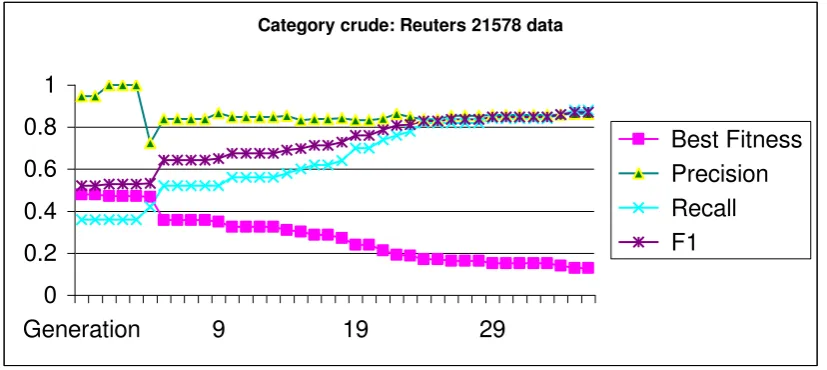
creation of the next generation. Figure 2 shows a fairly typical pattern of evolution
and in this case we see the emergence of a useful rule after approximately 20
generations. Precision is very high during the early evolution but is reduced as recall
improves. In other cases we see recall starting very high and reducing as precision
improves. In general we will see an improvement in F1 as measured against the
training set and a corresponding but lower F1 as measured against the test set.
3.3 Example of Rule Induction: Reuters 21578 Category Crude
In this section we included an example of the evolution of a rule for the Reuters 21578 category “crude”. Some good results can be evolved quite easily on this category e.g. the individual
(EXISTS barre)
(ORSTR cru barre)
has been evolved in generation 4 and achieves an F1 measure of 0.729 when
measured against the test data. The highly compressed rule using only 6 characters
(disjunction of 2 tri-grams) appeared after 15 generations and was able to achieve and
F1 measure of 0.802
(ORSTR rgy rud)
Note that ‘rgy’ is a substring of ‘energy’ and ‘rud’ is a substing of ‘crude’. The best performing rule we have evolved in our experiments achieves a fitness (F1 measure)
of 0.826 is shown below.
(OR (OR (OR (ORSTR arrels~ rude~) (EXISTS opec~) (EXISTS energy) (EXISTS
oleum))))
3.4 Results
A classification rule was evolved for each category by using 4 GP runs and selecting
the best rule to emerge from the 4 runs. GP contains a number of random elements
and the use of multiple runs is commonly applied to improve the chances of finding a
useful solution. The rule produced by the best individual for each category is shown
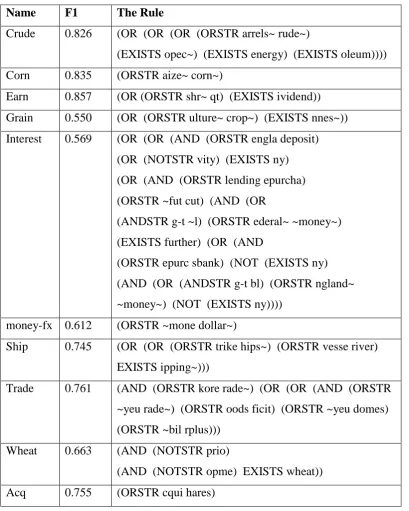
in Table 4 together with the F1 measure (against the test set). Functions are shown in
upper case and N-Grams are shown in lower case. The blank character is indicated by ‘~’.
The global macro-average F1 is 0.717 which compares favourably with other
classifiers such as (Tan et al. 2002) although we should note that this is not a strictly
controlled comparison. Indeed our intention at this point is not to produce the best
classifier in terms of accuracy but to produce a good classifier which is based on a
are much easier to understand than others. However we argue that in contrast to other
methods of automatic classification such as Support Vector Machines even the more
complex rules are somewhat comprehensible to a human analyst.
GP’s have a tendency to ‘bloat’ and to produce long forms of equivalent shorter programs by including redundant sections. For example the rule
(OR (ORSTR ~mone dollar~)(ORSTR ~mone dollar~))
is equivalent to the rule
(ORSTR ~mone dollar~)
One of the key objectives of our system was comprehensibility. We therefore applied
a simple form of parsimony pressure such that where the F1 fitness of two programs
was found to be equal the shorter program was assigned a better fitness value. With
this method we were able to evolve the rules shown in Table 4 although they are still
not necessarily in the most compact form. Comprehensibility may be improved by
using other forms of parsimony pressure on the GP evolution and by favouring longer
N-Grams or words.
Performance is also an important issue. In the experiments we described here to
evolve a classifier for a single category requires that 800 rules be evaluated against all
documents in the training set for each generation of every run. For our experiments
we were using fairly modest machine resources (processor speed of 800Mhz and
memory of 128MB) and we found that the average time to complete a run for one
category was just under 20 minutes.
4
Discussion
Previous text classification systems have used various sets of features including
purposes. In addition the system can easily make use of negative information via the
inclusion of Boolean NOT functions in the rule. The rule produced is in a form which
can be easily manipulated so that it can be fed directly into a search engine such as a
database or Internet search to retrieve similar texts. The rule is produced
automatically but is somewhat similar to rules produced by knowledge engineering
systems using human experts. For example the following rule was evolved for the
Reuters Trade category happened to be in DNF form although it was not the most
effective classifier (F1 0.692).
(OR (OR (OR (ANDSTR llion export) (OR (ANDSTR llion surpl) (ANDSTR ~trad mport) (ANDSTR ~trad vis) (ANDSTR ~trad yeutt)))
The rule created may also be used for purposes beyond classification such as text
mining. For example, the regular occurrence of synonyms (different words with the
same meaning) and homonyms (words with the same spelling but with distinct
meanings) are key problems in the analysis of text data: in the language of relational
databases this is a classic many-to-many relationship. There is some evidence that the
rules evolved in our current system are using synonyms to improve the effectiveness
of a rule, e.g.:
(ORSTR aize~ corn~)
Furthermore we suggest that homonyms are best discriminated by the use of
contextual evidence, i.e. by an analysis of nearby strings in the text. We believe that
much of this contextual evidence can be detected simply by the use of the Boolean
operators AND, OR and NOT, though it may be that additional operators that impose
constraints on the relative positions of two N-Grams in the text will allow an
improved discrimination.
5
Future Work
Special functions for identifying word order. For example FOLLOWS X Y (Bergström 2000) indicates that the word matched by N-Grams Y must follow
the word matched by N-Gram X in the text of a document.
Kleene's star (*) could be included as a marker for an arbitrary sequence of characters, e.g. a*t matches any of "at", "ant" or "agony aunt" within an
N-Gram. We will also investigate the use of full regular expressions for the rules
evolved by the GPs.
Functions for identifying words that are ADJACENT in the text or NEAR one another.
New functions together with numeric terminals for identifying frequency information may be introduced. Functions such as ‘>’ return a Boolean value based on the frequency of a particular N-Gram in comparison to an integer
terminal. This frequency could be a simple count of the occurrence of an
N-Gram in a document or a more sophisticated measure such as the term
frequency inverse document frequency (tf-idf) described above.
We believe that the system described here may be of particularly value when used in
conjunction with other classification systems in a classification committee (Sebastiani
2002) because the method of producing the classifier is quite different to other
automatic classifiers based on vectors of weights.
6
Conclusion
We have produced a system capable of discovering rules based on a rich and varied
set of features which are useful to the task of discriminating between text documents.
We suggest that there may a number of areas within automatic text analysis where the
References
Ahonen-Myka, H. 1999. Finding All Maximal Frequent Sequences in Text. In
Proceedings of the 16th International Conference in Machine Learning ICML
Bled, Slovenia,
Apt´e, C., F. J. Damerau, and S. M. Weiss. 1994. Automated learning of decision
rules for text categorization. ACM Trans. on Inform. Syst. 12, 3, 233–
251.ATTARDI
Anthony N. 2003. Generalization error bounds for threshold decision lists. Technical
report, LSE CDAM-LSE-2003-09.
Bennet K., J. Shawe-Taylor , D. Wu. 2000. Enlarging the margins in perceptron
decision trees. Machine Learning 41, pp 295-313
Bergström, A., P. Jaksetic, P. Nordin. 2000. Enhancing Information Retrieval by
Automatic Acquisition of Textual Relations Using Genetic Programming. In
Proceedings of the 2000 International Conference on Intelligent User
Interfaces (IUI-00), pp. 29-32, ACM Press.
Berleant, D., Z. Gu. 2000. Hash table sizes for storing n-grams for text processing,
Technical Report 10-00a, Software Research Lab, 3215 Coover Hall, Dept. of
Electrical and Computer Engineering, Iowa State University.
Biskri I., S. Delisle. 2002. Text Classification and Multilinguism: Getting at Words
via N-grams of Characters. In Proceedings of the 6th World Multiconference
on Systemics, Cybernetics and Informatics (SCI-2002), Orlando (Florida,
USA), Volume V, 110-115.
Cavnar, W., J. Trenkle. 1994. N-Gram-Based Text Categorization In Proceedings of
SDAIR-94, 3rd Annual Symposium on Document Analysis and Information
Retrieval
Damashek, M. 1995. Gauging similarity with n-grams: Language-independent
categorization of text, Science, 267 pp. 843 . 848.
Ebert D., D. Shaw , A. Zwa , E. Miller, D. Roberts. 1997. Interactive Volumetric
Information Visualization for Document Corpus Management, Proceedings of
Graphics Interface .97, Kelowna, B.C.,121-128.
Feldman R., M. Fresko, Y. Kinar, O. Lindell,. M. Liphstat, Y. Rajman, O. Schler, O.
Zamir. 1998. Text mining at the term level. In Proceedings of the Second
European Symposium on Principles of Data Mining and Knowledge
Discovery, pages 65--73, Nantes, France.
Hayes, P. J., P. M. Andersen, I. B. Nirenburg, and L.M. Schmandt. 1990. Tcs: a shell
for content-based text categorization. In Proceedings of CAIA-90, 6th IEEE
Conference on Artificial Intelligence Applications (Santa Barbara,CA, 1990),
320–326.
Hirsch, L., M. Saeedi, R. Hirsch 2004. Evolving Text Classifiers with Genetic
Programming, In Proceedings of the Euro-GP conference 2004, Portugal,
Springer.
Joachims, T. 1998. Text categorization with support vector machines: learning with
many relevant features. In Proceedings of the l0th European Conference on
Machine Learning (ECML98) , pp 137-142.
Karanikas, H., C. Tjortjis, B. Theodoulidis. 2000 An Approach to Text Mining using
Information Extraction PKDD 2000 Conference: Papers and Presentations,
Springer-Verlag Publisher
Koza, J.R. 1992. Genetic Programming: On the Programming of Computers by
Means of Natural Selection. The MIT Press, Cambridge MA
Koza, J.R., Bennet F, Andre D, Kean M, 1999 Genetic Programming III Darwinian
Invention and Problem Solving, Morgan Kaufman Publishers
Langdon,W.B., 2000. Natural Language Text Classification and Filtering with
Genetic and Evolutionary Computation Conference, Las Vegas, Nevada,
USA, editor Darrell Whitley, pages 210—217.
Lodhi H., J. Shawe-Taylor, N. Cristianini, C. Watkins 2001. Text classification using
string kernels. In T. K. Leen, T. G. Dietterich, and V. Tresp, editors, Advances
in Neural Information Processing Systems 13, pages 563--569. MIT Press
Merkel, M., M. Andersson. 2000. Knowledge-lite extraction of multi-word units with
language filters and entropy thresholds. In Proceedings of the 2000 Conf.
User-Oriented Content-Based Text and Image Handling (RIAO'00), pages
737--746, Paris, France.
Montana, D. 1995. Strongly Typed Genetic Programming. In Evolutionary
Computation. 3:2, 199--230. The MIT Press, Cambridge MA.
Pickens, J., W.B. Croft. 2000. An Exploratory Analysis of Phrases in Text Retrieval.
In Proceedings of RIAO 2000 Conference, Paris, France.
Salton, G., M.J. McGill M.J.1983. An Introduction to Modern Information Retrieval,
McGraw-Hill.
Salton,G., S. Singhal., C. Buckley, M. Mitra 1996. Automatic Text Decomposition
Using Text Segments and Text Themes. In Proceedings of the hypertext ’96
Conference, Washington D.C. USA.
Sebastiani, F. 2002. Machine learning in automated text categorization, ACM
Computing Surveys, 34(1), pp. 1-47.
Tan, C.M., Y. F. Wang and C. D. Lee. 2002. The use of bigrams to enhance text
categorization In Information Processing and Management: an International
Journal, Vol 38, Number 4 Pages 529-546
Tauritz D.R., J.N. Kok, I.G. Sprinkhuizen-Kuyper. 2000. Adaptive information
filtering using evolutionary computation, Information Sciences, vol.122/2-4,
pp.121-140.
Van Rijsbergen, C.J. 1979. Information Retrieval, 2nd edition, Department of
Yang, Y. and X. Liu. 1999. A re-examination of text categorization methods. In
Proceedings of the 22nd Annual ACM SIGIR Conference on Research and
Table 1: GP Types
GP Type Description
String A sequence of one or more characters.
[image:26.595.87.555.243.751.2]Boolean True/False: the return type of all GPs
Table 2: GP Functions
Function Name
Number of Arguments
Type of Arguments
Return Type
Description
EXPAND 2 String String Concatenate 2 N-Grams and return
the nearest N-Gram of the same
length extracted from the training
data. If found in the set of N-Grams
extracted from the training data
return that N-Gram else return the
next N-Gram in the set.
EXISTS 1 String Boolean IF the N-Gram is found in a
document return TRUE ELSE return
FALSE
AND 2 Boolean Boolean Return arg1 AND arg2
OR 2 Boolean Boolean Return arg1 OR arg2
NOT 1 Boolean Boolean Return NOT arg1
ANDSTR 2 String Boolean IF arg1 AND arg2 are found in the
document return TRUE ELSE return
FALSE
ORSTR 2 String Boolean IF arg1 OR arg2 are found in the
document return TRUE ELSE return
FALSE
NOTSTR 1 String Boolean IF arg1 is NOT found in the
document return TRUE ELSE return
Table 3: GP Parameters
Parameter Value
Population 800
Generations 50
Typing Strongly typed
Creation Method Ramped half and half
GP format Tree Based
Selection type Tournament
Tournament size 7
Mutation probability 0.1
Reproduction probability 0.1
Crossover probability 0.8
Elitism No
ADF No
Maximum tree depth at creation 9
Maximum tree depth 17
Table 4: Rules evolved for Reuters top 10 categories
Name F1 The Rule
Crude 0.826 (OR (OR (OR (ORSTR arrels~ rude~)
(EXISTS opec~) (EXISTS energy) (EXISTS oleum))))
Corn 0.835 (ORSTR aize~ corn~)
Earn 0.857 (OR (ORSTR shr~ qt) (EXISTS ividend))
Grain 0.550 (OR (ORSTR ulture~ crop~) (EXISTS nnes~))
Interest 0.569 (OR (OR (AND (ORSTR engla deposit)
(OR (NOTSTR vity) (EXISTS ny)
(OR (AND (ORSTR lending epurcha)
(ORSTR ~fut cut) (AND (OR
(ANDSTR g-t ~l) (ORSTR ederal~ ~money~)
(EXISTS further) (OR (AND
(ORSTR epurc sbank) (NOT (EXISTS ny)
(AND (OR (ANDSTR g-t bl) (ORSTR ngland~
~money~) (NOT (EXISTS ny))))
money-fx 0.612 (ORSTR ~mone dollar~)
Ship 0.745 (OR (OR (ORSTR trike hips~) (ORSTR vesse river)
EXISTS ipping~)))
Trade 0.761 (AND (ORSTR kore rade~) (OR (OR (AND (ORSTR
~yeu rade~) (ORSTR oods ficit) (ORSTR ~yeu domes)
(ORSTR ~bil rplus)))
Wheat 0.663 (AND (NOTSTR prio)
(AND (NOTSTR opme) EXISTS wheat))
Count of unique N-grams by size (Reuters 21578 data)
1 10 100 1000 10000
1 2 3 4 5 6 7 8 9 10 11 12 13 14 15 16 17 18 19
N-Gram Size
Co
u
n
t
[image:29.595.92.502.91.250.2]N-Gram Count
Figure 1. Count of unique N-Grams by size.
Category crude: Reuters 21578 data
0 0.2 0.4 0.6 0.8 1
Generation 9 19 29
Best Fitness
Precision
Recall
F1
[image:29.595.92.506.367.552.2]