www.wjpr.net Vol 4, Issue 08, 2015.
2953
FORMULATION AND EVALUATION OF FLOATING BILAYERED
TABLETS OF NAPROXEN AND SUMATRIPTAN
Amreen Sultana* and R. Balaji Reddy
Department of Pharmaceutics, Deccan School of Pharmacy, Darr-us-salam, Aghapura,
Hyderabad-01, Telanagana, India.
ABSTRACT
Floating drug delivery systems (FDDS) have a bulk density less than
gastric fluids and so remain buoyant in the stomach without affecting
the gastric emptying rate for a prolonged period of time. Usual
treatment for migraine includes “double therapy” consisting of an
NSAID (Naproxen) and 5HT- agonist (Sumatriptan). The aim of the
present investigation was to develop a bilayer floating tablets of
Naproxen and Sumatriptan for effective treatment of Migraine.
Naproxen is newly developed NSAID having analgesic and
anti-inflammatory activity,Sumatriptan is the most effective vasoconstrictor
among the Triptans for treatment of migraine. Bilayer floating tablets
were formulated using direct compression method, it consist of two
layers i.e IR layer containing Naproxen and floating SR layer
containing Sumatriptan. The IR layer comprises ofpolysplasdone XL as
super disintegrant and the SR layer contains Methocel as release retarding polymers. Sodium
bicarbonate was used as gas generating agent in the floating layer. In order to optimize, the
best formulation among the six formulations from IR and SR was selected on the basis of their
dissolution profiles. IR layer tablets IR5 containing 15mg of polypasdone was found to be
optimum and released 98.24% of Naproxen in 300mins. The optimized floating SR layer
tablet of Sumatriptan SR3 containing Methocel containing 50mg showed 99.3% of drug
release at the end of 12 hours. The optimized IR 6 and SR 3 fomulation was combined and
made into bilayer floating tablet. The optimized bilayer tablet of Naproxen and Sumatriptan
was evaluated for various evaluation parameters i.e Hardness 2.5kg/cm2, Friability 0.56%, floating lag time 2mins 20sec and floating time of 24 hours. All the results of evaluations was
found to be within limits and the final optimized bilayer formulation released 98.24% of
Volume 4, Issue 8, 2953-3008. Research Article ISSN 2277– 7105
Article Received on 03 July 2015,
Revised on 27 July 2015, Accepted on 22 Aug 2015
*Correspondence For Author
Amreen Sultana Department of
Pharmaceutics, Deccan
School of Pharmacy,
Darr-us-salam, Aghapura,
Hyderabad-01,
www.wjpr.net Vol 4, Issue 08, 2015.
2954 Naproxen in 30mins and 98.67% of Sumatriptan in 12 hours. The optmised formulation was
fitted in the Kinetic models and it follows korsmeyerpeppas kinetics and the release
mechanism was Case II Non- fickian refers to a combination of both diffusion controlled and
erosion controlled-drug delivery.
KEYWORDS: Naproxen, Sumatriptan, SR floating layer,Floating bilayer tablets, polyplasdone, methocel, floating lag time and floating time.
3 MATERIALS AND METHODS
The following materials are used in the present study
1. Ingredients
2. Equipments
1. INGREDIENTS
The Materials used in the present work are as follows
Table 3.a List of ingredients
Source category Source
Naproxen Sodium NSAID Ranbaxy laboratories
Sumatriptan Vaso constrictor Ranbaxy laboratories
Methocel Tablet binder, coating agent Merck Specialities Pvt Ltd, Mumbai, India
Polyplasdone XL super disintegrent Merck Specialities Pvt Ltd, Mumbai, India
Explotab super disintegrent Merck Specialities Pvt Ltd, Mumbai, India
Sodium
bicarbonate Effervescent agent Merck Specialities Pvt Ltd, Mumbai, India
Magnesium
stearate Lubricant Merck Specialities Pvt Ltd, Mumbai, India
Micro crystalline
cellulose Diluent Merck Specialities Pvt Ltd, Mumbai, India
Talc Lubricant and glidant Merck Specialities Pvt Ltd, Mumbai, India
0.1N Hcl buffer -
EQUIPMENTS
Table 3.b List of equipments
S.NO EQUIPMENTS MANUFACTURER MODEL PURPOSE
1 Digital balance Wensar weighing scales
Ltd. PGB-600 Weighing
2 Bulk Density Apparatus Thermo lab ETD- 1020 Density
3 Tablet hardness tester Lab Hosp Corporation Hardness
4 Friability test apparatus Lab Hosp Friability
5 Vernier caliper Aerospace Thickness
www.wjpr.net Vol 4, Issue 08, 2015.
2955
spectrophotometer compatibility
7 pH Meter Systronics Digital - 335 Ph
8 Compression machine Rimeka RSB4 - 1 Punching
9 Tablet dissolution
apparatus LAB INDIA DS 8000/S % Drug release
10 UV/Visible
Spectrophotometer Elico, PG instruments T60 UV
Analytical estimation
11 DSC HITACHI Drug excipient
compatibility
3.1 DRUG PROFILE
A. DRUG PROFILE OF IMMEDIATE RELEASE LAYER[42] NAPROXEN
Description: An anti-inflammatory agent with analgesic and antipyretic properties. Both the acid and its sodium salt are used in the treatment of rheumatoid arthritis and other rheumatic
or musculoskeletal disorders, dysmenorrhea, and acute gout. [PubChem]
Structure
fig 3.1 a structure of Naproxen
Chemical Name : (2S)-2-(6-methoxynaphthalen-2-yl)propanoic acid Molecular Formula : C14H14O3
Molecular Weight : 230.2592 gram/mole Appearance : Solid
Solubility : Water solubility - 250 g / L Melting Point : 153 °C
PKa : 4.15
www.wjpr.net Vol 4, Issue 08, 2015.
2956 Pharmacokinetic Data
Absorption: Naproxen itself is rapidly and completely absorbed from the GI tract with an in vivo bioavailability of 95%. Although naproxen itself is well absorbed, the sodium salt form
is more rapidly absorbed resulting in higher peak plasma levels for a given dose.
Protein Binding: At therapeutic levels naproxen is greater than 99% albumin-bound.
Metabolism: Naproxen is extensively metabolized to 6-0-desmethyl naproxen and both parent and metabolites do not induce metabolizing enzymes.
Half-life: The observed terminal elimination half-life is approximately 15 hours.
Excretion: Renal
Mechanism of Action: The mechanism of action of naproxen, like that of other NSAIDs, is believed to be associated with the inhibition of cyclooxygenase activity. Two unique
cyclooxygenases have been described in mammals. The constitutive cyclooxygenase, COX-1,
synthesizes prostaglandins necessary for normal gastrointestinal and renal function. The
inducible cyclooxygenase, COX-2, generates prostaglandins involved in inflammation.
Inhibition of COX-1 is thought to be associated with gastrointestinal and renal toxicity while
inhibition of COX-2 provides anti-inflammatory activity.
Uses: For the treatment of rheumatoid arthritis, osteoarthritis, ankylosing spondylitis, tendinitis, bursitis, and acute gout. Also for the relief of mild to moderate pain and the
treatment of primary dysmenorrhea.
Side Effects: Gastrointestinal problems such as heartburn, constipation, diarrhea, ulcers and stomach bleeding. It was found that high-dose naproxen induced near-complete suppression
of platelet thromboxane throughout the dosing interval and appeared not to increase
cardiovascular disease (CVD) risk, whereas other high-dose NSAID regimens had only
transient effects on platelet COX-1 and were associated "with a small but definite vascular
hazard". Conversely, naproxen was associated with higher rates of upper gastrointestinal
www.wjpr.net Vol 4, Issue 08, 2015.
2957 Marketed Products
S No Brand Name Manufacturers Dosage form Strength
1 Aleve Bayer Tablet 220mg
B. DRUG PROFILE OF SUSTAINED RELEASE LAYER- SUMATRIPTAN43 SUMATRIPTAN
Proprietary Name : Imitrex, Imigran, Treximet Chemical structure :
Fig 3.1.b: Structure of Sumatriptan
Chemical Name : 1-[3-(2-Dimethylaminoethyl)-1H-indol-5-yl]-N-methyl-methanesulfonamide
Molecular Formula : C14H21N3O2S
Molecular weight : 295.4
Category : Vasoconstrictor agent, Serotonin Antagonist, Serotonin 5-HT1 receptor agonist, Serotonin receptor agonist.
Appearance : a white to off-white powder. Solubility : Soluble in water and saline Melting point : 169-171 °C.
pKa : 9.74
Absorption : Approximately 15%
Half life : 2.5 hours.
Protein binding : 14-21%
Metabolism : MAO
Elimination : 60% urine, Feces 40%.
Mechanism of action : The 5-HT1B and 5-HT1D receptors function as autoreceptors,
which inhibit the firing of serotonin neurons and a reduction in the synthesis and release of
www.wjpr.net Vol 4, Issue 08, 2015.
2958 activity is inhibited via regulatory G proteins, incrases intracellular calcium, and affects other
intracellular events. This results in vasoconstriction and inhibtion of sensory nociceptive
(trigeminal) nerve firing and vasoactive neuropeptide release.
Side effect: convulsions, tremor, paralysis, inactivity, ptosis, erythema of the extremities, abnormal respiration, cyanosis, ataxia, mydriasis, salivation, and lacrimation.
3.2 EXCIPIENT PROFILE[44] A. POLYPLASDONE XL Nonproprietary Names
BP: Crospovidone, PhEur: Crospovidone, USP-NF: Crospovidone.
Synonyms
Crospovidonum; Crospopharm; crosslinked povidone; E1202; Kollidon CL; Kollidon CL-M;
Polyplasdone XL.
Chemical Name and CAS Registry Number
1-Ethenyl-2-pyrrolidinone homopolymer [9003-39-8]
Structural formula
Fig3.2.a: Structure of Polyplasdone XL
Functional Category: Tablet disintegrant.
Applications in Pharmaceutical Formulation or Technology
Crospovidone is a water-insoluble tablet disintegrant and dissolution agent used at 2–5%
concentration in tablets prepared by direct compression or wet- and dry-granulation methods.
It rapidly exhibits high capillary activity and pronounced hydration capacity, with little
tendency to form gels. Studies suggest that the particle size of crospovidone strongly
influences disintegration of analgesic tablets. Larger particles provide a faster disintegration
than smaller particles. Crospovidone can also be used as a solubility enhancer. With the
www.wjpr.net Vol 4, Issue 08, 2015.
2959 soluble drugs. The drug is adsorbed on to crospovidone in the presence of a suitable solvent
and the solvent is then evaporated. This technique results in faster dissolution rate.
Description
Crospovidone is a white to creamy-white, finely divided, free flowing, practically tasteless,
odorless or nearly odorless, hygroscopic powder.
Stability and Storage Conditions
Since crospovidone is hygroscopic, it should be stored in an airtight container in a cool, dry
place.
Incompatibilities
Crospovidone is compatible with most organic and inorganic pharmaceutical ingredients.
When exposed to a high water level, crospovidone may form molecular adducts with some
materials.
Safety
Crospovidone is used in oral pharmaceutical formulations and is generally regarded as a
nontoxic and nonirritant material. Short-term animal toxicity studies have shown no adverse
effects associated with crospovidone. However, owing to the lack of available data, an
acceptable daily intake in humans has not been specified by the WHO.
B. EXPLOTAB
Nonproprietary Names: BP: Sodium Starch Glycolate, PhEur: Sodium Starch Glycolate, USP-NF: Sodium Starch Glycolate.
Synonyms
Carboxymethyl starch, sodium salt; carboxymethylamylum natricum; Explosol; Explotab;
Glycolys; Primojel; starch carboxymethyl ether, sodium salt; Tablo; Vivastar.
www.wjpr.net Vol 4, Issue 08, 2015.
2960 Structural Formula
Fig 3.2.b: Structure of Explotab
Functional Category
Tablet and capsule disintegrant.
Applications in Pharmaceutical Formulation or Technology
Sodium starch glycolate is widely used in oral pharmaceuticals as a disintegrant in capsule
and tablet formulations. It is commonly used in tablets prepared by either direct-compression
or wet-granulation processes. The usual concentration employed in a formulation is between
2% and 8%, with the optimum concentration about 4%, although in many cases 2% is
sufficient. Disintegration occurs by rapid uptake of water followed by rapid and enormous
swelling. Although the effectiveness of many disintegrants is affected by the presence of
hydrophobic excipients such as lubricants, the disintegrant efficiency of sodium starch
glycolate is unimpaired. Increasing the tablet compression pressure also appears to have no
effect on disintegration time. Sodium starch glycolate has also been investigated for use as a
suspending vehicle.
Description
Sodium starch glycolate is a white or almost white free-flowing very hygroscopic powder.
The PhEur 6.0 states that when examined under a microscope it is seen to consist of:
granules, irregularly shaped, ovoid or pear-shaped, 30–100 mm in size, or rounded, 10–35
mm in size; compound granules consisting of 2–4 component occur occasionally; the
granules have an eccentric hilum and clearly visible concentric striations. Between crossed
nicol prisms, the granules show a distinct black cross intersecting at the hilum; small crystals
are visible at the surface of the granules. The granules show considerable swelling in contact
www.wjpr.net Vol 4, Issue 08, 2015.
2961 Stability and Storage Conditions
Tablets prepared with sodium starch glycolate have good storage properties. Sodium starch
glycolate is stable although very hygroscopic, and should be stored in a well-closed container
in order to protect it from wide variations of humidity and temperature, which may cause
caking. The physical properties of sodium starch glycolate remain unchanged for up to 3
years if it is stored at moderate temperatures and humidity.
Incompatibilities
Sodium starch glycolate is incompatible with ascorbic acid.
Safety
Sodium starch glycolate is widely used in oral pharmaceutical formulations and is generally
regarded as a nontoxic and nonirritant material. However, oral ingestion of large quantities
may be harmful.
Handling Precautions
Observe normal precautions appropriate to the circumstances and quantity of material
handled. Sodium starch glycolate may be irritant to the eyes; eye protection and gloves are
recommended. A dust mask or respirator is recommended for processes that generate a large
quantity of dust.
C. METHOCEL
General Descriptions
Nonproprietry Names: BP: Hypromellose, USP : Hypromellose. Synonyms: HPMC2208, Benecal MHPC, Pharmacoat.
Description: It is odorless & tasteless, white or creamy white colored Fibrous or granular powder.
Structural Formula
www.wjpr.net Vol 4, Issue 08, 2015.
2962 Functional categories : Tablet binder, Coating agent, Film former stabilizing agent, Suspending agent, Viscosity increasing agent.
Solubility : It is soluble in cold water but insoluble in Chloroform, ethanol (95%) & ether but Soluble in mixture of ethanol & dichloromethane mixture of methanol &
dichloromethane, mixture of alcohol.
Viscosity (dynamic): A wide range of viscosity types are commercially available. Aqueous solutions are most commonly prepared, although hypromellose may also be dissolved in
aqueous alcohols such as ethanol and propan-2-ol provided the alcohol content is less than
50% w/w. Dichloromethane and ethanol mixtures may also be used to prepare viscous
Hypromellose.
PH : 5.5 – 8.0 for a 1 % w/w aqueous solution.
Melting point: Brown at 190- 2000C; chars at 225-2300C. Specific gravity: 1.26
Loss on drying : < 5.0 % Density (bulk) : 0.341 gm / cm3 Density (tapped) : 0.557 gm / cm3
Stability and storage Conditions: Hypromellose powder is a stable material although it is hydroscopic after drying. Solutions are stable at pH 3.Upon heating and cooling
hypromellose undergoes a reversible gel transformation. Viscosity of solutions is reduced by
increasing the temperature. Depending upon the grade and concentration of material, the gel
point is 50-90°C. It is stable material although it is hygroscopic after drying. It should be
stored in a well -closed container in a cool dry place.
Incompatibilities: Incompatible with some oxidizing Agents.
Application: It is widely used oral & topical pharmaceutical formulations primarily used in film-coating, binder in tablets in concentrations of 2 – 5 %.
D. SODIUM BICARBONATE[45]
Non-proprietary names: BP/EP: sodium bicarbonate Synonym: Baking soda, e-500, and monosodium carbonate.
www.wjpr.net Vol 4, Issue 08, 2015.
2963 Molecular weight: 84.01
Category: alkalizing agent, therapeutic agent.
Description: it is an odorless, white crystalline powder with slight alkaline taste. Acidity/ alkalinity: pH 8.3 for freshly prepared 0.1m aqueous solution at 250c. Density: 2.159 g/cm3
Solubility: Soluble in water, practically insoluble in ethanol.
Stability and storage: Sodium bicarbonate is stable in dry air but slowly decomposes in Moist air and should therefore be stored in well-closed container in a cool dry place.
Safety: Orally ingested sodium bicarbonate neutralizes gastric acid with the evolution of carbon dioxide and may cause stomach cramps and flatulence.
Applications
1. Employed as a source of carbon dioxide in effervescent tablets and granules.
2. Also used to buffer the drug molecules that are weak acids.
3. Used in solutions as buffering agent.
E. MICROCRYSTALLINE CELLULOSE
Synonyms : Avicel PH; Celex; cellulose gel; Celphere; Ceolus KG; crystalline cellulose; E460;Emcocel; Ethispheres;
Chemical Name: Cellulose
Empirical Formula: (C6H10O5)n where n ≈ 220.
Molecular Weight: ≈36 000
Functional Category: Adsorbent; suspending agent; tablet and capsule diluent; tablet disintegrant.
Applications: Microcrystalline cellulose is widely used in pharmaceuticals, primarily as a binder/diluent in oral tablet and capsule formulations where it is used in both wet-granulation
and direct-compression processes. In addition to its use as a binder/diluent, microcrystalline
cellulose also has some lubricant and disintegrant properties that make it useful in tableting.
Microcrystalline cellulose is also used in cosmetics and food products.
USES OF MICROCRYSTALLINE CELLULOSE Table 3.2.a: Uses of MCC
Use Concentration (%)
Adsorbent 20–90
Anti adherent 5–20
www.wjpr.net Vol 4, Issue 08, 2015.
2964 Description: Microcrystalline cellulose is a purified, partially depolymerized cellulose that occurs as a white, odourless, tasteless, crystalline powder composed of porous particles. It is
commercially available in different particle sizes and moisture grades that have different
properties and application.
Melting point: 260–270°C.
Moisture content: Typically less than 5% w/w. microcrystalline cellulose is hygroscopic. Particle size distribution: Typical mean particle size is 20–200 μm.
Solubility: Slightly soluble in 5% w/v sodium hydroxide solution; practically insoluble in water, dilute acids.
Safety: It is widely used in oral pharmaceutical formulations is generally regarded as a relatively nontoxic and nonirritant material. Deliberate abuse of formulations containing
cellulose, either by inhalation or by injection, has resulted in the formation of cellulose
granulomas.
F. MAGNESIUM STEARATE
Synonyms: Magnesium octadecanoate; octadecanoic acid, magnesium salt; stearic acid, magnesium salt.
Molecular weight: 591.34.
Structural formula: [CH 3 (CH 2) 16 COO] 2 Mg
Functional category: Tablet and capsule lubricant
Applications in pharmaceutical formulation technology: It is primarily used as a lubricant in capsule and tablet manufacture at concentrations between 0.25 % and 5.0 % w/w.
Description: Magnesium stearate is a fine, white, precipitated or milled, impalpable powder of low bulk density, having a faint odor of stearic acid and a characteristic taste. The powder
is greasy to touch and readily adheres to the skin.
Crystalline forms: High purity magnesium stearate has been isolated as a trihydrate, dihydrate and an anhydrate.
Flowability: Poorly flowing, cohesive powder.
Melting range: 117-150o C (commercial samples) 126-130o C (high purity magnesium stearate).
Solubility: Practically insoluble in ethanol, ethanol (95 %), ether and water; slightly soluble in warm benzene and warm ethanol (95 %).
Tablet disintegrant 5–15
www.wjpr.net Vol 4, Issue 08, 2015.
2965 Stability and Storage Conditions: Magnesium stearate is stable and should be stored in a well-closed container in a cool, dry place.
Incompatibilities: Incompatible with strong acids, alkalis and iron salts strong oxidizing materials. Magnesium stearate cannot be used in products containing aspirin, some vitamins
and most alkaloid salts.
Method of manufacture: Magnesium stearate is prepared either by the interaction of aqueous solutions of magnesium Chloride with sodium stearate or by the interaction of
magnesium oxide, hydroxide or carbonate with stearic acid at elevated temperatures.
Safety : Magnesium stearate is widely used as a pharmaceutical excipient and is generally regarded as being nontoxic following oral administration. However, oral consumption of large
quantities may result in some laxative effect or mucosal irritation.
G. TALC
Synonyms : Altalc; E553b; hydrous magnesium calcium silicate; hydrous magnesium silicate; Luzenac Pharma; magnesium hydrogen metasilicate; Magsil Osmanthus; Magsil
Star; powdered talc; purified French chalk; Purtalc; soapstone; steatite; Superiore.
Functional category: Anticaking agent; Tablet and Capsule diluent; Tablet and Capsule lubricant.
Applications in pharmaceutical formulations: Used in oral solid dosage formulations as a lubricant and glidant (1-10%), Dissolution retardant in the development of controlled release
products. Used as dusting powder (90.0-99.0), Lubricant properties in cosmetics and food
properties, Talc is widely used in oral solid dosage formulations as lubricant and diluents.
Description: Talc is a very fine, white to greyish-white coloured, odorless, impalatable crystalline powder. It adheres to the skin readily. Insoluble in water, dilute acids, alkalis and
organic solvents.
Moisture content: Talc absorbs insignificant amounts of water at 25°C and relative humidities up to about 90%.
Solubility: practically insoluble in dilute acids and alkalis, organic solvents, and water. Specific gravity: 2.7–2.8
Stability and storage conditions: Talc is a stable material and may be sterilized by heating at 1600C for not less than 1 hr. It may also be sterilized by exposure to ethylene oxide or gamma irradiation. Talc should be stored in a well-closed container in a cool, dry place.
www.wjpr.net Vol 4, Issue 08, 2015.
2966 Method of manufacture: Talc is a naturally occurring hydropolysilicate mineral found in many parts of the world including: Australia; China; Italy and the US. Naturally occurring
talc is mined and pulverized before being subjected to flotation processes to remove various
impurities such as: asbestos (tremolite), carbon, dolomite, iron oxide and various other
magnesium and carbonate minerals. Following this process the talc is finely powdered,
treated with dilute Hydrochloric acid, washed with water and then dried. It is the processing
variables of agglomerated talc that strongly influence its physical characteristics.
Safety: Talc is mainly used in tablet and capsule formulations. Following oral ingestion talc is not absorbed systemically and may thus be regarded as an essentially nontoxic material.
However, intranasal or intravenous abuse of products containing talc can cause granulomas in
body tissues, particularly the lungs. Contamination of wounds or body cavities with talc may
also cause granulomas, hence it should not be used to dust surgical gloves. Inhalation of talc
causes irritation and may cause severe respiratory distress in infants.
3.3. PREFORMULATION STUDIES
Preformulation may be described as a stage of development during which the
physicochemical and biopharmaceutical properties of a drug substance are characterized. It is
an important part of the drug development process. The information relating to drug
development acquired during this phase is used for making critical decisions in subsequent
stages of development. Characterization of the drug is a very important step at the
Preformulation phase of product development followed by studying the properties of the
excipients and their compatibility.
3.3.1 MICROMERITIC PROPERTIES
a.
ANGLE OF REPOSEThe frictional force in a loose powder can be measured by the angle of repose. Angle of Repose () is the maximum angle between the surface of a pile of powder and horizontal
plane. It is usually determined by Fixed Funnel Method and is the measure of the flowability
of powder/granules.
A funnel with 10 mm inner diameter of stem was fixed at a height of 2 cm. over the platform.
About 10 gm of sample was slowly passed along the wall of the funnel till the tip of the pile
formed and touches the steam of the funnel. A rough circle was drawn around the pile base
www.wjpr.net Vol 4, Issue 08, 2015.
2967 Angle of repose was calculated from the average radius using the following formula
= tan1
(h/r) = tan1 (height of pile/0.5base)
Where, = Angle of repose; h = Height of the pile; r = Average radius of the powder cone.
b.
BULK DENSITYBulk Density of a compound varies substantially with the method of crystallization, milling
or formulation. Usually, bulk density is of great importance when one considers the size of a
high-dose drug product or homogeneity of a low-dose formulation. The homogeneity of a
low-dose formulation in which there are large differences in drug and excipient could lead to
segregation).
Apparent Bulk density (gm/ml) of the drug was determined by pouring (preseived 40-mesh)
gently 4 gm of sample through a glass funnel into a 10 ml graduated cylinder. Then after
pouring the powder bed was made uniform without disturbing. Then the volume was
measured directly from the graduation marks on the cylinder as ml. The volume measure was
called as the bulk volume and the bulk density was calculated by following formula.
Bulk density = Weight of powder / Bulk volume
Limits: It has been stated that the bulk density values having less than 1.2 g/cm3 indicates good packing and values greater than 1.5 g/cm3 indicates poor packing.
c.
TAPPED DENSITYTapped densities the drug was determined by pouring gently 4 gm of sample through a glass
funnel into a 10 ml graduated cylinder. The cylinder was tapped from height of 2 inches until
a constant volume was obtained. In USP TAP DENSITY TESTER, Tap density is measured
in 500taps, 750 taps & 1250taps with drop/time-299-302. Volume occupied by the sample
after tapping were recorded and tapped density was calculated.
Tapped density = Weight of powder / Tapped volume
d.
COMPRESSIBILITY INDEX (CARR’S INDEX)Compressibility is the ability of powder to decrease in volume under pressure.
Compressibility is a measure that is obtained from density determinations. It is also one of the
simple methods to evaluate flow property of powder by comparing the bulk density and
www.wjpr.net Vol 4, Issue 08, 2015.
2968 empirical guide is given by the Carr‟s index or compressibility index calculated from bulk
density and tapped density.
Carr’s index = (Tapped density – Bulk density / Tapped density) X 100
e.
HAUSNER’S RATIO: Hausner‟s ratio provides an indication of the degree of densification which could result from vibration of the feed hopper. A lower value ofindicates better flow and vice versa.
Hausner’s Ratio = Tapped density /Bulk density
Table no.3.3.a: Acceptance Criteria Of Flow Properties
S. No Flow properties Angle of repose(θ) Compressibility Index (%) Hausner ratio
1. Excellent 25-30 <10 1.00-1.11
2. Good 31-35 11-15 1.12-1.18
3. Fair 36-40 16-20 1.19-1.25
4. Passable 41-45 21-25 1.26-1.34
5. Poor 46-55 26-31 1.35-1.45
6. Very poor 56-65 32-37 1.46-1.59
7. Very very poor > 66 >38 >1.6
3.3.2. DRUG-EXCIPIENTS COMPATIBILITY STUDIES BY FTIR
Excipients are integral components of almost all pharmaceutical dosage forms. The
successful formulation of a stable and effective solid dosage form depends on the careful
selection of the excipients, which are added to facilitate administration, promote the
consistent release and bioavailability of the drug and protect it from degradation.
Infra- Red spectroscopy is one of the most powerful analytical techniques to identify
functional groups of a drug.
FTIR STUDIES
FTIR studies were performed on drug and the optimized formulation using FTIR (Agilent
technologies, India). The samples were analyzed between wavenumbers 4000 and 400 cm-1.
DIFFERENTIAL SCANNING STUDIES
Differential scanning calorimetry or DSC is a thermoanalytical technique in which the
difference in the amount of heat required to increase the temperature of a sample and
reference is measured as a function of temperature. Both the sample and reference are
maintained at nearly the same temperature throughout the experiment. Generally, the
www.wjpr.net Vol 4, Issue 08, 2015.
2969 increases linearly as a function of time. The reference sample should have a well-defined heat
capacity over the range of temperatures to be scanned.
3.4 FORMULATION DEVELOPMENT
3.4.1 FORMULATION OF NAPROXEN IMMEDIATE RELEASE LAYER: BY DIRECT COMPRESSION METHOD
PROCEDURE
Direct compression: Accurately weighed amounts of drug, super disintegrants, binder and
diluents were mixed geometrically in a mortar. This mixture was passed through No.40 sieve.
The powder blend was then lubricated with magnesium stearate for 2 minutes and
compressed into tablets on a 16-station rotary tableting machine using 9 mm round, flat-faced
punches.
Table: 3.4.1a Formulation of immediate release layer Naproxen
Ingredients IR1 IR2 IR3 IR4 IR5 IR6
Naproxen
Sodium (mg) 100 100 100 100 100 100
Explotab(mg) 5 10 15 - - -
PolyplasdoneXL(mg) - - - 5 10 15
Mg. Stearate(mg) 2 2 2 2 2 2
Talc(mg) 2 2 2 2 2 2
MCC PH 102(mg) Q.S Q.S Q.S Q.S Q.S Q.S
Total weight mg 200 200 200 200 200 200
Optimisation of Sodium bicarbonate
Sodium bicarbonate was employed as effervescent gas generating agent. It helps the
formulation to float. Various concentrations of sodium bicarbonate were employed; floating
lag time and floating duration were observed. Based on the concentration of sodium
bicarbonate was finalized and preceded for further formulations.
Table 3.4.1b: optmisation of sodium bicarbonate concentration
Ingredients EF1 EF2 EF3
Sumatriptan(mg) 50 50 50
METHOCEL(mg) 50 50 50
NaHCO3(mg) 5 10 15
Colour (Sunset yellow) (mg) 2 2 2
Mg.Stearate(mg) 2 2 2
Talc(mg) 2 2 2
MCC pH 102 (mg) Q.S Q.S Q.S
www.wjpr.net Vol 4, Issue 08, 2015.
2970 FORMULATION OF SUSTAINED RELEASE LAYER
BY DIRECT COMPRESSION METHOD: Accurately weighed amounts of drug, sustained release polymer, binder and diluents were mixed geometrically in a mortar. This
mixture was passed through No.40 sieve. The powder blend was then lubricated with
magnesium stearate for 2 minutes and compressed into tablets on a 16-station rotary tableting
machine using 9 mm round, flat-faced punches.
Table 3.4.1c: Formulation composition for sustained release layer
Formulation No. SR1 SR2 SR3 SR4 SR5 SR6
Sumatriptan (mg) 50 50 50 50 50 50
Methocel(mg) 12.5 25 50 - - -
NaHCO3(mg) 15 15 15 15 15 15
Mg. Stearate (mg) 4 4 4 4 4 4
Talc (mg) 4 4 4 4 4 4
MCC PH 1029mg Q.S Q.S Q.S Q.S Q.S Q.S
Total Weight(mg) 200 200 200 200 200 200
3.4.2. FORMULATION OF OPTIMISED BILAYER TABLETS OF NAPROXEN AND SUMATRIPTAN
PROCEDURE: The Gastroretentive Bilayered Floating Tablets were prepared by direct compression method and wet granulation method. The immediate release layer granules were
prepared by direct compression technique and the controlled release layer is prepared by wet
granulation technique. The controlled release layer mixture was compressed in 8mm flat
faced punches on a Rimek tablet press. Before final compression immediate release layer
poured on sustained release layered.
Table 3.4.2 a: formulation of optimized bilayer tablet
S.NO. INGREDIENTS IR5 SR3 OPTIMISED
FORMULA
1. Naproxen (mg) 100 -- 100
2. Sumatriptan (mg) -- 50 50
3. Polyplasdone eXL (mg) 10 -- 12.5
4. methocel (%) - 50 50
5. microcrystalline cellulose
(mg) Q.S. Q.S. Q.S.
6. magnesium stearate (mg) 2 4 6
7. talc (mg) 2 2 4
8. Sodium bicarbonate (mg) - 15 15
9 Colouring (mg)agent(saffron) - 4 4
www.wjpr.net Vol 4, Issue 08, 2015.
2971 3.5. ANALYTICAL METHOD
3.5.1 ANALYTICAL METHOD FOR ESTIMATION OF NAPROXEN IR a) Determination of absorption maxima
A solution containing the concentration 10 µg/ ml drug was prepared in 0.1N HCl UV
spectrum was taken using Double beam UV/VIS spectrophotometer. The solution was
scanned in the range of 200 – 400.
b) Preparation calibration curve
10mg of Naproxen pure drug was dissolved in 10ml of methanol (primary stock solution).
From primary stock, 1ml of solution was taken and make up with 10ml of 0.1N HCl
(100μg/ml) from this secondary stock solution 0.5, 1, 1.5, 2 and 2.5 ml was taken and diluted up to 10 ml with 0.1N HCl to obtain 5, 10 ,15 ,20 and 25μg/ml concentration. The absorbance
of the above dilutions was measured at 227 nm by using UV-Spectrophotometer taking 0.1N
HCl as blank. Then a graph was plotted by taking Concentration on X-Axis and Absorbance
on Y-Axis which gives a straight line Linearity of standard curve was assessed from the
square of correlation coefficient (R2) which determined by least-square linear regression analysis. Similar procedure was followed for sumatriptan at 271 nm.
STANDARD GRAPH OF NAPROXEN
www.wjpr.net Vol 4, Issue 08, 2015.
2972 Table 3.5 a: Standard graph data
Conc [µg/mL] Abs
0 0
5 0.139
10 0.284
15 0.44
20 0.578
25 0.702
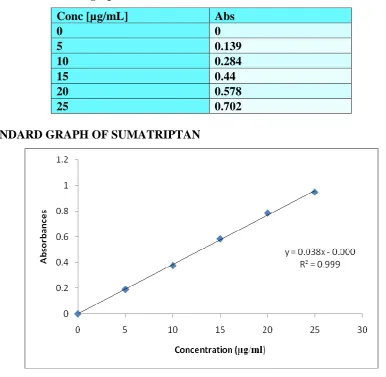
[image:20.595.96.483.85.462.2]STANDARD GRAPH OF SUMATRIPTAN
Figure 3.5 b: Standard graph
Table 3.5 b: Standard graph data
Conc [µg/mL] Abs
0 0
5 0.189
10 0.376
15 0.585
20 0.784
25 0.947
3.6 EVALUATION OF GASTRORETENTIVE BILAYER FLOATING TABLETS OF NAPROXEN AND SUMATRIPTAN38, 39, 40
The prepared formulations were evaluated for the following parameters:
1. THICKNESS
www.wjpr.net Vol 4, Issue 08, 2015.
2973 FIG. 3.6.a.- Vernier Calipers
2. HARDNESS TEST
Hardness indicates the ability of a tablet to withstand mechanical shocks while handling the
hardness of the tablets was determined using Monsanto Hardness tester. It is expressed in
kg/cm2.
Fig-3.6.b.: Monsanto Hardness tester
3. FRIABILITY TEST
The friability of tablets was determined using Roche Friabilator. It is expressed in percentage
(%). Ten tablets were initially weighed (W) and transferred in to the friabilator. The
friabilator was operated at 25 rpm for 4 minutes or run up to 100 revolutions. The tablets
were weighed again (W) final. The % friability was then calculated by
Where,
% F= Friability in percent
% friability of tablets <1% were considered acceptable.
www.wjpr.net Vol 4, Issue 08, 2015.
2974 Fig-3.6.c.: Roche Friabilator
4. WEIGHT VARIATION TEST
Ten tablets were selected randomly from each batch and weighed individually to check for
weight variation. A little variation is allowed in the weight of tablet by U.S. Pharmacopoeia.
Table no.3.6.a: I.P limits for weight variation Standard limit value in weight variation test Average Weight of a
tablet
Percentage Deviation
130mg or less ±10
>130mg and <324mg ±7.5
324mg or more ±5.0
5. IN VITRO BUOYANCY STUDIES
The time taken for tablet to emerge on surface of medium is called the floating lag time
(FLT) and duration of time the dosage form constantly remain on surface of medium is called
the total floating time (TFT).The in vitro buoyancy was determined by floating lag time, as
per the method described by Rosa et al. The tablets were placed in a 100 ml beaker
containing 0.1 N hydrochloric acid. The time required for the tablet to rise to the surface and
float was determined as floating lag time. The duration of time the dosage form constantly
remained on the surface of medium was determined as the total floating time
6. DRUG CONTENT UNIFORMITY
FOR IMMEDIATE RELEASE NAPROXEN TABLETS
Tablet containing drug is dissolved in 100 ml of 0.1N HCl taken in volumetric flask. The
www.wjpr.net Vol 4, Issue 08, 2015.
2975 in 50 ml of volumetric flask and diluted up to mark with 0.1N HCl and analyzed
spectrophotometrically at 282nm for sustained release layer of Naproxen.
FOR SUSTAINDE RELEASE SUMATRIPTAN TABLETS
Ten tablets were weighed and powdered and 250mg equivalent weight of Sumatriptan was
accuarately weighed and transfered in 100ml volumetric flask. It was dissolved and made up
the volume with 0.1N HCl pH- 1.2. Subsequently the solution was filtered and suitable
dilution were made and analyzed at 275nm using UV-Visible spectroscopy.
7. DISINTEGRATION TEST
By using disintegration apparatus, tablets were tested for disintegration time at 37± 0.50C taking distilled water as medium.
Fig.3.6.d.-Disintegration Apparatus
9. IN VITRO DISSOLUTION STUDIES
In-vitro release studies were carried out USP II paddle type dissolution test apparatus. 900 ml
of 0.1 N HCl (PH 1.2) was filled in dissolution vessel and the temperature of the medium
were set at 37° C ± 0.1°C.The speed was set at 50 rpm. 5 ml of sample was withdrawn at
predetermined time intervals and analysed by using UV- Spectroscopy.
Dissolution study for immediate layer
900ml of 0.1N HCl was placed in vessel and the USP apparatus –II (Paddle Method) was
assembled. The medium was allowed to equilibrate to temp of 37°c + 0.5°c. Tablet was
www.wjpr.net Vol 4, Issue 08, 2015.
2976 then the medium 0.1 N HCl was taken and process was continued at 50 rpm. At definite time
intervals of 5 ml of the medium was withdrawn, filtered and again 5ml fresh medium was
replaced. Suitable dilutions were done with receptor fluid and analyzed by
spectrophotometrically at 227 nm using UV-spectrophotometer.
Dissolution study for sustained floating layer
900ml 0f 0.1 HCl was placed in vessel and the USP apparatus –II (Paddle Method) was
assembled. The medium was allowed to equilibrate to temp of 37°c + 0.5°c. Tablet was
placed in the vessel and the vessel was covered the apparatus was operated for 12 hours and
then the medium 0.1 N HCl was taken and process was continued from 0 to 12 hrs at 50 rpm.
At definite time intervals of 5 ml of medium was withdrawn, filtered and again 5ml receptor
fluid was replaced. Suitable dilutions were done with medium and analyzed by
spectrophotometrically at 271 nm using UV-spectrophotometer.
Dissolution study for Bilayer Tablets
The dissolution study of bilayer tablets was performed over a 12 hr period using USP type II
(paddle) Dissolution Testing Apparatus 900ml of 0.1N HCl was used as dissolution medium
agitated at 50 RPM, at temperature of 37o± 0.5oC. 5 ml samples were withdrawn at 5, 10, 15, and 20 min to estimate the release of Naproxen, and at 0.5, 1, 2, 3, 4, 5, 6, 7, 8, 9, 10, 11 and
12 hrs for estimating Sumatriptan release. The samples were analyzed for Naproxen and
Sumatriptan by UV Spectrophotometry at their respective λ max values. The samples
collected for first twenty minutes were analyzed for Naproxen content at 227 nm in UV
spectrophotometer by keeping the solution containing Sumatriptan formulation as blank to
minimize the interference. The samples collected for 0.5 – 12 hrs were analyzed for the
release of Sumatriptan at 227nm in UV spectrophotometer by keeping the solution containing
Naproxen formulation as blank to minimize the interference.
KINETIC MODELS
Various models were tested for explaining the kinetics of drug release. To analyze the
mechanism of the drug release rate kinetics of the dosage form, the obtained data were fitted
into zero-order, first order, Higuchi, and Korsmeyer-Peppas release model.
Zero order release rate kinetics
To study the zero–order release kinetics the release rate data are fitted to the following
www.wjpr.net Vol 4, Issue 08, 2015.
2977 F = Ko t
Where, „F‟ is the drug release at time„t‟, and „Ko‟ is the zero order release rate constant. The
plot of % drug release versus time is linear.
First order release rate kinetics: The release rate data are fitted to the following equation Log (100-F) = kt
A plot of log cumulative percent of drug remaining to be released vs. time is plotted then it
gives first order release.
Higuchi release model: To study the Higuchi release kinetics, the release rate data were fitted to the following equation.
F = k t1/2
Where, „k‟ is the Higuchi constant.
In higuchi model, a plot of % drug release versus square root of time is linear.
Korsmeyer and Peppas release model
The mechanism of drug release was evaluated by plotting the log percentage of drug released
versus log time according to Korsmeyer- Peppas equation. The exponent „n‟ indicates the
mechanism of drug release calculated through the slope of the straight Line.
Mt/ M∞ = K tn
Where, Mt/ M∞ is fraction of drug released at time „t‟, k represents a constant, and „n‟ is the
diffusional exponent, which characterizes the type of release mechanism during the dissolution
process. For non-Fickian release, the value of n falls between 0.5 and 1.0; while in case of
Fickian diffusion, n = 0.5; for zero-order release (case I I transport), n=1; and for supercase II
transport, > 1. In this model, a plot of log (Mt/ M∞) versus log (time) is linear.
4 RESULTS AND DISCUSSION
DRUG EXCIPIENT COMPATIBILITY STUDIES BY FTIR: FTIR OF NAPROXEN
Table 4.0.a : KBr disc value of Naproxen
S.No KBr disc value (cmˉ¹) indication
1 793 benzene
2 1157 OH group
www.wjpr.net Vol 4, Issue 08, 2015.
[image:26.595.86.487.72.294.2]2978 Fig 4.0. a : FTIR spectrum of Naproxen
[image:26.595.83.488.355.707.2]FTIR OF SUMATRIPTAN
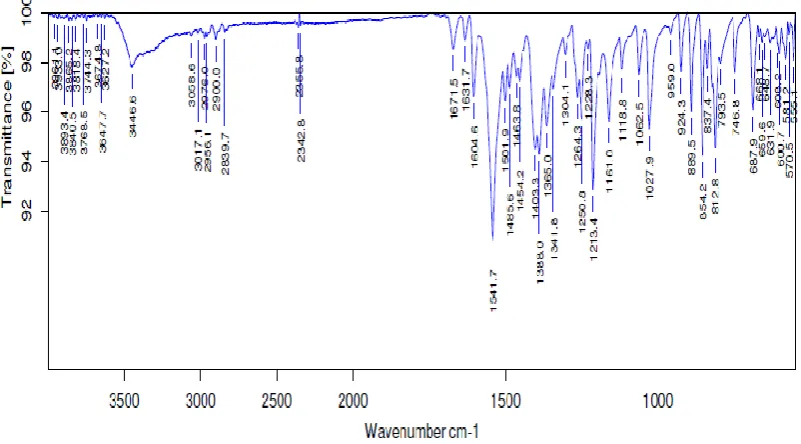
Table 4.0. b: KBr disc value of Sumatriptan
KBr disc value (cmˉ¹) Indication
1266 Amine
777 Benzene
2682 Nitrile
3359 Methyl
www.wjpr.net Vol 4, Issue 08, 2015.
[image:27.595.84.497.102.382.2]2979 FTIR OF POLYPLASDONE
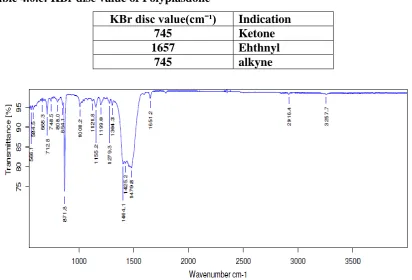
Table 4.0.c: KBr disc value of Polyplasdone
KBr disc value(cmˉ¹) Indication
745 Ketone
1657 Ehthnyl
745 alkyne
Fig 4.0.c: FTIR spectrum of Polyplasdone XL
[image:27.595.75.508.444.745.2]FTIR OF METHOCEL
Table 4.0.d: KBr disc value of Methocel
KBr disc value (cmˉ¹) Indication
925 Alkyne
1367 Methyl
1681 C=0
3031 =C-H
3765 OH
www.wjpr.net Vol 4, Issue 08, 2015.
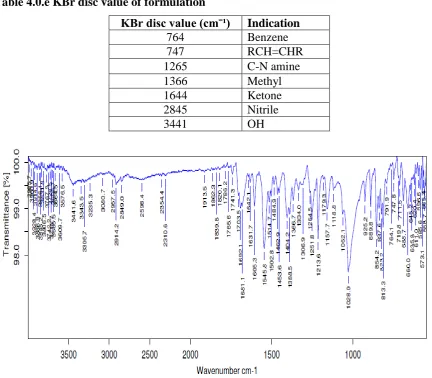
[image:28.595.78.511.98.476.2]2980 FTIR OF FORMULATION
Table 4.0.e KBr disc value of formulation
KBr disc value (cmˉ¹) Indication
764 Benzene
747 RCH=CHR
1265 C-N amine
1366 Methyl
1644 Ketone
2845 Nitrile
3441 OH
Fig 4.0.e : FTIR spectrum of Formulation
DISCUSSION
FTIR ANALYSIS OF NAPROXEN
FTIR analysis of Naproxen was obtained using KBr pellet technique and the peaks mentioned
in standards are compared with those obtained. The peaks were found to be at 793 cm-1 indicates presence of benzene ring, 1157 cm-1 presence of OH group, 2893cm-1 indicates the presence of secondary OH group.
FTIR ANALYSIS OF SUMATRIPTAN
www.wjpr.net Vol 4, Issue 08, 2015.
2981 FTIR OF POLYPLASDONE XL
The FTIR of polyplasdone XL was carried out using KBr pellet technique and peaks obtained
were compared with that of the standard. The FTIR studies showed C=O stretching vibration
at 1657 cm-1 from ketone group, 3257 cm-1 showed the presence of alkyne group and CRH=RCH stretching at 745cm-1.
FTIR OF METHOCEL
The FTIR studies of methocel showed the presence of following functional groups.
C-H stretching at 1367 cm-1, 3765 cm-1 peak indicating thepresence of OH group, at 1681 cm-1 presence of C=O group, C-H stretching of alkyl group at 3031 cm-1.
INFERENCE:
The FTIR of pure drugs, excipients and formulation was carried out.. it was found that there
is no significant change in the peaks obtained when compared with the formulation. Thus
indicating that there is no drug excipient interaction.
DRUG EXCIPIENT COMPATIBILITY STUDIES BY DSC
www.wjpr.net Vol 4, Issue 08, 2015.
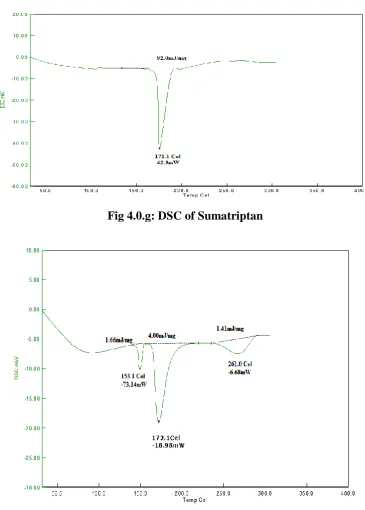
[image:30.595.112.478.63.574.2]2982 Fig 4.0.g: DSC of Sumatriptan
fig 4.0.h: Dsc Of Drug And Excipient
INFERENCE
The compatibility study found that the main thermic peak of pure drug 1 (naproxen) found at
1530C and pure drug 2 (sumaptriptan) was found at 1710C when it was mixed with excipients and made tablet the main endothermic peak of formulation was found to be the same.
It was observed that there is no significant change between the formulation and pure drug.
www.wjpr.net Vol 4, Issue 08, 2015.
2983 4.1 PREFORMULATION STUDIES
A. PREFORMULATION STUDIES FOR IMMEDIATE RELEASE LAYER OF NAPROXEN
Table 4.1a: Pre-formulation parameters of blend Formulation
Code
Angle of Repose
Bulk density (gm/mL)
Tapped density (gm/mL)
Carr’s index (%)
Hausner’s Ratio
IR1 26.01 0.49 0.57 14.03 1.16
IR2 24.8 0.56 0.65 13.84 1.16
IR3 22.74 0.56 0.68 17.64 1.21
IR4 25.33 0.54 0.64 15.62 1.18
IR5 26.24 0.55 0.67 17.91 1.21
IR6 26.12 0.56 0.66 15.15 1.17
DISCUSSION: Tablet powder blend was subjected to various pre-formulation parameters. The angle of repose values indicates that the powder blend has good flow properties. The bulk
density of all the formulations was found to be in the range of 0.49 to 0.56 (gm/ml) showing
that the powder has good flow properties. The tapped density of all the formulations was
found to be in the range of 0.57 to 0.68 showing the powder has good flow properties. The
compressibility index of all the formulations was found to be below 18 which shows that the
powder has good flow properties. All the formulations has shown the hausners ratio ranging
between 0 to 1.2 indicating the powder has good flow properties. The 2983ptimized batch
IR5 has good flow properties.
www.wjpr.net Vol 4, Issue 08, 2015.
2984 Fig 4.1b: Bulk density of Naproxen IR tablets
Fig 4.1 c: Tapped density of Naproxen IR tablets
www.wjpr.net Vol 4, Issue 08, 2015.
[image:33.595.116.486.67.272.2]2985 Fig 4.1 d : Hausners ratio of Naproxen IR tablets
[image:33.595.74.522.372.732.2]B. PREFORMULATION STUDIES FOR SUSTAINED RELEASE LAYER OF SUMATRIPTAN
Table 4.1 b: Pre-formulation parameters of blend Formulation
Code
Angle of Repose
Bulk density (gm/mL)
Tapped density (gm/mL)
Carr’s index (%)
Hausner’s Ratio
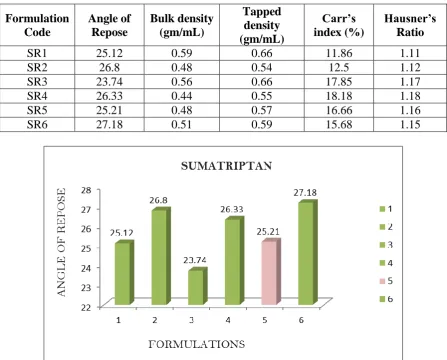
SR1 25.12 0.59 0.66 11.86 1.11
SR2 26.8 0.48 0.54 12.5 1.12
SR3 23.74 0.56 0.66 17.85 1.17
SR4 26.33 0.44 0.55 18.18 1.18
SR5 25.21 0.48 0.57 16.66 1.16
SR6 27.18 0.51 0.59 15.68 1.15
www.wjpr.net Vol 4, Issue 08, 2015.
[image:34.595.118.479.72.275.2]2986 Fig 4.1 f: Bulk density of Sumatriptan SR tablets
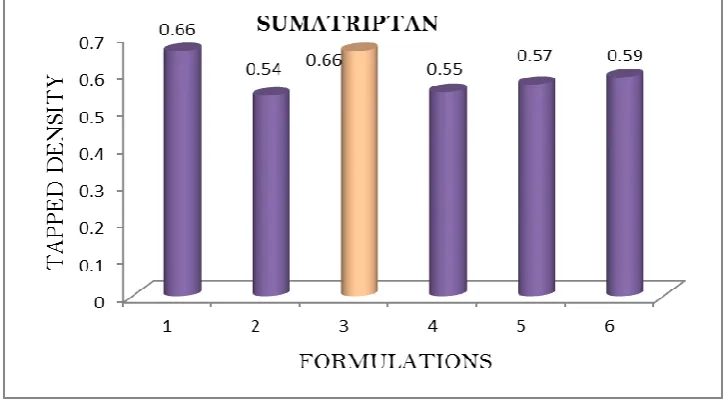
Fig 4.1 g: Tapped density of Sumatriptan SR tablets
[image:34.595.116.480.322.524.2]www.wjpr.net Vol 4, Issue 08, 2015.
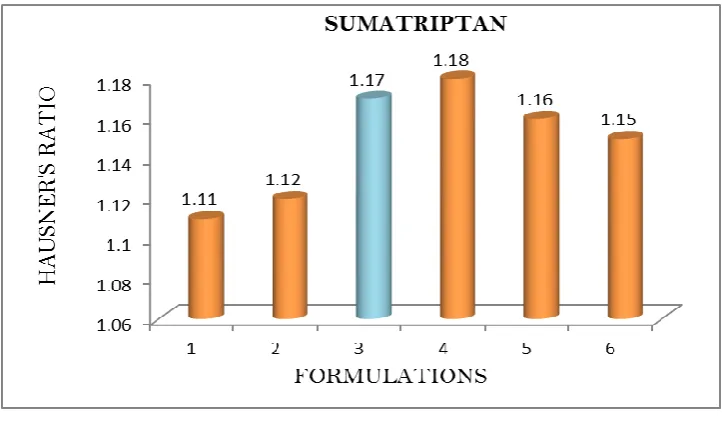
[image:35.595.117.479.70.281.2]2987 Fig 4.1 i: Hausners ratio of Sumatriptan SR tablets
DISCUSSION: Tablet powder blend was subjected to various pre-formulation parameters. The angle of repose values indicates that the powder blend has good flow properties. The bulk
density of all the formulations was found to be in the range of 0.48 to 0.59 (gm/ml) showing
that the powder has good flow properties. The tapped density of all the formulations was
found to be in the range of 0.54 to 0.66 showing the powder has good flow properties. The
compressibility index of all the formulations was found to be below 18 which shows that the
powder has good flow properties. All the formulations has shown the hausners ratio ranging
between 0 to 1.2 indicating the powder has good flow properties.
Optimization of sodium bicarbonate concentration for Sumatriptan Layer
Three formulations were prepared with varying concentrations of sodium bicarbonate. The
formulation containing sodium bicarbonate in 15mg concentration showed less floating lag
time of 2 min and the tablet was in floating condition for more than 12 hours.
4.2 EVALUATION OF POST COMPRESSION PARAMETERS
A. EVALUATION TESTS FOR VARIOUS FORMULATIONS OF IMMEDIATE RELEASE LAYER OF NAPROXEN
Formulation codes
Weight
variation(mg) Hardness(kg/cm2)
Friability (%loss)
Thickness (mm)
Drug content (%)
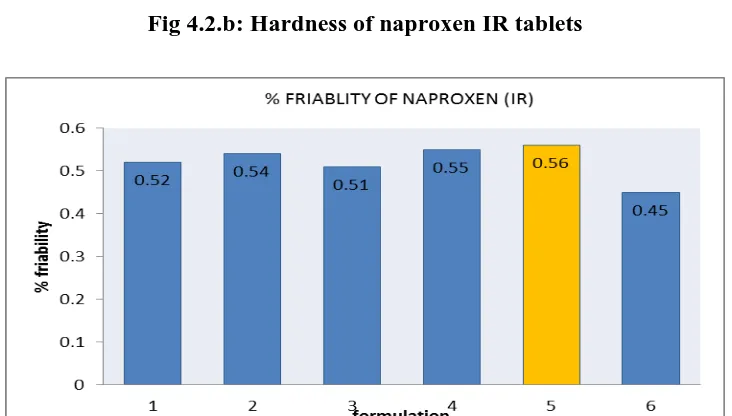
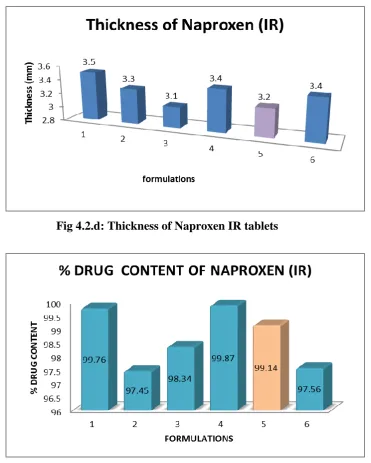
IR1 195.5 2.5 0.52 3.5 99.76
IR2 202.4 2.0 0.54 3.3 97.45
IR3 197.6 2.4 0.51 3.1 98.34
IR4 199.6 2.5 0.55 3.4 99.87
IR5 202.4 2.4 0.56 3.2 99.14
www.wjpr.net Vol 4, Issue 08, 2015.
2988 Table 4.2 a: Post compression data of Naproxen IR tablets
All the parameters for IR layer such as weight variation, friability, hardness, thickness, drug
content were found to be within limits.
[image:36.595.115.481.533.741.2]Fig 4.2.a: weigtht varitaion of Naproxen IR tablets
Fig 4.2.b: Hardness of naproxen IR tablets
www.wjpr.net Vol 4, Issue 08, 2015.
[image:37.595.112.484.66.530.2]2989 Fig 4.2.d: Thickness of Naproxen IR tablets
Fig 4.2.e: % Drug content of Naproxe IR tablets
B. EVALUATION TESTS FOR VARIOUS FORMULATIONS OF SUSTAINED RELEASE LAYER OF SUMATRIPTAN
Table 4.2.b: Post compression data of Sumatriptan SR tablets Formulation
codes
Weight
variation(mg) Hardness(kg/cm2)
Friability (%loss)
Thickness (mm)
Drug content
(%)
Floating lag time (min)
SR1 198.4 3.1 0.61 3.3 98.42 3.5
SR2 199.2 3.2 0.58 3.2 99.65 2.4
SR3 201.3 3.5 0.45 3.4 99.12 2.0
SR4 196.3 3.1 0.61 3.3 98.42 4.5
SR5 198.6 3.3 0.59 3.5 99.65 3.6
[image:37.595.116.478.74.279.2]www.wjpr.net Vol 4, Issue 08, 2015.
[image:38.595.112.480.79.482.2]2990 Fig 4.2.f : % weight varittion of Sumatriptan SR tablets
Fig 4.2.g : Hardness of Sumatriptan SR tablets
www.wjpr.net Vol 4, Issue 08, 2015.
[image:39.595.114.481.79.473.2]2991 Fig 4.2.i: Thickness of Sumatriptan SR tablets
Fig 4.2.j: % Drug content of Sumatriptan SR tablets
In Vitro Drug Release Studies for immediate release layer Naproxen
In-vitro drug release of Naproxen IR1 formulation Table 4.2.c: Drug release data of IR 1 formulation
S.NO Time (mins) % Drug release
1 0 0
2 5 10.28
3 10 22.63
4 15 34.18
5 20 46.91
6 30 59.32
7 45 72.84
www.wjpr.net Vol 4, Issue 08, 2015.
2992 Graph 4.2ac: Drug release data of IR 1 formulation
[image:40.595.113.481.345.721.2]In-vitro drug release of Naproxen IR2 formulation Table 4.2.d: Drug release data of IR 2 formulation
S.NO Time (mins) % Drug release
1 0 0
2 5 19.36
3 10 35.82
4 15 48.64
5 20 63.27
6 30 82.51
7 45 95.42
8 60 95.42
www.wjpr.net Vol 4, Issue 08, 2015.
[image:41.595.81.481.71.392.2]2993 In-vitro drug release of Naproxen IR3 formulation
Table 4.2.e: Drug release data of IR 3 formulation
S.NO Time (mins) % Drug release
1 0 0
2 5 22.38
3 10 40.66
4 15 62.83
5 20 76.58
6 30 96.82
Graph 4.2.c: Drug release data of IR3 formulation
In-vitro drug release of Naproxen IR4 formulation Table 4.2.f: Drug release data of IR4 formulation
S.NO Time (mins) % Drug release
1 0 0
2 5 21.69
3 10 43.52
4 15 62.71
5 20 88.43
6 30 97.21
[image:41.595.76.483.435.750.2]www.wjpr.net Vol 4, Issue 08, 2015.
[image:42.595.83.481.73.398.2]2994 In-vitro drug release of Naproxen IR5 formulation
Table 4.2.g: Drug release data of IR 5 formulation
S.NO Time (mins) % Drug release
1 0 0
2 5 30.14
3 10 63.93
4 15 84.27
5 20 90.65
6 30 98.24
Graph 4.2.e: Drug release data of IR5 formulation
In-vitro drug release of Naproxen IR6 formulation Table 4.2.h: Drug release data of IR 6 formulation
S.NO Time (mins) % Drug release
1 0 0
2 5 28.46
3 10 51.47
4 15 79.86
5 20 91.63
6 30 94.25
7 45 94.25
[image:42.595.76.482.432.744.2]www.wjpr.net Vol 4, Issue 08, 2015.
[image:43.595.78.518.100.491.2]2995 CUMMULATIVE % DRUG RELEASE
Table 4.2.i: Cumulative drug release data of Naproxen IR tablets
TIME(Min) IR1 IR2 IR3 IR4 IR5 IR6
0 0 0 0 0 0 0
5 10.28 19.36 22.38 21.69 30.14 28.46
10 22.63 35.82 40.66 43.52 63.93 51.47
15 34.18 48.64 62.83 62.71 84.27 79.86
20 46.91 63.27 76.58 88.43 90.65 91.63
30 59.32 82.51 96.82 97.21 98.24 94.25
45 72.84 95.42 94.25
60 89.66 95.42
Graph 4.2.g: Cumulative Dissolution data of Naproxen Immediate release Layer
From the dissolution data of Naproxen Immediate release Layer, IR1, IR2, IR3 formulations
containing Explotab as super disintegrate revealed that increase in the concentration of
Explotab shown good drug release. IR4, IR5, IR6 formulations containing Polyplasdone XL
were shown good drug release compared to formulations containing Explotab.
Among all IR Layer formulations, IR5 formulation was shown maximum drug release at
www.wjpr.net Vol 4, Issue 08, 2015.
2996 In vitro drug release studies for sustained release layer of sumatriptan
In-vitro drug release of sumatriptan sr1 formulation
Table4.2.j : Dissolution data of Sumatriptan SR1 formulation
S.No Time % Drug release
1 0 0
2 0.5 18.45
3 1 36.26
4 2 52.16
5 3 70.01
6 4 87.26
7 5 93.1
8 6
9 7
10 8
11 9
12 10
13 11
14 12
Graph 4.2.k: Dissolution data
[image:44.595.133.468.125.579.2]In-vitro drug release of SUMATRIPTAN SR2 formulation Table 4.2.k Dissolution data
S.No Time % Drug release
1 0 0
2 0.5 18.42
3 1 27.73
4 2 35.63
www.wjpr.net Vol 4, Issue 08, 2015.
2997
6 4 57.25
7 5 64.33
8 6 75.41
9 7 83.84
10 8 92.8
11 9
12 10
13 11
14 12
Graph 4.2.l: in-vitro drug release of SR2 Formulation
[image:45.595.114.483.69.453.2]In-vitro drug release of SUMATRIPTAN SR3 formulation Table 4.2.l Dissolution data
S.No Time % Drug release
1 0 0
2 0.5 10.62
3 1 21.86
4 2 32.35
5 3 41.45
6 4 47.8
7 5 55.25
8 6 60.24
9 7 66.73
10 8 71.34
11 9 78.52
12 10 85.17
13 11 91.75
www.wjpr.net Vol 4, Issue 08, 2015.
2998 Graph 4.2.m: in-vitro drug release of SR3 Formulation
[image:46.595.116.483.331.747.2]In-vitro drug release of SUMATRIPTAN SR4 formulation Table 4.2.m. Dissoultion data
S.No Time % Drug release
1 0 0
2 0.5 21.73
3 1 59.23
4 2 84.9
5 3 94.873
6 4 94.873
7 5
8 6
9 7
10 8
11 9
12 10
13 11
14 12
www.wjpr.net Vol 4, Issue 08, 2015.
2999 In-vitro drug release of SUMATRIPTAN SR5 formulation
Table 4.2.n Dissoultion data
S.No Time % Drug release
1 0 0
2 0.5 18.52
3 1 37.47
4 2 59.93
5 3 65.85
6 4 77.54
7 5 89.55
8 6 96.6
9 7
10 8
11 9
12 10
13 11
14 12
Graph 4.2.o: in-vitro drug release of SR5 Formulation
[image:47.595.118.478.108.594.2]In-vitro drug release of SUMATRIPTAN SR6 formulation Table 4.2.o. Dissoultion data
S.No Time % Drug release
1 0 0
2 0.5 19.53
3 1 28.97
www.wjpr.net Vol 4, Issue 08, 2015.
3000
5 3 45.7
6 4 54.38
7 5 61.2
8 6 67.06
9 7 72.52
10 8 77.88
11 9 96.6
12 10 99.09
13 11 99.09
14 12
Graph 4.2.p: in-vitro drug release of SR6 Formulation
[image:48.595.117.484.69.458.2]CUMMULATIVE % DRUG RELEASE OF SUMATRIPTAN
Table 4.2.p. Cumulative % drug release data of Sumatriptan SR tablets
Time SR1 SR2 SR3 SR4 SR5 SR6
0 0 0 0 0 0 0
0.5 18.45 18.42 10.62 21.73 18.52 19.53
1 36.26 27.73 21.86 59.23 37.47 28.97
2 52.16 35.63 32.35 84.9 59.93 35.89
3 70.01 42.04 41.45 94.873 65.85 45.7
4 87.26 57.25 47.8 94.873 77.54 54.38
5 93.1 64.33 55.25 89.55 61.2
6 75.41 60.24 96.6 67.06
7 83.84 66.73 72.52
8 92.8 71.34 77.88
9 78.52 86.6
10 85.17 99.09
11 91.75 99.09