Learning Better Rule Extraction with Translation Span Alignment
Jingbo Zhu Tong Xiao Chunliang Zhang
Natural Language Processing Laboratory Northeastern University, Shenyang, China
{zhujingbo,xiaotong,zhangcl}@mail.neu.edu.cn
Abstract
This paper presents an unsupervised ap-proach to learning translation span align-ments from parallel data that improves syntactic rule extraction by deleting spuri-ous word alignment links and adding new valuable links based on bilingual transla-tion span correspondences. Experiments on Chinese-English translation demonstrate improvements over standard methods for tree-to-string and tree-to-tree translation.
1 Introduction
Most syntax-based statistical machine translation (SMT) systems typically utilize word alignments and parse trees on the source/target side to learn syntactic transformation rules from parallel data. The approach suffers from a practical problem that even one spurious (word alignment) link can pre-vent some desirable syntactic translation rules from extraction, which can in turn affect the quality of translation rules and translation performance (May and Knight 2007; Fossum et al. 2008). To address this challenge, a considerable amount of previous research has been done to improve alignment qual-ity by incorporating some statistics and linguistic heuristics or syntactic information into word alignments (Cherry and Lin 2006; DeNero and Klein 2007; May and Knight 2007; Fossum et al.
2008; Hermjakob 2009; Liu et al. 2010).
Unlike their efforts, this paper presents a simple approach that automatically builds the translation span alignment (TSA) of a sentence pair by utiliz-ing a phrase-based forced decodutiliz-ing technique, and then improves syntactic rule extraction by deleting spurious links and adding new valuable links based on bilingual translation span correspondences. The proposed approach has two promising properties.
S
VP ADVP NNS
imports
VBZ
have
DT
VBN RB
fallen drastically the
减少 jianshao 大幅度
dafudu 进口
jinkou
了 le
NN
VV AS
AD VP
VP S
NP Frontier node
[image:1.612.334.518.200.339.2]Word alignment
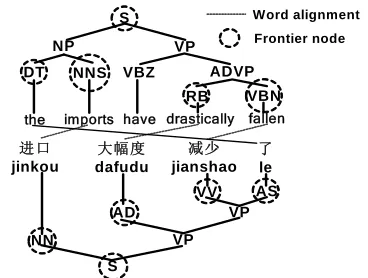
Figure 1. A real example of Chinese-English sentence pair with word alignment and both-side parse trees.
Some blocked Tree-to-string Rules:
r1: AS(了) → have
r2: NN(进口) → the imports r3: S (NN:x1 VP:x2) →x1x2
Some blocked Tree-to-tree Rules:
r4: AS(了) → VBZ(have)
r5: NN(进口) → NP(DT(the) NNS(imports)) r6: S(NN:x1 VP:x2) → S(NP:x1 VP:x2) r7: VP(AD:x1 VP(VV:x2 AS:x3))
→ VP(VBZ:x3 ADVP(RB:x1 VBN:x2))
Table 1. Some useful syntactic rules are blocked due to the spurious link between “了” and “the”.
Firstly, The TSAs are constructed in an unsuper-vised learning manner, and optimized by the trans-lation model during the forced decoding process, without using any statistics and linguistic heuristics or syntactic constraints. Secondly, our approach is independent of the word alignment-based algo-rithm used to extract translation rules, and easy to implement.
2 Translation Span Alignment Model
Different from word alignment, TSA is a process of identifying span-to-span alignments between parallel sentences. For each translation span pair,
1. Extract phrase translation rules R from the parallel corpus with word alignment, and construct a phrase-based translation model M.
2. Apply M to implement phrase-based forced decoding on each training sentence pair (c, e), and output its best derivation d* that can transform c into e. 3. Build a TSA of each sentence pair (c, e) from its best
derivation d*, in which each rule r in d* is used to form a translation span pair {src(r)<=>tgt(r)}. Figure 2. TSA generation algorithm. src(r) and tgt(r)
indicate the source and target side of rule r.
its source (or target) span is a sequence of source (or target) words. Given a source sentence c=c1...cn,
a target sentence e=e1...em, and its word alignment A, a translation span pair τ is a pair of source span (ci...cj) and target span (ep...eq)
) ( q p j i e c ⇔ =
τ
where τ indicates that the source span (ci...cj) and
the target span (ep...eq) are translational equivalent.
We do not require that τ must be consistent with the associated word alignment A in a TSA model.
Figure 2 depicts the TSA generation algorithm in which a phrase-based forced decoding tech-nique is adopted to produce the TSA of each sen-tence pair. In this work, we do not apply syntax-based forced decoding (e.g., tree-to-string) because phrase-based models can achieve the state-of-the-art translation quality with a large amount of train-ing data, and are not limited by any constituent boundary based constraints for decoding.
Formally, given a sentence pair (c, e), the phrase-based forced decoding technique aims to search for the best derivation d* among all consis-tent derivations that convert the given source sen-tence c into the given target sentence e with respect to the current translation model induced from the training data, which can be expressed by
) | ) ( ( Pr max arg ) ( ) , (
* TGT d c
d e d TGT e c D
d∈ ∧ = θ
= (1)
where D(c,e) is the set of candidate derivations that transform c to e, and TGT(d) is a function that out-puts the yield of a derivation d. θ indicates parame-ters of the phrase-based translation model learned from the parallel corpus.
The best derivation d* produced by forced de-coding can be viewed as a sequence of translation steps (i.e., phrase translation rules), expressed by
k
r r
r
d*= 1⊕ 2⊕...⊕ ,
c = 进口大幅度减少了
e = the imports have drastically fallen
The best derivation d* produced by forced decoding:
r1: 进口→ the imports
r2: 大幅度减少→ drastically fallen r3: 了→ have
Generating TSA from d*: [进口]<=>[the imports]
[image:2.612.307.545.74.202.2][大幅度减少]<=>[drastically fallen] [了]<=>[have]
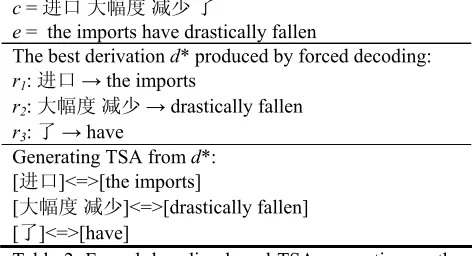
Table 2. Forced decoding based TSA generation on the example sentence pair in Fig. 1.
where ri indicates a phrase rule used to form d*.
⊕is a composition operation that combines rules {r1...rk} together to produce the target translation.
As mentioned above, the best derivation d* re-spects the input sentence pair (c, e). It means that for each phrase translation rule ri used by d*, its
source (or target) side exactly matches a span of the given source (or target) sentence. The source side src(ri) and the target side tgt(ri) of each phrase
translation rule ri in d* form a translation span pair
{src(ri)<=>tgt(ri)} of (c,e). In other words, the
TSA of (c,e) is a set of translation span pairs gen-erated from phrase translation rules used by the best derivation d*. The forced decoding based TSA generation on the example sentence pair in Figure 1 can be shown in Table 2.
3 Better Rule Extraction with TSAs
To better understand the particular task that we will address in this section, we first introduce a definition of inconsistent with a translation span alignment. Given a sentence pair (c, e) with the word alignment A and the translation span align-ment P, we call a link (ci, ej)∈Ainconsistent with P, if ci and ej are covered respectively by two
dif-ferent translation span pairs in P and vice versa. (ci, ej)∈A inconsistent with P ⇔
) ( ) ( : ) ( ) ( :
τ
τ
τ
τ
τ
τ
tgt e src c P OR tgt e src c P j i j i ∈ ∧ ∉ ∈ ∃ ∉ ∧ ∈ ∈ ∃where src(τ) and tgt(τ) indicate the source and tar-get span of a translation span pair τ.
By this, we will say that a link (ci, ej)∈A is a
Source Target WA TSA 1: 进口 1: the 1→2 [1,1]<=>[1,2] 2: 大幅度 2: imports 2→4 [2,3]<=>[4,5] 3: 减少 3: have 3→5 [4,4]<=>[3,3] 4: 了 4: drastically 4→1
5: fallen (null)→3
Table 3. A sentence pair with the original word align-ment (WA) and the translation span alignalign-ment (TSA).
([4,4]<=>[3,3]) and ([1,1] <=>[1,2]), respectively. In such a case, we think that this link (4→1) is a spurious link according to this TSA, and should be removed for rule extraction.
Given a resulting TSA P, there are four different types of translation span pairs, such as one-to-one, one-to-many, many-to-one, and many-to-many cases. For example, the TSA shown in Table 3 contains a one-to-one span pair ([4,4]<=>[3,3]), a one-to-many span pair ([1,1]<=>[1,2]) and a many-many span pair ([2,3]<=>[4,5]). In such a case, we can learn a confident link from a one-to-one translation span pair that is preferred by the translation model in the forced decoding based TSA generation approach. If such a confident link does not exist in the original word alignment, we consider it as a new valuable link.
Until now, a natural way is to use TSAs to di-rectly improve word alignment quality by deleting some spurious links and adding some new confi-dent links, which in turn improves rule quality and translation quality. In other words, if a desirable translation rule was blocked due to some spurious links, we will output this translation rule. Let’s revisit the example in Figure 1 again. The blocked tree-to-string r3 can be extracted successfully after
deleting the spurious link (了, the), and a new tree-to-string rule r1 can be extracted after adding a new
confident link (了, have) that is inferred from a one-to-one translation span pair [4,4]<=>[3,3].
4 Experiments
4.1 Setup
We utilized a state-of-the-art open-source SMT system NiuTrans (Xiao et al. 2012) to implement syntax-based models in the following experiments. We begin with a training parallel corpus of Chi-nese-English bitexts that consists of 8.8M Chinese words and 10.1M English words in 350K sentence pairs. The GIZA++ tool was used to perform the
Method Prec% Rec% F1% Del/Sent Add/Sent
Baseline 83.07 75.75 79.25 - -
[image:3.612.65.538.70.145.2]TSA 84.01 75.46 79.51 1.5 1.1
Table 4. Word alignment precision, recall and F1-score of various methods on 200 sentence pairs of Chinese-English data.
bi-directional word alignment between the source and the target sentences, referred to as the baseline
method. For syntactic translation rule extraction, minimal GHKM (Galley et al., 2004) rules are first extracted from the bilingual corpus whose source and target sides are parsed using the Berkeley parser (Petrov et al. 2006). The composed rules are then generated by composing two or three minimal rules. A 5-gram language model was trained on the Xinhua portion of English Gigaword corpus. Beam search and cube pruning techniques (Huang and Chiang 2007) were used to prune the search space for all the systems. The base feature set used for all systems is similar to that used in (Marcu et al.
2006), including 14 base features in total such as 5-gram language model, bidirectional lexical and phrase-based translation probabilities. All features were log-linearly combined and their weights were optimized by performing minimum error rate train-ing (MERT) (Och 2003). The development data set used for weight training comes from NIST MT03 evaluation set, consisting of 326 sentence pairs of less than 20 words in each Chinese sentence. Two test sets are NIST MT04 (1788 sentence pairs) and MT05 (1082 sentence pairs) evaluation sets. The translation quality is evaluated in terms of the case-insensitive IBM-BLEU4 metric.
4.2 Effect on Word Alignment
To investigate the effect of the TSA method on word alignment, we designed an experiment to evaluate alignment quality against gold standard annotations. There are 200 random chosen and manually aligned Chinese-English sentence pairs used to assert the word alignment quality. For word alignment evaluation, we calculated precision, recall and F1-score over gold word alignment.
4.3 Translation Quality
Method # of Rules MT03 MT04 MT05
Baseline (T2S) 33,769,071 34.10 32.55 30.15
TSA (T2S) 32,652,261 34.61
+
(+0.51)
33.01+
(+0.46)
30.66+
(+0.51)
Baseline (T2T) 24,287,206 34.51 32.20 31.78
TSA (T2T) 24,119,719 34.85 (+0.34)
32.92*
(+0.72)
32.22+
(+0.44) Table 5. Rule sizes and IBM-BLEU4 (%) scores of baseline and our method (TSA) in tree-to-string (T2S) and tree-to-tree (T2T) translation on Dev set (MT03) and two test sets (MT04 and MT05). + and * indicate significantly better on performance comparison at p<.05 and p<.01, respectively.
Table 5 depicts effectiveness of our TSA method on translation quality in string and tree-to-tree translation tasks. Table 5 shows that our TSA method can improve both syntax-based translation systems. As mentioned before, the resulting TSAs are essentially optimized by the translation model. Based on such TSAs, experiments show that spuri-ous link deletion and new valuable link insertion can improve translation quality for tree-to-string and tree-to-tree systems.
5 Related Work
Previous studies have made great efforts to incor-porate statistics and linguistic heuristics or syntac-tic information into word alignments (Ittycheriah and Roukos 2005; Taskar et al. 2005; Moore et al.
2006; Cherry and Lin 2006; DeNero and Klein 2007; May and Knight 2007; Fossum et al. 2008; Hermjakob 2009; Liu et al. 2010). For example, Fossum et al. (2008) used a discriminatively trained model to identify and delete incorrect links from original word alignments to improve string-to-tree transformation rule extraction, which incor-porates four types of features such as lexical and syntactic features. This paper presents an approach to incorporating translation span alignments into word alignments to delete spurious links and add new valuable links.
Some previous work directly models the syntac-tic correspondence in the training data for syntacsyntac-tic rule extraction (Imamura 2001; Groves et al. 2004; Tinsley et al. 2007; Sun et al. 2010a, 2010b; Pauls
et al. 2010). Some previous methods infer syntac-tic correspondences between the source and the
target languages through word alignments and con-stituent boundary based syntactic constraints. Such a syntactic alignment method is sensitive to word alignment behavior. To combat this, Pauls et al. (2010) presented an unsupervised ITG alignment model that directly aligns syntactic structures for string-to-tree transformation rule extraction. One major problem with syntactic structure alignment is that syntactic divergence between languages can prevent accurate syntactic alignments between the source and target languages.
May and Knight (2007) presented a syntactic re-alignment model for syntax-based MT that uses syntactic constraints to re-align a parallel corpus with word alignments. The motivation behind their methods is similar to ours. Our work differs from (May and Knight 2007) in two major respects. First, the approach proposed by May and Knight (2007) first utilizes the EM algorithm to obtain Viterbi derivation trees from derivation forests of each (tree, string) pair, and then produces Viterbi alignments based on obtained derivation trees. Our forced decoding based approach searches for the best derivation to produce translation span align-ments that are used to improve the extraction of translation rules. Translation span alignments are optimized by the translation model. Secondly, their models are only applicable for syntax-based sys-tems while our method can be applied to both phrase-based and syntax-based translation tasks.
6 Conclusion
This paper presents an unsupervised approach to improving syntactic transformation rule extraction by deleting spurious links and adding new valuable links with the help of bilingual translation span alignments that are built by using a phrase-based forced decoding technique. In our future work, it is worth studying how to combine the best of our ap-proach and discriminative word alignment models to improve rule extraction for SMT models.
Acknowledgments
References
Colin Cherry and Dekang Lin. 2006. Soft syntactic con-straints for word alignment through discriminative training. In Proc. of ACL.
John DeNero and Dan Klein. 2007. Tailoring word alignments to syntactic machine translation. In Proc. of ACL.
Victoria Fossum, Kevin Knight and Steven Abney. 2008. Using syntax to improve word alignment pre-cision for syntax-based machine translation. In Proc. of the Third Workshop on Statistical Machine Trans-lation, pages 44-52.
Michel Galley, Mark Hopkins, Kevin Knight and Daniel Marcu. 2004. What's in a translation rule? In Proc. of HLT-NAACL 2004, pp273-280.
Declan Groves, Mary Hearne and Andy Way. 2004. Robust sub-sentential alignment of phrase-structure trees. In Proc. of COLING, pp1072-1078.
Ulf Hermjakob. 2009. Improved word alignment with statistics and linguistic heuristics. In Proc. of EMNLP, pp229-237
Liang Huang and David Chiang. 2007. Forest rescoring: Faster decoding with integrated language models. In
Proc. of ACL, pp144-151.
Kenji Imamura. 2001. Hierarchical Phrase Alignment Harmonized with Parsing. In Proc. of NLPRS, pp377-384.
Abraham Ittycheriah and Salim Roukos. 2005. A maxi-mum entropy word aligner for Arabic-English ma-chine translation. In Proc. of HLT/EMNLP.
Yang Liu, Qun Liu and Shouxun Lin. 2010. Discrimina-tive word alignment by linear modeling. Computa-tional Linguistics, 36(3):303-339
Daniel Marcu, Wei Wang, Abdessamad Echihabi and Kevin Knight. 2006. SPMT: Statistical machine translation with syntactified target language phrases. In Proc. of EMNLP, pp44-52.
Jonathan May and Kevin Knight. 2007. Syntactic re-alignment models for machine translation. In Proc. of EMNLP-CoNLL.
Robert C. Moore, Wen-tau Yih and Andreas Bode. 2006. Improved discriminative bilingual word alignment. In Proc. of ACL
Franz Josef Och. 2003. Minimum error rate training in statistical machine translation. In Proc. of ACL. Adam Pauls, Dan Klein, David Chiang and Kevin
Knight. 2010. Unsupervised syntactic alignment with
inversion transduction grammars. In Proc. of NAACL, pp118-126
Slav Petrov, Leon Barrett, Roman Thibaux and Dan Klein. 2006. Learning accurate, compact, and inter-pretable tree annotation. In Proc. of ACL, pp433-440. Jun Sun, Min Zhang and Chew Lim Tan. 2010a. Explor-ing Syntactic Structural Features for Sub-Tree Alignment Using Bilingual Tree Kernels. In Proc. of ACL, pp306-315.
Jun Sun, Min Zhang and Chew Lim Tan. 2010b. Dis-criminative Induction of Sub-Tree Alignment using Limited Labeled Data. In Proc. of COLING, pp1047-1055.
Ben Taskar, Simon Lacoste-Julien and Dan Klein. 2005. A discriminative matching approach to word align-ment. In Proc. of HLT/EMNLP
John Tinsley, Ventsislav Zhechev, Mary Hearne and Andy Way. 2007. Robust language pair-independent sub-tree alignment. In Proc. of MT Summit XI. Tong Xiao, Jingbo Zhu, Hao Zhang and Qiang Li. 2012.