Improving Statistical Word Alignment with a Rule-Based Machine
Translation System
WU Hua, WANG Haifeng
Toshiba (China) Research & Development Center
5/F., Tower W2, Oriental Plaza, No.1, East Chang An Ave., Dong Cheng District
Beijing, China, 100738
{wuhua, wanghaifeng}@rdc.toshiba.com.cn
Abstract
The main problems of statistical word alignment lie in the facts that source words can only be aligned to one target word, and that the inappro-priate target word is selected because of data sparseness problem. This paper proposes an ap-proach to improve statistical word alignment with a rule-based translation system. This ap-proach first uses IBM statistical translation model to perform alignment in both directions (source to target and target to source), and then uses the translation information in the rule-based machine translation system to improve the statis-tical word alignment. The improved alignments allow the word(s) in the source language to be aligned to one or more words in the target lan-guage. Experimental results show a significant improvement in precision and recall of word alignment.
1 Introduction
Bilingual word alignment is first introduced as an
intermediate result in statistical machine transla-tion (SMT) (Brown et al. 1993). Besides being used in SMT, it is also used in translation lexicon building (Melamed 1996), transfer rule learning (Menezes and Richardson 2001), example-based machine translation (Somers 1999), etc. In previ-ous alignment methods, some researches mod-eled the alignments as hidden parameters in a statistical translation model (Brown et al. 1993; Och and Ney 2000) or directly modeled them given the sentence pairs (Cherry and Lin 2003). Some researchers used similarity and association measures to build alignment links (Ahrenberg et al. 1998; Tufis and Barbu 2002). In addition, Wu (1997) used a stochastic inversion transduction grammar to simultaneously parse the sentence pairs to get the word or phrase alignments.
Generally speaking, there are four cases in word alignment: word to word alignment, word
to multi-word alignment, multi-word to word alignment, and multi-word to multi-word align-ment. One of the most difficult tasks in word alignment is to find out the alignments that in-clude multi-word units. For example, the statisti-cal word alignment in IBM translation models (Brown et al. 1993) can only handle word to word and multi-word to word alignments.
Some studies have been made to tackle this problem. Och and Ney (2000) performed transla-tion in both directransla-tions (source to target and target to source) to extend word alignments. Their re-sults showed that this method improved precision without loss of recall in English to German align-ments. However, if the same unit is aligned to two different target units, this method is unlikely to make a selection. Some researchers used preprocessing steps to identity multi-word units for word alignment (Ahrenberg et al. 1998; Tiedemann 1999; Melamed 2000). The methods obtained multi-word candidates based on con-tinuous N-gram statistics. The main limitation of these methods is that they cannot handle sepa-rated phrases and multi-word units in low fre-quencies.
In order to handle all of the four cases in word alignment, our approach uses both the alignment information in statistical translation models and translation information in a rule-based machine translation system. It includes three steps. (1) A statistical translation model is employed to per-form word alignment in two directions1 (English to Chinese, Chinese to English). (2) A rule-based English to Chinese translation system is em-ployed to obtain Chinese translations for each English word or phrase in the source language. (3) The translation information in step (2) is used to improve the word alignment results in step (1).
A critical reader may pose the question “why
not use a translation dictionary to improve statis-tical word alignment?” Compared with a transla-tion dictransla-tionary, the advantages of a rule-based machine translation system lie in two aspects: (1) It can recognize the multi-word units, particularly separated phrases, in the source language. Thus, our method is able to handle the multi-word alignments with higher accuracy, which will be described in our experiments. (2) It can perform word sense disambiguation and select appropriate translations while a translation dictionary can only list all translations for each word or phrase. Experimental results show that our approach im-proves word alignments in both precision and recall as compared with the state-of-the-art tech-nologies.
2
Statistical Word Alignment
Statistical translation models (Brown, et al. 1993) only allow word to word and multi-word to word alignments. Thus, some multi-word units cannot be correctly aligned. In order to tackle this prob-lem, we perform translation in two directions (English to Chinese and Chinese to English) as described in Och and Ney (2000). The GIZA++ toolkit is used to perform statistical alignment. Thus, for each sentence pair, we can get two alignment results. We use and to represent the alignment sets with English as the source lan-guage and Chinese as the target lanlan-guage or vice versa. For alignment links in both sets, we use i for English words and j for Chinese words.
1
S S2
} 0 }, { | ) , {(
1= Aj j Aj = aj aj ≥ S
} 0 }, { | ) , {(
2 = i Ai Ai = ai ai ≥ S
Where, represents the index posi-tion of the source word aligned to the target word in position x. For example, if a Chinese word in position j is connected to an English word in po-sition i, then . If a Chinese word in position j is connected to English words in positions i
and , then .
) , (x i j
ax =
i aj =
, {i1 i2 Aj =
) 1 (k>
1 2
i } 2 We call an element in the alignment set an alignment link. If the link includes a word that has no translation, we call it a null link. If k words have null links, we treat them as k different null links, not just one link.
2 In the following of this paper, we will use the position
number of a word to refer to the word.
Based on and , we obtain their intersec-tion set, union set and subtracintersec-tion set.
1
S S2
Intersection: S =S1∩S2 Union: P=S1∪S2 Subtraction: F=P−S
Thus, the subtraction set contains two differ-ent alignmdiffer-ent links for each English word.
3 Rule-Based Translation System
We use the translation information in a rule-based English-Chinese translation system3 to im-prove the statistical word alignment result. This translation system includes three modules: source language parser, source to target language trans-fer module, and target language generator.
From the transfer phase, we get Chinese trans-lation candidates for each English word. This information can be considered as another word alignment result, which is denoted as
)} , {(
3 k Ck
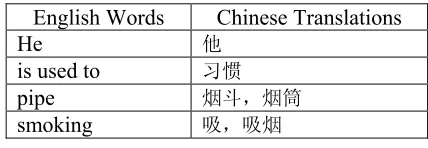
S = . C the set including the trans-lation candidates for the k-th English word or phrase. The difference between S and the common alignment set is that each English word or phrase in S has one or more translation can-didates. A translation example for the English sentence “He is used to pipe smoking.” is shown in Table 1.
k is
3
3
English Words Chinese Translations
He 他
is used to 习惯
pipe 烟斗,烟筒
smoking 吸,吸烟
Table 1. Translation Example
From Table 1, it can be seen that (1) the trans-lation system can recognize English phrases (e.g. is used to); (2) the system can provide one or more translations for each source word or phrase; (3) the translation system can perform word se-lection or word sense disambiguation. For exam-ple, the word “pipe” has several meanings such as “tube”, “tube used for smoking” and “wind instrument”. The system selects “tube used for smoking” and translates it into Chinese words “烟斗” and “烟筒”. The recognized translation
3 This system is developed based on the Toshiba
candidates will be used to improve statistical word alignment in the next section.
4
4.1
Word Alignment Improvement
As described in Section 2, we have two align-ment sets for each sentence pair, from which we obtain the intersection set S and the subtraction set . We will improve the word alignments in S and with the translation candidates produced by the rule-based machine translation system. In the following sections, we will first describe how to calculate monolingual word similarity used in our algorithm. Then we will describe the algo-rithm used to improve word alignment results.
F F
Word Similarity Calculation
This section describes the method for monolin-gual word similarity calculation. This method calculates word similarity by using a bilingual dictionary, which is first introduced by Wu and Zhou (2003). The basic assumptions of this method are that the translations of a word can express its meanings and that two words are simi-lar in meanings if they have mutual translations.
Given a Chinese word, we get its translations with a Chinese-English bilingual dictionary. The translations of a word are used to construct its feature vector. The similarity of two words is estimated through their feature vectors with the cosine measure as shown in (Wu and Zhou 2003). If there are a Chinese word or phrase w and a Chinese word set Z, the word similarity between them is calculated as shown in Equation (1).
)) ' , ( ( ) , (
' simw w
Max Z w sim
Z w∈
= (1)
4.2
Alignment Improvement Algorithm As the word alignment links in the intersection set are more reliable than those in the subtraction set, we adopt two different strategies for the alignments in the intersection set S and the sub-traction set . For alignments in S, we will mod-ify them when they are inconsistent with the translation information in S . For alignments in , we classify them into two cases and make se-lection between two different alignment links or modify them into a new link.F
3
F
In the intersection set S, there are only word to word alignment links, which include no multi-word units. The main alignment error type in this
set is that some words should be combined into one phrase and aligned to the same word(s) in the target sentence. For example, for the sentence pair in Figure 1, “used” is aligned to the Chinese word “习惯”, and “is” and “to” have null links in . But in the translation set , “is used to" is a phrase. Thus, we combine the three alignment links into a new link. The words “is”, “used” and “ to” are all aligned to the Chinese word “习惯”, denoted as (is used to, 习惯). Figure 2 describes the algorithm employed to improve the word alignment in the intersection set S.
S S3
)
j
phk,
3
S
Figure 1. Multi-Word Alignment Example Input: Intersection set S, Translation set S3, Final word alignment set WA
For each alignment link(i, in S, do:
(1) If all of the following three conditions are satisfied, add the new alignment link
WA phk )∉
( , w to WA.
a) There is an element( , and the English word i is a constituent of the phrase .
3
) S Ck ∈
k ph
b) The other words in the phrase ph also have alignment links in S.
k
c) For each word s in phk , we get }
) , |
{t (s t S
T = ∈ and combine4 all words in T into a phrase w, and the similar-itysim(w,Ck)>δ1.
(2) Otherwise, add(i,j) to WA. Output: Word alignment set WA
Figure 2. Algorithm for the Intersection Set In the subtraction set, there are two different links for each English word. Thus, we need to select one link or to modify the links according to the translation information in .
For each English word i in the subtraction set, there are two cases:
4 We define an operation “combine” on a set consisting of
Case 1: In , there is a word to word alignment link( . In , there is a word to word or word to multi-word alignment link
1 is a word to word or word to multi-word
align-ment link( .
For Case 1, we first examine the translation set . If there is an element( , we cal-culate the Chinese word similarity between j in
and with Equation (1) shown in Section 4.1. We also combine the words in A
) into a phrase and get the word simi-larity between this new phrase and C . The align-ment link with a higher similarity score is selected and added to WA.
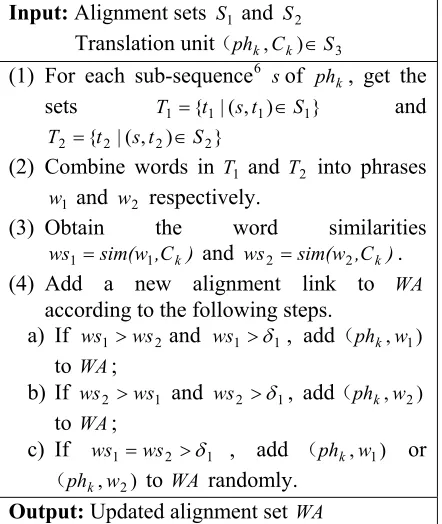
(3) Obtain the word similarities
and .
according to the following steps. a) If ws1 >ws2 and ws1 >δ1, add (
Output: Updated alignment set WA
Figure 3. Multi-Word to Multi-Word Align-ment Algorithm
combined with other words to form phrases. In this case, we modify the alignment links into a multi-word to multi-word alignment link. The algorithm is described in Figure 3.
5(, )
i A
i represents both the word to word and word to multi-word alignment links.
6 If a phrase consists of three words w , the
sub-For example, given a sentence pair in Figure 4, in S , the word “whipped” is aligned to “突然” and “out” is aligned to “抽出”. In S , the word “whipped” is aligned to both “突然” and “抽出” and “out” has a null link. In , “whipped out” is a phrase and translated into “迅速抽出". And the word similarity between “突然抽出” and “迅速抽 出” is larger than the threshold
1 combine the aligned target words in the Chinese sentence into “突然抽出”. The final alignment link should be (whipped out, 突然抽出).
Figure 4. Multi-Word to Multi-Word Alignment Example
For Case 2, we first examine S to see whether there is an element( . If true, we combine the words in (( ) into a word or phrase and calculate the similarity be-tween this new word or phrase and C in the same way as in Case 1. If the similarity is higher than a threshold
3 constituent of ph , we combine the English words in A ( ) into a phrase. If it is multi-word to multi-word alignment algorithm in Figure 3 to modify the links.
) ,
Aj j
add the link into the set WA.
Training and Testing Set
We did experiments on a sentence aligned Eng-lish-Chinese bilingual corpus in general domains. There are about 320,000 bilingual sentence pairs in the corpus, from which, we randomly select 1,000 sentence pairs as testing data. The remain-der is used as training data.
The Chinese sentences in both the training set and the testing set are automatically segmented into words. The segmentation errors in the testing set are post-corrected. The testing set is manually annotated. It has totally 8,651 alignment links including 2,149 null links. Among them, 866 alignment links include multi-word units, which accounts for about 10% of the total links.
Experimental Results
There are several different evaluation methods for word alignment (Ahrenberg et al. 2000). In our evaluation, we use evaluation metrics similar to those in Och and Ney (2000). However, we do not classify alignment links into sure links and possible links. We consider each alignment as a sure link.
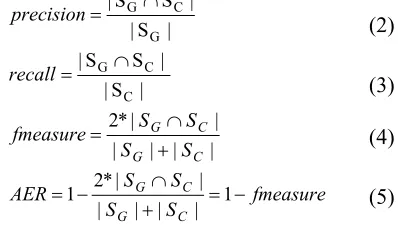
If we use S to indicate the alignments iden-tified by the proposed methods and S to denote the reference alignments, the precision, recall and f-measure are calculated as described in Equation (2), (3) and (4). According to the definition of the alignment error rate (AER) in Och and Ney (2000), AER can be calculated with Equation (5).
G
In this paper, we give two different alignment results in Table 2 and Table 3. Table 2 presents alignment results that include null links. Table 3 presents alignment results that exclude null links. The precision and recall in the tables are obtained to ensure the smallest AER for each method.
Precision Recall AER IBM Refined 0.7046 0.6532 0.3235 Table 2. Alignment Results Including Null Links
Precision Recall AER Table 3. Alignment Results Excluding Null Links
In the above tables, the row “Ours” presents the result of our approach. The results are ob-tained by setting the word similarity thresholds to
1 . 0
1=
δ and δ2=0.5. The Chinese-English dic-tionary used to calculate the word similarity has 66,696 entries. Each entry has two English trans-lations on average. The row “Dic” shows the re-sult of the approach that uses a bilingual dictionary instead of the rule-based machine translation system to improve statistical word alignment. The dictionary used in this method is the same translation dictionary used in the rule-based machine translation system. It includes 57,684 English words and each English word has about two Chinese translations on average. The rows “IBM E-C” and “IBM C-E” show the re-sults obtained by IBM Model-4 when treating English as the source and Chinese as the target or vice versa. The row “IBM Inter” shows results obtained by taking the intersection of the align-ments produced by “IBM E-C” and “IBM C-E”. The row “IBM Refined” shows the results by refining the results of “IBM Inter” as described in Och and Ney (2000).
Generally, the results excluding null links are better than those including null links. This indi-cates that it is difficult to judge whether a word has counterparts in another language. It is be-cause the translations of some source words can be omitted. Both the rule-based translation sys-tem and the bilingual dictionary provide no such information.
the best among others in both cases. Our ap-proach achieves a relative error rate reduction of 26% and 25% when compared with “IBM E-C” and “IBM C-E” respectively7. Although the
pre-cision of our method is lower than that of the “IBM Inter” method, it achieves much higher recall, resulting in a 30% relative error rate re-duction. Compared with the “IBM refined” method, our method also achieves a relative error rate reduction of 30%. In addition, our method is better than the “Dic” method, achieving a relative error rate reduction of 8.8%.
In order to provide the detailed word align-ment information, we classify word alignalign-ment results in Table 3 into two classes. The first class includes the alignment links that have no multi-word units. The second class includes at least one multi-word unit in each alignment link. The de-tailed information is shown in Table 4 and Table 5. In Table 5, we do not include the method “In-ter” because it has no multi-word alignment links.
Precision Recall AER
Ours 0.9213 0.8269 0.1284
Dic 0.8898 0.8215 0.1457
IBM E-C 0.8202 0.7972 0.1916 IBM C-E 0.8200 0.7406 0.2217 IBM Inter 0.9392 0.6360 0.2416 IBM Refined 0.8920 0.7196 0.2034
Table 4. Single Word Alignment Results
Precision Recall AER
Ours 0.5123 0.3118 0.6124
Dic 0.3585 0.1478 0.7907
IBM E-C 0.1682 0.1697 0.8311 IBM C-E 0.1718 0.2298 0.8034 IBM Refined 0.2105 0.2910 0.7557
Table 5. Multi-Word Alignment Results All of the methods perform better on single word alignment than on multi-word alignment. In Table 4, the precision of our method is close to the “IBM Inter” approach, and the recall of our method is much higher, achieving a 47% relative error rate reduction. Our method also achieves a 37% relative error rate reduction over the “IBM Refined” method. Compared with the “Dic” method, our approach achieves much higher pre-cision without loss of recall, resulting in a 12%
relative error rate reduction.
6 Discussion
7 The error rate reductions in this paragraph are obtained
from Table 2. The error rate reductions in Table 3 are omitted.
Our method also achieves much better results on multi-word alignment than other methods. However, our method only obtains one third of the correct alignment links. It indicates that it is the hardest to align the multi-word units.
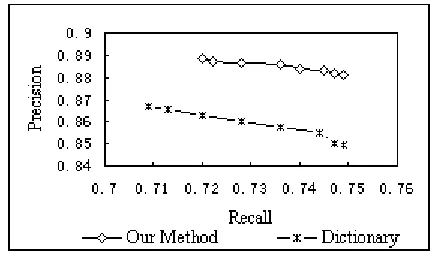
Readers may pose the question “why the rule-based translation system performs better on word alignment than the translation dictionary?” For single word alignment, the rule-based translation system can perform word sense disambiguation, and select the appropriate Chinese words as translation. On the contrary, the dictionary can only list all translations. Thus, the alignment pre-cision of our method is higher than that of the dictionary method. Figure 5 shows alignment precision and recall values under different simi-larity values for single word alignment including null links. From the figure, it can be seen that our method consistently achieves higher precisions as compared with the dictionary method. The t-score value (t=10.37, p=0.05) shows the im-provement is statistically significant.
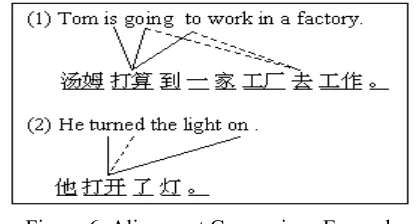
indicates the tense not the phrase “go to” as the dictionary shows. In example (2), our method detects the separated phrase “turn … on” while the dictionary does not. Thus, the dictionary method produces the wrong alignment link.
Figure 6. Alignment Comparison Examples
7 Conclusion and Future Work
This paper proposes an approach to improve sta-tistical word alignment results by using a rule-based translation system. Our contribution is that, given a rule-based translation system that pro-vides appropriate translation candidates for each source word or phrase, we select appropriate alignment links among statistical word alignment results or modify them into new links. Especially, with such a translation system, we can identify both the continuous and separated phrases in the source language and improve the multi-word alignment results. Experimental results indicate that our approach can achieve a precision of 85% and a recall of 71% for word alignment including null links in general domains. This result signifi-cantly outperforms those of the methods that use a bilingual dictionary to improve word alignment, and that only use statistical translation models.
Our future work mainly includes three tasks. First, we will further improve multi-word align-ment results by using other technologies in natu-ral language processing. For example, we can use named entity recognition and transliteration tech-nologies to improve person name alignment. Sec-ond, we will extract translation rules from the improved word alignment results and apply them back to our rule-based machine translation sys-tem. Third, we will further analyze the effect of the translation system on the alignment results.
References
Lars Ahrenberg, Magnus Merkel, and Mikael Anders-son 1998. A Simple Hybrid Aligner for Generating Lexical Correspondences in Parallel Texts. In Proc. of the 36th Annual Meeting of the Association for
Computational Linguistics and the 17th Int. Conf. on Computational Linguistics, pp. 29-35.
Lars Ahrenberg, Magnus Merkel, Anna Sagvall Hein and Jorg Tiedemann 2000. Evaluation of word alignment systems. In Proc. of the Second Int. Conf. on Linguistic Resources and Evaluation, pp. 1255-1261.
ShinYa Amano, Hideki Hirakawa, Hiroyasu Nogami, and Akira Kumano 1989. Toshiba Machine
Trans-lation System. Future Computing Systems,
2(3):227-246.
Peter F. Brown, Stephen A. Della Pietra, Vincent J. Della Pietra and Robert L. Mercer 1993. The Mathematics of Statistical Machine Translation: Parameter Estimation. Computational Linguistics, 19(2):263-311.
Colin Cherry and Dekang Lin 2003. A Probability Model to Improve Word Alignment. In Proc. of the 41st Annual Meeting of the Association for Com-putational Linguistics, pp. 88-95.
I. Dan Melamed 1996. Automatic Construction of Clean Broad-Coverage Translation Lexicons. In Proc. of the 2nd Conf. of the Association for Ma-chine Translation in the Americas, pp. 125-134. I. Dan Melamed 2000. Word-to-Word Models of
Translational Equivalence among Words. Compu-tational Linguistics, 26(2): 221-249.
Arul Menezes and Stephan D. Richardson 2001. A Best-first Alignment Algorithm for Automatic Ex-traction of Transfer Mappings from Bilingual Cor-pora. In Proc. of the ACL 2001 Workshop on Data-Driven Methods in Machine Translation, pp. 39-46. Franz Josef Och and Hermann Ney 2000. Improved
Statistical Alignment Models. In Proc.of the 38th Annual Meeting of the Association for Computa-tional Linguistics, pp. 440-447.
Harold Somers 1999. Review Article: Example-Based Machine Translation. Machine Translation 14:113-157.
Jorg Tiedemann 1999. Word Alignment – Step by Step.
In Proc. of the 12th Nordic Conf. on Computational Linguistics, pp. 216-227.
Dan Tufis and Ana Maria Barbu. 2002. Lexical Token Alignment: Experiments, Results and Application.
In Proc. of the Third Int. Conf. on Language Re-sources and Evaluation, pp. 458-465.
Dekai Wu 1997. Stochastic Inversion Transduction Grammars and Bilingual Parsing of Parallel Cor-pora. Computational Linguistics, 23(3):377-403. Hua Wu and Ming Zhou 2003. Optimizing Synonym