1
The application of the Practitioners in Applied Practice Model during
breaking bad news communication training for medical students: A case
study
Rose Dunning1, Anita Laidlaw2*
1
The School of Medicine, University of Manchester 2 The School of Medicine, University of St Andrews
*
Corresponding author: Anita Laidlaw
The School of Medicine, University of St Andrews
Medical and Biological Sciences building North Haugh
St Andrews Fife
KY16 9TF
Tel: 01334 463561
e-mail: [email protected]
2 Abstract
Background and Aims
Breaking bad news is a key skill within clinical communication and one which can impact outcomes for both the patient and practitioner. The evidence base for effective clinical communication training in breaking bad news is scarce. Frameworks have been found to assist the practitioner, such as SPIKES, however the pedagogical approach used alongside such frameworks can vary. This study sought to examine the impact of utilising the
Practitioners in Applied Practice Model (PAPM) alongside the SPIKES framework for training undergraduate medical students in breaking bad news.
Methods and Results
A case study approach is used to highlight the impact of training based on the PAPM and SPIKES on patient-centred communication and simulated patient satisfaction with the clinical communication behaviour.
Results showed that following training, both patient-centred behaviour and patient satisfaction improved. With detailed communication behaviour changes a balance was established between rapport building behaviour, lifestyle and psychosocial talk alongside biomedical information.
Conclusion
3 Key words
4 Introduction
The method used to break bad news can have widespread effects upon the patient such as
their comprehension of information and satisfaction with the care they receive1,2. The process of breaking bad news to a patient can also impact upon physicians who rate it as one of the most stressful tasks to complete3. Ultimately the approach taken to breaking bad news to a patient can also affect subsequent clinical outcomes for the patient4,5. A centered approach to communicating with patients is known to produce highest patient-satisfaction6, and the same approach has been shown to be most effective when breaking bad news7. However it is clear that not all practitioners use a patient-centred approach8. Therefore training medical students and junior doctors in breaking bad news is of significant importance.
However, few evidence-based training techniques have been established and implemented in order to educate in this approach. The SPIKES protocol is arguably the most frequently utilised framework to assist in the training of patient-centred breaking bad news9. The acronym stands for Setting, Perception, Invitation, Knowledge, Explore and Empathise, and Summary and Setting. It was developed by Robert Buckman to assist in training physicians in breaking bad news. However, the pedagogical approach used alongside the SPIKES
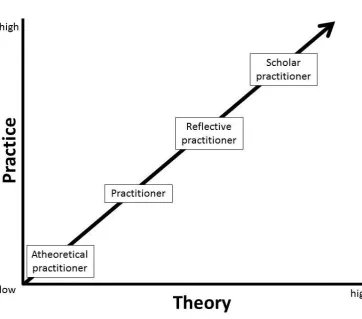
framework varies9. The Practitioners in Applied Practice Model (PAPM)10 describes the development from an atheoretical practitioner to one who is informed by theory and tries to implement it in their practice, but does so consciously and with effort (Fig. 1). Potentially an individual may then further progress to reflective practitioner whose practice is informed by theory with less effort but who also critically reflects upon their own practice and
5
scholar practitioner who also contributes to improving the field through scholarship relating to their practice10. This model, alongside experiential methods11 could be an effective way of using the SPIKES protocol9 to train medical students in breaking bad news.
[insert Fig. 1]
This case study investigated the extent to which patient-centered behaviours and patient satisfaction with clinical communication could be improved within a breaking bad news consultation as a result of a medical undergraduate clinical communication training intervention based on the PAPM and SPIKES framework.
Methods
Sample and procedure
This case study involved one third year medical student from the Medical School, University of St Andrews completing three separate video recorded breaking bad news consultations with three different simulated patients over a five week period (February – March 2014). The first consultation was recorded as a baseline, with no prior breaking bad news
education. The consultation scenarios included breaking bad news relating to a diagnosis of; diabetes (consultation 1), breast cancer, (consultation 2) and ovarian cancer (consultation 3). Alongside these simulated consultations the student also experienced their normal teaching, which during the time period between the simulated consultations, included two clinical teaching days involving two x 15 minute simulated history taking sessions each and one or two day-long clinical placements.
6
In line with the PAPM, following the first consultation theoretical knowledge was increased alongside practice with the introduction of the SPIKES framework9. The participant was provided with information regarding the SPIKES protocol, the rationale behind it and also viewed video clips showing its potential use. Following the second consultation and again, in line with the PAPM, the participant was encouraged to reflect upon their clinical
communication performance having previously been informed of the theoretical background to breaking bad news. Reflection was encouraged by the participant transcribing the first and second interviews from the video footage, and carrying out a detailed self-analysis of their own communication behaviour using the Roter Interaction Analysis System (RIAS)12.
RIAS is extensively used in healthcare communication research and codes utterances (units of speech with distinct, separate meanings) with mutually exclusive codes which relate to their function and content13. Following this reflective exercise the participant then completed a third breaking bad news consultation which was again recorded, transcribed and coded using RIAS13. All participants were blinded as to the nature of the PAPM until after the final consultation was recorded.
Measures and analysis
7
immediately following each consultation in order to assess patient satisfaction with the clinical communication.
As this is a case study, statistical analysis was limited to descriptives to highlight potential changes to behaviour and patient clinical communication satisfaction ratings.
Results
The three consultations lasted varying lengths with a mean = 16mins 18 secs (range = 11.34 – 21.46). This impacted on the number of utterances from both the simulated patient and student within the consultations, mean = 289 (range = 218 – 366).
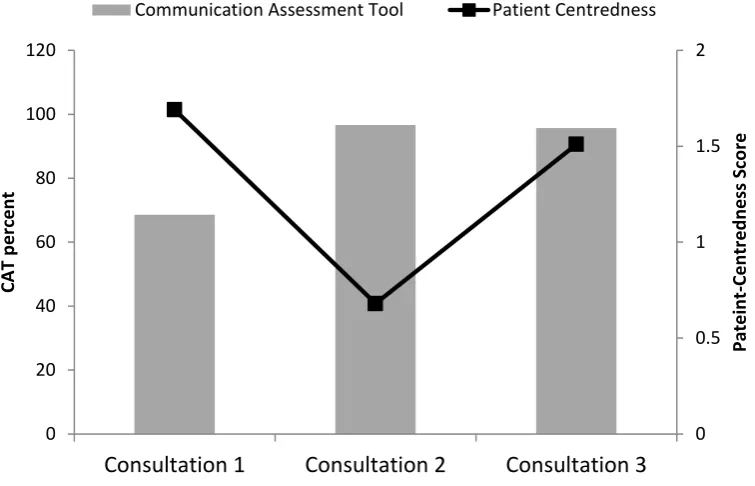
The patient-centredness scores and the patient clinical communication satisfaction rating (CAT) for each of the three consultations are shown in Fig. 2. It can be observed that whilst consultation one had the highest patient-centredness score, consultation two has the highest CAT score. Consultation three however, scores relatively highly in both patient-centredness and the CAT.
[insert Fig. 2]
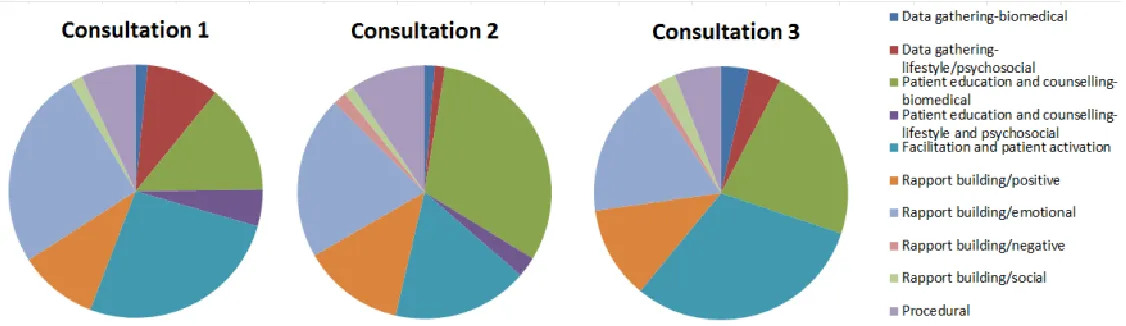
When the communication behaviour exhibited by both the student participant and simulated patients in these three consultations was examined using the RIAS coding scheme, distinct differences were observed in the proportion of utterances which were of specific codes.
It is clear from Fig. 3 that following the SPIKES training the percentage of student participant utterances that were classified as emotional rapport building, patient facilitation and
8
classified as biomedical patient education and counselling increased. Following the RIAS coding and reflection training however, the percentage of student participant utterances coded as facilitation behaviour increased compared to consultation two, whilst the proportion categorised as biomedical patient counselling utterances reduced.
[insert Fig. 3]
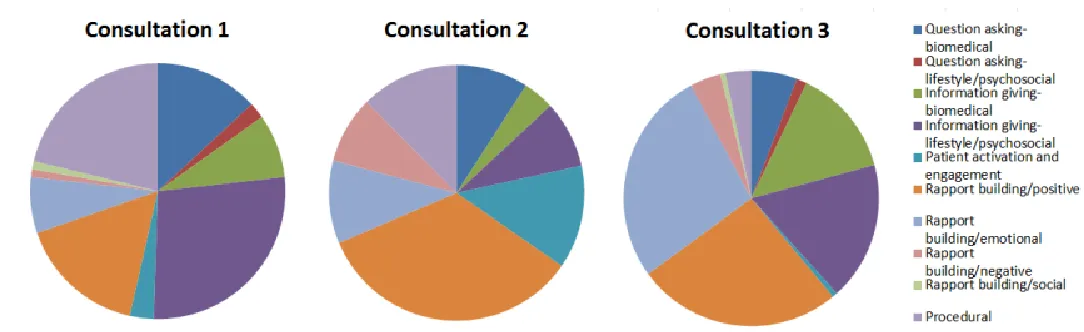
When we examined the simulated patient communication behaviour, between the first and second consultations, the percentage of simulated patient utterances coded as lifestyle and psychosocial, procedural and asking biomedical questions decreased, whilst the percentage of rapport building positive utterances increased. After the student participant completed RAIS coding and reflection training (consultation three) however, the proportion of the simulated patient utterances which were coded as rapport building emotional or giving lifestyle and psychosocial information or biomedical information increased compared to consultation two, whilst the proportion categorised as rapport building positive reduced (Fig. 4).
[insert Fig. 4]
Discussion
9
participant exhibited clinical communication behaviour that rated highly in both its patient-centredness and CAT. Both patient satisfaction and patient patient-centredness have been linked to improved patient outcomes6,15,16, and thus both are an important outcome for clinical communication training.
When the detailed clinical communication behaviour of the participant was examined to determine the potential basis of these changes, patterns were observed which could be explained by the application of the SPIKES framework9 and PAPM10. Prior to education about breaking bad news with the SPIKES protocol9, the CAT score was low as the medical student focused on instinctive consultation skills (atheoretical), resulting in an emphasis on data gathering on the topic of lifestyle and psychosocial along with procedural
communication and patient facilitation. The patient communication during this consultation constituted mainly information provision relating to lifestyle and psychosocial, procedural and asking for biomedical information. This style of communication within a consultation could be referred to as emotion-centred, and was found previously to result in low patient satisfaction ratings7 due to its focus on the emotions the patient experiences combined with little biomedical content.
10
biomedical aspects and disregard of emotional and psychological aspects. This also fits with the practitioner component of the PAPM as the practitioner has gained knowledge, but has not had the opportunity to practice and reflect upon the use of that knowledge within a consultation context10.
Finally, following the experiential learning methods alongside detailed self-analysis and reflection, patient satisfaction with clinical communication was increased and the third consultation also achieved a high patient-centeredness score. This could be a result of the participant becoming a reflective practitioner10. The student participant facilitation
behaviour increased, whilst the proportion of student utterances categorised as biomedical patient counselling utterances were lower than consultation two but not as low as
consultation one. Meanwhile the simulated patient used more rapport building emotional communication and provided more lifestyle / psychosocial and biomedical information increased, whilst exhibiting less rapport building positive communication. This style of communication achieves a balance, with an increased amount of patient engagement, biomedical understanding and emotional rapport building, which is essential to a patient-centred approach to breaking bad news7.
11 Conclusion
This study therefore highlights a model, the Practitioners in Applied Practice’ model
(PAPM)10, which can be used alongside the SPIKES framework9 in achieving improvement in clinical communication behaviour following a breaking bad news clinical communication training intervention. However this study adds to the literature in that the actual clinical communication behaviour changes which occurred during the training intervention were explored in detail and were shown to match recognised approaches to breaking bad news, as described in previous research7. The process outlined within the PAPM could be applied in different clinical communication context, however as this is a case study, further research would be required on a larger scale to examine its generalisability.
Acknowledgments
The authors thank the School of Medicine, University of St Andrews for support for this project.
Ethical approval
Ethical approval for this project was obtained from the School of Medicine, Teaching and Research Ethics Committee, University of St Andrews (MD10812).
Declaration of Conflicting Interests
The authors declare that there is no conflict of interest.
Funding Acknowledgement
12 Notes on Contributors
Rose Dunning, BSc (Hons) St Andrews, is an undergraduate MB ChB student continuing her clinical training at the School of Medicine, University of Manchester, UK.
Dr Anita Laidlaw, BSc (Hons), PhD, is a Principal Teaching Fellow with an interest in research in healthcare communication and medical education research, School of Medicine,
University of St Andrews, UK.
References
1. Maynard DW. On 'Realization' in Everyday Life: The Forecasting of Bad News as a Social Relation. Am Sociol Rev 1996; 61(1): 181-182.
2. Ford S, Fallowfield L, Lewis S. Doctor-patient interactions in oncology. Soc Sci Med 1996; 42(11): 1511-1519.
3. Berman R, Campbell M, Makin W, et al. Occupational stress in palliative medicine, medical oncology and clinical oncology specialist registrars. Clin Med 2007; 7(3): 235-242.
4. Sardell AN, Trierweiler SJ. Disclosing the cancer diagnosis. Procedures that influence patient hopefulness. Cancer 1993; 72(11): 3355-3365.
13
6. Levinson W, Roter DL, Mullooly JP, Dull VT, et al. Physician-patient communication. The relationship with malpractice claims among primary care physicians and surgeons. JAMA
1997; 277(7): 553-559.
7. Schmid Mast M, Kindlimann A, Langewitz W. Recipients' perspective on breaking bad news: how you put it really makes a difference. Patient Educ Couns 2005; 58(3): 244-251.
8. Vail L, Sandhu H, Fisher J, et al. Hospital consultants breaking bad news with simulated patients: an analysis of communication using the Roter Interaction Analysis System. Patient Educ Couns 2011; 83(2): 185-194.
9. Baile WF, Buckman R, Lenzi R, et al. SPIKES-A six-step protocol for delivering bad news: application to the patient with cancer. Oncologist 2000; 5(4): 302-311.
10. Ruona WEA, Gilley JW. Practitioners in Applied Professions: A Model Applied to Human Resource Development. Adv in Dev Hum Res 2009; 11(4): 438-453.
11. Kolb D. Experiential Learning: Experience as the Source of Learning and Development. 1st ed.: Financial Times/ Prentice Hall; 1983.
12. Roter D, Larson S. The Roter interaction analysis system (RIAS): utility and flexibility for analysis of medical interactions. Patient Educ Couns 2002 Apr; 46(4): 243-251.
14
14. Makoul G, Krupat E, Chang CH. Measuring patient views of physician communication skills: development and testing of the Communication Assessment Tool. Patient Educ Couns
2007; 67(3): 333-342.
15. Zachariae R, Pedersen CG, Jensen AB, et al. Association of perceived physician communication style with patient satisfaction, distress, cancer-related self-efficacy, and perceived control over the disease. Br J Cancer 2003; 88(5): 658-665.
15
16
Figure 2: The Communication Assessment Tool (CAT) percentages and RIAS based
patient-centredness scores for all three consultations. 0 20 40 60 80 100 120
Consultation 1 Consultation 2 Consultation 3
0 0.5 1 1.5 2 CA T p er ce n t Pate in t-Ce n tr e d n e ss S co re
17
18