An Iterated Multi-stage Selection Hyper-heuristic
Ahmed Kheiri1a, Ender ¨Ozcana
a
University of Nottingham School of Computer Science
Jubilee Campus, Wollaton Road, Nottingham, NG8 1BB, UK
{psxak1,ender.ozcan}@nottingham.ac.uk
Abstract
There is a growing interest towards the design of reusable general purpose search methods that are applicable to different problems instead of tailored solutions to a single particular problem. Hyper-heuristics have emerged as such high level methods that explore the space formed by a set of heuris-tics (move operators) or heuristic components for solving computationally hard problems. A selection hyper-heuristic mixes and controls a predefined set of low level heuristics with the goal of improving an initially generated solution by choosing and applying an appropriate heuristic to a solution in hand and deciding whether to accept or reject the new solution at each step under an iterative framework. Designing an adaptive control mechanism for the heuristic selection and combining it with a suitable acceptance method is a major challenge, because both components can influence the overall per-formance of a selection hyper-heuristic. In this study, we describe a novel iterated multi-stage hyper-heuristic approach which cycles through two in-teracting hyper-heuristics and operates based on the principle that not all low level heuristics for a problem domain would be useful at any point of the search process. The empirical results on a hyper-heuristic benchmark indi-cate the success of the proposed selection hyper-heuristic across six problem domains beating the state-of-the-art approach.
Keywords: Heuristics, Combinatorial Optimisation, Hyper-heuristic, Meta-heuristic, Hybrid Approach
1Ahmed Kheiri ([email protected]) is currently an Associate Research Fellow at
1. Introduction
Most of the current decision support systems tend to use expert knowledge at their core, and are often custom tailored to a specific application domain. As a result, they cannot be reused for solving a problem from another domain. On the other hand, there has been some significant scientific progress in devel-oping automated general purpose systems that can learn, adapt and improve their behaviour on the fly while solving a given problem. Hyper-heuristicsare such methodologies which perform search over the space formed by a set of low level heuristics (move operators) which operate on solutions (Burke et al., 2013). An aim in hyper-heuristic research is to increase the level of gener-ality of solution methodologies by selecting and/or generating heuristics automatically during the search process (Burke et al., 2010b). One of the key features of a hyper-heuristic is that there is a logical separation between the problem domain and the high level hyper-heuristic methodology that operates at the top level. This study focuses on selection hyper-heuristics which combineheuristic selectionandmove acceptancemethods as their com-ponents under a single point iterative search framework which processes a single complete solution at each step (Burke et al., 2003; ¨Ozcan et al., 2008; Burke et al., 2012). A selection hyper-heuristic chooses a heuristic from a predefined set of low level heuristics and applies it to a candidate solution. The new solution is then considered and a decision is made whether it will be accepted or not. If accepted, the new solution replaces the current solution and the search continues iteratively. There is a growing number of hyper-heuristics (Chakhlevitch and Cowling, 2008; Burke et al., 2013) and they have been successfully applied to different hard computational problems, in-cluding examination timetabling (Pillay and Banzhaf, 2009; Rahman et al., 2014), course timetabling (Burke et al., 2007; Soria-Alcaraz et al., 2014), re-sponse time variability (Garc´ıa-Villoria et al., 2011) and water distribution problems (Kheiri et al., 2015).
The proposed multi-stage hyper-heuristic framework is general, reusable and useful in relieving the difficulty of choosing a hyper-heuristic method for solving a problem, by automating the process of selecting a hyper-heuristic at different point of the search process.
There are already some software tools supporting the rapid development of (meta-)hyper-heuristics, such as HyFlex (Hyper-heuristics Flexible frame-work) (Ochoa et al., 2012a) and Hyperion (Swan et al., 2011). The Java implementation of the HyFlex interface was used in a cross-domain heuristic search challenge, referred to as CHeSC 2011. The results form this competi-tion and six HyFlex problem domain implementacompeti-tions became a benchmark in selection hyper-heuristic studies (see Section 4 for more details). The winning state-of-the-art approach of CHeSC 2011 is an elaborate but compli-cated algorithm which makes use of machine learning techniques (Misir et al., 2011). In this study, a novel iterated multi-stage selection hyper-heuristic based on the proposed framework is designed, implemented and analysed. The empirical results using the CHeSC 2011 benchmark across six problem domains indicate the success of our hyper-heuristic beating the state-of-the-art approach.
The sections are organised as follows. Section 2 covers some selection hyper-heuristics relevant to this study and introduces the concept of multi-stage selection hyper-heuristics summarising some recent studies. Section 3 describes the components of the proposed multi-stage selection hyper-heuristic framework. An overview of HyFlex and CHeSC 2011 is provided in Section 4. Section 5 presents the empirical results. Finally, Section 6 concludes the study.
2. Related Work
Functionis a learning heuristic selection method which gives a score to each low level heuristic based on their utility value. Cowling and Chakhlevitch (2003) suggested the use of a Tabu search based hyper-heuristic that pro-vides a list that disallows heuristics with poor performance.
The idea of applying different hyper-heuristics at different stages has been studied previously. Hyper-heuristics often employ a learning mechanism Burke et al. (2013). Online learning hyper-heuristics receive feedback during the search process potentially influencing their decision in heuristic selection and move acceptance. Offline learning hyper-heuristics generally operate in a train and test fashion in two fixed successive stages. Mostly, latter type of hyper-heuristics are used to generate heuristics Burke et al. (2009). There are studies on offline learning selection hyper-heuristics as well. For instance, Chakhlevitch and Cowling (2005) proposed a two-stage hyper-heuristic using a different hyper-heuristic at each stage. The first stage hyper-heuristic em-ploys a Greedy approach which is used to reduce the number of low level heuristics. In the following stage, a simple random hyper-heuristic accepting non-worsening moves is used. The authors reported that using both greedy and tabu search in combination with the aim of linearly reducing the number of the best performing low level heuristics, is promising.
The studies particularly on iterated multi-stage selection hyper-heuristics which enable the cyclic use of multiple selection hyper-heuristics in a staged manner are limited. Asta and ¨Ozcan (2015) used a data science technique to partition the low level heuristics which perform well together under a hyper-heuristic using a certain move acceptance method. Then each partition is associated with a relevant move acceptance method. Hence learning takes place during this phase. In the following phase, the approach employs an iterated multi-stage search with two hyper-heuristics, each combining the simple random heuristic selection and a different move acceptance method with the associated low level heuristics. There is no learning mechanism used during this phase.
with the highest score at each step. Since Greedy stage is costly, this stage gets invoked dynamically if all heuristics start generating poor performance. An iterated multi-stage hyper-heuristic which combines a Dominance-based heuristic selectionmethod and a Random Descent hyper-heuristic with Na¨ıve Move Acceptance (DRD) is proposed in ( ¨Ozcan and Kheiri, 2012). The dominance-based selection method employs a greedy approach aiming to determine an active subset of low level heuristics taking into account the trade-off between the change in the objective value and the number of steps taken to achieve that result. The second stage applies random descent hyper-heuristic using that active subset of low level hyper-heuristics from the first stage to improve the quality of a solution in hand. If the second stage hyper-heuristic stagnates, then the first stage restarts with a given probability for detecting a new active subset of low level heuristics. This hyper-heuristic is tested using HyFlex producing the best performance when compared to the ‘default’ hyper-heuristics provided with HyFlex.
An iterated multi-stage hyper-heuristic known asRobinhoodhyper-heuristic (RHH) combining three hyper-heuristics is proposed in (Kheiri and ¨Ozcan, 2013). The three hyper-heuristics use the same heuristic selection method but they differ in the move acceptance component. The selection heuristic component employs round-robin strategy-based neighbourhood method and applies the mutational and ruin and re-create heuristics on the candidate so-lution, then crossover heuristics, and then hill climbing heuristics and assigns equal time for each low level heuristic. Three move acceptance criteria (one per each hyper-heuristic) including only improving, improving or equal, and an adaptive acceptance methods are used in this approach. In the adaptive acceptance method, a move that improves the quality of the current solution is always accepted. Deteriorating moves are accepted according to a proba-bility that is adaptively modified at different stages throughout the search. Each hyper-heuristic in RHH is applied for a fixed duration of time and therefore The transition between the three stages is static. This approach outperforms the ‘default’ hyper-heuristics of HyFlex, and took the fourth place with respect to the twenty approaches from CHeSC 2011.
mutational and hill-climbing operators, respectively. The transition between two stages of HySST is deterministic. The following stage starts if the input solution cannot be improved at all in a given stage after a certain duration. This solver is tested on a set of real-world instances and competed at the 3 rounds of the third International Timetabling Competition (ITC 2011)2. In
round 1, HySST generated the best solutions for three instances, and took the second place in rounds 2 and 3 (Kheiri et al., in press).
Asta et al. (2013a) proposed another iterated multi-stage hyper-heuristic combining two hyper-heuristics, namely; Dominance-based hyper-heuristic and Roulette Wheel selection with Adaptive Threshold move acceptance (DRW). The dominance-based hyper-heuristic reduces the set of low level heuristics using a greedy-like approach in a given stage. This learning ap-proach considers the trade-off between number of steps versus achieved solu-tion quality, discovering the most useful low level heuristics in improvement and at the same time generates their selection probabilities. Then the other hyper-heuristic gets invoked using the reduced set of low level heuristics and associated selection probabilities to improve a given solution at a stage. Sim-ilar to HySST, the transition between stages in DRW is deterministic. This multi-stage hyper-heuristic is used to improve pool of solutions as a local search. The approach won the MISTA 2013 challenge3 at which the
pur-pose was to solve a multi-mode resource-constrained multi-project scheduling problem (MRCMPSP).
In this study, our approach extends the previous multi-stage hyper-heuristics and makes use of therelay hybridisation(Misir et al., 2011; Kheiri and Keedwell, 2015) technique which applies a low level heuristic to a solution generated by applying a preceding heuristic. We propose an online learning iterated multi-stage hyper-heuristic which is evaluated on six HyFlex problem domains. Its performance is compared to the other multi-stage hyper-heuristics from the scientific literature and also to the competing hyper-heuristics from CHeSC 2011.
2ITC2011 website: http://www.utwente.nl/ctit/hstt/
3. Methodology
3.1. A Multi-stage Selection Hyper-heuristic Framework
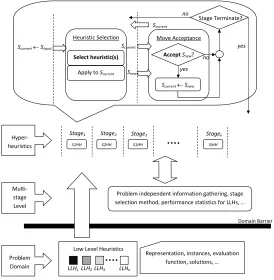
The traditional single-stageselection hyper-heuristic framework employs a single heuristic selection and a single move acceptance method. If a different hyper-heuristic component is used during the search process, this constitutes a different stage enabling the design of multi-stage hyper-heuristics as illus-trated in Figure 1. Allowing the use of multiple hyper-heuristic components interchangeably under a multi-stage framework opens up richer design op-tions, such as the possibility of having several hyper-heuristics controlling different sets of low level heuristics cooperatively. As discussed in Section 2, there is empirical evidence that multi-stage hyper-heuristics has the poten-tial to deliver better performance than the traditional (meta)hyper-heuristics (Kalender et al., 2013, 2012; ¨Ozcan and Kheiri, 2012; Asta and ¨Ozcan, 2015; Kheiri et al., in press; Asta et al., 2013a). A multi-stage framework requires inclusion of an additional upper level which will be referred to asmulti-stage level within the selection hyper-heuristic framework as shown in Figure 1. The multi-stage level allows the transition between available hyper-heuristics and their automated control at different points during the search process. Al-gorithm 1 provides the pseudocode of a multi-stage hyper-heuristic alAl-gorithm based on the framework in Figure 1.
3.2. An Iterated Multi-stage Hyper-heuristic Using Dominance and Relay Hybridisation
This study introduces an iterated multi-stage selection hyper-heuristic utilising two interacting hyper-heuristics cyclically and controlled by the multi-stage level as provided in Algorithms 2, 3 and 4. In one stage, a subset of “useful” low level heuristics, each associated with a score is determined by a hyper-heuristic embedding a greedy heuristic selection method (Algorithm 2, lines 15-28). Only that subset of low level heuristics is then used in the other stage (Algorithm 2, lines 9-11) and at each step, a heuristic is selected using a roulette wheel strategy based on those scores. As a move acceptance component of the multi-stage hyper-heuristic, a threshold move acceptance method is used (Asta et al., 2013a; Kheiri et al., in press) in both stages (Al-gorithm 3, line 13 and Al(Al-gorithm 4, line 10), however the threshold values are treated in a different way in each stage as explained in this section.
Representation, instances, evaluation function, solutions, … Low Level Heuristics
LLH1 LLH2 LLH3 LLHn
Domain Barrier
Problem Domain
Problem independent information gathering, stage selection method, performance statistics for LLHs, …
Multi-stage Level
yes Scurrent
no no
Scurrent← Sinput
Move Acceptance Heuristic Selection
Snew
Scurrent
Stage Terminate?
yes Select heuristic(s)
Apply to Scurrent
AcceptSnew?
Scurrent← Snew
Hyper-heuristics S1HH
Stage1 Stage2 Stage3 Stagek
[image:9.595.168.442.176.456.2]S2HH S1HH SjHH
Figure 1: A multi-stage hyper-heuristic framework.
up each low level heuristic and invoking them successively. The technique of combining two heuristics is known as relay hybridisation which applies the second low level heuristic to the solution generated by the preceding low level heuristic. The motivation behind relay hybridisation is that although a low level heuristic that does not generate any improvement can still be useful when employed in combination with another low level heuristic. There is indeed empirical evidence that this technique is useful when embedded into a selection hyper-heuristic, considering that relay hybridisation is part of the winning selection hyper-heuristic of CHeSC 2011 (Misir et al., 2011). The proposed selection hyper-heuristic method employing relay hybridisation ig-nores the nature of the low level heuristics and does not make explicit use of the heuristic type information. Consequently, given n low level heuristics
({LLH1, ..., LLHn}), we end up with (n+n2) low level heuristics in the overall
({LLH1, ..., LLHn, LLH1+LLH1, LLH1+LLH2, ..., LLHn+LLHn}), where
Algorithm 1: Multi-stage hyper-heuristic framework
1 LetHH ={S1HH, S2HH, ..., SjHH}represent set of all hyper-heuristics; 2 LetSinput represent set of input solutions;
3 LetSoutputrepresent set of output solutions; 4 Letsbest represent the best solution;
5 repeat
6 SiHH←SelectHH(HH); /* ith hyper-heuristic is chosen */
7 Update1(); /* set/update relevant parameter/variable values before entering into a stage */
8 whilenotSatisfied(SiHH–T erminationCriteria)do 9 Soutput, sbest←ApplyHH(SiHH, Sinput);
10 Update2(); /* set/update relevant parameter/variable values
during a stage */
11 end
12 Update3(); /* set/update relevant parameter/variable values after finishing a stage */
13 untilTerminationCriterionSatisfied(); 14 returnsbest;
Iterated Local Search (ILS) is an iterative metaheuristic seeking an improved (optimal) solution through two main steps of perturbation and local search (Louren¸co et al., 2010). ILS explicitly balances diversification/exploration (capability of jumping to other promising regions of the search space) and in-tensification/exploitation (capability of performing a thorough search within a restricted promising region) employing those steps, respectively. The relay hybridisation technique has the potential to combine a mutational and a hill climber as a new low level heuristics and if chosen, such a low level heuristic would yield an ILS-like behaviour in an iteration.
Following the previous work in (Kheiri and ¨Ozcan, 2013), any selected low level heuristic is executed for a certain duration, τ (Algorithm 3, lines 9-21 and Algorithm 4, lines 6-12).
Combining multiple hyper-heuristics always requires a decision on when to switch between selection hyper-heuristics. The proposed method handles this decision adaptively. If there is no improvement in consecutive stages while the first hyper-heuristic (denoted as S1HH) is used then the second hyper-heuristic (denoted as S2HH) may kick in with a pre-defined transi-tion probability (PS2HH), otherwise, with a probability of (1-PS2HH), S1HH
Algorithm 2: MultiStageLevel
1 LetLLHall represent set of all (n+n2) LLHs. Each associated withscorei 2 LetScurrentrepresent the candidate (current) solution;Sinputstage1 the input
solution to S1HH;Sinputstage2 the input solution to S2HH;Sbestoverall the best
solution obtained so far;Sbeststage the best solution obtained in the relevant stage 3 LetPS2HH represent the probability to apply S2HH
4 Letf(x) represent the objective value of a solutionx
5 Scurrent, Sinputstage1, Sinputstage2, Sbestoverall, Sbeststage ←Sinitial
6 scoreall ← {LLH1= 1, . . . , LLHn= 1, LLH1+LLH1= 0, . . . , LLHn+LLHn= 0} 7 LetC={c0, c1, . . . , c(|C|−1)}be the set of threshold values to be used by the move
acceptance;counter←0;timeSbeststageImproved←getTimeElapsed() 8 whilenotSatisfied(terminationCriteria) do
9 whilenotSatisfied(S1HH–T erminationCriteria)do
10 Scurrent, Sbestoverall, Sbeststage←S1HH(LLHall, scoreall, Sinputstage1, Sbestoverall, timeSbeststageImproved, ccounter)
11 end
12 if counter= (|C| −1)then
13 Sbeststage←Scurrent;counter←0
14 end
15 if Random(0,1)< PS2HH then
// Pre-processing steps of S2HH 16 if f(Sbeststage)≥f(Sinputstage2)then 17 Sinputstage2←Sbeststage
18 counter←counter+ 1
19 end
20 else
21 counter←0;Sinputstage2←Sbeststage
22 end
23 whilenotSatisfied(S2HH–T erminationCriteria)do 24 Sbestoverall, Sbeststage, Sbeststep, paretoArchive←
S2HH(LLHall, Sinputstage2,
Sbestoverall, ccounter) 25 Sinputstage2←Sbeststep
26 end
// Post-processing steps of S2HH
27 scoreall←computeScoresBasedOnDominance(paretoArchive)
28 end
29 else
30 scoreall← {1, ...,1,0, ...,0};ǫ←updateEpsilon(ccounter)
31 end
32 Sinputstage1←Sbeststage
33 end
explained in more details in the following subsections.
3.2.1. Stage One Hyper-heuristic (S1HH)
Algorithm 3: S1HH
input : LLHall, scoreall, Sinputstage1, Sbestoverall, timeSbeststageImproved, ccounter
output: Scurrent, Sbestoverall, Sbeststage
1 Letf(x) represent the objective value ofx 2 Scurrent←Sinputstage1
3 hIndex←rouletteWheelSelection(LLHall, scoreall)
4 if (getTimeElapsed()−timeSbeststageImproved)exceeds dthen 5 Scurrent←Sbeststage
6 ǫ←updateEpsilon(ccounter)
7 timeSbeststageImproved←getTimeElapsed()
8 end
9 whilenotExceeded(τ) & notExceeded(timeLimit)do 10 Snew←applyHeuristic(LLHhIndex, Scurrent)
11 if Snew isBetterT han Scurrent OR f(Snew)isBetterT han(1 +ǫ)f(Sbeststage)
then
12 Scurrent←Snew
13 end
14 if Scurrent isBetterT han Sbeststage then
15 Sbeststage←Scurrent
16 timeSbeststageImproved←getTimeElapsed()
17 end
18 if Scurrent isBetterT han Sbestoverall then
19 Sbestoverall←Scurrent
20 end
21 end
22 Sinputstage1 ←Scurrent
23 returnScurrent, Sbestoverall, Sbeststage
In stage one (Algorithm 3), the roulette wheel selection based hyper-heuristic chooses and applies randomly a low level hyper-heuristic based on a score associated with each low level heuristic (Algorithm 3, lines 3 and 10). As-suming that the ith low level heuristic LLH
i has a score of scorei, then the
probability of that heuristic being selected is scorei/
P
∀k(scorek). Initially,
all single heuristics are assigned a score of 1, while the rest of the paired heuristics are assigned a score of 0. The stage one hyper-heuristic always maintains the best solution found during search process, denoted asSbeststage
approach directly accepts improving moves, while non-improving moves are accepted if the objective value of the candidate solution is better than (1 +ǫ) of the objective value of the best solution obtained in the relevant stage. Whenever the best solution during a stage can no longer be improved for a duration of d,ǫ gets updated according to Equation 1.
ǫ= ⌊log(f(Sbeststage))⌋+ci
f(Sbeststage)
(1)
where f(Sbeststage) is the objective value of the best solution obtained during
the stage andci is an integer value in C={c0, ..., ci, ..., c(k−1)}, where c(i−1) <
ci for 0 < i < k and k = |C|. If f(Sbeststage) is less than 1, ǫ takes a small
value ∼0.
The value of ci never changes in this stage but it might get updated in
stage two as explained in the following section. In the first execution of stage one, c0 is used by default.
If the overall given time limit (timeLimit) is exceeded, or there is no improvement in the quality of the best solution obtained during the stage for a duration of s1, then the stage one hyper-heuristic terminates.
3.2.2. Stage Two Hyper-heuristic (S2HH)
The aim of this stage (Algorithm 4) is to reduce the set of low level heuris-tics and adjust their scores according to their “performance” using the idea of the dominance-based heuristic selection (Asta et al., 2013a; ¨Ozcan and Kheiri, 2012). A score of 0 indicates that the corresponding heuristic will not be used in the following stage. The reduced set of low level heuristics along with the associated score are fed into the stage one hyper-heuristic.
Firstly,ǫis set using Equation 1 for once at the start of this stage. Having a sortedcircularlist of valuesC={c0, ..., ci, ..., c(k−1)}enables adaptive control
of the level of diversification and gives flexibility of relaxing the threshold further whenever necessary allowing larger worsening moves. Initially, ci
takes the value of c0. If the best solution obtained after applying stage one
does not improve for a stage and stage two hyper-heuristic is applied, the parameter takes the next value on the list, that is, for example, c1, allowing
a larger worsening move to be accepted, and so on. If stage one hyper-heuristic manages to improve the solution and then stage two hyper-hyper-heuristic is applied, the parameter is reset toc0. By default,Sbeststage is fed as an input
to the next stage. There might be a case when even the (c(k−1)) value is not
Algorithm 4: S2HH
input : LLHall, Sinputstage2, Sbestoverall, ccounter
output: Sbestoverall, Sbeststage, Sbeststep, paretoArchive
1 Letf(x) represent the objective value ofx 2 Sbeststage←Sinputstage2
3 ǫ←updateEpsilon(ccounter) 4 fori= 0;i <(n+n2);i+ +do 5 Scurrent←Sinputstage2
6 whilenotExceeded(τ) & notExceeded(timeLimit)do 7 Snew←applyHeuristic(LLHi, Scurrent)
8 if Snew isBetterT han Scurrent OR
f(Snew)isBetterT han(1 +ǫ)f(Sbeststage)then
9 Scurrent←Snew
10 end
11 Sbeststage, Sbestoverall, Sbeststep, heurbeststep←updateBestValues(Scurrent)
12 end
13 paretoArchive←update(Sbeststep, heurbeststep)
14 end
15 returnSbestoverall, Sbeststage, Sbeststep, paretoArchive
is worse than Sbeststage. If the second stage gets executed at this point of the
search process, then the current solution is fed into the next stage as input to allow further diversification. It is possible for a given problem domain that Equation 1 could return a value of 0, then ci is assigned to one of the
values in C at random. After ci is updated, it does not get changed during
the execution of the remaining steps of this stage.
A greedy hyper-heuristic is applied usingLLHall (Algorithm 4, lines 4-14)
for a fixed number of steps s2. At each step, all the objective values obtained
by applying all the low level heuristics are recorded only if they generate solutions different in quality to the input solution. If all heuristics cannot generate a new solution, then they considered all to have the worst possi-ble objective value. The greedy approach takes the best generated solution obtained at a step and feeds it as an input solution to the next step.
multiple low level heuristics produce the same non-dominated solution for a given step, their scores are all incremented.
Due to the costly run time that the second stage hyper-heuristic intro-duces, takings2×(n+n2) steps, a relatively low value fors2 is preferred.
Ad-ditionally, we have introduced a probability parameter (PS2HH) (Algorithm
2, line 15) in order to limit the use of this stage often. The stage terminates if
s2steps are fully executed or overall given time limit (timeLimit) is exceeded
(Algorithm 2, line 23).
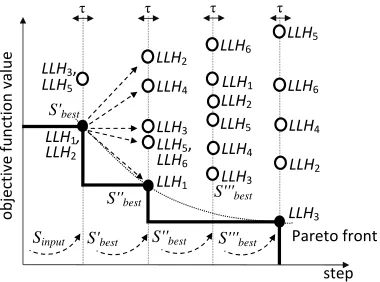
Figure 2 provides an example of how stage two hyper-heuristic executes with n = 2, i.e., combining two heuristics {LLH1, LLH2} via relay
hybridi-sation yielding a set of six low level heuristics,LLHall = {LLH1, LLH2,
LLH3=LLH1+LLH1,LLH4=LLH1+LLH2,LLH5=LLH2+LLH1,LLH6=LLH2+
LLH2} and where s2 = 4. After running all low level heuristics in a greedy
fashion for 4 steps, the number of low level heuristics is automatically re-duced to three using the Pareto front which considers the trade-off between number of steps a heuristics executes and improvement in the quality of the resultant solution. Also, the selection probability of each heuristic for the use in the next stage is determined based on the information derived from the Pareto front. The low level heuristics on the Pareto front are{LLH1, LLH2},
{LLH1} and {LLH3}. Hence, the scores of the fourth, fifth and sixth low
level heuristics are zeros; and scores of LLH1, LLH2 and LLH3 are assigned
to 2, 1 and 1, respectively. Given that the probability of a heuristic in S1HH being selected is scorei/
P
∀k(scorek), therefore, in this example the
proba-bility of selecting LLH1 becomes 50%, while it is 25% forLLH2 and LLH3.
This means that LLH4, LLH5 and LLH6 are not expected to perform well
and hence disabled. LLH1 is expected to perform better than LLH2 and
LLH3 and hence its selection probability is higher than LLH2 and LLH3.
4. Hyper-heuristics Flexible Framework - HyFlex
HyFlex4 is an interface which supports the selection hyper-heuristic
de-velopment. This interface including six problem domains was implemented in Java as version v1.0 for a competition, referred to as Cross-Domain Heuristic Search Challenge, CHeSC 20115. The aim of CHeSC 2011 was to
deter-mine the state-of-the-art hyper-heuristic that generalises well across a set
4http://www.hyflex.org/
LLH4
LLH3
LLH2
LLH3
LLH2
LLH1,
LLH3,
o b je ct iv e f u n ct io n v a lu e step LLH3 S'best
LLH4 LLH1
LLH4
LLH2
LLH5,
LLH1
LLH6
LLH5
LLH6
LLH5
Sinput S''best S'''best S''best S'''best
Pareto front
τ τ τ τ
LLH6
LLH2
LLH5
[image:16.595.211.401.174.315.2]S'best
Figure 2: An example of how the stage two hyper-heuristic works. The commas seperate multiple low level heuristics achieving a solution with the same quality. For example,
LLH1 and LLH2, as well as, LLH3 andLLH5 generate solutions with the same quality
in the first step. Similarly, in the second step, LLH5 and LLH6 generate solutions with
the same quality.
of problem instances from six different problem domains. Throughout this paper, “HyFlex” refers to that version. There is a new version of HyFlex which is version v1.1 supporting the batch mode operation of hyper-heuristics (Asta et al., 2013b), which is not within the scope of this study. HyFlex currently provides implementation of six minimisation problem domains: boolean satisfiability (SAT), one-dimensional bin-packing (BP), personnel scheduling (PS), permutation flow-shop (PFS), travelling salesman problem (TSP) and vehicle routing problem (VRP). The software package includes a set of low level heuristics (LLHs) and a number of instances associated with each domain. The code for SAT, BP, PS and PFS was released first along with some public instances, while the code and instances for TSP and VRP were released after the competition.
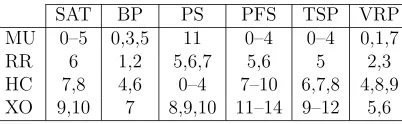
intensity of the mutation and ruin and re-create operators, as well as, the depth of the search in local search operators. The setting of a parameter is allowed to range from 0.0 to 1.0. Table 1 provides an overview of the low level heuristics from each heuristic category for each HyFlex domain. A low level heuristic from a domain in HyFlex is given a unique ID. For example, low level heuristics from LLH0 to LLH5 in the SAT domain are all mutational
[image:17.595.204.405.331.393.2]heuristics.
Table 1: The category of low level heuristics, each indicated by its unique HyFlex ID from each problem domain.
SAT BP PS PFS TSP VRP
MU 0–5 0,3,5 11 0–4 0–4 0,1,7
RR 6 1,2 5,6,7 5,6 5 2,3
HC 7,8 4,6 0–4 7–10 6,7,8 4,8,9
XO 9,10 7 8,9,10 11–14 9–12 5,6
Before CHeSC 2011, the results of eight mock hyper-heuristics from liter-ature over four of the HyFlex problem domains were put on the competition website. The description of the mock hyper-heuristics were not provided on the competition website, but it is reported in (Burke et al., 2010a) that the iterated local search which applies a sequence of heuristics in a predefined order has the best performance.
The ranking method used at CHeSC 2011 is inspired from the Formula 1 points scoring system. The top eight hyper-heuristics are determined after comparison of the median objective values that all hyper-heuristics achieve over 31 trials for each instance. Each algorithm is then awarded a score according to its ranking. The winner receives 10 points, the runner up gets 8 and then 6, 5, 4, 3, 2 and 1, respectively. In the case of a tie for a given instance, the corresponding points are added together and shared equally between each algorithm. In CHeSC 2011, five instances from each domain is used. The winner is the one which scores the maximum points over the thirty instances across all six problem domains.
com-bined with adaptive iteration limited list-based threshold move accepting method (Misir et al., 2011). The second place was taken by a hyper-heuristic based on Variable Neighborhood Search (VNS-TW) which applies shaking heuristics then hill-climber heuristics (Hsiao et al., 2012).
There has been a growing number of studies on selection hyper-heuristics which are evaluated on HyFlex problem domains since CHeSC 2011. We provide a brief overview of some of those single stage generic selection hyper-heuristics in here. An improved choice function hyper-hyper-heuristics is proposed in (Drake et al., 2012) showing that this approach is more successful than the traditional choice function heuristic selection. Drake et al. (2015) extended this previous study introducing crossover operators into the set of low level heuristics and a mechanism to control the input those binary operators, which slightly improved the overall performance of the hyper-heuristic. An adaptive iterated local search approach is proposed and applied on HyFlex problem domains in (Burke et al., 2011; Ochoa et al., 2012b). Jackson et al. (2013) evaluated variants of late acceptance-based selection hyper-heuristics. The authors point out the best configuration for the late acceptance strategy which accepts a solution if its quality is better than the quality of a solution obtained from a certain number of prior steps. None of those previously proposed selection hyper-heuristics perform better than AdapHH.
5. Experimental Results
We have evaluated the performance of the proposed dominance-based and relay hybridisation multi-stage hyper-heuristic, denoted as MSHH, across six problem domains of HyFlex. During our experimentation, crossover oper-ators are ignored as low level heuristics, considering that the multi-stage hyper-heuristics operate under a single point based search framework. The Mann-Whitney-Wilcoxon test (Fagerland and Sandvik, 2009; Kruskal, 1957) is used as a statistical test for pairwise average performance of two given algorithms. We have used the following notation: Given two algorithms; A versus B,>(<) denotes that A (B) is better than B (A) and this performance difference is statistically significant within a confidence interval of 95% and A ≥B (A ≤B) indicates that A (B) performs better on average than B (A) but no statistical significance.
to obtain the equivalent time value (timeLimit) on the used machines that correspond to 600 nominal seconds according to the competition rule.
We have fixed the parameter values based on our previous work ( ¨Ozcan and Kheiri, 2012; Kheiri and ¨Ozcan, 2013; Kheiri et al., in press; Asta et al., 2013a): τ =
15ms, d = 9s, s1 = 20s, s2 = 5, PS2HH = 0.3, C = {0,3,6,9}. The
experi-ments are performed using those settings as “regular” settings on all thirty in-stances from all domains used at CHeSC 2011. We compare the performance of our approach to each individual hyper-heuristic used in a stage, previ-ously proposed multi-stage hyper-heuristics and competing hyper-heuristics of CHeSC 2011 including the state-of-the art hyper-heuristic which won the competition, respectively.
5.1. Parameter Settings
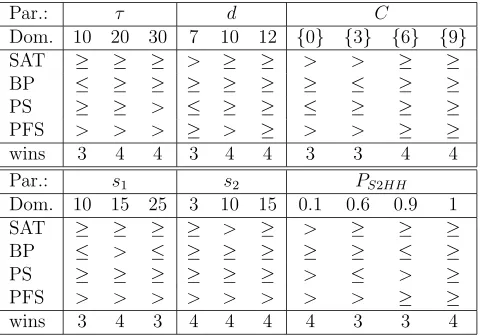
A set of experiments is performed on four arbitrarily chosen (first) in-stances of four public problem domains to observe the performance of the proposed algorithm under different parameter settings:
• τ ={10,15,20,30} (in milliseconds)
• d={7,9,10,12}(in seconds)
• s1 ={10,15,20,25}(in seconds)
• s2 ={3,5,10,15}(in steps/iterations)
• PS2HH ={0.1,0.3,0.6,0.9,1.0}
• C ={{0},{3},{6},{9},{0, 3, 6, 9}}
PS2HH = 0.6 is a slightly better choice thanPS2HH = 0.3 for the PS instance.
MSHH with the “regular” parameter setting always performs better than an-other setting on the PFS and SAT instances. The overall performance of a setting across all domains is important in cross domain search. Hence, MSHH with the “regular” parameter setting turns out to be indeed a good choice and so the same setting is used during the remaining experiments.
[image:20.595.186.426.430.598.2]Recall that each low level heuristic in HyFlex has a parameter (intensity or depth of the search) that can take any value in the range from 0.0 to 1.0. Initially, we assigned the parameter value of 0.0 to each low level heuristic. The relevant parameter setting of a selected low level heuristic gets updated to a random value in case the move does not improve the candidate solution, otherwise the same setting is kept.
Table 2: The average performance comparison of MSHH for different parameter settings over 10 trials. MSHH with “regular” setting of a given parameter is compared to MSHH when that setting is changed to a given setting based on Mann-Whitney-Wilcoxon statis-tical test for each selected instance from a public domain.
Par.: τ d C
Dom. 10 20 30 7 10 12 {0} {3} {6} {9}
SAT ≥ ≥ ≥ > ≥ ≥ > > ≥ ≥
BP ≤ ≥ ≥ ≥ ≥ ≥ ≥ ≤ ≥ ≥
PS ≥ ≥ > ≤ ≥ ≥ ≤ ≥ ≥ ≥
PFS > > > ≥ > ≥ > > ≥ ≥
wins 3 4 4 3 4 4 3 3 4 4
Par.: s1 s2 PS2HH
Dom. 10 15 25 3 10 15 0.1 0.6 0.9 1
SAT ≥ ≥ ≥ ≥ > ≥ > ≥ ≥ ≥
BP ≤ > ≤ ≥ ≥ ≥ ≥ ≥ ≤ ≥
PS ≥ ≥ ≥ ≥ ≥ ≥ > ≤ > ≥
PFS > > > > > > > > ≥ ≥
wins 3 4 3 4 4 4 4 3 3 4
5.2. Performance Comparison to the Constituent Hyper-heuristics
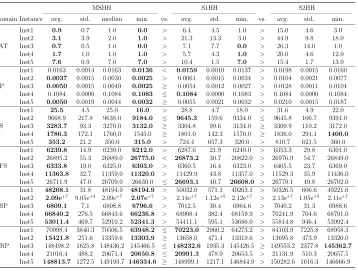
the SAT, BP and TSP domains and exclude one instance from the remain-ing domains. On average, MSHH still performs better than the constituent hyper-heuristics of S1HH and S2HH run on their own on the 22 instances across all six problem domains. The standard deviation associated with the average objective value from MSHH is the lowest in all cases on the SAT and TSP problem domains.
On average, MSHH outperforms S2HH and this performance is statisti-cally significant for all instances, except for Inst2, Inst3 and Inst4 from the PS domain and Inst3 from the VRP domain. On the SAT and TSP domains, MSHH performs still significantly better than S1HH on all instances. On PS, MSHH is better than S1HH in four instances, but this performance variation is significant for two out of the four instances. MSHH performs slightly bet-ter than S1HH on the BP, PFS and VRP domains. However, S1HH performs better than MSHH only on two instances, Inst1 from BP and Inst2 from PFS for which the performance difference is statistically significant.
Our study empirically confirms that combining hyper-heuristics under a multi-stage framework can potentially lead to an improved overall perfor-mance.
5.3. Performance Comparison to the Previous Multi-stage Selection Hyper-heuristics
The performance of the proposed dominance-based and relay hybridisa-tion multi-stage hyper-heuristic is compared to the performance of some pre-viously proposed elaborate and successful multi-stage hyper-heuristics which are described in Section 2: greedy, random gradient and simulated annealing hyper-heuristic (also known as greedy-gradient) (GGHH) (Kalender et al.,
2012), dominance-based and random descent hyper-heuristic (DRD) ( ¨Ozcan and Kheiri, 2012), Robinhood selection hyper-heuristic (RHH) (Kheiri and ¨Ozcan, 2013),
hyper-heuristic search strategies and timetabling approach (HySST) (Kheiri et al., in press), dominance-based and roulette wheel hyper-heuristic (DRW) (Asta et al., 2013a). Table 4 presents the results achieved after the application of all those multi-stage hyper-heuristics to the CHeSC 2011 domains under the same set-ting.
Table 3: The performance comparison of MSHH, S1HH and S2HH based on the average (avg.), associated standard deviation (std.), minimum (min.) of the objective values over 31 trials and the pairwise average performance comparison of MSHH vs S1HH and MSHH vs S2HH based on Mann-Whitney-Wilcoxon for each CHeSC 2011 instance produced by each approach. The hyper-heuristic producing the best value for avr. and min. per each instance are highlighted in bold.
MSHH S1HH S2HH
Domain Instance avg. std. median min. vs. avg. std. min. vs. avg. std. min.
SAT
Inst1 0.9 0.7 1.0 0.0 > 6.4 4.5 1.0 > 15.0 4.6 3.0
Inst2 3.1 3.9 2.0 1.0 > 21.3 13.3 3.0 > 44.9 9.8 18.0
Inst3 0.7 0.5 1.0 0.0 > 7.1 7.7 0.0 > 26.3 14.0 1.0
Inst4 1.7 1.0 1.0 1.0 > 5.7 4.3 1.0 > 20.0 4.6 12.0
Inst5 7.6 0.9 7.0 7.0 > 10.4 1.5 7.0 > 15.4 1.7 13.0
BP
Inst1 0.0163 0.0014 0.0163 0.0136 < 0.0159 0.0010 0.0137 > 0.0198 0.0015 0.0160 Inst2 0.0037 0.0015 0.0030 0.0025 > 0.0061 0.0015 0.0034 > 0.0104 0.0021 0.0077
Inst3 0.0050 0.0015 0.0049 0.0025 ≥ 0.0054 0.0012 0.0027 > 0.0128 0.0011 0.0104
Inst4 0.1084 0.0000 0.1084 0.1083 ≤ 0.1084 0.0000 0.1083 > 0.1084 0.0000 0.1084
Inst5 0.0050 0.0019 0.0044 0.0032 ≥ 0.0055 0.0021 0.0032 > 0.0210 0.0015 0.0187
PS
Inst1 25.5 4.5 25.0 16.0 > 28.8 4.7 18.0 > 31.6 4.9 22.0
Inst2 9668.9 217.8 9638.0 9184.0 ≤ 9645.3 159.6 9334.0 ≤ 9645.8 106.7 9391.0
Inst3 3283.7 93.3 3270.0 3132.0 ≥ 3304.8 99.6 3134.0 ≥ 3309.9 110.2 3172.0
Inst4 1786.3 172.1 1760.0 1545.0 ≥ 1801.0 142.3 1570.0 ≥ 1836.0 291.1 1400.0
Inst5 353.2 21.2 350.0 315.0 > 724.4 657.3 320.0 > 810.7 621.5 360.0
PFS
Inst1 6239.8 14.9 6239.0 6212.0 > 6287.6 21.9 6249.0 > 6353.3 29.8 6301.0
Inst2 26895.2 55.3 26889.0 26775.0 < 26873.2 30.7 26822.0 > 26976.9 54.7 26849.0
Inst3 6333.8 19.0 6325.0 6303.0 > 6360.5 16.4 6323.0 > 6405.5 23.7 6369.0
Inst4 11363.8 32.7 11359.0 11320.0 > 11429.9 43.8 11357.0 > 11529.3 35.9 11436.0
Inst5 26711.9 47.0 26709.0 26630.0 ≤ 26693.1 40.7 26608.0 > 26779.1 49.8 26702.0
TSP
Inst1 48208.1 31.8 48194.9 48194.9 > 50032.0 571.1 49263.1 > 50326.5 606.6 49221.6 Inst2 2.09e+7 9.05e+4 2.09e+7 2.07e+7 > 2.14e+7 1.12e+5 2.12e+7 > 2.13e+7 1.05e+5 2.11e+7
Inst3 6809.1 7.1 6808.8 6796.6 > 7012.5 30.4 6964.6 > 7040.2 31.3 6988.6
Inst4 66840.2 276.5 66843.6 66236.8 > 68908.4 382.4 68159.9 > 70241.9 704.6 68791.0 Inst5 53011.4 469.7 52910.2 52341.3 > 54411.1 595.1 53686.0 > 55814.8 946.4 53992.4
VRP
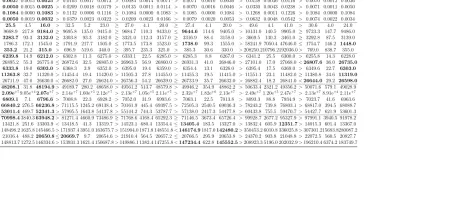
performs better in terms of average and minimum objective values. MSHH achieves the best average results on three instances on the PS and PFS prob-lem domains. MSHH performs the best on average only on the Inst1 VRP instance, while RHH and GGHH perform better on three instances and one VRP instance, respectively. This appears to be an indication that appli-cation of all low level heuristics and performing local search and accepting solutions which is the best at any given time is potentially a better approach on the VRP domain. DRD performs the worst on the SAT problem domain, but delivers a good average performance on the BP problem domain. GGHH and DRW manage to provide the best average results on a single instance of VRP and PFS, respectively. MSHH is better than HySST on all problem instances across all domains and this performance difference is statistically significant.
5.4. Performance Comparison to the CHeSC 2011 Hyper-heuristics
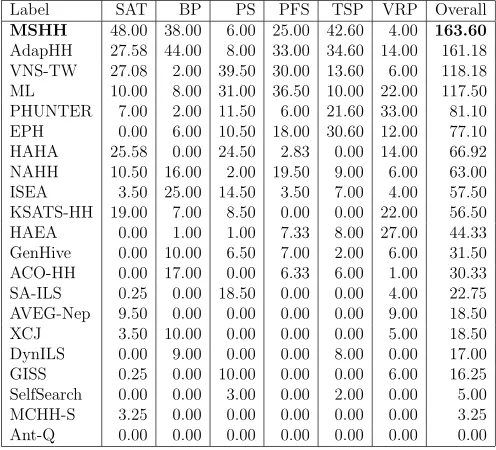
MSHH and the twenty competing hyper-heuristics from CHeSC 2011 are ranked under the same criteria used at the time of the competition. Table 5 presents the scores for each algorithm based on the Formula 1 scoring system with respect to the median objective values obtained during the 31 trials over all instances across the six domains. Although MSHH delivers a relatively poor “median” performance in the PS and VRP problem domains, the overall results reveal that MSHH is the winner with a total score of 163.60.
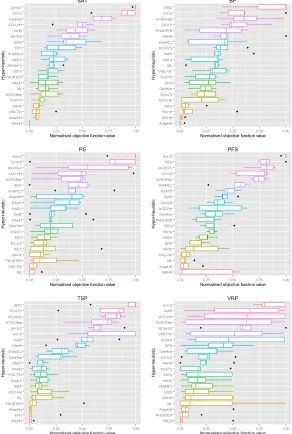
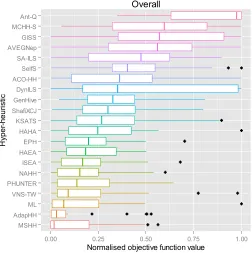
Another performance evaluation method was suggested by Di Gaspero and Urli (2012) to illustrate the relative performance variation of each hyper-heuristic in a given bunch. Considering a set of hyper-heuristics, denoted as P and the resultant solutions associated with their objective values obtained from running a hyper-heuristic, denoted asj ∈P for 31 trials on a given problem instance i, the median objective value, denoted as medj(i) is normalised to
a value, Nmedj(i) in [0,1] using Equation 2:
Nmedj(i) =
medj(i)−minP(i) maxP(i)−minP(i)
, (2)
where minP(i) andmaxP(i) are the minimum and maximum median
Table 4: The performance comparison of MSHH, GGHH, DRD, RHH, HySST and DRW multi-stage hyper-heuristics based on the average (avg.), associated standard deviation (std.), minimum (min.) of the objective values over 31 trials and the pairwise average performance comparison of MSHH vs (GGHH, DRD, RHH, HySST and DRW) based on Mann-Whitney-Wilcoxon for each CHeSC 2011 instance produced by each approach. The hyper-heuristic producing the best value for avr. and min. per each instance are highlighted in bold.
MSHH GGHH DRD RHH HySST DRW
Domain Instance avg. std. min. vs. avg. std. min. vs. avg. std. min. vs. avg. std. min. vs. avg. std. min. vs. avg. std. min.
SAT
Inst1 0.9 0.7 0.0 > 18.4 4.5 9.0 > 27.7 5.0 16.0 > 6.6 1.2 3.0 > 3.2 1.2 1.0 > 7.4 2.7 2.0 Inst2 3.1 3.9 1.0 > 42.0 9.8 17.0 > 58.2 8.3 27.0 > 11.8 1.9 8.0 > 16.0 20.4 2.0 > 15.2 12.2 5.0 Inst3 0.7 0.5 0.0 > 22.0 7.8 10.0 > 40.5 6.1 17.0 > 4.3 1.5 1.0 > 4.0 6.8 1.0 > 9.4 7.9 0.0
Inst4 1.7 1.0 1.0 > 19.5 3.5 10.0 > 29.9 3.7 22.0 > 8.9 2.0 4.0 > 4.2 1.5 1.0 > 6.3 2.0 2.0 Inst5 7.6 0.9 7.0 > 10.4 1.5 7.0 > 18.5 2.7 13.0 > 8.5 0.8 7.0 > 9.7 2.5 7.0 > 10.5 1.5 7.0
BP
Inst1 0.0163 0.0014 0.0136 > 0.0608 0.0038 0.0541 < 0.01330.00180.0109≥ 0.0167 0.0016 0.0136 > 0.0659 0.0066 0.0536 > 0.0228 0.0022 0.0190 Inst2 0.00370.0015 0.0025> 0.0105 0.0017 0.0073 > 0.0084 0.0014 0.0071 > 0.0071 0.0010 0.0036 > 0.0158 0.0036 0.0116 > 0.0070 0.0012 0.0036 Inst3 0.00500.0015 0.0025> 0.0209 0.0018 0.0179 > 0.0135 0.0011 0.0114 > 0.0070 0.0016 0.0046 > 0.0330 0.0043 0.0238 > 0.0071 0.0011 0.0050 Inst4 0.10840.0000 0.1083> 0.1132 0.0006 0.1116 ≥ 0.1084 0.0000 0.1083 > 0.1085 0.0000 0.1084 > 0.1268 0.0011 0.1226 > 0.1084 0.0000 0.1084 Inst5 0.00500.0019 0.0032> 0.0379 0.0023 0.0322 > 0.0209 0.0023 0.0166 > 0.0079 0.0020 0.0053 > 0.0632 0.0048 0.0542 > 0.0074 0.0022 0.0034
PS
Inst1 25.5 4.5 16.0 > 32.5 5.2 23.0 ≥ 27.0 4.1 20.0 ≥ 27.4 4.1 20.0 > 49.6 4.1 41.0 > 30.6 4.0 24.0 Inst2 9668.9 217.8 9184.0≥ 9695.8 135.0 9415.0 ≥ 9684.7 110.3 9433.0 ≤ 9644.6 114.6 9405.0 >10131.0 140.5 9905.0 ≥ 9723.3 147.7 9486.0 Inst3 3283.7 93.3 3132.0≥ 3303.8 93.3 3182.0 ≥ 3321.0 112.3 3157.0 ≥ 3316.9 88.4 3158.0 > 3669.5 130.3 3461.0 ≥ 3292.8 87.5 3139.0 Inst4 1786.3 172.1 1545.0 ≥ 1791.9 217.7 1505.0 ≤ 1773.5 173.8 1523.0 ≤ 1738.0 99.3 1555.0 >58241.9 7050.4 47646.0≤ 1754.7 146.2 1448.0
Inst5 353.2 21.2 315.0 > 696.9 519.6 340.0 ≥ 395.7 235.3 325.0 > 385.3 30.6 330.0 >208250.210796.2192036.0> 769.0 838.7 355.0
PFS
Inst1 6239.8 14.9 6212.0> 6302.8 11.3 6275.0 > 6333.1 22.5 6285.0 > 6285.3 8.8 6267.0 > 6341.2 25.5 6300.0 > 6255.8 14.3 6228.0 Inst2 26895.2 55.3 26775.0≤26872.6 32.5 26805.0> 26963.5 56.9 26860.0> 26931.3 41.0 26846.0 >27101.0 17.0 27068.0<26807.6 36.0 26735.0
Inst3 6333.8 19.0 6303.0> 6368.3 3.9 6352.0 > 6395.0 19.4 6359.0 > 6354.4 13.1 6326.0 > 6395.4 17.5 6369.0 > 6349.6 22.7 6303.0
Inst4 11363.8 32.7 11320.0 >11454.4 19.4 11420.0> 11505.3 27.8 11455.0> 11455.3 19.5 11415.0 >11551.1 23.1 11482.0≥11380.8 34.6 11319.0
Inst5 26711.9 47.0 26630.0<26682.0 27.0 26624.0> 26756.3 54.2 26639.0≥ 26733.9 35.7 26632.0 >26882.4 18.2 26841.0<26644.0 29.2 26598.0
TSP
Inst1 48208.1 31.8 48194.9>49189.7 280.2 48658.0> 49561.2 513.7 48579.8> 49946.2 354.9 48862.2 >50633.4 2321.2 49356.2>50071.6 579.1 49028.9 Inst2 2.09e+79.05e+42.07e+7>2.14e+71.60e+52.12e+7> 2.13e+71.05e+52.11e+7> 2.32e+7 1.82e+6 2.13e+7 >2.49e+71.20e+52.47e+7 >2.13e+78.91e+42.11e+7
Inst3 6809.1 7.1 6796.6> 7008.8 22.3 6928.2 > 7052.0 31.9 6993.6 > 7063.1 22.5 7013.8 > 8093.3 88.8 7934.9 > 7023.7 41.6 6963.6 Inst4 66840.2276.566236.8>71115.5 1245.2 69138.4> 70161.9 445.4 69397.5> 72505.3 2540.5 69036.3 >78243.2 739.8 76803.1>68817.0 394.5 68088.7 Inst5 53011.4469.752341.3>57995.5 1643.8 54137.8> 55144.2 744.3 53787.7> 57138.0 2417.3 54477.8 >60433.8 755.5 59470.7>54427.7 621.9 53601.3
VRP
Inst1 70998.43840.363948.2>81271.4 4660.9 73486.9≥ 71768.6 4168.4 65292.3≥ 71146.5 3673.4 65726.4 >99928.7 2677.2 95327.9>97991.1 3940.5 91978.2 Inst2 13421.8 251.6 13303.9<13418.5 41.3 13319.7> 14523.1 680.4 13354.4≤ 13405.4 183.5 13327.0 >13832.4 605.9 12351.7>14015.3 601.4 13367.0 Inst3 148498.2 1625.8 145466.5>171937.4 3951.0 163675.7>151904.0 1871.8 148551.8<146174.91817.0142480.2>350453.2 6010.8 336025.8>307301.215683.8280087.2
Table 5: Ranking (performance comparison) of MSHH and the 20 hyper-heuristic ap-proaches competed at CHeSC 2011 across six problem domains based on the Formula 1 scoring system.
Label SAT BP PS PFS TSP VRP Overall
MSHH 48.00 38.00 6.00 25.00 42.60 4.00 163.60
AdapHH 27.58 44.00 8.00 33.00 34.60 14.00 161.18
VNS-TW 27.08 2.00 39.50 30.00 13.60 6.00 118.18
ML 10.00 8.00 31.00 36.50 10.00 22.00 117.50
PHUNTER 7.00 2.00 11.50 6.00 21.60 33.00 81.10
EPH 0.00 6.00 10.50 18.00 30.60 12.00 77.10
HAHA 25.58 0.00 24.50 2.83 0.00 14.00 66.92
NAHH 10.50 16.00 2.00 19.50 9.00 6.00 63.00
ISEA 3.50 25.00 14.50 3.50 7.00 4.00 57.50
KSATS-HH 19.00 7.00 8.50 0.00 0.00 22.00 56.50
HAEA 0.00 1.00 1.00 7.33 8.00 27.00 44.33
GenHive 0.00 10.00 6.50 7.00 2.00 6.00 31.50
ACO-HH 0.00 17.00 0.00 6.33 6.00 1.00 30.33
SA-ILS 0.25 0.00 18.50 0.00 0.00 4.00 22.75
AVEG-Nep 9.50 0.00 0.00 0.00 0.00 9.00 18.50
XCJ 3.50 10.00 0.00 0.00 0.00 5.00 18.50
DynILS 0.00 9.00 0.00 0.00 8.00 0.00 17.00
GISS 0.25 0.00 10.00 0.00 0.00 6.00 16.25
SelfSearch 0.00 0.00 3.00 0.00 2.00 0.00 5.00
MCHH-S 3.25 0.00 0.00 0.00 0.00 0.00 3.25
Ant-Q 0.00 0.00 0.00 0.00 0.00 0.00 0.00
the same scale. Figures 3 and 4 provide the box plots of the normalised median objective values for the MSHH and the competitors’ hyper-heuristics for each domain and overall, respectively. It is observed that the MSHH out-performs the other approaches overall and in SAT, PFS, and TSP problem domains, taking the second place in BP problem domain. However, the pro-posed hyper-heuristic delivers a relatively poor performance on the PS and VRP problem domains.
5.5. An Analysis of the Proposed Hyper-heuristic
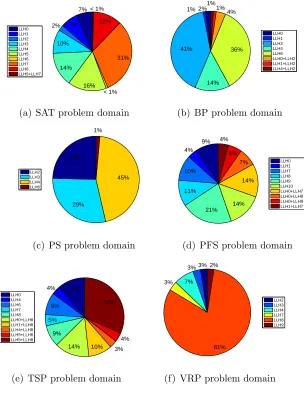
each problem domain is solved. As one would expect, not all the low level heuristics can generate improvement over the best solution found so far dur-ing the search process. For example, in PS, surprisdur-ingly, LLH0 and LLH1
heuristics which are provided as hill climbers do not yield any improvement neither themselves individually nor in combination with another low level heuristic on the tested instance. On the other hand, LLH3 and LLH5 are
not able to make any improvement on the best solutions while BP instance is being solved. This is not surprising, though, as those low level heuristics are mutational heuristics.
With the exception on SAT problem domain, most of the improving moves are due to hill climbers rather than mutational heuristics. The use of the combination of a mutational heuristic followed by a hill climbing heuristic, like the basic steps of iterated local search (Burke et al., 2010a), is automat-ically favoured by our hyper-heuristic in the PFS and TSP domains (Figure 5(d), (e)). Similarly, ruin and re-create followed by a hill climber is another favourite automatically detected pairing in the TSP problem domain. In TSP,LLH1 does not seem to be that useful at the first glance, but considering
the relay hybridisation technique, it seems to serve as a ‘good’ diversification component, improving the performance of the hill climbing heuristic (LLH8)
employed afterwards. In BP, MSHH favours the pairing of a mutational low level heuristic followed by a ruin and re-create heuristic. The relay hybridi-sation of low level heuristics seem to be useful, except for the PS and VRP domains, in which it has been observed that no generated heuristic pairs contributes towards the improvement of the best solutions. The proposed hyper-heuristic looses time by testing all pairs of given low level heuristics which could have been used in the search process. This could be one of the reasons why the proposed hyper-heuristic performs relatively poor on those domains.
solutions are obtained. MSHH seems to require partial restarts while solving problem instances from the SAT and PFS problem domains more than the others which definitely works and this could be one of the reasons for the success of MSHH on those problem domains.
Figure 7 depicts the average number of low level heuristics including indi-vidual and paired low level heuristics versus time, over 10 trials on a selected instance from each problem domain. Interestingly, on average, the number of low level heuristics are reduced to approximately less than 10% of the total in all six problem domains. This reduction occurs due to the employment of S2HH which aims to disable the poor performing heuristics. In PS problem domain, it is observed that all the single low level heuristics are used during the entire search process. The fluctuations in the number of used low level heuristics during the search process are very frequent in all the other problem domains. It has been observed that the number of low level heuristics never decreases to a single low level heuristic at any time in none of the domains. Figure 7 illustrates that different set of low level heuristics are useful at dif-ferent parts of the overall search process. For example, at the start of the search process, the number of the low level heuristics stays the same for BP, then it starts decreasing towards the midst of the given time.
6. Conclusion
A selection hyper-heuristic is a general-purpose search methodology that mixes and controls a given set of heuristics for solving a computationally hard problem. Such high level methods do not require any modification while being applied to a new/unseen problem domain. Moreover, the component-based design of selection hyper-heuristics enables re-usability of those com-ponents as well.
move acceptance method. One of the hyper-heuristics aims to reduce the number of low level heuristics discovering the “potentially” useful ones at a given stage during the search process and adjust the probability of each low level heuristic being selected in the following stages. The hyper-heuristic extends the low level heuristic set first by creating “new” heuristics through relay hybridisation, and then a dominance based learning strategy is em-ployed reducing the number of heuristics. The strategy captures the trade-off between the extent of improvement that a heuristic can generate and the number of steps it takes to achieve that improvement. Moreover, each cho-sen low level heuristic in the “reduced” set is associated with an adaptively decided selection probability to be used in the following stages. The second hyper-heuristic mixes the “reduced” set of low level heuristics with the given probabilities during the search process.
The proposed learning multi-stage selection hyper-heuristic with adaptive move acceptance is tested on a benchmark of problem domains. The results confirm its success when compared to each constituent hyper-heuristics, pre-viously proposed other multi-stage hyper-heuristics as well as the state-of-the-art heuristic which won the CHeSC 2011 competition. Our hyper-heuristic is a relatively simple approach which is easy-to-implement and easy-to-maintain as compared to some previously proposed hyper-heuristics including the previous state-of-the-art hyper-heuristic, yet, it is extremely ef-fective in cross-domain search delivering a superior performance. The success of the proposed multi-stage hyper-heuristic approach based on the proposed “simple” framework across a variety of domains indeed indicates the potential of utilising and mixing the existing or new selection hyper-heuristics.
References
Asta, S., Karapetyan, D., Kheiri, A., ¨Ozcan, E., Parkes, A. J., 2013a. Combining monte-carlo and hyper-heuristic methods for the multi-mode resource-constrained multi-project scheduling problem. In: Kendall, G., Vanden Berghe, G., McCollum, B. (Eds.), Proceedings of the 6th Mul-tidisciplinary International Scheduling Conference: Theory and Applica-tions (MISTA2013). Ghent, Belgium, pp. 836–839.
Asta, S., ¨Ozcan, E., Parkes, A. J., 2013b. Batched mode hyper-heuristics. In: Nicosia, G., Pardalos, P. (Eds.), Learning and Intelligent Optimiza-tion. Vol. 7997 of Lecture Notes in Computer Science. Springer Berlin Heidelberg, pp. 404–409.
Bilgin, B., ¨Ozcan, E., Korkmaz, E. E., 2007. An experimental study on hyper-heuristics and exam scheduling. In: Burke, E. K., Rudov´a, H. (Eds.), Practice and Theory of Automated Timetabling VI. Vol. 3867 of Lecture Notes in Computer Science. Springer Berlin Heidelberg, pp. 394–412.
Burke, E., Kendall, G., Misir, M., ¨Ozcan, E., 2012. Monte Carlo hyper-heuristics for examination timetabling. Annals of Operations Research 196 (1), 73–90.
Burke, E. K., Curtois, T., Hyde, M. R., Kendall, G., Ochoa, G., Petrovic, S., Rodr´ıguez, J. A. V., Gendreau, M., 2010a. Iterated local search vs. hyper-heuristics: towards general-purpose search algorithms. In: IEEE Congress on Evolutionary Computation (CEC ’10). pp. 1–8.
Burke, E. K., Gendreau, M., Hyde, M., Kendall, G., Ochoa, G., ¨Ozcan, E., Qu, R., 2013. Hyper-heuristics: a survey of the state of the art. Journal of the Operational Research Society 64 (12), 1695–1724.
Burke, E. K., Gendreau, M., Ochoa, G., Walker, J. D., 2011. Adaptive iter-ated local search for cross-domain optimisation. In: Proceedings of the 13th Annual Conference on Genetic and Evolutionary Computation (GECCO ’11). ACM, New York, NY, USA, pp. 1987–1994.
Burke, E. K., Hart, E., Kendall, G., Newall, J., Ross, P., Schulenburg, S., 2003. Hyper-heuristics: an emerging direction in modern search technology. In: Glover, F., Kochenberger, G. (Eds.), Handbook of Metaheuristics. Kluwer, pp. 457–474.
Burke, E. K., Hyde, M., Kendall, G., Ochoa, G., ¨Ozcan, E., Woodward, J. R., 2010b. A classification of hyper-heuristic approaches. In: Gendreau, M., Potvin, J.-Y. (Eds.), Handbook of Metaheuristics. Vol. 146 of International Series in Operations Research and Management Science. Springer US, pp. 449–468.
programming. In: Kacprzyk, J., Jain, L. C., Mumford, C. L., Jain, L. C. (Eds.), Computational Intelligence. Vol. 1 of Intelligent Systems Reference Library. Springer Berlin Heidelberg, pp. 177–201.
Burke, E. K., McCollum, B., Meisels, A., Petrovic, S., Qu, R., 2007. A graph-based hyper-heuristic for educational timetabling problems. Euro-pean Journal of Operational Research 176 (1), 177–192.
Chakhlevitch, K., Cowling, P., 2005. Choosing the fittest subset of low level heuristics in a hyperheuristic framework. In: Raidl, G., Gottlieb, J. (Eds.), Evolutionary Computation in Combinatorial Optimization. Vol. 3448 of Lecture Notes in Computer Science. Springer Berlin Heidelberg, pp. 23– 33.
Chakhlevitch, K., Cowling, P., 2008. Hyperheuristics: recent developments. In: Cotta, C., Sevaux, M., S¨orensen, K. (Eds.), Adaptive and Multilevel Metaheuristics. Vol. 136 of Studies in Computational Intelligence. Springer Berlin Heidelberg, pp. 3–29.
Cowling, P., Chakhlevitch, K., 2003. Hyperheuristics for managing a large collection of low level heuristics to schedule personnel. In: IEEE Congress on Evolutionary Computation (CEC ’03). pp. 1214–1221.
Cowling, P., Kendall, G., Soubeiga, E., 2001. A hyperheuristic approach to scheduling a sales summit. In: Burke, E., Erben, W. (Eds.), Practice and Theory of Automated Timetabling III. Vol. 2079 of Lecture Notes in Computer Science. Springer Berlin Heidelberg, pp. 176–190.
Di Gaspero, L., Urli, T., 2012. Evaluation of a family of reinforcement learn-ing cross-domain optimization heuristics. In: Hamadi, Y., Schoenauer, M. (Eds.), Learning and Intelligent Optimization. Vol. 7219 of Lecture Notes in Computer Science. Springer Berlin Heidelberg, pp. 384–389.
Drake, J. H., ¨Ozcan, E., Burke, E. K., May 2015. A modified choice function hyper-heuristic controlling unary and binary operators. In: Evolutionary Computation, 2015. CEC ’15. IEEE Congress on. p. to appear.
Fagerland, M. W., Sandvik, L., 2009. The Wilcoxon–Mann–Whitney test under scrutiny. Statistics in Medicine 28 (10), 1487–1497.
Garc´ıa-Villoria, A., Salhi, S., Corominas, A., Pastor, R., 2011. Hyper-heuristic approaches for the response time variability problem. European Journal of Operational Research 211 (1), 160–169.
Hsiao, P.-C., Chiang, T.-C., Fu, L.-C., 2012. A VNS-based hyper-heuristic with adaptive computational budget of local search. In: IEEE Congress on Evolutionary Computation (CEC ’12). pp. 1–8.
Jackson, W. G., ¨Ozcan, E., Drake, J. H., 2013. Late acceptance-based selec-tion hyper-heuristics for cross-domain heuristic search. In: 13th UK Work-shop on Computational Intelligence (UKCI2013). IEEE, pp. 228–235.
Kalender, M., Kheiri, A., ¨Ozcan, E., Burke, E. K., 2012. A greedy gradient-simulated annealing hyper-heuristic for a curriculum-based course timetabling problem. In: 12th UK Workshop on Computational Intelli-gence (UKCI2012). IEEE, pp. 1–8.
Kalender, M., Kheiri, A., ¨Ozcan, E., Burke, E. K., 2013. A greedy gradient-simulated annealing selection hyper-heuristic. Soft Computing 17 (12), 2279–2292.
Kheiri, A., Keedwell, E., 2015. A sequence-based selection hyper-heuristic utilising a hidden Markov model. In: Proceedings of the 2015 on Genetic and Evolutionary Computation Conference. GECCO ’15. ACM, New York, NY, USA, pp. 417–424.
Kheiri, A., Keedwell, E., Gibson, M. J., Savic, D., 2015. Sequence analysis-based hyper-heuristics for water distribution network optimisation. Pro-cedia Engineering 119, 1269–1277, computing and Control for the Water Industry (CCWI2015) Sharing the best practice in water management.
Computation in Combinatorial Optimization. Vol. 7832 of Lecture Notes in Computer Science. Springer Berlin Heidelberg, pp. 1–12.
Kheiri, A., ¨Ozcan, E., Parkes, A. J., in press. A stochastic local search al-gorithm with adaptive acceptance for high-school timetabling. Annals of Operations Research.
Kruskal, W. H., 1957. Historical notes on the Wilcoxon unpaired two-sample test. Journal of the American Statistical Association 52 (279), 356–360.
Lehre, P. K., ¨Ozcan, E., 2013. A runtime analysis of simple hyper-heuristics: to mix or not to mix operators. In: Proceedings of the Twelfth Workshop on Foundations of Genetic Algorithms (FOGA XII ’13). ACM, New York, NY, USA, pp. 97–104.
Louren¸co, H. R., Martin, O. C., St¨utzle, T., 2010. Iterated local search: framework and applications. In: Gendreau, M., Potvin, J.-Y. (Eds.), Hand-book of Metaheuristics. Vol. 146 of International Series in Operations Re-search and Management Science. Springer US, pp. 363–397.
Misir, M., Verbeeck, K., De Causmaecker, P., Vanden Berghe, G., 2011. A new hyper-heuristic implementation in HyFlex: a study on generality. In: Fowler, J., Kendall, G., McCollum, B. (Eds.), Proceedings of the 5th Multi-disciplinary International Scheduling Conference: Theory and Application (MISTA2011). pp. 374–393.
Ochoa, G., Hyde, M., Curtois, T., Vazquez-Rodriguez, J. A., Walker, J., Gen-dreau, M., Kendall, G., McCollum, B., Parkes, A. J., Petrovic, S., Burke, E. K., 2012a. HyFlex: a benchmark framework for cross-domain heuristic search. In: Hao, J.-K., Middendorf, M. (Eds.), Evolutionary Computation in Combinatorial Optimization. Vol. 7245 of Lecture Notes in Computer Science. Springer Berlin Heidelberg, pp. 136–147.
¨
Ozcan, E., Bilgin, B., Korkmaz, E. E., 2006. Hill climbers and mutational heuristics in hyperheuristics. In: Runarsson, T. P., Beyer, H.-G., Burke, E., Merelo-Guerv´os, J. J., Whitley, L. D., Yao, X. (Eds.), Parallel Problem Solving from Nature (PPSN IX). Vol. 4193 of Lecture Notes in Computer Science. Springer Berlin Heidelberg, pp. 202–211.
¨
Ozcan, E., Bilgin, B., Korkmaz, E. E., 2008. A comprehensive analysis of hyper-heuristics. Intelligent Data Analysis 12 (1), 3–23.
¨
Ozcan, E., Burke, E. K., 2009. Multilevel search for choosing hyper-heuristics. In: Proceedings of the 4th Multidisciplinary International Scheduling Con-ference: Theory and Application (MISTA2009). pp. 788–789.
¨
Ozcan, E., Kheiri, A., 2012. A hyper-heuristic based on random gradient, greedy and dominance. In: Gelenbe, E., Lent, R., Sakellari, G. (Eds.), Computer and Information Sciences II. Springer London, pp. 557–563.
¨
Ozcan, E., Misir, M., Kheiri, A., 2013. Group decision making hyper-heuristics for function optimisation. In: 13th UK Workshop on Compu-tational Intelligence (UKCI2013). IEEE, pp. 327–333.
Pillay, N., Banzhaf, W., 2009. A study of heuristic combinations for hyper-heuristic systems for the uncapacitated examination timetabling problem. European Journal of Operational Research 197 (2), 482–491.
Rahman, S. A., Bargiela, A., Burke, E. K., ¨Ozcan, E., McCollum, B., Mc-Mullan, P., 2014. Adaptive linear combination of heuristic orderings in constructing examination timetables. European Journal of Operational Re-search 232 (2), 287–297.
Soria-Alcaraz, J. A., Ochoa, G., Swan, J., Carpio, M., Puga, H., Burke, E. K., 2014. Effective learning hyper-heuristics for the course timetabling problem. European Journal of Operational Research 238 (1), 77–86.
MSHH AdapHH VNS-TW HAHA KSATS AVEGNep ML NAHH PHUNTER ISEA MCHH-S HAEA ShafiXCJ EPH GISS SA-ILS SelfS ACO-HH GenHive Ant-Q DynILS
0.00 0.25 0.50 0.75 1.00 Normalised objective function value
H y p e r-h e u ri s ti c SAT AdapHH MSHH NAHH ISEA ACO-HH DynILS GenHive EPH KSATS VNS-TW ML HAEA SelfS MCHH-S ShafiXCJ HAHA PHUNTER SA-ILS AVEGNep Ant-Q GISS
0.00 0.25 0.50 0.75 1.00 Normalised objective function value
H y p e r-h e u ri s ti c BP ML VNS-TW PHUNTER HAHA ISEA SA-ILS EPH KSATS GenHive NAHH SelfS HAEA MSHH AdapHH ShafiXCJ GISS AVEGNep ACO-HH MCHH-S DynILS Ant-Q
0.00 0.25 0.50 0.75 1.00 Normalised objective function value
H y p e r-h e u ri s ti c PS MSHH AdapHH ML VNS-TW NAHH EPH HAEA HAHA ISEA PHUNTER GenHive ACO-HH DynILS SelfS KSATS ShafiXCJ AVEGNep SA-ILS MCHH-S GISS Ant-Q
0.00 0.25 0.50 0.75 1.00 Normalised objective function value
H y p e r-h e u ri s ti c PFS MSHH EPH AdapHH PHUNTER ML ACO-HH ISEA DynILS VNS-TW NAHH HAEA GenHive ShafiXCJ HAHA SelfS Ant-Q SA-ILS AVEGNep MCHH-S KSATS GISS
0.00 0.25 0.50 0.75 1.00 Normalised objective function value
H y p e r-h e u ri s ti c TSP HAEA PHUNTER AdapHH ML MSHH GISS ShafiXCJ HAHA ISEA KSATS NAHH SA-ILS GenHive EPH DynILS VNS-TW MCHH-S AVEGNep ACO-HH SelfS Ant-Q
0.00 0.25 0.50 0.75 1.00 Normalised objective function value
[image:34.595.159.451.208.642.2]H y p e r-h e u ri s ti c VRP
MSHH AdapHH ML VNS-TW PHUNTER NAHH ISEA HAEA EPH HAHA KSATS ShafiXCJ GenHive DynILS ACO-HH SelfS SA-ILS AVEGNep GISS MCHH-S Ant-Q
0.00 0.25 0.50 0.75 1.00
Normalised objective function value
H
y
p
e
r-h
e
u
ri
s
ti
c
[image:35.595.180.432.299.552.2]Overall
7% 7% 2% 10% 14% 16% < 1% 31% 12% < 1% LLH0 LLH1 LLH2 LLH3 LLH4 LLH5 LLH6 LLH7 LLH8 LLH5+LLH7
(a) SAT problem domain
2% 1% 41% 14% 36% 4% 1% 1% LLH0 LLH1 LLH2 LLH4 LLH6 LLH0+LLH2 LLH1+LLH2 LLH4+LLH2
(b) BP problem domain
25% 29% 45% 1% LLH2 LLH3 LLH4 LLH6
(c) PS problem domain
9% 4% 10% 11% 21% 14% 14% 7% 6% 4% LLH0 LLH1 LLH7 LLH8 LLH9 LLH10 LLH0+LLH7 LLH0+LLH8 LLH0+LLH9 LLH1+LLH7
(d) PFS problem domain
11% 4%
9% 5%
9%
14% 10% 3% 4% 32% LLH0 LLH4 LLH6 LLH7 LLH8 LLH0+LLH8 LLH1+LLH8 LLH4+LLH8 LLH5+LLH6 LLH5+LLH8
(e) TSP problem domain
3% 3% 7% 3% 81% 2% LLH2 LLH3 LLH4 LLH7 LLH8 LLH9
[image:36.595.163.467.233.627.2](f) VRP problem domain
0 100 200 300 400 500 600 10
15
20 obj vs. time
threshold vs. time
(a) SAT problem domain
0 100 200 300 400 500 600
0.005 0.01 0.015 0.02
obj vs. time threshold vs. time
(b) BP problem domain
0 100 200 300 400 500 600
0 1000 2000 3000
obj vs. time threshold vs. time
(c) PS problem domain
200 250 300 350 400 450 500 550 600
6255 6260 6265 6270 6275
obj vs. time threshold vs. time
(d) PFS problem domain
0 100 200 300 400 500 600
4.8 4.9 5
5.1x 10
4
obj vs. time threshold vs. time
(e) TSP problem domain
0 100 200 300 400 500 600
2 2.2
2.4x 10
4
obj vs. time threshold vs. time
[image:37.595.181.429.194.658.2](f) VRP problem domain
0 100 200 300 400 500 600 6
8 10 12 14
#LLH vs. time
(a) SAT problem domain
0 100 200 300 400 500 600
4 5 6 7 8
#LLH vs. time
(b) BP problem domain
0 100 200 300 400 500 600
8 9 10
#LLH vs. time
(c) PS problem domain
0 100 200 300 400 500 600
0 2 4 6 8 10 12 14
#LLH vs. time
(d) PFS problem domain
0 100 200 300 400 500 600
2 4 6 8 10 12
#LLH vs. time
(e) TSP problem domain
0 100 200 300 400 500 600
4 6 8 10
#LLH vs. time
[image:38.595.181.430.178.654.2](f) VRP problem domain