Supervised exercise training as an adjunct therapy for
venous leg ulcers: a randomised controlled feasibility trial
KLONIZAKIS, Markos <http://orcid.org/0000-0002-8864-4403>, TEW, Garry, GUMBER, Anil <http://orcid.org/0000-0002-8621-6966>, CRANK, Helen <http://orcid.org/0000-0001-6086-049X>, KING, B, MIDDLETON, G and MICHAELS, J.A.Available from Sheffield Hallam University Research Archive (SHURA) at: http://shura.shu.ac.uk/17171/
This document is the author deposited version. You are advised to consult the publisher's version if you wish to cite from it.
Published version
KLONIZAKIS, Markos, TEW, Garry, GUMBER, Anil, CRANK, Helen, KING, B, MIDDLETON, G and MICHAELS, J.A. (2018). Supervised exercise training as an adjunct therapy for venous leg ulcers: a randomised controlled feasibility trial. British Journal Of Dermatology, 178 (5), 1072-1082.
Copyright and re-use policy
See http://shura.shu.ac.uk/information.html
Title: Supervised exercise training as an adjunct therapy for venous leg ulcers: a randomised controlled feasibility trial
Running Title: Exercise in adults with venous ulcers
M. Klonizakis1, G. A. Tew2, A. Gumber3, H. Crank1, B. King4, G. Middleton5, J. A. Michaels6
1
Centre for Sport and Exercise Science, Sheffield Hallam University, Sheffield, United Kingdom, S10 2BP
2
Department of Sport, Exercise and Rehabilitation, Northumbria University, Newcastle-upon-Tyne, United Kingdom, NE1 8ST
3
Centre for Health and Social Care Research, Sheffield Hallam University, Sheffield, United Kingdom, S10 2BP
4
Manor Clinic, Sheffield Teaching Hospitals NHS Foundation Trust, Sheffield, United Kingdom, S12 2ST
5
School of Sport and Exercise Science, University of Lincoln, Brayford Pool, Lincoln, Lincolnshire LN6 7TS
6
School of Health and Related Research, University of Sheffield, Sheffield, United Kingdom, S1 4DA.
*Correspondence to: Dr Markos Klonizakis, Centre for Sport and Exercise Science, Sheffield Hallam University, Sheffield, S10 2BP. Email: [email protected] Tel: +44(0)1142252465
Keywords: Venous ulcers, Venous insufficiency, Physical therapy, Exercise therapy, Rehabilitation, Randomized controlled trial, Feasibility studies
Word Count: 2835 Tables: 8
Figures: 1
Funding Source: This paper presents independent research funded by the NIHR under its Research for Patient Benefit (RfPB) Programme (Grant Reference Number PB-PG-0213-30029).
What’s already known about this topic?
Almost 70% of all leg ulcers have a venous component. Furthermore, up to 30% of venous leg ulcers (VLU’s) don't respond to compression alone, remain open after a year's treatment, needing an average of 51 treatment visits to heal. Therefore, adjunct therapies to compression are needed, which would improve healing outcomes. Exercise can form part of the therapeutic pathway, however, research evidence to determine whether exercise training has an effect on ulcer healing and QoL is limited, and further work is needed.
What does this study add?
The findings support the feasibility and acceptability of supervised exercise training as an adjunct therapy for adults with VLU’s. Our preliminary data also support the potential effectiveness of exercise training in improving ulcer healing. An
Abstract
Background: Almost 70% of all leg ulcers have a venous component.Venous leg ulcers
(VLU’s) are typically painful and heal slowly, resulting in an impaired quality of life (QoL), social isolation and reduced work productivity. Compression therapy offers high healing rates, however, improvements aren’t usually sustained. Exercise is a low-cost, low-risk, and effective strategy for improving physical and mental health. However, little is currently known about the feasibility and efficacy of supervised exercise training used in combination with compression therapy in this patient group.
Objectives: To assess the feasibility of a 12-week supervised exercise programme combining aerobic, resistance and flexibility exercises as an adjunct therapy to compression in patients with VLU’s.
Methods: This was a two-centre, two-arm, parallel-group, randomised feasibility trial. Thirty-nine patients with venous ulcers were recruited and randomised 1:1 either to exercise (3 sessions per week) and compression therapy or compression only.
Progress/success criteria included exercise attendance rate, loss to follow-up and patients’ preference. Baseline assessments were repeated at 12 weeks, 6 months and 1 year
following baseline, with healing rate and time, ulcer recurrence and infection incidents also being documented. Intervention and healthcare utilisation costs were calculated.
Qualitative data was collected to assess participants' experiences.
Results: Overall, 72% of the exercise group participants attended all scheduled exercise sessions. No serious adverse events, and only two exercise-related adverse events (e.g., increased ulcer discharge) were reported. Loss to follow-up was 5%. At 12-months median ulcer healing time was lower in the exercise group (13 vs 34.7 weeks). Total NHS costs were calculated as £813.27 for the exercise and £2,298.57 for the control group.
Introduction
Almost 70% of all leg ulcers have a venous component.1 Occurrence of venous leg ulcers (VLU’s) increases with age, with the annual UK prevalence in those over 65 years being estimated at about 3%.2 VLU’s arise from venous valve incompetence and calf muscle pump insufficiency, which leads to venous stasis and hypertension. This results in microcirculatory changes and localised tissue ischaemia.3,4 The natural history of VLU’s is of a continuous cycle of healing and breakdown over decades5: VLU’s are typically painful and heal slowly, resulting in an impaired quality of life (QoL), social isolation and reduced work productivity.6
Treatment of this major health problem results in a considerable cost to the National Health Service (NHS): each ulcer costs up to £1,981 per year7 and estimated total healthcare costs total between £198-£400 million per year8,9, with 65% of those occurring in the
community.10
Lower-limb compression therapy is an established first-line therapy for VLU’s11, with approximately 50% of VLUs closing within 24 weeks.10 Nevertheless, recurrence rates remain high (up to 56% within 4 years12). Furthermore, up to 30% of VLU’s don't respond to compression alone11, remain open after a year's treatment 13, needing an average of 51 treatment visits to heal.10 Therefore, it is important to develop adjunct therapies to compression, which would improve healing outcomes.
Lifestyle factors, including nutrition, exercise and smoking, are mentioned in guidelines on the management of VLU’s14, but receive relatively little emphasis. Exercise training might enhance ulcer healing and other aspects of health and is routinely prescribed for other cardiovascular disease (e.g., peripheral arterial disease15 and coronary artery disease16). In patients with VLU's, supervised calf muscle exercise has been shown to increase calf muscle pump function and improve lower-limb haemodynamics17,18, as well as mobility and QoL.
19-21 A recent systematic review suggested further research to determine whether exercise
training has an effect on ulcer healing and QoL.22
Our team recently completed “FISCU”, (Feasibility of Implementing Supervised exercise training alongside Compression therapy in people with venous Ulceration - an NIHR-funded study; PB-PG-0213-30029)5 to assess the feasibility of a 12-week supervised exercise programme combining aerobic, resistance and flexibility exercises as an adjunct therapy to compression in patients with VLU’s. We report on rates of screening, eligibility, recruitment, retention, outcome completion, exercise adherence, and adverse events. We also report on reasons for exclusion and non-consent, sample characteristics, the distribution and
completeness of potential primary outcomes as well as providing information on preliminary data on effectiveness and health care resource use.
Methods
A full description of methods is available in our previously published protocol paper.5 The study was a two-arm, parallel-group, randomised controlled feasibility trial conducted in two U.K. sites (Lincoln and Sheffield). Ethics approval was granted by the NHS National Research Ethics Service, Yorkshire and the Humber (Sheffield) Committee (14/YH/0091), and all participants provided written informed consent prior to enrolment. The trial was
Participants
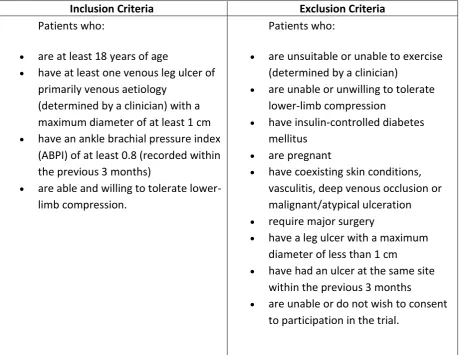
Participants were recruited from community nursing and tissue viability teams or services, community and outpatient leg ulcer clinics, and newspaper advertisement. Inclusion and exclusion criteria are given in Table 1.
Randomisation, allocation concealment and blinding
Following baseline assessments, participants were randomly assigned 1:1 to an intervention group or a control group. Participants were stratified by ulcer size (maximum ulcer diameter 1 – 3 cm or >3 cm in any direction). Outcome assessors were blinded to group allocation.
Interventions
All participants received standard compression therapy directed by experienced tissue-viability nurses, following standard local practice. Patients were reviewed in clinics as considered clinically necessary, with no interference by the study team.
Participants randomised in the exercise group were invited to attend three sessions of supervised exercise each week for 12 weeks (total of 36 sessions) at one of the two study exercise training facilities (Sheffield Hallam University and University of Lincoln). For details on the exercise components see Online Supplement 1.
Study schedule and assessments
In Visit 1, after written informed consent has been obtained and eligibility confirmed (which included a medical examination), the following baseline measurements were recorded at one of the two research centres (Sheffield Hallam University, University of Lincoln): -Demographic data, including age, sex, and socioeconomic status.
-Clinical history, current medications, stature, body mass, ankle and calf circumference. -Ulcer size.
-ABPI: A Doppler-determined measurement of ABPI was performed according to the procedures of Aboyans et al.23, unless a reading <3 months old could be obtained from clinical records, following patient’s consent.
-Baseline exercise history.
-Health-related QoL questionnaires: EQ-5D-5L24,25 and VEINES-QOL.26
-Lower-limb cutaneous microvascular function (methods27, 28 and results reported elsewhere).
-Physical fitness, using 3 items from the Senior Fitness Test (6-minute walking test, chair sit and reach, chair sit and stand29) and ankle range of motion assessed using a bi-plane ankle goniometer.
All participants were given a resource use diary to complete at home for the duration of the study (to conduct Health Economics’ analysis).
Participants were then randomised to one of the two groups, as described above.
At 12 weeks and 12 months, participants had the following measures and tests repeated: physical fitness, microvascular function, ulcer-related clinical data (size, status and
recurrence) and medications, body mass and health-related QoL questionnaires. A copy of the resource use diary was also taken. A postal assessment involving the completion of health-related QoL questionnaires was also undertaken at 6 months.
Feasibility and acceptability outcomes
discontinuing participants and comparing attrition rates between the two study groups. Suitability of measurement procedures was evaluated by completion rates and reasons for missing data. Attrition rate was established as discontinuation of intervention and loss to follow-up measurement for all conditions. The acceptability of the exercise programmes was assessed by using session attendance and compliance data and participant feedback via one-to-one semi-structured interviews conducted with a sub-group of participants after the 3-month follow-up visit (see 5; detailed analysis will be presented elsewhere). The safety of exercise training was also assessed by exploring reasons for dropout from the exercise programme and the number and type of adverse events that occurred in each group.
Sample size
Sample size calculation (see Online Supplement 1) was based on willingness for
randomisation and aimed to recruit 80 participants within an 18-month recruitment period.
Data analysis
All analyses were conducted on intention to treat basis (ITT), conducted in SPSS version 24 (IBM, USA). Missing data were reported by trial arm with description of underlying reasons.
Baseline
Summary tables report all baseline variables, clinical, fitness and patient-reported outcome variables. Continuous variables were summarised with descriptive statistics. Frequency counts and percentages were provided for categorical data.
Feasibility and acceptability
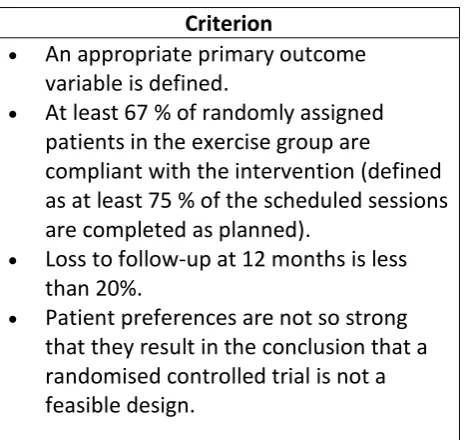
For success criteria see Table 2. Outcomes used to assess the feasibility and acceptability of key trial parameters were rates of eligibility, recruitment, retention, outcome completion, exercise adherence, and adverse events.5 Group preference, reasons for exclusion and non-consent, sample characteristics and the distribution of potential primary outcomes are presented.
Clinical, fitness and patient-reported outcomes
Descriptive statistics are presented for clinical, fitness and patient-reported outcomes at each time point.
Economic evaluation
A prospective economic evaluation was rehearsed to develop and refine the methods for a subsequent definitive trial (see Online Supplement 2).
Results
Figure 1 shows the flow of participants through the trial. Recruitment took place between July 2014 and May 2016, with all follow-up data collection completed by May 2017. The trial was extended for 3 months to allow extra recruitment time.
Screening, eligibility and recruitment
was chosen as the primary outcome for the definitive trial). Of 514 patients screened for participation, 109 met eligibility criteria and 39 (24 male, 15 female) were recruited, giving eligibility and recruitment rates of 21% and 36%, respectively. Sites 1 and 2 recruited 38 and 1 participants, respectively. Reasons for non-consent and exclusion are shown in Figure 1.
Group allocation, group preference and participant characteristics
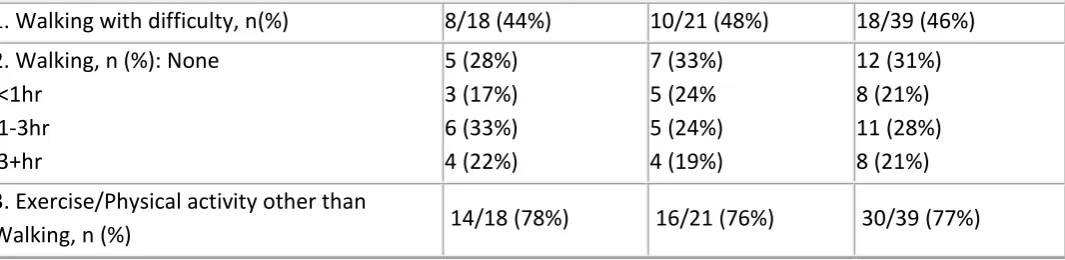
Eighteen participants were allocated to exercise and 21 to usual care. Seventeen (69%) of 27 participants expressed a preference for exercise (12 expressed no preference). Participant characteristics at baseline are shown in Table 4; the groups were well balanced for most variables except QoL.
Retention
Retention rate was 95%. Two of 39 participants formally left the study; one from the exercise group for ulcer pain before the 3-month assessment, one control group for non-ulcer related health reasons before the 6-month assessment. All others completed all assessment sessions. Five participants withdrew from exercise training due to family commitments and non-ulcer related health reasons.
Exercise attendance and safety data
Of the 18 exercise participants, 13 (72%) completed all sessions, overall session completion rate of 79% (512/648). No bandage slippage/misplacement was detected during exercise sessions. We observed two exercise-related adverse events (both excessive discharge from the ulcer). Actions taken included the removal of resistance exercises and postponement of exercise sessions.
Physical function and body mass
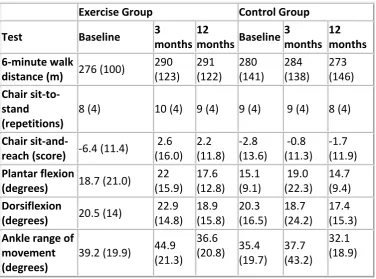
Participants in the exercise group showed higher mean values at all 3 months in all tests (Table 5). Results stabilised at 12 months at all tests except plantar flexion. The reduction in weight was modest for the exercise group in relation to the baseline [(103.9 (24) at baseline vs 99.8 (28.4) at 12 months]. In contrast there was an increase in weight in the control group [(102.6 (25.6) vs 105.7 (25.2) at 12 months].
Ulcer related data
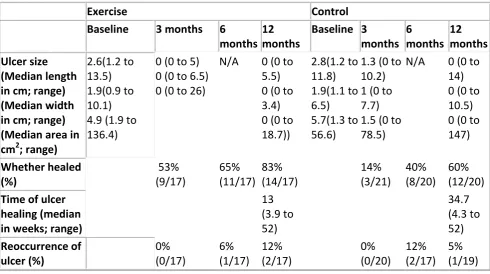
Median ulcer size was similar at 12 months (Table 6), but healing rate was higher in the intervention group (83% vs 60%), with shorter median ulcer healing time (13 (3.9 to 52) vs 34.7 weeks (4.3 to 52)). Recurrence rates were low in both groups (2 intervention vs 1 control).
Health-related QoL
Participants in the intervention group started the study with a higher EQ5D utility score than the control group (Table 7; 0.8022 (0.17) vs 06010 (0.35)). This difference was maintained throughout the study. Similar difference was observed with EQ-Visual Analogue Scale, VEINES-QOL (overall score and symptom score) and pain score, although for VEINES-QOL and pain score the difference between groups was increased from 3 months onwards.
Health Economic data
Personal costs were calculated using a diary with “out of pocket” expenses being estimated at £113.63 and £174.58 for the exercise and control group respectively.
The “per patient” cost-savings to NHS from the exercise intervention was £875.08. Similarly, the “per patient” less “out of pocket” expenses to participants, as a result of participation in exercise intervention was £60.95. The combined per “per patient” total cost-savings was £936.03 (Table 8; Online Supplement 2).
Discussion
Our study successfully assessed a series of feasibility study aspects, including recruitment, baseline and follow-up measurements, as well as the feasibility and preliminary
effectiveness of a supervised exercised programme for people with venous leg ulcers. Our main finding was that the study procedures were feasible and acceptable.
The feasibility and acceptability of using a supervised exercise regime as an adjunct therapy to compression therapy, had been an area of uncertainty prior to this study. Indeed, during the preliminary study stages, such a notion was met with scepticism by some clinicians and patients, who believed that exercise may be either inappropriate or harmful and may delay rather than promote healing - an attitude that has been documented in the literature as well.30,31 Nevertheless, the majority of the eligible patients had a positive attitude towards undertaking exercise in addition to following a therapeutic pathway based on compression therapy. This was irrespective of whether they consented to take part and reasons for non-participation will help make the programme more accessible (i.e., by choosing appropriate venues). Our feasibility data show few adverse events, with no bandage misplacement or slippage incidents, one of the biggest concerns of collaborating clinicians.
Exercise attendance was 79% with 72% completing all sessions. This is high considering that many participants were old, frail and had no previous exercise experience. This was
achieved without employing any specific adherence-enhancing components or provision of behavioural change support, which could have potentially improved attendance rates and the effect of the intervention even further.32 This suggests a great interest and
self-motivation from our participants, which will be a decisive factor for the success of a
definitive trial and any wider roll-out of the intervention. Despite our success however, it is our plan to incorporate cognitive-behavioural strategies as part of any future trial to optimise exercise adherence and increase any potential, positive effect.
In respect to practicality our intervention was primarily delivered within a university setting, at some distance from the clinics that our participants were treated. The high attendance rate, suggests that this didn’t have a negative impact on the outcome, although it may have impacted recruitment rate. Recruitment rate may be improved in the definitive trial, where 12-week exercise referral schemes33 will be utilised for the intervention delivery. Delivery with an option of times in community-based venues increases accessibility but comes with a number of challenges (as adherence and success varies) 34, recent research suggests that these schemes can offer QoL and physical activity gains.35
was a collection exercise only, an appopriate Health Economics analysis in the definitive trial will provide responses in that area as well.
Overall, no major difficulties were identified in the design or implementation of trial procedures. For example, the blinding procedures ran as intended, the rates of retention and outcome completion (including the 6-month postal assessment) was very good, and from a point onwards there was an excellent communication between clinical and research teams, which allow smooth recruitment. There was an imbalance between groups in EQ-5D-5L data, which didn’t affect the success of our study but may need to be considered in planning the definitive trial.
Designing, setting up and managing a definitive, multi-centre study has other challenges besides recruitment rate, data collection and exercise delivery. One important issue is the recruitment of a sufficient number of sites which will: a) deliver the required number of participants, b) have experienced clinicians to act as local Principal Investigators, c) have dedicated tissue viability services, which will support and promote the study and d) have a good communication level between exercise deliverers, tissue viability clinics, local
stakeholders (e.g., NHS Trusts) and the main research team. It is therefore, advisable that a cost-effective use of a clinical trials unit is implemented, which would safeguard data quality and guarantee database management, in addition to costing dedicated personnel (e.g., a trial co-ordinator and a trial manager) for day-to-day study management and involving experienced research sites in previous, similar studies (which would safeguard a consistent delivery of the trial protocol).
Our findings support the feasibility and acceptability of both the supervised exercise programme in conjunction with compression therapy and the study procedures and all our originally-set, success criteria5 were met. In addition, our results suggest that there may be significant potential benefit in healing rates and that, if this were confirmed in a full trial, the introduction of supervised exercise for VLU may well also be cost-saving for the NHS. The next step will be the design and implementation of an appropriately-powered, multi-centre trial is required to provide answers on the clinical and cost-effectiveness of the intervention, and measure its impact.
Acknowledgments
The authors acknowledge the study participants for supporting this research. We would also like to acknowledge the following people; the tissue viability nurses who supported recruitment and data collection, Dr. Mark Boon (Conisbrough Group Practice) for his role as co-applicant on the original grant application and providing clinical assessments to Sheffield participants, Mrs Sue Kesterton and Mr. Alexandros Mitropoulos (Sheffield Hallam
This paper presents independent research funded by the NIHR under its Research for
Patient Benefit (RfPB) Programme (Grant Reference Number PB-PG-0213-30029). The views expressed are those of the author(s) and not necessarily those of the NHS, the NIHR or the Department of Health.
Conflicts of interest None.
Figure Legends
Figure 1. The flow of participants through the trial.
References
1.Nelzén N, Bergqvist D, Lindhagen A. Leg ulcer etiology - a cross sectional population study. J Vasc Surg 1991; 14:557–64.
2. In: ABC of arterial and venous disease (Donnelly R, London N, eds), 2nd edn. Chichester, London: Wiley Blackwell/BMJ, 2009.
3. Browse NL, Burnand KG. The cause of venous ulceration. Lancet 1982; 2:243–5.
4. Coleridge Smith PD, Thomas P, Scurr JH, Dormandy JA. Causes of venous ulceration: a new hypothesis. Br Med J 1988; 296:1726–7.
5. Tew GA, Michaels J, Crank H, et al. Supervised exercise training as an adjunctive therapy for venous leg ulcers: study protocol for a randomised controlled trial. Trials 2015:
6;16:443–453.
6. Vowden KR, Vowden P. The prevalence, management and outcome for patients with lower limb ulceration identified in a wound care survey within one English health care district. J Tissue Viability 2009; 18:13–9.
7. Guest JF, Ayoub N, Greaves T. Clinical outcomes and cost-effectiveness of an externally applied electroceutical device in managing venous leg ulcers in clinical practice in the UK. J
Wound Care. 2015 Dec; 24(12):572, 574-80.
8. Posnett J, Franks PJ. The burden of chronic wounds in the UK. Nurs Times 2008; 104:44–5.
9. Thurlby K, Griffiths P. Community leg ulcer clinics vs home visits: which is more effective?.
Br J Community Nurs 2002; 7:260–4.
10. Guest JF, Vowden K, Vowden P. The health economic burden that acute and chronic wounds impose on an average clinical commissioning group/health board in the UK. J
Wound Care 2017; 26:292–303.
12. Gohel MS, et al. Long term results of compression therapy alone versus compression plus surgery in chronic venous ulceration (ESCHAR): randomised controlled trial. BMJ 2007; 335:83–9.
13. Drew P, Posnett J, Rusling L, Wound Care Audit Team. The cost of wound care for a local population in England. Int Wound J 2007; 4:149–55.
14. NICE Clinical Knowledge Summaries. Leg Ulcers - Venous. Available at: https://cks.nice.org.uk/leg-ulcer-venous (last accessed 25 June 2017).
15. Layden J, Michaels J, Bermingham S, et al. Diagnosis and management of lower limb peripheral arterial disease: summary of NICE guidance. BMJ 2012: 345;e4947.
16. Balady GJ, Williams MA, Ades PA, et al. Core components of cardiac
rehabilitation/secondary prevention programs: 2007 update: a scientific statement from the American Heart Association Exercise, Cardiac Rehabilitation, and Prevention Committee, the Council on Clinical Cardiology; the Councils on Cardiovascular Nursing, Epidemiology and Prevention, and Nutrition, Physical Activity, and Metabolism; and the American Association of Cardiovascular and Pulmonary Rehabilitation. Circulation 2007; 115:2675–82.
17. Kan YM, Delis KT. Hemodynamic effects of supervised calf muscle exercise in patients with venous leg ulceration: a prospective controlled study. Arch Surg 2001; 136:1364–9.
18. Jull A, Parag V, Walker N, et al. The prepare pilot RCT of home-based progressive resistance exercises for venous leg ulcers. J Wound Care 2009; 18:497–503.
19. O'Brien J, Finlayson K, Kerr G, Edwards H. Evaluating the effectiveness of a
self-management exercise intervention on wound healing, functional ability and health-related quality of life outcomes in adults with venous leg ulcers: a randomised controlled trial. Int
Wound J 2017; 14:130–137.
20. Meagher H, Ryan D, Clarke-Moloney M, et al. An experimental study of prescribed walking in the management of venous leg ulcers. J Wound Care 2012; 21:421–430.
21. Heinen M, Borm G, van der Vleuten C, et al. The Lively Legs self-management programme increased physical activity and reduced wound days in leg ulcer patients: Results from a randomized controlled trial. Int J Nurs Stud 2012; 49:151–61.
22. Yim E, Kirsner RS, Gailey RS, et al. Effect of physical therapy on wound healing and quality of life in patients with venous leg ulcers: a systematic review. JAMA Dermatol
2015;151:320–7. doi: 10.1001/jamadermatol.2014.3459.
23. Aboyans V. Measurement and interpretation of the ankle-brachial index: a scientific statement from the American Heart Association. Circulation 2012; 126:2890–909.
25. Dolan P. Modeling valuations for EuroQol health states. Med Care 1997; 35:1095–1108.
26. Lamping DL, Schroter S, Kurz X, et al. Evaluation of outcomes in chronic venous disorders of the leg: development of a scientifically rigorous, patient-reported measure of symptoms and quality of life. J Vasc Surg 2003; 37:410–9.
27. Klonizakis M, Tew G, Michaels J, Saxton J. Impaired microvascular endothelial function is restored by acute lower limb exercise in post-surgical varicose vein patients. Microvas Res
2009; 77:158–62.
28. Klonizakis M, Tew G, Michaels J, Saxton J. Exercise training improves cutaneous microvascular endothelial function in post-surgical varicose vein patients. Microvasc Res
2009; 78:67–70.
29. Rikli RE, Jones CJ. Senior fitness test manual-2nd Edition. Champaign. IL; Human Kinetics 2013.
30. O'Brien J, Finlayson K, Kerr G, Edwards H. The perspectives of adults with venous leg ulcers on exercise: an exploratory study. J Wound Care 2014; 23:496–8.
31. McCulloch J, Mahoney E, McCallon S. Enhancing the role of physical therapy in venous leg ulcer management. JAMA Dermatol 2015; 151:327.
32. National Institute for Clinical Excellence. Behaviour change: general approaches. Available at: https://www.nice.org.uk/Guidance/PH6 (last accessed 17 July 2017).
33. National Institute for Clinical Excellence. Physical activity: exercise referral schemes. https://www.nice.org.uk/guidance/ph54 (last accessed 17 July 2017).
34. Williams NH, Hendry M, France B, et al. Effectiveness of exercise-referral schemes to promote physical activity in adults. Br J Gen Pract 2007; 57:979–986.
Inclusion Criteria Exclusion Criteria Patients who:
are at least 18 years of age
have at least one venous leg ulcer of primarily venous aetiology
(determined by a clinician) with a maximum diameter of at least 1 cm have an ankle brachial pressure index
(ABPI) of at least 0.8 (recorded within the previous 3 months)
are able and willing to tolerate lower-limb compression.
Patients who:
are unsuitable or unable to exercise (determined by a clinician)
are unable or unwilling to tolerate lower-limb compression
have insulin-controlled diabetes mellitus
are pregnant
have coexisting skin conditions, vasculitis, deep venous occlusion or malignant/atypical ulceration require major surgery
have a leg ulcer with a maximum diameter of less than 1 cm
have had an ulcer at the same site within the previous 3 months
[image:14.595.70.541.137.492.2] are unable or do not wish to consent to participation in the trial.
Criterion
An appropriate primary outcome variable is defined.
At least 67 % of randomly assigned patients in the exercise group are
compliant with the intervention (defined as at least 75 % of the scheduled sessions are completed as planned).
Loss to follow-up at 12 months is less than 20%.
[image:15.595.183.416.134.354.2] Patient preferences are not so strong that they result in the conclusion that a randomised controlled trial is not a feasible design.
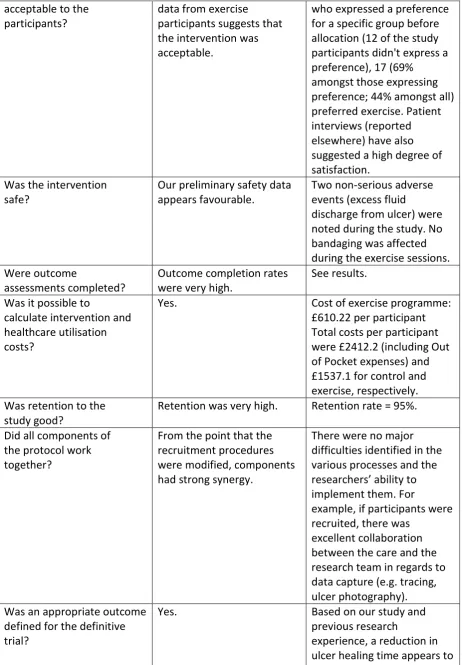
Methodological issues Findings Evidence What factors influenced
eligibility and what proportion of those screened were eligible?
Tissue Viability Clinics see a variety of patient wounds the majority of which are not ulcers or of venous origin.
109 out of 514 screened were eligible.
The most common reasons for non-eligibility being ulcer not of venous origin or other type of wound present=206. The main reasons for non-consent were mainly of social origin (e.g., work commitments or difficulty travelling; n=52).
Was recruitment successful? Recruitment was slower than anticipated
39 participants were
recruited within a 21-month period.
Were eligible patients recruited?
Conversion rate to
recruitment was within our primary targets.
39 out of the 109 (36%) eligible participants were recruited in the study. Were participants
successfully randomised and did randomisation yield equality in groups?
Randomisation process worked well.
Similar sized groups, well-balanced on
stratification and most other variables; however, quality of life scores were higher at baseline in exercise group. Were blinding procedures
adequate?
Blinding of outcome assessors and ulcer healing assessments worked well.
Two different assessors were used at follow-up sessions. No discussions were reported between
participants and assessors on their study experience during follow-up sessions. Assessment of digital ulcer photographs was completed by a team member unaware of the association between study id numbers and group allocation.
Did participants adhere to the intervention?
We experienced a very high attendance rate.
Overall, 13/18 (72%) of the exercise group participants attended 100% of the scheduled exercise sessions. 512/648 (79%) of the
scheduled sessions were completed.
acceptable to the participants?
data from exercise
participants suggests that the intervention was acceptable.
who expressed a preference for a specific group before allocation (12 of the study participants didn't express a preference), 17 (69%
amongst those expressing preference; 44% amongst all) preferred exercise. Patient interviews (reported elsewhere) have also suggested a high degree of satisfaction.
Was the intervention safe?
Our preliminary safety data appears favourable.
Two non-serious adverse events (excess fluid
discharge from ulcer) were noted during the study. No bandaging was affected during the exercise sessions. Were outcome
assessments completed?
Outcome completion rates were very high.
See results.
Was it possible to
calculate intervention and healthcare utilisation costs?
Yes. Cost of exercise programme:
£610.22 per participant Total costs per participant were £2412.2 (including Out of Pocket expenses) and £1537.1 for control and exercise, respectively. Was retention to the
study good?
Retention was very high. Retention rate = 95%.
Did all components of the protocol work together?
From the point that the recruitment procedures were modified, components had strong synergy.
There were no major difficulties identified in the various processes and the researchers’ ability to implement them. For
example, if participants were recruited, there was
excellent collaboration between the care and the research team in regards to data capture (e.g. tracing, ulcer photography). Was an appropriate outcome
defined for the definitive trial?
Yes. Based on our study and
previous research
[image:17.595.68.531.49.715.2]experience, a reduction in ulcer healing time appears to be the most appropriate outcome for the definitive trial.
Baseline characteristics Intervention (18) Control (21) Combined (39) 1. Male gender, n (%) 9/18 (50%) 14/21 (67%) 23/39 (59%)
2. Age in years, mean (SD) 65.4 (14.9) 61.9,10.9 63.5,12.8
3. Working, n (%) 8/18 (44%) 6/21 (29%) 14/39 (36%)
4. White ethnicity, n (%) 17/18 (94%) 21/21 (100%) 38/39 (98%)
5. Body mass, mean (SD) 102.1 (29.4) 104.9 (24.3) 103.6(26.5)
6. Blood pressure, heart rate, mean (SD) BP – Systolic (mmHg)
BP - Diastolic (mmHg) Heart Rate (beats/minute)
143 (20) 79 (10) 72 (13) 140 (18) 84 (13) 69 (11) 141 (19) 81 (12) 70 (12)
7. Smoking status, n (%) 4 (22%) 5 (24%) 9 (24%)
8. Alcohol consumption, units/week, mean
(SD) 8 (13) 9 (14) 8 (13)
9. Key medications names (% yes) Anti-platelet/Anti-coagulant Statin
ACE-inhibitor Beta-blocker
Calcium channel blocker Diuretic 7 (39%) 3 (17%) 1 (6%) 3 (17%) 1 (6%) 4 (22%) 5 (25%) 5 (25%) 1 (5%) 6 (29%) 2 (10%) 3 (15%) 12 (31%) 8 (21%) 2 (5%) 9 (23%) 3 (8%) 7 (18%) 10. Comorbidities, n (%)
Hypertension
History of other CVD
Non-insulin-dependent diabetes History of cancer
Hypercholesterolemia 12/18 (67%) 7 (39%) 1 (6%) 4 (22%) 2 (11%) 1 (6%) 16/21 (76%) 4 (20%) 8 (39%) 4 (20%) 1 (5%) 2 (10%) 28/39 (72%) 11 (28%) 9 (23%) 8 (21%) 3 (8%) 3 (8%) Ulcer Related
1. Had ulcer before, n (%) 11/18 (61%) 14/21 (67%) 25/39 (64%)
2. Duration of reference ulcer, mean months
(SD) 12.7(19.9) 7.1 (8.1) 7.9(14.8)
3. Time since diagnosis of reference ulcer,
mean months (SD) 8.9(13.7) 6.1(8.0) 7.4(10.9)
4. Previously had ulcer at same site (>3
months ago), n(%) 3/18 (17%) 3/21 (14%) 6/39 (15%)
5. Ulcer size, median length in cm(range) median width in cm(range)
median area in cm2(range)
2.6(1.2 to 13.5) 1.9(0.9 to 10.1) 4.9(1.9 to 136.4)
2.8(1.2 to 11.8) 1.9(1.1 to 6.5) 5.7(1.3 to 56.6)
2.7(1.2 to 13.5) 1.9(0.9 to 10.1) 5.0(1.3 to 136.4)
6. ABPI, mean (SD) 1.0(0.1) 1.1(0.2) 1.1(0.2)
1. Walking with difficulty, n(%) 8/18 (44%) 10/21 (48%) 18/39 (46%) 2. Walking, n (%): None
<1hr 1-3hr 3+hr
5 (28%) 3 (17%) 6 (33%) 4 (22%)
7 (33%) 5 (24% 5 (24%) 4 (19%)
12 (31%) 8 (21%) 11 (28%) 8 (21%)
3. Exercise/Physical activity other than
[image:19.595.49.582.50.180.2]Walking, n (%) 14/18 (78%) 16/21 (76%) 30/39 (77%)
Exercise Group Control Group Test Baseline 3
months 12
months Baseline 3 months
12 months 6-minute walk
distance (m) 276 (100)
290 (123) 291 (122) 280 (141) 284 (138) 273 (146) Chair sit-to-stand (repetitions)
8 (4) 10 (4) 9 (4) 9 (4) 9 (4) 8 (4)
Chair
sit-and-reach (score) -6.4 (11.4)
2.6 (16.0) 2.2 (11.8) -2.8 (13.6) -0.8 (11.3) -1.7 (11.9) Plantar flexion
(degrees) 18.7 (21.0)
22 (15.9) 17.6 (12.8) 15.1 (9.1) 19.0 (22.3) 14.7 (9.4) Dorsiflexion
(degrees) 20.5 (14)
22.9 (14.8) 18.9 (15.8) 20.3 (16.5) 18.7 (24.2) 17.4 (15.3) Ankle range of
movement (degrees)
39.2 (19.9) 44.9 (21.3)
36.6
(20.8) 35.4 (19.7)
37.7 (43.2)
[image:20.595.105.482.63.342.2]32.1 (18.9)
Table 6: Ulcer related data.
Exercise Control
Baseline 3 months 6 months
12 months
Baseline 3 months 6 months 12 months Ulcer size (Median length in cm; range) (Median width in cm; range) (Median area in cm2; range)
2.6(1.2 to 13.5) 1.9(0.9 to 10.1) 4.9 (1.9 to 136.4)
0 (0 to 5) 0 (0 to 6.5) 0 (0 to 26)
N/A 0 (0 to 5.5) 0 (0 to 3.4) 0 (0 to 18.7)) 2.8(1.2 to 11.8) 1.9(1.1 to 6.5) 5.7(1.3 to 56.6)
1.3 (0 to 10.2) 1 (0 to 7.7) 1.5 (0 to 78.5)
N/A 0 (0 to 14) 0 (0 to 10.5) 0 (0 to 147) Whether healed (%) 53% (9/17) 65% (11/17) 83% (14/17) 14% (3/21) 40% (8/20) 60% (12/20) Time of ulcer
healing (median in weeks; range)
Table 7: Summary of health status, disease-specific quality of life and pain data (Mean, SD).
Exercise Control
Baseline 3 Months
6 Months
12
Months Baseline
3 Months 6 Months 12 Months EQ-5D-5L utility score 0.8022 (0.17) 0.8567 (0.15) 0.8147 (0.21) 0.7874 (0.28) 0.6010 (0.35) 0.5698 (0.42) 0.5740 (0.40) 0.5825 (0.41) EQ-VAS score 69.03 (15.13) 75.35 (15.38) 71.47 (21.34) 75.53 (20.37) 57.43 (19.84) 64.33 (22.74) 58.70 (26.21) 56.20 (27.58) VEINES-QOL: Main 53.68 (24.62) 69.53 (26.13) 67.49 (27.75) 67.23 (29.86) 42.65 (24.70) 47.24 (29.57) 51.79 (33.62) 52.46 (34.81) VEINES symptom sub-Domain 62.03 (26.52) 75.18 (24.76) 73.24 (26.26) 73.41 (31.73) 53.17 (28.82) 54.60 (32.11) 58.13 (30.05) 58.53 (33.58)
Table 8: Summary of Annual Costs to NHS, Out of Pocket Expenses of Treatment and Intervention Study Cost by Group.
Summary of Annual Costs to NHS, Out of Pocket Expenses of Treatment and Exercise Study Cost by Group
Cost Type Total Per Patient
Exercise Control Combined Exercise Control Combined I. NHS Healthcare professional £12,724.00 £34,573.00 £47,297.00 £748.47 £1,646.33 £1,244.66
II. A&E £0.00 £2,110.00 £2,110.00 £0.00 £100.48 £55.53
III. Inpatient Care £0.00 £9,365.00 £9,365.00 £0.00 £445.95 £246.45 IV. Diagnostic Tests £257.00 £746.00 £1,003.00 £15.12 £35.52 £26.39 V. Medicine (Free prescriptions) £844.60 £1,476.00 £2,320.60 £49.68 £70.29 £61.07 Total Cost to NHS £13,825.60 £48,270.00 £62,095.60 £813.27 £2,298.57 £1,634.09
Cost to Patients
1. Travel £1,081.66 £2,341.68 £3,423.34 £63.63 £111.51 £90.09
2. Medicine £229.10 £413.44 £642.54 £13.48 £19.69 £16.91
3. Equipment £621.00 £911.00 £1,532.00 £36.53 £43.38 £40.32
Total OOP expenses £1,931.76 £3,666.12 £5,597.88 £113.63 £174.58 £147.31
Intervention Study Cost
1. Exercise intervention delivery
£10,984.00 NA £10,984.00 £610.22 £610.22
2. Including study Outcome measures cost