disability
PAINTER, Jon <http://orcid.org/0000-0003-1589-4054>, TREVITHICK, Liam,
HASTINGS, Richard, INGHAM, Barry and ROY, Ashok
Available from Sheffield Hallam University Research Archive (SHURA) at:
http://shura.shu.ac.uk/13899/
This document is the author deposited version. You are advised to consult the
publisher's version if you wish to cite from it.
Published version
PAINTER, Jon, TREVITHICK, Liam, HASTINGS, Richard, INGHAM, Barry and ROY,
Ashok (2016). Development and Validation of the Learning Disabilities Needs
Assessment Tool (LDNAT), a HoNOS-based needs assessment tool for use with
people with intellectual disability. Journal Of Intellectual Disability Research, 60 (12),
1178-1188.
Copyright and re-use policy
See
http://shura.shu.ac.uk/information.html
Development and validation of the Learning Disabilities
Needs Assessment Tool (LDNAT), a HoNOS-based needs
assessment tool for use with people with intellectual
disability
J. Painter,
1L. Trevithick,
2R. P. Hastings,
3,4B. Ingham
5,6& A. Roy
71 Faculty of Health and Wellbeing, Sheffield Hallam University, Sheffield, UK
2 Durham and Darlington Mental Health Services for Older People, Tees, Esk and Wear Valley NHS Foundation Trust, Durham, UK
3 CEDAR (Centre for Educational Development, Appraisal and Research), University of Warwick, Coventry, UK
4 Centre for Developmental Psychiatry and Psychology, Monash University Australia, Melbourne, Australia
5 Psychological Services, Northumberland, Tyne and Wear NHS Foundation Trust, Newcastle upon Tyne, UK
6 School of Psychology, Newcastle University, Newcastle upon Tyne, UK
7 Solihull Community Services, Faculty of Intellectual Disability Psychiatry, Royal College of Psychiatrists, Birmingham, UK
Abstract
Background In meeting the needs of individuals with intellectual disabilities (ID) who access health services, a brief, holistic assessment of need is useful. This study outlines the development and testing of the Learning Disabilities Needs Assessment Tool (LDNAT), a tool intended for this purpose.
Method An existing mental health (MH) tool was extended by a multidisciplinary group of ID practitioners. Additional scales were drafted to capture needs across six ID treatment domains that the group identified. LDNAT ratings were analysed for the following: item redundancy, relevance, construct validity and internal consistency (n=1692); test–retest reliability (n=27); and concurrent validity (n=160).
Results All LDNAT scales were deemed clinically relevant with little redundancy apparent. Principal component analysis indicated three components
(developmental needs, challenging behaviour, MH and well-being). Internal consistency was good (Cronbach alpha0.80). Individual item test–retest reliability was substantial-near perfect for20scales and slight-fair for three scales. Overall reliability was near perfect (intra-class correlation =0.91). There were significant associations withfive of six condition-specific measures, i.e. the Waisman Activities of Daily Living Scale (general ability/disability), Threshold Assessment Grid (risk), Behaviour Problems Inventory for Individuals with Intellectual Disabilities-Short Form (challenging behaviour) Social Communication Questionnaire (autism) and a bespoke physical health questionnaire. Additionally, the statistically significant correlations between these tools and the LDNAT components made sense clinically. There were no statistically significant correlations with the Psychiatric Assessment
Schedules for Adults with Developmental Disabilities (a measure of MH symptoms in people with ID).
Conclusions The LDNAT had clinically utility when rating the needs of people with ID prior to condition-specific assessment(s). Analyses of internal and
Correspondence: Mr Jon Painter, Sheffield Hallam University,38, Collegiate Crescent, Sheffield, S10 2BP, UK. (e-mail: J. [email protected]).
external validity were promising. Further evaluation of its sensitivity to changes in needs is now required.
Keywords autistic specturm disorder, challenging behaviour, HoNOS, mental health, needs assessment, screening
Background
A purely diagnostic approach to the provision of care/treatment intended to assist people with intellectual disabilities (ID) to lead meaningful lives has been recognised as limited (Xenitidiset al.2000; Thompsonet al.2004; Snellet al.2009). In a quest for more responsive, individualised interventions and services, there has been a shift towards a need-led approach (Parmenter & Riches2002). In the UK at least, this has led to the boundary between ID and mental health (MH) services at times becoming blurred with both sets of practitioners addressing needs that would traditionally have fallen within the other’s remit, depending on the primary presenting issue.
Thompsonet al. (2009) classify service support needs into four types:
• Normative/objective (i.e. a professional’s comparison of an individual’s assessed needs against a notional standard for those particular circumstances).
• Felt (i.e. the individual’s perception of their own needs).
• Expressed (i.e. usually a request for help from the individual).
• Comparative (i.e. the difference between the support an individual receives and the norm for their peers).
Within ID and MH services, a thorough
individual assessment is generally accepted to be the cornerstone of effective treatment or support with an objective assessment of needs seen as integral to this process (Gamble & Brennan 2000; Snell et al.
2009). Several conceptual frameworks exist to describe needs and disability that help to provide structure to the clinical assessment processes. In particular, the socioecological model (Institute of Medicine 1991) and the biopsychosocial model
(Engel 1977) have gained popularity, arguably because of their holistic nature and ability to accommodate most professional, service and service users’perspectives. Condition-specific assessment tools exist for more discrete domains such as MH problems (e.g. Moss et al.1998) and challenging behaviour (e.g. Rojahnet al.2001). However, a broader tool that encourages both ID and MH practitioners to consider how they might address needs across all aspects of the biopsychosocial model (prior to focusing in on their own sub-specialty) has merit in ensuring an individual’s full range of needs are consistently considered.
Few MH screening tools address the full range of issues typically associated with ID, but some ID needs assessments do include MH problems. Examples of broad ID needs assessment tools include the Camberwell Assessment of Need for Adults with Developmental and Intellectual Disabilities (CANDID, Xenitidiset al.2000); the Supports Intensity Scale (SIS, Thompsonet al.2004); and the Instrument for the Classification and Assessment of Support Needs (I-CAN, Richeset al.2009). Fundamentally, these tools seek to capture normative needs with some also eliciting felt need and expressed need (including those articulated by the individual’s carers). However, as there is no accepted ‘gold standard’ needs assessment tool for people with ID (Xenitidiset al.2000), these existing tools will each have limitations. For example, the SIS was designed to elicit the support needs of people with ID, but it consists of over 80 scales, thus posing a significant time and cost burden on routine practice. Also, concerns have been raised about the degree of subjectivity it involves (Riches
et al. 2009). The I-CAN is shorter but still takes between 30–60min to complete and is yet to be validated for use in people with ID whose primary need is MH-related (Riches et al. 2009). The CANDID was adapted from the original version (designed for use in mainstream psychiatry) and is described as a screening rather than a diagnostic tool. Despite this, the CANDID takes around
30min to compete, and hence, concerns have again been raised about the feasibility of its use in routine practice (Xenitidis et al.2000). Overall therefore, given the shift towards more holistic, needs-led service provision, the list of brief needs assessment tools that are potentially suitable for routine practice
in both ID and MH settings remains somewhat modest.
The purpose of the present study was to extend an existing MH needs assessment tool to create and test a new needs assessment tool, the Learning Disability Needs Assessment Tool (LDNAT) that was suitable for use in either service as a broad assessment of need in people with ID prior to more detailed, condition-specific assessments. The tool therefore needed to be brief whilst adequately capturing the full range of needs that people with ID typically present with when accessing health services.
Method
Participants
The needs of2063individuals were recorded by specialist ID professionals from a range of disciplines across six National Health Service (NHS) services in England. The subsequent analyses focus on the1692 cases with all the required data scales. Of those,992 (54.5%) were male and the mean age was41.7years (range18–90years). Treatment setting information was available for1466cases, of which84(5.7%) were assessed in inpatient settings. Most individuals assessed (94.4%) (1540of1631) were White British, and493of1170(42.1%) cases with data available were recorded as living in a form of supported accommodation (i.e. community placements with varying levels of paid staff input). People with ID were being assessed by health services for a variety of health needs. Of686cases for whom their‘primary need’ (i.e. main reason health service involvement) was recorded, most frequent were challenging behaviour (180,26.2%), mental illness (110,16.0%), autism spectrum disorder (ASD) (62,9.0%) and problems with mobility and posture (55,8.0%).
Measures
The Learning Disability Needs Assessment Tool
An established MH tool–the Mental Health Clustering Tool (MHCT) (Selfet al.2008) was developed from the Health of the Nation Outcome Scales (HoNOS; Winget al.1998) to uniformly identify and rate individual need to assist with the costing, planning, commissioning and most
importantly the delivery of appropriate MH treatment in the UK.
In a desire for more integrated MH and ID services that facilitated non-stigmatising, needs-led access (as advocated by Snellet al. 2009), a multidisciplinary group of 70 ID practitioners reviewed the MHCT in a workshop format for its applicability. Initially, they identified six broad treatment domains that they felt were important when planning support/treatment for people with ID (i.e. general ability/disability severity, risks, MH, challenging behaviour, ASD and physical health). By mapping each MHCT scale in turn to these domains, they were able to identify omissions. Through a similar consensus approach to that of Winget al. (1998), these omissions were then translated into more specific, clearly defined descriptions of need (e.g. social communication and interaction difficulties, non-accidental self-injury associated with cognitive impairment,
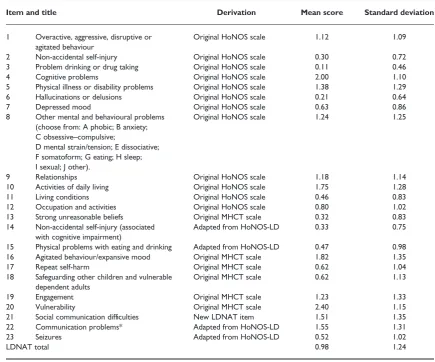
communication and problems with understanding). Finally, with reference to the HoNOS-LD (Royet al. 2002), a 5-point scale for each need was developed by small working groups. A short description of the resulting LDNAT scales together with their origins is listed in Table 1.
Thefirst24-item version of the tool (including both expressive and receptive communication scales) was piloted with more than2000individuals by qualified ID staff from18NHS organisations with qualitative and quantitative data used to refine the new LDNAT scales. Clinical feedback suggested broad consensual content validity however, the expressive and receptive communication scales, were highly correlated and hence were collapsed into a single item. Following this and other minor refinements, the LDNAT was judged to capture the full range of needs from the six domains identified at the original multidisciplinary workshop and be a seamless extension to the MH version of the tool.
Measures used to validate the Learning Disability
Needs Assessment Tool
For each of the six treatment domains, candidate condition-specific measures were identified from a brief literature review. The final choice for each domain was taken by a small multidisciplinary group of ID practitioners and was based on criteria including brevity, simplicity, psychometric quality
and cost. The first two of these criteria were deemed particularly important given the tools would be completed independently by informants who would receive no training. The final list was as follows.
The Waisman Activities of Daily Living Scale (Maenneret al.2013) was used to assess general ability/disability. Raters record whether an individual can complete various activities of daily living independently (score2), with help (score1) or not at all (score0). The tool consists of17activities ranging from basic skills (e.g. drinking from a cup) to more advanced tasks (e.g. simple home repairs and
budgeting). The tool was validated on people with a broad range of ID diagnoses including autism and Fragile-X syndrome.
The Threshold Assessment Grid (TAG) (Slade
[image:5.595.107.543.137.499.2]et al.2000) was selected to provide an overall risk rating. It was originally developed and validated through a series of workshops and a Delphi consultation as a means of prioritising access to mainstream MH services. Seven scales are each rated on4-point or5-point scales to give an overall rating of illness severity. However, thefirst four scales (i.e. intentional self-harm, unintentional self-harm, risk from others and risk to others) were deemed by Table 1 Item titles, derivation and summary scoring statistics for LDNAT (n=1692)
Item and title Derivation Mean score Standard deviation
1 Overactive, aggressive, disruptive or agitated behaviour
Original HoNOS scale 1.12 1.09
2 Non-accidental self-injury Original HoNOS scale 0.30 0.72
3 Problem drinking or drug taking Original HoNOS scale 0.11 0.46
4 Cognitive problems Original HoNOS scale 2.00 1.10
5 Physical illness or disability problems Original HoNOS scale 1.38 1.29
6 Hallucinations or delusions Original HoNOS scale 0.21 0.64
7 Depressed mood Original HoNOS scale 0.63 0.86
8 Other mental and behavioural problems (choose from: A phobic; B anxiety; C obsessive–compulsive;
D mental strain/tension; E dissociative; F somatoform; G eating; H sleep; I sexual; J other).
Original HoNOS scale 1.24 1.25
9 Relationships Original HoNOS scale 1.18 1.14
10 Activities of daily living Original HoNOS scale 1.75 1.28
11 Living conditions Original HoNOS scale 0.46 0.83
12 Occupation and activities Original HoNOS scale 0.80 1.02
13 Strong unreasonable beliefs Original MHCT scale 0.32 0.83
14 Non-accidental self-injury (associated with cognitive impairment)
Adapted from HoNOS-LD 0.33 0.75
15 Physical problems with eating and drinking Adapted from HoNOS-LD 0.47 0.98
16 Agitated behaviour/expansive mood Original MHCT scale 1.82 1.35
17 Repeat self-harm Original MHCT scale 0.62 1.04
18 Safeguarding other children and vulnerable dependent adults
Original MHCT scale 0.62 1.13
19 Engagement Original MHCT scale 1.23 1.33
20 Vulnerability Original MHCT scale 2.40 1.15
21 Social communication difficulties New LDNAT item 1.51 1.35
22 Communication problems* Adapted from HoNOS-LD 1.55 1.31
23 Seizures Adapted from HoNOS-LD 0.52 1.02
LDNAT total 0.98 1.24
*Initially piloted as two separate (expressive and receptive) communication items, but combined because of redundancy.
HoNOS, Health of the Nation Outcome Scales; HoNOS-LD, Health of the Nation Outcome Scales for people with Learning Disabilities; LDNAT, Learning Disabilities Needs Assessment Tool; MHCT, Mental Health Clustering Tool.
clinicians to adequately capture risks to/from people with ID.
The Psychiatric Assessment Schedules for Adults with Developmental Disabilities checklist (PAS-ADD checklist) (Mosset al.1998) was used to rate the severity of MH problems. The tool consists of24 scales written using lay terms to allow
non-professionals to identify MH problems in people with ID. Originally developed as a screening tool, it includes three different scoring triggers for a fuller MH assessment. Scales include irritability, loss of appetite and strange unshakeable beliefs. Scales are rated on a4-point scale, which combines intensity and frequency, and is based on the previous4weeks but specifically excludes long-standing issues.
The Behaviour Problems Inventory for Individuals with Intellectual Disabilities-Short Form (Rojahn
et al.2012a,2012b; Mascitelliet al.2015) was selected to rate challenging behaviours. This shortened version captures self-injurious behaviours (e.g. head hitting), aggressive/destructive behaviours (e.g. verbal aggression) and stereotyped behaviours (e.g.
rocking/repetitive body movements) and is based on a longer (52-item) original version. The frequency rating for each of the30scales was used to provide an overall total score.
The Social Communication Questionnaire, (Rutter
et al.2003) was selected to provide a rating of the severity of ASD symptoms. Valid for both children and adults (Brooks & Benson2013), it consists of40
‘yes/no’questions intended to capture the key features of ASD for example:‘Does he/she have interests that pre-occupy him/her and might seem odd to other people (e.g. traffic lights, drainpipes or timetables)?’
No single suitable physical health measure could be identified, and so, a bespoke questionnaire was created by the authors (available on request). It consisted of12yes/no questions (e.g.‘Is the person blind/visually impaired?’), three rating scale questions (e.g.‘How good is the person’s health in general? Very good/ good/ fair/ bad/ very bad/ don’t know’) and two that ask for height and weight. The yes/no and scaled questions were used to create a total score representing the overall level of physical disability. Although yet to be fully validated, it was based on the POMONA study (Havermanet al.2011), and a brief investigation of its internal consistency yielded acceptable results in the present sample (Cronbach alpha =0.73).
Procedure
Six NHS services in England used the LDNAT between01/07/2014and31/08/2015to systematically record the needs of their users following routine assessment. Qualified staff from a range of disciplines attended a one-day training event before cascading this information to staff in their own organisations. LDNAT ratings were then recorded as part of their routine assessments. Participating NHS services sourced the data required for the study from their case records before submission via a standardised, encrypted data set to the lead organisation for collation and central analysis. The study received NHS approval for the purposes of an NHS service evaluation project. A subset of these services was able to consider the nature of their users in greater detail. For each routine referral to these services, the LDNAT assessor was contacted to identify an independent rater who knew the person well enough to complete the six additional assessment measures. Typically, this was the referrer, the GP or a family/carer. These individuals were contacted by telephone, and if they were willing to provide this more detailed level of referral information, the six validation questionnaires were posted out for completion within2weeks. This exercise resulted in
160cases that had the six independently rated questionnaires in addition to their LDNAT ratings. This convenience sample did not differ significantly from the full data set in terms of their demographics other than having a higher proportion of people assessed in inpatient settings (21% vs.5.7% in the main data set). These additional ratings were then included in the electronic data submission for analysis.
Data analysis
Statistical validation of the LDNAT involved several different analyses. Potentially redundant scales were assessed using correlations between scales. Scales with limited application to the population were assessed with reference to the percentage of cases scoring zero (i.e. scoring as having no problems on the item). Construct validity was addressed through principal components analysis (PCA) to investigate the structure of the LDNAT. Internal consistency was assessed using Cronbach’s alpha. Test–retest reliability was assessed using the records from individuals who, (typically because of a transfer between teams) had second LDNAT assessments
completed within30days of thefirst (totaln=27). Finally, concurrent validity was assessed by examining associations between the six additional questionnaires and the LDNAT scores.
Results
Once duplicate entries, repeat assessments and assessments of children were removed from the data set, mean scores for each item were calculated. Table1shows summary statistics for each item and the LDNAT total score. The range for all scales was identical (0–4), indicating that at least one person had been rated as having‘no needs’and one as having a
‘severe need’in each area of the LDNAT.
Item redundancy
Correlations were examined to assess for possible redundant scales. Because of their closely related clinical interpretations, close attention was paid to scales 2, 14and17(differing forms of self-injurious behaviour). There were weak correlations between items 2 and14(r(1952) =0.370,P=<0.001); items
14 and17(r(1944) =0.353,P<0.001); and a weak-moderate correlation between items 2and 17 (r= (1948) =0.452,P<0.001). Given that the shared variance represented by these correlation values was low, each item was retained because of its potential clinical utility. In general, raters were using these scales differently (to assess different needs).
Item relevance
Items with potentially limited application for people accessing ID services were assessed by identifying items with a high incidence of‘zero’scores (indicating no problem). Items with high percentages of‘zero’ scores were items2(n=1395,82.4%),3(n=1578,
93.3%),6(n=1494,88.3%) and13(n=1430,
84.5%). The mean frequency of‘zeros’for the remaining scales was46.1%. All of these scales were retained in the LDNAT for clinical assessment purposes and were initially retained also for PCA.
Principal components analysis
A PCA was conducted on the21scales using orthogonal rotation (varimax). Scales3and6were excluded from this analysis as earlier exploratory tests
revealed they did not significantly load onto any component, and it had already been established that these two scales had high levels of zero scores in the population. The Kaiser–Meyer–Olkin (KMO) measure verified the overall sampling adequacy for the analysis, KMO =0.83, and all KMO values for individual scales were above0.73.
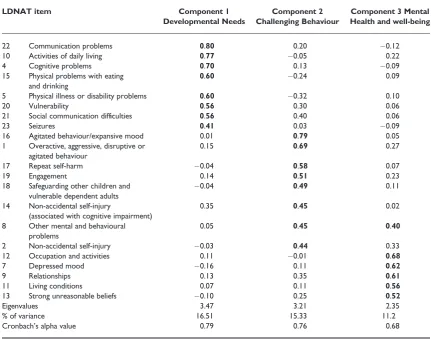
An initial analysis (PCA with varimax rotation) was performed to obtain eigenvalues for each component in the data. Five components had eigenvalues over Kaiser’s criterion of1and together explained54.7% of total variance. The point of inflexion on the scree plot indicated the retention of three components that together explained43.0% of total variance. Table2 shows the component loadings after rotation as well as Cronbach’s alpha values for each of the three potential LDNAT sub-scale scores identified through the PCA.
Learning Disability Needs Assessment Tool internal
consistency
The internal consistency of the LDNAT total score was evaluated using Cronbach’s alpha. The alpha value was0.80indicating good internal reliability of the tool, according to Nunally’s rule of thumb (Nunnally & Bernstein 1994). Corrected item-total correlations were examined with only one very low value for item3 – ‘alcohol and drug problems’
r=0.05. However, removing this item did not improve the internal consistency of the total score, so this item was retained for its potential clinical value.
Test
–
retest reliability
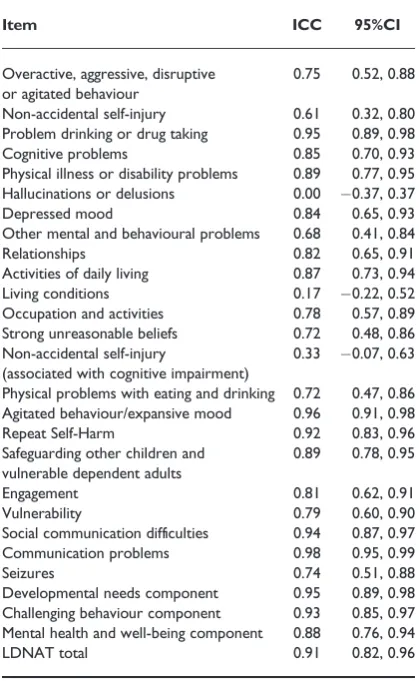
Test–retest reliability was assessed by calculating intra-class correlation (ICC) coefficients. Individuals were included in this analysis if they had two LDNATs completed within30days of each other. Table3shows the ICCs and confidence intervals for individual LDNAT scales and for each independent component derived from the PCA. Using Landis and Koch’s (1977) thresholds, these values suggest substantial or near perfect agreement for all but three scales (hallucination/delusions, living conditions and self-injurious behaviour) that show slight or fair agreement over time.
Learning Disability Needs Assessment Tool
concurrent validity
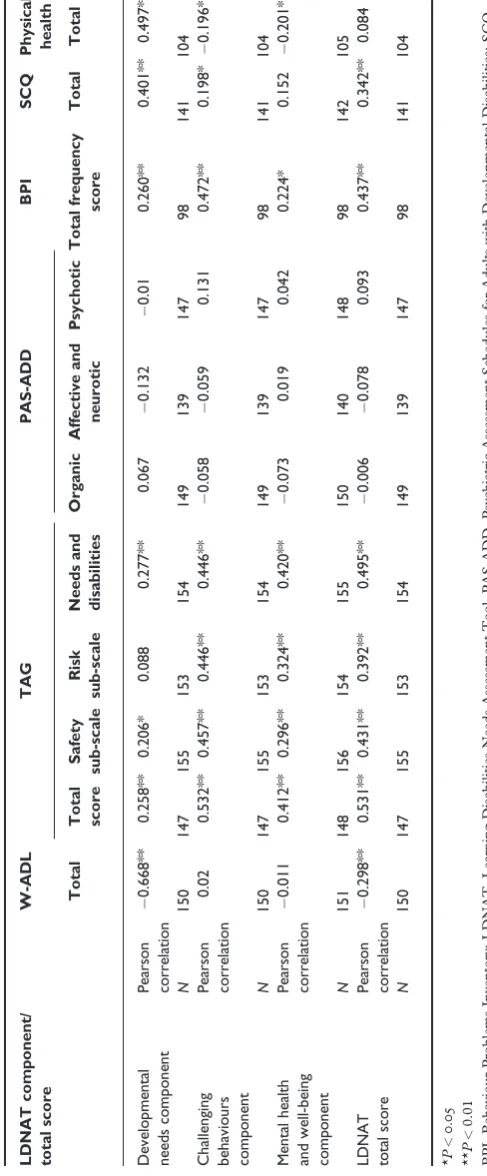
There were160cases from three NHS services who had scores for the six additional measures recorded by independent assessors. Correlations between the sub-scales and totals for these six measures and the three LDNAT component scores and the total LDNAT score were investigated. These results are summarised in Table4.
The Waisman Activities of Daily Living Scale total (used as a measure of general disability) was
negatively correlated with LDNAT total score and also the developmental needs component. The TAG total score (a measure of risk) was significantly associated with the LDNAT total as were the three
TAG sub-scales. More specifically, the TAG needs and disabilities sub-scale was associated with the LDNAT developmental needs component, whilst the TAG safety and risk sub-scales both had significant correlations with the LDNAT challenging behaviour component. There were no statistically significant associations between any of the PAS-ADD checklist sub-scales and the LDNAT total score or the LDNAT component totals. The LDNAT’s relationship with the Behaviour Problems Inventory for Individuals with Intellectual Disabilities-Short Form (the selected independent measure of
[image:8.595.111.543.138.478.2]challenging behaviour) was as expected, with the total frequency score associated with the LDNAT total score. They were also strongly correlated with the LDNAT challenging behaviour component. The Table 2 Summary of PCA varimax rotated component loadings.N=1692Component loadings above0.40appear in bold
LDNAT item Component 1
Developmental Needs
Component 2 Challenging Behaviour
Component 3 Mental Health and well-being
22 Communication problems 0.80 0.20 0.12
10 Activities of daily living 0.77 0.05 0.22
4 Cognitive problems 0.70 0.13 0.09
15 Physical problems with eating and drinking
0.60 0.24 0.09
5 Physical illness or disability problems 0.60 0.32 0.10
20 Vulnerability 0.56 0.30 0.06
21 Social communication difficulties 0.56 0.40 0.06
23 Seizures 0.41 0.03 0.09
16 Agitated behaviour/expansive mood 0.01 0.79 0.05
1 Overactive, aggressive, disruptive or agitated behaviour
0.15 0.69 0.27
17 Repeat self-harm 0.04 0.58 0.07
19 Engagement 0.14 0.51 0.23
18 Safeguarding other children and vulnerable dependent adults
0.04 0.49 0.11
14 Non-accidental self-injury
(associated with cognitive impairment)
0.35 0.45 0.02
8 Other mental and behavioural problems
0.05 0.45 0.40
2 Non-accidental self-injury 0.03 0.44 0.33
12 Occupation and activities 0.11 0.01 0.68
7 Depressed mood 0.16 0.11 0.62
9 Relationships 0.13 0.35 0.61
11 Living conditions 0.07 0.11 0.56
13 Strong unreasonable beliefs 0.10 0.25 0.52
Eigenvalues 3.47 3.21 2.35
% of variance 16.51 15.33 11.2
Cronbach’s alpha value 0.79 0.76 0.68
LDNAT, Learning Disabilities Needs Assessment Tool; PCA, principal components analysis.
Social Communication Questionnaire-total score (used to measure autism symptoms) was strongly correlated with the LDNAT total, the developmental needs component and to a lesser but still significant extent to the challenging behaviour component. Finally, the total score for the physical health tool (calculated from15/17questions) had a strong association with the LDNAT developmental needs component.
Discussion
This study outlines the development and validation of a needs assessment tool (the LDNAT) for use in ID
health services as a precursor to more detailed, condition-specific assessment. Whilst the catalyst for its development stemmed from a move away from traditional commissioning arrangements, it is important to stress that, as with similar MH developments, this has been a clinically led project. The primary aim for these project staff was to encourage a holistic assessment of the needs of people with ID regardless of whether they enter a specialist MH or ID service.
The resulting23-item LDNAT showed good overall internal consistency for the total score and three potential sub-scale scores. Corrected item-total correlations were all acceptable with the exception of scale 3(drug and alcohol problems) that was retained because of its clinical value. The original MH tool already contained two scales concerned with differing types of self-injury; however, neither was felt to adequately capture the self-injurious behaviour traditionally associated with cognitive impairment, and hence, a third item was created. Analysis confirmed the shared variance between these three scales to be small, confirming that they were being used to capture different clinical constructs. In contrast, redundancy between two new scales concerning communication was identified during piloting, resulting in their replacement by a single, over-arching communication item.
Principal component analysis using a component loading threshold of0.4identified three components: developmental needs, challenging behaviour and MH and well-being. At this loading threshold, item8(a pick list item of‘other mental and behavioural problems’) loaded onto the second and third components (presumably because of the plurality of mental and behavioural issues it was designed to capture). The item related to seizures did not load significantly onto any component. It must be stressed that these three components are merely a preliminary exploration of the LDNAT’s structure used to facilitate validation. Further research (particularly of the heterogeneous MH and well-being) component is required before they could be used clinically.
[image:9.595.112.322.157.498.2]Intra-class correlation coefficients indicated a high level of test–retest reliability for scales, total LDNAT scores and the three sub-scale/component scores. ICCs for only three scales fell below an acceptable level in terms of test–retest reliability.
Table 3 Intra-class correlation coefficients and95% confidence intervals for cases (n-27) with two completed LDNAT assessments within30days
Item ICC 95%CI
Overactive, aggressive, disruptive or agitated behaviour
0.75 0.52, 0.88
Non-accidental self-injury 0.61 0.32, 0.80 Problem drinking or drug taking 0.95 0.89, 0.98
Cognitive problems 0.85 0.70, 0.93
Physical illness or disability problems 0.89 0.77, 0.95 Hallucinations or delusions 0.00 0.37, 0.37
Depressed mood 0.84 0.65, 0.93
Other mental and behavioural problems 0.68 0.41, 0.84
Relationships 0.82 0.65, 0.91
Activities of daily living 0.87 0.73, 0.94
Living conditions 0.17 0.22, 0.52
Occupation and activities 0.78 0.57, 0.89 Strong unreasonable beliefs 0.72 0.48, 0.86 Non-accidental self-injury
(associated with cognitive impairment)
0.33 0.07, 0.63
Physical problems with eating and drinking 0.72 0.47, 0.86 Agitated behaviour/expansive mood 0.96 0.91, 0.98
Repeat Self-Harm 0.92 0.83, 0.96
Safeguarding other children and vulnerable dependent adults
0.89 0.78, 0.95
Engagement 0.81 0.62, 0.91
Vulnerability 0.79 0.60, 0.90
Social communication difficulties 0.94 0.87, 0.97 Communication problems 0.98 0.95, 0.99
Seizures 0.74 0.51, 0.88
Developmental needs component 0.95 0.89, 0.98 Challenging behaviour component 0.93 0.85, 0.97 Mental health and well-being component 0.88 0.76, 0.94
LDNAT total 0.91 0.82, 0.96
CI, confidence interval; ICC, intra-class correlation; LDNAT, Learning Disabilities Needs Assessment Tool.
Table 4 Correlations between LDNAT component and total scores with sub-scale and total scores for the six independently rated questionnaires LDN AT com ponent/ total score W-AD L TAG PAS-ADD BPI SCQ Phys ical health Tot al Total score Safety sub-scale R isk sub-scale Needs and disa bilities Org anic Aff ecti ve and ne urotic P sychotic Tot al frequen cy sco re Total Total Developme ntal need s compone nt Pears on cor relation 0.66 8** 0.258 ** 0.20 6* 0.08 8 0.27 7** 0.06 7 0.132 0.01 0.260 ** 0.401 ** 0.497 ** N 150 147 155 153 154 149 139 147 98 141 104 Ch allenging beh aviours comp onent Pears on cor relation 0.02 0.532 ** 0.45 7** 0.44 6** 0.44 6** 0.05 8 0.059 0.131 0.472 ** 0.198 * 0.196 * N 150 147 155 153 154 149 139 147 98 141 104 Mental heal th and well-being comp onent Pears on cor relation 0.01 1 0.412 ** 0.29 6** 0.32 4** 0.42 0** 0.07 3 0.019 0.042 0.224 * 0.152 0.201 * N 151 148 156 154 155 150 140 148 98 142 105 LDNA T to tal sco re Pears on cor relation 0.29 8** 0.531 ** 0.43 1** 0.39 2** 0.49 5** 0.00 6 0.078 0.093 0.437 ** 0.342 ** 0.084 N 150 147 155 153 154 149 139 147 98 141 104 * P < 0 . 05 ** P < 0.01 BPI, Behaviour Problems Inventory; LDNAT, Learning Disabilities Needs Assessment Tool, PAS-ADD, Psychiatric Assessment Schedules for Adults wit h Developmental Disabilities; SCQ, Social Communication Questionnaire; TAG, Threshold Assessment Grid; W-ADL, Waisman Activities of Daily Living Scale.
[image:10.595.210.454.119.708.2]Finally, convergent validity was demonstrated by comparing the tool’s performance to that of more specific measures for each of the six needs domains identified by professionals as important in
care/treatment planning. The statistical associations with five of the six validation measures all had clinical face validity. However, the LDNAT had no statistically significant associations with the PAS-ADD checklist (a screening tool for MH problems in people with ID). One possible reason for this is the heterogeneous nature of the LDNAT’s MH and well-being component. Alternatively, the PAS-ADD checklist’s scoring guidance specifically excludes issues that have ‘always been like this’, whilst eight of the 23LDNAT scales addressing MH problems encourage raters to consider historical issues and behaviours that remain relevant to the current plan of care. It is then possible that individuals had long-standing MH problems rather than new episodes or acute deteriorations that the PAS-ADD checklist was not designed to capture. Finally, data suggest that the PAS-ADD checklist may have some psychometric weaknesses (as muted by Hatton & Taylor 2008).
Although the reliability and validity data for the LDNAT are encouraging, there are a number of limitations with this study that should be borne in mind when interpreting the results.
The naturalistic nature of the study has both strengths and weaknesses. Training was cascaded, albeit with a standardised structure, which may have led to variable accuracy of ratings. Conversely, however, this approach did not foster any unrealistic expectations, i.e. that already stretched services can create and sustain the burden of gold-standard research conditions in routine practice. Also, the sample was neither randomly selected nor stratified (e.g. on the basis of IQ) and hence may or may not be representative of the entire population of people with ID accessing health services.
Second, the inability to identify the names of raters from the much smaller data set (n=27) used for test– retest analysis means that this analysis was in effect a combination of inter-rater reliability and stability over time. Anecdotally, however, these second ratings were usually a consequence of movement between services and hence mainly undertaken by a different practitioner, making the ICCs all the more
encouraging.
The choice of additional measures was heavily influenced by their suitability for untrained informant completion. Whilst independence from LDNAT raters was seen as crucial, as with the study of Xenitidiset al. (2000), this inevitably led to trade-offs between the utility of tools and their validity. For example, the PAS-ADD was selected as an
appropriate measure selected despite known potential psychometric weaknesses (Hatton & Taylor2008). Equally, the creation and use of a largely untested physical health assessment was deemed more favourable than using any of the alternative tools identified.
Overall therefore, in the context of ever-blurring service boundaries, the LDNAT has the potential to support the brief but holistic assessment of a wide range of needs associated with both MH and ID by staff in either setting. The tool now needs to be subjected to further testing with data from new samples. Also, evaluation of its potential to monitor changes in need in the same way that MHCT data can monitor outcomes in MH services (Speaket al.2015) is required. In this way, a second application of the tool could serve to reduce the perceived burden its use places on practitioners and services through adding value to service functions.
Con
fl
ict of Interest
The authors report no conflicts of interest.
References
Brooks W. T. & Benson B. A. (2013) The validity of the social communication questionnaire in adults with intellectual disability.Research in Autism Spectrum Disorders 7(2),247–55. DOI:10.1016/j.rasd.2012.10.002.
Engel G. (1977) The need for a new medical model: a challenge for biomedicine.Science196,129–96. Gamble C. & Brennan G. (2000) Assessment: a rationale
and glossary of tools. In:Working with Serious Mental
Illness: A Manual for Clinical Practice(eds C. Gamble & G.
Brennan), pp.67–84. Balliere Tindall, London. Hatton C. & Taylor J. L. (2008) Factor structure of the
PAS-ADD checklist with adults with intellectual disabilities.Journal of Intellectual and Developmental
Disability33,330–6.
Haverman M., Perry J., Salvador-Carulla L., Walsh P., Kerr M., Van Schrojenstein Lantman-de Valk H.et al. (2011) Ageing and health status in adults with intellectual
disabilities: results of the European POMONA II study.
Journal of Intellectual Disability3,49–60.
Institute of Medicine (1991) A model for disability and disability prevention. In:Disability in America: Toward a
National Agenda for Prevention, pp.76–108. Available at:
http://www.nap.edu/read/1579/chapter/5#80. The National Academies Press, Washington, DC. Landis J. R. & Koch G. G. (1977) The measurement of
observer agreement for categorical data.Biometrics33, 159–74.
Maenner M. J., Smith L. E., Hong J., Makuch R., Greenberg J. S. & Mailick M. R. (2013) Evaluation of an activities of daily living scale for adolescents and adults with developmental disabilities.Disability and Health
Journal6,8–17. Available at: http://www.sciencedirect.
com/science/article/pii/S1936657412001185.
Mascitelli A. N., Rojahn J., Moore L., Hastings R. P. & Christian-Jones C. (2015) The behaviour problems inventory-short form: reliability and factorial validity in adults with intellectual disabilities.Journal of applied
research in intellectual disabilities : JARID28,561–71.
Available at: http://www.ncbi.nlm.nih.gov/pubmed/ 25758786[Accessed February24,2016].
Moss S., Prosser H., Costello H., Simpson N., Patel P., Rowe S.et al. (1998) Reliability and validity of the PAS-ADD checklist for detecting psychiatric disorders in adults with intellectual disability.Journal of Intellectual Disability
Research42,173–83.
Nunnally J. C. & Bernstein I. H. (1994)Psychometric Theory, 3rd edn. McGraw-Hill, New York.
Parmenter T. R. & Riches V. C. (2002) Pathways6 Conference2002. InAssessment and Classification of
Support Needs. Centre for Developmental Disability
Studies, Sydney University.
Riches V. C., Parmenter T. R., Llewellyn G., Hindmarsh G. & Chan J. (2009) I-CAN: a new instrument to classify support needs for people with disability: Part I.Journal of
Applied Research in Intellectual Disabilities22,326–39.
Available at: http://search.ebscohost.com/login.aspx? direct=true&db=psyh&AN=2009-09049-002& site=ehost-live\[email protected].
Rojahn J., Matson J. L., Lott D., Esbensen A. J. & Smalls Y. (2001) The behavior problems inventory: an instrument for the assessment of self-injury, stereotyped behavior, and aggression/destruction in individuals with developmental disabilities.Journal of Autism and Developmental Disorders 31,577–88.
Rojahn J., Rowe E. W., Sharber A. C., Hastings R. P., Matson J. L., Didden R.et al. (2012a) The Behavior Problems Inventory-Short Form for individuals with intellectual disabilities: Part I: development and
provisional clinical reference data.Journal of Intellectual
Disability Research56,527–45.
Rojahn J., Rowe E. W., Sharber A. C., Hastings R. P., Matson J. L., Didden R.et al. (2012b) The Behavior Problems Inventory-Short Form for individuals with intellectual disabilities: Part II: Reliability and validity.
Journal of Intellectual Disability Research56,546–5.
Roy A., Matthews H., Clifford P., Fowler V. & Martin D. (2002) Health of the Nation Outcome Scales for People with learning disabilities (HoNOS--LD).The British
Journal of Psychiatry180,61–6.
Rutter M., Bailey A. & Lord C. (2003) The Social Communication Questionnaire: Manual.
Self R., Rigby A., Leggett C. & Paxtorn (2008) Clinical Decision Support Tool: a rational needs-based approach to making clinical decisions.Journal of Mental Health17, 33–48.
Slade M., Powell R., Rosen A. & Strathdee G. (2000) Threshold Assessment Grid (TAG): the development of a valid and brief scale to assess the severity of mental illness.
Social Psychiatry and Psychiatric Epidemiology35,78–85.
Snell M., Luckasson R., Borthwick-Duffy S., Bradley V., Buntinx W. H. E., Coulter D. L.et al. (2009) Characteristics and needs of people with intellectual disability who have higher IQs.Intellectual and
Developmental Disabilities47,220–33.
Speak B., Hay P. & Muncer S. (2015) HoNOS–their utility for payment by results in mental health.International
Journal of Health Care Quality Assurance28,115–128.
Thompson J., Bradley V. J., Buntinx W. H. E., Schalock R. L., Shogren K. A., Snell M. E.et al. (2009)
Conceptualising supports and the support needs of people with intellectual disability.Intellectual and Developmental
Disabilities47,135–46.
Thompson J. R. Bryant B., Campbell E. M., Craig E. M., Hughes C., Rotholtz D. A.,et al. (2004)Supports Intensity
Scale. American Association of Mental Retardation,
Washington.
Wing J., Beevor A. S., Curtis R. H., Park S. B. G., Hadden S. & Burns A. (1998) Health of the Nation Outcome Scales (HoNOS).British Journal of Psychiatry 172,11–18.
Xenitidis K., Thornicroft G., Leese M., Slade M., Fotiadou M., Philp H.et al. (2000) Reliability and validity of the CANDID-a needs assessment instrument for adults with learning disabilities and mental health problems.The
British Journal of Psychiatry176,473–8.
Accepted25August2016