A bidirectional mapping between English and CNF-based reasoners
Steven Abney University of Michigan
Abstract
If language is a transduction between sound and meaning, the target of semantic interpreta-tion should be the meaning representainterpreta-tion ex-pected by general cognition. Automated rea-soners provide the best available fully-explicit proxies for general cognition, and they com-monly expect Clause Normal Form (CNF) as input. There is a well-known algorithm for converting from unrestricted predicate calcu-lus to CNF, but it is not invertible, leaving us without a means to transduce CNF back to En-glish. I present a solution, with possible reper-cussions for the overall framework of seman-tic interpretation.
1 Overview 1.1 The problem
I would like to address a problem that illustrates how considerations of the place of semantic inter-pretation in the larger cognitive system, even very schematic considerations, can have consequences for the manner and target of interpretation.
Let us take seriously the idea that language is a mapping between sound and meaning—which is to say, essentially, an input-output device for general cognition—and let us provisionally accept current automated reasoners as the best available fully ex-plicitmodels of general cognition. Then an impor-tant goal for a semantics of English is to define an in-vertible transduction between English sentences and a meaning representation that is suitable for use with an automated reasoner. Model-theoretic interpreta-tion is good and useful, but it does not provide us with a transducer.
Standard accounts are easily recast as defining a mappingf from English sentences to predicate cal-culus. However, the mapping does not appear to be invertible. For one thing, not every predicate-calculus expression is in the range off. If general cognition produces an arbitrary predicate-calculus expressionφto render into English, we must find a
logically equivalent expressionφ0such thatf−1(φ0)
is defined, but logical equivalence is undecideable, a problem pointed out by Shieber (1993). Even if
f−1(φ)is defined, it is unclear how to compute it.
In addition, the most common choice of meaning representation for automated reasoners is not gen-eral predicate calculus, but a normal form known as Clause Normal Form (CNF). Reasoners that re-quire CNF input include systems based on resolu-tion (McCune, 2003b), some model-building algo-rithms (McCune, 2003a), probabilistic reasoners us-ing weighted model-countus-ing (Gogate and Domin-gos, 2011), and more general cognitive architectures that incorporate such reasoners.
CNF is a genuine normal form, in the sense that for every expression of first-order predicate calculus (FOPC), there is a unique logically-equivalent CNF expression. Fortuitously, by mapping to CNF, we eliminate a significant part of the variation that leads to Shieber’s logical-equivalence problem. But there is a catch. There is a well-known algorithm that con-verts FOPC expressions to CNF, but it is not invert-ible. That is the problem: once we have interpreted a sentence, converted the meaning to CNF, and passed it to an automated reasoner, we do not have a way of taking the CNF expressions that the reasoner pro-duces as output and mapping them to English.
S:∨
DP1:
every: NP:∨
stray:−S(x) NP: cat:−C(x)
S:
DP:
Kim:
VP:
[image:2.612.116.288.71.168.2]feeds:F(k, x) t1:
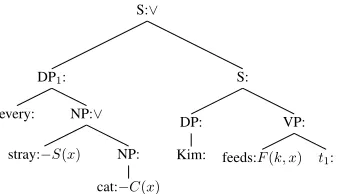
Figure 1:A tree that serves simultaneously as English LF and parse tree for the CNF translation−S(x)∨ −C(x)∨F(k, x).
1.2 A solution
The solution I propose can be stated briefly as fol-lows. (1) Use CNF as the target of semantic trans-lation. (2) Instead of assembling the translation in a bottom-up pass through the parse tree, creating larger and larger partial translations at each step, let us label selected nodes in the parse tree with CNF operators. In other words, take the English parse tree
to bethe CNF parse tree, albeit with some extrane-ous nodes and labels. The resulting tree is symmet-ric between English and CNF (e.g., Figure 1). In particular, the leaf nodes are labeled symmetrically with English words and CNF literals. Define a stan-dard grammar with features to generate such trees. (3) Given a CNF expression as input from general cognition, use the grammar to parse the sequence of literals, constructing an English/CNF parse tree, and read off the English sentence.
Figure 1 provides an illustration of a combined English/CNF parse tree. The English portion is the LF for the sentenceKim feeds every stray cat, and the CNF portion represents the translation−S(x)∨
−C(x)∨F(k, x). Each node has a label pairα:β.
For the purposes of the grammar, the label pairs are simply complex categories; we construct a sin-gle grammar that generates the pairs. When pars-ing English, the input consists of the English labels of leaf nodes (Kim feeds every stray cat) and when parsing CNF, the input consists of the CNF labels
−S(x),−C(x), F(k, x).
A few complications must be addressed, but they have known solutions. We must convert the tree from LF to SS before parsing English, creating a necessity for two different versions of the grammar, one for LF and one for SS. However, both versions generate the same labels, and the two-step process of parsing and converting to LF is standard and
fa-miliar. In the CNF-to-English direction, the CNF input will actually be partially parsed input: for ex-ample,[∨−S(x),−C(x), F(k, x)]. We do not pass
the nonterminal nodes directly as input to the parser, but rather use them to constrain the operation of the parser. In our example, the constraint prevents the parser from constructing a node whose right la-bel is not∨. Further, CNF is a “free word order”
language. Unordered inputs make for less efficient parsing, but they are manageable, and the partial-parse constraints actually ameliorate the problem. There are also more empty nodes in the CNF-to-English direction than in the other direction—for example, in Figure 1, the nodes labeled “every:,” “Kim:,” and “t1:” are all empty nodes in the
CNF-to-English direction—but parsers routinely deal with empty nodes, and dealing with many of them is no harder than dealing with a few. In short, handling these issues requires some care in implementation but no novel parsing techniques.
The main question I will address in the rest of the paper is how we systematically design the gram-mar, that is, how we determine what the CNF labels should be.
2 Direct translation constrained by feature propagation
2.1 Assigning FOPC labels
To assign CNF operators to LF nodes, I propose (at least conceptually) that we first label the tree with the usual FOPC translation, and then apply the stan-dard conversion to CNF. I adopt the particularly di-rect form of translation sketched in the previous sec-tion. A key desideratum is that the assignment of se-mantic operators and atomic formulae to parse-tree nodes should be constrained by local feature con-straints of the usual sort. The full power of feature grammars will not be required; features with atomic values will suffice.
S:∀x
every1: S:→
DP1:
e1: NP:∧
stray:S(x) NP: cat:C(x)
S:
DP:
Kim:
VP:
[image:3.612.108.259.70.180.2]feeds:F(k, x) t1:
Figure 2:The LF tree labeled with the standard FOPC transla-tion.
How do we specify this labeling within the gram-mar? Constraining the occurrence of semantic oper-ators and predicates is generally straightforward and local. For our example, we may state as a general rule that an NP representing adjectival modification translates as∧, that an S headed by a (raised) univer-sal determiner translates as ∀ (we return shortly to the question of the variable), and that an S that is sib-ling of a universal determiner translates as→. In the leaf-node translations, the predicates obviously rep-resent the lexical translations of the corresponding English words (Sforstray,Cforcat,F forfeed). It is less obvious how to constrain the choice of vari-ables.
2.2 Index propagation
The standard approach relies heavily on lambda ex-pressions to specify which variable goes in which position. This is a major cause of difficulty in in-version: the inverse of beta-reduction is infinitely ambiguous. Instead of using lambda expressions, let us replace numeric syntactic indices with the seman-tic variables themselves and propagate them through the tree by syntactic feature-passing. We can then use the syntactic indices to determine the choice of variables in the atomic formulae.
In our example, let us use the variable k for the
subject DP and x for the raised object DP. Let us
propagate the DP index throughout the DP, and use it to determine the variables in the atomic formulae
S(x)andC(x), as in Figure 3. (I give a more
rigor-ous characterization of the spreading in Constraint 2 below.)
As for the variables in F(k, x), let us assume a
form of syntactic concord in which the subject’s in-dexkis shared with the VP and then, because V is
Sx:∀
everyx S:→
DPx
ex NPx:∧ Adjx
stray:S(x)
NPx
Nx
cat:C(x)
S
DPk
Kim
VPk
Vk,x
feeds:F(k, x)
[image:3.612.352.500.70.201.2]tx
Figure 3:The results of index propagation.
S
DPa
Ann
VPa:¬
doesa not VPa:∨
VPa
sing:S(a)
or VPa
dance:D(a)
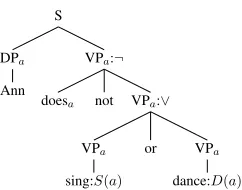
Figure 4: Negation and VP disjunction; the translation is
¬(S(a)∨D(a)).
the head of VP, with the V. Let us also impose an object-agreement constraint on the verb, requiring its second subscript to match the object.
Only two minor items remain: traces obtain their indices from their antecedents in the usual way, and the variable associated with∀is now written as an
index. Figure 3 shows the final result. Henceforth I omit colons when the semantic label is empty. I also usually omit preterminal nodes—Adj, N, V—to save space, but I include them when needed for clarity.
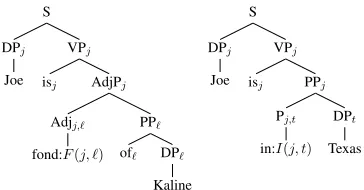
Let us consider some more examples (adapted from Heim and Kratzer (1997)). These will motivate additions to the index propagation rules, and will il-lustrate at least a small range of cases in which index propagation can be used in lieu of lambda expres-sions. The tree in Figure 4 illustrates negation and disjunction, and the trees in Figure 5 illustrate the handling of “case-marking” versus “lexical” prepo-sitions. Relative clauses and multiple quantifiers are illustrated in later trees.
Note that Figure 4 includes an extension of the in-dex propagation rules: the auxiliary (namely,does) shares its index with its complement (the disjunc-tive VP). In Figure 5 we have extended the object-agreement rule to apply to the two-place adjective
[image:3.612.372.493.222.317.2]S
DPj
Joe VPj
isj AdjPj
Adjj,`
fond:F(j, `)
PP`
of` DP`
Kaline S
DPj
Joe VPj
isj PPj
Pj,t
in:I(j, t)
DPt
Texas
Figure 5:Differing treatments of case-marking (left) and lexi-cal (right) prepositions.
sense that it shares its index with its complement. In the right-hand tree,inis treated like a transitive verb, sharing its first index with its parent and sharing its second index with its object.
2.3 Constraints on indices
Based on the examples we have considered, we may hazard a general statement of the index propagation rules. Indices are present only as required by the following two constraints.
Constraint 1 (Intrinsic Indices) Every DP has an index (excluding pleonastics). A leaf node labeled with atomic formulaπ(α1, . . . , αn)must be child of
a preterminal with syntactic indicesα1, . . . , αn.
Constraint 2 (Index Propagation) Syntactic in-dices are propagated as necessary to satisfy the following requirements.
1. A trace has the same index as its antecedent.
2. A modifier has the same index as the node it modifies.
3. A function word (e.g., auxiliary, case marker) has the same index as its complement.
4. An argument-taker’s last index is the same as the argument’s index. In this case and this case only, the index isdischarged.
5. A parent inherits its head’s undischarged in-dices.
“Head” includes X heads, as well as the head in
an adjunction structure, all heads in a coordina-tion structure, and the relative pronoun in a relative clause.
+¬
−∨
−P −∧
−Q −¬
[image:4.612.86.268.70.165.2]+R
Figure 6: Local propagation of node polarity substitutes for negation lowering.
3 Conversion to CNF
The standard conversion from unrestricted FOPC to CNF involves a sequence of tree transformations: (1) rewriting conditionals, (2) lowering negation, (3) Skolemization, and (4) distribution (of disjunc-tion over conjuncdisjunc-tion). We would like to consider how to implement the conversion via feature con-straints, without altering the basic structure of our LF trees.
3.1 Negation lowering
Let us begin with negation lowering. Its effect is to eliminate the negation operator in favor ofliterals, consisting of an atomic formula and a sign (posi-tive or nega(posi-tive). By adding polarity as an attribute of all nodes, not just terminal nodes, we can give a succinct characterization of negation lowering in the form of a local constraint that is readily imple-mented in a feature grammar.
Constraint 3 (Polarity) (a) The polarity of the root node is positive. (b) The polarity of a child node is the same as the polarity of its parent, unless the par-ent node is labeled with an operator that is polarity-reversingfor the child in question, in which case the child’s polarity is the opposite of the parent’s.
For our purposes there are two polarity-reversing op-erators: negation and the conditional →, which is
polarity-reversing for its first child.
As an example, the FOPC expression¬(P∨(Q∧ ¬R))has the parse tree in Figure 6. Polarities have
been added in accordance with Constraint 3. In par-ticular, ¬ has inverse polarity to that of its child,
+¬ = −¬ = +∧ =∧ −∧ =∨ +∨ =∨ −∨ =∧ +→=∨ −→=∧ +∀ = −∀ = +∃ = −∃ =
Table 1:The interpretations of signed operators.
S:+→
CP−
if S−
Anna VPa:−∧
VP−
a
dancesa:−D(a)
and VP−
a
singsa:−S(a)
S+
Bettyb VP+
b
isb AdjP+
b happyb:+H(b)
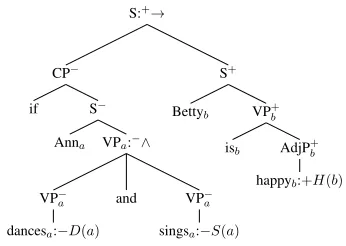
Figure 7:An LF tree illustrating polarity reversal under→.
is indeed logically equivalent to¬(P∨(Q∧ ¬R)).
Note thatindicates deletion of the operator.
3.2 Rewriting conditionals
In the standard conversion to CNF, rewriting con-ditionals precedes negation lowering. We can deal with conditionals as follows. We define the signed operator +→ to be a synonym for ∨ and −→ to
be a synonym for ∧. However, unlike ∨ or ∧, ±→ reverses the polarity of its first child.
Con-sider the example of Figure 7. The → opera-tor inverts the polarity of its first child, but other-wise polarities are passed unchanged from parent to child. Accordingly, Figure 7 is equivalent to
−D(a)∨ −S(a)∨+H(b), which is indeed
equiva-lent toD(a)∧S(a)→H(b), the natural translation
forif Ann dances and sings, Betty is happy.
Note that Table 1 is used in the process of “read-ing off” the CNF expression for input to the rea-soner; it is not used to eliminate signed operators from the LF tree. The signed operators do serve a purpose beyond the truth function they represent. For one thing, even though+→is equivalent to∨,
the former reverses its first child’s polarity whereas the latter does not. The signed operators also permit us to use local constraints to define the assignment of translations. An example of such a local constraint is the following:a node has semantic operator→if
it is headed by a CP headed by “if.” Such a state-ment remains valid whether the polarity of the node is positive or negative, though in the former case the signed operator +→ is interpreted as ∨ and in the
latter case the signed operator−→is interpreted as ∧.
3.3 Skolemization
The third step of the conversion to CNF is Skolem-ization. As usually formulated, one replaces existen-tially bound variables with Skolem terms consisting of a Skolem function applied to the list of outscoping universal variables, then one deletes all quantifiers. The deletion is already reflected in Table 1—though, as already mentioned, the signed operators remain in the LF tree and are not actually deleted until we read off the CNF expression for input to the reasoner.
I will use the termvariableto refer loosely to both universal variables (that is, implicitly universally-bound variables) and Skolem terms. I write Skolem functions with a dot, e.g.,x˙, to make it easy to
dis-tinguish them from universal variables. Whether a variable should be a universal variable or a Skolem term is determined by the signed operator at the vari-able’shome, which I define to be the node labeled with the quantifier that originally bound it. Specifi-cally:
Constraint 4 (Variable type determination) (a) The syntactic index of a node whose signed operator is+∀or−∃ must be a universal variable, and (b) the syntactic index of a node whose signed operator is+∃or−∀must be a Skolem term.
This constraint determines the type of variable, and the variable is then propagated to other nodes by Constraint 2. See Figure 8 for an example.
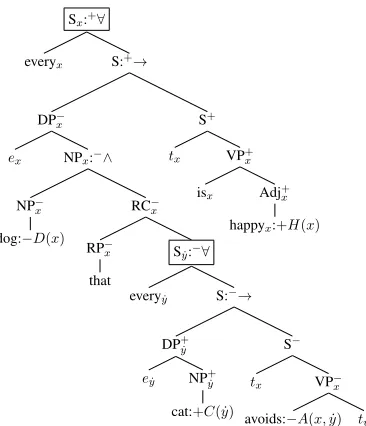
The variabley˙ in Figure 8 is a shorthand for the
Skolem term y˙(x). To avoid clutter, I have
sup-pressed the argument list, but it does need to be com-puted in a complete implementation. One may use a featureouvwhose value for a given nodeνis the list
ofoutscoping universal variables, that is, the list of universal variables whose home position dominates
ν. It is straightforward but tedious to write out the
feature constraints that determine the correct value forouv; I omit the details.
[image:5.612.101.274.182.305.2]Sx:+∀
everyx S:+→
DP−
x
ex NPx:−∧
NP−
x
dog:−D(x)
RC−
x
RP−
x
that
Sy:˙−∀
everyy˙ S:−→
DP+ ˙
y
ey˙ NP+y˙
cat:+C( ˙y)
S−
tx VP−x avoids:−A(x,y˙) t˙y S+
tx VP+x isx Adj+
x
[image:6.612.105.288.68.281.2]happyx:+H(x)
Figure 8:A complex example. The boxed nodes are the home nodes for the variablesxandy˙.
occurring at the first child of a node with operator
→. The boxed nodes are the homes of the two quan-tifiers. Because the upper one has signed operator
+∀, the variable is a universal, and because the lower
one has signed operator−∀, the variable is a Skolem
term.
Reading off the CNF, we obtain the following. For readability, I have again replaced the signed op-erators with their more familiar unsigned equiva-lents; I also indicate the Skolem argument lists ex-plicitly.
−D(x)∨[C( ˙y(x))∧ −A(x,y˙(x))]∨H(x).
In words: eitherxis not a dog, or elsex’sy˙is a cat
thatx fails to avoid, or elsex is happy. That is in-ferentially equivalent to the original sentenceevery dog that avoids every cat is happy.
3.4 Donkey anaphora
A pleasant side effect of the lack of explicit quanti-fiers in CNF is that donkey anaphora becomes avail-able without any stipulations. The structure of ev-ery farmer that owns a donkey beats it is essen-tially the same as that in Figure 8 except for the choice of lower quantifier: see Figure 9. I assume that the pronoun it picks up the index of its an-tecedent a donkey. The resulting CNF translation is −F(x)∨ −D(y)∨ −O(x, y) ∨B(x, y), which
Sx:+∀
everyx S:+→
DP−
x
ex NPx:−∧
NP−
x
farmer:−F(x)
RC−
x
RP−
x
that
Sy:−∃
ay S:−∧
DP−
y
ey NP−y donkey:−D(y)
S−
tx VP−x owns:−O(x, y) ty S+
tx VP+x V+
x,y
beats:B(x, y)
DP+
y
it
Figure 9:Donkey anaphora is covered without stipulation.
correctly captures the strong reading.1
3.5 Distribution
The final step in the conversion to CNF is distri-bution of disjunction over conjunction. Distribu-tion unavoidably involves a structural transforma-tion of the tree, so we will not attempt to incorpo-rate it into the LF structure. Although distribution is not uniquely invertible, the degree of ambiguity that arises in inversion is limited. When translating from CNF to English, let us assume the inverse of distribution, which we may callconsolidation, as a preprocessing step.
To fix ideas, let us consider the following exam-ple:
φ=P∨(Q∧R)
The result of distribution isψ:
ψ= (P ∨Q)∧(P ∨R)
In general, whenever distribution is non-trivial, it has the effect of introducing copies of existing atomic formulae, as with P in ψ. Hence invert-ing distribution (consolidation) involves recombin-ing copies. Consolidation is ambiguous. For exam-ple, φis not the only undistributed expression that 1I suggest that the weak reading is spurious; the use of the
may give rise to ψ: ψ itself might have been the
source. More generally, every way of combining copies produces a form that constitutes a possible undistributed source.
On the other hand, the amount of ambiguity is limited by the number of duplicates in the input (go-ing from CNF to English). Moreover, each possible result of consolidation does give rise to a valid En-glish sentence. The choice among them is not one of well-formedness but of stylistic preference. Since each duplicate atomic formula gives rise to dupli-cated words, it seems natural to prefer to do as much consolidation as possible, and we may adopt that as a heuristic.
In most cases, there is a unique most-consolidated form, though it is possible to construct exam-ples with multiple distinct maximally-consolidated forms. For example, given the CNF expression
(P∨Q)∧(Q∨R)∧(R∨P), we may eliminate any
one of the three duplicate pairs, but only one, leav-ing us with three different maximally-consolidated forms. This is not likely to be a major problem in practice.
4 Discussion
4.1 Generalized quantifiers
Important questions remain. Perhaps the most ur-gent is how generalized quantifiers are to be ac-commodated in the proposed approach. Generalized quantifiers are relations between sets, so the ques-tion can be rephrased as accommodating phrases (namely, NPs) that define sets.
One can include sets in a first-order account by reification. That is, introduce a membership predi-cateM and define a set such ass˙=λx . φ[x]as:
M(x,s˙)↔φ[x].
The problem is that converting an LF tree that con-tains ↔ to CNF involves a substantial structural change. For example, M(x,s˙) ↔ F(x) ∧G(x),
converted to CNF, expands out as:
[−M(x,s˙)∨F(x)]∧ [−M(x,s˙)∨G(x)]∧
[−F(x)∨ −G(x)∨M(x,s˙)].
(1)
My proposal relies crucially on the conversion to CNF being structure-preserving, but this is a case in which it emphatically does not preserve structure.
One possibility is to permit ↔ in the LF tree as
a primitive operator, and to handle it much as we handled distribution. Going from the LF tree to the reasoner, an expression containing ↔ is expanded
out as in (1). In the opposite direction, as a pre-processing step one seeks instances of the pattern illustrated in (1) and replaces them withM(x,s˙)↔
F(x)∧G(x), much as we recognize the repetitions
that may be consolidated. A more ambitious alter-native is to incorporate the replacement into the rea-soner as an inference rule, much as rearea-soners often include primitive support for an equality predicate and substitution of equals. I leave this as a question for future research.
4.2 Related work
There have been proposals in the literature for re-versible grammars, which support both interpre-tation and generation (Appelt, 1987; de Kok et al, 2011; Copestake et al, 1996; Melamed, 2003; Shieber, 1988; Shieber and Schabes, 1990; Shieber et al, 1990; Strzalkowski, 1991; Strzalkowski, 1994). Reversibility was indeed one of the original motivations for unification grammars (Kay, 1975; Kay, 1996), though the translational target was predicate-argument structure rather than FOPC. The present paper can be seen as extending that work to map bidirectionally between English and CNF using a feature grammar.
For general unification grammars, it was proposed that one define an interpretation relation I(s, φ) in
Prolog: to parse, provide the sentencesand solve for the meaningφ, and to generate, provideφand solve
fors(Shieber, 1988; Shieber et al, 1990).
Unfortu-nately, solving for sproved to be beyond Prolog’s abilities, and much work went into elaborate meth-ods for helping Prolog along (Strzalkowski, 1991; Strzalkowski, 1994). In additional, the usual uni-fication grammars were susceptible to the logical-equivalence problem that Shieber pointed out: the range ofφinI(s, φ)is typically not the entire space of FOPC expressions but only a subset of the space, and given an arbitrary inputψone must seek a
log-ically equivalent ψ0 for which I(s, ψ0) is defined; but logical equivalence is not decideable (Shieber, 1993).
of logically equivalent expressions corresponding to a given semantic input (Whitelock, 1992; Trujillo, 1995). Perhaps the best known current approach is Minimal Recursion Semantics (MRS) (Copestake et al, 2005). However, MRS expressions are not “flat” in the right way—an MRS expression is actually a meta-logical description of a standard FOPC parse tree—and the use of MRS does not ameliorate the logical equivalence problem. The main attraction of MRS is not that it addresses the problems of inter-est here, but that it supports a transparent and com-pact representation of certain ambiguities, particu-larly quantifier-scope ambiguities.
When genuinely flat semantic languages have been proposed (Whitelock, 1992; Trujillo, 1995), they usually have severely limited expressivity, per-mitting only conjunctions of ground clauses, and ex-cluding disjunction and quantification. By contrast, CNF represents a flat semantic language with the full expressive power of FOPC. It is flat in the sense that no CNF expression has depth greater than three: the most complex CNF expression is a conjunction of clauses, each clause being a disjunction of literals. There are no explicit quantifiers, but their expres-sive capacity is preserved via the distinction between universal variables and Skolem terms. The use of CNF for semantic translations does ameliorate the logical equivalence problem. A CNF expression is the normal form for an (infinite) equivalence class of unrestricted FOPC expressions, and the commonest sorts of logically equivalent pairs fall together when we map to CNF.
I build also on a line of inquiry into reversibil-ity that involves simultaneous grammars, in which a single derivation constructs two parse trees. Si-multaneous grammars have been used both for ma-chine translation (Melamed, 2003) and for transla-tion between English and FOPC (Shieber and Sch-abes, 1990). However, previous work has not con-sidered the further conversion from FOPC to CNF. Moreover, the simultaneous grammars considered in this paper are unusually simple: the two syntax trees are homomorphic, allowing them to be treated as a single tree with paired labels.
4.3 Conclusion
I have described a method of translating between English and CNF whose advantages are as follows:
it provides a direct connection to automated reason-ers; it is fully invertible; it is arguably simpler than simultaneous-tree or standard direct-interpretation approaches; it ameliorates the logical-equivalence problem by virtue of CNF’s status as normal form; it is computable using an atomic-valued feature gram-mar, enabling efficient parsing/generation; and it predicts the existence of donkey anaphora as a side effect of Skolemization, which is an essential step in the conversion to CNF. To the extent that the pro-posal has merit, it illustrates how considerations of the role of interpretation in the larger cognitive sys-tem can influence the form of the semantic account in fundamental ways.
Acknowledgements
I have benefited greatly from discussions with Ezra Keshet and joint work we have done on seman-tic consequences of using CNF as metalanguage. The paper has also benefited from the comments of anonymous reviewers. Obviously, they bear no re-sponsibility for any remaining shortcomings of the work.
References
James Allen. 1995. Natural Language Understanding
(Second edition). Benjamin Cummings, Menlo Park, CA.
Douglas E. Appelt. 1987. Bidirectional grammars and the design of natural language generation systems. In:
Theoretical Issues in NLP 3.
Patrick Blackburn and Johan Bos. 2005. Representa-tion and Inference for Natural Language.CSLI Publi-cations, Stanford, CA.
Ann Copestake, Dan Flickinger, Robert Malouf, Susanne Riehemann, and Ivan Sag. 1996. Translation using minimal recursion semantics.Proceedings of the Sixth International Conference on Theoretical and Method-ological Issues in MT.
Ann Copestake, Dan Flickinger, Carl Pollard, and Ivan Sag. 2005. Minimal Recursion Semantics: An in-troduction. Research on Language and Computation
3:281–332.
Dani¨el de Kok, Barbara Plank, and Gertjan van Noord. 2011. Reversible Stochastic Attribute-Value Gram-mars. Proceedings of the Conference of the Associ-ation for ComputAssoci-ational Linguistics (ACL).
Irene Heim and Angelika Kratzer. 1997. Semantics in generative grammar. Blackwell Publishers.
Daniel Jurafsky and James H. Martin. 2009. Speech and Language Processing(2nd edition). Prentice Hall, Upper Saddle River, NJ.
Martin Kay. 1975. Syntactic processing and functional sentence perspective. Proceedings of TINLAP.
Martin Kay. 1996. Chart generation. Proceedings of the Conference of the Association for Computational Linguistcs (ACL).
John E. Laird. 2012. The Soar Cognitive Architecture.
The MIT Press, Cambridge, MA and London, Eng-land.
William McCune. 2003a. Mace4 Reference Manual and Guide. Tech. Memo ANL/MCS-TM-264, Mathemat-ics and Computer Science Division, Argonne National Laboratory, Argonne, IL.
William McCune. 2003b. Otter 3.3 Reference Manual.
Tech. Memo ANL/MCS-TM-263, Mathematics and Computer Science Division, Argonne National Labo-ratory, Argonne, IL.
Dan Melamed. 2003. Multitext Grammars and Syn-chronous Parsers, Proceedings of NAACL.
Robert C. Moore. 1989. Unification-based semantic in-terpretation. Proceedings of the 27th Meeting of the Association for Computational Linguistics.
Fernando Pereira and Yves Schabes. 1992. Inside-outside reestimation from partially bracketed corpora.
Proceedings of the Association for Computational Linguistics 30th Annual Meeting, 128–135. Newark, Delaware.
Stuart J. Russell and Peter Norvig. 2002.Artificial Intel-ligence: A Modern Approach(2nd edition). Prentice Hall, Upper Saddle River, NJ.
Stuart Shieber. 1988. A uniform architecture for pars-ing and generation. Proceedings of the 12th Confer-ence on Computational Linguistics (COLING),vol. 2, pp. 614–619.
Stuart Shieber. 1993. The problem of logical-form equivalence. Computational Linguistics19(1), 179– 190.
Stuart Shieber and Yves Schabes. 1990. Synchronous Tree-Adjoining Grammars. Proceedings of the Con-ference on Computational Linguistics (COLING).
Stuart Shieber, Gertjan van Noord, Fernando Pereira, and Robert Moore. 1990. Semantic head-driven genera-tion. Computational Linguistics16(1):30–42.
Tomek Strzalkowski. 1991. A general computational method for grammar inversion. Proceedings of the ACL Workshop on Reversible Grammar in Natural Language Processing.
Tomek Strzalkowski (ed.) 1994. Reversible Grammar in Natural Language Processing. Kluwer Academic Publishers.
Indalecio Arturo Trujillo. 1995. Lexicalist Machine Translation of Spatial Prepositions.PhD dissertation, University of Cambridge.