Website Design Quality and Form Input Validation: An
Empirical Study on Irish Corporate Websites
Mary Levis1, Markus Helfert1 and Malcolm Brady1
1 Dublin City University
ABSTRACT
The information maintained about products, services and customers is a most valuable organisational asset. Therefore, it is important for successful electronic business to have high quality websites. A website must however, do more than just look attractive it must be usable and present useful, usable information. Usability essentially means that the website is intuitive and allows visitors to find what they are looking for quickly and without effort. This means careful consid-eration of the structure of information and navigational design. According to the Open Web Applications Security Pro-ject, invalidated input is one of the top ten critical web-application security vulnerabilities. We empirically tested 21 Irish corporate websites. The findings suggested that one of the biggest problems is that many failed to use mechanisms to validate even the basic user data input at the source of collection which could potentially result in a database full of useless information.
Keywords: Website Design Quality, Form Input Validation, Information Quality, Data Quality
1. Introduction
The World Wide Web (WWW) is the largest available distributed dynamic repository of information, and has undergone massive and rapid growth since its inception. There are over 2,060,000 users in Ireland alone. Over the last seven years (2000 - 2007), Internet usage in Ireland has grown by 162.8%; in United Kingdom by 144.2%; in Europe by 221.5% and Worldwide by 244.7% [18].
Based on these facts, the Internet has assumed a central role in many aspects of our lives and therefore creates a greater need for businesses to design better websites in order to stay competitive and increase revenue. Interac-tivity is essential to engage visitors and lead them to the desired action and customers are more likely to return to a website that has useful interactivity.
The website's homepage should be a marketing tool designed as a 'billboard' for the organization. The design is critical in capturing the viewer's attention and interest [25] and should represent the company in a meaningful and positive light. Therefore, there are many web design concerns for commercial organizations when designing their website.
The most basic are as follows: content that should be included, selecting relevant and essential information, designing a secure, usable, user friendly web interface that is relatively easy to navigate, and ensuring the site is easy to find using any of the major search engines. In the drive to make the website look appealing from a visual per-spective other factors are often ignored, such as validation
and security, which leads to poor user experience and data quality problems.
Data in the real world is constantly changing therefore feedback is necessary in order to ensure that quality is maintained. Data is deemed of high quality if it ‘correctly represents the real-world construct to which it refers so that products or decisions can be made’ [30]. One can probably find as many definitions for quality on the web as there are papers on quality. There are however, a number of theoretical frameworks for understanding data quality.
[image:1.595.321.555.612.687.2]Redman [33] and Orr [27] have presented cybernetic models of information quality. The cybernetic view con-siders organizations as made up of closely interacting feedback systems that link quality of information to how it is used, in a feedback cycle where the actions of each system is continuously modified by the actions, changes and outputs of the others [2,29,36]. Figure 1 shows an information system in the real world context.
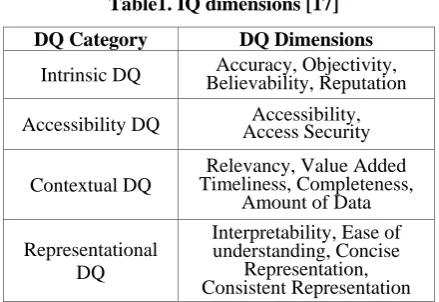
Wang and Strong proposed a data quality framework that includes the categories of intrinsic data quality, ac-cessibility data quality, contextual data quality and repre-sentational data quality outlined in table 1.
Table1. IQ dimensions [17]
DQ Category DQ Dimensions
Intrinsic DQ Believability, ReputationAccuracy, Objectivity,
Accessibility DQ Access SecurityAccessibility,
Contextual DQ
Relevancy, Value Added Timeliness, Completeness,
Amount of Data
Representational DQ
Interpretability, Ease of understanding, Concise
Representation, Consistent Representation
The quality of websites may be linked to such criteria as timeliness, ease of navigation, ease of access and presentation of information. From the customer's perspec-tive usability is the most important quality of a Web ap-plication [8].
However, even if all procedures are adhered to, errors can still arise that reduce the quality standard of the online experience. For example, a file may be moved or an image deleted, which results in broken links. The root cause that leads to web application problems is the poor approach to web design.
To remedy this several techniques exist to evaluate the quality of websites for example link checkers, accessibility checkers and code validation. To help improve the quality of a website, aspects such as structure and page layout need to be consistent and coherent. A good website must include safeguards against failure and provide simple, user friendly data entry and validation processes.
[image:2.595.64.284.127.278.2]From the literature reviewed a universal definition of information quality is difficult to achieve [3, 21, 26, 29, 38, 42]. According to [25] 'Technically, information that meets all the requirements is quality information'. Some ac-cepted definitions of quality from the quality gurus are shown in table 2.
Table 2. Quality definitions from the quality gurus
Author Quality Definitions
Deming Meeting the customers needs
Juran Fitness for use
Crosby Conformance to requirements
Ishikawa Continuous improvement
Feigenbaum Customer satisfaction
One definition of quality is ‘the totality of characteris-tics of an entity that bear on its ability to satisfy stated and implied needs’ [13, 14]. Two requirements for website evaluation emerge from this definition. 1) general valua-tion of all the site’s characteristics and 2) how well the site meets specific needs.
1.1. Related Work
Pernici and Scannapieco [28] discuss a set of data quality dimensions such as expiration, completeness, source reli-ability, and accuracy to evaluate data quality in web in-formation systems to support correct interpretation of web pages content. Cusimano Com Corp[4] declared that ef-fective web sites must be clear, informative, concise, and graphically appealing.
Tilton [40] recommends that Web designers should present clear information that has a consistent navigation structure. Hylnka and Welsh [12] put forward the argu-ment that the web page is a source of communication and should be analysed within communication theory.
Kelly and Vidgen [16]is concerned with the combina-tion of a quality assessment method, E-Qual, and a light-weight quality assurance method, QA focus and states that website developers need to use standards and best prac-tices to ensure that websites are functional, accessible and interoperable.
There are a number of ways to evaluate the quality of websites, such as competitive analysis, inspection, and online questionnaires. WebQual, developed by Barnes and Vidgen [1] is one approach to the assessment of website quality. WebQual, has 3 main dimensions: usability, in-formation quality, and service interaction quality. Ac-cording to[1],WebQual is a ‘structured and disciplined process that provides a means to identify and carry the voice of the customer through each stage of product and or service development and implementation’.
Usability is concerned with the quality associated with the site design; Information Quality is concerned with the quality of content of the site; Service Interaction quality is concerned with quality provided to the users as they enter into the site. Within these dimensions, WebQual consists of a set of 23 questions regarding the website being as-sessed and each question contains a rating from 1-7; 1 = strongly disagree, 7 = strongly agree.
Detailed information about evaluating websites can be found at [24, 34, 35].Eppler & Muenzemayer[7] identifies 2 manifestations, 4 quality categories, and 16 quality di-mensions. Kahn et al. [17] mapped IQ dimensions to the PSP/IQ model with 2 quality types, 4 quality classifica-tions, and 16 quality dimensions. Zhu & Gauch [44] out-lines 6 quality metrics for information retrieval on the web.
1.2. What Is a Quality Website?
quality of business websites and web designers should be aware of how design affects the quality of the website and the image of the organization.
Good websites have a rich and intuitive link structure. A link going to the Customer Service should be named 'Customer Service' and the surfer looking for Customer Service information will know this link goes to the page they want. Therefore, 'click here' should never be used as a link.
Information managers and developers must determine how much information users need [25]. Some users will need much background on a specific topic whilst others may only need a summary or overview. A good web de-signer will think clearly about how each piece of data links up with the rest of the content on the website and will organize the links accordingly.
Without a clear navigation system, viewers can become disoriented. Hyperlinks are distinguished from normal text within a page by its colour. When the page pointed to by a hyperlink has been 'visited’ browsers will inform the users by changing the link's colour [41].
The most vulnerable part of any web application is its forms and the most common activity of web applications is to validate the users’ data. According to the Open Web Applications Security Project [27] invalidated input is in the top ten critical web application security vulnerabilities. Input validation is an important part of creating a robust technological system and securing web applications. Be-cause of the fundamental client server nature of the web application, input validation should be done both on the client and the server.
Client side validation is used to provide input data validation at the data collection point before the form is submitted and check that the required fields are filled and conform to certain characteristics such as built in length restriction, numeric limits, email address validity, charac-ter data format etc. Incorrect data validation can lead to data corruption.
Table 3. Example validation checks
Validation check Description
Character set Ensure data only contain char-acters you expect
Data format Ensure structure of data is con-sistent with what is expected
Range check Data lies within specific range of values
Presence check No missing / empty fields
Consistency check If title is 'Mr' then gender is 'Male'
Input validation should be performed on all incoming data ensuring the information system stores clean, correct
and useful data. Examples of invalid data are: text entered into a numeric field, numeric data entered into a text field, or a percentage entered into a currency field. Table 3 provides an example set of checks that could be performed to ensure the incoming data is valid before data is proc-essed or used.
Having contact information available and visible on the website is a marketing plus that potential customers use in order to judge a company’s trustworthiness, as it signifies respect for the customer and implies promise of good service.
Feedback mechanisms built into the website are a useful way to get meaningful feedback on the website and service quality from the people who matter most – your customers. After all, one definition of quality is ‘meeting or exceeding the customer’s expectations’.
One of the most important factors for a website being successful is speed. If the website is unresponsive, with long response times the visitors will not come again. Speed or responsiveness is integral to good website design and organizational success. Web pages should be designed with speed in mind [31]. It is estimated that if a page doesn't load within 5-8 seconds you will lose 1/3 of your visitors [35]. However, many designers believe that with the recent development of broadband, visual aesthetics is now more important as download speed is not such a major concern. Nevertheless, not all users have broadband and this should be taken into consideration.
For the purpose of this study we conducted an empirical study using a data set of twenty one finalists in a recent website quality technology award. The aim of this study was to examine these websites for Technical quality issues from the user’s perspective.
Our analysis focused on helping website owners under-stand the importance of certain website characteristics, quality of information and functionalities. During the analysis we tested functionalities in the website like forms, the navigation process, the relevance of all click through and the page download speed.
The rest of the paper is organized as follows: Section 2 shows our methodology, Section 3 gives a brief summary and Section 4 some conclusions.
2. Research
2.1. Methodology
38%
10% 5%
29% 52%
29% 90%
48% 57% 62%
90% 95%
71%
48% 71%
10% 52%
43%
0% 10% 20% 30% 40% 50% 60% 70% 80% 90% 100% their identity.
[image:4.595.311.540.171.633.2]The aim of this study was to examine these websites for Technical quality issues. This required validating the sites against a series of checkpoints that included: checking that legal and regulatory guidelines were adhered to (e.g. data protection and privacy), that pages conformed to Web-Accessibility standard (e.g. missing 'alt tags'), miss-ing page titles, browser compatibility, user feedback mechanisms, applications were functioning correctly (e.g. online forms are validated for input etc.). It also included evaluation of the main characteristics and structure of the sites for example clear ordering of information, broken links, and ease of navigation. The principle used was based on the same criteria used to evaluate the participants in the 2006 award [10, 32, 39, 43]. The criteria subset used for this study is outlined in table 4.
Table 4. Set of criteria used in our study
Validation Criteria
Contrast colours support readability & understanding Professional appearance
Do not use 'click here'
What you clicked on is title of page jumped to Links back to home page are functional & relevant
Help features available and easy to access Visited links change colour
Site map
Interactive form validated for input Mailto parameters set correctly?
Web address simply a case of adding .com or .ie to Useful search engine provided
Site search provided FAQ
Data Protection & Privacy
[image:4.595.59.289.277.513.2]2.2. Findings and Analysis
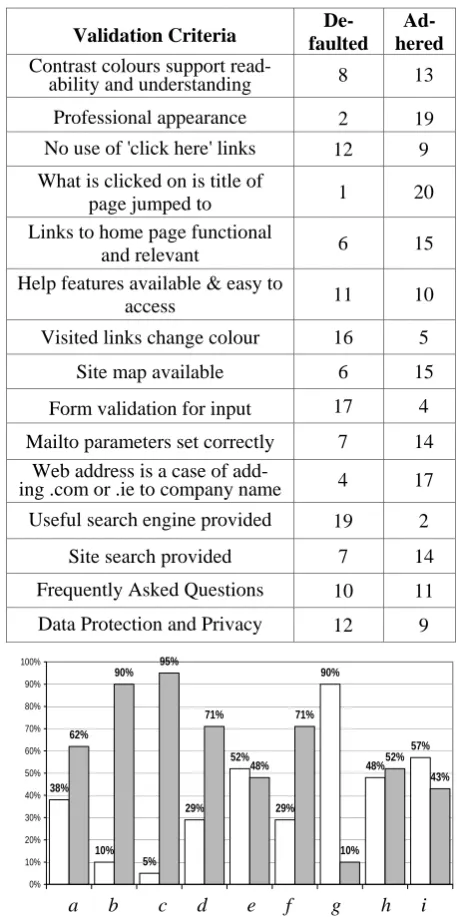
Table 5 shows the number of companies who defaulted and the number of companies who adhered to selected criteria.
Twelve websites did not include a link to their data protection and privacy policy. A help and Frequently Asked Question (FAQ) page is a general requirement for good website design. As far as navigation goes, this page should tell the user how to find products or information and how to get to the sitemap, yet, 10 companies did not have a FAQ link and 11 did not have help features avail-able and easy to access. Seven out of the 21 sites evalu-ated did not have the mailto parameters set correctly.
Fifteen sites had fully functional and relevant links to other pages and back to the homepage. Thirteen sites promoted contrast colours supporting readability and
un-derstanding and 19 had a professional feel and appearance and did not have horizontal scroll bars. Twenty of the total twenty one sites adhered to the criteria of having the title of page jumped also as the label of the link connecting to it. The percentage of sites that adherence to the criteria and the percentage of sites that defaulted on the criteria are shown in figure 2.
Table 5. Criteria for website evaluation
Validation Criteria faultedDe- hered
Ad-Contrast colours support
read-ability and understanding 8 13
Professional appearance 2 19 No use of 'click here' links 12 9
What is clicked on is title of
page jumped to 1 20
Links to home page functional
and relevant 6 15
Help features available & easy to
access 11 10
Visited links change colour 16 5
Site map available 6 15
Form validation for input 17 4
Mailto parameters set correctly 7 14 Web address is a case of
add-ing .com or .ie to company name 4 17 Useful search engine provided 19 2
Site search provided 7 14
Frequently Asked Questions 10 11
Data Protection and Privacy 12 9
a b c d e f g h i
Figure 2. Percentage of sites that defaulted and per-centage of sites that adhered to selected criteria (a- Colours s support readability; b-Professional appear-ance; c-what clicked on was title of page jumped to; d-Links functional &relevant; e-Help features avail-able &easy to access; f-Mailto parameters set cor-rectly. g-Use search engine; h-Frequently asked ques-tion page; i-Data protecques-tion &privacy)
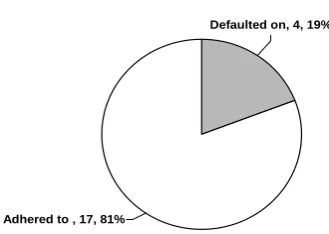
[image:4.595.60.288.278.514.2](Uniform Resource Locator). Seventeen (81%) of the 21 sites tested had good structured semantic URLs, made up of the actual name of the specific company where we could guess the URL by simply adding .com , .org or .ie to the company name. For example a company named ‘Jitnu’ had a URL http://www.jitnu.ie or http://www.jitnu.com or http://www.jitnu.org as the web addresseswhich convey meaning and structure. Only 19 % of the companies amined defaulted on these criteria having a URL for ex-ample such as http://www.jitnu.ie/?id=478 instead of http://www.jitnu.ie/services or had a file extension like .php as part of their URL.
Web address adding .com, .org or .ie
Adhered to , 17, 81%
[image:5.595.330.526.150.289.2]Defaulted on, 4, 19%
[image:5.595.68.233.235.352.2]Figure 3. Results of the friendly URL's criteria
Figure 4 shows that 16 (76%) of the 21 sites examined used the same link colour for visited and unvisited pages and did not support a convention that users expect. Failing on this navigational aid could well increase navigational confusion and introduce usability problems for the user. Good practice is to let viewers see their navigation path history (i.e. pages they have already visited) by displaying links to ‘visited pages’ in a different colour.
Visited links change colour
Did not change colour, 16, 76% Changed Colour
[image:5.595.319.514.380.536.2], 5, 24%
Figure 4. Visited pages changed link colour
Sitemaps are particularly beneficial when users cannot access all areas of a website through the browsing interface. Failure to provide this access option may lose potential viewers. A large website should contain a site map and search option. From analysis of our findings in figure 5, we show that six websites (29%) did not provide a site map.
Visitors appreciate search capability on sites that deals
with several different products or services. In figure 6 we show that although adding a search function on a website helps visitors to quickly find information they need, seven (33%) of the 21 sites reviewed failed to provide a com-prehensive site search or search interface.
Defaulted, Site map , 6
Adheared to, Site map , 15
0 2 4 6 8 10 12 14 16
Site map
Figure 5. Site map
While creating a good navigation system will be suffi-cient help for many people, it won't meet the needs of everyone. It appears that these companies fail to realise the importance of providing a search capability, which not only make sites more interactive but also gives visitors more control over their browsing experience.
Provision of search facility
No Search facility provided, 19
Search Facility provided, 2
0 2 4 6 8 10 12 14 16 18 20
Is a useful search engine provided
Figure 6. Search facility
[image:5.595.70.273.482.619.2]in the inputted email address. From the review of the sites we found that 17 (81%) had no validation process on email addresses while only 4, (19%) of the 21 sites reviewed shown in figure 7 had complete validation.
Interactive form validated for input
Passed input validation,
[image:6.595.117.240.134.260.2]4, 19% Failed input validation , 17, 81%
Figure 7. Email validation
Figure 8 shows that 12 (57%) of the 21 websites were careless about their link text quality by using the ‘Click Here’, which does not give indication of the content of the linked page, while nine (43%) used meaningful link text which clearly identified the target of the links.
Defaulted: Used 'click here',
12
Adheared to, Did not use 'click here',
9
0 2 4 6 8 10 12 14
[image:6.595.322.532.175.305.2]Use typed link labels on HTML anchors; do not use 'click here'
Figure 8. Click here anchors
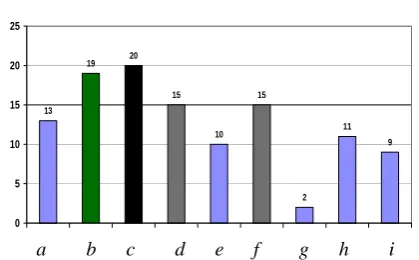
Figure 9 shows the number of companies that observed and adhered to the quality criteria set out for this review and figure 10 shows the number that defaulted in the above criteria. It can be seen that 19 sites had a professional appearance with no annoying horizontal scroll bars and 20 sites used the page title of the page linked to as an anchor. However only 2 of the 21 sites under review had provided a site search option and 4 sites had complete validation on email addresses.
Figure 11 shows that six out of 21 sites under review did not have their ‘mailto’ parameter set correctly to facilitate the user with easy feedback option and none of the 21 sites provided an option for the users to view the feedback provided by other users. Providing feedback options greatly enhances the website as many errors go unnoticed until the user draws it to the attention of the organization.
From our analysis we found that all sites had good page
load speed between a minimum 0.5 seconds and a maxi-mum of 1.5 seconds and an average load speed of .89 seconds. The average download per Kb was .26 seconds with a minimum speed of .02 seconds and a maximum speed of 3.76 seconds. The minimum site size was .17kb, the maximum site size was 45.68kb and the average site size was 20.45 kb.
Adhered To Criteria
13
19 20
15
10 15
2 11
9
0 5 10 15 20 25
[image:6.595.75.258.344.484.2]a b c d e f g h i
Figure 9. Adhered to selected criteria(a- Colors sup-port readability; b-Professional appearance; c-what clicked on was title of page jumped to; d-Links func-tional &relevant; e-Help features available &easy to access; f-Mailto parameters set correctly. g-Use search engine; h-Frequently asked question page; i-Data protection &privacy)
Defaulted
8
2 1
6 11
6 19
10 12
0 2 4 6 8 10 12 14 16 18 20
a b c d e f g h i
Figure 10. Defaulted on selected criteria(a- Colors support readability; b-Professional appearance;c-what clicked on was title of page jumped to; d-Links func-tional &relevant; e-Help features available &easy to access; f-Mailto parameters set correctly. g-Use search engine; h-Frequently asked question page; i-Data protection &privacy)
3. Summary
[image:6.595.327.528.415.556.2]money and resources to make their website a strategic part of their business. But what do their customers actu-ally experience when they perform a transaction on their site?
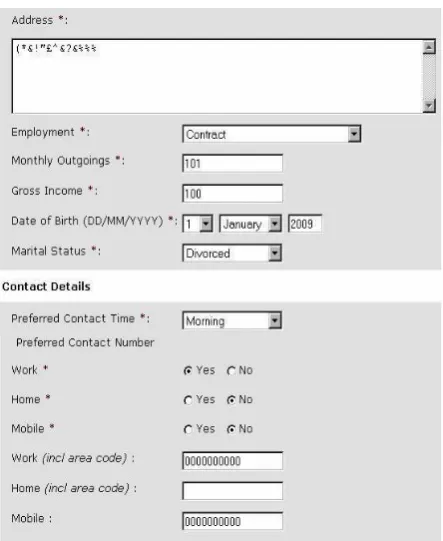
From our study we found that the web applications un-der investigation were notorious for taking practically any type of input, assuming that it's valid, and processing it further. Not validating input is one of the biggest mistakes that Web-application developers make. This can lead to database corruption. The results from our investigation of the company websites show that one of the biggest prob-lems with online forms on the web is that many corporate companies failed to validate user input to ensure reliability and potentially resulted in a database full of useless in-formation. (See figure 12, figure 13 and figure 14).
Number/21
Number/21, 6
Number/21, 21
0 5 10 15 20 25
Feedback "mailto" parameters not set correctly
[image:7.595.317.525.152.194.2]users can not see the feedback that others have provided Feedback "mailto" parameters not set correctly users can not see the feedback that others have provided
Figure 11. Feedback option and accessibility
[image:7.595.302.521.256.520.2]Figure: 12. Example of no date of birth validation on corporate website form
[image:7.595.75.275.270.393.2]Figure 13. Example of trusting the user to enter and validate their own data
Figure 14. Example of useless information collected in one Irish corporate website
[image:7.595.58.280.416.687.2]site map.
Providing a site search function makes the site search-able. The sitemap should include every page on the site, categorized for easier navigation. These are the links that users look for when they cannot find what they are actually looking for on the site. However, 67% provided a site search facility and 81% had friendly URL’s that were easy to remember and most sites had a good design layout that was consistent throughout. The consistency aspect of quality was closely adhered to by all sites making it easier for the user to navigate.
4. Conclusions
Today's Internet user expects to experience personalized interaction with websites. If the company fails to deliver they run the risk of losing a potential customer forever. An important aspect of creating interactive web forms to collect information from users is to be able to check that the information entered is valid, therefore; information submitted through these forms should be extensively validated. Validation could be performed using client script where errors are detected when the form is submit-ted to the server and if any errors are found the submis-sion of the form to the server is cancelled and all errors displayed to the user. This allows the user to correct their input before re-submitting the form to the server. We can not underestimate the importance of input validation which ensures that the application is robust against all forms of input data obtained from the user.
Although the majority of web vulnerabilities are easy to understand and avoid many web developers are unfortu-nately not very security-aware. A company database needs to be of reliable quality in order to be usable. A simple check whether a website conforms to the very basic stan-dards could have been done using the W3C HTML vali-dation service, which is free to use.
Web developers need to become aware and trained in Information Quality Management principles, and espe-cially in the information quality dimensions as outlined in Table 2. The only proven reliable way to deal with bad data is to prevent it from entering the system. Input can be compared against a specific value; ensure that an input field was filled and that the value falls within a certain range. Allowing bad data into the system makes the entire system unreliable and indeed unusable.
Making purchases online is all about confidence; a customer must feel assured that you are a reputable com-pany, and the best way to project that image is through a well designed website. A consumer visiting a website that looks a little dodgy will not feel confident enough to submit their credit card information.
Slow response times and difficult navigation are the most common complaints of Internet users. After waiting past a certain ‘attention threshold’ users look for a faster
site. Of course, exactly where that threshold is depends on many factors. How compelling is the experience? Is there effective feedback? Etc. Our analysis identified these and many other shortcomings that should have been realised and dealt with during the website test phases. Many problems could be eliminated by checking for letters (al-phabet entries only); checking for numbers (numeric en-tries only); checking for a valid range of values ; checking for a valid date input; and checking for valid email ad-dresses. However, it is important to keep in mind that a user could enter a valid e-mail address that does not actu-ally exist. It is therefore, imperative that some sort of ac-tivation process needs to be done in order to confirm a valid and correct email address.
5. Acknowledgements
This research is funded by Dublin City University Busi-ness School.
REFERENCES
[1] Barnes S. J., and Vidgen R.T., An Integrative Ap-proach to the Assessment of E-Commerce Quality, Journal of Electronic Commerce Research, Vol. 3, No. 3, (2002) pp.114-27.
[2] Beckford J., 2nd edition, Quality, Rutledge Taylor and Frances Group, London and New York (2005). [3] Bugajski J., Grossman R. L., Tang Zhao., An event
based framework for improving information quality that integrates baseline models, casual models and formal models, IQIS 2005 ACM 1-59593-160-0/5/06. (2005).
[4] Cusimano Com Corp., Planning and Designing an Effective Web Site,
http://www.cusimano.com/webdesign/articles/effecti v.html .
[5] Clarke R., Internet Privacy Concerns Confirm the Case for Intervention, Communications of the ACM, Vol. 42, No. 2, (1999) pp.60-68.
[6] Cranor L.F., Internet Privacy, Communications of the ACM, Vol. 42, No. 2, (1999), pp.28-31.
[7] Eppler, M & Muenzenmayer, P, Measuring informa-tion quality in the web context: A survey of state of the art instruments and an application methodology. Proceedings of 7th international conference on in-formation quality, (2002), pp.187-196.
[8] Fraternali, P., Tools and Approaches for Developing Data-Intensive Web Applications: A Survey, ACM Computing Surveys, Vol.31, No.3, (1999).
[9] Internet World Statistics
http://www.internetworldstats.com. [10] FFHS Web Award
http://www.ffhs.org.uk/awards/web/criteria.php . [11] Gefen D., E-Commerce: The Role of Familiarity and
Home Page? A Critical Analysis
http://www.umanitoba.ca/faculties/education/cmns/a ect.html).
[13] ISO 8402, Quality Management Assurance- Vo-cabulary, Int’l Org. for standardization, (1994) http://www.techstreet.com/iso_resource_center/iso_ 9000_meet.tmpl .
[14] ISO 9241-11, International Organization for Stan-dardization, Geneva, (1998).
http://www.idemployee.id.tue.nl/g.w.m.rauterberg/le cturenotes/ISO9241part11.pdf .
[15] Jarvenpaa S.L., N. Tractinsky, and M. Vitale, Con-sumer Trust in an Internet Store, Information Tech-nology and Management, Vol. 1, No. 1, (2000), pp.45-71.
[16] Kelly B., and Vidgen R., A Quality Framework for Web Site Quality: User Satisfaction and Quality As-surance, WWW 2005, May 10-14, 2005, Chiba, Ja-pan, ACM 1-59593-051-5/05/0005, (2005).
[17] Khan B K ., Strong D.M. & Wang R.Y., Information Quality benchmarks: Product and service perform-ance, Communications of the ACM, Vol. 45, No 4, (2002), pp.84-192.
[18] Kumar G, Ballou T, Ballou D, P.,Guest editors, Examining data Quality, Communications of the ACM, Vol. 41, No 2, (1998), pp.54-57.
[19] Useit.com:http://www,useit.com/ .
[20] Manchala D.W., E-Commerce Trust Metrics and Models, IEEE Internet Computing, Vol. 4, No. 2, (2000), pp.36-44.
[21] Mandel T., Quality Technical Information: Paving the Way for UsableW3C Web Content Accessibility Guidelines 1.0,
http://www.w3.org/tr/wai-webcontent/ .
[22] McKnight, D.H., L.L. Cummings, and N.L. Cher-vany, Initial Trust Formation in New Organizational Relationships, Academy of Management Review, Vol. 23, (1998), pp.473-490.
[23] McKnight D.H., and N.L. Chervany, An Integrative Approach to the Assessment of E-Commerce Qual-ity, Journal of Electronic Commerce Research, Vol. 3, No. 3, (2002), pp.114-127.
[24] Web standard schecklist.
http://www.maxdesign.com.au/presentation/checklist .htm.
[25] Olson J.E., Data Quality: The Accuracy dimension, Morgan Kaufmann, ISBN 1558608915, (2003). [26] Open Web Application Security Project,
http://umn.dl.sourceforge.net/sourceforge/owasp/O WASPTopTen2004.pdf .
[27] Orr K., Data Quality and Systems, Communications of the ACM, Vol. 41, No 2, (1998), pp.66-71.
[28] Pernici B., and Scannapieco M., Data Quality in
Web Information Systems, (2002) 397-413.
[29] Pike R.J., Barnes R., TQM in Action: A practical approach to continuous performance improvement, Springer, ISBN 0412715309 (1996).
[30] Mandel T., Print and Web Interface Design, ACM Journal of Computer Documentation, Vol. 26, No. 3. ISSN: 1527-6805, (2002).
[31] Poll R., and te Boekhorst, P., Measuring quality performance measurement in libraries, 2nd revised., Saur, Munchen, IFLA publications Durban, 127, (2007)http://www.ifla.org/iv/ifla73/index.htm. [32] Quality Criteria for Website Excellence World Best
Website Awards
http://www.worldbestwebsites.com/criteria.htm. [33] Redmond T.C., Improve Data Quality for
Competi-tive Advantage, Sloan Management Review, Vol. 36, No 2, (1995), pp.99-107.
[34] Schulz U., Web usability,
http://www.bui.fh-hamburg.de/pers/ursula.schulz/we busability/webusability.html,
[35] Selfso
http://www.selfseo.com/website_speed_test.php. [36] Strong D. M., Lee Y. W., Wang R,Y., Data Quality
in Context Communications of the ACM, Vol. 40, No 5, , (1997), pp.103-109.
[37] Stylianou A.C., Kumar R.L., An integrative frame-work for IS Quality management, Communications of the ACM, Vol. 43, No 9, (2000), pp.99-104. [38] Tauscher L., Greenberg S., How people revisit web
pages: Empirical findings and implication for the design of history systems, International Journal of Human-Computer Studies, Vol. 47, (1997), pp.97-137.
[39] McClainT,http://www.e-bzzz.com/web_design.htm. [40] Tilton J. E., Composing Good HTML,
http://www.cs.cmu.edu/~tilt/cgh/.
[41] Wang R.Y., and Strong D.M. Beyond accuracy: what data quality means to data consumers, Journal of Management Information Systems Vol. 12, No 4, (1996), pp.5–34.
[42] Wang R.Y., A product perspective on Total Data Quality Management, Communications of the ACM, Vol.41, No.2, (1998), pp.58-65.
[43] Web standards
http://www.webstandardsawards.com/criteria/#Crite ria .
AUTHORS’ BIOGRAPHIES
Mary Levis joined Dublin City University Business School as a full time, Ph.D Research Scholar in the field of
Infor-mation Management, in November 2006. Mary’s work is co-supervised by Dr. Malcolm Brady, Dublin City University Business School, and Dr. Markus Helfert, Dublin City University (School of Computing). Her studies are funded for three years by a scholarship from Dublin City University Business School. She holds a B.Sc degree in Computer Ap-plications (Info Sys) from Dublin City University (School of Computing). Mary has presented her work at many Inter-national conferences. Mary is a member of the Irish Computer Society (ICS), British Computer Society (BCS), the In-ternational Association of Information Data Quality (IAIDQ), Engineers Ireland (EI) and United Kingdom Academy for Information Systems (UKAIS) Institute for the Management of Information Systems. Mary has been invited by the In-ternational Conference on Enterprise Information Systems (ICEIS) to be session chair of an ICEIS-2008 session(s), in Barcelona, Spain. Email: [email protected]
Dr. Malcolm Brady has lectured in management at Dublin City University Business School since 1996. Prior to joining
DCU he worked for many years as an IT consultant in the financial services and utility industries and before that as a civil engineer in the design and construction of gas, water, and sewerage systems. He teaches courses in strategic management, project management, and business process innovation. His research interests are in game theory, duopoly, advertising, differentiation and competitive advantage. He graduated from University College Dublin with a Bachelors degree in Civil Engineering and a Masters degree in Management Science; he holds a Diplôme d'Ingénieur from Ecole National Supérieur du Pétrole et des Moteurs, a French Grande Ecole; he obtained an MBA from Dublin City University. He recently completed a PhD from the Department of Economics at Lancaster University. Email:[email protected]
Dr. Markus Helfert is a lecturer in Information Systems at Dublin City University, Ireland and programme chair of the
![Figure 1: Information system in the realworld context [29]](https://thumb-us.123doks.com/thumbv2/123dok_us/8732533.386675/1.595.321.555.612.687/figure-information-realworld-context.webp)