© 2019, IRJET | Impact Factor value: 7.211 | ISO 9001:2008 Certified Journal | Page 6094
Smart & Intelligent Field Irrigation System using IoT
Mr. Bhuvnesh Singh
1, Mr. Dharmendra Kumar
2, Mr. Amit Kumar
3, Mr. Ajeet Singh
4,
Dr. Dushyant Singh
51,2,3,4 Department of Electronics & Communication Engineering, Raja Balwant Singh Engineering Technical Campus
Agra, Uttar Pradesh, India
5 Professor, Head of Department of Electronics & Communication of Engineering, Raja Balwant Singh Engineering
Technical Campus Agra, Uttar Pradesh, India
---***---Abstract - The main objective of this project is to develop an
automation irrigation system using an ESP8266 board with Internet being remotely controlled by any computer Operating System as well as mobile application. It is cost effective, simple and easy to use to farmers. This system consists of the soil temperature sensor, air temp & humidity sensor and soil moisture sensor. There are two ESP8266 board used in which one works as transmitter to transmit sensors data to node js server. The second board analysis the data on server and response accordingly to pump and lamp ON and OFF . The second board also works as a manual control of pump and lamp turn ON and OFF. The web & mobile applications use to show the sensors data in visually and also control the pump and lamp if system fails. Automation allows us to control the appliances automatically. This system will be a substitute to traditional farming method.
Key Words: NodeMCU (ESP8266), Nodejs Server, DHT11
sensor, Soil Moisture Sensor, DS18B20 Sensor, Blynk App, Grafana etc.
1. INTRODUCTION
India is the country of village and agriculture plays an important role for development of country. In our country, agriculture depends on the monsoons which has insufficient source of water. So the irrigation is used in agriculture field.
Agriculture is the worldwide prime occupation of human being, 64% of total available land is occupied by the agriculture, and it contains 85% freshwater. This figure of water consumption increases every year due to globalization and population of growth.
Nowadays, for irrigation, different techniques are available which are used to reduce the dependency of rain. And mostly this technique is driven by electrical power and on/off scheduling. In this technique, soil moisture sensors are placed root zone of plant and near the module and gateway unit handles the sensor information.
This project is for to create an IOT based automated irrigation systems which turns the pumping motor ON and OFF on detecting the moisture content and sufficient water level and pass data through IOT platform. The web & mobile applications use to show the sensors data in visually and also control the pump and lamp if system fails. Automation allows us to control the appliances automatically.
1.1 Literature Review
Karan kansara (2015) proposed an automated irrigation system where the humidity and temperature sensors are used to sense the soil conditions and based on that microcontroller will control the water flow. Farmer will be intimated through GSM module. This system doesn’t monitor the nutrient content in the soil [1].
Archana and Priya (2016) proposed a paper in which the humidity and soil moisture sensors are placed in the root zone of the plant. Based on the sensed values the microcontroller is used to control the supply of water to the field. This system doesn’t intimate the farmer about the field status [2].
Sonali D.Gainwar and Dinesh V. Rojatkar (2015) proposed a paper in which soil parameters such as humidity, moisture and temperature are measured for getting high yield from soil. This system is fully automated which turns the motor pump ON/OFF as per the level of moisture in the soil. The current field status is not intimated to the farmer [3].
© 2019, IRJET | Impact Factor value: 7.211 | ISO 9001:2008 Certified Journal | Page 6095 G. Parameswaran and K. Sivaprasath (2016) proposed
a smart drip irrigation system using IOT in which humidity, temperature and pH sensors are used. Irrigation status is updated to the server or local host using personal computer. The farmer can’t access about the field condition without internet [5].
1.2 PRAPOSED SYSTEM
Nowadays agricultural field is facing lot of problems due to lack of water resources. In order to help the farmers to overcome the difficulties, smart irrigation system has been used. In this system, various sensors such as DHT11, soil moisture sensor, DS18B20 are connected to the input pins of ESP8266 microcontroller. The sensed values from the sensors are displayed in Oled as well as on mobile and web application. If the sensed value goes beyond the threshold values set in the program, the pump will be automatically switched ON/OFF by the relay circuit and it is connected to the driver circuit which helps to switch the voltage. The farmer will be intimated about the current field condition through GSM module and also updated in the web page. By using this system, the farmer can access the details about the condition of the field anywhere at any time.
2. METHODELOGY
[image:2.595.310.558.288.474.2]2.1 Block Diagram
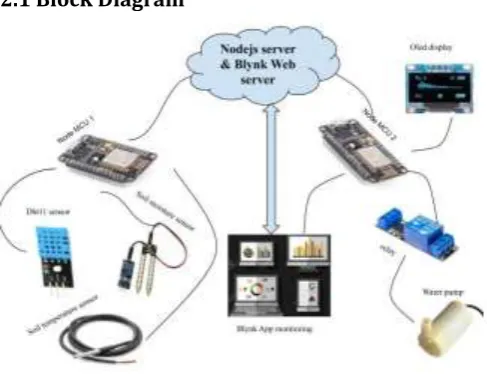
Figure 1. Block diagram of project
From the block diagram we will see that nodemcu-1 consist of three sensors connected that are DHT11 sensor, soil moisture sensor and also soil temperature sensor (DS18B20). Here the nodemcu-1 collect the data from all three sensors and the data are sending to the node JS server into the database that are created by MongoDB
database . This database is also connect with nodemcu second and also connected to the mobile and web application mobile and web applications are used to show the data online and everyone can see that and also monitor. Nodemcu-2 Retrieve the data the data from the node JS server. Nodemcu-2 connected to the railway that also connected with the pump at a used to control pump on and off. The data that are stored by node JS server also show on the Oled display. When the soul master is passes the threshold value the relay will on that by the pump also ON. If the system will fails then we use the manual control of pump and lamp and also we control the pump and lamp by the mobile application.
[image:2.595.36.280.475.662.2]2.2 Flow Chart
Figure 2. Flow chart of project
3. HARDWARE DISCRIPTION
3.1 NodeMCU(ESP8266)
© 2019, IRJET | Impact Factor value: 7.211 | ISO 9001:2008 Certified Journal | Page 6096 early in the development and operation of at least
[image:3.595.101.222.143.242.2]occupy system resources.
Figure 3. NodeMCU(ESP8266)
3.2 SOIL MOISTURE SENSOR
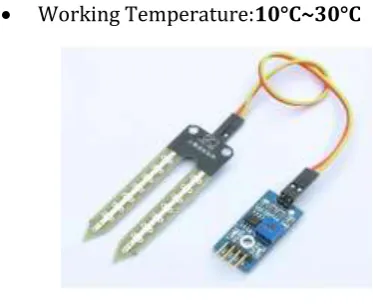
The Moisture sensor is used to measure the water content (moisture) of soil. When the soil is having water shortage, the module output is at high level; else the output is at low level. This sensor reminds the user to water their plants and also monitors the moisture content of soil. It has been widely used in agriculture, land irrigation and botanical gardening.
Working Voltage:5V
Working Current:<20mA
[image:3.595.53.240.426.578.2] Working Temperature:10°C~30°C
Figure 4. soil and moisture sensor
3.3 AIR TEMPERATURE & HUMIDITY SENSOR
DHT11 sensor is used for measuring temperature and humidity. It uses a capacitive humidity sensor and a thermistor to measure the surrounding air. This sensor is cost effective, provides low power consumption and up-to 20 meter signal transmission is possible.
SPECIFICATION
1. Supply Voltage: +5 V
2. Temperature range :0-50 °C error of ± 2 °C 3. Humidity :20-90% RH ± 5% RH error
Figure 5. Air temp & humidity sensor
3.4 SOIL TEMPERATURE SENSOR (DS18B20)
DS18B20 is unique 1-wire interface makes it easy to communicate with devices. It can converts temperature to a 12-bit digital word in 750ms (max). Besides, it can measures temperatures from -55°C to +125°C (-67F to +257F). The DS18B20 can derive power directly from the data line eliminating the need for an external power supply.
Figure 6. Soil Temperature Sensor
3.5 OLED DISPLAY
[image:3.595.364.503.590.726.2]As all these modules support I2C protocol as a mean for communication, the code and wiring of all of them is exact same. OLED display module is a receiver which accepts some data and displays them, while a temperature sensor is a transceiver that sends captured temperature via I2C bus.
© 2019, IRJET | Impact Factor value: 7.211 | ISO 9001:2008 Certified Journal | Page 6097
3.6 5V MINI WATER PUMP
Small DC Submersible water pumps push fluid to the surface as opposed to jet pumps having to pull fluids. Submersibles are more efficient than jet pumps. It is usually operated between 3v to 12v.
Voltage: 2.5-10V 2.
Maximum lift: 40-110cm / 15.75"-43.4" 3. Flow rate: 80-120L/H 4.
[image:4.595.309.559.101.316.2] Outside diameter : 7.5mm / 0.3"
Figure 8. Mini Dc Water Pump
3.7 5V RELAY MODULE
The relay module is an electrically operated switch that allows you to turn on or off a circuit using voltage and/or current much higher than a microcontroller could handle.
Figure 9. 5V Relay Module
4. SOFTWARE DISCRIPTION
4.1 ARDUINO IDE
Arduino IDE is an open source software that is mainly used for writing and compiling the code into the Arduino Module.
It is an official Arduino software, making code compilation too easy that even a common person with no prior technical knowledge can get their feet wet with the learning process. It is easily available for operating systems like
MAC, Windows, Linux and runs on the Java Platform that comes with inbuilt functions and commands that play a vital role for debugging, editing and compiling the code in the environment.
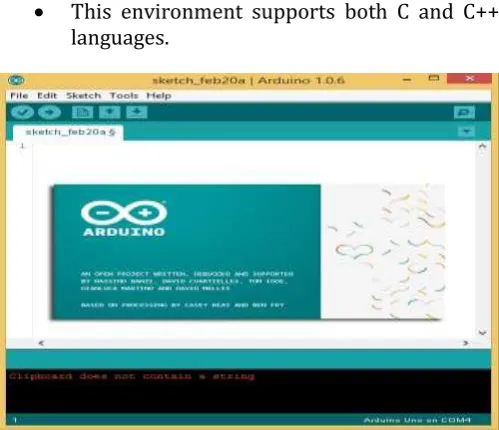
This environment supports both C and C++ languages.
Figure 10. Arduino ide
4.2 GRAFANA
[image:4.595.307.559.578.739.2]Grafana is a beautiful dashboard for displaying various Graphite metrics through a web browser. Grafana is nice because it is simple to set up and maintain and is easy to use and displays metrics in a very nice Kibana like display style.Grafana gives you the ability to bolt on all kinds of bells and whistles to your graphs.
Figure 11. Grafan Icon
© 2019, IRJET | Impact Factor value: 7.211 | ISO 9001:2008 Certified Journal | Page 6098
4. RESULT & OBSERVATION
[image:5.595.38.299.142.335.2]4.1 Visualization on PC
Figure 13. Project Visualization on Grafana Dashboard
4.2 Visualization on Mobile Application
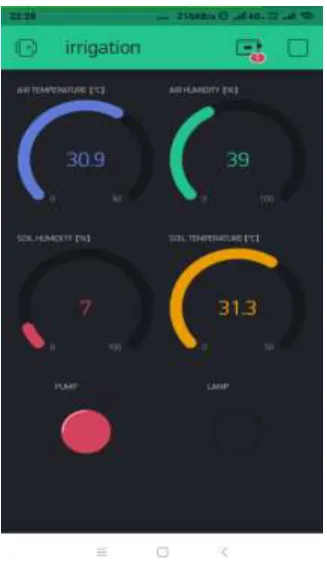
The data is visualize on mobile screen every time whenever the system is ON as figure 14.
Figure 14. Mobile App Data Visualization
[image:5.595.347.518.147.458.2]The below figure 15 shows the controlling section on mobile app that allow us to control the pump as well as lamp on and Off from anywhere.
Figure 15. Controlling Dashboard Section on App
[image:5.595.80.244.430.711.2] [image:5.595.345.524.499.736.2]© 2019, IRJET | Impact Factor value: 7.211 | ISO 9001:2008 Certified Journal | Page 6099
5. CONCLUSIONS
The main objective of this smart irrigation system using IOT is to make it more innovative, user friendly, time saving and more efficient than the existing system. Measuring four parameters such as soil moisture, soil temperature, air humidity and Air Temperature values and the system also includes intruder detecting system. Due to server updates farmer can know about crop field nature at anytime, anywhere.
REFERENCES
[1] Karan Kansara and Vishal Zaweri, ”Sensor Based Automated Irrigation System with IOT” presented at International Journal of Computer Science and Information Technologies, vol-06, 2015.
[1] Archana and Priya, ”Design and Implementation of Automatic Plant Watering System” presented at International Journal of Advanced Engineering and Global technology , vol-04, Issue-01 , Jan-2016.
[3] Sonali.D.Gainwar and Dinesh.V.Rojatkar ,“Soil Parameters Monitoring with Automatic Irrigation System” presented at International Journal of Science, Engineering and Technology Research (IJSETR) ,vol04, Issue 11, Nov 2015.
[4] S.Reshma and B.A.Sarath Manohar Babu, ”Internet of things Based Automatic Irrigation System using Wireless Sensor Networks” presented at International Journal and Magazine of Engineering, Technology, Management and Research, vol-03, Issue-09, Sep2016.
[5] G.Parameswaran and K.Sivaprasath, ”Arduino Based Smart Drip Irrigation System Using IOT” presented at International Journal of Engineering Science and Computing (IJESC), May2016.
[7] Sampath,“Smart Irrigation System Through Wireless Sensor Networks”,ARPN Journal of Engineering and Applied Sciences, vol. 10, pp. 1,no. 17, september 2015.
[8] Joaquin Gutierrez and Juan Francisco, “Automated Irrigation System using a Wireless sensor Network and GPRS Module” presented at IEEE Transactions on Instrumentation and Measurement, 2013.
[9] Yunseop Kim and Robert G.Evans, “Remote Sensing and Control of an Irrigation System using a Distributed
Wireless Sensor Network” presented at IEEE Transactions on Instrumentation and Measurement, Vol- 57, July-2008.