Mattering Press is an academic-led Open Access publisher that operates on a not-for-profit basis as a UK registered charity. It is committed to developing new publishing models that can widen the constituency of academic knowledge and provide authors with significant levels of support and feedback. All books are available to download for free or to purchase as hard copies. More at matteringpress.org.
INVENTING
THE SOCIAL
Copyright © Noortje Marres, Michael Guggenheim and Alex Wilkie, chapters by respective authors, 2018.
Cover art © Mattering Press, 2018.
Freely available online at matteringpress.org/books/inventing-the-social
This is an open access book, with the text and cover art licensed under Creative Commons By Attribution Non-Commercial Share Alike license. Under this license, authors allow anyone to download, reuse, reprint, modify, distribute, and/or copy their work so long as the material is not used for commercial purposes and the authors and source are cited and resulting derivative works are licensed under the same or similar license. No permission is required from the authors or the publisher. Statutory fair use and other rights are in no way affected by the above.
Read more about the license at creativecommons.org/licenses/by-nc-sa/4.0/
ISBN: 978-0-9955277-5-1 (pbk) ISBN: 978-0-9955277-6-8 (ebk)
List of Figures 7
Contributors 11
Acknowledgements 15
1 · Introduction: From Performance to Inventing the Social
Noortje Marres, Michael Guggenheim, Alex Wilkie 17
Section One: Projects
2 · Inviting Atmospheres to the Architecture Table
Nerea Calvillo 41
3 · Incubations: Inventing Preventive Assemblages
Michael Guggenheim, Bernd Kräftner, Judith Kröll 65
4 · Turning Controversies into Questions of Design: Prototyping Alternative Metrics for Heathrow Airport
Christian Nold 94
5 · Designing and Doing: Enacting Energy-and-Community
Alex Wilkie, Mike Michael 125
6 · Outing Mies’ Basement: Designs to Recompose the Barcelona Pavilion’s Societies
Andrés Jaque 149
Section Two: Essays
7 · Earth, Fire, Art: Pyrotechnology and the Crafting of the Social
8 · How to Spot the Behavioural Shibboleth and What to Do About It
Fabian Muniesa 195
9 · The Social and its Problems: On Problematic Sociology
Martin Savransky 212
10 · The Sociality of Infectious Diseases
Marsha Rosengarten 234
11 · Social Media as Experiments in Sociality
Noortje Marres, Carolin Gerlitz 253
Commentaries 12 · Hacking the Social?
Christopher M. Kelty 287
13 · How Can We…? Connecting Inventive Social Research with Social and Government Innovation
Lucy Kimbell 298
Appendix
14 · Inventive Tensions: A Conversation
Fig. 2.1 Helium bottles used to inflate the balloons (photo: Nerea
Calvillo) 46
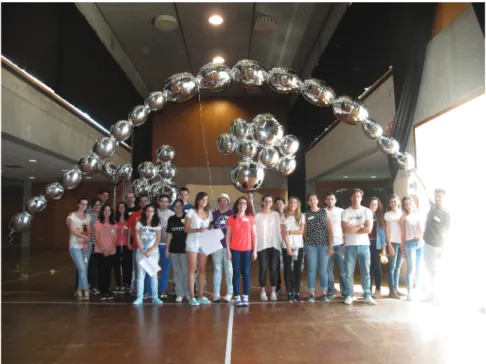
Fig. 2.2 Celebration of the construction of the first arch of the
structure (photo: Nerea Calvillo) 49
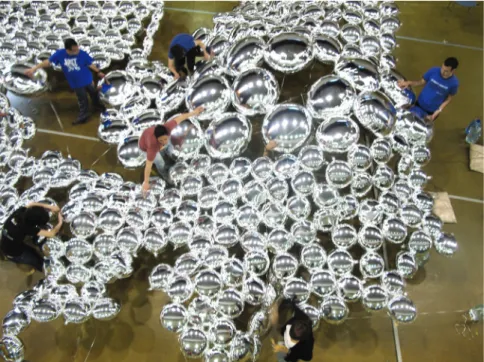
Fig. 2.3 Assembling the different domes (photo: Nerea Calvillo) 50
Fig. 2.4 Balloon assembling process (photo: Nerea Calvillo) 51
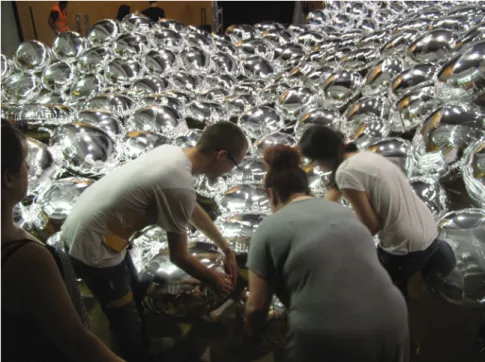
Fig. 2.5 Practices of embodied material care (photo: Nerea
Calvillo) 52
Fig. 2.6 Firefighters who replaced the smoke detectors, and who, in
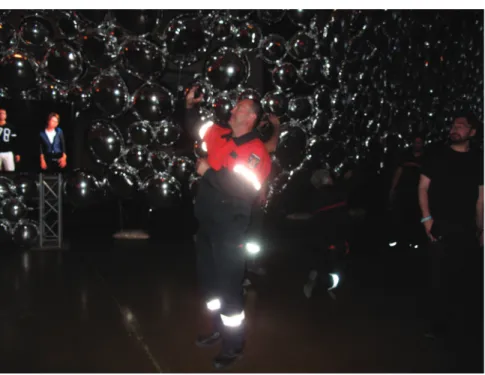
the process, took on the role of supervising the exhibition as well as taking selfies (photo: Nerea Calvillo) 53
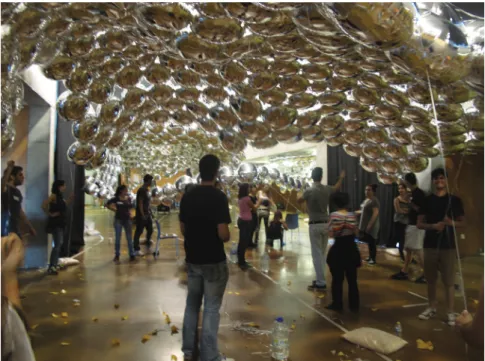
Fig. 2.7 Atmospheric attunements inside the Polivagina during a
performance (photo: Nerea Calvillo) 55
Fig. 2.8 Visitors attuning to the balloons and art installations (photo:
Nerea Calvillo) 57
Fig. 2.9 Music fan posing with balloons repurposed as a dress (photo:
Nerea Calvillo) 58
Fig. 3.1 The prevention laboratory at the Department of General
Practice, Charité, Humboldt University (photo: Bernd
Kräftner) 76
Fig. 3.2 Consumption offers at the Department of European
Anthropology, Humboldt University (photo: Bernd
Kräftner) 78
Fig. 3.3 Kit for blood taking (photo: Bernd Kräftner) 79
Fig. 3.5 Introductory Poster (image: the authors) 86
Fig. 3.6 Example poster based on flying animals (image: Bernd
Kräftner) 87
Fig. 3.7 Example poster based on blood (image: Bernd Kräftner) 88
Fig. 4.1 Photograph of the ‘I speak your feelings’ prototype (photo:
Christian Nold) 106
Fig. 4.2 Image mock-up of the ‘I display noise publicly’ prototype
(photo: Christian Nold) 109
Fig. 4.3 Photograph of the ‘I make someone responsible’ prototype
(photo: Christian Nold) 111
Fig. 4.4 Photograph of the ‘I turn noise into numbers’ prototype
(photo: Christian Nold) 113
Fig. 4.5 Photo of the ‘I quantify AND broadcast’ prototype (photo:
Christian Nold) 115
Fig. 4.6 Windsor prototype data being used to make a noise complaint
about an off-track aircraft 116
Fig. 4.7 Visualisation of thirteen months of data from the Windsor
prototype. Each day is represented by a vertical line with yellow indicating many loud episodes above 50dB LAeq2s.
The red line indicates the noise trend 118
Fig. 4.8 Detail of the ‘Prototyping a new Heathrow Airport’ sound
installation 119
Fig. 5.1 The Energy Babble (photo: Alex Wilkie) 134
Fig. 5.2 The Energy Babble, held by project member Matthew
Plummer-Fernandez, as featured in the November 2013 issue of Reepham Life (Reepham Community Press) 140
Fig. 6.1 Barcelona Pavilion, above and below ground (photos and
composition: Andrés Jaque, 2012) 148
Fig. 6.2 Broken piece of tinted glass in the basement of the Barcelona
Pavilion (photo: Andrés Jaque, 2012) 149
Fig. 6.3 Broken travertine slabs and remaining pieces of Alpine marble
stored in the basement of the Barcelona Pavilion (photo:
Fig. 6.4 Fading velvet curtain stored in the basement of the Barcelona
Pavilion (photo: Andrés Jaque, 2012) 154
Fig. 6.5 Hoses, Kärcher machine, vacuum cleaner and mop in the
basement of the Barcelona Pavilion (photo: Andrés Jaque,
2012) 154
Fig. 6.6 Fanny Nole (photo: Andrés Jaque, 2012) 155
Fig. 6.7 Niebla’s cat space in the basement of the Barcelona Pavilion
(photo: Andrés Jaque, 2012) 155
Fig. 6.8 Niebla, the cat of the Barcelona Pavilion (photos and
composition: Andrés Jaque, 2012) 156
Fig. 6.9 Filtering system in the basement of the Barcelona Pavilion
(photo: Andrés Jaque, 2012) 157
Fig. 6.10 Removed plexiglass cladding in the basement of the Barcelona
Pavilion (photo: Andrés Jaque, 2012) 157
Fig. 6.11 Broken door in the basement of the Barcelona Pavilion
(photo: Andrés Jaque, 2012) 158
Fig. 6.12 Events equipment in the basement of the Barcelona Pavilion
(photo: Andrés Jaque, 2012) 159
Fig. 6.13 Phantom. Mies as Rendered Society (photo: Andrés Jaque,
2012) 162
Fig. 6.14 Phantom. Mies as Rendered Society (photo: Andrés Jaque,
2012) 162
Fig. 6.15 Phantom. Mies as Rendered Society (photo: Andrés Jaque,
2012) 163
Fig. 6.16 Phantom. Mies as Rendered Society (research and drawings:
Office for Political Innovation; graphic design: David Lorente
and Tomoko Sakamoto) 163
Fig. 6.17 Comments in Dezeen reacting to Phantom. Mies as Rendered
Society 165
Fig. 8.1 A usual rendering of society (adapted by the author from a
quick online search) 198
Fig. 8.2 The little dotted agent 199
Fig. 8.4 Von Foerster’s Conjecture 200
Fig. 8.5 Chimeric scientism 201
Fig. 8.6 The behavioural configuration 203
Fig. 8.7 Performative entanglement 203
Fig. 8.8 The juristic damper 204
Fig. 11.1 Top twenty most active users based on tweets and mentions
(created by Stefania Guerra) 266
Fig. 11.2 Interactive users (fragment of a visualisation created by
Gabriele Colombo) 268
Fig. 11.3 Devices used to send tweets (created by Allessandro
Brunetti) 271
Fig. 11.4 Automated activity pattern (created by Carlo De Gaetano
(unfinished)) 272
Fig. 11.5 Neologisms associated with #privacy (fragment of a
visualisation created by Carlo De Gaetano) 275
Fig. 11.6 Associational profile of #security (created by Carlo De
Gaetano) 277
Fig. 11.7 Associational profile of #tech (created by Carlo De
nerea calvillo is an architect, researcher and curator, Assistant Professor at the Centre for Interdisciplinary Methodologies (University of Warwick) and unit master at the Architectural Association. The work produced at her office, C+ arquitectos, and her environmental visualization projects like In the Air have been presented, exhibited and published at international venues. Her
research investigates the material, technological, political and social dimensions of environmental pollution. This has led her to analyse notions of toxicity, digital infrastructures of environmental monitoring, DIY and collaborative forms of production, smart cities and feminist approaches to sensing the environment.
nigel clark is Professor of social sustainability and human geography at the Lancaster Environment Centre, Lancaster University, UK. He is the author of
Inhuman Nature: Sociable Life on a Dynamic Planet (2011) and co-editor (with
Kathryn Yusoff) of a recent Theory, Culture & Society special issue on Geosocial Formations and the Anthropocene (2017). Current work includes the paleo-politics of the Mid Holocene, speculative volcanology, and the intersection of social and geological rifting.
Michael guggenheiM is Reader at the Department of Sociology, Goldsmiths, University of London, and a Co-Director of the Centre for Invention and Social Process (CISP). His research focuses on expertise and lay people in the fields of disaster management, buildings and cooking. He teaches inventive and visual methods and dreams of a different sociology.
andrés Jaque is the founder of Office for Political Innovation (New York/ Madrid), and Director of the Advanced Architectural Design Program at Columbia University GSAPP. The work of the office includes awarded pro-jects including ‘IKEA Disobedients’ (MoMA NY, 2011), ‘Superpowers of Ten’ (Lisbon, 2013) and COSMO PS1 (New York, 2015). His research work has been published in Log, Threshold, Perspecta or Volume; and his books include Transmaterial Politics, PHANTOM. Mies as Rendered Society, Calculability and Different Kinds of Water Pouring Into a Swimming Pool.
christopher kelty is Professor at the University of California, Los Angeles. He is the author of Two Bits: The Cultural Significance of Free Software (Duke
University Press, 2008), and The Participant (forthcoming, 2018).
lucy kiMbell is Director of the Innovation Insights Hub and Professor of Contemporary Design Practices at University of the Arts London and Associate Fellow at Said Business School, University of Oxford. She writes on and prac-tices versions of design thinking and service design and works occasionally as an artist. She spent a year as AHRC design research fellow in Policy Lab, a team in the Cabinet Office, a department of the UK government. With Guy Julier, Lucy has undertaken two projects investigating social design commissioned by the AHRC.
Judith kröll is a sociologist. She is part of the transdisciplinary research group ‘Shared Inc.’ and Lecturer at the Department of Science and Technology Studies at the University of Vienna. She also works as a trainer with the Tomatis method.
noortJe Marres is Associate Professor in the Centre for Interdisciplinary Methodologies (CIM) at the University of Warwick (UK). She studied sci-ence, technology and society (STS) at the University of Amsterdam and the Ecole des Mines (Paris). She was formerly the Director of the Centre for the Study of Invention and Social Process, Goldsmiths, University of London. Her book Material Participation (Palgrave) came out in paperback in 2015, and she
published Digital Sociology (Polity) in 2017.
Mike Michael is a sociologist of science and technology, and a Professor in the Department of Sociology, Philosophy and Anthropology at the University of Exeter. His research interests have touched on the relation of everyday life to technoscience, the role of culture in biomedicine, and the interplay of design and social scientific perspectives. Recent major publications include Actor-Network Theory: Trials, Trails and Translations (Sage, 2017). He is currently writing
books on Science and Technology Studies and Design (with Alex Wilkie) and on Speculative Research Methodology.
fabian Muniesa, a researcher at Mines ParisTech (the Ecole des Mines de Paris) and a member of the Centre de Sociologie de l’Innovation, studies busi-ness life from a cultural perspective. He is the author of The Provoked Economy: Economic Reality and the Performative Turn (2014, Routledge), and the co-author
of Capitalization: A Cultural Guide (2017, Presses des Mines). This latter book
(not about fonts) is a study on the meaning of considering things in terms of assets, and society in terms of a society of investors.
Mapping’ and ‘Bijlmer Euro’ projects, which were staged with thousands of participants across the world. He wrote and edited Emotional Cartography: Technologies of the Self, (2009) The Internet of People for a Post-Oil World (2011)
and Autopsy of an Island Currency (2014). His PhD was on the ontological politics
of participatory sensing and the potential of design interventions.
Marsha rosengarten is Professor in Sociology and a Director of the Centre for Invention and Social Process, Department of Sociology, Goldsmiths, University of London. She is co-author with Alex Wilkie and Martin Savransky of an
edited collection Speculative Research: The Lure of Possible Futures (Routledge,
2017), co-author Mike Michael Innovation and Biomedicine: Ethics, Evidence and Expectation in HIV (Palgrave, 2013) and author of HIV Interventions: Biomedicine and the Traffic in Information and Flesh (University of Washington Press, 2009).
Martin savransky is Lecturer and Director of the Unit of Play at the Department of Sociology, Goldsmiths, University of London. His works devel-ops a philosophy of practices, weaving together a speculative pragmatism with an ecologically pluralistic politics. He is the author of The Adventure of Relevance
(Palgrave, 2016), co-editor of Speculative Research: The Lure of Possible Futures
(Routledge 2017), and guest-editor of a special issue titled ‘Isabelle Stengers and The Dramatization of Philosophy’ (forthcoming in SubStance). He is cur-rently working on a second monograph under the title of Around the Day in Eighty Worlds: Politics of the Pluriverse.
alex Wilkie is a sociologist of science, technology and design and a designer. He is a Senior Lecturer in the Department of Design, at Goldsmiths, University of London where he is also a Director of the Centre for Invention and Social Process (CISP, Department of Sociology). Alex has recently been working on questions of aesthetics and speculation in relation to knowledge and inven-tive practices and has co-edited the volume Studio Studies (Routledge, 2015)
with Ignacio Farías and Speculative Research (Routledge, 2017) with Martin
This book grew out of conversations that began at the Symposium Inventing the Social, which took place at Goldsmiths, University of London, on May 29–30,
INTRODUCTION: FROM
PERFORMANCE TO
INVENTING THE SOCIAL
Noortje Marres, Michael Guggenheim, Alex Wilkie
across Many different doMains, efforts are underWay to reinvent ways of researching social life. Both in established fields of social inquiry, such as sociology and anthropology, and in disciplines such as art, design and archi-tecture, there is an appetite for adventure, for moving beyond the customary distinctions between knowledge and art, and for combining the ‘doing’ ‘research-ing’ and ‘mak‘research-ing’ of social life in potentially new ways. Designers, architects and artists are now re-framing their practices as novel forms of social research (Rosner, forthcoming; Mazé 2013), while social and cultural researchers are taking up artistic instruments and techniques to research society by other than textual means, such as drawing and installation art (Wakeford and Lury 2012; Wilkie 2017). However, while the projects of conjoining sociology and design, and more generally of rethinking epistemic and aesthetic engagement with social life, are increasingly widespread, they have raised many unanswered questions, such as: What are the specific qualities of such endeavours and the entities they produce? Can the aims of artistic intervention and social inquiry really be aligned in research practices? Is it possible to contribute to both knowledge and art at once, and should we even wish to?
of this book is to introduce inventive approaches to social inquiry through the presentation of concrete projects and reflections on the contexts in which these projects are undertaken. At the outset, however, we want to offer a wider discussion of the intellectual background, methodological orientation and sensibilities that inform the projects and reflections presented here, and the commitment we think they have in common. Why use the term ‘invention’ in relation to social research? In what follows, we will describe the logics at work in the phrase ‘inventing the social’ and clarify what differentiates invention from
innovation, and from performance, in relation to social life. We will argue that invention, unlike the other two terms, involves an active search for alternative ways of combining representation of, and intervention in, social life.
We will start by giving a brief introduction to what we take to be three key ingredients of established understandings of how social life is subject to design and artistic intervention. These approaches build on an old idea, namely that social life is not simply given – in the way that nature was previously assumed to be – but is performed, materially conditioned or constrained, and/or reflexive, i.e. it is transformable through knowledge, intervention and creativity. This will bring us to a discussion of the role of objects, technologies and environments in the accomplishment of social life, and of the difference between dominant ideals of the designability of social life and more inventive approaches to it. One of the main points we wish to make is that bringing together social research with arts and design practices makes possible new types of experimental intervention, that differ from narrow scientific experimentalism – moving away from from the idea that social science is able to engineer social phenomena like communities,
S o c i a l L i f e a s To g e t h e r n e s s :
P e r f o r m at i v e , R e f l e x i v e , a n d M at e r i a l
So, what does this rather awkward and counter-intuitive phrase ‘inventing the social’ mean? We want to start by considering some background assumptions shared by the contributions to this volume. Most important is the well-estab-lished view in the social sciences that social life is not something that simply exists out there, but is made: the very existence of social life depends on specific
practices of display, representation, accounting and enactment. Society is not like nature was long presumed to be, something that exists independently of human intervention and needs only to be represented in order to be known. Society is not given but done; indeed, it is often difficult to separate the doing and the knowing of social life. Take, for example, a wedding celebration. It is both a way of practising togetherness and of making visible, and representable, the various relations and actors involved. It is also a way of making new relations. Importantly, this insight into the role of social practices is nothing new: it has long been championed by social theorists, and can be variously traced back to the works of Max Weber, Gabriel Tarde, Alfred North Whitehead, John Dewey, John Austin, Ludwig Wittgenstein, Alfred Schütz, and Harold Garfinkel (for a discussion see Halewood 2014). According to these – in many respects very different – authors and the intellectual traditions they represent, social life is accomplished through rituals, representations, accounts, and dramatisations of togetherness: it is a consequence of our deliberate orientation towards others. In this view, then, there is no such thing as a society that exists independently of performative acts.1 Perhaps the most pertinent version of such a perspective
is Garfinkel’s (1967) generous idea of the ‘methodical character’ of social life, and his claim that social life is accomplished through everyday practices of ‘accounting for social life as part of social life’ (Thielmann 2012).
sociability. Thus, it has been argued that social life has a dramaturgy (Goffman 1959), is reflexive (Woolgar 1988), and is marked by looping effects between how people are labelled – say, as foreigners – and how they understand them-selves (Hacking 1995). This is to say that the basic idea of what we might call the artificiality of social life has become fairly well established over the course of the twentieth century. However, it has been argued that current proposals to ‘engineer’ social life, as in ‘smart’ urban laboratories, are raising new challenges for the understanding of social life as performed (e.g. Calvillo and Halpern 2016). Contemporary phenomena like the rise of social media platforms, and the digital city, have granted fresh relevance to the idea that social life is artificial, as we will discuss in more detail below.
It is important to recognise that not only social research, but also arts and design disciplines have, for some time, drawn attention to the special role of technology and material entities – such as buildings – in the conduct and performance of social life. The idea of the materiality of social life is of crucial importance in understanding how invention may be a characteristic of social research. Sociologists and anthropologists have long argued that it is not just practices, rituals and ideas that inform the ongoing performance of social life, but also the settings (such as buildings), infrastructures (such as electricity and radio) and environments (mountains, cities, the air) in which it unfolds. In social research, this attention to materiality is today mostly associated with Actor-Network Theory (ANT) (Michael 2016) and with anthropological approaches like material culture studies (Miller 1987; Hicks 2010). In social theory, ANT is known for introducing the concept of the non-human as an actor (Callon 1986; Latour 1992). Here, the idea that society is performed or made becomes directly associated with material and technological practices of engineering and design, such as attempts to design an electric vehicle (Callon 1986) the instal-lation of ‘sleeping policemen’ in the street (Latour 1992), and the famous ANT slogan ‘society is technology made durable’.2 However, as Calvillo reminds us in
understanding why exchanges between social research and arts and design are becoming pertinent today. Or, to put it another way, architects and designers will not be surprised to hear it said that buildings and artefacts do things. ‘Of
course they do things’ comes the reply – ‘it’s our job to make them do things!’.
For designers and architects, the question is how things do things. Still, it is not
self-evident how what architects and designers do ‘to’ society, relates to how sociologists understand it.
It is also increasingly recognised that social research itself, not just social life, is constituted by material practices (Lezaun 2007; Wyatt 2008). Drawing on John Austin’s philosophy of language, sociologists have argued that material devices initially developed by social scientists to represent society – such as focus groups or surveys – may actually influence the conduct of social life or even generate forms of sociality (Muniesa et al. 2007; Law, Ruppert and Savage 2013). Such studies of the performativity of research methods strive to reveal the myriad of practical and material interventions that lurk below the surface of the official endeavour to represent society. Some of this work has explicitly challenged the representational understanding of social research, arguing that knowledge objects, such as focus groups and opinion polls, do not just refer to external states of affairs, but may actively constitute the very phenomena they purport to repre-sent, such as opinions and preferences (Osborne and Rose 1999). Performative perspectives on social research reveal a troubling circumstance: devices that ostensibly serve to report on social life in actual fact influence it. A stock market index or opinion poll does not simply re-present the state of the economy or the public, but actively enrols audiences in arrangements for knowing and acting on the economy and the public. Moreover, the reverse is also true: phenomena that ostensibly serve as occasions for the enactment of social and public life – say a public debate organised by government or policy actors – at the same time enable the production of data, analysis and knowledge about it (Lezaun and Soneryd 2007). In short, devices that have been designed to represent a phenomenon – society, publics – actively work to shape or even create it.
that ‘social research is always already an intervention’ but that this is not suffi-ciently appreciated in representational social science, and public discourse more widely (Law 2004). In this view, one needs to adopt a performative perspec-tive – and its favoured research methodology, ethnography – to appreciate that observational social methods, such as survey research, do not simply represent social life, but act on and in it. By contrast, the project of inventing the social does not begin with a critique of the blind spots of representational [social]
science, which must learn to acknowledge performativity. Instead, it begins with the idea that social life and social research are performed, and seeks to put this insight to use in a generative way, in collaboration with disciplines such as architecture, arts, computing and design. Here the starting point is not the for-getting of intervention, which performative approaches can subsequently claim to recover, but engagement with the creative competencies of other disciplines, and the question of how social research may share in these creative competen-cies. In our view, the difference between representational and performative approaches in social research methodology does not hinge on the question of
whether research constitutes a form of intervention or not, but on the types of connection between representation and intervention that are made, enabled, and explored in social research. To acknowledge the performativity of social research is but a first step. To rethink social research based on this understand-ing means to invent the social.
F ro m A n a lys i n g P e r f o r m at i v i t y
to I n v e n t i n g t h e S o c i a l
participatory design to elicit views of local residents on noise pollution around Heathrow. Each of these projects is idiosyncratic, but they share an important feature highlighted in Lury and Wakeford’s (2012) introduction to the book
Inventive Methods, which states that to inquire into a given phenomenon is to
participate in it. For Lury and Wakeford, inventive methods are the means by which ‘the social world is not only investigated, but may also be engaged. […] To describe [methods] as inventive is to seek to realise the potential of this engagement, whether this is as intervention, interference or refraction’ (Lury and Wakeford 2012: 6). From this insight a number of critical questions arise: can social research serve as an occasion for inventive engagement with social life? If participation is in some sense inevitable, could social research actively contribute to generating sociality? Crucially, however, for Lury and Wakeford the purpose of inventive methods is not to design new forms of living together from scratch but ‘to enable the happening of the social world – its ongoingness, relationality, contingency and sensuousness – to be investigated’ (Lury and Wakeford 2012: 2). In formulating this proposal, Lury and Wakeford make an important move beyond the critique of representational social science, to pose the question of how the creative capacities of social research might be purpose-fully or methodologically deployed.
engineered, has become increasingly prominent. Take for example the recent large-scale Facebook experiments, in which the social media platform deliber-ately modified particular platform settings by introducing an ‘I voted button’ on election day, to see if voter turnout could thereby be increased, and more gener-ally to demonstrate the degree to which ‘social behaviour is amenable to online intervention’ (Bond et al. 2012). Such experiments may not, strictly speaking, be new – indeed they invoke early twentieth-century experiments in deploy-ing social network analysis for reform purposes (Mayer 2012; Guggenheim 2012). They do signal, however, that the ideal of a purely representational social science is today less prominent in public discourses themselves and, in turn, that accounts – idealised or not – of experimental intervention in social life are becoming more so.
In this context, it becomes apparent why the critique of narrow scientific representationalism – of the view that social science merely represents phenom-ena that exist independently out there in external reality – is at the very least
incomplete. In light of the idealisation of the instrumental deployment of social
science research (as discussed in Muniesa’s chapter on behaviouralism, this volume), what is required in addition is a critique of narrow scientific experi-mentalism – of the idea that social science is able to engineer social phenomena
like communities, networks and publics. This, we want to argue, is not a form of
How do inventive approaches to social research address this situation? One way is by challenging methodological indifference, the way in which scientific methodology risks remaining unresponsive to the phenomenon under study (Stengers 2017). In this respect, there is another important difference between performative and inventive approaches in social research. Social studies of per-formativity tend to frame social methods as an object of inquiry – they wish to demonstrate how social research, say a census, does not simply represent but enacts social reality (Law and Urry 2004). By contrast, inventive approaches tend to regard the enactment of social phenomena not as a topic to be exposed or described, but as a research task or challenge: can we do it? Can we contribute to the creative articulation of social phenomena (Guggenheim et al., this volume)? As we have noted, inventive approaches take to task not just representationalism but also interventionism: instrumentalist ideals of experimental intervention in society, such as the behavioural nudge policy pursued by the UK government, are founded on the passivity of social phenomena. It is presumed that social phenomena are out there to be known and acted upon. Inventive approaches deem this presumption not just ethically but also methodologically unsound: conducting research on society always means actively engaging with social set-tings and actors – with techniques to which the researched are not indifferent. The contributions to this book take as their starting point the experimentality of social life. That is to say, following Matthias Gross, the authors treat society as an experiment: a ‘sociological perspective [that] has got nothing to do with the idea of sociologists as experimenters in white coats. It is rather to be understood as called forth by the observation that in modern societies, social practices increasingly present themselves as experiments via a willingness to remain open to new forms of experience’ (Gross and Krohn 2005: 80; see also Marres 2012). Inventive research takes this experimentality of social life as the occasion to reconfigure social research.
This is also to say that in shifting our attention away from the critique of social scientific representationalism as such, we do not move from
research is still to be invented insofar as to engage in this type of social inquiry is to recognise that there are many possible inter-articulations between knowl-edge and intervention. In making this point, we follow Lury and Wakeford’s insistence in Inventive Methods that research constitutes a form of participation.
But we also differ from their approach. In choosing ‘inventing the social’ as the title for this book, we foreground a specific interest in not only the methods, but also the objects and objectives of creative forms of social inquiry.3 Many
of the contributions to this book translate sociological ideas and sensibilities into arts and design research practices. Thus, Andre Jaque’s chapter deploys the sociological distinction between the backstage and the frontstage of social and public life, while Christian Nold draws on insights from social studies of science and technology in examining the ‘provocational capacities’ of techno-logical devices to elicit public debate and issue articulation in a specific setting, namely a neighbourhood in the proximity of Heathrow airport affected by sound pollution. For others, the primary interest is in the possibility of exchange – of collaboration – between arts and design and social research. Our intended audi-ence for this book is all those engaged in social and cultural research, design, computing, art and architecture who are interested in the exchange of capacities, knowledges and sensibilities between these fields, to make possible new ways of combining knowing, doing and intervening in social life.
roles that researchers can adopt in the curation of social situations, and how do and might they interact with various co-inventors, be they human – in the case of research subjects for example – or non-human, in the form of instruments, devices and so on? What role can tools and technologies play, from drawing pens to audio equipment (e.g. Michael 2004), prototypes and Twitter Bots (e.g. Wilkie et al. 2015), and hyperlinks, social media buttons, hashtags and Web scrapers (Rogers 2013) in the curation of social formations? And finally, what are the criteria of success of inventive social research?
G o o d I n v e n t i o n s : E x p e r i m e n t a s I m ag i n at i o n
It should now be obvious that, in our view, inventive approaches to social research are experimental. Above we have specified this notion in terms of the commitment to combine representation and intervention in social research. Practically, this means applying the term in two ways. First, the willingness to try out new methods, practices and techniques that are different from those presumed to define or belong to a home discipline, whether, for example, sur-veys or fieldwork in social research or modelling and prototyping practices in design and architecture. Second, taking an interest in forms of expression and knowledge that do not merely seek to represent social reality but seek to ‘make visible phenomena in a form in which they could never possibly be lived, never otherwise made manifest’ (Brown 2012: 69).4 Experimental social research
Furthermore, if the imperative of clinical intervention is to improve a medical disorder – a definition that, arguably, informs how intervention is commonly understood – then what new kinds of intervention does creative experimentation make possible: does it ameliorate, add, enhance, provoke, reverse, challenge, accommodate?
Among those who have developed an experimental methodology specifically for social research, the aforementioned and pioneering ethnomethodologist Harold Garfinkel stands out. He famously noted that in order to understand society, we need to conduct experiments as ‘aids to our sluggish imagination’ (Garfinkel 1967: 38): to render visible what is going on in social situations it is not enough to carefully describe what happens, we must also provoke accounts. If we want to really grasp social processes we must somehow invite, persuade, or (to put it more strongly) provoke actors and situations to
gener-ate accounts, and to produce expressions and articulations of social reality. However, and as the sociologist Alvin Gouldner (1970) has pointed out, there are remarkable similarities between, on the one hand, Garfinkel’s interven-tionist approach and, on the other hand, interventions in social and public life undertaken under the rubric of performance art and activism. Gouldner gives the example of the provocative methods used by the Amsterdam-based Provo movement to render visible the true nature of society. Provo mobilised a visible and material police force by releasing a small number of chickens on the Prinsengracht in Amsterdam one Saturday morning, thereby demonstrat-ing the fear and anxiety of the Amsterdam authorities (Gouldner 1970; see also Marres 2012).
life changes what it means to undertake experiments in social research. In this context, it makes sense to adopt a minimal definition of experimental social inquiry, one that foregrounds the tactical modification of social settings, archi-tectures and situations in order to render explicit latent social phenomena. As such, to experiment, first and foremost, means to intervene in social life, not necessarily with an instrumental goal in mind but to highlight social formations (Kimbell, this volume). Neither is the aim necessarily to scale the experiment up to a population, but rather to make visible, audible and tangible collective processes and problems that would otherwise be invisible, remain latent or exist as virtual phenomena, or in potentia (Savranksy, this volume; Lezaun et
al. 2017).
While this definition is in need of further development, this way of fram-ing the methodology of inventive social inquiry can help to clarify the relation between knowledge and creativity in these practices. Crucially, inventive social research does not proceed by adding creativity to more traditional,
evidence-based forms of social research. The very idea that social research suffers from a creative deficit that needs to be addressed in order to make social research more engaging is, in our view, misguided. There are plenty of fictions, visions, and fantasies already at work in social research. The notion of a creativity deficit wrongly suggests a strict opposition between forms of knowledge and intervention grounded in facts and those that are grounded in the imagination. As philosophers of science such as Karl Popper, Alfred North Whitehead and Isabelle Stengers have long reminded us, imagination is not the opposite of truth; fiction is not the opposite of fact. Inquiry (knowledge) requires imagination. As
Stengers (2002) pointed out in her retelling of Galilei Galileo’s classic physics experiments, science always starts with an idea, a fiction, a ‘what if?’ What if weight made no difference to the velocity with which things fall?
doing things. However, Rosner also insists that asking ‘what if’ – introducing new scenarios and prototypes into social life – does not mean losing one’s inter-est in what is already given in the world: it does not entail a shift from loyalty to ‘what is’ to ‘what might be’; and it does not mean exchanging empiricism for speculation (Savransky et al. 2017). Instead, as Marsha Rosengarten shows in her contribution to this volume, practising inquiry by way of creative interven-tion is about engaging with what is already ongoing, already happening in the world with an explicit view to what might be in the world in a different mode.
And this project does not belong to any one discipline, but is best understood as a shared undertaking across fields. Inventive inquiry may be pursued with the aid of social research methods such as participant observation, as well as through art and design practice. Its aim is to develop new ways of deploying the imagination as a method for knowing and intervening in social life, and to this end a variety of methodological traditions can be mobilised.
G o o d I n v e n t i o n s :
M at e r i a l i t i e s a n d T e c h n i c i t i e s
things, environments and non-humans to make an ostensible difference to our forms of life, and to how we live together.
It is now commonplace to point out that non-humans actively participate in social life. For example, we typically interact with bots on our phones, we find their messages in our inboxes and we are lured into bot-enhanced advertis-ing, marketing and lobbying in our everyday interactions on social media, and many of us reflect on these novel yet mundane circumstances. Remarkably, however, even if non-humans are acknowledged as a significant presence in social life, this does not mean that society is now widely recognised as being hybrid – involving a co-mingling of humans and machines. On the contrary, human forms of sociability are, on the whole, firmly upheld and prioritised in the world of designed sociability. Examples of this, such as social media platforms, tend to materialise distinctively human forms of social organisation (Marres & Gerlitz, this volume): the friend network, the community, social behaviour. Contemporary forms of designed sociality tend to invoke classic social forms. This is another reason why we want to affirm experimentality, and why we need to exercise our skills in other than descriptive/observational forms of inquiry. It is not enough to empiricise the question of the social (Boltanski 2011), and to describe the social theories invoked by the actors themselves to account for social life. Now that we have established the generative capacities of devices, objects and settings in social life, the question arises: how does their participation in social life make a difference to our forms of life; can they inspire alternative
forms of knowing and doing? This experimentalisation of social life is inherently
in question (this is part of what makes an experiment): we do not already know
how to conduct, understand and change contemporary social life, and no one knows what forms of inquiry and intervention are the most adequate for this purpose (not even the actors themselves).
To adopt an inventive approach to social inquiry, then, is not to jump on the technological determinist bandwagon and to believe that it is new technologies that have the power to produce new societies. Rather, the aim is to create experi-ments that can serve to articulate, explicate and elaborate ways of (not) living
well as literal) operations upon materialities: moving materials from the cellar to the exhibition space (Jaque, this volume), or exchanging bricks with helium (Calvillo, this volume), or, for that matter, the re-programming of bots (Wilkie & Michael, this volume), or introducing soft toys to a medical measuring tool (Guggenheim, Kroell and Kraftner, this volume).
Jaque’s paper offers a fascinating account of the type of experimental rene-gotiation of social forms that we have in mind. His Barcelona Pavilion experi-ment produced a form of assembly that went against the organisational forms and logics of the social composed and given concrete form by self-appointed executors of the ideas of the architect Mies van der Rohe (the ‘Mies Society’): their obsession with stabilisation and purification was exposed as limited in scope and un-lively. Jaque’s pavilion intervention demonstrates the cost of stabilisation, exposing how this commitment rendered particular kinds of assembly invisible and impracticable. However, his attempt to address this by staging some of these invisible assemblies in the pavilion also comes at a cost, as it threatens to render un-doable particular modes of assembly like the Mies Society. This is an excellent example of the ‘coming out of things’ (Marres, 2012): the outing of hybrid collectives and the explication of experimental forms of togetherness by way of material intervention. It also demonstrates a political truth: that the work of re-assembling the social is likely to generate
tensions and conflicts; one society’s assembly, to put it somewhat inelegantly, is another’s dis-assembly.
C o n c l u s i o n
In sum, then, inventive approaches to social research must be distinguished both from performative social studies and from attempts to reinstate social engineering as a viable paradigm. On the one hand, inventive approaches do not seek to describe the performance of social reality, but rather treat performativ-ity as an effect that may be purposefully deployed in social research. However, to move from performance to invention does not require the endorsement of the simplistic ideal of the designability of social life. Inventive social inquiry precisely seeks to carve out an alternative to the ideal of the designable society. The two approaches, or experimental regimes, if you will – designability versus invention – are markedly different, in two ways: first, from the standpoint of the designable society, experimental capacities are an attribute of technical appa-ratuses or architectures. It is the online platform, or the smart city architecture that is presumed to enable experimental intervention into an external object (society) – as for example in recent policy preoccupations where creativity as an economic object can be stimulated by urban planning (Farías and Wilkie 2015: 2). Inventive approaches, by contrast, find their starting point in the experimentality of social life and social situations themselves.
From the standpoint of the designability of society, the latter are presumed to be largely passive, they are to be acted upon by technology and innova-tion, and technology is assumed to align itself with this purposeful invention. Here the assumption is that the social world will comply with the goals of social design (‘and if it won’t we’ll try something else’). By contrast, inventive approaches to social inquiry are para-instrumental: they expect social
N ot e s
1 A word of caution is necessary here regarding the performance of social life. For Austin
(1962), performativity in language – statements that bring into being states of affairs, such as marriage or war – require particular ‘felicity conditions’, meaning that certain circumstances need to obtain in order for them to work. For example, they may need to be pronounced by an appropriate actor (priest, head of state) or in a particular place (a church or press conference). If these conditions of felicity are not in place, then such statements will not ‘act’ appropriately, i.e. they will not work.
2 Things quickly become complicated, however, when, for instance, actor-network
theorists such as Bruno Latour disavow the concept of the social. Latour mischievously adopted Margaret Thatcher’s phrase that there is no such thing as society (Latour 2005). As Marres and Gerlitz suggest in their contribution, ‘inventing the social’ can also be framed as a project to recover the specificity of social forms in the face of ANT’s (and Thatcherite) indifference.
3 Lury and Wakeford are interested in invention as a property of method. In their
account, method is what constitutes the interface between social research and art. In presenting invention in this light, their approach has the advantage of foregrounding the question of how research operates in the world, but it also has the effect of suspending,
or downplaying, the question of what forms of collaboration and types of exchange are possible between social research and creative disciplines in the practice of social research. Reinstating the more abstract notion of ‘method’ inevitably distracts from – and at times, brackets – the issue of collaboration, the exchanges of competencies that are possible between the domains, fields, sites, technologies and genealogies of social research, design, art, and architecture.
4 In this regard, inventive social inquiry returns us to a classic maxim of structuralist
sociology: to gain knowledge of society requires the explication of dynamics that are not readily observable.
R e f e r e n c e s
Austin, J. L., How to Do Things with Words, 2nd edn (Oxford: University Press, 1975 [1962]).
Barry, A., and N. Thrift., ‘Gabriel Tarde: Imitation, Invention and Economy’, Economy and Society, 36.4 (2007), 509–25.
Boltanski, L., On Critique: A Sociology of Emancipation (Cambridge; Malden, MA: Polity,
2011).
Bond, R. M., et al., ‘A 61-Million-Person Experiment in Social Influence and Political Mobilisation’, Nature, 489. 7415 (2012), 295–98.
Sociology of Knowledge? (Abingdon, Oxon; New York, NY: Routledge, 1986), pp.
196–223.
Callon, M., ‘The Sociology of an Actor-Network: The Case of the Electric Vehicle’ in M. Callon et al., eds, Mapping the Dynamics of Science and Technology (London:
Macmillan, 1986), pp. 19–34.
Callon, M., and J. Law., ‘Agency and the Hybrid Collectif’. The South Atlantic Quarterly,
94 (1995), 481–507.
Calvillo, N., et al., eds, ‘Testbed as urban epistemology’, in S., Marvin, A., Luque-Ayala, and C. McFarlane, Smart Urbanism: Utopian Vision or False dawn? (Abingdon, Oxon;
New York, NY: Routledge, 2016), pp. 145–167.
Farías, I., and A. Wilkie, ‘Studio studies: Notes for a research programme’ in I. Farías and A. Wilkie, eds, Studio studies: Operations, topologies and displacements. (Abingdon,
Oxon; New York, NY: Routledge, 2015), pp. 1–21.
Ford, L. S., ‘Creativity in a Future Key’, in R. C. Neville, ed., New Essays in Metaphysics
(Albany, New York: State University of New York Press, 1986), pp. 179–197. Garfinkel, H., Studies in Ethnomethodology (Cambridge: Polity Press, 1967).
Goffman, E., The Presentation of Self in Everyday Life (New York: Anchor, 1959).
Gouldner, A. W., ‘Ethnomethodology: Sociology as Happening’, in The Coming Crises of Western Sociology (London and New York: Basic Books, 1970), pp. 390–5.
Grommé, F., ‘Governance by pilot projects: Experimenting with surveillance in Dutch crime control’ (PhD thesis, Institute for Social Science Research, University of Amsterdam, 2015).
Gross, M., and W. Krohn, ‘Society as Experiment: Sociological Foundations for a Self-Experimental Society’, History of the Human Sciences, 18.2 (2015), 63–86.
Guggenheim, M., ‘Mutable Immobiles. Change of Use of Buildings as a Problem of Quasi-Technologies’, in Ignacio Farias and Thomas Bender, eds, Urban Assemblages. How Actor Network Theory Transforms Urban Studies. (London and New York: Routledge,
2012), pp.161–78.
—— ‘Laboratizing and De-laboratizing the World: Changing Sociological Concepts for Places of Knowledge Production’, History of the Human Sciences, 25.1(2012),
99–118.
—— ‘From Prototyping to Allotyping: The Invention of Change of Use and the Crisis of Building Types, Journal of Cultural Economy, 7.1 (2014), pp. 411–33.
—— ‘The Media of Sociology: Tight or Loose Translations’, British Journal of Sociology,
66.2 (2015), 345–72.
Hacking, I., Representing and Intervening (Cambridge, England: Cambridge University
Press, 1983).
Halewood, M., Rethinking the Social through Durkheim, Marx, Weber and Whitehead.
(London: Anthem Press, 2014).
Hicks, D., and M. C., Beaudry, eds, The Oxford Handbook of Material Culture Studies
Jiménez, A. C., A., Estalella, and Z. Collective, ‘The Interior Design of [Free] Knowledge’,
Journal of Cultural Economy, 7.4 (2014), pp. 493–515.
Latour, B., ‘Where are the Missing Masses, Sociology of a Few Mundane Artefacts’ in W., Bijker and J., Law, eds, Shaping Technology-Building Society. Studies in Sociotechnical Change (Cambridge: MIT Press, 1992), pp. 225–59.
—— ‘Do Scientific Objects Have a History? Pastuer and Whitehead in a Bath of Lactic Acid’, Common Knowledge 5.1 (1996), 76–91.
—— Reassembling the social: An Introduction to Actor-NetworkTheory. (Clarendon Lectures.
Oxford: Oxford University Press, 2005).
Law, J., After Method: Mess in Social Science Research (London and New York: Routledge,
2004).
Law, J., and J. Urry, ‘Enacting the Social’, Economy and Society, 33.3 (2004), 390–410.
Lezaun, J., ‘A Market of Opinions: the Political Epistemology of Focus Groups’. The Sociological Review, 55.52 (2007), 130–51.
Lezaun, J., and L. Soneryd., ‘Consulting Citizens: Technologies of Elicitation and the Mobility of Publics’, Public Understanding of Science, 16.3 (2007), 279–97.
Lezaun, J., N. Marres and M. Tironi, ‘Experiments in Participation’, in C. Miller et al., eds, Handbook of Science and Technology Studies, vol 4 (Cambridge: MIT Press,
forthcoming).
Lury, C., and N. Wakeford, ‘Introduction’ in C. Lury and N. Wakeford, eds, Inventive Methods: The Happening of the Social (London and New York: Routledge, 2012), pp. 1–24.
——eds., Inventive Methods: The Happening of the Social. (London; New York, NY:
Routledge, 2012).
Marres, N., Material Participation: Technology, the Environment and Every Publics.
(Basingstoke: Palgrave, 2012).
——‘Who is Afraid of the Green Cloud? On the Environmental Rendering of Controversy, CSISP Working Paper Nr. 2. (2013) <http://www.gold.ac.uk/media/Marres_ NuageVert_Controversy_analysis%20copy.pdf> [accessed 30 April 2018].
——Digital Sociology: the Re-invention of Social Research (Cambridge: Polity, 2017).
Mayer, K., ‘Objectifying Social Structures: Network Visualisation as Means of Social
Optimisation’, Theory and Psychology, 22.162 (2012).
Mazé, R., ed, SWITCH! Design and Everyday Energy Ecologies (Stockholm: Interactive
Institute Swedish ICT, 2013).
Michael, M., Actor Network Theory: Trials, Trails and Translations (New York and London:
Sage, 2016).
——‘On Making Data Social: Heterogeneity in Sociological Practice’, Qualitative Research.
4.1 (2004), 5–23.
——Actor Network Theory: Trials, Trails and Translations (Los Angeles, CA; London; New
Delhi; Singapore; Washignton, CD; Melbourne: Sage, 2016).
Osborne, T., and N. Rose, ‘Do the Social Sciences Create Phenomena?: The Example of Public Opinion Research’, The British Journal of Sociology, 50.3 (1999), 367–96.
Rogers, R., Digital Methods (Cambridge: MIT Press, 2013).
Rosner, D., Integrative Inquiry: A Reflexive Approach to Design Research (Cambridge: MIT
Press, forthcoming).
Savransky, M., A. Wilkie and M. Rosengarten, ‘The Lure of Possible Futures: On Speculative Research’, in Wilkie, A., et al., eds, Speculative Research: The Lure of Possible Futures
(Abingdon, Oxon; New York, NY: Routledge, 2017), pp.1–18.
Shaviro, S., Without Criteria: Kant, Whitehead, Deleuze, and Aesthetics (Cambridge, MA:
MIT Press, 2009).
——Discognition (Watkins Media Limited, 2016).
Stengers, I., ‘The Thousand and One Sexes of Science’, in Power and invention: situating science (Minnesota: The University of Minnesota Press, 1997), pp.133–52.
——A Constructivist Reading of Process and Reality’ Theory, Culture & Society, 25.4
(2008), 91–110.
——Cosmopolitics (Minnesota: University of Minnesota Press, 2010).
Thielmann, T., ‘Taking into Account. Harold Garfinkels Beitrag für eine Theorie sozialer Medien’, in: Zeitschrift für Medienwissenschaft, 6 (2012), 85–102.
Wakeford, N., ‘Don’t Go All the Way: Revisiting ‘Misplaced Concretism’ in G.Bowker and S. Timmermans, eds, Boundary Objects and Beyond: Working with Leigh Star
(Cambridge: MIT Press, 2012).
Whitehead, A. N., Science and the Modern World (New York, NY: The Free Press, 1997
[1926]).
Wilkie, A., ‘User Assemblages in Design: an Ethnographic Study’ (PhD Thesis, Goldsmiths, University of London, 2010).
——‘Prototyping as Event: Designing the Future of Obesity’, Journal of Cultural Economy, 7.4 (2014), 476–492.
Wilkie, A., et al., Speculative Techniques. Speculative research: The Lure of Possible Futures
(Abingdon, Oxon; New York, NY, Routledge: 2017), 111–13.
Wilkie, A. (2018) ‘Studios, Publics, Problems’, in A., Boucher, et al., Energy Babble.
(Manchester: Mattering Press, forthcoming).
Wilkie, A., M. Michael and M. Plummer-Fernandez., ‘Speculative Method and Twitter: Bots, Energy and Three Conceptual Characters’, The Sociological Review, 63 (2015),
79–101.
Woolgar, S., ed., Knowledge and Reflexivity: New Frontiers in the Sociology of Knowledge.
(Thousand Oaks: Sage Publications, 2008).
Woolgar, S., C. Coopmans and D. Neyland, ‘Does STS Mean Business?’ Organisation,
INVITING ATMOSPHERES TO
THE ARCHITECTURE TABLE
Nerea Calvillo
B u i l d i n g t h e S o c i a l
in sts (science, technology and society) and feMinist studies of technoscience there has been much discussion about the ways in which the social can be redefined by expanding it to more-than-humans, from an inclu-sive invitation to a parliament of things (Latour 1993), to messier and more entangled modes of co-habitation (Haraway 2003: 1991). In this context, this chapter asks if and how other disciplines can contribute to this debate, specifi-cally by discussing the attempt in the field of architecture to build the social from air. Architecture is a discipline that manifests expertise in managing inert more-than-humans, while at the same time being deeply intertwined with the social, as it builds spaces with materials to be inhabited by humans. The question I want to explore here in response to the topic of this issue concerns the ways in which architecture articulates this relationship. Can, for example, architec-ture construct, facilitate or design the social, or is it ‘just’ its container, with no agency of its own? More particularly, can architecture, as a practice, design the
socialities needed for a good life (e.g. Braidotti 2012)?
Architects have long thought about how to invent the social through build-ings1. There are, however, some problems with this approach. In order to unfold
century or communal housing at the beginning of the twentieth. These pro-jects assumed a direct causal relationship between spatial organisation and the social, whereby a certain material configuration could enhance a specific human behaviour, and even construct complex social organisations such as socialism, for instance (e.g. Buchli 1998). Crucially, however, both architecture and the social were conceived as static materials: architecture as that which concerned buildings as finished and stable entities, and the social as a unified and immu-table set of social relations.
Studies of architecture have demonstrated that this causal and static way of inventing the social through buildings did not succeed, in part because it did not take into consideration the fluidity of the social (e.g. Guggenheim 2014; Vanderburgh and Russell Ellis 2001) and in part because it had a narrow under-standing of what architecture is, limiting it to the built environment. One way to move away from this framework is to reduce the expectations of architecture and shift from constructing the social to facilitating socialities. Another path is to
gain a more processual and experimental understanding of inventing socialities with/through buildings where architectural practice can learn from STS and feminist research.
be completely predetermined, by architecture design for instance, and are necessarily experimental.
In order to assess this shift to the processual, as well as the ability of archi-tectural practice to design socialities, in this chapter I propose to think and work with a dynamic and seemingly intangible material: air. Although air has been largely ignored throughout architectural history (Banham 1969), during the 1960s and 1970s there was a proliferation of inflatable structures that used air to explore the lightness, ephemerality, transparency and transportability of new plastics. This took place in the context of an attempt to propose new ways of living that were closer to everyday, popular culture and that might thereby facilitate political resistance (Dessauce 1999; Topham 2002). The project I dis-cuss here, although sharing certain aesthetic qualities with these earlier ventures, was conceived differently. Firstly, the Polivagina was not conceived as addressing air through its structural capacity, but drew on its invisibility and dynamism to destabilise architectural practice, requiring a transformation of methods, techniques, materials and forms of organisation. Secondly, it acknowledges that the social is not simply the result of the inhabitation of inflatable structures: the air is already social. German philosopher and cultural theorist Peter Sloterdijk, in his work on social foams (2005), proposes that sociality is not only about human exchanges of information (Wakeford 2011), but is a foam that includes humans, structures, and the air and climate that brings them together. If this is so, then taking air into account in architecture shifts attention beyond boundaries, such as walls and roofs, to what is in between them, working with humidity, pressure, smell, toxicity and breath.
social effects of buildings are described in generic and representational terms. For example, Sloterdijk describes the apartment as a symbol of society’s indi-vidualism, but he does not specify the relationships between material assem-blages and particular practices that make him draw this conclusion. In order to test the potentials of Sloterdijk’s conceptual proposal this chapter addresses these absences by making three moves. Firstly, instead of using Sloterdijk’s metaphorical reading of architecture as an enclosure, it uses his notion of ‘air design’ (2005: 140) to think about architecture not simply as creating enve-lopes for climate control, but as involving the actual design of atmospheres where the air is not only a conditioner of well-being but also a material for the construction of certain modes of sociality. Secondly, it takes the process of architectural design and construction as its main site of inquiry into the design of socialities. Finally, the chapter proposes a conceptual framework to describe (or sense) the after-effects of construction: the socialities that emerge during the inhabitation of an atmospheric space, which are spontaneous, fragile and in constant transformation.
material invention of the social. This approach, drawing on STS and Sloterdijk, can begin to describe how the social can be (in part) designed with matter and atmospheres.
C o n s t ru c t i n g w i t h H e l i u m a n d A i r
This speculative proposal is part of an ongoing practice-based research project that will be illustrated in narrative and visual means through the installa-tion ‘The Polivagina of Fan Riots’ (Polivagina).2 The project was designed by
C+arquitectos – the office directed by the author of this article – for the art event Fan Riots curated by Ivan Lopez Munuera for the SOS4.8 music festival, in Murcia3. The Polivagina became an exploration of how to take seriously the
application of (atmospheric) more-than-humans to architecture, taking in this case air and helium as the main materials for construction. This decision was made as an intellectual challenge, but also because it helped to respond to many of the demands of the curator, the existing building, the building regulations and the climate. Examples include the need to completely transform a seven-hundred m2 space that could not be touched4; to host art installations, performances and
round-tables; to ‘attract’ party-goers whose main interest in a festival may not be art; to deal with a limited budget; and to work within the time constraints of two days to set up the project and five hours to dismantle it. These conditions, seeming almost contradictory, could only be brought together by means of a light structure or some sort of inflatable, but this would have driven the project over budget. We therefore asked ourselves the following questions: Does air design necessarily imply the creation of a controlled envelope (such as those referred to by Sloterdijk)? What are the limits of atmospheres? Do they need continuous physical boundaries?
that it could perform its structural function. Even when enclosed, compared with bricks, stone or concrete, gases – in this case helium – have very dif-ferent properties: they have fluidity and can move, change and react. Gases are, by nature, volatile, and for that reason difficult to control. Architects, typically trained in mechanics rather than in thermodynamics, are in most cases not prepared or equipped to deal with their properties. This, of course, does not mean that there are no previous references or existing centres of expertise: as the abovementioned inflatable projects in architecture, arts and industry show, architects have developed techniques to keep large mem-branes inflated. Polivagina, however, was a permeable membrane composed of micro inflated units, rather than a capsule filled with structural condi-tioned air. The balloons-as-containers used in Polivagina therefore added an extra dimension of complexity and technical difficulty. As balloons are not used in architectural construction, manufacturers do not provide the required technical specifications stating how they perform (how much they
lift, for example), there are no building codes or regulations covering their usage, and there is little or no expertise in how to assemble balloons in such circumstances.
Pushed by these uncertainties we framed the project as a ‘cosmopolitical experiment’ (Hinchliffe et al. 2003), in order to explore other ways of
know-ing that may enable a different composition of the world. For this purpose, we wondered how we could bring those invisible agents to the project, in the same way as Hinchliffe et al. had to decide how to encourage water voles – the elusive animals they were trying to detect – to inhabit their urban site. We did so by taking helium’s agency into account in material terms, learning about its material performance by engaging with the small differences between the gas’ properties and attributes, because ‘this openness to difference, which is borne out of a looser kind of sense, a knowing around rather than a knowledge of, is a vital means to allow for nonhuman knowledgeabilities’ (Hinchliffe et al. 2003: 653). Given this, we collected stories, experiences, and expertise about helium from domains outside architectural construction, making use of experts in corporate conference design and decoration, or drawing on our own experiences of childhood birthday parties or wedding catalogues. Having collated this knowledge, we then tested a number of small prototypes at home, counting weights, lifting times, trying out ways of sticking, attaching, gluing or tying them together; while beginning to understand how to attune three interrelated and processual aspects of aerostatic things: envelopment, infla-tion and buoyancy (McCormack 2009). Attunement was gradually achieved as the architects became more sensitive to very small changes in the quantity of helium injected when feeling the tension of the stretching polyamide, or to the unexpected choreography that the balloons initiated in response to subtle currents of breeze through, for example, an open door.
of helium, in a dialogue where we, humans, became only mediators. The question now is whether these encounters with non-humans gave rise to new relations and modes of becoming between humans and more-than-humans. By observing what occurred in the design and construction process it could be argued that vari-ous changes occurred in how architecture is practised. Furthermore, the design process also gave rise to outcomes, or desired socialities, that were imagined and anticipated by the architects, whilst other socialites emerged unexpectedly.
E f f e c t s i n t h e M a k i n g o f A rc h i t e c t u r e
The first effect of taking atmospheric more-than-human agency into account is that it requires a conceptual and practical change in what architectural design means. Instead of being a process that defines how things are assembled prior to construction (or even during construction), taking air into account forces the whole process to become experimental. The object of design is the experiment itself and no longer a formal configuration. Instead of having to define every construction detail (which is the tendency towards which architectural practice keeps moving), what has to be defined are the conditions of experimentation, moving from drawings to protocols, a similar shift to that made in music in the 1970s by John Cage and his contemporaries. In the Polivagina the design of the experimental setting implied the definition of fixed elements (a number of balloon arches) that meant random filling, distribution of time, labour and learning processes for the students with whom we built the installation, and the acceptance of failure, even though stressful and painful, as part of the process. This move towards the design of an experimental setting demands a redefinition of what control means in design, and pushes to deal with uncertainty, making design a performative and emergent practice that blurs the boundaries between design and construction by substituting embodied movements in space for drawings and models.