ISSN Print: 1949-4998
DOI: 10.4236/health.2018.105046 May 24, 2018 577 Health
Effects of Mild Hyperthermia Treatment Using
Nano-Mist Sauna on Blood Gas Parameters and
Skin Appearance
Takayoshi Hayakawa
1, Mayumi Watanabe
2,3*, Chikako Tomiyama
4,
Ayaka Sasagawa
1, Takashi Honma
1, Akihiro Inada
1, Toru Abo
51CORONA CORPORATION, Niigata, Japan
2Faculty of Science and Engineering, Chuo University, Tokyo, Japan
3Faculty of Health Sciences, Kansai University of Health Sciences, Osaka, Japan 4Graduate School of Health Sciences, Niigata University, Niigata, Japan 5Toru Abo Research Center, Niigata, Japan
Abstract
Physicians often observe patients’ complexion (their natural skin color) as an indicator of health. The complexion may depend on the internal environment, however, very few researchers studied its evidence. We previously reported various benefits of a mild hyperthermia treatment on human health using the nano-mist sauna (NMS), including acceleration of gas exchange (O2 and CO2) in the venous blood, enhancement of immunity, and the modulation of auto-nomic nervous system. However, the effects of NMS on skin appearance are unknown. There is a historical and widespread belief that mild hyperthermic treatments such as hot springs are good for improving skin appearance. However, the effect of NMS on the skin appearance has not been examined. In the present study, we examined the color of venous blood using the CIELAB (a color space specified by the French Commission internationale de l’éclairage) method, and then compared the color changes before and after NMS stimula-tion. Next, we examined correlations of blood gas parameters with color ele-ments of the venous blood, which are highly dependent on oxygen. Our re-sults suggest that the colors and appearance of the face depend on the internal environment, because there are numerous vessels under the skin. Thus, the color of the venous blood may provide medical evidence of changes in com-plexion. This new method may be useful for assessment of medical complex-ion by physicians, for use in determining internal health based on skin color information.
How to cite this paper: Hayakawa, T., Watanabe, M., Tomiyama, C., Sasagawa, A., Honma, T., Inada, A. and Abo, T. (2018) Effects of Mild Hyperthermia Treatment Using Nano-Mist Sauna on Blood Gas Parameters and Skin Appear-ance. Health, 10, 577-586.
https://doi.org/10.4236/health.2018.105046
Received: April 11, 2018 Accepted: May 21, 2018 Published: May 24, 2018
Copyright © 2018 by authors and Scientific Research Publishing Inc. This work is licensed under the Creative Commons Attribution International License (CC BY 4.0).
DOI: 10.4236/health.2018.105046 578 Health
Keywords
Nano-Mist Sauna, Hyperthermia Treatment, Medical Complexion, Blood Gas, Color, Commission Internationale de L’éclairage
1. Introduction
Numerous studies have examined the health effects of mild hyperthermia, in-cluding bathing, saunas, or hot springs [1]-[6]. We previously reported the ef-fects of conventional bathing with high temperature (>42˚C) [7] [8] and (≤42˚C) hyperthermia treatment with lower temperatures on internal health [9]. We also found that mild hyperthermia using the nano-mist sauna (NMS), a new hyper-thermia (40˚C) treatment system, can provide beneficial health effects using dicators such as body temperature, autonomic nervous system function, and in-nate and adaptive immunity [10] [11]. For example, NMS treatment was asso-ciated with: 1) elevated body temperature, and increased PO2 (partial pressure of oxygen) and decreased PCO2 (partial pressure of carbon dioxide) of venous blood, resulting in alkalization; 2) decreased lactate levels, suggesting a mild pa-rasympathetic nerve dominant (relaxed) condition; 3) a retention effect on body temperature; 4) a female-, patient-, and elderly-friendly hyperthermic stimula-tion (such patients may have difficulties in convenstimula-tional bathing, which can also have a negative physiological effect); and 5) activation of leucocytes, and en-hanced immunity and parasympathetic nerve activity [10] [11]. Nevertheless, the effects of NMS on skin appearance are largely unknown, although there is a long historical belief of beneficial effects of mild hyperthermia treatment on health and beauty.
In the present study, we examined the color elements (brightness, red, and yellow) of the venous blood and the face (as an indicator of beauty/appearance) in subjects before and after NMS stimulation. Further, we examined the rela-tionship of venous blood gas parameters [pH (hydrogen-ion exponent), PO2 (partial pressure of oxygen), and SO2 (oxygen saturation)] as an indicator of in-ternal health with the outside appearance of the body.
2. Materials and Methods
2.1. Subjects
DOI: 10.4236/health.2018.105046 579 Health stimulation (20 min) using the NMS (40˚C, 100% relative humidity; CORONA Co., Niigata, Japan). NMS provides a mild stimulation without stressors such as water pressure. All subjects rested for more than 20 min before they received NMS stimulation. Subjects in the control group (no NMS) sat down in a work room (24.3˚C ± 0.3˚C, 70.0% ± 3.0% relative humidity) (Figures 1(a)-(d)).
2.2. Mild Hyperthermic Stimulation with the NMS
The NMS produces ultra-small fog-shaped hot water termed a nano-mist, which barely condenses to dew in the air. For generation of the nano-mist, the cone ra-pidly rotates and centrifugally lifts water in the tank (Figure 1(a), Figure 1(b)). The water then escapes from small holes in the upper part of the cone, and passes through the metal mesh above the cone. This generates very fine water drops (nano-mist) that are negatively charged and released into the air. Rela-tively large drops fall back into the tank (Figure 1(a)). To activate the NMS, wa-ter is heated to approximately 45˚C by the sheath heawa-ter, the nano-mist is gener-ated as described, and it is then sent into the sauna room by a cross flow fan (Figure 1(a), Figure 1(c)). The heated air with the nano-mist comes from the air outlet on the lower side, and is sucked into the upper duct, which circulates the air in the nano-mist sauna room (40˚C, 100% relative humidity) (Figure
1(a), Figure 1(c)). The diameter range of the nano-mist water droplets is
ap-proximately 10 to 500 nm [11]. Additionally, it provides a non-wet feeling, dif-ferent from typical steam or mist [10].
2.3. Assessment of Blood Parameters
Fresh venous blood obtained from the median antebrachial vein before and after NMS stimulation was used to measure pH (hydrogen-ion exponent), PO2 (par-tial pressure of oxygen), and SO2 (oxygen saturation) using an i-STAT 1 analyzer (Abbott Point of Care Inc., Princeton, NJ, USA), as previously described [12] [13] [14]. Those parameters are collected within 10 minutes before the experi-ment and within 10 minutes after the experiexperi-ment (Figure 1(d)).
2.4. Assessment of Venous Blood Color
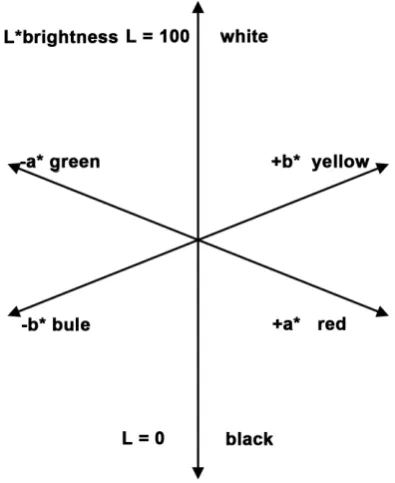
The color of venous blood was assessed with the CR-400 (Konica Minolta, Inc., Tokyo, Japan) using the CIE L*a*b* (CIELAB) (a color space specified by the French Commission internationale de l’éclairage) method. This method is a col-or space specified by the International Commission on Illumination that scribes all the colors visible to the human eye, and was created as a de-vice-independent model to be used as a reference (Figure 2).
DOI: 10.4236/health.2018.105046 580 Health
Figure 1. Nano-mist sauna (NMS) is filled with nano-mist. (a) Nano-mist is produced in NMS. Its diameter is approximately 10 to 500 nm, and it hardly condenses to dew in the air; (b) The appearance of NMS; (c) Nano-mist circulates in the NMS (40˚C, 100% relative humid-ity); (d) The protocol and difference of two groups of this study.
2.5. Assessment of Facial Color
The color elements of the face (at the top of cheek bones) were also measured using the same method as for the blood.
2.6. Statistical Analysis
DOI: 10.4236/health.2018.105046 581 Health
Figure 2. The conception of CIELAB. 1. brightness L* = 0 (black) to L* = 100 (white), 2. red and green (a*), nega-tive values (green) posinega-tive values (red) and 3. yellow and blue (b*), negative values (blue) positive values (yellow).
venous blood with color of the face, was also examined. All statistical tests were performed using statistical software (Statcel 2; OMS Publishing, Saitama, Japan), which is written in Visual Basic for Applications. A P-value < 0.05 was consi-dered statistically significant.
3. Results
3.1. Blood Gas Parameters
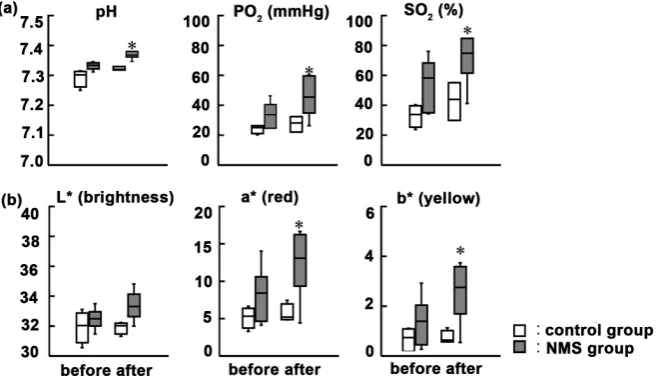
We previously reported that an increase in heart rate may affect blood circula-tion and the oxygen content of venous blood induced by the NMS stimulacircula-tion. Therefore, in the present study we examined the changes in various blood gas parameters, including pH, PO2, and SO2, after NMS. There was a significant in-crease in blood pH (baseline: 7.35 ± 0.01 vs. NMS: 7.40 ± 0.02; P < 0.05), PO2 (baseline: 33 ± 9 mmHg vs. NMS: 47 ± 15 mmHg; P < 0.05), and SO2 (baseline: 57% ± 19% vs. NMS: 76% ± 19%; P < 0.05) after NMS stimulation. There were no changes in these parameters in the control group (Figure 3(a)).
3.2. Changes in Venous Blood Color
DOI: 10.4236/health.2018.105046 582 Health
Figure 3. (a) Various blood Gas. pH, the partial pressures of oxygen (PO2) and oxygen
saturation (SO2). Statistically increased after NMS while the control group did not. (b)
The color of venous blood changed from dark red to vivid red. Although increased the value of brightness (L*) did not show significant increase, those of the red (a*) and yellow (b*) elevated (*P < 0.05).
following NMS treatment. Thus, visually the color of the venous blood became brighter (from dark to white) after hyperthermic stimulation, while the red and yellow values increased, and the green and blue values decreased. There were no changes in these parameters in the control group (Figure 3(b)).
3.3. Changes in Face Color
Simultaneous measurement of color elements of the face showed no significant differences with NMS treatment (data not shown).
3.4. Correlations of Blood Gas Parameters with Blood Color
Elements
There were positive correlations of all color elements with venous blood para-meters (pH, PO2, and SO2), with particular strong correlations with PO2 and SO2 (Figure 4).
3.5. Correlations of Blood Color Elements with Complexion
The regression analyses of blood color with complexion (color of the face) are shown in Figure 5. Although there were no significant changes, the b* value (yellow) showed trend towards a negative correlation, while the a* (red) and L* values showed trend towards a positive correlation.
4. Discussion
In the present study, we found a change in face color in all subjects (from pale to red) during and after NMS stimulation, as we previously demonstrated [8] [9]
DOI: 10.4236/health.2018.105046 583 Health
Figure 4. Positive correlations between blood gas parameters and color elements of blood correlations between all color elements of venous blood (brightness = L*, red = a* and yellow = b*) and its parameters (PO2 and SO2) positive and high.
Figure 5. The color of blood and the complexion (color of the face). The value of b* (yel-low) was the highest and followed by a* (red) and L* (brightness). Only b* showed a neg-ative correlation.
[image:7.595.215.535.450.566.2]DOI: 10.4236/health.2018.105046 584 Health We previously reported that hyperthermic stimulation accelerated internal gases exchange [8] [9] [10] [11]. Indeed, in the present study, the PCO2 (base-line: 52 ± 6 mmHg vs. NMS: 45 ± 5 mmHg) and total CO2 (base(base-line: 30 ± 2 mmHg vs. NMS: 29 ± 2 mmHg) decreased after NMS [8] [9] [10] [11]. The NMS also increased respiratory rate (baseline: 15.7 ± 5.8 vs. NMS: 16.7 ± 6.3 per minute) and heart rate (baseline: 72.2 ± 10.1 vs. NMS: 74.2 ± 11.3 per minute) (data not shown). Thus, these data support the change of venous blood color from dark red to vivid red. These findings may be explained by the Bohr Effect, whereby the reduction in blood CO2 and corresponding increase in pH causes a shift in the oxygen-dissociation curve [16].
The specific position of the yellow color may also support the findings of a change in blood color from dark red to vivid red with NMS, as yellow is located at the opposite end of the scale from blue (Figure 2) [15]. In other words, with improving blood circulation following NMS, there is a decrease in the blue color and an increase in the yellow color, which can result in a change in the skin complexion (from pale to red).
The rich network of capillary blood vessels in the face may also allow assess-ment of blood condition by measureassess-ment of the face color (complexion). Our study provides suggestive evidence for a correlation of complexion (red and yel-low) with blood parameters (Figure 5), while the red color in the face likely re-flects the level of blood oxygen. We also found that the yellow color in the blood showed a strong negative correlation with that in the face. All our subjects were of Mongoloid race. Therefore, the yellow color element of the venous blood was not as strong as being able to reflect through the facial skin. However, further studies with more subjects of different backgrounds are required to examine this hypothesis. Further, these studies should minimize interpersonal differences of the facial skin including suntan or age.
Physicians often observe the appearance of a patient’s complexion to help with diagnosis (e.g., anemia or blood circulation). However, this requires time and experience, and sometimes medical testing equipment. Our findings provide support for the use of medical complexion as a diagnostic tool, as it can reflect changes in the blood color, which is dependent on blood circulation and oxyge-nation. This technique may be particularly useful in the ambulatory setting or primary care, as it is minimally invasive and easy to perform. Nevertheless, fur-ther studies examining the correlation of complexion with health (internal envi-ronment) are required to confirm the clinical utility of this method. There are also a number of limitations of this study, including the small number of sub-jects. Thus, additional larger scale studies using age-matched groups, in various occupations, in different seasons, genders, and in different countries are re-quired to further support our findings.
Funding
DOI: 10.4236/health.2018.105046 585 Health
Competing Interest
The authors have no competing interests to report.
Acknowledgements
We thank all volunteers who participated in this study, Dr. Katsuhiko NISHINO and all staff of Niigata Association of Occupational Health, Inc. who supported obtaining blood samples. We also thank Edanz Group
(http://www.edanzediting.com/ac) for editing a draft of this manuscript.
References
[1] Maeda, M., Nagasawa, H., Shimizu, S., Yorizumi, K., Katsura and Tanaka., K. (2003) The Concentration of Artificial CO2 Warm Water Bathing and the Skin
Blood Flow. The Japanese Society of Balneology, Climatology and Physical Medi-cine, 66, 180-184.
[2] Yano, Y. (2013) Medical Insight into the Hot Springs According to Comparisons of the Chemical Compositions of the Hot Springs in Tokyo 23-Wards with Those of the Volcanic Hot Springs. The Japanese Society of Balneology, Climatology and Physical Medicine, 76, 207-214.
[3] Ostberg, J.R., Patel, R. and Repasky, E.A. (2000) Regulation of Immune Activity by Mild (Fever-Range) Whole Body Hyperthermia Effects on Epidermal Langerhans Cells. Cell Stress and Chaperones, 5, 458-461.
https://doi.org/10.1379/1466-1268(2000)005<0458:ROIABM>2.0.CO;2
[4] Ostberg, J.R., Dayanc, B.E., Yuan, M, Oflazoglu, E. and Repasky, E.A. (2007) En-hancement of Natural Killer (NK) Cell Cytotoxicity by Fever-Range Thermal Stress Is Dependent on NKG2D Function and Is Associated with Plasma Membrane NKG2D Clustering and Increased Expression of MICA on Target Cells. Journal of Leukocyte Biology, 82, 1322-1331. https://doi.org/10.1189/jlb.1106699
[5] Pilch, W., Szygula, Z., Palka, T., Pilch, P., Cison, T., Wiecha, S. and Tota, Ł. (2014) Comparison of Physiological Reactions and Physiological Strain in Healthy Men under Heat Stress in Dry and Steam Heat Saunas. Biology of Sport, 31, 145-149.
https://doi.org/10.5604/20831862.1099045
[6] Maeda, M. (2006) Hot Spring Water Bathing and the Thermology. Biomedical Thermology, 26, 58-61.
[7] Ohishi, T., Nukuzuma, C., Seki, A., Watanabe, M., Tomiyama-Miyaji, C., Kainuma, E., Inoue, M., Kuwano, Y. and Abo, T. (2009) Alkalization of Blood pH Is Respon-sible for Survival of Cancer Patients by Mild Hyperthermia. Biomedical Research, 30, 95-100. https://doi.org/10.2220/biomedres.30.95
[8] Tomiyama-Miyaji, C., Watanabe, M., Ohishi, T., Kanda, Y., Kainuma, E., Bakir, H.Y., Shen, J., Ren, H., Inoue, M., Tajima, K., Bai, X. and Abo, T. (2007) Modula-tion of the Endocrine and Immune Systems by Well-Controlled Hyperthermia Equipment. Biomedical Research, 28, 119-125.
https://doi.org/10.2220/biomedres.28.119
[9] Watanabe, M., Koboshi, S., Yoshimoto, H., Kobayashi, K., Tomiyama, C. and Abo, T. (2016) Traditional Japanese Style Bathing May Contribute to Good Health and Longevity. Health, 8, 756-763. https://doi.org/10.4236/health.2016.88079
DOI: 10.4236/health.2018.105046 586 Health
Temperature, Energy Production and Immune and Autonomic Nerve System. The Japanese Society of Balneology, Climatology and Physical Medicine 74, 96-102. [11] Tomiyama, C., Watanabe, M., Honma, T., Inada, A., Hayakawa, T., Ryufuku, M.
and Abo, T. (2015) The Effect of Repetitive Mild Hyperthermia on Body Tempera-ture, the Autonomic Nervous System, and Innate and Adaptive Immunity. Bio-medical Research, 36, 135-142. https://doi.org/10.2220/biomedres.36.135
[12] Watanabe, M., Takano, O., Tomiyama, C., Matsumoto, H., Urahigashi, N., Kainu-ma, E., Madarame, T., Fukuda, M. and Abo, T. (2012) The Effects of Application of an Ancient Type of Acupuncture Needle on Body Temperature, Immune Function and the Autonomic Nerve System. Health, 4, 775-780.
https://doi.org/10.4236/health.2012.410120
[13] Watanabe, M., Takano, O., Tomiyama, C., Matsumoto, H., Kobayashi, T., Mada-rame, T. and Abo, T. (2012) Skin Rubdown with a Dry Towel, “Kanpu-Masatsu”, Is an Aerobic Exercise. Biomedical Research, 33, 243-248.
https://doi.org/10.2220/biomedres.33.243
[14] Watanabe, M., Miyajima, K., Matsui, I., Tomiyama-Miyaji, C., Kainuma, E., Inoue, M., Matsumoto, H., Kuwano, Y. and Abo, T. (2010) Internal Environment in Can-cer Patients and Proposal That Carcinogenesis Is Adaptive Response of Glycolysis to Overcome Adverse Internal Conditions. Health, 2, 781-788.
https://doi.org/10.4236/health.2010.27118
[15] Jain, A.K. (1989). Fundamentals of Digital Image Processing. Prentice Hall, New York.