0
The impact of a gratitude
intervention on well-being:
a randomized controlled
trial
Faculty of Behavioural, Management and Social Sciences Study
Jennifer Hülsing
24.09.2018
Programme: MA Psychology
Specialization: Positive Psychology and Technology
Supervisors: Marion Sommers-Spijkerman, MSc
1
Table of content
Abstract ... 2
Introduction ... 3
Well-being ... 3
Gratitude ... 4
Efficacy of previous gratitude intervention ... 5
Working mechanisms ... 6
Gratitude ... 6
Positive affect ... 7
Positive relations ... 8
Current Research ... 9
Methods ... 10
Design ... 10
Participants and Procedure ... 11
Outcome measures ... 13
Data-Analysis ... 15
Results ... 18
Discussion ... 23
2
Abstract
Background: Although earlier studies have found positive effects of gratitude interventions on well-being, those interventions were mostly implemented in a student sample and put little emphasis on underlying working mechanisms. This study examines the effects of a gratitude self-help intervention on emotional, psychological, social and overall well-being, as well as the influence on gratitude, positive affect and positive relations in a general sample. Despite the efficacy, gratitude, positive affect and positive relations are examined as possible working mechanisms.
Methods: A non-clinical sample consisting of mostly higher educated Dutch women (N=144) was divided at random into a gratitude (N=73) and waitlist condition (N=71). Repeated measure analysis at post-test and follow-up were used to test the effect of the gratitude condition on well-being (MHC-SF), gratitude (GRAT-NL), positive affect (mDES), and positive relations (PGGS). To examine possible underlying working mechanisms, mediational analysis using PROCESS were performed with gratitude, positive affect and positive relations as mediators
Results. A significant difference between both conditions in case of emotional (d=.54), psychological (d=.44), social (d=.66) and overall well-being (d=.60), as well as on gratitude (d=.67) and positive affect (d=.75) at post-test was found, where participants scored higher on the measures in comparison to the waitlist group. The effects were maintained at follow-up, except for emotional well-being (p=.054). The treatment effect of the gratitude condition compared to the waitlist condition on well-being was mediated by changes in positive affect and gratitude. No significant difference between the conditions have been found for positive relations at post-test (p=.531) and follow-up (p=.492). The proposed mediational effect of positive relations has also not been found.
Conclusion. The implemented gratitude intervention showed promising effects on the sample to improve well-being, gratitude and positive affect. More insights into the working
3
Introduction
With putting more and more emphasis on enhancing people’s well-being instead of the mere
reduction of negative symptoms of certain diseases in mental health care, new interventions
are designed to achieve this goal. The effects of those interventions show different benefits for
the individual and consequently society (Seligman & Csikszentmihalyi, 2000; Keyes, 2016).
In the field of positive psychology, gratitude shows promising results in the enhancement of
well-being (Diener & Chan, 2011), though it remains unclear how those effects are achieved
(Wood, Froh, Gerghty (2009). The aim of the current study is to test the efficacy of a new
gratitude intervention on enhancing well-being and get more insights into underlying working
mechanisms.
Well-being
With the upcoming notion of positive psychology, well-being gained more attention within
research. Positive psychology aims at changing the mere focus on the study and reduction of
negative properties like mental illness to a more global view of mental health, including
constructs like well-being and individual strengths (Seligman & Csikszentmihalyi 2000).
More recent studies suggest, that mental well-being and mental illness are two related but
independent dimensions of mental health, where mental illnesses are absent and the person
experiences a high level of mental well-being (Keyes, 2016). This indicates that to effectively
promote mental health in the individual, not only the reduction of mental illness should be the
focus of interventions, but also the promotion of well-being.
Mental well-being consists of three different aspects, all adding up to overall mental
wellbeing: emotional, psychological, and social well-being. Emotional well-being reflects the
experience of positive emotions and general satisfaction in life. Psychological well-being
includes self-acceptance, the feeling of being able to manage responsibilities of the daily life
4
context, including the feeling of social integration, social acceptance and social contribution
(Lamers, Westerhof, Bohlmeijer, Ten Klooster, & Keyes, 2010).
To enhance mental well-being has many positive effects: Diener and Chan (2011)
reviewed different studies on well-being and indicate that enhanced well-being contributes to
health and general longevity. Keyes (2016) states that people who experience signs of
emotional well-being and functioning, are less likely to suffer from chronic diseases, and are
less likely to develop mental illness. Furthermore, people scoring high on well-being report a
good quality of life and having more meaningful relationships (Veenhoven, 2008). Besides
the benefits for the individual, the inclusion of well-being in interventions leads to higher
work-productivity, less days of absence at work, and reduced health care costs (Keyes &
Grzywacz, 2005). To develop interventions directed at the enhancement of well-being has
therefore individual and economical value.
Gratitude
The oxford dictionary defines gratitude as “the quality of being thankful; readiness to show
appreciation for and to return kindness.” (Simpson & Weiner, 1989). Gratitude is differently
used in psychological literature: as an emotion (see Fredrickson , 2005; Armenta, Fritz &
Lyubomirsky, 2017) or as an affective trait (see Wood, Maltby, Stewart, Linley, Joseph,
2008; McCullough, Emmons, & Tsang, 2002) . The latter describes gratitude as a disposition
that influences the tendency to react to other people’s acts and situations with grateful
emotions, such as pride (Overwalle, Ervielde & De Schuyter, 1995), trust (Laros &
Steenkamp, 2005), or joy (Schimmack & Reizenheim, 1997). Besides these different
approaches they both have in common that gratitude is in some way linked to the experience
of positive emotions, either in being a positive emotion itself or by influencing the probability
5
Efficacy of previous gratitude intervention
In a meta-analysis, Davis et al. (2016) summarized existing gratitude interventions under
three categories, namely lists/journals about things people are grateful for, expressing
gratitude to someone, and lastly psycho-educational interventions about gratitude. The first
two are more common and have shown effects on emotional well-being, furthermore no
differentiation in effect size has been found between both types of interventions. Another
possible differentiation between gratitude interventions is the duration of it. Some
interventions require the participant to focus on gratitude tasks for a longer time or perform
them more frequently. Again, no difference in effect size can be found between the dose and
duration of different interventions when comparing for minutes or days, according to Davis et
al. (2016).
Previous studies implemented various interventions directed at gratitude: Emmons and
McCullough (2003) performed different interventions in a student sample, namely a weekly
(N=192) and a daily intervention (N=152) where people made a gratitude list. The authors
measured a rise in emotional well-being. However, the effects were only measured at
post-test, long-term influences of the interventions have not been measured. Additionally, only
indications about emotional well-being has been made, whether the intervention affects
overall, psychological and social well-being is not known. In another study, Froh, Kashdan,
Ozimkowski and Miller (2009) implemented a high intensity intervention (N=89), where
students had to write a letter showing their gratitude towards a person and finally presenting
the person to the addressed person. Results show a positive effect of the intervention on
emotional well-being. Geraghty (2010) implemented a gratitude list intervention and
compared the intervention group with a measurement only group (total N= 108). Effects of
the intervention on psychological well-being were found (d=.54). In another study, Toepfer et
al. (2012) implemented a gratitude intervention, where the participants expressed gratitude in
6
(total N=183). A positive effect of the intervention on psychological well-being has been
found (d=.24).
Different studies found effects of gratitude intervention on either emotional or
psychological well-being, but were mostly implemented in a student sample. Furthermore, a
broader measurement of overall well-being, emotional, psychological and social well-being is
still missing. Additionally, have most studies only measured the effects during the
intervention. To what extent results might change after the participants stopped with the
intervention is not known. Lastly, did most studies not examine possible working mechanisms
behind the found effects.
Working mechanisms
Different theories might give indications about the working mechanisms: firstly the
moral affect theory (McCullough, Kilpatrick, Emmons, & Larson, 2001) puts emphasis on the
social component behind the experience of gratitude and how it might positively influences
social relationships. Another explanation is the positive affect hypothesis (Wood, Froh, &
Gereghaty, 2009): with gratitude being linked to a higher valence of positive emotions, the
individual may benefit from the preventive quality of the frequent experience of positive
emotions. Furthermore, may the habitual experience of positive emotions heighten the overall
life satisfaction of the individual in long-term (Gallup, 1999).
Gratitude
With earlier gratitude interventions showing positive effects on well-being, a logical
relationship should therefore be, that if those interventions are directed at gratitude, an
enhancement of gratitude should explain the enhancement of well-being. Still, by comparing
different studies Wood, Froh, Gerghty (2009) did not find any studies where gratitude was
measured at the end of an implemented intervention. Statements about a possible mechanism
7
gratitude within this studies, more indications about the mechanisms behind gratitude
interventions are possible.
Positive affect
Gratitude is linked to the experience of positive emotions: In different studies various
emotions related to gratitude have been identified, for example: happiness, pride and hope
(Overwalle, Ervielde & De Schuyter, 1995), admiration, respect, trust and regard (Laros &
Steenkamp, 2005), or joy and contentment (Schimmack & Reizenheim, 1997). Touissaint and
Friedman (2008) found a mediational effect on the association between gratitude and mental
well-being, proposing positive affect being a possible working mechanism on the found
observed effects of for gratitude on well-being.
An explanation why positive affect is associated with mental well-being has been
made by Fredrickson & Joiner (2002). With the broaden-and-build theory, they argued that
with each positive emotion a certain behaviour is promoted that builds up physical,
psychological and social resources. Based on this theory, Friedrickson & Joiner (2002)
furtherly discovered the possible effect of positive emotions on well-being. They proposed an
upwards spiral of the experiencing of positive emotions towards an enhanced well-being,
where positive emotions do not only influence the person positively in the present but also in
the future. Applying this theory on gratitude a reason for its positive effects can be that stating
ones gratefulness towards another person strengthens the emotional bond between both. The
rewarding nature of strong social bonds will then benefit the wellbeing of the person in the
future.
Several studies (see Wood, Froh & Geraghty,2009) described a relationship between a
gratitude intervention condition, positive affect and mental well-being, where they influenced
each other positively. Based on earlier interventions positive affect has been proposed as a
8
those interventions were implemented in a children sample or only examined direct effects
after the intervention.
Positive relations
As mentioned before, are gratitude and social relationships two connected subjects.
Many explanations behind the existence of gratitude touch the theme of social relationships
and a functioning social life. Wood, Maltby, Gillett, Linley, & Joseph (2008) found that
gratitude led directly to higher levels of perceived social support. Within interventions
focussed on enhancing well-being by strengthening gratitude, a trend of a more positive
perception of social relationships has also been found (Martínez-Martí, Avia, &
Hernández-Lloreda, 2010).
This influence on social relations is also suggested by other authors: Michie (2009)
found an association between gratitude and social means like pride, altruism, and social
justice, Tsang (2006) linked gratitude with a heightened motivation to act prosocial, and
generally an association between gratitude and positive relationships has been found in
different studies (e.g. Wood, Joseph, and Matlby (2009); Wood, Maltby, Gilett et al. (2008);
Froh, Yurkewicz, & Kashdan, 2009.
A possible explanation why we experience gratitude and how it leads to its associated
positive effects is the moral affect theory (McCullough, Kilpatrick, Emmons, & Larson,
2001). Within this theory, gratitude has certain prosocial effects influenced by three moral
functions of it. Firstly, gratitude can act as a moral barometer: the experience of the several
positive emotions linked to gratitude gives the person the sign that he is in a positive situation
or was the receptor of a kind act. Secondly, gratitude is explained as a moral motive. People
are therefore more motivated to act more prosocial when they feel grateful. Therefore, if you
feel thankful towards someone for his acts towards you, you are more likely to return the act
9
reinforce, where the receiver of a prosocial act shows his gratefulness to the other person,
which reinforces the person to, again, act prosocial towards the receiver. If a person
experiences gratitude, or respectively positive emotions linked to gratitude, and expresses this
in a “thank you”, the other person will feel validated for his act and repeat it in the future.
With social well-being, means like social functioning and social acceptance are
determinants for well-being (Lamers, Westerhof, Bohlmeijer, Ten Klooster, & Keyes, 2010).
Besides the theoretical explanations of gratitude in terms of social functioning, little is known
about the effects of gratitude interventions on social relations and whether it serves as a
possible mediator in the association between gratitude and mental well-being.
Current Research
The purpose of this study was to replicate earlier findings of gratitude interventions in a
general population sample. The main research question was:
To what extent is the brief gratitude intervention effective in enhancing psychological, social,
emotional and overall well-being, gratitude, positive affect and positive relations compared to
a waitlist control condition?
It was hypothesized that participants in the intervention group score significantly higher on
overall well-being emotional, social and/or psychological well-being, gratitude, positive affect
and positive relations than participants in the waitlist control condition at post-test and/or six
weeks after the intervention.
Little is known about the working mechanisms of gratitude interventions. As a
secondary aim, this study examined positive affect, positive relations and gratitude as possible
mediators of the effects of the intervention on well-being. The following secondary research
question was formulated:
Can the possible effect of the intervention be explained by an enhancement of positive affect,
10
It was hypothesized that the effect of the gratitude intervention on overall well-being (at
post-test) is mediated by changes in positive affect (two week measurement) (H2), positive
relations (two week measurement) (H3), and/or gratitude during the intervention (difference
between baseline and post-test).
Methods
Design
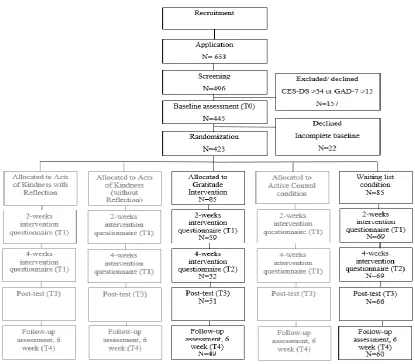
A single-blind randomized controlled intervention study has been employed, consisting of
five different conditions. Within this study two conditions are compared, namely a gratitude
and waitlist condition. A test battery was filled out by the participants at different moments:
before the intervention at baseline (T0), two weeks (T1) and four weeks (T2) after the
beginning of the intervention, a post-test measurement (T3) after the end of the intervention
(sixs week after baseline), and a six week (T4) after the intervenion follow-up measurement
11
Figure 1. Procedure
Participants and Procedure
Participants were reached via advertisements in national daily newspapers (e.g. Volkskrant,
Telegraaf) and the online newsletter of psychology magazines. To specifically reach persons
who are generally interested in their own happiness, the advertisement included the question
“do you want to experience more satisfaction and enduring happiness in your life”. Another
part of the advertisement was a link to a website, to attain further information and finally sign
themselves up for the study. A convenience sampling method has therefore been employed
within this study. During the online registration process, participants had to give informed
consent.
The target population within this study was the general public without high levels of
12
inclusion criteria. For this matter, participants received a screening test battery, the participant
has to be at least 18 years old, has an adequate understanding of the Dutch language and is
able to write reflections in Dutch. The participants also have access to an internet connection,
can be contacted via email and has to be willing to participate in the course of 6 weeks in the
exercises of the intervention and to reflect on this experience the day after for approximately
10 minutes. Lastly, the participants have to accept the informed consent within the application
process.
Participants were excluded for the further participation in case they fulfilled one or
both of the following two criteria. Firstly, participants who fall in the category of
“flourishers”, meaning that they (1) scored high (score of 4 or 5) on one or more items of the
subscale “emotional well-being” of the Mental Health Continuum-Short Form (MHC-SF) and
(2) scored high on six or more items of the combined subscales “social well-being” and
“psychological well-being” of the MHC-SF. Secondly, participants were excluded when they
showed moderate or serious symptoms of depression or anxiety, meaning that they scored 24
or higher on the Center for Epidemiological Studies Depression Scale (CES-D) and/or had a
score of 15 or higher on the Generalized Anxiety Disorder 7 items (GAD-7).
If the interested person fulfilled the inclusion criteria, a randomization process took
place dividing the sample to the conditions. Participants of all conditions started around the
same time with their assigned intervention. After the end of the intervention the participants
had to fill in again the test battery (T3), and six weeks after the end of the intervention (T4).
After the screening the study included in total N=144 participants who were randomly
assigned to the two conditions. The gratitude and waitlist condition included at the beginning
13
Outcome measures
For the current study, a battery of questionnaires was used including the Mental Health
Continuum-Short Form (MHC-SF), the modified Differential Emotions Scale (mDES), the
Gratitude Questionnaire-6 Dutch translation (GQ-6-NL), and the Positive Mental Health Scale
(Positieve Geestelijke Gezondheid Schaal; PGGS).
Mental-Wellbeing.
To measure overall, emotional, psychological and social well-being, the Mental Health
continuum-Short form (MHS-SF) developed by Keyes (2002b), has been used. The translated
and validated Dutch version from Lamers, Westerhof, Bohlmeijer, ten Klooster, & Keyes
(2011) has been used. The participants is introduced to rate the statements on how often he or
she experienced the described situation, the itemscores go from never (0) to nearly always
(5), where a high score a higher level of wellbeing implies. Overall well-being, all scales
combined, had an alpha ranging from .87 (T0) to .91 (T3). The subscale emotional well-being
contains three items, e.g. “.. that you are happy?”. Lamers et al. reported a Cronbach’s Alpha
of a=.83, within this study the internal reliability is ranging from .78 (T0) to .91 (T3). The
subscale psychological well-being contains 6 items, e.g. “.. that your life has an direction and
purpose?”.Lamers et al. reported a Cronbachs alpha of a=.83, within this study the internal
reliability is ranging from .64 (T0) to .73 (T3). The subscale social well-being contains 5
items, e.g. “..that you understand how our society works?”. Lamers et al.(2011) reported a
Cronbach’s alpha of a=.74, within this study the internal reliability within this study is
ranging from .77 (T0) to .85 (T3).
Gratitude
To measure gratitude the Short Gratitude, Resentment and Appreciation Test, Dutch
translation (S-GRAT-NL) was used (Jans-Beken, Lataster, Leontjevas, & Jacobs, 2015). The
14
in what extent they agree with the statement; the item scores go from “strongly disagree” (1)
to “strongly agree” (7), where a high score implies a stronger experience of gratitude. The
internal reliability in earlier studies was a Cronbach’s Alpha of a=.82 (Jans-Beken, Lataster,
Leontjevas, & Jacobs, 2015), in this study Cronbach’s alpha ranges from .84( T0) to .88(T3).]
Positive affect
To measure positive affect, the subscale of the modified Differential Emotional Scale
(Schaefer, Nils, Sanchez, & Philippot, 2002) has been used. The subscale positive affect
consists of eight items. The participants were asked in which extent they experience a certain
emotion, e.g. “satisfied, content, pleased”; the item scores go from “not at all” (1) to “very
intense” (7), where a higher score implies a stronger experience of positive emotions.
Schaefer, Nils, Sanchez, & Philippot (2002) reported a Cronbach’s alpha of at least above
a=.6, within this the study the internal reliability is ranging from .51 (T0) to .91 (T4).
Positive relations
To measure positive relations the Positive Mental Health Scale (PGGS) was used. The
questionnaire contains 9 items, e.g. “I enjoy personal conversations with family members or
friends.”. The item scores range from 1 (disagree strongly) to 6 (agree strongly), where a high
score implies more positive relations. Out of an earlier study (van Dierendonck, 2011), only
the internal consistency for the whole questionnaire is known, where it ranges from .82 and .9,
within this study the internal consistency for the used scale ranges from .49(T2) to .59 (T4).
Gratitude intervention condition
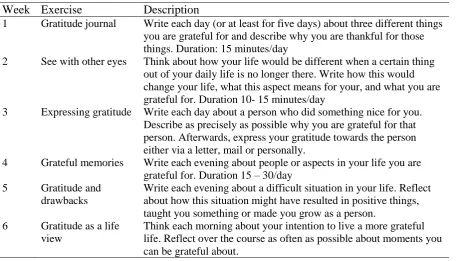
Within the gratitude condition, participants carried out six different exercise directed
to influence gratitude each week including a short written reflection over the executed task
over the course of six weeks (see Table 1). The intervention includes exercises involving
gratitude lists and expressing gratitude towards another person. Within the reflection people
were asked to state the task they performed and what this has meant for the person. Example
15
Participants received each week an email with information about next week’s tasks.
Participants were completely autonomous in acting out their tasks, being able to decide
[image:16.595.74.532.163.424.2]themselves when and where to do it.
Table 1. Gratitude exercises
Week Exercise Description
1 Gratitude journal Write each day (or at least for five days) about three different things you are grateful for and describe why you are thankful for those things. Duration: 15 minutes/day
2 See with other eyes Think about how your life would be different when a certain thing out of your daily life is no longer there. Write how this would change your life, what this aspect means for your, and what you are grateful for. Duration 10- 15 minutes/day
3 Expressing gratitude Write each day about a person who did something nice for you. Describe as precisely as possible why you are grateful for that person. Afterwards, express your gratitude towards the person either via a letter, mail or personally.
4 Grateful memories Write each evening about people or aspects in your life you are grateful for. Duration 15 – 30/day
5 Gratitude and drawbacks
Write each evening about a difficult situation in your life. Reflect about how this situation might have resulted in positive things, taught you something or made you grow as a person.
6 Gratitude as a life view
Think each morning about your intention to live a more grateful life. Reflect over the course as often as possible about moments you can be grateful about.
Waiting list control condition
Within this condition participants did not participate in an intervention directly. After the six
weeks-follow up questionnaire (T3), they can choose for one of the four happiness
interventions.
Data-Analysis
Analysis has been run with SPSS 22. First, means, standard deviations, and Cronbach’s alpha
have been computed to determine the internal consistency and to examine the scale structure
of the mentioned measures. Further descriptives have been run to examine the sample’s
demographics and mean scores of the measurement outcomes at the baseline. Drop-outs were
detected for the T3 and T4 assessment, with in total 40 cases (22.8%). Those case were
removed before hypotheses testing by listwise deletion. To identify possible differences
16
demographics and outcomes measures at baseline. Adherence was examined by an estimate of
time spent for the exercise per week made by each participant, low adherence was judged in
case a participant spent less than 15 minutes per week on the exercise, which is under the
recommended time for the exercises. No exclusion of participants took place due to low
adherence. To check whether randomization was successful between the gratitude and waitlist
condition, Chi-square for the demographics and independent t-test for mean age and mean
scores on the outcome measures have been run on both conditions at baseline. The data has
been checked for normality with the Shapiro-Wilk-Test.
To test hypothesis one, the effects of the gratitude intervention on well-being,
gratitude, positive affect and positive relations mixed ANOVA’s have been run. With a 2
(condition) X 3 (time) design the mean scores of the MHC-SF, GRAT-NL at T0, T3, T4 and
for the mDes and PGGS at T0, T2, T3, T4, the effects of the intervention were illustrated for
each measurement moment. Significance was set at p≤ .05. The effect size given as Cohen’s
d, was calculated with the mean and standard deviation at each measurement moment, using
the following formula: d=mean1-mean2
𝑆𝐷 . Cohen’s d was judged regarding to Cohen (1988) as
following: d≤.2 (small effect), d≤.5 (medium effect), d>.8 (large effect). To examine whether
the possible effects at post-assessment were maintained at follow-up effect was maintain, a
one-way ANOVA was run with the measurement outcomes at post-assessment and follow-up
as the dependent variable and condition as the factor.
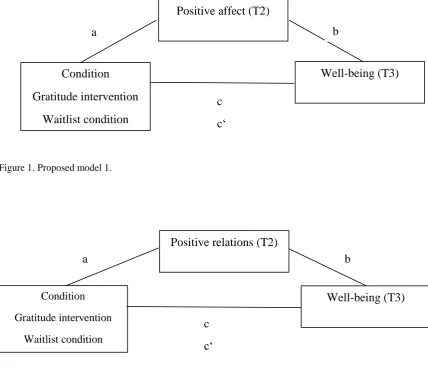
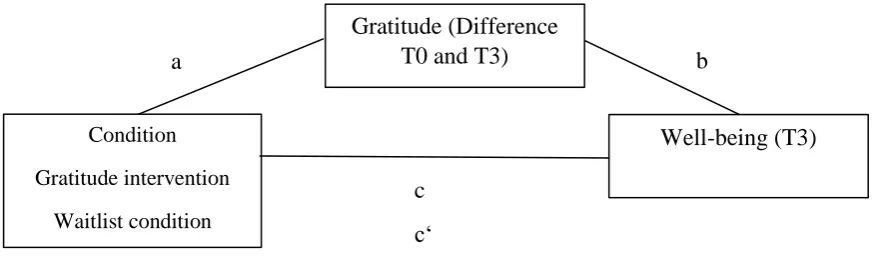
To test hypotheses two to four a simple mediational analyses were conducted. With
use of the PROCESS plug-in by Preacher and Hayes (2008) a mediational effect of positive
affect, positive relations, and gratitude (M) on the association between the condition as the
independent variable (X), and well-being as the dependent variable (Y), has been examined.
See figure 2 for the proposed models. The models have been analysed separately. In each
17
for the gratitude intervention, 0 for the waitlist condition) on the dependent variable
well-being (mean scores of the MHC-SF at T3). The c’-path represents the indirect effect of X on
Y when controlling for the mediator positive affect,positive relations or gratitude (M: mean
scores on mDES or PGGS at T1; difference scores on GRAT between T0 and T3). The a-path
describes the direct effect of condition on the possible mediator (M: mean scores on mDES or
PGGS at T1; difference scores on GRAT between T0 and T3). Similarly, the b path describes
the direct effect of the possible mediator on the dependent variable (mean scores of the
MHC-SF at T3). Significance was set at p≤ .05. The bias corrected (BC) 95% confidence intervals
(CI) were estimated based on 5000 bootstrapping samples. When the CI of the indirect effect
[image:18.595.72.501.368.744.2]of X on Y did not include zero, the indirect effect was considered as significant.
Figure 1. Proposed model 1.
[image:18.595.90.499.368.504.2]Results
Figure 2. Proposed Model 2.
Positive affect (T2)
a b
Condition
Gratitude intervention
Waitlist condition
Well-being (T3)
c c‘
Positive relations (T2)
a b
Condition
Gratitude intervention
Waitlist condition
Well-being (T3)
18
[image:19.595.69.508.86.220.2]Results
Figure 3. Proposed model 3
Results
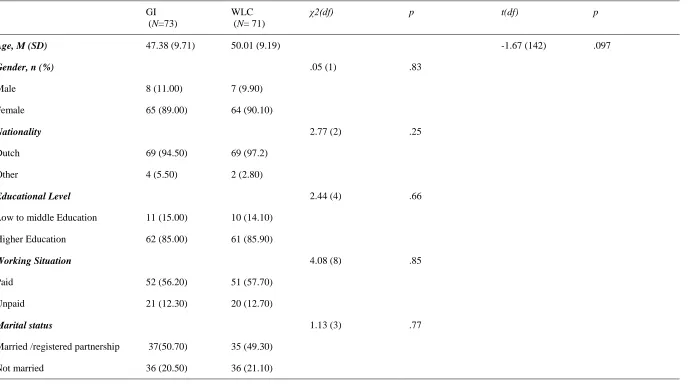
Study sample
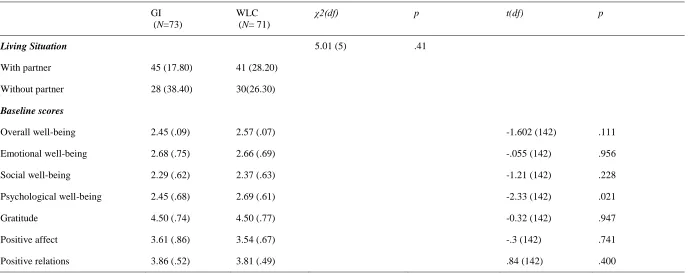
The whole sample was predominantly female (89.6%). Furthermore, has the high educational
status of both samples to be noted (85.3%). The mean age of the sample is 46.68 years
(SD=9.51). No significant difference between the gratitude and the waitlist condition has been
found at the baseline level concerning the demographics (see Table 2). A significant
difference was observed for psychological well-being (p=.021), where the waitlist condition
scored higher on the measure than the participants of the gratitude condition. For the other
outcome measures no significant difference was present at baseline. Gratitude (Difference
T0 and T3)
a b
Condition
Gratitude intervention
Waitlist condition
Well-being (T3)
19
Table 2.
Baseline characteristics (N=144).
GI (N=73)
WLC (N= 71)
χ2(df) p t(df) p
Age, M (SD) 47.38 (9.71) 50.01 (9.19) -1.67 (142) .097
Gender, n (%) .05 (1) .83
Male 8 (11.00) 7 (9.90) Female 65 (89.00) 64 (90.10)
Nationality 2.77 (2) .25
Dutch 69 (94.50) 69 (97.2) Other 4 (5.50) 2 (2.80)
Educational Level 2.44 (4) .66
Low to middle Education 11 (15.00) 10 (14.10) Higher Education 62 (85.00) 61 (85.90)
Working Situation 4.08 (8) .85
Paid 52 (56.20) 51 (57.70) Unpaid 21 (12.30) 20 (12.70)
Marital status 1.13 (3) .77
20
Table 2 (continued).
Baseline characteristics (N=144).
GI (N=73)
WLC (N= 71)
χ2(df) p t(df) p
Living Situation 5.01 (5) .41
With partner 45 (17.80) 41 (28.20) Without partner 28 (38.40) 30(26.30)
Baseline scores
[image:21.842.81.781.105.378.2]21
Drop-out and adherence
28 cases of the gratitude condition and 12 in the control condition were reported as missing
and excluded within the following analyses. Baseline differences were assessed between
outs and completers. A significant difference in mean age was found, where the
drop-outs (M=43.93) were on average 6.59 years younger than the completers (M=50.51), (t= 3.90
(142), p<.001). Additionally, a significant difference in marital status has been found
(χ2=10.82(3), p=.013), where in the completers group more people were married (N=56)
compared to the drop-out group (N=16). The vast majority of the participants of the
intervention spent 30 to 60 minutes each week on the exercise (35.3%). Only five cases are
reported (9.8%), where the participant spent less than 15 minutes per week on the
intervention, which is under the recommended time.
Efficacy of the gratitude intervention
Table 2 displays the interaction effect between time and group for each outcome
measure. There has been a significant interaction effect for emotional, psychological, social
and overall well-being, as well as for gratitude and positive affect from T0 to T3, and from T0
to T4. This indicates the changes in the measurement outcomes over time were dependent on
the condition. Additionally, the found effects are maintained from post-test to follow-up
measurement. Effect sizes were medium, varying from d=.40 to d=.75.There has been no
significant interaction effect between time and group in case of positive relations (p=.958).
There is a significant difference between both groups at T3 for emotional,
psychological, social and overall well-being, as well as for gratitude and positive affect. The
found effect was not maintained for emotional well-being at T4, no significant difference
between both conditions is present (p=.054). In case of positive relations the groups did not
22
Tabel 3. Estimated means and effects of the gratitude intervention compared to the waitlist condition on emotional, social, psychological an overall well-being, as well as on gratitude, positive affect and positive relations at baseline (T0), interim measure (T2), post-assessment (T3) and follow-up (T4).
GI WLC Time*Group Outcomes Time M (SD) M (SD) F p
Overall well-being
Baseline 2.45 (61) 2.57 (.54)
T3 3.06 (.70) 2.66 (.64) 28.642 <.001 T4 3.02 (.65) 2.72 (.68) 5.808 .004 Emotional well-being
Baseline 2.68 (.75) 2.67 (.64)
T3 3.22 (.80) 2.80 (.77) 7.990 .006 T4 3.11 (.70) 2.81 (.82) 16.718 <.001 Social well-being
Baseline 2.30 (.62) 2.37 (.63)
T3 2.90 (.68) 2.45 (.68) 25.972 <.001 T4 2.81 (.72= 2.54 (.65) 11.203 <.001 Psychological
well-being
Baseline 2.45 (.68) 2.69 (.61)
T3 3.13 (.79) 2.80 (.71) 19.953 <.001 T4 3.13 (.71) 2.84 (.72) 15.870 <.001 Gratitude
Baseline 4.51 (.76) 4.47 (.75)
T3 5.14 (.77) 4.62 (.78) 15.038 <.001 T4 5.05 (.91) 4.56 (.74) 9.200 <.001 Positive affect
Baseline 3.61 (.86) 3.54 (.67) T2 3.92 (.711) 3.54 (.72)
T3 4.62 (1.10) 3.84 (.99) 5.523 .005 T4 4.53 (1.25) 3.91 (1.13) 4.097 .008 Positive relations
Baseline 3.87 (.52) 3.81 (.49) T2 3.80 (.47) 3.67 (.53)
T3 3.81 (.47) 3.74 (.60) .023 .971 T4 3.72 (.49) 3.66 (.55) .095 .958
23
Exploration of proposed working mechanisms
The results of all three mediational analyses are displayed in Table 4. Results indicate that the
gratitude condition, as compared to the control condition, had a significant effect on
overall-wellbeing at post-test(c-path). The gratitude condition was a significant predictor of positive
affect and gratitude, in case of positive relations was it not a significant predictor (p=.251)
(a-path). All three possible mediators were significant predictors of overall well-being (b-(a-path).
The indirect effects of positive affect and gratitude were in both cases significant, meaning
they mediate the effect of the gratitude intervention on well-being. 28% of the variance of
scores in well-being can be accounted for by the indirect effects of condition and positive
effect (R²=.28), in case of the indirect effects of condition and gratitude 7.5% of the variance
in well-being can be explained by changes of both predictors (R²=.07). In case of positive
[image:24.595.77.526.442.568.2]relations was the indirect effect not significant, 95% CI=-.0473, .2111.
Table 4. Outcomes of simple mediation analysis assessing indirect effects of positive affect (PA), positive relations (PR) and gratitude (G) on the outcome measure MHC-SF compared to both conditionsa
Bootstrap results for indirect effects (95% CI)
c-path c’path a-path b-path ab LL UL
PA -0.35* .19 -0.37* 0.44* 0.08* -.3381 -.0267
PR -0.35* -0.43* -0.13 -0.58* 0.07 -.0473 .2111
G -0.11* -0.12 -0.45* 0.19* -.04* -.0884 -.0028
aValues are unstandardized Betas; * Significant at p < .05
Discussion
This study was aimed to examine the efficacy of a six-week gratitude intervention on general,
emotional, social, and psychological well-being as well as on positive affect and positive
relations. A second aim was to get more insights into the working mechanisms of gratitude
interventions by examining a possible meditational effect of positive affect, positive relations
24
long intervention was implemented in a Dutch general population sample, consisting mostly
of higher educated women. The findings show a positive influence of the gratitude
intervention on enhancing emotional, social, psychological and overall well-being, as well as
positive affect and gratitude. Mediation analysis revealed positive affect and gratitude as
mediators on the effect of the gratitude condition on overall well-being. Positive relations did
not change significantly over the course of the intervention, and the expected mediational role
of it was not proven.
Efficacy of the gratitude intervention
The gratitude intervention was primarily aimed at enhancing levels of well-being of the
sample. According to the results, the participants scored significantly higher on emotional,
psychological, social and overall well-being than participants of the waitlist condition at
post-test. These findings support the hypothesis and are in line with earlier research, where
different gratitude interventions have been implemented (Wood, Froh, & Geraghty, 2010).
Especially emotional and psychological well-being showed a large effect size. Emotional
well-being is among other given when a person experiences positive emotions (Lamers et al.,
2010). By actively expressing something a person is grateful for, the person can take the most
out of the positive life event (Sheldon & Lyumbomirsky, 2006). Participants might have
therefore raised the impact of positive experience with help of the intervention, which led to
higher scores in emotional well-being. Psychological well-being includes personal growth and
the ability to cope with daily hazards (Lamers et al., 2010). Wood (2007) linked gratitude
with positive coping styles: people who are grateful tend to use more positive coping
mechanisms, like planning and fining potential for growth. The heightened likelihood to
engage in adaptive coping styles might explain the effect on psychological well-being.
Next to well-being has the influence of the gratitude intervention on positive affect
25
gratitude condition score significantly different over time compared to the control condition,
and enhanced their experience of positive affect. Therefore, the hypothesis can be accepted,
which goes along with earlier studies. Wood (2007) describes gratitude as being strongly
related to the habitual experience of positive emotions. A rise of positive affect is therefore in
line with theory. On the other hand, there has been no significant difference found between
both groups on positive relations. The expected positive effect of the gratitude intervention on
positive relations has not been found, the hypothesis is therefore not true. A possible
explanation could be the used questionnaire, which mostly consists of items rather focussing
on the amount of relationships than the value of those. Earlier studies described possible
influences of gratitude interventions on the perception of relationships (e.g. Martínez-Martí,
Avia, & Hernández-Lloreda, 2010; Froh, Yurkewicz, & Kashdan, 2009). A superficial
assessment of the answers given of the participants in the gratitude condition, revealed many
answers containing social and relationship subjects, e.g. valuing encounters with peers.
Additionally, different theories on the positive effects of gratitude interventions are partly
explained by social means, like more prosocial behaviour or seeking help of others more often
(Wood, 2010). It seems therefore that gratitude is associated to effect the value of a
relationship and help seeking behaviour and not a rise in the amount of relationships. An
influence of the used measurement method might therefore be possible, since social
well-being did change significantly over the course of the six week long intervention, compared to
the waitlist condition.
Mediating role of positive affect and positive relations on well-being
Another aim of this study was to get more insights into the working mechanisms of gratitude
interventions. One possible explanation was the effect of positive affect on the association
between the gratitude intervention and well-being. The expected model has found to be true,
26
stated before, gratitude being linked with the experience of more frequent positive emotions
might explain this effect. Gallup (1999) suggested that a frequent experience of positive
emotions may change the balance between positive and negative effect towards the former
and in the end enhances well-being. Furthermore, was gratitude examined as a possible
mediator. Results indicate that gratitude influences the association between participating in a
gratitude intervention and enhanced well-being. In comparison to positive affect explains
gratitude a smaller percentage of variance in well-being.With the results out of this study, it is
indicated that not only outcomes associated with gratitude, like positive affect, are
mechanisms behind well-being, but also gratitude itself. Though, it seems that constructs
associated with gratitude play an important role on its positive influence on well-being.
In contrast, was the expected effect of positive relations on the association between the
gratitude intervention and well-being not found. Davis et al. (2006) suggest in different
explanation how a social component could explain the influence of gratitude on well-being,
expecting it to be a working mechanisms behind it. Since positive relations did not differ
significantly between both conditions, positive relations has not been found to be a mediator
in the different well-being scores of both conditions. Again, a reason behind this could be the
choice of the measurement instrument.
Strengths and Limitations
One of the main advantages of this study is the use of the MHC-SF which measures all three
forms of well-being and overall well-being. Within gratitude research, most focus has been
put on the effects of emotional well-being. This study used a more comprehensive measure of
well-being, giving more insights into the effects of a gratitude intervention. Additionally, with
its consideration of gratitude as an outcome measure, it is one of the few studies examining
27
mediator. Another strength of the study is the high adherence of the participants with close to
90% of the participants spending the requested amount of time on the exercises or even more.
Besides its strengths, this study also contains some limitations. Firstly, the used
sampling method attracted mostly middle-aged high educated women, which is not a
representative sample. Therefore, the findings are not generalizable to the general public. A
second limitation is the reliance on self-reporting measurements within this study. It might be
possible that the social desirability of high well-being might have influenced the answers of
the participants to higher ratings. Thirdly, due to the use of a waitlist control condition, might
it be possible that changes in the outcomes have been simply due to engaging in an activity
involving self-discipline (Davis et al., 2016). To compare the effects of the gratitude condition
with another active control condition might have given smaller effect sizes (Cunningham,
Kypri, & McCambridge, 2013). Thus, an overestimation of the actual effect sizes of this study
might be possible. Lastly, has there been no supervision of treatment integrity, it can therefore
not be excluded that the found effects might not be due to the intervention If participants
followed the instructions precisely has not been checked.
Implication and future research
This study revealed that the implemented gratitude intervention was able to enhance levels of
emotional, psychological, social and overall well-being, as well as positive affect and
gratitude. With a raising interest in the enhancement of well-being in the general public, this
study gives important insights.
Lambert et al. (2010) proposes that the full effects of gratitude are only reached by
actively expressing one’s gratitude. To ensure that the participant benefits the most from the
intervention moments of expressions could be risen and controlled more. By letting the
28
experience can on the first hand become more insightful for the participant and, on the other
hand, control for the actual engagement of the participant in such an act.
Since the sample consisted mostly of highly educated women, it would be interesting
to implement the intervention in a different sample. Whereas not only a more generalizable
sample would be from interest, the effects on a clinical sample should also be examined in the
future (see Davis et al., 2016; Wood, Froh &Geraghty, 2010). Within this study, the
participants already scored high at baseline on measures of well-being, gratitude, positive
affect and positive relations. A sample with lower levels might show different outcomes. It
would be also interesting to examine the effects of the intervention on the other dimension of
mental health, namely mental diseases, to see whether this intervention affects both
dimensions of mental health.
One of the main advantages of this study is the consideration of possible working
mechanisms. This study gave insights about the positive role of positive affect and gratitude
on the efficacy of gratitude interventions. Still, there are other different possible working
mechanisms: studies revealed an association between gratitude and different personality traits
like the Big five personality traits (Wood, Maltby, Stewart & Joseph, 2008; Wood, Joseph &
Maltby, 2009). Conducting moderation analysis on those traits might reveal whether people
with certain traits might benefit more of a gratitude intervention.
Conclusion
With the present study a few gaps within the gratitude research could be filled. Effects have
been found of the gratitude intervention combining different gratitude exercises. The findings
yield evidence for the importance of positive affect as a working mechanism behind the
positive effects of gratitude interventions, but also showed that those are explained by
gratitude itself. Nevertheless is there still need for more research to examine the effects in
29
References
Armenta, C. N., Fritz, M. M., & Lyubomirsky, S. (2017). Functions of positive emotions: Gratitude as a motivator of self-improvement and positive change. Emotion Review,
9(3), 183-190.
Cunningham, J. A., Kypri, K., & McCambridge, J. (2013). Exploratory randomized controlled trial evaluating the impact of a waiting list control design. BMC Medical Research Methodology, 13(1). doi:10.1186/1471-2288-13-150
Davis, D. E., Choe, E., Meyers, J., Wade, N., Varjas, K., Gifford, A., Worthington, E. L.
(2016). Thankful for the little things: A meta-analysis of gratitude
interventions. Journal of Counseling Psychology, 63(1), 20-31.
doi:10.1037/cou0000107
Davis, D. E., Choe, E., Meyers, J., Wade, N., Varjas, K., Gifford, A., Worthington, E. L.
(2016). Thankful for the little things: A meta-analysis of gratitude
interventions. Journal of Counseling Psychology, 63(1), 20-31.
doi:10.1037/cou0000107
Diener, E., & Chan, M. Y. (2011). Happy People Live Longer: Subjective Well-Being
Contributes to Health and Longevity. Applied Psychology: Health and
Well-Being, 3(1), 1-43. doi:10.1111/j.1758-0854.2010.01045.x
Emmons, R. A., & McCullough, M. E. (2003). Counting blessings versus burdens: An
experimental investigation of gratitude and subjective well-being in daily life. Journal
of Personality & Social Psychology, 84(2), 377-389. doi:10.1037//0022-3514.84.2.377
Evaluating the psychometric properties of the mental health Continuum-Short Form (MHC-SF) S.M. S.M. S Lamers Journal of Clinical Psychology 67(1):99-110 Wiley 2011 0021-9762
30
Fredrickson, B. L. (2004). The broaden-and-build theory of positive emotions. Philosophical
Transactions of the Royal Society B: Biological Sciences, 359(1449), 1367.
Fredrickson, B. L., & Joiner, T. (2002). Positive Emotions Trigger Upward Spirals Toward Emotional Well-Being. Psychological Science, 13(2), 172-175. doi:10.1111/1467-9280.00431
Fredrickson, B. L. (2001). The role of positive emotions in positive psychology: The
broaden-and-build theory of positive emotions. American Psychologist, 56(3), 218-226.
doi:10.1037//0003-066x.56.3.218
Fredrickson, B. L., & Joiner, T. (2002). Positive Emotions Trigger Upward Spirals Toward
Emotional Well-Being. Psychological Science, 13(2), 172-175.
doi:10.1111/1467-9280.00431
Froh, J. J., Kashdan, T. B., Ozimkowski, K. M., & Miller, N. (2009). Who benefits the most
from a gratitude intervention in children and adolescents? Examining positive affect as
a moderator. The Journal of Positive Psychology, 4(5), 408-422.
doi:10.1080/17439760902992464
Froh, J. J., Yurkewicz, C., & Kashdan, T. B. (2009). Gratitude and subjective well-being in
early adolescence: Examining gender differences. Journal of Adolescence, 32(3),
633-650. doi:10.1016/j.adolescence.2008.06.006
Gallup (1999). Survey results on “Gratitude”, adults and teenagers. Emerging Trends, 20 (4–
5), 9.
Jans-Beken, L., Lataster, J., Leontjevas, R., & Jacobs, N. (2015). Measuring Gratitude: A
31
Gratitude, Resentment, and Appreciation Test (SGRAT). Psychologica Belgica, 55(1),
19-31. doi:10.5334/pb.bd
Keyes, C. (2016). Why Flourishing? In Well-Being and Higher Education: A Strategy for
Change and the Realization of Education's Greater Purposes (1st ed., pp. 99-107).
Brining Theory to Practice.
Keyes, C. L. M., & Grzywacz, J. G. (2005). Health as a Complete State: The Added Value in
Work Performance and Healthcare Costs. Journal of Occupational and Environmental
Medicine, 47(5), 523-532. doi: 10.1097/01.jom.0000161737.21198.3a
Lambert, N. M., Fincham, F. D., & Stillman, T. F. (2012). Gratitude and depressive
symptoms: The role of positive reframing and positive emotion. Cognition &
Emotion, 26(4), 615-633. doi:10.1080/02699931.2011.595393
Lamers, S. M., Westerhof, G. J., Bohlmeijer, E. T., Ten Klooster, P. M., & Keyes, C. L.
(2010). Evaluating the psychometric properties of the mental health Continuum-Short
Form (MHC-SF). Journal of Clinical Psychology, 67(1), 99-110.
doi:10.1002/jclp.20741
Laros, F. J., & Steenkamp, J. E. (2005). Emotions in consumer behavior: a hierarchical
approach. Journal of Business Research, 58(10), 1437-1445.
doi:10.1016/j.jbusres.2003.09.013
Lumley, T., Diehr, P., Emerson, S., & Chen, L. (2002). The importance of the normality
assumption in large public health data sets. Annual review of public health, 23, 151–
169. doi:10.1146/annurev.publhealth.23.100901.140546
Martínez-Martí, M. L., Avia, M. D., & Hernández-Lloreda, M. J. (2010). The Effects of
32
Sample. The Spanish journal of psychology, 13(02), 886-896.
doi:10.1017/s1138741600002535
McCullough, M. E., Emmons, R. A., & Tsang, J. (2002). The grateful disposition: A
conceptual and empirical topography. Journal of Personality and Social Psychology, 82(1), 112-127. doi:10.1037//0022-3514.82.1.112
McCullough, M. E., Kilpatrick, S. D., Emmons, R. A., & Larson, D. B. (2001). Is gratitude a
moral affect? Psychological Bulletin, 127(2), 249-266.
doi:10.1037//0033-2909.127.2.249
Overwalle, F. V., Mervielde, I., & Schuyter, J. D. (1995). Structural modelling of the
relationships between attributional dimensions, emotions, and performance of college
freshmen. Cognition & Emotion, 9(1), 59-85. doi:10.1080/02699939508408965
Rosenberg, E. L. (1998). Levels of analysis and the organization of affect. Review of General Psychology, 2, 247–270.
Seligman, M. E., & Csikszentmihalyi, M. (2000). Positive psychology: An introduction (Vol. 55, No. 1, p. 5). American Psychological Association.
Schimmack, U., & Reisenzein, R. (1997). Cognitive processes involved in similarity
judgments of emotions. Journal of Personality and Social Psychology, 73(4), 645-661.
doi:10.1037/0022-3514.73.4.645
Simpson, J., & Weiner, E. (1989). gratitude. Oxford English Dictionary. Oxford: Oxford University Press. Retrieved from
http://www.oxforddictionaries.com/definition/english/gratitude
Toussaint, L., & Friedman, P. (2008). Forgiveness, Gratitude, and Well-Being: The Mediating
Role of Affect and Beliefs. Journal of Happiness Studies, 10(6), 635-654.
doi:10.1007/s10902-008-9111-8
van Dierendonck, D. (2011). Handleiding positive geestelijke gezondheidsschaal (pggs)
33
Veenhoven, R. (2008). Healthy happiness: Effects of happiness on physical health and the
consequences for preventive health care. Journal of Happiness Studies, 9(3), 449-469.
doi: 10.1007/s10902-006-9042-1
Wood, A. M., Joseph, S., & Linley, P. A. (2007). Coping style as a psychological resource of
grateful people. Journal of Social and Clinical Psychology, 26, 1108−1125.
Wood, A. M., Maltby, J., Stewart, N., Linley, P. A., & Joseph, S. (2008). A social-cognitive model of trait and state levels of gratitude. Emotion, 8(2), 281.
Wood, A. M., Joseph, S., & Maltby, J. (2009). Gratitude predicts psychological well-being above the Big Five facets. Personality and Individual differences, 46(4), 443-447.
Wood, A. M., Maltby, J., Stewart, N., & Joseph, S. (2008). Conceptualizing gratitude and
appreciation as a unitary personality trait. Personality and individual
differences, 44(3), 621-632.
Wood, A. M., Froh, J. J., & Geraghty, A. W. (2010). Gratitude and well-being: A review and
theoretical integration. Clinical Psychology Review, 30(7), 890-905.
doi:10.1016/j.cpr.2010.03.005
Wood, A. M., Maltby, J., Gillett, R., Linley, P. A., & Joseph, S. (2008). The role of gratitude
in the development of social support, stress, and depression: Two longitudinal
studies. Journal of Research in Personality, 42(4), 854-871.