University of Warwick institutional repository: http://go.warwick.ac.uk/wrap
A Thesis Submitted for the Degree of PhD at the University of Warwick
http://go.warwick.ac.uk/wrap/4172
This thesis is made available online and is protected by original copyright. Please scroll down to view the document itself.
AGENT-BASED RESOURCE
MANAGEMENT FOR GRID COMPUTING
Junwei Cao
A Thesis Submitted to the University of Warwick for the Degree of Doctor of Philosophy
Department of Computer Science University of Warwick
,,
+z:
-"Octobcr'2001
x ýFýi
41iGi
ýAp+V
CONTENTS
WWO. M-4 . 40 -Ilm"t. -I '. ,
Contents
...
I
List of Figures
...
VI
List of Tables
...
VIII
Acknowledgements
...
IX
Declaration
...
X
Glossar-
..
XT
Abstract
...
XIV
Chapter 1 Introduction
... 1 1.1 Grid Computing
... 2 1.2 Software Agents
... 5 1.3 Thesis Contributions
... 7 1.4 Thesis Outline
... 8
CONTENTS
Chapter 2 Resource Management for Grid Computing
...
11
2.1 Performance
Evaluation
...
11
2.2 PACE Methodology
...
14
2.2.1 Layered Framework
... 14
2.2.2 Object Definition
...
16
2.2.3 Model Creation
...
17
2.2.4 Mapping Relations
... 18
2.2.5 Evaluation Engine
...
18
2.2.6 PACE Toolkit
...
19
2.3 Grid Resource
Management
...
21
2.3.1 Data Management
... 25
2.3.2 Communication Protocols
...
27
2.3.3 Resource Advertisement and Discovery ... 28
2.3.4 QoS Support
...
29
2.3.5 Resource Scheduling
... 30 2.3.6 Resource Allocation and Monitoring ... 31
2.4 Summary
...
32
Chapter 3 Service Discovery in Multi-Agent Systems
...
34
3.1 Multi-Agent Systems
...
34
3.1.1 Knowledge Representation
...
.... . .
37
.. .. ... .
3.1.2 Agent Communication
...
38
3.1.3 Agent Negotiation
... 38 3.1.4 Agent Coordination
... 39
3.2 Service Advertisement and Discovery
...
41
3.2.1 Service Registry
...
44
3.2.2 Service Advertisement
...
45
3.2.3 Service Discovery
... 46
3.2.4 Interoperability
...
47
3.3 Use of Agent Technologies in Grid Development
...
48
3.4 Summary
...
49
CONTENTS
Performance Evaluation Using the PACE Toolkit
...
51
4.1 Overview of Sweep3
D
...
51
4.2 Sweep3D
Models
...
53
4.2.1 Model Description ... 53
4.2.2 Application Model Creation ... 55
4.2.3 Resource Model Creation ... 58
4.2.4 Mapping Relations ... 61
4.3 Validation Experiments
...
62
4.3.1 Validation Results on SGI Origin2000
...
62
4.3.2 Validation Results on Sun Clusters
...
64
4.4 PACE as a Local Resource Manager ... 66
Chapter 5 A4:
Agile Architecture and Autonomous Agents
...
68
5.1 Agent Hierarchy ... 69
5.2 Agent Structure ... 71
5.3 Service Advertisement ... 72
5.3.1 Agent Capability Tables
...
72
5.3.2 ACT Maintenance
...
74
5.4 Service Discovery
...
75
5.4.1 ACT Lookup
...
76
5.4.2 Formal Approach
...
78
5.5 Performance Metrics ... 81
5.5.1 Discovery Speed ... 82
5.5.2 System Efficiency ... 82
5.5.3 Load Balancing ... 83
5.5.4 Success Rate ... 83
5.6 A4 Simulator ... 84
5.6.1 Inputs/Outputs ... 84
5.6.2 Simulator Kernel ... 86
5.6.3 User Interfaces ... 89
5.6.4 Main Features ... 92
CONTENTS
5.7.1 Performance Model
... 93 5.7.2 Simulation Results
... 93 5.8 A4 as a Global Framework ... 96
Chapter 6 ARMS:
Agent-based Resource Management System for Grid Computing
....
98
6.1 ARMS in Context
...
98
6.2 ARMS Architecture
...
100
6.2.1 Grid Users
... 100 6.2.2 Grid Resources
... 101 6.2.3 ARMS Agents
... 102 6.2.4 ARMS Performance Monitor and Advisor ... 103 6.3 ARMS Agent Structure
... 103 6.3.1 ACT Manager
... 105 6.3.2 PACE Evaluation Engine
... 107 6.3.3 Scheduler
... 108 6.3.4 Matchmaker
... 110 6.4 ARMS Implementation
... 111 6.4.1 Agent Kernel
... 111 6.4.2 Agent Browser
... 112 6.5 A Case Study
... 113 6.5.1 System Design
... 113 6.5.2 Automatic Users
... 115 6.5.3 Experiment Results I
... 116 6.5.4 Experiment Results II
... 117
Chapter 7 PMA:
Performance Monitor and Advisor for ARMS
...
123
7.1 PMA Structure
...
123
7.2 Performance
Optimisation Strategies
...
125
7.2.1 Use of ACTs ... 125 7.2.2 Limited Service Lifetime
... 126 7.2.3 Limited Scope
... 127
CONTENTS
7.2.4 Agent Mobility and Service Distribution ...
127
7.3 Performance
Steering Policies
...
128
7.4 A Case Study
... 130 7.4.1 Example Model
... 130 7.4.2 Simulation Results
... 132
Chapter 8 Conclusions
...
136
8.1 Thesis Summary
...
136
8.2 Future Work
...
139
8.2.1 Performance Evaluation
... 139 8.2.2 Multi-processor Scheduling
... 140 8.2.3 Agent-based Resource Management
... 141 8.2.4 Enhanced Implementation
... 142
Bibliography
...
143
Appendix A PSL Code for Sweep3D
...
156
Appendix B ARMS Experiment Results
...
178
LIST OF FIGURES
Figure 2.1 The PACE Layered Framework
...
15
Figure 2.2 Software Object Structure
...
16
Figure 2.3 Hardware Object Structure
...
17
Figure 2.4 Model Creation Process ... 17
Figure 2.5 Mapping Relations
...
18
Figure 2.6 Evaluation Process
of PACE Models ...
19
Figure 2.7 The PACE Toolkit
...
20
Figure 2.8 Grid Resources ... 25
Figure 3.1 Research Topics in Multi-Agent Systems ... 37
Figure 3.2 Knowledge Representation
...
38
Figure 3.3 Coordination Models: Control-driven vs. Data-driven
...
40
Figure 4.1 Data Decomposition
of the Sweep3D Cube ...
52
Figure 4.2 Sweep3D Object Hierarchy (HLFD Diagram) ... 54
Figure 4.3 Sweep3D Application Object
...
55
Figure 4.4 SGI Origin2000 Hardware Object
...
58
Figure 4.5 Creating Hardware Communication
Models Using Mathematica...
60
Figure 4.6 Mapping between Swcep3D Model Objects and C Source Code... 61
Figure 4.7 PACE Model Validation on an SGI Origin2000 ... 64
Figure 4.8 PACE Model Validation on a Cluster of SunUltral Workstations... 65
LIST OF FIGURES
Figure 5.1 Agent Hierarchy ...
69
Figure 5.2 Layered Agent Structure
...
71
Figure 5.3 An Example System
...
78
Figure 5.4 A4 Simulator ... 84
Figure 5.5 Simulation Process
of A4 Simulator ...
.
87
Figure 5.6 A4 Simulator GUIs for Modelling ...
.
90
Figure 5.7 A4 Simulator GUIs for Simulation ... . 91
Figure 5.8 Example Model: Agent Hierarchy ...
.
93
Figure 5.9 Simulation Results ...
.
94
Figure 6.1 ARMS in Context
...
.
99
Figure 6.2 ARMS Architecture ... 100
Figure 6.3 ARMS Agent Structure ...
104
Figure 6.4 Service Information in ARMS ...
105
Figure 6.5 ARMS Agent Browsers
...
113
Figure 6.6 ARMS Case Study: Agent Hierarchy ... 114
Figure 6.7 ARMS Case Study: Applications ...
115
Figure 6.8 ARMS Experiment Results: Application Execution ... 119
Figure 6.9 ARMS Experiment Results: Service Discovery ... 119
Figure 7.1 PMA vs. ARMS ... 124
Figure 7.2 Choice of Optimisation Strategies ... 133
Figure 7.3 Choice of G-ACT Update Frequency
...
134
LIST OF TABLES
Table 2.1 Overview of Performance Evaluation Tools ... 13
Table 2.2 Overview of Grid Projects and their Resource Management ... 24
Table 3.1 Overview of Multi-Agent Systems: Applications and Tools ... 36
Table 3.2 Overview of Distributed System Infrastructures with Service Discovery
Capabilities
...
44
Table 4.1 PACE Model Validation on an SGI Origin2000
...
63
Table 4.2 PACE Model Validation on a Cluster of SunUltral Workstations... 65
Table 5.1 Service Advertisement and ACT Maintenance
...
75
Table 5.2 Formal Representation ... 79
Table 6.1 ARMS Case Study: Resources
...
114
Table 6.2 ARMS Case Study: Requirements
...
116
Table 6.3 ARMS Case Study: Workloads
...
116
Table 6.4 ARMS Experiment Results: Application Execution ... 118
Table 6.5 ARMS Experiment Results: Service Discovery
...
118
Table 7.1 Example Model: Agents
...
130
Table 7.2 Example Model: Services
...
131
Table 7.3 Example Model: Requests ... 131
Table 7.4 Example Model: Strategies ... 131
Table 7.5 Simulation Results ... 132
ACKNOWLEDGEMENTS
I would like to thank my supervisor, Prof. Graham R. Nudd, for offering me a
great environment, plenty of opportunities, and freedom to be creative. I would like to thank my advisors, Dr. Darren J. Kerbyson and Dr. Stephen A. Jarvis, for
giving me many detailed instructions on the ideas presented in this thesis.
I would also like to thank the members of High Performance Systems Group, for
their help: Efstathios Papaefstathiou,
John Harper, Stewart Perry, Daniel Spooner,
James
Turner, Ahmed Alkindi, Sirma Cekirdek, Dechao Wang, and Jiang Chen.
I would like to give special thanks to Prof. Malcolm McCrae and Dr. Li Xu.
Without their efforts, I would not be able to get the opportunity to study at the
University of Warwick.
Finally, I would like to thank my wife, Ms. Yu Ilan. Her love can always give
inspirations for me to make progress on my work.
DECLARATION
This thesis is presented in accordance with the regulations for the degree of
Doctor of Philosophy. It has been composed by myself and has not been
submitted in any previous application for any degree. The work described in this
thesis has been undertaken by myself except where otherwise stated.
The various aspects concerning the PACE methodology have been published in [Cao2000]. Parts of the content in Chapters 4-7, concerning Sweep3D, A4, ARMS, and PMA, have been published in [Cao1999d], [Cao2000b], (Cao200lb] and [Cao2001 ] respectively. The detail introductions to the A4 methodology and the ARMS implementation have been accepted for journal publications in
[Cao200lc] and [Cao200ld].
GLOSSARY
A4 Agile Architecture and Autonomous Agents
AARIA Autonomous Agents at Rock Island Arsenal
ACL Agent Communication Language
ACT Agent Capability Table
ADEPT Advanced Decision Environment for Process Tasks
API Application Programming Interface
AppLeS Application-Level Scheduler
ARMS Agent-based Resource Management System (for Grid Computing) ASCI Accelerated Strategic Computing Initiative
AT (PACE) Application Tools
C ACT Cached Agent Capability Table
CIMS Computer Integrated Manufacturing System CORBA Common Object Request Broker Architecture CORBA-LC CORBA Lightweight Components
DHCP Dynamic Host Configuration Protocol
DPM Dynamic Performance Measurement
DPSS Distributed-Parallel Storage System
EE (PACE) Evaluation Engine
FTP File Transfer Protocol
GLOSSARY
G ACT Global Agent Capability Table
GA Genetic Algorithm
GRACE Grid Architecture for Computational Economy
GUI Graphical User Interface
GUSTO Globus Ubiquitous Supercomputing Testbed HAVi Home Audio-Video interoperability
HLFD Hierarchical Layered Framework Diagram
HMCL
Hardware Model Configuration Language
HTC High Throughput Computing
HTTP Hypertext Transfer Protocol
IETF Internet Engineering Task Force
JATLite Java Agent Template, Lite
KQML Knowledge Query and Manipulation Language
L ACT Local Agent Capability Table
LDAP Lightweight Directory Access Protocol MACIP CIMS Application Integration Platform
MAS Multi-Agent Systems
MDS Metacomputing Directory Service
MPI Message Passing Interface
OAS Operational Administration System
OMG Object Management Group
PACE Performance Analysis and Characterisation Environment
PMA Performance Monitor and Advisor
POEMS Performance Oriented End-to-end Modelling System
PSE Problem Solving Environment
PSL Performance Specification Language
PVM Parallel Virtual Machine
QoS Quality of Service
RMI Remote Method Invocation
RMS Resource Management System
RSL Resource Specification Language
RT (PACE) Resource Tools
SDD Self Device Describing
SDP Service Discovery Protocol
GLOss, RY
SLA Service Level Agreement
SLP Service Location Protocol
SMP Symmetric Multiprocessor
SNMP Simple Network Management Protocol
SPE Software Performance Engineering
SSDP Simple Service Discovery Protocol
SUIF Stanford University Intermediate Format
TACT
This Agent Capability Table
TCP/IP Transmission Control Protocol/Internet Protocol
UPnP Universal Plug and Play
XML Extensible Makeup Language
ABSTRACT
A computational grid is a hardware and software infrastructure that provides dependable, consistent, pervasive, and inexpensive access to high-end
computational capability. An ideal grid environment should provide access to the available resources in a seamless manner. Resource management is an important infrastructural component of a grid computing environment. The overall aim of
resource management is to efficiently schedule applications that need to utilise the available resources in the grid environment. Such goals within the high performance community will rely on accurate performance prediction capabilities.
An existing toolkit, known as PACE (Performance Analysis and Characterisation Environment), is used to provide quantitative data concerning the performance of sophisticated applications running on high performance resources. In this thesis an ASCI (Accelerated Strategic Computing Initiative) kernel application, Sweep3D, is used to illustrate the PACE performance prediction capabilities. The validation results show that a reasonable accuracy can be obtained, cross-platform
comparisons can be easily undertaken, and the process benefits from a rapid evaluation time. While extremely well-suited for managing a locally distributed multi-computer, the PACE functions do not map well onto a wide-area
environment, where heterogeneity, multiple administrative domains, and
ABSTRACT
communication irregularities dramatically complicate the job of resource
management.
Scalability and adaptability are two key challenges that must be
addressed.
In this thesis, an A4 (Agile Architecture and Autonomous Agents) methodology is introduced for the development of large-scale distributed software systems with highly dynamic behaviours. An agent is considered to be both a service provider
and a service requestor. Agents are organised into a hierarchy with service advertisement and discovery capabilities. There are four main performance metrics for an A4 system: service discovery speed, agent system efficiency, workload balancing, and discovery success rate.
Coupling the A4 methodology with PACE functions, results in an Agent-based Resource Management System (ARMS), which is implemented for grid
computing. The PACE functions supply accurate performance information (e. g. execution time) as input to a local resource scheduler on the fly. At a meta-level, agents advertise their service information and cooperate with each other to discover available resources for grid-enabled applications. A Performance Monitor and Advisor (PMA) is also developed in ARMS to optimise the performance of the agent behaviours.
The PMA is capable of performance modelling and simulation about the agents in ARMS and can be used to improve overall system performance. The PMA can monitor agent behaviours in ARMS and reconfigure them with optimised
strategies, which include the use of ACTs (Agent Capability Tables), limited service lifetime, limited scope for service advertisement and discovery, agent mobility and service distribution, etc.
The main contribution of this work is that it provides a methodology and prototype implementation of a grid Resource Management System (RMS). The
system includes a number of original features that cannot be found in existing research solutions.
Chapter 1
INTRODUCTION
In fifty years, the raw speed of individual computers has increased by around one
million times. However, they are still too slow for more and more scientific problems. For example, in some physics applications, data is produced by the
fastest contemporary supercomputer, and it is clear that the analysis of this data would need much more computing power.
One solution to the computing power challenge leads to the research on Cluster Computing [Buyya1999]. Multiple individual computers can be linked into each other and work together to provide high computing capabilities. For example, the ASCI white system at Lawrence Livermore National Laboratory in the USA
currently is the No. 1 supercomputer in the TOP500 list. This consists of SMP (Symmetric Multi-Processor) nodes, each containing 16 processors and clustered together using a high performance interconnect. Although clustering technologies enable a great deal of progress in providing computing power, a cluster remains a separate machine, dedicated to a specific purpose, and not being able to scale across organisation boundaries, which limits how large such a system can become.
CHAPTER 1 INTRODUCTION
With the rapid development of communication technologies, Internet Computing [Foster2000] provides another attempt towards supplying computing power in a
more decentralised way. There are millions of powerful PCs around the world, however, most of them are idle much of the time. It is thought possible to harness these free CPU cycles so that scientists could solve important problems via the
Internet. However, the real requirements may become much more complex. Email and the Web can only provide basic mechanisms for scientists to work together. Scientists may also want to link their data, their computers, and other resources together to provide a virtual laboratory [Foster2001]. The so-called Grid
Computing technologies seek to make this possible.
1.1 Grid Computing
Civilisation has benefited from many successful infrastructures developed during 20`s century. These include road systems, railways, the power grid, the telephone system, and the Internet. Once you press a light switch in a room, the light turns on. One can use it without knowing where the power comes from. The Internet is the latest important infrastructure, which is often referred to as the information highway. Given a domain name, you can get the information you want from your
computer without knowing where the information comes from and how it reaches you.
The emerging concepts such as "The network is the computer", "world-wide
computer", and "information power grid" [Leinbergerl999] enable researchers in the high performance community to seek a new infrastructure that can provide not only information, but also high-end computing capabilities through networks. Once connected via your resource-short notebook to the network, it would be possible to run large scientific programs without worrying where the computing power comes from and whether it is a supercomputer in the US, Europe, or Japan
that is actually doing computation for you.
A computational grid is a hardware and software infrastructure that provides dependable, consistent, pervasive, and inexpensive access to high-end
CHAPTER 1 INTRODUCTION
computational capability [Foster! 998]. It provides the protocols, services, and software development kits needed to enable flexible, controlled resource sharing on a large scale. The main components in the grid architecture include
[Baker2001]:
" Grid Fabric - Comprising global resources geographically distributed and accessible from anywhere on the Internet. These resources might include computers (such as PCs and workstations running operating systems such as UNIX or Windows NT), supercomputers, clusters (running cluster operating systems or resource management systems), databases, and other
special scientific instruments.
" Grid Services - Offering core services, such as information, communication, naming, resource management, performance analysis, visualisation, security and authentication, accounting, etc.
" Grid Tools - Providing high-level services allow programmers to develop grid applications. These services include languages, libraries, APIs, SDKS, debuggers, web tools, etc.
" Grid Applications - Grid-enabled applications developed using grid tools. There are many kinds of potential grid applications, such as wide-area distributed supercomputing, high-throughput computing, data-intensive
computing, on-demand computing, etc.
The research into grid computing technologies can be split into three main phases:
" Exploration phase (- 1998). Several early attempts, which are- now considered to be the classical projects in grid research, started with different motivation and together build an umbrella termed "Computational Grids". The key sign during this phase is the emergence of the GUSTO (Globus Ubiquitous Supercomputing Testbed), a prototype for future computational grids. Also the publication of the book in 1998, "The GRID - Blueprint for a New Computing Infrastructure"
[Fosterl998], indicate that the concept of the grid comes into being.
CHAPTER 1 INTRODUCTION
" Spreading phase (1998 - 2001). During this period, the concept of the grid has spread very rapidly. Researchers from the high performance
community and others give annotations to the concepts from different views. Many projects begin to fit their research backgrounds into this new
context. The key sign of this phase is that in March 2001,360 researchers from USA, Europe, and Japan attended the first global grid forum (GGF1) held in Amsterdam (with 60 people having registration refused), and in May about 200 researchers from all over the world attended the first IEEE/ACM international symposium on cluster computing and the grid
(CCGrid2001) held in Brisbane, Australia.
" Exploding phase (2001 -). Entering the new millennium, grid computing is considered to be an active research field with great potential and well known by most of computer scientists. Researchers from different fields of
computer science will contribute work in this context. Companies support related activities on grid research. Governments begin to make plans to support native grid research and development. For example, the European Union gives 9.8 million euros funding over three years in support of the DataGrid project [Segal2000]. The UK Department of Industry also earmarked a large sum of money for their e-Science activities [Hey2001].
However, a practical grid environment does not yet exist. It is clear that the grid
software infrastructure will be a large-scale distributed software system that is perhaps more complex than any existing software system. The most essential parts of the grid are its services, which act as middleware between grid resources and grid-enabled applications. Currently many grid-oriented software systems. are being developed separately with different motivations, methodologies and tools. Many new ideas in them are important to accelerate the grid development. In order to integrate existing efforts and put the grid into practice, advanced software engineering methodology and technologies should be applied for the grid infrastructure development.
CHAPTER I INTRODUCTION
1.2 Software Agents
Software agents are becoming an important software development technology. The key sign of this trend is the emergence of diverse applications and approaches
in many different areas [Bradshaw 1997], including intelligent user interfaces [Lieberman 1997], industry [Parunakl998], electronic commerce [Nwanal998], business process management [Jennings2000], digital libraries [Atkinsl996],
electronic meeting [Chen1996], entertainment [Maes1995], network management [Davisonl998], and so on.
Agents are computer systems, capable of flexible, autonomous action in dynamic, unpredictable, typically multi-agent domains. Autonomy is the most essential
feature, which differentiate the agent from other simple programs. Unfortunately,
as mentioned in [Jennings 1998], autonomy is a difficult concept to pin down precisely, but we mean it simply in the sense that the system should be able to act without the direct intervention of humans (or other agents), and should have control over its own actions and internal state.
There are basically two different ways for agents to achieve autonomy: intelligence and social ability. Intelligence means that an agent can achieve the
autonomy by an AI approach within the ability of itself, such as personality, emotion, self-learning, life-like, knowledge reasoning, etc. Social ability means that an agent achieves its autonomy by relationships with the other agents in a Multi-Agent System (MAS), such as communication via an Agent Communication Language (ACL), coordination, negotiation, evolution, self-
organisation, market mechanism, and mobility, etc.
For any new technology to be considered to be useful, it must offer either the ability to solve problems that have hitherto not been solved or the ability to solve problems that can already be solved in a significantly better (cheaper, more natural, easier, more efficient, or faster) way [Jennings200lb]. Software agents
can be used to develop three classes of system:
CHAPTER 1 INTRODUCTION
" Open systems.
An open system is one in which the structure of the system
itself is capable of dynamically changing. The characteristics of such a
system are that its components are not known in advance, can change over time, and may be highly heterogeneous. The best-known example of a highly open software environment is the Internet; and the grid is likely to
also be an open system on a scale possibly larger than the Internet. The functionality is almost certain to require techniques based on negotiation
or cooperation,
which lie very firmly in the domain of MAS.
" Complex systems. The most powerful tools for handling complexity in
software development are modularity and abstraction. Agents represent a powerful tool for making systems modular. They can provide a useful
abstraction in just the same way those procedures, abstract data types, and objects provide abstractions. They allow a software developer to conceptualise a complex software system as a sokiety of cooperating autonomous problem solvers. For many applications, this high-level view is simply more appropriate than the alternatives.
" Ubiquitous computing systems. Interaction between computer and user must become an equal partnership. The machine should not just act as a dumb receptor of task descriptions, but should cooperate with the user to
achieve their goal. These considerations give rise to the idea of an agent acting as an expert assistant with respect to some application, knowledgeable about both the application itself and the user, and capable of acting with the user in order to achieve the user's goals.
Software agents have been accepted as a powerful high-level abstraction for the
modelling of complex software systems like the grid software infrastructure. However, though in current grid-oriented software systems agent technology has been used in different ways, many new techniques developed in agent research have not yet been applied. The work described in this thesis integrates agent,
performance, and scheduling technologies to implement one of the most important grid services, resource management.
CHAPTER 1 INTRODUCTION
1.3 Thesis Contributions
In this work the methodology, tools and implementation of agent-based resource
management for grid computing are introduced. The performance prediction capabilities are used to provide quantitative data concerning the performance of sophisticated applications running on local high performance resources. At a metacomputing level, agents cooperate with each other and perform resource advertisement and discovery functions to schedule applications that need to utilise the available resources. The performance of the agent system can be also monitored, simulated, steered, and improved. The main contributions of this thesis
include:
" Performance prediction driven QoS (Quality of Service) support of resource management and scheduling. Existing performance evaluation technologies can provide accurate prediction information regarding the execution of parallel and distributed applications. In this work, we integrate these performance prediction capabilities into resource
management for grid computing. This is a key feature that differentiates this work from other solutions.
" Agent-based hierarchical model for service discovery. Agent hierarchies can be found in other agent applications [Ciancarinil999]. In this work, a hierarchy of homogenous agents with service advertisement and discovery
capabilities is defined at a meta-level of a grid computing environment. This provides the first scalable agent-based resource management system
for grid computing.
" Simulation-based performance optimisation and steering of agent-based service discovery. Most current grid resource management infrastructures focus on the implementation of data models and communication protocols. Performance issues have not been the key consideration of these systems.
In our work, we focus more on performance optimisation of agent behaviours for service discovery. Several optimisation strategies and
steering policies are provided and simulation tools and results are included
CHAPTER 1 INTRODUCTION
to show their impact on the overall system performance. To the authors'
knowledge, this cannot be found in any of other works.
In summary, all of the above provide an available methodology and prototype implementation of agent-based resource management for grid computing, which
can be used as a fundamental framework for further improvement and refinement. However, there are still some limitations on the system implementation aspect of
this work.
" An existing PACE toolkit is used to provide performance prediction capabilities. For example, the PACE application performance modelling is based on the source code analysis, and a PACE resource model includes
only static performance
information of a resource.
" In the implementation of the agent-based grid resource management system, grid applications refer to only scientific computing applications that are computing intensive rather than data intensive, and grid resources are considered to be providers of high performance computing power rather than storage capabilities.
" While the performance monitoring and optimisation of agent behaviours are described as automatic processes, this is not implemented in the system described in this work. The use of the performance optimisation strategies
and steering policies must be supervised
by a system manager.
1.4 Thesis Outline
The introduction to agent-based resource management is divided into four parts. The PACE performance prediction capabilities are described using a parallel benchmarking program, Sweep3D. The agent hierarchy is included in the introduction of an A4 methodology. An initial implementation of the agent-based resource management for grid computing, ARMS, is given in an individual
chapter. And the following chapter gives details of performance optimisation issues and an implementation of a performance monitor and advisor (PMA) in the ARMS.
CHAPTER 1 INTRODUCTION
The remaining parts of the thesis is organised in the following way:
Chapter 2 reviews existing performance techniques for parallel and distributed applications. The PACE toolkit, developed at the University of Warwick, is presented in greater detail. Several current solutions to grid resource management are also described and compared. Current challenges are then summarised.
Chapter 3 reviews existing agent infrastructure and service discovery techniques. The state of the art of agent technologies for
grid computing is also summarised.
Chapter 4 introduces Sweep3D, a case study of performance
evaluation using the PACE toolkit. The PACE performance model for Sweep3D is given in some detail. Validation results on different platforms with different data sizes are
also included to show the prediction capabilities of PACE.
Chapter 5 presents the A4 methodology, agile architecture and
autonomous agents, which can be used to build large-scale distributed systems that exhibit highly dynamic behaviour. The main issues include agent hierarchy, agent structure,
agent capability tables, service advertisement and discovery, performance metrics. A simulator for A4 has been developed and is used to illustrate these issues.
Chapter 6 describes an implementation of an agent-based resource management system for grid computing, ARMS, which integrates PACE functions using the A4 methodology. The ARMS architecture and agent structure are presented in detail. The main modules in an ARMS agent include a communication module, an ACT (Agent Capability Tables) manager, a scheduler and a matchmaker. Experiments are
CHAPTER 1 INTRODUCTION
also included to show the grid resource management
capabilities of ARMS.
Chapter 7 discusses performance optimisation issues that arise from the agent system of ARMS. A special agent, PMA, acts as a performance monitor and advisor for ARMS, which is
capable of performance modelling and simulation for agent resource discovery. Some optimisation strategies are
suggested, including use of ACTs, limit resource lifetime, limit scope for resource advertisement and discovery, etc.
Chapter 8 draws conclusions from the work presented in this thesis
and offers suggestions for future improvement to the
methodology,
tools, and implementation.
Chapter 2
RESOURCE MANAGEMENT FOR
GRID COMPUTING
The grid, composed of distributed and often heterogeneous computing resources, is becoming the platform-of-choice for many performance-challenged
applications. Proof-of-concept implementations have demonstrated that the grid environment has the potential to provide great performance benefits to parallel and distributed computing applications. The current research into grid computing aims to provide access to a multitude of processing systems in a seamless fashion. That is, from a user's perspective, applications may be executed on such a grid
without the need to know which systems are being used, or where they are physically located. The overall aim of resource management is to efficiently
schedule applications that need to utilise the available resources in the grid environment. Such goals within the high performance community will rely on accurate performance evaluation, analysis and scheduling.
2.1 Performance Evaluation
An increasing number of applications are being developed to run on parallel systems. An underlying goal in the use of high performance systems is to apply complex systems to achieve rapid application execution times. Whether there will
CHAPTER 2 RESOURCE MANAGEMENT FOR GRID COMPUTING
be impressive gains in cost-performance make performance a key issue in parallel
computing. For decades, the quantitative evaluation of computer performance has been applied to the entire life cycle of a system. These methods assist in the
prediction, analysis, scheduling, and tuning of the performance of computers.
Numerous methodologies have been developed to evaluate the performance of
computer systems. These can be organised into four main groups: benchmarking, analytical modelling, simulation, and monitoring. In benchmarking pre-defined workloads are run on systems to obtain performance measurements, which can be
used as a basis for performance comparisons.
Modelling methodologies require
the construction of a mathematical or logical relationship that represents the
behaviour of the system. The evaluation of this representation is performed by
either analytical based techniques
or by simulation. Monitoring tools can also be
used to measure and analyse the performance of parallel systems. Performance studies often use more than one technique simultaneously to validate and verify the results of each other.
The techniques and tools that are being developed for the performance evaluation
of parallel and distributed computing systems are many-fold, each having their
own motivation and methodology. The main research projects currently in
progress in this area are summarised
in Table 2.1. A more detailed overview of
previous performance evaluation methods and tools can be found in
[Papaefstathiou 1995b].
Name Unit Description
AppLeS Grid Computing This is an application-level scheduler using expected [Berma Lab., performance as an aid. Performance predictions are n1996] Dept. of Computer generated from structural models, consisting of
Science and components that represent the performance activities Engineering, of the application.
Univ. of California, San Diego
CHAOS High Performance A part of this work is concerned with the [Uysall Systems Software performance prediction of large-scale data intensive 998] Lab., applications on large-scale parallel machines. It
Dept. of Computer includes a simulation-based framework to predict the Science, performance of these applications on existing and
CHAPTER 2 RESOURCE MANAGEMENT FOR GRID COMPUTING
Univ. of Maryland future parallel machines.
PACE High Performance PACE is a performance prediction toolkit suitable for [Nudd2 Systems Lab., a non-performance expert. PACE supports the
000] Dept. of Computer development of performance prediction models for
Science, sequential and parallel applications running on high Univ. of Warwick, performance systems. It is based on a layered UK characterisation methodology, and is an analytical
approach that organises a performance model into
three separate layers: application, parallelisation, and hardware.
Paradyn Paradyn Group, Paradyn is a performance measurement tool for
[Miller1 Dept. of Computer parallel and distributed programs. Paradyn scales to
995] Science, Univ. of long running programs (hours or days) and large Wisconsin- (thousand node) systems, and automates much of the
Madison search for performance bottlenecks. It can provide precise performance data down to the procedure and
statement level. Paradyn is based on a dynamic
notion of performance linstrumentation and
measurement. Unmodified executable files are placed
into execution and then perfo nce instrumentation is inserted into the applicationprogram and modified
during execution.
Parsec Parallel Computing This is a parallel simulation environment for complex
[Bagrod Lab., systems, which includes a C-based simulation
ia1998] Dept. of Computer language, a GUI (Pave), and a portable run-time Science, system that implements the simulation operations.
Univ. of California, Los Angeles
POEMS Parallel Computing The aim of this work is to create a problem-solving [Deelm Lab., environment for end-to-end performance modelling
an1998] Dept. of Computer of complex parallel and distributed systems. This Science, spans application software, run-time and operating Univ. of California, system software, and hardware architecture. The Los Angeles, project supports evaluation of component etc. functionality through the use of analytical models and discrete-event simulation at multiple levels of detail. The analytical models include deterministic task graph analysis, and LogP, LoPC models
[Frankl997].
GMA Performance The goal of the development of a Grid Monitoring [Tierne Working Group, Architecture is to describe a common architecture y2001] Global Grid Forum with all the major components and their essential
interactions in just enough detail that Grid
Monitoring systems that follow the architecture can easily devise common APIs and wire protocols.
Table 2.1 Overview of Performance Evaluation Tools
CHAPTER 2 RESOURCE MANAGEMENT FOR GRID COMPUTING
The motivation behind the development of the Performance Analysis and Characterization Environment (PACE) at the University of Warwick was to
provide quantitative data concerning the performance of sophisticated applications running on high performance systems [Cao2000]. The framework of PACE is a methodology based on a layered approach that separates software and hardware system components through the use of a parallelisation template. This is a modular approach that leads to readily reusable models, which can be
interchanged
for experimental analysis.
Each of the modules in PACE can be described at multiple levels of detail in a similar way to POEMS, thus providing a range of result accuracies but at varying costs in terms of prediction evaluation time. PACE is aimed to be used for pre- implementation analysis, such as design or code porting activities as well as for
on-the-fly use in scheduling systems in similar manner to that of AppLeS. AppLeS is not originally motivated for grid computing but being improved to be utilised in a grid environment. In this work, PACE is integrated into an agent- based architecture to evaluate performance of grid applications. GMA is the only
project that is developed in context of grid computing, however, it focuses more on performance monitoring than evaluation. The PACE methodology and toolkit are described in greater detail below.
2.2 PACE Methodology
The main concepts behind PACE include a layered framework and the use of
associative objects as a basis for representing system components. An initial implementation of PACE supports performance modelling of parallel and distributed applications from object definition, through to model creation and result generation. These factors are described further below.
2.2.1 Layered Framework
Many existing techniques, particularly for the analysis of serial machines, use Software Performance Engineering (SPE) methodologies [Smithl990], to provide
CHAPTER 2 RESOURCE MANAGEMENT FOR GRID COMPUTING
a representation of the whole system in terms of two modular components, namely a software execution model and a system model. However, for high performance computing systems, which involve concurrency and parallelism, the model must be enhanced. The PACE layered framework is an extension of SPE
for the characterisation of parallel and distributed systems. It supports the development of three types of models: software model, parallelisation model and
system (hardware) model. It allows the separation of the software and hardware model by the addition of the intermediate parallelisation model.
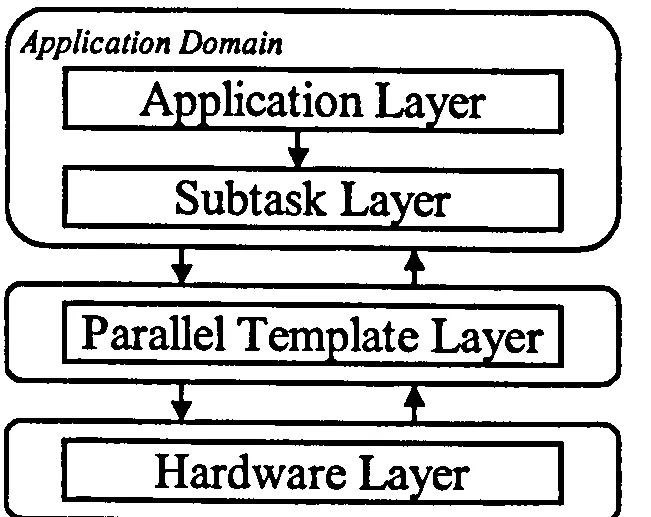
The framework and layers can be used to represent entire systems, including: the application, parallelisation and hardware aspects, as illustrated in Figure 2.1.
Application Domain
Apipfication Layer
Subtask La er
Parallel Template La er
Hardware Layer
Figure 2.1 The PACE Layered Framework
The functions of the layers are:
" Application Layer - describes the application in terms of a sequence of parallel kernels or subtasks. It acts as the entry point to the performance
study and includes an interface that can be used to modify parameters of a performance study.
" Application Subtask Layer - describes the sequential part of every subtask within an application that can be executed in parallel.
" Parallel Template Layer - describes the parallel characteristics of subtasks in terms of expected computation-communication interactions between processors.
" Hardware Layer - collects system specification parameters, micro- benchmark results, statistical models, analytical models, and heuristics to
[image:32.1964.722.1373.1179.1696.2]CHAPTER 2 RESOURCE MANAGEMENT FOR GRID COMPUTING
characterise
the communication and computation abilities of a particular
system.
According to the layered framework, a performance model is built up from a number of separate objects. Each object is of one of the following types: application, subtask, parallel template, and hardware. A key feature of the object organisation is the independent representation of computation, parallelisation, and
hardware.
This is possible due to strict object interaction rules.
All objects have a similar structure, and a hierarchical set of objects representing the layers of the framework is built up into the complete performance model. An
example of a complete performance model, represented by a Hierarchical Layered Framework Diagram (HLFD), is shown in Figure 4.2.
2.2.2 Object Definition
Each software object (application, subtask, or parallel template) is comprised of
[image:33.1964.591.1450.1950.2348.2]an internal structure, options, and an interface that can be used by other objects to modify its behaviour. A schematic representation of a software object is shown in Figure 2.2.
Figure 2.2 Software Object Structure
Each hardware object is subdivided into many smaller component hardware
models, each describing the behaviour of individual parts of the hardware system. An example is shown in Figure 2.3 illustrating the main subdivision currently
considered involving a distinction between computation, communication, memory [Harper1999] and 110 models.
CHAPTER 2 RESOURCE MANAGEMENT FOR GRID COMPUTING
Hardware Object
CPU
I
clc flcII
suifII
ctMemo Cache Cache Main
Networ Sockets MPI PVM
Figure 2.3 Hardware Object Structure
2.2.3 Model Creation
The creation of a software object in the PACE system is achieved through an
application characterisation tool. It aids the conversion of sequential or parallel source code into a Performance Specification Language (PSL) [Papaefstathiou
1995] via the Stanford University Intermediate Format (SUIF) [Ha111996]. It
performs a static analysis of the code to produce the control flow of the application, operation counts in terms of high-level language operations
[image:34.1964.441.1619.1686.2183.2][Qinl991], and also the communication structure. This process is illustrated in Figure 2.4.
Source User Profiler Code
---
A,, Application
SUIF Sý C
Front End Format T
Layer
__ _. __ Parallelisation
Layer
Figure 2.4 Model Creation Process
In PACE a Hardware Model Configuration Language (HMCL) allows users to create new hardware objects by specifying system dependent parameters. On evaluation, the relevant sets of parameters are used, and supplied to the evaluation methods for each of the component models. An example HMCL fragment is
illustrated in Figure 4.4.
CHAPTER 2 RESOURCE MANAGEMENT FOR GRID COMPUTING
2.2.4 Mapping Relations
There are strict mapping relations between source code of the application and its
performance model. Figure 2.5 illustrates the way in which independent objects are abstracted directly from the source code and built up into a complete performance model, which can be used to produce performance prediction results.
The source code of the parallel application is firstly divided into several serial
parts and an abstracted parallel part. Serial parts can be automatically converted into performance scripts using the PACE application characterisation tool. The
parallel part can be converted into the corresponding parallel template line by line. The strict mapping relations make the model creation processes fast and
straightforward. The user does not even need to understand the detailed
parallelisation of the application.
The mapping relations are controlled by the PSL compiler and the PACE evaluation engine, which is described further in Chapter 4 through the use of the example application - Sweep3D.
2.2.5 Evaluation Engine
Once all the necessary objects have been defined for a performance study, they can be combined and evaluated within the PACE evaluation engine. This involves
-18-
[image:35.1964.556.1477.1719.2527.2]CHAPTER 2 RESOURCE MANAGEMENT FOR GRID COMPUrrNG
the evaluation of the single application object, and all subtask objects, which in turn require the evaluation of associated parallel template objects and hardware objects. The sequence of steps performed during the evaluation of one subtask object is shown in Figure 2.6.
The snit procedure of the subtask object is the entry point, which may call other
procedures within the object. Parameters are linked to the currently active parallel template object (specified by the option command). The parallel template object is similarly evaluated and uses the hardware object. The result of the evaluation of the parallel template object is the execution time, which is returned to the application object. Further details can be found in [Papaefstathiou1998].
Execution Time
Application Object
Subtask Object PýTmp Object Init
Init )-K Link
Proc 1) . «(Proc n Proc 1) ... ( Proc n
Hardware Object
Figure 2.6 Evaluation Process of PACE Models
2.2.6 PACE Toolkit
The PACE methodology described above is implemented as a toolkit, which is summarised in Figure 2.7. The main components in the PACE toolkit include: application tools (AT), resource tools (RT), and an evaluation engine (EE).
" Application Tools: The Source Code Analyser can be used to convert sequential source code components into performance descriptions. Users can also edit these descriptions using the object editor or retrieve existing objects from a library. These performance descriptions are organised together into the PSL scripts of the application, which can be compiled into the application model. The application model is one of the inputs into
CHAPTER 2 RESOURCE MANAGEMENT FOR GRID COMPUTING
the evaluation engine, which contains all of the application-level
performance
information.
" Resource Tools: The RTs provide several benchmarking programs to measure the performance of CPU, network interfaces (e. g. MPI and PVM),
and memory aspects of hardware platforms respectively. The measurement results are represented in HMCL scripts and added to the system. The resource model is another input into the evaluation engine, which contains
all of the system-level performance information.
" Evaluation Engine: The EE is the kernel part of the PACE toolkit, which executes completed performance models and produces evaluation results
on time estimates, or trace information of the expected application behaviour. Important applications of prediction data include those of on- the-fly performance analysis [Kerbysonl998] and dynamic multi- processor scheduling [Perry2000], which can be applied for efficient resource management.
Application Tools (AT)
Source
I
Object ObjectCode Editor Library
Analysis
Resource Tools (RT)
CPU l(P jk II
(Cacti)
PSL Scripts HMCL Scripts
Compiler Compiler
Applicat Model Resourc ode]
Evaluation Engine (EE)
Performance On-the-fly
I Multi-processor OOO Prediction analysis scheduling
Figure 2.7 The PACE Toolkit
Some assumptions are made to simplify the PACE implementation. For example, the PACE application performance modelling is based on the source code
analysis. The source code of the application is assumed to be available for performance modelling. A resource model in PACE can only include static
CHAPTER 2 RESOURCE MANAGEMENT FOR GRID COMPUTING
performance information of a resource. The dynamic situation of the network
traffic or CPU workload is not considered. The PACE toolkit is relatively smaller than many other performance evaluation tools, and some of its unique features (e. g. rapid evaluation time, reasonable accuracy, etc. ) allow it to be applied to performance-driven resource management in a grid computing environment.
2.3 Grid Resource Management
The resource management is central to the operation of a grid. The basic function
of resource management is to accept requests for resources from machines within the grid and assign specific machine resources to a request from the overall pool of grid resources for which the user has access permission. A resource
management system matches requests to resources, schedules the matched
resources,
and executes
the requests using the scheduled
resources.
Several solutions have been offered that address to some extent the issues of resource management and scheduling for grid computing. Our work is different from these in a number of ways. Some of the principal existing grid projects and their resource management are described in Table 2.2. A good overview of grid resource management technologies can be found in [Krauter2000].
Name Unit Project Description Resource Management
Condor Condor The goal of the Condor Condor uses a classified [Litzko team, project is to develop, advertisement (classad) w1988] Dept. of implement, deploy and matchmaking framework for
[Raman Computer evaluate mechanisms and flexible resource management 1998] Science, policies that support High in distributed environments
Univ. of Throughput Computing with decentralised ownership Wisconsin- (HTC) on large collections of resources, which uses the Madison of distributively owned matchmaker/entity (which can
computing resources. be both provider and requestor) structure.
Features: extensible schema
model; no QoS; network
directory store; centralised queries discovery; periodic push advertisement.
DPSS Data The DPSS is a data block DPSS uses a broker/agent
CHAPTER 2 RESOURCE MANAGEMENT FOR GRID COMPUTING [Tierney 2000] [Brooks 1997] Globus [Fosterl 997] [Czajko wskil99 8] GRACE [Buyya2 000] Intensive Distributed Computing Group, Lawrence Berkeley National Laboratory Mathemati cs and Computer Science Division, Argonne National Laboratory
School of Computer Science and
Software
server, which provides high-performance data handling and architecture
for building high- performance storage
systems from low-cost commodity hardware components. This technology has been quite
successful in providing an economical, high- performance, widely
distributed, and highly scalable architecture for caching large amounts of data that can potentially be used by many different users.
The Globus system is intended to achieve a vertically integrated treatment of application, middleware, and network. A low-level toolkit provides basic mechanisms such as
communication,
authentication, network information, and data access. These mechanisms are used to construct various higher-level metacomputing services, such as parallel programming tools and
schedulers. The long-term goal is to build a grid infrastructure, an integrated set of higher-level services that enable applications to adapt to heterogeneous and dynamically changing metacomputing
environments.
GRACE (Grid Architecture for
Computational Economy) is a new framework that uses
economic theories in grid resource management and
architecture: agents are processes that monitors the state of the system; broker agent (or broker) is an agent that manages the information,
filters information for clients, or performs some action on behalf of a client. Agents model their environment using an extensible set of Facts and act on their environment using
a set of Tasks.
Features: object model; no QoS; agent-based store; centralised queries discovery; periodic push advertisement.
The architecture distributes the resource management problem among distinct local manager, resource broker, and resource co-allocator components, and defines an extensible resource
specification language (RSL) to exchange information about requirements. The information
service within the architecture uses a Metacomputing Directory Service (MDS) [Fitzgerald 1997], which adopts the data representations and API defined by the LDAP
service [Yeong 1995].
Features: extensible schema model; soft QoS; network directory store; distributed queries discovery; periodic push advertisement.
Nimrod/G is a grid resource broker that allows managing
and steering task farming applications (parameter studies) on computational grids. It follows an economic
CHAPTER 2 RESOURCE MANAGEMENT FOR GRID COMPUTING
g,
Monash
University, Australia
Legion Dept. of [Grinish Computer
aw1999] Science,
[Chapin Univ. of
1999] Virginia
NetSolv e
[Casano va1998]
Dept. of Computer
Science,
Univ. of Tennessee
scheduling. The components that make up GRACE include global scheduler (broker), bid- manager, directory server, and bid-server working closely
. with grid middleware and fabrics. The GRACE infrastructure
also offers generic interfaces (APIs) that the grid tools and applications programmers can use to develop software supporting the
Legion is an object-oriented metacomputing
environment, intended to connect many millions of hosts ranging from PCs to massively parallel
supercomputers. It manages billions of objects and
allows users to write and run applications in an easy- to-use, transparent fashion. It unites machines from thousands of administrative
domains into a single coherent system.
NetSolve is a client-server system that enables users to solve complex scientific problem remotely. The
system allows users to access both hardware and software computational resources distributed across
a network. NetSolve searches for computational resources on a network,
chooses the best one available, and using retry
(computational market) model for resource management and scheduling. It allows the study of the behaviour of output variables against a range of
different input scenarios.
Features: extensible schema model; hard QoS; relational resource info store; distributed queries discovery; periodic push/pull advertisement.
Legion uses a resource management infrastructure. The philosophy of scheduling
is that it is a negotiation of service between autonomous agents, one acting on the part of the application (consumer) and one on behalf of the resource or system (provider). The components of the model
are the basic resources (hosts and vaults), the information database, the schedule implementer, and an execution monitor.
Features: extensible object model; soft QoS; object model store; distributed queries discovery; periodic pull advertisement.
The NetSolve agent operates both as a database and as a resource broker. The agent keeps track of information about all the servers in its resource pool, including their availability, load, network accessibility, and the range of computational tasks that they can perform. The agent then selects a server to perform the task, and the server responds to the client's request.