warwick.ac.uk/lib-publications
Original citation:Sanborn, Adam N., Griffiths, Thomas L. and Navarro, Daniel J. (2010) Rational approximations to rational models : alternative algorithms for category learning. Psychological Review, Vol.117 (No.4). pp. 1144-67.
Permanent WRAP URL:
http://wrap.warwick.ac.uk/36000
Copyright and reuse:
The Warwick Research Archive Portal (WRAP) makes this work by researchers of the University of Warwick available open access under the following conditions. Copyright © and all moral rights to the version of the paper presented here belong to the individual author(s) and/or other copyright owners. To the extent reasonable and practicable the material made available in WRAP has been checked for eligibility before being made available.
Copies of full items can be used for personal research or study, educational, or not-for-profit purposes without prior permission or charge. Provided that the authors, title and full
bibliographic details are credited, a hyperlink and/or URL is given for the original metadata page and the content is not changed in any way.
Publisher’s statement: © APA 2010
http://dx.doi.org/10.1037/a0020511
"This article may not exactly replicate the authoritative document published in the APA journal. It is not the copy of record."
A note on versions:
The version presented here may differ from the published version or, version of record, if you wish to cite this item you are advised to consult the publisher’s version. Please see the ‘permanent WRAP URL’ above for details on accessing the published version and note that access may require a subscription.
Running head: RATIONAL APPROXIMATIONS TO CATEGORY LEARNING
Rational approximations to rational models:
Alternative algorithms for category learning
Adam N. Sanborn
Gatsby Computational Neuroscience Unit, University College London
Thomas L. Griffiths
University of California, Berkeley
Daniel J. Navarro
University of Adelaide
Send Correspondence To:
Adam Sanborn
Gatsby Computational Neuroscience Unit
17 Queen Square
London WC1N 3AR
United Kingdom
+44 07942 551970
Abstract
Rational models of cognition typically consider the abstract computational problems
posed by the environment, assuming that people are capable of optimally solving those
problems. This differs from more traditional formal models of cognition, which focus on
the psychological processes responsible for behavior. A basic challenge for rational models
is thus explaining how optimal solutions can be approximated by psychological processes.
We outline a general strategy for answering this question, namely to explore the
psychological plausibility of approximation algorithms developed in computer science and
statistics. In particular, we argue that Monte Carlo methods provide a source of “rational
process models” that connect optimal solutions to psychological processes. We support
this argument through a detailed example, applying this approach to Anderson’s (1990,
1991) Rational Model of Categorization (RMC), which involves a particularly challenging
computational problem. Drawing on a connection between the RMC and ideas from
nonparametric Bayesian statistics, we propose two alternative algorithms for approximate
inference in this model. The algorithms we consider include Gibbs sampling, a procedure
appropriate when all stimuli are presented simultaneously, and particle filters, which
sequentially approximate the posterior distribution with a small number of samples that
are updated as new data become available. Applying these algorithms to several existing
datasets shows that a particle filter with a single particle provides a good description of
Rational approximations to rational models:
Alternative algorithms for category learning
Rational models of cognition aim to explain human thought and behavior as an
optimal solution to the computational problems that are posed by our environment
(Anderson, 1990; Chater & Oaksford, 1999; Marr, 1982; Oaksford & Chater, 1998). This
approach has been used to model several aspects of cognition, including memory
(Anderson, 1990; Shiffrin & Steyvers, 1997), reasoning (Oaksford & Chater, 1994),
generalization (Shepard, 1987; Tenenbaum & Griffiths, 2001a), and causal induction
(Anderson, 1990; Griffiths & Tenenbaum, 2005). However, executing optimal solutions to
these problems can be extemely computationally expensive, a point that is commonly
raised as an argument against the validity of rational models (e.g., Gigerenzer & Todd,
1999; Tversky & Kahneman, 1974). This establishes a basic challenge for advocates of
rational models of cognition: identifying psychologically plausible mechanisms that would
allow the human mind to approximate optimal performance.
The question of how rational models of cognition can be approximated by
psychologically plausible mechanisms addresses a fundamental issue in cognitive science:
bridging levels of analysis. Rational models provide answers to questions posed at Marr’s
(1982) computational level – questions about the abstract computational problems
involved in cognition. This is a different kind of explanation to those provided by other
modeling approaches, which tend to operate at the level of algorithms, considering the
concrete processes that are assumed to operate in the human mind. Theories developed at
these different levels of analysis provide different kinds of explanations for human
behavior, with the computational level explainingwhy we do the things we do, and the
algorithmic level explaininghow these things are done. Both levels of analysis contribute
of bird flight is informed by knowing both how the shape of wings results from
aerodynamics and how those wings are articulated by muscle and bone.
Despite the importance of both the computational and algorithmic level to
understanding human cognition, there has been relatively little consideration of how the
two levels might be connected. In differentiating these levels of analysis, Marr (1982)
clearly stated that they were not independent, with the expectation that results yielded at
one level would provide constraints on theories at another. However, accounts of human
cognition are typically offered at just one of these levels, offering theories of either the
abstract computational problem or the psychological processes involved. Cases where
rational and process models can be explicitly connected are rare and noteworthy, such as
the equivalence of exemplar and prototype models of categorization to different forms of
density estimation (Ashby & Alfonso-Reese, 1995), although recent work has begun to
explore how rational models might be converted into process models (e.g., Kruschke,
2006b).
Considering the processes by which human minds might approximate optimal
solutions to computational problems thus provides us with an opportunity not just to
address a challenge for rational models of cognition, but to consider how one might
develop a general strategy for bridging levels of analysis. In this paper, we outline a
strategy that is applicable to rational analyses of probabilistic inference tasks. In such
tasks, the learner needs to repeatedly update a probability distribution over hypotheses as
more information about those hypotheses becomes available. Due to the prevalence of
such tasks, our strategy provides tools that can be used to derive rational approximations
to a variety of rational models of cognition.
The key idea behind our approach is that efficient implementation of probabilistic
inference is not just a problem in cognitive science – it is an issue that arises in computer
introduction and examples, see Bishop, 2006; Hastie, Tibshirani, & Friedman, 2001;
Mackay, 2003). These algorithms often provide asymptotic guarantees on the quality of
the approximation they provide, meaning that with sufficient resources they can
approximate the optimal inference to any desired level of precision. The existence of these
algorithms suggests a strategy for bridging levels of analysis: starting with rational
models, and then considering efficient approximations to those models as candidates for
psychological process models. The models inspired by these algorithms will not be
rational models, but instead will be process models that are closely tied to rational
models, and typically come with guarantees of good performance as approximations – a
kind of “rational process model”.
Our emphasis in this paper will be on one class of approximation algorithms: Monte
Carlo algorithms, which approximate a probability distribution with a set of samples from
that distribution. Sophisticated Monte Carlo schemes provide methods for sampling from
complex probability distributions (Gilks, Richardson, & Spiegelhalter, 1996), and for
recursively updating a set of samples from a distribution as more data are obtained
(Doucet, Freitas, & Gordon, 2001). These algorithms provide an answer to the question of
how learners with finite memory resources might be able to maintain a distribution over a
large hypothesis space. We introduce these algorithms in the general case, and then
provide a detailed illustration of how these algorithms can be applied to one of the first
rational models of cognition: Anderson’s (1990, 1991) rational model of categorization.
Our analysis of Anderson’s rational model of categorization draws on a surprising
connection between this model and work on density estimation in nonparametric Bayesian
statistics. This connection allows us to identify two new algorithms that can be used in
evaluating the predictions of the model. These two algorithms both asymptotically
approximate ideal Bayesian inference, and help to separate the predictions that arise from
evaluate these algorithms by comparing the results to the full posterior distribution and to
human data. The new algorithms better approximate the posterior distribution and fit
human data at least as well as the original algorithm proposed by Anderson. In addition,
we show that these new algorithms have greater psychological plausibility and provide
better fits to data that have proved challenging to Bayesian models. These results
illustrate the use of rational process models to explain how people perform probabilistic
inference, provide a tool for exploring the relationship between rational models and
human performance, and begin to bridge the gap between computational and algorithmic
levels of analysis.
The plan of the paper is as follows. In the first part of the paper we describe the
general approach. We begin with a discussion of the challenges associated with performing
probabilistic inference, followed by a description of various Monte Carlo methods that can
be used to address these challenges, leading finally to the development of the rational
approximation framework. In the second part of the paper, we apply the rational
approximation idea to categorization problems, using Anderson’s rational model. We first
describe this model, and use its connection to nonparametric statistics to motivate new
approximate inference algorithms. We then evaluate the psychological plausibility of these
algorithms at both a descriptive level and with comparisons to human performance in
several categorization experiments.
The challenges of probabilistic inference
The computational problems that people need to solve are often inductive problems,
requiring an inference from limited data to underdetermined hypotheses. For example,
when learning about a new category of objects, people need to infer the structure of the
category from examples of its members. This inference is inherently inductive, since the
learner; and because of this, it is not possible to know exactly which structure is correct.
That is, the optimal solution to problems of this kind requires the learner to make
probabilistic inferences, evaluating the plausibility of different hypotheses in light of the
information provided by the observed data. In the remainder of this section, we discuss
two challenges that a learner attempting to implement the ideal solution faces: reasoning
about hypotheses that are composed of large numbers of variables, and repeatedly
updating beliefs about a set of hypotheses as more information becomes available over
time.
Reasoning about large numbers of variables
One of the most fundamental challenges in performing probabilistic inference
concerns the situation when the number of hypotheses is very large. This is typically
encountered when each hypothesis corresponds to a statement about a number of different
variables. The number of hypotheses then suffers from a combinatoric explosion. For
example, many theories of category learning assume that people assign objects to clusters.
If so, then each hypothesis is composed of many assignment variables, one per object.
Likewise, in causal learning, hypotheses about causal structure can often be expressed in
terms of all of the individual causal relationships that make up a given structure, thus
requiring multiple variables. Reasoning about hypotheses comprised of large numbers of
variables poses a particular challenge, because of the combinatorial nature of the
hypothesis space: the number of hypotheses to be considered can increase exponentially in
the number of relevant variables. The number of possible clusterings of nobjects, for
example, is given by thenth Bell number, with the first ten values being 1, 2, 5, 15, 52,
203, 877, 4140, 21147, and 115975. In such cases, brute force enumeration of all
hypotheses will be extremely computationally expensive, and scale badly with the number
Updating beliefs over time
When making probabilistic inferences, we rarely have all the information we need to
definitively evaluate a hypothesis. As a result, when a learner observes a piece of data and
uses this to form beliefs, he or she generally remains somewhat uncertain about which
hypothesis is really the correct one. When a new piece of information arrives, this
distribution needs to be updated to the new beliefs. The consequence is that an ideal
learner needs to constantly update a probability distribution over hypotheses as more data
are observed.
Updating beliefs over time is computationally challenging because it requires the
learner to draw inferences every time new information becomes available. Unless the
learner uses methods that allow the efficient updating of his or her beliefs, he or she would
be required to perform the entire inference from scratch every time new information
arrives. The cost of probabilistic inference is thus multiplied by the number of
observations that have to be processed. As one would expect, this becomes particularly
expensive with large hypothesis spaces, such as the combinatorial spaces that result from
having hypotheses expressed over large numbers of random variables. Making
probabilistic inference computationally tractable thus requires developing strategies for
efficiently updating a probability distribution over hypotheses as new data are observed.
Algorithms to address the challenges
Some of the challenges of probabilistic inference can be addressed by approximating
optimal solutions using algorithms based on the Monte Carlo principle. This principle is
one of the most basic ideas in statistical computing: rather than performing computations
using a probability distribution, we perform those computations using a set of samples
from that distribution. The resulting approximation becomes increasingly accurate as the
approximation can be used to determine how many samples should be generated. This
principle forms the foundation of an entire class of approximation algorithms (Motwani &
Raghavan, 1996). Monte Carlo methods provide a way to efficiently approximate
probabilistic inference. However, generating samples from posterior distributions is
typically not straightforward: generating samples from a distribution requires knowing the
form that distribution takes, which is a large part of the challenge of probabilistic
inference in the first place. Consequently, sophisticated algorithms need to be used in
order to generate samples. Here we introduce two such algorithms at an intuitive level:
Gibbs sampling and particle filters. A parallel mathematical development of the general
algorithms is given in the Appendix and toy examples of these algorithms applied to
categorization and a discussion of their psychological plausibility are given later.
Gibbs sampling
Gibbs sampling (Geman & Geman, 1984) is a very commonly used Monte Carlo
method for sampling from probability distributions. This algorithm is initialized with a
particular set of values for each variable, often with random values. Gibbs sampling works
on the principle of sampling a single random variable at each step. One random variable is
selected, and the value of this variable is sampled, conditioned on the values of all of the
other random variables and the data. The process is repeated for each variable; each is
sampled conditioned on the values of all of the other variables and the data. Intuitively,
Gibbs sampling corresponds to the process of inspecting one’s beliefs about each random
variable conditioned on one’s beliefs about all of the other random variables, and the data.
Reflecting on each variable in turn provides the opportunity for changes to propagate
through the set of random variables. A complete run through sampling all of the random
variables is an iteration and the algorithm is usually engaged for many iterations.
at a particular, often random, set of values. The early iterations show the algorithm
converging to the desired distribution, but are not yet samples from this distribution.
These iterations are known as theburn-inand are thrown away. An additional difficulty is
that iterations following the burn-in iterations often show strong dependency from one
iteration to the next. These iterations are then thinned, which means keeping everynth
iteration and discarding the rest. The remaining iterations after burn-in and thinning are
used as samples from the desired distribution. This process provides a way to generate
samples from probability distributions defined over large numbers of variables without
ever having to enumerate the entire hypothesis space, providing a tractable way to
perform probabilistic inference in these cases.
Particle filters
A second class of Monte Carlo algorithms, particle filters, are specifically designed to
deal with sequential data. Particle filters are underpinned by a simpler algorithm known
as importance sampling, which is used in cases in which it is hard to sample from the
target distribution, but easy to sample from a related distribution (known as theproposal
distribution). The basic idea of importance sampling is that we generate samples from the
proposal distribution, and then assign those samples weights that correct for the difference
from the target distribution. Samples that are more likely under the proposal than the
target distribution are assigned lower weights, since they should be over-represented in a
set of draws from the proposal distribution, and samples that are more likely under the
target than the proposal are assigned higher weights, increasing their influence.
Particle filters extend importance sampling to a sequence of probability
distributions, typically making use of the relationship between successive distributions to
use samples from one distribution to generate samples from the next (for more details, see
about variables in a dynamic environment – the problem of “filtering” is to infer the
current state of the world given a sequence of observations. However, it also provides a
natural solution to the general problem of updating a probability distribution over time.
Each particle is a sample from the posterior distribution on the previous trial, and these
samples are updated when new data become available.
Rational approximations to rational models
Monte Carlo algorithms provide efficient schemes for approximating probabilistic
inference, and come with the asymptotic guarantee that they can produce an arbitrarily
good approximation if sufficient computational resources are available. These algorithms
thus seem like good candidates for explaining how human minds could be capable of
performing probabilistic inference, bridging the gap between the computational-level
analyses typically associated with rational models of cognition and the algorithmic level at
which psychological process models are defined. In particular, Gibbs sampling and particle
filters provide solutions to the challenges posed by probabilistic inference with large
numbers of variables and updating probability distributions over time.
Part of the attraction of the Monte Carlo principle as the basis for developing
rational process models is that it reduces probabilistic computations to one operation:
generating samples from a probability distribution. The notion that people might be
capable of generating samples from internalized probability distributions has previously
appeared in psychological process models of decision making (Stewart, Chater, & Brown,
2006), estimation (Fiedler & Juslin, 2006), and prediction (Mozer, Pashler, & Homaei,
2008). Indeed, the foundational premise of the highly successful “sequential sampling”
framework (Ratcliff, 1978; P. L. Smith & Ratcliff, 2004; Vickers, 1979) is that choice
behavior is fundamentally reliant on people drawing and evaluating samples from
representations (Lee & Cummins, 2004; Ratcliff, 1978; Vandekerckhove, Verheyen, &
Tuerlinckx, 2010). Taken together, these models provide support for the idea that the
basic ingredients required for Monte Carlo simulation are already part of the psychological
toolbox.
Recent research has also identified correspondences between the kind of
sophisticated Monte Carlo methods discussed above and psychological process models.
Shi, Feldman, and Griffiths (2008) showed that the basic computations involved in
importance sampling are identical to those used in exemplar models (also see Shi, Griffiths,
Feldman, & Sanborn, in press). Exemplar models assume that people store stimuli in
memory, activating them based on their similarity to new stimuli (e.g., Medin & Schaffer,
1978; Nosofsky, 1986). An importance sampler can be implemented by storing hypotheses
in memory, and activating them in proportion to the probability of observed data under
that hypothesis. Moreover, this interpretation of exemplars as stored hypotheses links
exemplar-based learning nicely to previous rational analyses of exemplar-based decisions
as a form of sequential analysis (see Navarro, 2007; Nosofsky & Palmeri, 1997). That is,
the importance sampling method allows people to efficiently learn and store a posterior
distribution, and the sequential analysis method allows efficient decisions to be made on
the basis of this stored representation. This thus constitutes a natural, psychologically
plausible scheme for approximating some probabilistic computations.
Several recent papers have also examined the possibility that particle filters might
be relevant to understanding how people can update probability distributions over time.
This idea was first raised by Sanborn, Griffiths, and Navarro (2006), and particle filters
have subsequently been used to explain behavioral patterns observed in several tasks.
Daw and Courville (2008) argued that a particle filter with a small number of particles
could explain rapid transitions seen in associative learning tasks with animals. Brown and
detection task, where variation of the number of particles being considered captured one
dimension along which participants varied. Finally, Levy, Reali, and Griffiths (2009)
showed that garden path effects in sentence processing could be accounted for by using a
particle filter for parsing, where the frequency with which the parser produced no valid
particles was predictive of the difficulty that people had interpreting the sentence.
Evaluating Monte Carlo algorithms as candidates for rational process models
requires exploring how the predictions of rational models of cognition vary under these
different approximation schemes, and examining how well these predictions correspond to
human behavior. In the remainder of the paper, we provide a detailed investigation of the
performance of different approximation algorithms for Anderson’s (1990; 1991) rational
model of categorization. This model is a good candidate for such an investigation, since it
involves an extremely challenging computational problem: evaluating a posterior
distribution over all possible partitions of a set of objects into clusters. This problem is so
challenging that Anderson’s original presentation of the model resorted to a heuristic
solution. We use a connection between this rational model and a model that is widely
used in Bayesian statistics to specify a Gibbs sampler and particle filter for this model,
which we evaluate against a range of empirical data.
The Rational Model of Categorization
The problem of category learning is to infer the structure of categories from a set of
stimuli labeled as belonging to those categories. The knowledge acquired through this
process can ultimately be used to make decisions about how to categorize new stimuli.
Several rational analyses of category learning have been proposed (Anderson, 1990; Ashby
& Alfonso-Reese, 1995; Nosofsky, 1998). These analyses essentially agree on the nature of
the computational problem involved, casting category learning as a problem ofdensity
labels. Viewing category learning in this way helps to clarify the assumptions behind the
two main classes of psychological models: exemplar models and prototype models.
Exemplar models assume that a category is represented by a set of stored exemplars, and
categorizing new stimuli involves comparing these stimuli to the set of exemplars in each
category (e.g., Medin & Schaffer, 1978; Nosofsky, 1986). Prototype models assume that a
category is associated with a single prototype and categorization involves comparing new
stimuli to these prototypes (e.g., Reed, 1972). These approaches to category learning
correspond to different strategies for density estimation used in statistics, being
nonparametric and parametric density estimation respectively (Ashby & Alfonso-Reese,
1995).
Anderson’s (1990, 1991) rational analysis of categorization takes a third approach,
modeling category learning as Bayesian density estimation. This approach encompasses
both prototype and exemplar representations, automatically selecting the number of
clusters to be used in representing a set of objects. Unfortunately, the inference for this
model is extremely complex, requiring an evaluation of every possible way of partitioning
exemplars into clusters, with the number of possible partitions growing exponentially with
the number of exemplars. Anderson proposed an approximation algorithm in which stimuli
are sequentially assigned to clusters, and assignments of stimuli are fixed once they are
made. However, this algorithm does not provide any asymptotic guarantees for the quality
of the resulting assignments, and is extremely sensitive to the order in which stimuli are
observed, a property which is not intrinsic to the underlying statistical model. As a result,
evaluations of the model are tied to the particular approximation algorithm that was used.
Before we consider alternative approximation algorithms for Anderson’s model, we
need to provide a detailed specification of the model and the original algorithm. In this
section, we first outline the Bayesian view of categorization, showing how exemplar and
approach taken by Anderson.
Bayesian categorization models
Rational models of categorization must solve the density estimation problem
outlined above and use this estimate to identify the category label or some other
unobserved property of an object using its observed properties (Anderson, 1990; Ashby &
Alfonso-Reese, 1995; Rosseel, 2002). This prediction problem has a natural interpretation
as a form of Bayesian inference, which we now outline. Suppose that the learner has
previously been shown a set of two stimuli and their labels, where the two stimuli are the
first two stimuli in Figure 1. We letyi refer to the category label given to theith object in
this list (often a nonsense syllable such as “DAX”), and the mental representation of the
object is assumed to be characterized by a collection of features, denotedxi. So for
instance if the stimulus is the first stimulus, it could be simply described in terms of
features such as “is circular”, “is black”, and “is large”. Thus, if the learner is told “the
first stimulus is a DAX”, we would describe the trial by the pair (xi, yi). Across the set of
two labelled objects, the information available to the learner can be thought of as a
collection of statements (e.g., “the first stimulus is a DAX” and “the second stimulus is a
ZUG”) that can be formally characterized by the collection of stimulus representations
x2 = (x1, x2), along with the labels given to each of these objectsy2= (y1, y2). More
generally we will refer to these already known stimuli as the firstN −1 stimuli with
representationsxN−1= (x1, x2, . . . xN−1), and labelsyN−1 = (y1, y2, . . . yN−1)
With that in mind, the problem facing the learner can be written in the following
way: on the Nth trial in the experiment, he or she is shown a new stimulusxN (e.g., the
third stimulus in Figure 1), and asked what label it should be given. If there are J
possible labels involved in the task, the problem is to determine if the Nth object should
(xN,xN−1,yN−1). If we apply Bayes’ rule to this problem, we are able to see that
P(yN =j|xN,xN−1,yN−1) = P(xN|yN =j,
xN−1,yN−1)P(yN =j|yN−1)
!J
y=1P(xN|yN =y,xN−1,yN−1)P(yN =y|yN−1)
. (1)
In this expression,P(xN|yN =j,xN−1,yN−1) denotes the estimated probability that an
element of thejth category would possess the collection of featuresxN observed in the
novel object, andP(yN =j|yN−1) is an estimate of the prior probability that a new
object would belong to thejth category. Additionally, we have assumed that the prior
probability of an object coming from a particular category is independent of the features
of the previous objects. Thus, this expression makes clear that the probability that an
object with featuresxN should be given the labelyN =j is related both the probability of
sampling an object with featuresxN from that category, and the prior probability of
choosing that category label. Category learning, then, becomes a matter of determining
these probabilities – the problem known as density estimation.
One advantage to describing categorization in terms of the density estimation
problem is that both exemplar models and prototype models can be described as different
methods for determining the probabilities described by Equation 1. Specifically, Ashby
and Alfonso-Reese (1995) observed that if the learner uses a simple form of nonparametric
density estimation known as kernel density estimation (e.g., Silverman, 1986) in order to
compute the probabilityP(xN|yN =j,xN−1,yN−1), then an exemplar model of
categorization is the result. On the other hand, they note that the learner could use a
form of parametric density estimation (e.g., Rice, 1995), in which the category
distribution is assumed to have some known form, and the learner’s goal is to estimate the
unknown parameters of that distribution. If the learner uses this approach, then the result
is a prototype model, with the centroid being an appropriate estimate for distributions
whose parameters characterize their mean. To illustrate the point, Figure 2 shows a
distribution centered over the prototype, and an exemplar model on the right, in which a
separate normal distribution (the “kernel”) is placed over each exemplar, and the resulting
category distribution is a mixture model.
Having cast the problem in these terms, it is clear that exemplar and prototype
models are two extremes along a continuum of possible approaches to category
representation. As illustrated in the middle panel of Figure 2, the learner might choose to
break the category up into several clusters of stimuli, denotedzN−1, wherezi=kif the
ith stimulus is assigned to thekth cluster. Each such cluster is then associated with a
simple parametric distribution, and the category distribution as a whole then becomes a
mixture model (e.g. Rosseel, 2002; Vanpaemel & Storms, 2008). Expressed in these terms,
prototype models map naturally onto the idea of a one-cluster representation, and
exemplar models arise when there is a separate cluster for each object. In between lies a
whole class of intermediate category representations, such as the one shown in the middle
of Figure 2. In this case, the learner has divided the five objects into two clusters, and the
resulting category distribution is a mixture of two normal distributions.
The appeal of this more general class of category representations is that it allows
people to use prototype-like models when called for, and to move to the more flexible
exemplar-like models when needed. However, by proposing category representations of
this form, we introduce a new problem: for a set ofN objects how many clustersK are
appropriate to represent the categories, and how should the cluster assignmentszN be
made in light of the available data (xN,yN)? It is to this topic that we now turn.
Statistical model
A partial solution to this problem was given by Anderson (1990), in the form of the
Rational Model of Categorization (RMC). The RMC is somewhat different to the various
being equivalent to unobserved features. As a consequence, the RMC specifies a joint
distribution on features and category labels, rather than assuming that the distribution
over category labels is estimated separately and then combined with a distribution on
features for each category. This distribution is a mixture, with
P(xN,yN) = "
zN
P(xN,yN|zN)P(zN) (2)
whereP(zN) is a distribution over possible partitions of theN objects into clusters.
Importantly, the number of clustersK in the partition zN is not assumed to be fixed in
advance, but is rather something that the learner infers from the data. The RMC provides
an explicit form for this prior distribution, namely
P(zN) =
(1−c)KcN−K
#N−1
i=0 [(1−c) +ci]
K $
k=1
(Mk−1)! (3)
wherec is a parameter called thecoupling probability, Mk is the number of objects
assigned to cluster k, andK is the total number of clusters inzN. Although this
distribution appears unwieldy, it is in fact the distribution that results from sequentially
assigning objects to clusters with probability
P(zi =k|zi−1) =
cMk
(1−c)+c(i−1) ifMk>0 (i.e., k is old) (1−c)
(1−c)+c(i−1) ifMk= 0 (i.e.,k is new)
(4)
where the counts Mk are accumulated overzi−1. Thus, each object can be assigned to an
existing cluster with probability proportional to the number of objects already assigned to
that cluster, or to a new cluster with probability determined byc. Since the prior
distribution is set up in a way that allowsK to grow as more objects are encountered, the
RMC allows the learner to infer the number of clusters via the usual process of Bayesian
updating.
Intuitively, we can look at the prior as a rich-get-richer scheme: if a cluster already
coupling probability is the parameter that determines the severity of this scheme. For
high values of the coupling parameter, then larger clusters will be favored in the prior,
while for low values of the coupling parameter, smaller clusters will be favored. The
cluster sizes that actually result depend on the likelihoods as well as the prior.
The local MAP algorithm
When considering richer representations than prototypes and exemplars it is
necessary to have a method for learning the appropriate representation from data. Using
Equation 2 to make predictions about category labels and features requires summing over
all possible partitionszN. This sum rapidly becomes intractable for large N, since the
number of partitions grows rapidly with the number of stimuli according to the Bell
number introduced earlier. Consequently, an approximate inference algorithm is needed
and Anderson (1990, 1991) developed a simple inference algorithm to solve this problem.
We will refer to this algorithm as thelocal MAPalgorithm, as it involves assigning each
stimulus to the cluster that has the highest posterior probability given the previous
assignments (i.e., the maximum a posteriori or MAP cluster). The algorithm is a local
implementation of the MAP because it makes an assignment for each new stimulus as it
arrives, which does not necessarily result in the global MAP.
The local MAP algorithm approximates the sum in Equation 2 with just a single
clustering of theN objects,zN. This clustering is selected by assigning each object to a
cluster as it is observed. At this point, the features and labels of all stimuli, along with
the cluster assignments zi−1 for the previousi−1 stimuli are given. Thus, the posterior
probability that stimulusiwas generated from cluster k is
P(zi =k|zi−1, xi,xi−1, yi,yi−1)∝ (5)
P(xi|zi =k,zi−1,xi−1)P(yi|zi =k,zi−1,yi−1)P(zi =k|zi−1)
assigned to the cluster kthat maximizes Equation 5. Iterating this process results in a
single partition of a set ofN objects.
To illustrate the local MAP algorithm, we show in Figure 3 how it would be applied
it to the simple example of sequentially presented stimuli in Figure 1. Each stimulus is
parameterized by three binary features and the likelihood
P(xi|zi=k,zi−1,xi−1)P(yi|zi=k,zi−1,yi−1) is calculated using binomial distributions
that are independent for each feature. These binomial likelihoods are parameterized by
the probability of the outcome, and need a prior distribution over this probability. The
standard prior for binomial likelihoods is the Beta distribution (see the Appendix for
details). For the toy example, we used a symmetric Beta prior for the binomial likelihood,
withβ = 1. The symmetric Beta distribution withβ= 1 is a simple choice, because it is
equivalent to the uniform distribution.
The local MAP algorithm initially assigns the first observed stimulus to its own
cluster. When the second stimulus is observed, the algorithm generates each possible
partition: either it is assigned to the same cluster as the first stimulus or to a new cluster.
The posterior probability of each of these partitions is calculated and the partition with
the highest posterior probability is always chosen as the representation. After the third
stimulus is observed, the algorithm produces all possible partitions involving the third
stimulus, assuming that the clustering for the first two stimuli remains the same. Note
that not all possible partitions of the three stimuli are considered, because the algorithm
makes an irrevocable choice for the partition of the first two stimuli and the possible
partitions on later trials have to be consistent with this choice. The local MAP algorithm
will always produce the same final partition for a given sequential order of the stimuli,
assuming there are no ties in the posterior probability.
this partition. In effect, it assumes that
P(xN,yN)≈P(xN,yN|zN) (6)
wherezN is produced via the procedure outlined above. The probability that a particular
object receives a particular category label would likewise be computed using a single
partition.
Summary
The RMC specifies a rational model of categorization, capturing many of the ideas
embodied in other models and allowing the representation to be inferred from the data.
However, the model is still significantly limited, because the approximate algorithm used
for assigning objects to clusters in the RMC can be a poor approximation to the posterior.
In particular, this makes it hard to discriminate the predictions that result from the
underlying statistical model from those that are a consequence of the algorithm being
used. In order to explore alternative approximation algorithms, we now discuss the
connections between the RMC and nonparametric Bayesian statistics.
Dirichlet process mixture models
One of the most interesting properties of the RMC is that it has a direct connection
to a model used in nonparametric Bayesian statistics (Neal, 1998). The rationale for using
nonparametric methods is that real data are not generally sampled from some neat,
finite-dimensional family of distributions, so it is best to avoid this assumption at the
outset. From a Bayesian perspective, the nonparametric approach requires us to use priors
that include as broad a range of densities of possible, thereby allowing us to infer very
complex densities if they are warranted by data. The most commonly used method for
placing broad priors over probability distributions is theDirichlet process (DP; Ferguson,
infinite mixtures of point masses (Sethuraman, 1994), making them ideally suited to act
as priors in infinite mixture models (Escobar & West, 1995; Rasmussen, 2000). When used
in this fashion, the resulting model is referred to as aDirichlet process mixture model
(DPMM; Antoniak, 1974; Ferguson, 1983; Neal, 1998).
Although a complete description of the Dirichlet process is beyond the scope of this
paper (for more details, see Navarro, Griffiths, Steyvers, & Lee, 2006), what matters for
our purposes is that the Dirichlet process implies a distribution over partitions: any two
observations in the sample that were generated from the same mixture component may be
treated as members of the same cluster, allowing us to specify priors over an unbounded
number of clusters. In the case whereN observations have been made, the prior
probability that a Dirichlet process will partition those observations into the clusterszN is
P(zN) =
αK
#N−1
i=0 [α+i]
K $
k=1
(Mk−1)! (7)
whereα is the dispersion parameter of the Dirichlet process. This distribution over
partitions can be produced by a simple sequential stochastic process (Blackwell &
MacQueen, 1973). If observations are assigned to clusters one after another and the
probability that observationi+ 1 is assigned to clusterk is
P(zi =k|zi−1) =
Mk
i−1+α ifMk >0 (i.e., kis old)
α
i−1+α ifMk= 0 (i.e., kis new)
(8)
we obtain Equation 7 for the probability of the resulting partition. This distribution has a
number of nice properties, with one of the most important beingexchangeability: the prior
probability of a partition is unaffected by the order in which the observations are received
(Aldous, 1985). Intuitively, exchangeability is similar to independence, but slightly weaker.
To make some of these ideas more concrete, Figure 4 presents a visual depiction of
the relationship between the partitioning implied by the DP, the distribution over
stimuli that results in the DPMM. The partitioning implied by the DPMM shows that
items are divided into discrete clusters. Each of these clusters is given a parameter drawn
from the prior distribution over parameters. A large number of parameter draws are
shown in Figure 4b. Each spike is a new parameter value and the height of the bars
depends on the number of clusters that use that parameter. Finally, combining the
parameter values with a continuous likelihood function, such as a Gaussian distribution,
gives the mixture distribution shown in Figure 4c.
It should be apparent from our description of the prior distribution used in the
DPMM that it is similar in spirit to the prior distribution underlying the RMC. In fact,
the two are directly equivalent, a point that was first made in the statistics literature by
Neal (1998). If we letα= (1−c)/c, Equations 3 and 7 are equivalent, as are Equations 4
and 8. Thus the prior over cluster assignments used in the RMC is exactly the same as
that used in the DPMM. Anderson (1990, 1991) thus independently discovered one of the
most celebrated models in nonparametric Bayesian statistics, deriving this distribution
from first principles.
Alternative approximate inference algorithms
The connection between the RMC and the DPMM suggests a solution to the
shortcomings of the local MAP algorithm. In this section, we draw on the extensive
literature on approximate inference for DPMMs to offer two alternative algorithms for the
RMC: Gibbs sampling and particle filtering. These algorithms are less sensitive to order
and are asymptotically guaranteed to produce accurate predictions.
As discussed above, both Gibbs sampling and particle filters are Monte Carlo
methods. This means that they provide ways of approximating the intractable sum over
partitions numerically using a collection of samples. Specifically, to compute the
approximation gives
P(yN =j|xN,yN−1) =
"
zN
P(yN =j|xN,yN−1,zN)P(zN|xN,yN−1) (9)
≈ 1
M
M "
"=1
P(yN =j|xN,yN−1,z(N"))
wherez(1)N , . . . ,z(NM) areM samples fromP(zN|xN,yN−1), and the approximation becomes
exact asM → ∞. The two algorithms differ only in how these samples are generated.
Gibbs sampling
Gibbs sampling is the approximate inference algorithm most commonly used with
the DPMM (e.g., Escobar & West, 1995; Neal, 1998). It provides a way to construct a
Markov chain that converges to the posterior distribution over partitions. The state space
of the Markov chain is the set of partitions, and transitions between states are produced
by sampling the cluster assignment of each stimulus from its conditional distribution,
given the current assignments of all other stimuli. The clustering evolves by sequentially
sampling each zi from the distribution
P(zi =k|z−i, xi,x−i, yi,y−i)∝ (10)
P(xi|zi =k,z−i,x−i)P(yi|zi=k,z−i,y−i)P(zi =k|z−i)
wherez−i refers to all cluster assignments except for theith.
Equation 10 is extremely similar to Equation 5, although it gives the probability of
a cluster based on the all of the trials in the entire experiment except for the current trial,
instead of just the previous trials. The statistical property of exchangeability, briefly
noted above, means that these probabilities are actually computed in exactly the same
way: the order of the observations can be rearranged so that any particular observation is
considered the last observation. Hence, we can use Equation 8 to computeP(zi|z−i), with
being chosen with probability determined byα (or, equivalently,c). The other terms
reflect the probability of the features and category label of stimulus iunder the partition
that results from this choice ofzi, and depends on the nature of the features.
The Gibbs sampling algorithm for the DPMM is straightforward (Neal, 1998), and
is illustrated for the simple example in Figure 5. First, an initial assignment of stimuli to
clusters is chosen, with a convenient choice being all stimuli assigned to a single cluster.
Unlike the local MAP algorithm, Gibbs sampling is not a sequential algorithm; all stimuli
must be observed before it can be run. Next, we choose a single stimulus and consider all
possible reassignments of that stimulus to clusters, including not making a change in
assignments or assigning the stimulus to a new cluster. Equation 10 gives the probability
of each partition and one of the partitions is sampled based on its posterior probability,
making this algorithm stochastic, unlike the local MAP. The stochastic nature of the
algorithm is evident in the example in Figure 5, because the first circled assignment has
lower probability than the alternatives. The example shows two iterations of Gibbs
sampling, in which each stimulus is cycled through and reassigned. In an actual
application the algorithm would go through many iterations, with the output of one
iteration providing the input to the next. Since the probability of obtaining a particular
partition after each iteration depends only on the partition produced on the previous
iteration, this is a Markov chain.
After enough iterations for the Markov chain to converge, we begin to save the
partitions it produces. The partition produced on one iteration is not independent of the
next, so the results of some iterations are discarded to approximate independence. The
partitions generated by the Gibbs sampler can be used in the same way as samplesz(N") in
Equation 9. As with standard Monte Carlo approximations, the quality of the
approximation increases as the number of partitions in that collection increases. The
Equation 9, and thus of making accurate predictions about the unobserved features of
stimuli.
Particle filtering
There are several ways to construct a particle filter for the DPMM. The method we
will use is most closely related to the one discussed by Fearnhead (2004). The key idea is
to treat each new observation as a new “time step”, with each particle being a partition
z(i") of the stimuli from the firstitrials. Unlike the local MAP algorithm, in which the
posterior distribution is approximated with a single partition, the particle filter usesM
partitions. Summing over these particles gives us an approximation to the posterior
distribution over partitions
P(zi|xi,yi)≈ M "
"=1
1
Mδ(zi,z (")
i ) (11)
whereδ(z,z") is 1 whenz=z", and 0 otherwise. If Equation 11 is used as an
approximation to the posterior distribution over partitionszi after the first itrials, then
we can approximate the distribution ofzi+1 given the observationsxi,yi in the following
manner:
P(zi+1|xi,yi) = "
zi
P(zi+1|zi)P(zi|xi,yi)
≈ "
zi
P(zi+1|zi) m "
!=1
1 mδ(zi,z
(!) i ) = 1 m m " !=1
P(zi+1|z(
!)
i ) (12)
whereP(zi+1|zi) is given by Equation 8. We can then incorporate the information
conveyed by the features and label of stimulusi+ 1, arriving at the approximate posterior
probability
P(zi+1|xi+1,yi+1) ∝ P(xi+1|zi+1,xi)P(yi+1|zi+1,yi)P(zi+1|xi,yi)
≈ 1 m
m "
!=1
P(xi+1|zi+1,xi)P(yi+1|zi+1,yi)P(zi+1|z( !)
The result is a discrete distribution over all the previous particle assignments and all
possible assignments for the current stimulus. DrawingM samples from this distribution
provides us with our new set of particles.
The particle filter for the simple example is illustrated in Figure 6. The particle
filter for the DPMM is initialized with the first stimulus assigned to the first cluster for all
M particles, in this caseM = 2. On observing each new stimulus, the distribution in
Equation 13 is calculated, based on the particles sampled in the last trial. Like the local
MAP, the particle filter updates the partition as each new stimulus is observed, and like
the local MAP, only new partitions that are consistent with the previous choices made by
the algorithm are considered. This consistency can be seen in the potential partitions
when the third stimulus is observed in Figure 6: each descendant is consistent with the
partition choices made by its ancestor. Intuitively, the psychological processes involved in
this approximation are very similar to those involved in the local MAP algorithm. People
update their beliefs incrementally, keeping the assignments of old items fixed, and making
the assignments of new items conditional on these fixed beliefs. There are two key
differences between the local MAP and particle filter algorithms. The first is that the
choice of new partitions is stochastic instead of deterministic. The particle filter algorithm
samples new partitions based on their posterior probabilities instead of always selecting
the partition with the maximum probability. A particle filter withM = 1 particles is
equivalent to the local MAP algorithm, except that the new partition is sampled instead
of deterministically selected. The second difference is that multiple particles means that
multiple partitions can be used instead of the single partition passed forward by the local
MAP. The M partitions are selected without regard for ancestry, allowing a partition that
was selected for the early observations to die out as the descendants of other partitions
Approximation quality
The differences in quality of the various approximations can be explored by a toy
example using sequential observations of the stimuli in Figure 1. We compared the local
MAP, a particle filter withM = 100 particles, a particle filter withM = 1 particle, and
Gibbs sampling to the exact posterior. For each algorithm a symmetric Beta prior in
which β = 1 was used for the likelihood (see Appendix for details). The local MAP was
run a single time, because its outcome is deterministic on a fixed stimulus order. The
particle filters were each replicated 10,000 times, and the Gibbs sampler was run for
101,000 iterations. For the Gibbs sampler, the first 1,000 iterations were discarded and
every 10th iteration was taken as a sample, yielding 10,000 samples. The results of this
comparison are shown in Figure 7. The local MAP algorithm has selected a single
partition as an approximation to the exact posterior. In this example, the partition
selected by the local MAP is also the MAP of the exact posterior distribution, but the two
will not always be equivalent. By taking the MAP partition as each stimulus arrives, the
local MAP can be misled to choose a partition that is not the global MAP, if the initial
trials are not representative of the whole run of trials. An example of this can be seen in
the experiment by Anderson and Matessa in a later section.
The particle filter withM = 100 particles and the Gibbs sampler both produce a
posterior distribution that is nearly indistinguishable from the exact posterior. The
single-particle particle filter is an interesting intermediate case. Each run of the
single-particle particle filter produces a single partition, not the distribution produced by
a particle filter withM >1 particles. However, averaging over runs of the single-particle
particle filter gives an approximation that is much closer to the exact posterior than the
local MAP. Unlike the asymptotic performance of the Gibbs sampler and particle filter
with infinite particles, the approximation of the single-particle particle filter is slightly
algorithm is stochastic, but is still present because each run of the M = 1 particle filter
cannot correct its previous assignments by resampling.
Psychological plausibility of the algorithms
Before turning to a quantitative comparison of the algorithms with human data it is
worth considering their psychological plausibility at a descriptive level, to see whether
they are appropriate for human cognition. We take as a starting point Anderson’s (1990,
1991) two desiderata for an approximate inference algorithm: that it be incremental, and
that people see objects as arising from a single cause. These desiderata were based on
beliefs about the nature of human category learning. In tasks in which people see objects
presented sequentially and must judge which category they arise from “people need to be
able to make predictions all the time not just at particular junctures after seeing many
objects and much deliberation” (Anderson, 1991, p. 412), and “people tend to perceive
objects as coming from specific categories” (Anderson, 1991, p. 411).
In addition to these two desiderata, we are concerned with how these algorithms
might introduce new order effects into a model. Often statistical models, such as the
DPMM, are invariant to the order in which observations arrive. However, the
approximations used in practical applications of these models tend to introduce order
effects as a side effect of limited computation. People show effects of the order of
presentation of stimuli (Anderson, 1990; Medin & Bettger, 1994; Murdock, 1962), and to
have a psychologically plausible algorithm, the cumulative order effects of the model and
those introduced by the approximation should match the order effects displayed by people.
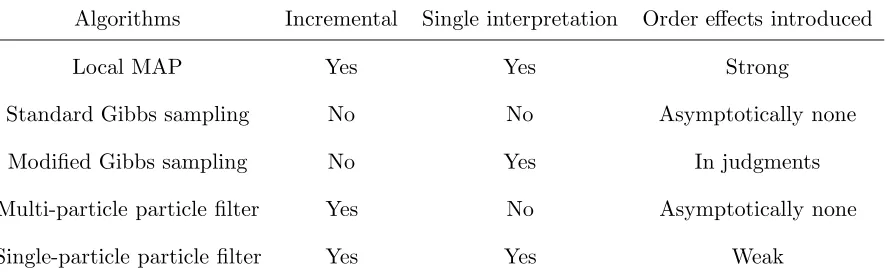
In the remainder of this section we summarize the psychological plausibility of the local
MAP, Gibbs sampling, and particle filters. We relate these algorithms to the properties of
incrementalism, a single interpretation of how the data arise, and the order effects
Local MAP
Anderson (1990, 1991) introduced the local MAP algorithm to satisfy his two
desiderata for psychological plausibility. The first desideratum is satisfied because the
local MAP is updated incrementally. In addition, the second desideratum is satisfied
because only a single partition of the stimuli into clusters is available to the algorithm in
order to make judgments about new stimuli. However, as a result of the single
interpretation and its maximization operation, the local MAP algorithm is extremely
sensitive to the order in which stimuli are observed. For example, Anderson and Matessa
(reported in Anderson, 1990) showed that the predictions of the local MAP algorithm
depended strongly on the order the stimuli were introduced in their clustering experiment.
For one type of order, the local MAP always predicted one partition of the stimuli, but for
the other order it always predicted a second partition. We will explore how the local MAP
can be led down garden paths when we compare the algorithms quantitatively.
Gibbs sampling
Gibbs sampling draws samples from one random variable conditioned on all of the
rest and all of the data, thus requiring all of the data be present before inference begins.
New data cannot be incrementally added to the sampling scheme, so in order to sample
from a posterior distribution when a new piece of data arrives, Gibbs sampling must start
from scratch. This property makes the algorithm computationally wasteful if sequential
judgments are required. For other tasks, however, Gibbs sampling is more psychologically
plausbile. In tasks in which all of the data arrive simultaneously, such as when a
researcher gives participants a set of objects to sort into groups, participants do not need
to make judgments until all of the stimuli are present. Here Gibbs sampling seems
psychologically plausible.
of the data. The algorithm gathers a set of samples from a probability distribution and all
of these samples are used to infer other properties about the data, such as category labels.
However, we should note that it would be possible to implement a modified version of the
Gibbs sampling algorithm that would provide a fixed interpretation of the data. Instead of
keeping all of the iterations, we could create a very forgetful Gibbs sampler that would
only recall the current values of the variables when making inferences. Likewise, referring
to our third property, Gibbs sampling is asymptotically unbiased, meaning that generating
a huge number samples would not introduce any order effects not already present in the
statistical model. Again though, the iterations of Gibbs sampling are dependent on one
another, so in the forgetful Gibbs sampler we would have iteration to iteration dependence.
This iteration to iteration dependence would not be an effect of the order in which the
stimuli were presented, but instead an autocorrelation of judgments made by this model.
Particle filters
Particle filters are designed as sequential algorithms that explicitly use incremental
updating, which clearly satisfies the first property and makes this algorithm appropriate
for modeling sequential judgments. For the second property, the answer depends on the
number of particles. Each particle is a sample from the posterior distribution, so a
single-particle particle filter will provide a single interpretation of the data. With a
multi-particle particle filter, the interpretation becomes probabilistic. The order effects
introduced depend on the number of particles, analogous to how the Gibbs sampler’s order
effects depend on the number of samples. With an infinite number of particles, the particle
filter is a very faithful representation of the posterior distribution and thus does not
introduce any order effects not present in the statistical model. However, small numbers of
Comparing the algorithms
Using the local MAP algorithm, the Rational Model of Categorization (RMC;
Anderson, 1991) has successfully predicted human choices in a wide range of experimental
paradigms. We introduced two new algorithms for the RMC in the above sections: the
Gibbs sampler and the particle filter. We have demonstrated that both of these
algorithms provide a closer approximation to the underlying model than the local MAP
algorithm and both share some aspects of its psychological plausibility. In this section, we
compare the local MAP algorithm, a sequential updating algorithm, against the sequential
algorithm we have introduced: the particle filter. Most empirical investigations of human
categorization use a sequential trial structure, so we have focused on this comparison. We
compare the fits of the multi-particle particle filter, the single-particle particle filter, and
the local MAP algorithm to show that the particle filter provides comparable fits to the
human data and for some paradigms, the particle filter algorithm actually allows the
RMC to better predict human choices.
There are a large number of categorization paradigms on which we could compare
the algorithms – we chose to compare the algorithms on several data sets for which the
local MAP algorithm performs well, including several cases from Anderson’s (1990; 1991)
original evaluation of the model. Testing our algorithm against data on which the local
MAP is known to perform well provides a strong test of the particle filter algorithm. We
examine the effect of specific instances with binary (Medin & Schaffer, 1978) and
continuous parameters (Nosofsky, 1988), and show the algorithms predict a similar
correspondence with human data. Next we explore paradigms that have been chosen to
highlight differences between the local MAP algorithm and the particle filter. The effects
of trial order (Anderson, 1990), how linearly separable and non-separable categories are
learned (J. D. Smith & Minda, 1998), and the wider class of learning problems in the
Glauthier, 1994) are employed to illustrate the advantages of using the particle filter to
approximate the RMC.
Effect of specific instances
In a classic paper, Medin and Schaffer (1978) tested whether categorization
judgments were influenced by the central tendency of a category alone. In their
Experiment 1, the stimuli were designed so as to test whether the nearness of stimuli had
an effect above contributing to the category center. The stimuli consisted of six training
items, each with five binary features (including the category label, listed last): 11111,
10101, 01011, 00000, 01000, and 10110. In the transfer session, the training items and
additional items were rated. The transfer stimuli are presented in Table 2, ordered by
human category ratings. These transfer stimuli were structured so that some were closer
to specific instances than others, while the distance to the category centers was constant.
In this experiment, an effect of specific instances was found in the ratings.
Anderson (1991) ran the local MAP algorithm for several different values of the
coupling parameter, but with a fixed prior ofβ = 1. The order of the training items was
randomized on each block. Low values of the coupling parameter, such asc= 0.3,
produced high correlations to human ratings (r = 0.87). At such values of the coupling
parameter, the representation tends to be more exemplar-like than prototype-like, which is
consistent with an effect of specific instances. We ran the particle filter algorithm on this
experimental design withM = 100 andM = 1 particles. The particle filter withM = 1
particle was replicated 1,000 times and theM = 100 particle particle filter was replicated
10 times. The results are shown in Figure 8. Using the same coupling parameter, c= 0.3,
we found good correlations for the multi-particle particle filter (r = 0.78) and for the
single-particle particle filter (r = 0.77). We also examined lower values of the coupling
r= 0.88, but the single-particle improved somewhat, tor= 0.84, as did the particle filter
withM = 100 particles (r= 0.84).
Prediction performance and the range of predicted probabilities both increase if the
model is trained with the same number of blocks human subjects were trained (ten)
instead of just a single block. Across coupling parameters, the best correlation with
human ratings were high for the local MAP (r= 0.95), the particle filter withM = 1
particles (r= 0.90), and the particle filter with M = 100 particles (r= 0.93). Overall, the
results in Figure 8 look accurate for all of the models, except for a serious disagreement
between the human data and model predictions for 1110, the seventh stimulus from the
left. Human ratings for 1110 diverged from the ratings of 0111 and 1101, the fourth and
fifth stimuli from the left. However these three stimuli are the same distances from the
training stimuli, so the models tended to give these three stimuli the same probability of
Category 1 as a result.
Specific instances with continuous features
The effect of specific instances has been studied with continuous features in Nosofsky
(1988). In this study, subjects were trained on 12 stimuli that varied in brightness and
saturation. As in Medin and Schaffer (1978), the category structure could not be learned
using only one feature. However, in this experiment, the frequency of specific examples
was manipulated. Over the course of two experiments, subjects showed a sensitivity to the
presentation frequency of specific colors. Anderson (1991) fit the RMC to these data using
a likelihood function (following Gelman, Carlin, Stern, & Rubin, 2004) appropriate for
continuous data. The continuous likelihood used was a Gaussian distribution for each
cluster and the chosen parameters are described in the Appendix. In this simulation, the
values of the continuous dimension prior parameters wereλ0 = 1 anda0 = 1. The label
an overall correlation between the two experiments ofr = 0.98 with the human data.
Both the single-particle particle filter and the particle filter withM = 100 particles
were run with these same parameters. There were 1,000 replications of the single-particle
particle filter and 10 repetitions of theM = 100 particle particle filter. On each
replication, the stimuli were presented in a new random order. The overall correlation
between the human data in the two experiments and the average output of the model was
r= 0.97 for the single-particle particle filter andr = 0.98 forM = 100 particles. Here
again, both types of particle filters perform as well as the local MAP algorithm.
Order effects
Order effects provide a strong challenge to stationary Bayesian models, such as the
statistical model underlying the RMC (Kruschke, 2006a, 2006b). A DPMM by nature does
not produce order effects, because the observations are exchangeable under the model.
However, order effects are easily found in investigations of human cognition, most saliently
in the primacy and recency effects found in free recall of a list of words (Murdock, 1962).
In categorization research, order effects are well established (Medin & Bettger, 1994). We
examine the order effects found including order sensitivity data collected by Anderson and
Matessa (reported in Anderson, 1990) to support the approximation used in the RMC.
The rational model is not able to predict these order effects, but approximations to
the rational model can. Approximations only assign mass to a small portion of the
posterior space over partitions, in effect embodying only a small number of hypotheses
about how the stimuli should be clustered. When a new trial is added to the
representation, the possible new representations are extensions of the previous
representations. So, if a particular partition of the existing stimuli is not present among
the particles, then it will never appear when the representation has been updated. In this