Getting to grips with exam fraud:
A qualitative study towards developing an evidence based
educational data forensics protocol.
Researcher :
Christiaan Jan van Ommering s1754262
Supervisor(s) :
Prof. Dr. Bernard Veldkamp [email protected]
Prof. Dr. Theo Eggen [email protected]
External supervisor and organization: Dr. Sebastiaan de Klerk
[email protected] eX:plain
Disketteweg 6, 3821 AR Amersfoort
Acknowledgements
The process of writing my Educational Science and Technology master thesis lasted seven challenging months. I can sincerely say that I am proud of this thesis, the process I have been through, and the final protocol that was developed as a result. However, I certainly did not do it all on my own. Therefore, I would like to take this opportunity to thank those who supported me and guided me through this process. First, I would like to thank both my supervisors; Prof. dr. Bernard Veldkamp for providing me with good feedback, new insights and regular communication about the thesis, and my second supervisor Prof. dr. Theo Eggen. Also, a special word of thanks is in order regarding their flexibility during the final phase of my graduation. Secondly, I would like to thank my colleagues at eX:plain for their support and for providing a very pleasant working atmosphere during this period. Special thanks go to dr. Sebastiaan de Klerk and Kees Boonman for the confidence that they placed in me at the start of this project, and for their support along the way.
I would also like to express my gratitude to my Isabella for being patient with me the last couple of months, and for always encouraging me to follow my dreams. Finally, I would like to thank my family and close friends for the motivational talks and support.
Thank you.
Getting to grips with exam fraud:
A qualitative study towards developing an evidence based
educational data forensics protocol.
Keywords
Test Security, Data Forensics, Exam Fraud, Cheating, Misconduct.
Abstract
Combating exam fraud before it occurs is often described as ideological and unattainable. On the other hand, it is described as a vital step to preserve the integrity of the exam. Hence, the question among practitioners is: ‘How do we get to grips with exam fraud’. For this reason, eX:plain, a Dutch testing agency, developed a data forensics monitor. This monitor analyses response data using multiple fraud indices. Subsequently, practitioners must be able to act on indications of exam fraud.
This design research was focused on developing standards covering the entire process of examination to limit the chances of security risks (e.g., the prevention of exam fraud as much as possible, and detection by means of data forensics), together these standards form the Educational Data Forensics Protocol. Two research questions guided this study. The first question, which standards regarding preventing and detecting fraud in the process of examination need to be included into the EDF protocol? In addition, practitioners must be able to act on indications of exam fraud based on these standards. Therefore, a second research question was formulated, namely which conditions must be considered during development of the EDF protocol to support practitioners in detecting possible gaps in the security of their examination process?
Content
INTRODUCTION ... 5
CONCEPTUAL FRAMEWORK ... 6
Educational data forensics ... 6
The educational data forensics improvement cycle ... 7
The EDF Monitor ... 7
The EDF Protocol ... 8
The EDF Qualifier ... 8
RESEARCH QUESTION AND MODEL ... 8
SCIENTIFIC AND PRACTICAL RELEVANCE ... 8
METHOD ... 9
STEP 1-LITERATURE SEARCH ... 9
STEP 2-DEVELOPING AN EDF-PROTOCOL PROTOTYPE ... 9
STEP 3-VALIDATING THE EDF-PROTOCOL STANDARDS ... 10
Ethics and Participants ... 10
Procedure and Materials ... 10
STEP 4-ADJUSTMENT OF THE PROTOTYPE AND FINAL EDF PROTOCOL ... 11
STEP 5-IMPLEMENTATION OF THE EDF PROTOCOL ... 11
RESULTS ... 12
STEP 1-LITERATURE SEARCH ... 12
STEP 2-DEVELOPING AN EDF PROTOCOL PROTOTYPE ... 15
Content of Part A ... 16
Grading of Part A ... 19
Content of Part B ... 20
STEP 3-VALIDATING THE EDF PROTOCOL STANDARDS ... 21
General questions of the protocol ... 22
Standards & Underlying criteria ... 23
Grading of the protocol ... 25
Standards on data forensics ... 26
STEP 4-ADJUSTMENT OF THE PROTOTYPE AND FINAL EDF PROTOCOL ... 28
General protocol adjustments ... 28
Content adjustments ... 29
Grading adjustments ... 29
STEP 5-IMPLEMENTATION OF THE EDF PROTOCOL ... 30
Standard 1: Security plan ... 30
Standard 2: Tasks and responsibilities... 31
Standard 3: Exam development & maintenance ... 31
Standard 4: Security of Examination ... 31
Standard 5: Security of Results ... 31
Standard 6: Data Forensics I ... 32
Standard 7: Incident response ... 32
Standard 8: Internet Screening ... 32
Standard 9: Data Forensics II ... 32
Standard 10: Security Audit ... 32
In summary ... 32
CONCLUSION ... 33
DISCUSSION ... 34
The practical value of the protocol ... 34
Proper use of data forensics ... 34
Limitations of the study and future recommendations ... 35
REFERENCE LIST ... 36
APPENDIX A–THE EDF PROTOTYPE ... 39
APPENDIX B–ETHICAL APPROVAL ... 53
APPENDIX C–INTERVIEW REQUEST ... 56
APPENDIX D–FORMAT INTERVIEW... 57
APPENDIX E–INTERVIEW TRANSCRIPTS ... 58
APPENDIX F–TRANSLATED STATEMENTS OF THE INTERVIEWS ... 59
APPENDIX G–THE EDFPROTOCOL ... 74
List of Figures and Tables
Figures
Figure 1. The educational data forensics improvement cycle (Xquiry, 2017).
Figure 2. PRISMA flow chart showing the search process in the query of Test Security.
Figure 3. PRISMA flow chart showing the search process articles in the query of Data Forensics. Figure 4. Overview of the EDF prototype content.
Figure 5. Overview of the EDF protocol content.
Figure 6. Example of the evidence table in the final protocol.
Figure 7. Excerpt of the content and grading in the final version of the protocol (standard 1). Figure 8. Example of the security risk table in the final protocol.
Tables
Table 1 Search terms used in the literature search
Table 2 Overview of the interview dates, focus of the interview and respondents in randomised order Table 3 Overview of literature results based on the search terms ‘test security’, ‘standards’, and ‘fraud’ (n=8).
Table 4 Overview of literature results based on the search terms ‘data forensics, and ‘fraud’ or ‘cheating’ (n=11).
Table 5 Overview of additional literature findings based on the snowball method (n=20) Table 6 Overview of openly available guidelines (n=8).
Table 7 Criteria and Evidence base concerning standard 1 Table 8 Criteria and Evidence base concerning standard 2 Table 9 Criteria and Evidence base concerning standard 3 Table 10 Criteria and Evidence base concerning standard 4 Table 11 Criteria and Evidence base concerning standard 5 Table 12 Criteria and Evidence base concerning standard 6 Table 13 Criteria and Evidence base concerning standard 7 Table 14 Criteria and Evidence base concerning standard 8 Table 15 Example of the prototype’s grading system
Introduction
In education, performance is measured mainly by using grades. These grades appear to have a major impact on student lives by means of pressure to perform well, and being concerned about failing (McCabe, Butterfield & Trevino, 2006). Hence, cheating reflects the need to get passing grades, especially considering high-stakes testing. Over the last two decades, interest in exploring ways of detecting and preventing cheating, fraud, or (test) misconduct in education has been growing. Literature provides separate definitions, due to this diversity it can be difficult to make a clear distinction between these terms. In all cases (i.e. cheating, fraud or misconduct) they refer to the intention of deliberately influence (parts of) the examination process with the aim of obtaining a different result on the exam or for personal gain. Rather than try to define these terms separately, the definition applies when these terms are used alternately in this study.
McCabe (2005) reported that 26% of the students admitted to cheat during test taking back in 1961, this percentage increased to 52% in 1991. In a 1999 study 75% of students admitted to cheat during tests. In similar fashion, based on a longitudinal research, Murdock, Hale and Weber (2001) reported an increase in cheating over the last decades, while they also found that the severity of individuals perceived dishonest behaviour has decreased. Although this research is outdated, it does show a certain trend in behaviour. In fact, in a more recent study, both Novotney (2011) and Witherspoon, Maldonado and Lacey (2012) state that students whom cheat during college are also more likely to partake in other unethical behaviour, for example cheat on their spouse, and cheat at work. Although prevalence numbers on cheating differ amongst research findings, ranging from 50% to 95% (McCabe, 2005; McCabe et al., 2006; Oleck, 2008; Witherspoon et al., 2012; Yee & MacKown, 2010), there seems to be consensus in the fact that cheating is a growing problem in contemporary education.
In similar fashion Computer-Based Testing (CBT) is becoming a more popular administration mode for examination. CBT is particularly popular with standardized testing, because of its operational advantages (Marianti, Fox, Avetisyan, Veldkamp, & Tijmstra, 2014). Although CBT provides many advantages in terms of testing and analysing the test data, it also comes with new security risks, for example the ability to obtain and share test information (Impara, Kingbury, Maynes & Fitzgerald, 2005; Marianti et al., 2014). Fortunately, next to the technological progress that brought CBT, also various methods are the topic of research in detecting cheating, for example (educational) data forensics (Impara et al. 2005; de Klerk, 2017; Plackner & Primoli, 2012).
Educational Data Forensics (EDF) offers a promising opportunity to detect cheating behaviour, for example by looking at aberrant response patterns, response time, and suspicious test results on individual levels as well as group level by comparing test results to prior examinations. Despite these advantages on the levels of securing the examination program, analysing examinees’ behaviour and the exam results, it is important to proceed with caution when using data forensics. Mainly because few studies report on the practical use and the reliability of data forensic methods (van Noord, 2018). Therefore, caution is advised in terms of decision making, for example. After all, data forensic indices provide indications of potential fraud rather than detect actual fraud. Therefore, the results of data forensics analysis should lead to further investigations (e.g., discus possible irregularities during examination), rather than sanctioning an examinee based on the results (de Klerk, 2017). The number of high-stakes testing programs that use data forensics is growing, due to the increasingly popular idea that it is essential to act on evidence of test misbehaviour to protect the validity of test programs (Fremer, 2011). These aberrant patterns may not always be caused by exam fraud, which stress the demand for reliable and accurate data forensics to detect aberrant patterns.
Two questions rise from the promising prospect of using data forensics to detect potential misconduct during the process of examination; can we be sure that indications of cheating are based on flawless and validated data forensics, and can we be sure students are not innocently accused of fraud? These questions support the vital need for an evidence based protocol when it comes to detecting and indicating misconduct after analysing response data. Detecting fraud remains an extremely difficult endeavour (Impara et al., 2005). While some students who get accused of cheating acknowledge it, many do not (Howell, Sorensen & Tippets, 2016). Therefore, it is the responsibility of testing agencies, such as eX:plain, to stay aware of the latest developments in terms of how test takers cheat, and can react on that with fitting responses, to preserve the integrity of examination standards (Howell et al., 2016).
randomized CBT, the questions are randomly drawn from an item bank, and the answers are presented in randomized order. In practice this means that a group of examinees answer completely different sets of items. In collaboration with the University of Twente, eX:plain developed a data forensics monitor (DFM). The DFM is an online web application that can analyse large amounts of data using multiple data forensic indices. Van Noord (2018) reported, by means of an experimental study, on the validity of the data forensics monitor. The DFM flagged 38% of potential cheaters with a reliability of 97%. As far as the usability of the DFM is concerned, these findings are promising. However, what remains unanswered is the question if we, to some extent, can prevent cheating from happening, and what the follow-up steps should be when cheating is detected by means of the DFM.
Therefore, the current study is considered a follow-up on the experimental study by Van Noord (2018). The aim of this study is to provide evidence based security standards, in the form of an EDF protocol for preventing, detecting and acting on indications of exam fraud. In practice, this protocol should be able to be implemented, both with and without the application of the data forensics monitor. The educational data forensics protocol can be regarded as an audit on the safety and fraud resistance of the exam and/or exam process. This audit shows possible security gaps and provides the user with practical guidelines to act, hence preventing misconduct in the future. To determine the practical value, the EDF protocol will be validated through interviews with experts from the field and subsequently implemented at one of eX:plains exam programs.
Conceptual framework
To clarify the context of this study, relevant concepts are discussed in this section. First, literature on data forensics will be discussed. Secondly, this study is part of the educational data forensics cycle developed by eX:plain, therefore an extensive discussion of this cycle is also provided.
Educational data forensics
In practice a variety of statistical methods are used for the detection of aberrant behaviour in response data. According to Impara et al. (2005) aberrance in response data is observed when data provided by an examinee is inconsistent with his or her expected performance (i.e. knowledge and behaviour). These methods offer the opportunity to look at response times, unusual response patterns, and computing indices of collusion on the individual, group and school level (Impara et al., 2005; Plackner & Primoli, 2012). On the level of the individual test taker, aberrant patterns in response times could indicate fraudulent behaviour (Marianti et al., 2014). This collective of statistical methods used for detecting exam fraud is referred to as (educational) data forensics (Clark & Kingston, 2014).
Provided test data is available over multiple test occasions, data forensics allows to analyse individual responses on every item of the test on every test occasion (Fremer, 2011). These results can be used to create models, which indicate a normal response to test items, and detect test-taking irregularities. Item Response Theory models can be used to objectively determine if a set of responses is in accordance with the probability model, which accounts for multiple levels (Impara et al., 2005). Plackner and Primoli (2012) for example, did an exploratory study on ten different data forensic methods (e.g., erasure analysis, scale score changes, performance level changes) to report if these models were accounting for variation in response irregularities. Although they point to some prudent considerations for future research they conclude that, to a certain degree, they all do account for irregularities in the test scores. Impara et al. (2005) reported on a study in which (among other things) aberrance, in a computerized adaptive testing environment could indicate cheating behaviour.
These findings emphasize the added value of using data forensics to preserve the integrity of the exam. However, the exam process consists of more steps than just ‘examination’ and ‘result analysis’. Moreover, owing the Ferrara’s (2017) earlier statement, practitioners should be provided with a clear set of guidelines or a ‘tool-kit’ to protect the integrity of the exam (e.g., flag potential security risks within the exam process). As a result, eX:plain started a project, called Xquiry, in which an educational data forensics improvement cycle was designed. The implications of this improvement cycle are explained in the next section.
The educational data forensics improvement cycle
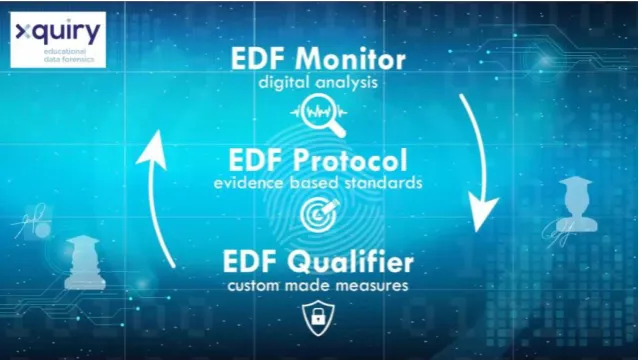
[image:8.595.72.393.303.483.2]The Xquiry educational data forensics improvement cycle consists of the EDF Monitor, the EDF Protocol, and the EDF Qualifier (Figure 1). The purpose of the cycle is to reduce the frequency in which exam fraud occurs. Although there is no set order for applying this cycle (e.g., both the monitor or the protocol can be the starting point). First the monitor will be discussed, because it has already been developed and validated through experimental research (van Noord, 2018). This way the improvement cycle can be described in order of development, since the development of the EDF protocol is the basis of this design study.
Figure 1. The educational data forensics improvement cycle (Xquiry, 2017).
The EDF Monitor
The EDF monitor can be considered an entry point of the improvement cycle, because this is a separate service offered by Xquiry. The monitor can be used to detect aberrant patterns in the exam data. These aberrant patterns are detected by means of a web based data forensics monitor (DFM) in which fraud indices are programmed to search the data for suspicious results. eX:plain developed the data forensics monitor in collaboration with the University of Twente. In the DFM there are several fraud indices included that can indicate possible fraud. These indices were the topic of a recent study to determine their validity and effectiveness (van Noord, 2018). Van Noord conducted an experimental study in which examinees were assigned to specific ‘cheating behaviour’ groups in order to determine if these kandidates would be flagged through DFM analyses. The results showed that the data forensics monitor can flag 37% of fraudulent behaviour, with a reliability of 97%.
The monitor is not only useful for detecting possible fraud among individual candidates, groups of candidates, exam officers, but also very useful for determining how often exam fraud generally occurs within the exam. For example, it is possible to check whether exam fraud occurs more often in certain item banks or certain exams. Provided the data is available regarding exam officers, locations, etc. Any suspicious patterns are automatically reported in the software interface, which uses available exam data up to 2 years to calculate (Xquiry, 2017).
The EDF Protocol
The EDF protocol, which has yet to be developed by means of this design study, is aimed to be a quality assurance system, validated by content experts, which is aimed at prevention (i.e., the prevention of exam fraud as much as possible in advance) and detection of exam fraud. Although exam fraud can never be fully banned, the protocol will provide security standards to limit the chance of exam fraud.
These standards can be used to determine whether there is a security risk (e.g., a high, medium, or low security risk). That is why the interaction with the EDF monitor is of the utmost importance, because it can highlight fraud trends and possible security gaps. By using the EDF protocol, based on scientifically based standards, gaps in the exam security can be detected (Xquiry, 2017).
The standards in the EDF protocol that relate to the prevention of exam fraud can be divided into two categories, namely physical and technological standards. Physical standards relate to how candidates enter the examination room, what kind of materials they can bring, and what precautions are taken against (technological) aids etc. The technological standards have an ICT technical impact. This relates to test construction (test items), the way items are manufactured and exchanged between test experts, and how an item bank is secured etc. In terms of detecting exam fraud, the EDF protocol standards can also be divided into physical and technological standards. Surveillance during exams, and the detections of unwanted objects in the examination room are examples concerning physical standards. The technological standards are mainly based on the EDF monitor. Applying an exam fraud detection system is of course an important standard for detecting fraud (Xquiry, 2017).
The EDF Qualifier
The third part of the cycle is the EDF qualifier. The EDF qualifier is an organisation which applies the improvement cycle. This means that the monitor is used repeatedly to measure the effect of the protocol. Also, based on the outcomes of the protocol application, the next step is to implement tailor-made measures. These measures are aimed to make exam fraud more difficult to achieve, and to lower exam fraud grades as determined by the EDF monitor or protocol. Hence, this makes the improvement cycle complete. In this way the EDF continuous improvement cycle offers a good working system for fraud prevention and detection, which is indispensable to guarantee the quality of the exam (Xquiry, 2017).
Research question and model
This research is focused on developing standards covering the entire process of examination in order to limit the chances of security risks (e.g., the prevention of exam fraud as much as possible, and detection by means of data forensics). Accordingly, the corresponding research question is:
1. Which standards regarding preventing and detecting exam fraud in the process of examination need to be included into the EDF protocol?
In addition, practitioners should be able to act on indications of exam fraud based on these standards, this study will therefor also answer a second research question:
2. Which conditions must be considered during development of the EDF protocol to support practitioners in detecting possible gaps in the security of their examination process?
Scientific and practical relevance
Method
To develop a set of standards on securing the process of examination this study is based on a qualitative design research method. Hence, a naturalistic approach is used to understand a context specific phenomenon (Golafshani, 2003), namely misconduct during examination (i.e. cheating, fraud).
The EDF protocol for preventing and detecting exam misconduct was constructed and validated in five consecutive steps: [1] a literature search relating relevant standards and criteria on security of the examination process, and also prevention and detection of exam misconduct; [2] development of the prototype; [3] validation of the prototype standards and criteria through semi-structured interviews with content experts; [4] adjustment of the prototype towards a final version of the EDF protocol; and [5] empirical testing of the protocol by putting the protocol to practice.
Step 1- Literature search
For the first step the PRISMA framework described by Moher, Liberati, Tetzlaff and Altman (2009) was used for conducting the literature review. To compile an evidence base for the development of the EDF protocol, three major databases were searched: Scopus, Web of Science, and Google Scholar. Foremost, using multiple databases enabled a more diverse collection of literature, but it also compensated for subjectivity by the researcher and uncontrolled validity threats (Rousseau et al., 2008). For the main topic of the study several search terms were used (see table 1). Boolean search operators were also used during this step (e.g., AND, OR, NOT, and *). The initial search findings were thinned through excluding duplicates. Hereafter, the articles were first screened on title, and secondly the abstract. Articles were included in the study if the main topic of the paper or chapter related to security of examination, or if the paper or chapter provided a structured set of guidelines or standards on security of examination. This method not only summarized existing literature, but also aimed to generalize and transfer findings for policy making and practice (Cassell et al., 2006). Prior to the development of the EDF prototype, an overview was made of the most important findings from the literature review. These insights were used to develop an EDF prototype.
Table 1
Search terms used in the literature search
Keywords Related/more specific/broader
Test Security Educat*, Prevention, Detection, Standards, Fraud, Cheating Data Forensics Educat*, Fraud, Cheating
Step 2- Developing an EDF-Protocol prototype
Based on the findings of step 1, a consultation with the scientific advisor and manager of Xquiry was organised in order to ensure that development was in line with their goals and expectations. The insights gathered in the consultation were used in the development of the first set of standards of the prototype (Part A), as well as a corresponding grading system. This initial prototype was hereafter discussed during consultation with the Xquiry team. The intention was to make the standards (concerning prevention of misconduct during the process of examination) as complete as possible before starting the interviews. Owing to this, subsequent feedback loops emphasized the content of the final version of this part of the prototype.
During this step a deliberate choice was made for a distinction between a set of standards for prevention as well as a set of standards for detection (by means of data forensics) because these actions not always coincide in practice.
Step 3- Validating the EDF-Protocol standards
Ethics and Participants
Before establishing the correctness of the prototype standards, ethical approval for conducting the semi-structured interviews was requested and granted by the Behavioural, Management and Societal Sciences Ethics Committee of the University of Twente (Appendix B). The prototype was validated by means of seven semi-structured interviews. All approached experts have practical and theoretical experience on the subject. These interviews were held with content experts from different backgrounds, amongst them psychometricians, policy makers and practitioners in the field of test security or education. Multiple experts who focus their work on (parts of) test security have been approached with the question to partake in this design research to gain an insight on their opinions and experiences concerning standards for securing the process of examination. To keep development of the prototype and validation of the content separate steps, the participating experts were not involved during the development of the prototype.
Procedure and Materials
For the purpose of developing a protocol which can be use in practice, the current study, will make use of experts interviews. Systematic expert interviews offer the possibility of identifying strengths and weaknesses in the content (McKenney & Reeves, 2012; Piercy, 2004). This method is a valuable source of data collection, particularly when establishing the correctness (e.g., validating) content of a product (Wools et al. 2011). The interview format consists of four categories; category one focused on general questions concerning the protocol (n=7), category two focused on questions concerning the protocol content (n=4), category three related to the grading of the protocol (n=5), and category four focused on the data forensic standards (n=5). An example question of a question would be: “The goal of the protocol is to provide a good check whether the process of examination is secure. Do you think this is feasible in the current form?”
All potential respondents were first contacted through e-mail or Linked-In. This e-mail contained a brief introduction of the researcher, a short explanation of the context of the design research (e.g., the duration of the interview, and method of the interview), and finally the request for an interview (Appendix C). Initially eight requests have been sent to potential respondents. However, due to a possible conflict of interest, one candidate preferred not to take part in an interview. A second e-mail was send to the seven remaining respondents. In this e-mail a more thorough explanation of the protocol’s goal was provided, the respondents were asked to read the prototype and the interview questions (Appendix D) in preparations of the interview, finally an appointment was set for the interview. This was either face-to-face (n=2), through phone (n=2), or through Skype(n=3). The choice for the interview method was in consultation with the respondents, and mainly based on convenience for both parties.
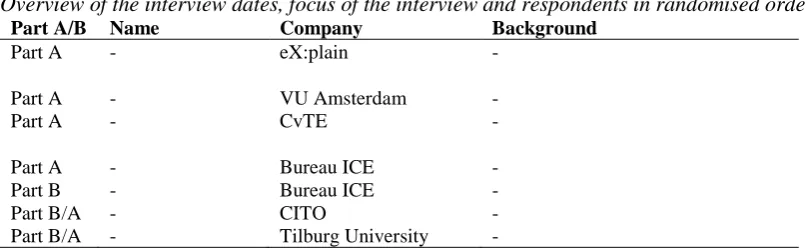
At the start of the interview, each respondent was asked for consent verbally. This means that they were asked whether the interview could be recorded and whether the input from the interview could be used to validate the content of the prototype. It was also agreed in advance with the participants that they would receive the transcript of the interview, to be completely transparent about the input that was collected. The semi-structured interviews were conducted between April 17th and June 1st of 2018. Table 2 provides an overview of the interviews, including the focus of the interview and background information on the participants.
Table 2
Overview of the interview dates, focus of the interview and respondents in randomised order
Part A/B Name Company Background
Part A - eX:plain -
Part A - VU Amsterdam -
Part A - CvTE -
Part A - Bureau ICE -
Part B - Bureau ICE -
Part B/A - CITO -
Part B/A - Tilburg University -
Step 4- Adjustment of the prototype and final EDF protocol
In the fourth step, the statements from the experts were used to transform the prototype into a final version of the EDF protocol. In the result section a comprehensive overview is provided on all changes made based on statements from the interviews. These statements provided several new insights, especially in terms of usability and assessment. This emphasizes the significant impact of the interviews on the validation process.
Step 5- Implementation of the EDF protocol
Results
In this section the results for each consecutive research step is described: [1] findings of the literature search; [2] development of the prototype; [3] validation of the prototype standards and criteria through seven semi-structured interviews with content experts; [4] adjustment of the prototype and final version of the EDF protocol based on the input of the interviews; and [5] empirical testing of the protocol by putting the protocol to practice.
Step 1- Literature search
The literature search was split into two main topics. Firstly, the search for literature on ‘Test Security’, and secondly the search for ‘Data Forensics’ related literature. The literature found is up to June 2018. As was described in the method section the PRISMA framework was used in this step (Moher et al., 2009).
[image:13.595.66.507.327.395.2]The first major topic was ‘Test Security’. The key search term was based on the research question, namely test security. To broaden or specify the search, the following search terms were also used: prevention, detection, standards, fraud and cheating. Not all search terms provided usable information. Figure 2 shows the steps of the search process. An overview of the articles and handbooks, that were included in the current study, is provided in table 3.
Figure 2. PRISMA flow chart showing the search process in the query of Test Security. Note: *only the first 10 pages were scanned (n=100 hits).
Table 3
Overview of literature results based on the search terms ‘test security’, ‘standards’, and ‘fraud’ (n=8).
Document title Authors Year Database / Source
Detecting Fraudulent Erasures at an Aggregate Level Sinharay 2018 Web of Science / Journal of Educational and
Behavioural Statistics 2018, Vol. 43, No. 3, pp. 286–315 A Framework for Policies and Practices to Improve Test
Security Programs: Prevention, Detection, Investigation, and Resolution (PDIR
Ferrara 2017 Scopus / Educational Measurement: Issues and Practice Fall 2017, Vol.36, No.3, pp.5–23
Which Statistic Should Be Used to Detect Item Pre-Knowledge When the Set of Compromised Items Is Known?
Sinharay 2017 Scopus / Applied
Psychological Measurement 2017, Vol. 41(6) 403–421 Detection of Item Pre-Knowledge Using Likelihood Ratio
Test and Score Test
Sinharay 2017 Scopus / Journal of Educational and Behavioural Statistics 2017, Vol. 42, No. 1, pp. 46–68 Robust Detection of Examinees With Aberrant Answer
Changes.
Belov 2015 Journal of Educational Measurement, 52 (4), pp. 437-456.
Item and test development strategies to minimize test fraud
Impara & Foster 2006 Google Scholar / Handbook of test development Selected-response item formats in test development Downing 2006 Google Scholar / Handbook
of test development The security risk assessments handbook Landoll 2006 Google Scholar / The
security risk assessments handbook
Start
•Scopus: 775
•Web of S.: 6
•Google Scholar: 331.000*
Duplicates
•- removed
•2 removed
•1 removed
Title
•761 excluded
•3 excluded
•88 excluded
Abstract
•10 excluded
•0 excluded
•9 excluded
Used
•4 articles
•1 articles
[image:13.595.76.524.456.731.2]The second major topic of this step was focused on gathering literature on data forensics. For this topic, the main keyword, data forensics, directly relates to the main research question. Again, to broaden or specify the search at certain points, the following search terms were also used: educat* standards, fraud and cheating. Also on this account not all search terms provided usable information. Figure 3 shows the steps of the search process. An overview of the articles and handbooks, that were included in the current study, is provided in table 4.
[image:14.595.73.525.315.599.2]Figure 3. PRISMA flow chart showing the search process articles in the query of Data Forensics. Note: *only the first 10 pages were scanned (n=100 hits).
Table 4
Overview of literature results based on the search terms ‘data forensics, and ‘fraud’ or ‘cheating’ (n=11).
Document title Authors Year Database / Source
Exploring the impact of organizational investment on occupational fraud: Mediating effects of ethical culture and monitoring control
Suh, Shim & Button 2017 Scopus / International Journal of Law, Crime and Justice 53 (2018) 46–5 A New Statistic for Detection of Aberrant Answer
Changes
Sinharay, Duong & Wood
2017 Scopus / Journal of Educational Measurement Summer 2017, Vol. 54, No. 2, pp. 200–217
Three New Methods for Analysis of Answer Changes Sinharay & Johnson 2016 Scopus / Educational and Psychological Measurement 2016, Vol. 77(1) 54–81 Detecting cheating in computer adaptive tests using data
forensics
Impara, Kingsbury, Maynes & Fitzgerald
2005 Google Scholar
Detecting potential collusion among individual examinees using similarity analysis
Maynes 2017 Google Scholar
Handbook of Quantitative Methods for Detecting cheating on Tests
Cizek & Wollack 2016 Google Scholar
Test Fraud: Statistical Detection and Methodology Kingston & Clark 2014 Google Scholar Educator cheating and the statistical detection of
group-based test security threats
Maynes 2013 Google Scholar
Data forensics: A compare and contrast analysis of multiple methods
Plackner & Primoli 2012 Google Scholar
The magnitude and extent of cheating and response distortion effects on unproctored internet‐based tests of cognitive ability and personality
Arthur, Glaze, Villado & Taylor
2012 Google Scholar
The new (and old) news about cheating for distance educators
Howell, Sorensen & Tippets
2016 Google Scholar
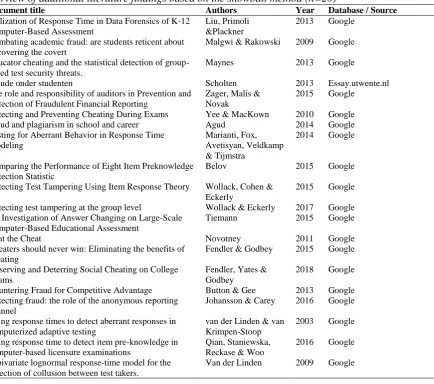
Because the literature search did not yield the desired results a snowballing approach, presented by Wohlin (2014) was used to find more relevant literature on the topic of test security. As a result of this method, scanning the reference lists of the articles and handbooks that were found during the initial literature search provided new information on studies in the field of data forensics and test security. Some of these are highlighted here, because they have proved to be very valuable for this study. For example, the handbook of test security (Wollack & Fremer, 2013) provided several directions for prototype content in terms of prevention criteria as well as input for the data forensics standards. Secondly, the Handbook of Quantitative Methods for Detecting Cheating on Tests (Cizek and Wollack, 2017) provided the ground work for the data forensics standards in the EDF prototype through offering multiple methodologies for identifying cheating of tests.
The third handbook, Test Fraud, by Kingston and Clark (2014) provided a solid summary of statistical detection methods. In terms of justification, these handbooks were very valuable since they summarize
Start
•Scopus: 108
•Web of S.: 2
•Google Scholar: 24.200*
Duplicates
•2 removed
•2 removed
•1 removed
Title
•102 excluded
•0 excluded
•84 excluded
Abstract
•3 excluded
•0 excluded
•7 excluded
Used
•3 articles
•0 articles
lessons learned from practice and involve numerous content experts in writing these handbooks. A full overview of the additional findings through the snowballing method is shown in table 5.
Table 5
Overview of additional literature findings based on the snowball method (n=20)
Document title Authors Year Database / Source
Utilization of Response Time in Data Forensics of K-12 Computer-Based Assessment
Liu, Primoli &Plackner
2013 Google
Combating academic fraud: are students reticent about uncovering the covert
Malgwi & Rakowski 2009 Google
Educator cheating and the statistical detection of group-based test security threats.
Maynes 2013 Google
Fraude onder studenten Scholten 2013 Essay.utwente.nl
The role and responsibility of auditors in Prevention and Detection of Fraudulent Financial Reporting
Zager, Malis & Novak
2015 Google
Detecting and Preventing Cheating During Exams Yee & MacKown 2010 Google Fraud and plagiarism in school and career Agud 2014 Google Testing for Aberrant Behavior in Response Time
Modeling
Marianti, Fox, Avetisyan, Veldkamp & Tijmstra
2014 Google
Comparing the Performance of Eight Item Preknowledge Detection Statistic
Belov 2015 Google
Detecting Test Tampering Using Item Response Theory Wollack, Cohen & Eckerly
2015 Google
Detecting test tampering at the group level Wollack & Eckerly 2017 Google An Investigation of Answer Changing on Large-Scale
Computer-Based Educational Assessment
Tiemann 2015 Google
Beat the Cheat Novotney 2011 Google
Cheaters should never win: Eliminating the benefits of cheating
Fendler & Godbey 2015 Google
Observing and Deterring Social Cheating on College Exams
Fendler, Yates & Godbey
2018 Google
Countering Fraud for Competitive Advantage Button & Gee 2013 Google Detecting fraud: the role of the anonymous reporting
channel
Johansson & Carey 2016 Google
Using response times to detect aberrant responses in computerized adaptive testing
van der Linden & van Krimpen-Stoop
2003 Google
Using response time to detect item pre-knowledge in computer-based licensure examinations
Qian, Staniewska, Reckase & Woo
2016 Google
A bivariate lognormal response-time model for the detection of collusion between test takers.
Van der Linden 2009 Google
Table 6
Overview of openly available guidelines (n=8).
Document title Authors Year Database / Source
Framework of Standards for Educational Assessment AERE, APA & NCME 2014 Google Richtlijnen voor het beschermen van de inhoud van examens NVE & Caveon 2016 Google
Test Fraud Threats Caveon 2016 Google
Security Planning Rubric CoSN 2017 Google
Guidelines of the Security of Tests, Examinations, and Other Assessments
ITC 2014 Google
Richtsnoer Veilige digitale toetsafname SURF 2014 Google COTAN Beoordelingssysteem voor de kwaliteit van tests COTAN 2010 Google RCEC Beoordelingssysteem voor de kwaliteit van
studietoetsen en examens
RCEC 2015 Google
In summary, there is a multitude of frameworks and handbooks available in literature on security guidelines. However, to a certain degree these guidelines lack direction in terms of a concrete model for assessing a possible security risk. Most guidelines are very precise in stating what to consider, yet a distinction between a high, medium or low security risks are often absent. On this note, the COTAN rating system for test quality (2010), and the RCEC rating system for quality test and exams (2015) both provide valuable input. All literature described in this section was used to support and justify the content of the prototype. For this reason, the content of these articles will be described during step 2.
Step 2- Developing an EDF protocol prototype
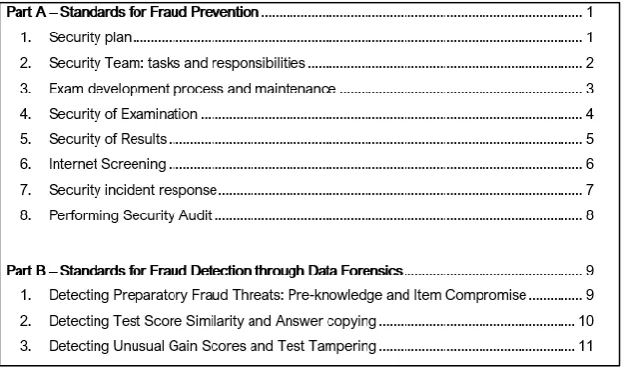
Based on the literature review and reading through similar protocols, manuals and handbooks, two main areas for development were identified. First, an area concerning standards and criteria with a focus on preventing misconduct during the process of examination (Part A). Second, an area with a set of standards concerning the detection of misconduct after examination by means of data forensics (Part B). The EDF prototype’ s body of content is presented in figure 4. The full EDF prototype is included in appendix A. The prototype standards each relate to the most commonly used and accepted guidelines on test security: The Security Guidelines by NVE and Caveon (2016), the guidelines by SURF (2014), and the Standards for Educational and Psychological Testing (AERE et al. 2014) as well as other literature to support the inclusion of these criteria in the prototype.
An important note for the development of the EDF protocol must be made beforehand. Namely, internally within eX:plain a protocol has been developed (Boonman, 2016), for which the NVE & Caveon (2016) guidelines have been adopted. To continue this path, the same guidelines also form an important base in the development of the current prototype. If there is no additional argumentation or reference to literature considering a certain standard or criterion, then the inclusion is considered valid because it already reflects the policy of eX:plain.
[image:16.595.143.457.556.740.2]
Content of Part A
The first part of the prototype involves eight standards. For part A, the aim was to describe a set of standards that cover all parts of the exam process, which were evidence-based, and are measurable.
[image:17.595.72.525.262.352.2]The first standard is ‘Security Plan’. To check whether current practice surrounding the exam process is secure, a security plan that aims to minimize the chance that the content of the exam will become known to unauthorised persons and parties must be present within the organization (NVE & Caveon, 2016). According to Ferrara (2017), such a security plan should include rules, guidelines, requirements and procedures. This led to five criteria, which together form this standard, namely, (1) security plan, (2) security goals, (3) security policy, (4) actuality, and (5) financial resources. A plan containing goals for each process step as well as policies are vital to determine a starting point for secure practice. When a security plan exists, it can function as an instrument for comparing and evaluating practices in all stages of the examination process (AEA Europe, APA & NCME 2014).
Table 7
Criteria and Evidence base concerning standard 1
Criteria Evidence base
NVE & Caveon AEA Europe et al. SURF
Security plan Guideline 1 Guideline 1.5.1 Section 2
Security goals Guideline 1 Guideline 1.5.1 Section 2
Security policy Guideline 1/4 Section 2
Actuality Guideline 1/3
Financial resources Guideline 3
The second standard is ‘Security team: tasks and responsibilities’. Both the tasks and responsibilities of all persons involved in the security of the exam content should be well-defined (NVE & Caveon, 2016). In this way the organization prevents weak points in the overall security of the exam process. Moreover, the organization must ensure that all parties involved recognize the value of security and that they carry out the relevant procedures correctly and carefully. Four criteria together form this standard, namely, (1) Security officer, (2) Security team, (3) Team responsibilities, and (4) Team competency. Zager, Malis and Novak (2015) state that there should be a clear distinction between roles and responsibilities of key stakeholders within an organization. This does not mean that tasks or responsibilities cannot overlap, but it emphasizes the importance of be being able to hold someone accountable for the responsibilities that they have. If these criteria are made explicit within practice (e.g., in the security plan) it increases awareness. In similar fashion, it is important that everyone involved, knows their place in the examination process, therefore ethics, fairness, and rights should be emphasized within security policies (AEA Europe et al., 2014). Part of these policies should be the training of personnel to protect and enforce security (Ferrara, 2017). In like manner, Ferrara (2017) states that a culture of professional ethics will stimulate both examinees and personnel to behave more professional in terms of reporting irregularities, and collaborating with investigations on such irregularities.
Table 8
Criteria and Evidence base concerning standard 2
Criteria Evidence base
NVE & Caveon AEA Europe et al. SURF
Security officer Guideline 2 Section 4
Security team Guideline 2 Section 1/3/4
Team responsibilities Guideline 2/13 Section 2/3/4
Team competency Guideline 2/13 Guideline 1.5.2 Section 2/4
[image:17.595.72.524.607.685.2]and (5) storage. Various statements from literature support the inclusion of these criteria (Table 9). Test developers can prepare multiple forms of an assessment to deter examinees from copying from their peers (Clark & Kingston, 2014). Moreover, they state a more extensive item bank increases the number of potential items an examinee might encounter, also making it more challenging for an examinee to memorize the items should they be disclosed.
Table 9
Criteria and Evidence base concerning standard 3
Criteria Evidence base
NVE & Caveon AEA Europe et al. SURF
Content development Guideline 5 Guideline 1.5.2 Section 5
Exam construction Guideline 6 Guideline 1.5.2&3 Section 3/4
Items Guideline 5 Guideline 1.5.2 Section 2/3/4
Disclosure Guideline 5/7/10 Guideline 1.5.2&3 Section 5
Storage Guideline 6/7/10 Guideline 1.5.2&3 Section 5
Standard four is ‘Security of Examination’. Examination should be done in a secure manner (NVE & Caveon, 2014). Cheating can also be prevented by providing clear documentation regarding what is and is not allowed during examination, by having a clear policy and informing test takers of the policy in advance, examinees cannot claim ignorance of the boundaries of acceptable behaviour (Clark & Kingston 2014). Four criteria together form this standard, namely, (1) Proctoring, (2) Examination, (3) Planning and Acting, and (4) Use of materials. Proctors are considered a good method for preventing misconduct during examination (Bellezza & Bellezza, 1989; Cizek, 2001). However, to be effective, proctors should be trained on what to look for and how to handle suspicious behaviour in an appropriate manner (Cizek, 2001). Disclosing to examinees that statistical methods (e.g., data forensics) will be used to examine the exam results on their fairness can also deter exam misconduct (Bellezza & Bellezza, 1989; Cizek, 2001; Sinharay, 2017a, 2017b). When examinees have knowledge of forensics being used to analyse for indications of cheating, they are more likely to change their behaviour considering the negative consequences (Ferrara, 2017; Kranacher et al., 2010). Also, Clark & Kingston (2014) state that verifying the identities of examinees prior to examination ensures that individuals do not attempt to take the exam for another person. Something that is not directly part of these criteria is the fact that assigned seats significantly decline cheating (Fendler, Yates & Godbey, 2018), this could be a strong example of wat can be considered a good security measure.
Table 10
Criteria and Evidence base concerning standard 4
Criteria Evidence base
NVE & Caveon AEA Europe et al. SURF
Proctoring Guideline 8/10 Guideline 1.5.2 Section 2/4/5/6/7/8
Examination Guideline 8 Guideline 1.5.2 Section 2/4/5/6/7/8
Planning and Acting Guideline 8/11 Guideline 1.5.2 Section 2/4/5/6/7/8
Use of materials Guideline 8/11 Section 2/4/5/6/7/8
[image:18.595.71.530.528.608.2]In terms of both planning and acting, and sharing results, the right of examinees should not be overlooked in case of an incident during examination. Ethical considerations should be part of this standard (AEA Europe et al., 2014).
Table 11
Criteria and Evidence base concerning standard 5
Criteria Evidence base
NVE & Caveon AEA Europe et al. SURF
Plan Guideline 9 Guideline 1.5.3 Section 2
Screening Guideline 9
Transfer Guideline 9/11 Section 9
Data Forensics Guideline 9/11 Guideline 1.5.5
Sharing results Guideline 11 Guideline 1.5.5&6 Section 9
[image:19.595.71.296.365.443.2]Standard 6 is ‘Internet Screening’. Not only internal criteria need to be considered in securing the examination. Organizations also should check the internet for possible disclosure of exam content (NVE & Caveon, 2014). Not many literature touches this subject, however this is also a vital part of the exam process. Exposed exam content can cause serious validity threats (COTAN, 2010; RCEC, 2015) Also these criteria are already included in the current eX:plain policy. Therefore, four criteria form this standard, namely, (1) Monitoring, (2) Reporting, (3) Evaluation, and (4) Actioning.
Table 12
Criteria and Evidence base concerning standard 6
Criteria Evidence base
NVE & Caveon
Monitoring Guideline 12
Reporting Guideline 12
Evaluating Guideline 12
Actioning Guideline 11
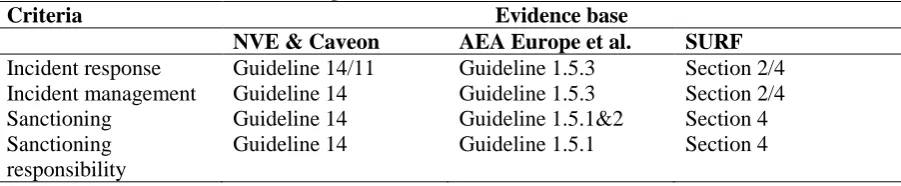
Standard seven, ‘Security incident response’. Literature does not provide clear standards or criteria on decision making or sanctioning in terms of security incidents. In fact, Ferrara (2017) states that decisions in this area are often best accepted by public if they are based on clearly communicated policies, guidelines and practices. Also, the organizations should take responsibility for ensuring that all personnel involved recognizes the value of proper incident response and carry out these procedures correctly and carefully (NVE & Caveon, 2016; Harris & Huang, 2017; SURF, 2014). This again relates back to a well-defined security plan. Therefore, the following four criteria are included in this standard; (1) Incident response, (2) Incident management, (3) Sanctioning, and (4) Sanctioning responsibility.
Combating fraud is primarily seen from the perspective of the organization, and although students may not be expected to actively participate in the fight against fraud, students’ opinions on how to combat fraud could provide new insight in developing criteria (Malgwi & Rakovski, 2009).
Table 13
Criteria and Evidence base concerning standard 7
Criteria Evidence base
NVE & Caveon AEA Europe et al. SURF
Incident response Guideline 14/11 Guideline 1.5.3 Section 2/4
Incident management Guideline 14 Guideline 1.5.3 Section 2/4
Sanctioning Guideline 14 Guideline 1.5.1&2 Section 4
Sanctioning responsibility
[image:19.595.73.524.631.724.2]The final standard of part A is standard eight, ‘Performing security audit’. Organizations must ensure that certain criteria are set, and procedures are described for conducting a security audit (NVE & Caveon, 2014). According to Ferrara (2017), performing security audits is a vital part of a security plan. Audits should be performed to confirm if current practice corresponds with the goals and policies included in the security plan (AEA Europe, APA & NCME 2014). Several studies reported on the effectiveness of performing audits on preventing and detecting fraud (Button & Gee, 2013; Johansson & Carey, 2016; Suh, Shim & Button, 2017).
Table 14
Criteria and Evidence base concerning standard 8
Criteria Evidence base
NVE & Caveon AEA Europe et al. Responsibility Guideline 15 Guideline 1.5.4&7
Archiving Guideline 15 Guideline 1.5.4&7
Security audit Guideline 15 Guideline 1.5.4&7 Updating security plan Guideline 15 Guideline 1.5.4&7
Grading of Part A
The multitude of guidelines and handbooks on security guidelines lack direction in determining the degree of possible security risks. In all consulted documents a fitting grading system for determining the security risk was absent. For this reason, also guidelines outside of the test security domain were consulted in order to develop a grading system for the current prototype. On this note, the COTAN rating system for test quality (2010), and the RCEC rating system for quality tests and exams (2015) provided reasonably validated and justified examples of grading systems. For example, both systems make use of a three-level classification system, namely ‘insufficient’, ‘sufficient’, and ‘good’ for assessing certain criteria. This system is also adopted for developing the prototype. Each of the eight standards are designed by means of a classification (e.g., rubric) including a description of what can be considered ‘insufficient’, ‘sufficient’ or ‘good’. In similar fashion, a score is assigned to these classifications, respectively a score of ‘0’ (zero), ‘1’ (one), or ‘2’ (two). So, a total score can be calculated for each standard, which in the end determines the level of the possible security risk.
The COTAN (2010) and RCEC (2015) models both distinguish between the value of certain criteria. This means that for each standard one or more ‘base-questions’ should be assessed before assessing the full standard. In case this ‘base question’ is assessed ‘insufficient’, the user automatically receives an ‘insufficient’ score for the entire standard. In comparison, this is not the case in grading the EDF protocol. In order to ensure valid decisions, scoring and grading must be separate steps (AEA Europe et al., 2014). The prototype should be able to evaluate the quality of current practice before determining the security risk.
Table 15
Example of the prototype’s grading system
Determining security risk for Standard 8
The total score on this standard is ‘8’ Low
security risk The total score on this standard is ‘4’ or ‘higher’, without an ‘insufficient’ score
Advise: Although all criteria score at least ‘sufficient’, it is advised to improve your security measures to meet ‘Good’ rubric descriptions to reduce the security risk
Medium security risk
One or more ‘Insufficient’ score(s) on one of the criteria
Advise: Direct your resources towards the criteria with the ‘Insufficient’ score, as it forms a high security risk for your exam
High security risk
Content of Part B
Within the Standards for Educational and Psychological Testing (AERE, APA & NCME, 2014), a certain standard recommends active efforts to prevent, detect and correct scores which are caused by fraudulent behaviour to ensure the integrity of the test. This supports the demand for adequate standards and criteria around detection by means of data forensics. Owing to this, the second part of the prototype involves three standards. For part B the aim was to provide an informing checklist on possibilities of data forensics use in the examinations process. The evidence base is mainly formed by the Handbook of Quantitative Methods for Detecting Cheating on Tests (Cizek & Wollack, 2017), and the Handbook of Test Security (Wollack & Fremer, 2013). Most literature around data forensics report on case studies in which certain indices are applied. Hence, the conclusions drawn there are often not applicable in the current design context, which has led to more general information from the aforementioned handbooks for the development of these standards.
The first standard is ‘Detecting pre-knowledge and item compromise’. Three criteria form this standard, namely, (1) pre-knowledge, (2) compromised items and/or people, and (3) obtaining exam content from an inside source. According to Eckerly (2017) and Sinharay (2017a), benefitting from pre-knowledge is a form of fraudulent behaviour. Pre-pre-knowledge is considered a form of fraud, although everyone is expected to have some degree of pre-knowledge when entering an exam. It is considered fraud when test takers study compromised test items, either received or bought from peers or obtained through the internet illegally (Ferrara, 2017). The direction of the standard as well as the criteria were adopted from section IIb of Cizek and Wollack’s handbook (2017), furthermore these criteria are supported by literature (e.g., Eckerly, 2017; Sinharay, 2017a; 2017b). Item compromise occurs when the performance of an item changes over time (Zara, 2006), this could be the result of pre-knowledge. Eckerly (2017), states that examinees can gain pre-knowledge from a variety of different sources of item compromise. According to Sinharay (2017a), benefitting from pre-knowledge during educational assessments is a major type of fraudulent behaviour. Several methods are proposed in literature to detect pre-knowledge. Belov (2016) for example suggested the ’posterior shift statistic’. By the same token, Sinharay (2017a) suggested a ’likelihood based test’ statistic for detecting pre-knowledge.
The second standard is ‘Detecting test score similarity and answer copying’. Here, also three criteria determine this standard, (1) response similarity (2) answer copying, and (3) colluding with others. The direction of the standard as well as the criteria were adopted from section IIa of Cizek and Wollack’s handbook (2017). Unusual similarities in responses between examinees or aberrant response patterns, which can be seen in test data, are types of irregularities that can indicate potential fraud (Zopluoglu, 2016). Collusion among individual examinees can also be potentially detected by using similarity statistics (Maynes, 2017), or by analysing response times (van der Linden, 2009). Although, similarity statistics and answer copying statistics are related, similarity statistics provide a means of detecting general forms of collusion that are not as easily detected by answer-copying statistics (Maynes, 2017). For this reason, both statistics are adopted in this standard. However, the applicability of these statistics can be limited depending on the type of exam. For example, with a computerised adaptive test, in which exam items are selected based on the users’ skill level, or with linear-on-the-fly testing in which items are randomly assigned, these statistics connot be applied.
literature. Several studies report on the possibilities of using response time to detect aberrant behaviour, for indicating possible fraudulent behaviour (e.g., Impara et al., 2005; van der Linden & van Krimpen-Stoop, 2003; Marianti et al., 2014; Plackner & Primoli, 2012; Qian, Staniewska, Reckase & Woo, 2016).
On a different note, erasure analysis is getting more attention in the literature (Sinharay, 2018; Sinharay & Johnson, 2016; Wollack, Cohen, & Eckerly, 2015; Wollack & Eckerly, 2017). Erasures refer to the possibility of changing you answer on a test for example. In a CBT environment the possibility of changing answers may support fraudulent answer changing. Research on detecting changing behaviour is mainly focused on a group level (Maynes, 2013). Analysing patterns of erasures can lead to the possible detection of test tampering (Sinharay, 2018; Sinharay, Duong & Wood, 2017). A separate section of the Standards for Educational and Psychological Testing is focused on erasure analysis. This section includes recommendations on analysis of erasure pattern to detect possible irregularities (AERE et al., 2014). Test tampering can be analysed on both the individual as well as the group level. The ‘Erasure Detection Index’ (EDI) suggested by Wollack et al. (2015), is used on individual examinees to detect fraudulent erasures, and is based on item response theory. In similar fashion, to detect erasures at the group level (e.g., group, location, proctor) Wollack and Eckerly (2017) extended the EDI.
Step 3- Validating the EDF protocol standards
[image:22.595.107.530.467.762.2]The content of the prototype was validated by means of seven semi-structured expert interviews. The interview is divided into four categories; category one focused on general questions concerning the protocol (n=7), category two focused on questions concerning the protocol content (n=4), category three related to the grading of the protocol (n=5), and category four focused on the data forensic standards (n=6). Below, the results are discussed per category together with an overview of corresponding statements from the interviews. In some cases, multiple statements were included from a single expert on a topic. In Some cased the statements made by the content experts were shortened because of readability. The full statements, both in English and Dutch, as well as the full interview transcripts are included in the appendixes (Appendix F, and E respectively).
Table 16
Overview of statements per interview category and question
Question Category N
What were your first impressions after reading through the EDF-protocol? General: first impression
6
What is your opinion on the design of the protocol? General: design opinion
4
In the current form, do you think the goal of securing the process of examination by using this protocol is feasible?
General: feasibility
5
Currently there are eight standards. Are these standards sufficient to describe the process of examination?
General: Current content
6
Do you know of any comparable guidelines or manuals, which have the same goal? General: Comparison
4
Ideally, what should this protocol (aimed at prevention and detection of exam fraud) be able to do?
General: Ideal protocol
5
Would you like to use this protocol yourself or recommend it to colleagues? General: Recommendation
6
For each standard, can you explain if and why it makes sense that this standard is included in the protocol?
Content: Standards
58
For each standard, are all underlying criteria clear? Content: Current criteria
2
For each standard, are all underlying criteria complete? Content: Criteria Missing
3
Are all underlying criteria equivalent? Content:
Equivalency
3
Currently, there is an insufficient-sufficient-good grading system. What is your opinion on this? Grading: Grading system
5
How exhaustive should these rubrics be according to you? Grading: Concreteness
5
Rubrics Are low-medium-high security risks realistic labels? Grading:
Security labels
4
Where lie the boundaries between these labels? Grading:
Security assessment 5
In the current form, do you think it is feasible to provide an informing checklist on possibilities of data forensics use in the examinations process?
Data Forensics: Feasibility
2
Can you explain for each standard if and why it makes sense for you that this standard is included in the protocol?
Data Forensics: Current standards
2
[Currently there are 3 standards describing data forensics]. Are these standards sufficient to describe the possibilities?
Data Forensics: Completeness
2
Are there fraud types missing? Data Forensics:
Types of fraud
3
Are there data forensics indices missing? Data Forensics:
Missing indices 3
General questions of the protocol
[image:23.595.75.530.357.529.2]In the first category, seven questions were asked. An overview of the questions is shown in Table 16. The statements from the experts are categorized per question if this was possible. Table 17 provides an overview of the statements on the first category of the interview. In case statements showed a high degree of similarity, they were merged in the overview to present a clear structure of the statements.
Table 17
Overview of expert statements on the general category
General question Statements: N
First Impression The protocol looks clear and applicable 4x
The protocol looks well-thought-out and manageable 3x
Design The design of the protocol looks clear / intuitive 4x
The design of the protocol is currently not very sexy 2x Feasibility Securing the process of examination by using this protocol is feasible 5x There will always be a chance of fraud, but minimalizing the chance of fraud is feasible 1x Current content The current standards seem to be sufficient 6x Currently criteria on responsibility and integrity are missing 1x I would have the assessor as a separate standard 2x Comparison Not to my knowledge. But we have our own internal documents regarding security 3x I see duplications with what we have in our manuals 1x Ideal protocol Ideally, this protocol should initiate awareness 4x Ideally, this protocol provides users with insight into possible security gaps 2x Usage I would use the protocol myself or recommend it to colleagues 5x I would use the protocol, provided that the protocol would be made more explicit 1x
First, the experts were asked about their first impression of the protocol. Four experts indicated that their first impression was that the protocol looked clear. They gave the following arguments; “I recognize a lot of things from which I think it is super valuable”, and “In practice you can see a lot of protocols which are often too difficult so they won’t get accepted”. Also, one of the experts already performed an audit this the content of the prototype (e.g., “Through the protocol I have received confirmation that our current practice is good”).
Only four experts were asked about their opinion of the prototypes’ design. A striking similarity in the answers was that two out of these four experts indicated that they would like the protocol to be ‘more sexy’. To illustrate with a quote, “Functional, but it may be a bit more sexy in terms of design”. Other statements contained terms like ‘easy to scan’, ‘it looks well-cared for’, and ‘it looks clear’.