RUN-TIME DISCOVERY, SELECTION,
COMPOSITION & INVOCATION OF WEB
SERVICES USING SEMANTIC
DESCRIPTIONS
By
Colm Brady
A dissertation submitted to the University of Dublin,
Trinity College in partial fulfilment of the requirements
for the degree of
Master of Science in Computer Science.
Trinity College Dublin
DECLARATION
I declare that the work described in this dissertation is, except where otherwise stated, entirely
my own work and has not been submitted as an exercise for a degree at this or any other
university.
Signed: ____________________
PERMISSION TO LEND AND/OR COPY
I agree that Trinity College Library may lend or copy this dissertation upon request.
Signed: ____________________
ACKNOWLEDGMENTS
The author wishes to thank the following people for contributing to this research:
Declan O’Sullivan and Dave Lewis for their guidance and tireless work on my behalf. It would
not have been possible for me to complete this work with out their support. Thank You.
Owen Conlon and Ian O’ Keeffe for their assistance while I evaluated APeLS.
Andrew Jackson who reviewed this dissertation and provided invaluable critique.
Fellow NDS class mates for their help and opinion through out the year.
TRINITY COLLEGE DUBLIN
ABSTRACT
RUN-TIME DISCOVERY, SELECTION,
COMPOSITION & INVOCATION OF WEB
SERVICES USING SEMANTIC
DESCRIPTIONS
By Colm Brady
Web Service computing is enabled by using an architecture that provides interoperability between disparate and diverse applications. One goal of Web Services is to facilitate inter-organisational distributed computing using traditional protocols such as the Hyper Text Transfer Protocol (HTTP) and the Simple Mail Transfer Protocol (SMTP). However, these web service technologies do not provide standards for dynamically discovering, selecting candidates, composing and invoking Web Services based on their capabilities. In effect, a human must interpret the functionality or applicability of a web service and write some software capable of using the service or configure a generic client to invoke the service.
Industry is currently proposing several standards which allow for software Agents to automate the process of composing Web Services, by annotating Web Services capabilities in machine readable form and using reasoners to reason over this information.
OWL-S is an emerging XML based mark-up language that can be used to describe the non-functional and functional attributes of a Web Service. OWL-S provides a well defined framework for expressing the capability of Web Services, in a platform and technology neutral representation.
TABLE OF CONTENTS
1 Introduction...1
1.1 Web Service Computing ...1
1.2 The Semantic Web...1
1.3 Semantic Web Services...2
1.3.1 E-Commerce Enrichment...2
1.4 Research Objectives...2
1.4.1 Enabling Semantic Discovery using UDDI ...3
1.4.2 Candidate Selection using Semantic Reasoning ...3
1.4.3 Enabling Service Composition ...3
1.4.4 Automating Semantic Service Invocation...4
1.5 Dissertation Road Map...4
2 Background ...6
2.1 Semantic Web ...6
2.1.1 Concepts ...7
2.1.2 Resource Description Framework (RDF) ...8
2.1.3 Web Ontology Language (OWL)...8
2.1.4 Intentional and Extensional Knowledge...9
2.1.5 OWL Example...10
2.1.6 Enforcing Semantic Relationships...12
2.2 Web Services...14
2.2.1 Universal Description, Discovery and Integration (UDDI) ...14
2.2.2 Web Service Definition Language (WSDL) ...15
2.2.3 Simple Object Access Protocol (SOAP)...15
2.3 OWL-Services (OWL-S) ...15
2.3.1 Introducing OWL-S 1.0...16
2.3.2 Service Profile Ontology ...17
2.3.3 Process Model Ontology...19
2.3.4 Service Grounding Ontology...22
2.3.5 OWL-S complementing WSDL standards ...23
2.3.6 Service Description Ontology ...23
3 State of the Art...24
3.1 Semantic Service Discovery...24
3.1.1 E-Speak ...24
3.1.2 DAML-S Matchmaker ...24
3.1.3 UDDI Enhancement ...25
3.1.4 Evaluation of Semantic Service Discovery Research ...25
3.2 Candidate Selection...25
3.2.1 DAML Dining ...25
3.2.2 Evaluation of Candidate Selection...26
3.3 Semantic Service Composition...26
3.3.1 BPEL4WS...26
3.3.2 Semi-Automatic Service Composer Tool ...26
3.3.4 Evaluation of Service Composition...27
3.4 Semantic Service Invocation...28
3.4.1 OWL-S API...28
3.4.2 Web Service Description Framework...28
3.4.3 Evaluation of Service Invocation...28
3.5 Conclusion ...29
4 Design ...30
4.1 Framework Overview...30
4.1.1 UDDI Integration for Semantic Discovery...30
4.1.2 Candidate Selection using Semantic Reasoning ...31
4.1.3 Service Composition using Capability Reasoning...31
4.1.4 Semantic Service Invocation...32
4.2 Application Description and Use Cases ...32
4.2.1 Non-Functional Service Attributes...32
4.2.2 Domain Description ...34
4.2.3 Domain Issues ...35
4.2.4 Actors & Goals ...35
4.2.5 Use Case UML...36
4.2.6 Ontologies and Semantic Descriptions...36
4.2.7 Scenario Steps ...39
4.2.8 Use Case Deployment Architecture ...40
5 Framework Implementation...41
5.1 Overview ...41
5.2 Assisting Technologies...42
5.3 Custom XML Schema ...45
5.4 Capability Advertisement and Service Discovery...45
5.4.1 Publishing OWL-S Semantically in JUDDI ...45
5.4.2 UDDI Discovery...46
5.4.3 Discovery Sequence ...46
5.5 Candidate Selection...48
5.5.1 Semantic Reasoner ...48
5.5.2 Inference Functionality...48
5.5.3 Reasoner Component Overview...50
5.5.4 Reasoner Functionality ...51
5.5.5 Reasoner Inference Thread...53
5.5.6 Candidate Priority Ordering ...53
5.5.7 Reasoner Sequence...55
5.6 Service Composition Functionality ...57
5.6.1 OWL-S Functionality...58
5.6.2 Executing a Service Composition ...59
5.7 Automated Invocation Functionality ...60
5.8 Universal Functionality...62
6 Framework Evaluation ...64
6.1.1 UDDI Discovery Portal ...64
6.1.2 Candidate Service Selection ...65
6.1.3 Service Composition ...65
6.1.4 Automated Service Invocation ...66
6.1.5 Discovery using Non-Functional Service Attributes ...67
6.2 Performance Tests ...68
6.2.1 Inference Overhead...68
6.2.1.1 Inference Methods ...68
6.2.1.2 Jena API Approach...68
6.2.1.3 XSL Approach...69
6.2.1.4 Inference Performance Tests ...69
6.2.1.5 Jena Vs XSL ...69
6.2.1.6 Jena Conclusion...70
6.2.1.7 XSL Conclusion ...71
6.2.2 Reasoner Implementations ...72
6.2.3 Ontology Persistence Storage Tests...74
6.3 Adaptive Personalised E-Learning Service Evaluation ...75
6.3.1 XML Database constraint ...75
6.3.2 Pre-Run-time Configuration...76
6.3.3 Scalability issues ...76
6.3.4 APeLS Builds New Knowledge ...76
7 Conclusion ...78
7.1 Research Review...78
7.1.1 Semantic Service Discovery ...78
7.1.2 Service Selection ...78
7.1.3 Semantic Service Composition...79
7.1.4 Semantic Service Invocation...79
7.2 OWL-S...79
7.3 The Bigger Picture ...80
7.3.1 Inference Overhead ...80
7.3.2 Internet Scalability...81
7.3.3 Semantic Tools...82
7.4 Final Remarks ...82
8 Appendix ...84
8.1 Model – View – Controller...84
8.1.1 Web Layer...84
8.1.2 Agent Control Layer ...84
8.2 HTTP Framework Control Parameters...85
8.2.1 HTTP Redirect Parameter ...86
8.2.2 HTTP Action Parameter ...86
8.3 E-Commerce System ...86
Bibliography ...87
LIST OF FIGURES
Number Page
Figure 2.1.1: simplistic graph representation detailing a Wine hierarchy...7
Figure 2.1.2: simplistic concept for Wine. ...8
Figure 2.1.3: OWL class definition for White Wine. ...9
Figure 2.1.4: individual (instance) of the class Wine...10
Figure 2.1.5: OWL representation for the concept of Wine. ...11
Figure 2.1.6: how to link a concept defined in an ontology to another equivalent concept...12
Figure 2.1.7: how one instance of a concept can be the same as another. ...13
Figure 2.1.8: how to specify the “is a” relationship. ...13
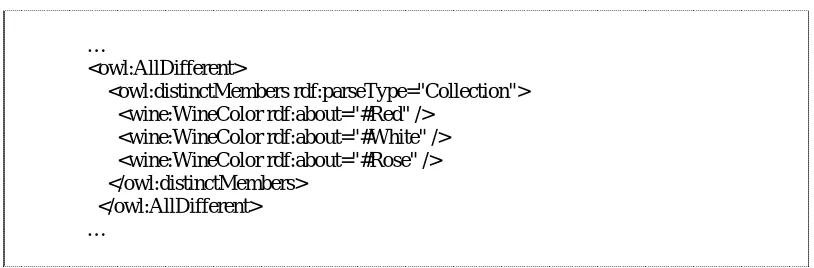
Figure 2.1.9: how to group a set of different concepts that are of the same class. ...14
Figure 2.3.1: OWL-S service ontology model relationships. ...16
Figure 2.3.2: segment of mark-up from an example OWL-S Profile Model...19
Figure 2.3.3: WSDL mark-up which only describes functional parameters. ...20
Figure 2.3.4: Atomic Process definition containing an output and effect. ...21
Figure 2.3.5: definition of a Purchase Confirmation concept. ...21
Figure 2.3.6: grounding mark-up for the Atomic Process “Purchase Item”...23
Figure 4.1.1: component overview of the semantic framework...30
Figure 4.2.1: Use Case UML definition. ...36
Figure 4.2.2: concept ontologies relationships express in UML notation. ...37
Figure 4.2.3: UML representation of the Portal Ontology. ...38
Figure 4.2.4: OWL definition to denote different Quality Rating concepts...38
Figure 4.2.4: OWL definition to denote different Quality Rating concepts...38
Figure 4.2.5: high level component architecture for Portal.. ...40
Figure 5.1.1: main deployments involved in the demo application. ...41
Figure 5.2.1: OWL-S Profile Model classes...42
Figure 5.3.1: XML document segment detailing the custom format...44
Figure 5.4.1: service parameter mark-up segment from a Profile Model. ...46
Figure 5.4.2: class diagram showing discovery functionality. ...46
Figure 5.4.3: sequence of method calls in the discovery process...47
Figure 5.5.1: class diagram showing the reasoner and inference packages...48
Figure 5.5.2: details the Java code for the matching algorithm. ...49
Figure 5.5.3: class diagram showing the inference functionality. ...50
Figure 5.5.4: reasoner component overview and interaction...51
Figure 5.5.5: reasoner interface signature. ...52
Figure 5.5.6: details the Java code that controls inference execution...52
Figure 5.5.7: details the Java code for handling inference thread notification...53
Figure 5.5.8: class diagram showing a subset of the reasoner classes...54
Figure 5.5.9: class diagram showing the reasoner and inference relationship...55
Figure 5.5.10: sequence of messages involved in the reasoner implementation...56
Figure 5.5.11: sequence of message sent during the inference process...57
Figure 5.6.1: OWL-S functionality is realised by the OWL-S package. ...59
Figure 5.6.2: sequence for how the Agent invokes a composition of processes. ...60
Figure 5.7.1: details the Java code showing the parameter reconciliation algorithm. ...61
Figure 5.8.1: class diagram showing the generic utility classes. ...63
Figure 6.2.1: Jena test results in graph format. ...70
Figure 6.6.2: XSL test results in graph format...71
Figure 8.1.1: class diagram sowing the Agents relationship to the client Servlet and sub
LIST OF TABLES
Number Page
Table 6.2.1: results for inference implementations tests ...70
Table 6.2.2: results of the second reasoner implementations tests...72
Table 6.2.3: results of the first reasoner implementations tests ...73
Chapter 1
INTRODUCTION
1 Introduction
1.1 Web Service Computing
Web Service computing is enabled by using an architecture that provides interoperability between disparate and diverse applications. Web Services are self-contained, self-describing modular applications that can be published, located and invoked in a dynamic fashion over the Internet [5]. Web Services are enabled by using a set of industry standard, platform neutral specifications such as Universal Description, Discovery, and Integration (UDDI) [1], Simple Object Access Protocol (SOAP) [3] and Web Service Description Language (WSDL) [4].
One goal of Web Services is to facilitate inter-organisational distributed computing using traditional protocols such as the Hyper Text Transfer Protocol (HTTP) [27] and the Simple Mail Transfer Protocol (SMTP) [28] [5]. However, these web service technologies do not provide standards for dynamically discovering, selecting candidates, composing and invoking Web Services based on their capabilities. In effect, a human must interpret the functionality or applicability of a web service and write some software capable of using the service or configure a generic client to invoke the service.
This scenario is one factor in limiting interoperable and global scale distributed applications. Industry is currently proposing several standards which allow for software Agents to automate the process of composing Web Services, by annotating Web Services capabilities in machine readable form and using reasoners to reason over this information.
1.2 The Semantic Web
1.3 Semantic Web Services
OWL-S [6] is an emerging XML [2] based mark-up language that can be used to describe the non-functional and non-functional attributes of a Web Service. OWL-S provides a well defined framework for expressing the capability of Web Services, in a platform and technology neutral representation.
This Dissertation is concerned specifically with researching the OWL-S specification for semantic mark-up of Web Services. Of specific interest are methods and techniques to use OWL-S descriptions for semantic discovery incorporating non-functional service attributes, candidate selection, service composition and semantic service invocation.
1.3.1 E-Commerce Enrichment
It is also a goal to provide knowledge and feedback relating to development of an E-Commerce semantic application, as there are still limited examples of semantically enabled Agent applications available on the Internet. There is a requirement to promote practical applications that casual users can benefit from and develop these applications immediately [11].
These requirements will be factored in to an experimental framework which will examine methods for achieving this semantic functionality. The framework will be applied to an E-Commerce portal application to showcase possible use cases for the Semantic Web.
1.4 Research Objectives
From this research, we wanted to address techniques and methods to realise an enriched E-Commerce environment. To achieve this goal we needed to investigate the following research questions:
» How to enable semantic discovery using UDDI.
» How to undertake candidate selection using Semantic Reasoning. » How to enable Service Composition.
» How to automate Semantic Service Invocation
Before we can discuss the research questions, we must firstly indicate the differences that exist between functional and non-functional Web Service attributes.
Functional is this context means, attributes that are directly bound to the operation and invocation of a Web Service. For example, an input parameter is a functional attribute, because the service needs this value in order to function correctly.
attribute is a geographical location for a specific service. A user may have a requirement to invoke a service that is located in Ireland, for example.
1.4.1 Enabling Semantic Discovery using UDDI
Current Web Service models facilitate automated discovery of services. This mechanism is purely syntactic and does not enable capability based discovery. On delivery of query results, a human needs to review the discovered services and evaluate the services suitability. This is a limiting factor in automating the discovery process.
Discovery in a semantic context means finding the location of Web Services on the basis of the capabilities that they provide [9]. Essentially, the discovery process needs to be able to find semantically annotated Web Services that will satisfy known user requirements. These requirements will most likely be expressed as semantic concepts.
It is an objective to formulate a method to enable semantic capability based discovery of Web Services using an industry standard called UDDI1. We believe that Semantic Web Services will need to leverage
current Web Service standards in order for their adoption to be widespread.
1.4.2 Candidate Selection using Semantic Reasoning
A critical element to the discovery process is the ability to evaluate, rank and prioritise the discovered services based on user requirements. Without accurate candidate selection, automation of the discovery process is highly restricted. A method to select services based in non-functional service attributes is of specific interest for this research.
The candidate selection process involves identifying Web Services in some priority ordering that best satisfy a set of user preferences. This process is typically done at discovery and/or composition time. A candidate service is classed as any service that matches any of the capabilities sought. A candidate that meets all the users’ requirements will be ranked as the most suited candidate.
It is an objective to examine methods for providing semantic inference functionality. We believe that performance and speed are critical factors in evaluating inference techniques.
1.4.3 Enabling Service Composition
It is conceivable that users will require multiple services to achieve their goals. There are several emerging models for Service Composition. To date, these models have failed to address dynamic
composition of services at run-time. Dynamic service composition at run-time is important because the number of compositions possible is greatly increased over and above the current static models.
Composing existing services to obtain new functionality will prove to be essential for both business-to-business and business-to-business-to-consumer applications [10]. The service composition process selects two or more Web Services and amalgamates them to provide new functionality. For example, a typical composition scenario is composing an air reservation service with a hotel reservation service, to produce a new outcome, not possible by using the services individually. In this case, an airline booking and a hotel booking.
It is also a research objective to enable the invocation of a composition of services. This requires using candidate service selection methods to formulate an execution plan that achieves a known semantic encoded plan.
1.4.4 Automating Semantic Service Invocation
The final piece of the problem is that currently, it is impossible to dynamically invoke a series of Web Services at run-time due to a lack of encoded semantic information about the functional attributes of a service. Without this encoded knowledge the semantics of inputs and outputs can not be determined.
Semantic service invocation involves executing concrete Web Services dynamically, using the encoded semantic metadata as an instruction set. This process involves selecting an appropriate operation to achieve a known outcome and also dynamic reconciliation of input parameters and interpretation of message return types.
Our final objective is to provide a service execution engine that is capable of automating the invocation of Web Services using semantic descriptions.
1.5 Dissertation Road Map
Chapter 2
BACKGROUND
2 Background
This chapter provides background information relating to Web Services and Semantic Web technologies. Section 2.1 discusses the history and motivation for the Semantic Web, as well as explaining relevant Semantic Web technologies. Section 2.2 reviews current Web Service standards and Section 2.3 presents an overview of the main concepts of OWL-S 1.0.
2.1 Semantic Web
There has been extensive research in the area of intelligent systems that can represent human knowledge. These systems are characterised as knowledge-based system. Description Logics are a family of knowledge representation languages that have been studied extensively in Artificial Intelligence over the last two decades. They are embodied in several knowledge-based systems and are used to develop various real-life applications [24]. Description Logics is a method for representing and ordering human knowledge in knowledge based systems [24]. Description Logics were developed out of semantic network and frame systems. These systems arranged data in network graphs. This arrangement allowed computer programs to traverse the graphs in different ways, using different algorithms.
Figure 2.1.1: simplistic graph representation detailing a Wine hierarchy.
One of the important features of Description Logic that is evident in the Semantic Web is that unambiguous conclusions can be ascertained from a description logic graph hierarchy. In Figure 2.1.1 we can infer that White Wine is a Wine, and Red Wine is a Wine also. This kind of relationship is known as a subsumption relationship. The subsumption relationship is discussed in Section 2.1.5.3.
The concepts behind the Semantic Web can also be traced back to work done on Conceptual Dependencies [40]. Conceptual Dependencies, like Description Logic express human knowledge in an unambiguous form and was also applied to traditional models of Artificial Intelligence computing. Conceptual Dependencies are abstract hierarchies of human concepts encoded into a computer readable form [40]. The definition could also be applied to ontologies. Ontologies are used in the Semantic Web framework to encode human concepts into a human readable form that can be interpreted by a machine or Agent.
Ontologies are a specification of a conceptualization [12]. They are a description (like a formal specification of a program) of the concepts and relationships that can exist for an Agent or a community of Agents [12].
2.1.1 Concepts
The World Wide Web consortium2 (W3C) is an Internet task force with the goal of standardising
protocols and rules for Internet technologies. W3C standardises the majority of Semantic Web technologies and specifications. This Section, 2.1; presents an overview of some of the W3C specifications.
2 http://www.w3.org/ - World Wide Web Consortium Home Page
W
the
hip
ine
Red Wine
White Wine
Link identifies
“is a” relations
Node defines t
pt “Wine
2.1.2 Resource Description Framework (RDF)
The Resource Description Framework (RDF) [13] is a general ontology language in which syntax conforms to well-formed XML. XML provides a surface syntax for structured documents, but imposes no semantic constraints on the meaning of these documents. RDF expands XML’s Schema to allow for this type of expression.
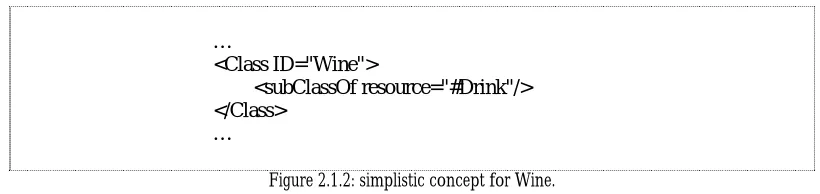
RDF was developed by the W3C for expressing semi-structured metadata in order to enable knowledge-management applications. An RDF document contains its knowledge in the form of data constructs called triples. Triples identify relationships between abstract concepts. RDF allows for the notion of Classes and Properties. A Class is a definition of some “Thing”, where as a Property is an attribute of a “Thing”. Uniform Resource Identifiers (URI) [26] is the glue that allows Agents to traverse the Semantic Web. URI’s are strings that identify resources in the web [25]. Ontologies use URI’s to reference other concepts that exist in perhaps other ontologies on some other endpoint on the Internet. The mark-up in Figure 2.1.2 shows a simple RDF triple. It is possible to deduce from the triple that there exists a concept called Drink, and Wine “is a” Drink.
…
<Class ID="Wine">
ource="#Drink"/> <subClassOf res
[image:20.612.100.510.357.454.2]</Class> …
Figure 2.1.2: simplistic concept for Wine.
A shortcoming of RDF, with r nability to express sophisticated constructs, such as data-typing of properties, characteristics of properties, enumerations and usage
gy Language (OWL) is an ontology mark-up language that enables the creation of tion of these ontologies for the description of specific Web egards the Semantic Web is the i
constraints on concepts. These constructs allows ontology providers to encode how a concept should be used and how a computer should represent it in memory. OWL [8] is an extension to RDF. It addresses the RDF short comings and introduces the necessary syntax to express these kinds of constraints.
2.1.3 Web Ontology Language (OWL) Web Ontolo
ontologies for any domain and the instantia
Defense Advanced Research Projects Agency (DARPA) Group3 under the guise of DAML+OIL.
DARPA is an organisation linked to the US Department of Defence with the aim of investigating Agent technologies, among other things. Ontology Inference Layer (OIL) was initially a European initiative, which was merged with the DARPA Agent Mark-up Language (DAML) to form DAML-OIL mark-up. W3C renamed DAML+DAML-OIL to OWL and standardised the OWL language in 2003.
2.1.4 Intentional and Extensional Knowledge
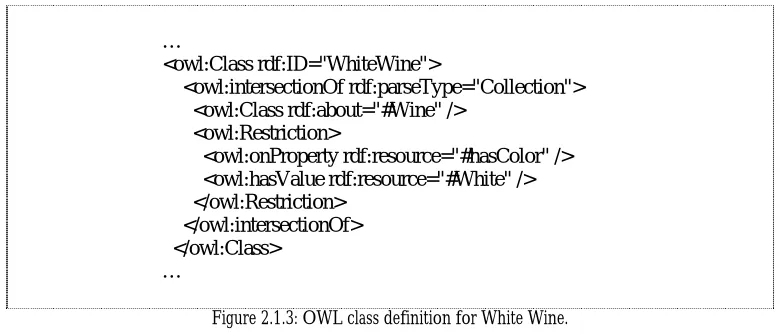
Within an ontologies knowledge base, there is a clear distinction between intentional knowledge and extensible knowledge. Intentional knowledge is general terminology built using OWL declarations about the knowledge domain. It expresses general concepts and properties. For example, in a Wine ontology, properties like hasColour, hasFlavour and hasBody are intentional properties. The OWL mark-up in Figure 2.1.3 shows intentional knowledge about White Wine. It states that White Wine must have the colour White.
l:Class rdf:ID="WhiteWine">
e="Collection">
asColor" /> rce="#White" /> …
<ow
<owl:intersectionOf rdf:parseTyp <owl:Class rdf:about="#Wine" /> <owl:Restriction>
<owl:onProperty rdf:resource="#h <owl:hasValue rdf:resou
</owl:Restriction> </owl:intersectionOf> </owl:Class>
[image:21.612.111.503.320.487.2]…
Figure 2.1.3: OWL class definition for White Wine.
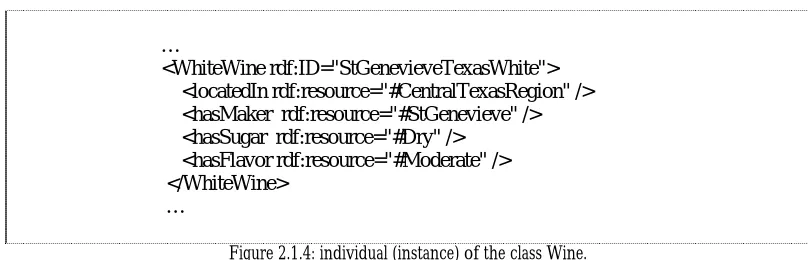
Extensional knowledge oduces the notion of instances of concepts. An instance of a concept is known as an individual Individuals assert properties and facts about an instance of a concept. The mark-up in Figure 2.1.4 iden assigns values to the general properties of Wine.
intr
.
tifies St Genevieve Texas white wine, and
hiteWine rdf:ID="StGenevieveTexasWhite"> /> …
<W
<locatedIn rdf:resource="#CentralTexasRegion" <hasMaker rdf:resource="#StGenevieve" /> <hasSugar rdf:resource="#Dry" />
<hasFlavor rdf:resource="#Moderate" /> </WhiteWine>
[image:22.612.102.506.81.211.2]…
Figure 2.1.4: individual (instance) of the class Wine.
In Description Logics, intentional and extensional knowledge are referred to as TBox and ABox logic
respectively. This is analogo bject Oriented (OO) [41]
development. A class defines the semantics of a thing, almost like a blueprint. An object assigns values
The mark-up expresses a concept for “Wine”. It is not a complete definition of what Wine is and some ut Wine have been omitted for clarity.
us to the terms Class and Object in O
to the class and is a real representation of a class type.
2.1.5 OWL Example
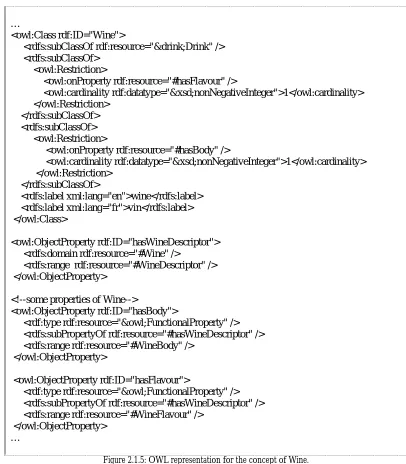
To help readers understand OWL syntax and mark-up, a simple example is presented in Figure 2.1.5.
…
<owl:Class rdf:ID="Wine">
<rdfs:subClas k" />
<rdfs:subClas <owl:Restri
<owl:onP sFlavour" />
<owl:car sd;nonNegativeInteger">1</owl:cardinality> </owl:Restr </rdfs:subClas <rdfs:subClassOf> <owl:Restri <owl:on <owl:car sd;nonNegativeInteger">1</owl:cardinality> </owl:Restrictio </rdfs:subClas <rdfs:label xm
<rdfs:label xml: el>
</owl:Class>
<owl:ObjectPrope <rdfs:domain <rdfs:range rd </owl:ObjectPro
<!--some propert <owl:ObjectProp <rdf:type rdf:res <rdfs:subProp
<rdfs:range rd ineBody" />
</owl:ObjectPro <owl:ObjectProp <rdf:type rdf:r <rdfs:subProp /> <rdfs:range rd </owl:ObjectPro … sOf rdf:resource="&drink;Drin sOf> ction> roperty rdf:resource="#ha dinality rdf:datatype="&x iction> sOf> ction>
Property rdf:resource="#hasBody" /> dinality rdf:datatype="&x n> sOf> l:lang="en">wine</rdfs:label> lang="fr">vin</rdfs:lab rty rdf:ID="hasWineDescriptor"> rdf:resource="#Wine" /> f:resource="#WineDescriptor" /> perty>
ies of Wine-->
erty rdf:ID="hasBody">
ource="&owl;FunctionalProperty" /> ertyOf rdf:resource="#hasWineDescriptor" /> f:resource="#W perty> erty rdf:ID="hasFlavour"> esource="&owl;FunctionalProperty" /> ertyOf rdf:resource="#hasWineDescriptor" f:resource="#WineFlavour" /> perty>
can be extracted from the mark-up is as follows. The mark “is a” sub class of Drink. Wine has two functional4 pr
erty is similar to a realisation of the “has a” re the hasWineDescriptor
ou
[image:23.612.100.506.80.544.2]
4 Functional Property: for each instance of the property there is at most one value for the property
Figure 2.1.5: OWL representation for the concept of Wine.
The information that -up defines an OWL
class called “Wine”. Wine operties, hasFlavour
and hasBody. A prop lationship used in OO development.
The properties extend property which is in the “domain” of Wine; therefore we can infer that hasFlav r and hasBody are also in the domain of Wine. hasFlavour must have a value of
type WineFlavour an Wine is constrained to only have one valu
It is possible for the of Wine to be replicated all over the Semantic Web. Each class of Wine can be made distinct and separate due to a namespace typing mechanism using URI’s. Agents can decide
that the OWL class loc t the same concept as
http://nowhere/other#Wine. The Semantic Web is an attempt to share knowledge and unify concepts
guages. The concepts of both can be linked by using the <owl: equivalentClass> mark-up perties of class Wine can also be made equivalent to properties in class Vino. Figure 2.1.6
="Wine">
lentClass rdf:resource="http://somewhere#Vino" /> </owl:Class>
d hasBody must have a type of WineBody. Each instance of e for hasBody and one value for hasFlavour.
class
ated at http://somewhere/concept#Wine is no
for things. It is more beneficial to have only a few concepts for Wine, rather then several conflicting definitions.
2.1.6 Enforcing Semantic Relationships
OWL allows ontology providers to link two different ontologies together through well defined relationships. Some of the most common constructs allowing this are “equivalency”, “same as”, “sub class of” and “all different”.
2.1.6.1 OWL Equivalency
Equivalency allows ontology providers express that two concepts are equal by intent. It allows Agents to infer that both concepts refer to the same human concept. For example, if two ontologies exist at different URI, one has a class “Wine” and the other has a class “Vino”. Let’s assume that these classes are similar by nature and express the same concepts but use different naming convention, perhaps different lan
tag. The pro
shows OWL mark-up for “equivalency”.
…
<owl:Class rdf:ID <owl:equiva
…
Figure 2.1.6: how to link a concept defined in an ontology to another equivalent concept.
2.1.6.2 OWL Same Individual As
…
<WhiteWine rdf:ID="StGenevieveTexasWhite"> <locatedIn rdf:resource="#CentralTexasRegion" /> <h ker rdf:resource="#StGenevieve" /> <h Sugar rdf:resource="#Dry" />
<hasFlavor rdf:resource="#Moderate" />
s rdf:resource="http://somewhere#StGenTexW"/> asMa
as
<owl:sameIndividualA </WhiteWine>
…
Figure 2.1.7: how one instance of a concept can be the same as another.
2.1.6.3 OWL Sub Class Of
A “sub class of” used to build
sub class relationship is also classed under a subsumption
…
<owl:Class rdf:ID="Wine">
fs:subClassOf rdf:resource="http://somewhere#Drink" /> </o
…
relationship is an expression of classic inheritance. This construct can be hierarchies of human concepts. A
relationship. Subsumption can be seen as the determination of sub concept and super concept relationships between concepts of a given terminology [24]. An example of a sub class relationship is the notion that Wine “is a” Drink. Figure 2.1.8 shows some example mark-up for an OWL subsumption relationship.
<rd wl:Class>
Figure 2.1.8: how to specify the “is a” relationship.
2.1.6.4 OWL Al
Using the OWL fferent. This
is useful for enfo t that an individual may be of the same type, but the concept it refers to is totally diffe to the any other concept of the same type. The example in Figure 2.1.9 enforces that real world fact that Wine has distinct colours which are not the same conceptually.
l Different
“All Different” construct one can assert that a group of individuals are di rcing the concep
…
<owl:AllDifferent>
<owl:distinctMembers rdf:parseType="Collection"> <wine: ineColor rdf:about="#Red" />
ine:WineColor rdf:about="#White" />
"#Rose" />
</ < …
W <w
[image:26.612.103.510.81.215.2]<wine:WineColor rdf:about= owl:distinctMembers> /owl:AllDifferent>
Figure 2.1.9: how to group a set of different concepts that are of the same class.
2.2 Web Services
Web Services are self-contained, self-describing modular applications that can be published, located and n over the Internet. Web Services can be local, distributed or Web-based.
g traditional protocols such as HTTP and SMTP. By using such protocols, company firewalls can be negated through the use well known open ports. This allows services that are initially unaware of each others existence; invoke remote messages on each other.
Typically, Web Services are end points to business services and advertise their functionality using WSDL5 mark-up [5].
2.2.1 Universal Description, Discovery and Integration (UDDI)
Universal Description, Discovery, and Integration, (UDDI) is a specification that defines a service registry of available Web Services, serving as a global electronic “yellow pages” for business services.
It is intended to allow companies to advertise and publish a description of their business/service to a directory. Businesses that register with a UDDI server are known as service providers. Service requesters use the service registry to discover a service provider for obtaining arbitrary goods or services. UDDI defines data-types that abstract the concept of a business and a service. It is therefore possible for any class of service to register their business and provide a way for electronic clients to connect to and use the advertised services.
invoked in a dynamic fashio
They interact with and/or invoke each other, fulfilling specific tasks and requests that, in turn, carry out specific parts of complex transactions or workflows [5].
One goal of Web Services is to facilitate inter-organisational distributed computing usin
Classification systems exist in UDDI registries to allow business to be associated with classes of organizations. UDDI sed as a method for publishing and finding service descriptions [5]. As with most new w echnologies, a custom XML schema is used to communicate with a UDDI registry. This means t I is technology neutral, and can be implemented in any programming
language. Most d can therefore leverage the open
architecture n
2.2.2 Web S
WSDL is an chema for describing the operational information of a Web Service such as i points. WSDL defines XML grammar for describing contracts between a se endpoints exchanging messages. Contracts provide documentation for distributed
systems and serve munication [5].
WSDL is somewhat comparable to IDL [36] [42] in its description of methods; argument types and return values, in that it describes the implementation details for clients who want to talk to the service.
crosoft, IBM, Sun, Oracle and BEA have incorporated WSDL into their tool sets and technology standards, as well as a healthy proportion of
ransport technology, Simple Object Access Protocol (SOAP). SOAP is a model of using simple request and response messages written in XML as the basic
mechanism, but it can be used for the exchange of any kind of XML information
s concepts that can be used to describe a Web Service such that humans and is u
eb t
hat like SOAP, UDD
UDDI servers are exposed as Web Services an ature of SOAP Services.
ervice Definition Language (WSDL) XML-based specification s
nterface and end t of
as a recipe for automating the details involved in applications com
Using WSDL, Web Services can be enabled to access and invoke remote applications and databases [5].
WSDL has recently become wide spread in its use. There are several tools that can automate the creation of WSDL documents, and it has proven to be a very robust and descriptive deployment mechanism. Major vendors of technologies like Mi
open source vendors.
2.2.3 Simple Object Access Protocol (SOAP) The glue that makes Web Services a reality it the t
protocol for electronic communication. SOAP messaging is often modelled as a platform-neutral remote procedure call
[5].
Any server or client can theoretically interpret the XML message and process a SOAP messages payload. SOAP messages can also be transported across networks using standard protocols like HTTP and SMTP, so no object level transport mechanisms like RMI [37] or CORBA [36] need to be used.
2.3 OWL-Services (OWL-S)
computers can reason over the description. It is a DARPA inspired mark-up language built using OWL syntax.
2.3.1 Introducing OWL-S 1.0
per also discusses the motivation for developing OWL-S and what areas of the specification are yet to be defined. There are three main ontologies defined in OWL-S
process model and the service grounding.
2.3.2, 2.3.3 and 2.3.4.
ce abstraction has a ServiceProfile element as an attribute. Figure 2.3.1 shows a diagrammatic overview of the OWL-S ontology hierarchy and how they inter-relate.
During the time period this Dissertation was being researched, OWL-S 1.0 was the latest release of the OWL-S specification [6]. The specification6 is a good starting point in understanding what the
motivation for OWL-S is. This specification document was formulated by the OWL Services coalition (formulary the DAML Services coalition). The coalition’s publications detail the current state of development for the OWL-S specification. It is currently at version 1.1, but 1.1 features were not examined during this research. The pa
specification [6]. They are called the service profile, the
OWL-S simply provides a mechanism and mark-up language for expressing human knowledge about a Web Service. This knowledge describes non-functional and functional attributes about a Web Service. An organisation or developer that adopts OWL-S to mark-up Web Services is obliged to provide four OWL ontologies to complete an OWL-S service. These ontologies are normally located at separate URI’s but can also be defined in the same ontology. Three of the user defined ontologies expand on concepts defined in the core OWL-S specification. These core ontologies are defined in the Sections
The OWL-S specification will be the basis for designing any beta OWL-S API because it defines the main elements in the OWL-S specification and what the concerns should be. It also blueprints the relationships between them, for example; it states that a Service “presents” a ServiceProfile which indicates that the Servi
Figure 2.3.1: OWL-S service ontology model relationships.
2.3.2 Service Profile Ontology
The service profile ontology defines the core concepts for advertising and classifying an OWL-S service [6]. An OWL-S service provider typically defines custom profile ontologies, specific to a Web Services domain. The service provider’s ontology uses and expands the concepts defined in the DARPA service profile ontology to ensure it type conforms to the specification.
The profile ontology is consulted primarily to establish what type of services a particular OWL-S ontology offers and under what industrial classification it is classed under. The profile ontology answers the question “What does this service offer me?” Essentially, a Web Services functional and non-functional attributes are advertised in the profile model. The service profile model also advertises its functional inputs, outputs, preconditions and effects (IOPE) that an Agent needs to know about.
Inputs are conceptual definitions for parameters that a concrete service needs as input in order to be invoked. Outputs are return data values that are returned from Web Services. Effects are conceptual
As well as IOPE, the service profile can also be consulted to look up contact information for human beings or physical locations that have some relevance to the service. A name and also a human readable description of the service are normally provided in the profile model also.
Advertising services in this context of a profile model means, expressing the real world functionality of implistically, semantic concepts. For example, a profile concepts that relate to real-world things. Outputs values may trigger an effect in the real world; this effect can be conceptualised using OWL constructs. Preconditions have only being sufficiently defined in OWL 1.1 [43] and therefore will not be in scope of this Dissertation. These functional attributes are defined in the process model, a description of which follows in Section 2.3.3. Collectively, they are normally referred to as IOPE.
model defined in an OWL-S service may contain information that it outputs weather forecasts, o rhaps that it is a currency converter service. The concepts for what weather is or what currency may exist in some other ontology repository. But, using this embedded knowledge; software Agents can
cide whether or not a service is suitable for achieving their goals.
The process of classifying a service in relation to the profile model is, binding a service to a specif third party service category. Again, Agents can determine if the service uses an industrial classificati mechanism. Typically, a separate ontology will define the semantics of the Web Services domai
fining what the domain is or industry category
r
pe is
de
ic on n,
de s.
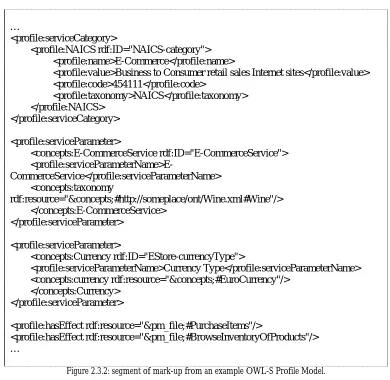
Figure 2.3.2 shows a mark-up segment from an OWL-S Profile Model used to annotate an inferred from this mark-up that the service is categorised under the
ine these concepts and upon further
7 it operates in and other useful concept
Commerce Web Service. It can be
NAICS classification schema as a Business to Consumer (B2C) E-Commerce trader. The service advertises that it is an E-Commerce Service and also that its currency type is Euro. The service also exhibits the real world effects of “Browsing a product inventory” and “Confirmation of Purchase”, two concepts associated with B2C E-Commerce. An Agent can exam
reasoning, it is possible to deduce that this Web Service is a B2C E-Commerce Web Service that supports browsing and purchasing of items.
…
<profile:serviceCategory>
<profile:NAICS rdf:ID="NAICS-category"> <profile:name>E-Commerce</profile:name>
<profile:value>Business to Consumer retail sales Internet sites</profile:value>
<profile:serviceParameterName>E-<profile:hasEffect rdf:resource="&pm_file;#PurchaseItems"/>
<profile:hasEffect rdf:resource="&pm_file;#BrowseInventoryOfProducts"/> …
<profile:code>454111</profile:code>
<profile:taxonomy>NAICS</profile:taxonomy> </profile:NAICS>
</profile:serviceCategory>
<profile:serviceParameter>
<concepts:E-CommerceService rdf:ID="E-CommerceService">
CommerceService</profile:serviceParameterName> <concepts:taxonomy
rdf:resource="&concepts;#http://someplace/ont/Wine.xml#Wine"/> </concepts:E-CommerceService>
</profile:serviceParameter>
<profile:serviceParameter>
<concepts:Currency rdf:ID="EStore-currencyType">
<profile:serviceParameterName>Currency Type</profile:serviceParameterName> <concepts:currency rdf:resource="&concepts;#EuroCurrency"/>
[image:31.612.110.500.77.457.2]</concepts:Currency> </profile:serviceParameter>
Figure 2.3.2: segment of mark-up from an example OWL-S Profile Model.
2.3.3 Process Model Ontology
The process model ontology defines the concepts that abstract how a service is intended to be used. Service Providers mark-up custom process model ontologies that give Agents rules and instructions for using the services advertised in the profile model. The process model answers the question “How can I use this service in the correct, prescribed manner?”
There are three types of processes that can be included in a process model description. These are Atomic processes, which have no sub-processes and operate in a single step [6], Composite processes which are decomposab to sub-processes whose operations are controlled via control structures [6] and finally Simple Pro ocable, but intended to act as an abstraction or specialisation of some o
The process model gen service. The
process model is entitl gies to represent web service
parameters. These conc SDL, parameters can
only be defined using X limits the typing of parameters to such primitive values as Booleans, Strings, In WL concepts, data types can be represented in richer, more descriptive ways. Figure 2.3.3 shows WSDL mark-up for a “purchase item” operation, compare this to Figure e operation marked up using OWL-S but with the functional parameters re
…
<wsdl:message na
<wsdl:part nam oolean"/>
</wsdl:message>
<wsdl:message name="purchaseItemRequest"> <wsdl:part name="itemId" type="xsd:int"/>
<wsdl:part n "/>
</wsdl:message>
<wsdl:operation n ount">
<wsdl:input m chaseItemRequest"/>
<wsdl:output m e"/>
</wsdl:operation> …
le in
cesses, which are not inv ther process.
erally provides semantic descriptions for the input parameters of a ed to use OWL constructs defined in ontolo
epts can be as simplistic or complex as desired. Using W SD [44] data types. This
tegers and others. By using O
2.3.4 which shows the sam
presented as concepts rather then XSD data types.
me="purchaseItemResponse">
e="purchaseItemReturn" type="xsd:b
ame="amount" type="xsd:int
ame="purchaseItem" parameterOrder="itemId am essage="impl:purchaseItemRequest" name="pur
essage="impl:purchaseItemResponse" name="purchaseItemRespons
ure 2.3.3: WSDL mark-up which o
an OWL-S Atomic process, which outputs a ” which is defined in some other ontology and is show Fig nly describes functional parameters.
Figure 2.3.3 defines semantic type,
“PurchaseConfirmation n in Figure 2.3.4. The
…
<process:UnConditionalOutput rdf:ID="purchaseItem_Output"> <process:parameterType rdf:resource="&
</process:UnConditionalOutput>
my_concepts;#PurchaseConfirmation" />
<process:Input rdf:ID="purchaseItem_itemId_IN">
urce="# ShippingID_Effect "/> </process:AtomicProcess>
…
<process:UnConditionalEffect rdf:ID="ShippingID_Effect">
<process:ceEffect rdf:resource="&my_concepts;#ShippingID"/> </process:UnConditionalEffect>
<process:Input rdf:ID="purchaseItem_ammount_IN">
<process:parameterType rdf:resource="&my_concepts;#ItemAmount" /> </process:Input>
<process:parameterType rdf:resource="&product;#UniqueId" /> </process:Input>
<process:AtomicProcess rdf:ID="Operation_purchaseItem">
<process:hasInput rdf:resource="# purchaseItem_ammount_IN"/> <process:hasInput rdf:resource="# purchaseItem_itemId_IN"/> <process:hasOutput rdf:resource="# purchaseItem _Output"/> <process:hasEffect rdf:reso
Figure 2.3.4: Atomic Process definition containing an output and effect.
Figure 2.3.5 details the OWL class for PurchaseConfirmation. It also defines a data type property associated with the class and constrained to the XSD type Boolean.
…
<owl:Class rdf:ID="PurchaseConfirmation"/>
<owl:DatatypeProperty rdf:ID="hasConfirmation"> <rdfs:range rdf:resource="&xsd;boolean"/>
<rdfs:domain rdf:resource="#PurchaseConfirmation"/> <rdfs:comment>has true if confirmation exists</rdfs:comment>
</owl:DatatypeProperty> …
ent can evaluate and reason over what a “Purch xists in its run-time environment coupled with th
an Agent to infer that this service is perhaps appr
Figure 2.3.5: definition of a Purchase Confirmation concept.
An Ag aseConfirmation” concept is, by using knowledge
that e e OWL concept defined in some ontology. This
A goo nderstanding the motivation for the process model is to think of it as well struct ed instructions for some arbitrary item, maybe a car owner’s manual. The “item” represents the
web s process, and are “well
struct
2.3.4 Service Groun
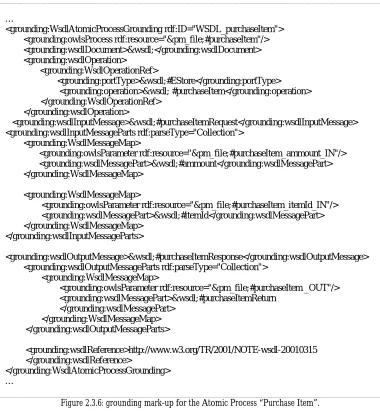
The cl ServiceGrounding defines concepts that can be used to map an OWL-S abstraction of a service to a concrete alisation of a service. The OWL-S specification defines a grounding ontology as
one which specifies at message formats
to use and what protocols are expected. A grounding ontology can answer the question “Where and in
urchaseItem” defined in Figure 2.3.4.
d metaphor for u ur
ervice. The “instructions” are analogous to the rules for operating a ured”, because there is almost always a finite way to use a certain item.
ding Ontology ass
re
the details of how to access a service [6]. The details include wh
… <grounding:WsdlAtomicProcessGrounding rdf:ID="WSDL_purchaseItem"> grounding:owlsProcess rdf:resource="&pm_file;#purchaseItem"/> grounding:wsdlDocument>&wsdl;</grounding:wsdlDocument> wsdl; #purchaseItem</grounding:operation> </grounding:wsdlOperation> :wsdlInputMessage>&wsdl;#purchaseItemRequest</grounding:wsdlInputMessage> < mount_IN"/> >&wsdl;#ammount</grounding:wsdlMessagePart> purchaseItem_itemId_IN"/> < tMessageParts> <grounding:wsdlOutputMessage>&wsdl;#purchaseItemResponse</grounding:wsdlOutputMessage> ollection"> _OUT"/> ding:wsdlMessagePart> </grounding:WsdlMessageMap> </grounding:wsdlOutputMessageParts> wsdl-20010315 </grounding:Ws … < < <grounding:wsdlOperation> <grounding:WsdlOperationRef> <grounding:portType>&wsdl;#EStore</grounding:portType> <grounding:operation>& </grounding:WsdlOperationRef> <grounding grounding:wsdlInputMessageParts rdf:parseType="Collection"> <grounding:WsdlMessageMap> <grounding:owlsParameter rdf:resource="&pm_file;#purchaseItem_am <grounding:wsdlMessagePart </grounding:WsdlMessageMap> <grounding:WsdlMessageMap> <grounding:owlsParameter rdf:resource="&pm_file;# <grounding:wsdlMessagePart>&wsdl;#itemId</grounding:wsdlMessagePart> </grounding:WsdlMessageMap> /grounding:wsdlInpu <grounding:wsdlOutputMessageParts rdf:parseType="C <grounding:WsdlMessageMap> <grounding:owlsParameter rdf:resource="&pm_file;#purchaseItem <grounding:wsdlMessagePart>&wsdl;#purchaseItemReturn </groun </grounding:wsdlReference> dlAtomicProcessGrounding>
Figure 2.3.6: grounding mark-up for the Atomic Process “Purchase Item”.
2.3.5 OWL-S complementing WSDL standards
Another key strength o WL-S is that it can utilise industry standards, namely WSDL [6]. This is an
important link to allo gies, while allowing
legacy systems to be integrated. Other XML based standards could also be incorporated due to the fact
The final ontol gy necessary to compose an OWL-S service is a Service Description. The service description is ess lly an entry point into a specific OWL-S ontologies collection. A Service
Description can h ually provide URI locations for where
the profile, process and grounding models exist for the service. f O
w OWL-S conform to existing industry standards and technolo
that the Service Grounding class is not constrained by any particular technology.
2.3.6 Service Description Ontology o
entia
Chapter 3
3 State of the Ar
Currently the most e areas of research in the Semantic Web Service domain8 are service invocation,
planning and re ponse interpretation using process descriptions, protocol interpretation and execution, semantic translation and mediation between processes, candidate service identification and selection, automated process composition, process status tracking, failure semantics, ontology creation,
bjectives of our research it
ring in its current state. There is currently no support for Semantic Matching of keywords in E-speak [18].
3.1.2 DAML-S Matchmaker
The DAML-S Matchmaker is a semantically enhanced UDDI registry [22]. It extends the UDDI specification to facilitate its goals [9]. The matchmaker allows service providers to publish OWL-S ontologies semantically into the registry by using the OWL-S ontologies Profile Model to express its
STATE OF THE ART
t
activ smanagement and access; trusted reputation services, inter-service negotiation and possibly the most important ambiguity, security, including identification, authentication, and policy based authorization [15].
The state of the art is focused on reviewing research efforts underway elsewhere which partially address our research objectives defined in Section 1.4, but not all of them in entirety. The format of each sub-section is as follows; firstly we will provide an overview of each research efforts aims. We will conclude each sub-section by evaluating what the merits of the research are and what o
does not address.
3.1 Semantic Service Discovery 3.1.1 E-Speak
The E-speak model was one of the first service architectures proposed. It was developed by Hewlett-Packard [18]. E-speak and UDDI both have complimentary goals, as they both allow the advertisement and discovery of services. E-speck acts as a portal for discovering E-speak services using keywords searches. E-speak concepts are not as inter-operable as UDDI, because it needs an E-speak engine to be running on all client machines. Moreover the E-speak model does not facilitate execution monito
capabilities [9]. The matchmaker aims to improve the service discovery process by allowing location of services based on thei capabilities [10]. Inference is used to select UDDI entries that have a subsumption relationship a certain request parameter.
3.1.3 UDDI Enhanceme
Akkiraju et al. [48] [49] hav enhance UDDI to support capability searches. This work aolucci et al [9]. They propose an extension to the UDDI
inquiry API specificatio Secondly,
the service discovery c performing semantic matching and
automatic ser Finally, it is proposed that these service
compositions should be presen ection 3.3.1.
3.1.4 Evaluation of Se
E-Speak currently does capability based queries and thus, fails to enable our research objectives for semantic installing proprietary software in order for an E-Speak engine to be u a limitation for examining semantic discovery mechanisms.
The DAML-S Matchm osed solutions to enable semantic discovery through the extension o UDDI specification. Both efforts do provide a mechanism to semantically discover Web Services nology we decided to use. Because of this research’s maturity, we anch of research that did not seek to extend UDDI, thus maintaining the op ethos of the Semantic Web.
3.2 Candidate Selectio 3.2.1 DAML Dining
DAML dining [23] is a semantically enabled web tool that allows users to search a DAML ontology
repository. This reposito is tool
is analogous to a seman sers to interact
and select attributes for formation that exists in OWL/DAML ontologies.
This application is also n service, or
sell any tangible goods. I ontologies could benefit from
such an application by a incorporated in the dining application. This could extend the application to facilitate on-line bookings and perhaps take-away services. There
r to
nt
e also proposed models to extends the findings proposed by P
n to enable requesters to specify the required capabilities of a service. apabilities of UDDI are enhanced by
g algorithms [48]. vice composition using plannin
ted in BPEL4WS, described in S
mantic Service Discovery Research not facilitate
discovery. E-Speak also involves sed effectively; We regard this as
aker and Akkiraju et al. have prop f the
and are based on UDDI, a tech wished to follow an alternative br
en
n
ry contains ontologies that describe the characteristics of restaurants. Th tic search portal. It is of interest to this research, as it allows u
search criteria that are compared to in
in the domain of E-Commerce, but does not offer any reservatio t is obvious from this scenario how OWL-S
are no details on the im o be seen as a showcase technology de
3.2.2 Evaluation of Candidate Selection
DAML Dining is not rvice orientated; this research however does address the area of candidate
selection using know g, it is not related to
the Web Service domain and thus fails to fully satisfy our research objectives described in Section 1.4.
ng the interactions of ion of workflow modelling [17]. Workflow in BPEL4WS is
ts to choreograph the planning and protocol interpretations in the Web Services domain.
BPEL4WS focuses on representing composit ll of the process and the bindings between services are known a priori. A more challenging problem is to compose services dynamically, on demand [6]. OWL-S intent is to use ents with the semantic knowledge necessary to dynamically discover and evaluate Web Services, BPEL4WS is more aligned to deployment
er it is clear that BPEL4WS and OWL-S have broad and similar objectives
emi-Automatic Service Composer Tool
Siren et al. have developed a semi-automatic web service composer [10]. This tool allows a user to control the selection of OWL-S annotated services and provides WSDL invocation capabilities. The figured and it is not the goal of the tool to discover services. The composer is plementation of this tool, or its accuracy or success. It is intended t
mo.
se
ledge encoded in ontologies. Although the research is promisin
3.3 Semantic Service Composition 3.3.1 BPEL4WS
The Business Process Execution Language for Web Services (BPEL4WS) [16] specification was co-authored by IBM, Microsoft and BEA. It supersedes work done by Microsoft on XLANG and also IBM’s Web Service Flow Language (WSFL). It provides a notation for describi
Web Services, following in the tradit
directed by traditional control structures like if, then, else; and while-loop. Services are integrated by treating them as partners that fill roles in a BPEL4WS process model. WSDL is used to notate the functional attributes of a web service. A process model, in BPEL4WS describes a workflow that orchestrates the interaction of the service partners. It attemp
ions where a
ontologies to provide Ag
time composition. Howev [10].
Essentially BPEL4WS provides a language for the formal specification of business processes and business interaction protocols. BPEL4WS defines an interoperable integration model that should facilitate the expansion of automated process integration both in the intra-corporate and the business-to-business spaces. [16]
3.3.2 S
capable of reading DAML-S descriptions and presents the service attributes to a user as a list. This allows the user to filter this list using the ontological information encoded in service descriptions, effectively to select a candidate service. The user can create a composition by choosing a service to supply the input of another service [10].
3.3.3 Pizza and a Movie Selection and Composition
s to help enrich applications in the E-Commerce domain [10] [46]. poses an evening organisation service, whose design is presented together with its
nctional requirements. It presents the potential of advanced Web Services through the case study [20]. In this case, the user wants to find a pizza restaurant in the San Francisco area and also a
terwards, including the relevant transport to and from the locations.
inal confirmation to proceed. The services theoretically, will be invoked depending on the users signal and the outcome of this process is once
any service fails to complete the user can be asked for further input or
eb Services using OWL-S but is not One future use case for OWL-S i
Dale et al. pro
reasoning flow [20]. This service is actually a collection of smaller programs, which are Web accessible and composed together to form the evening organizer. [20]. DAML-S is used to annotate how this composition should work.
The motivation for this example was to demonstrate how a user (customer) could benefit from having an intelligent Agent compose and invoke Web Services on the customer’s behalf that meet the customer fu
showing of a Sci-Fi movie for af
The scenario starts by asking the customer to fill out a template form which guides the user to a Restaurant and Shows template. The answers supplied to these questions are used to formulate a user profile; which the Agent will analyze when deciding which service to select for invocation. An event organiser component then returns a completed itinerary to the Agent [20]. The Agent, in turn will present the itinerary back to the user, asking for a f
again presented to the user. If
perhaps the reasoning engine can suggest an alternative. This process will continue until the user is satisfied with the Agents work.
3.3.4 Evaluation of Service Composition
BPEL4WS is an elegant solution to Web Service composition, but fails to address our research objective of achieving composition at run-time.
Siren et al. research supports composition and invocation of W
dynamically compose several services together to achieve a goal. It uses simplistic planning techniques to formalise a composition.
osition. It does not use profile model attributes to aid service selection. This means that non-functional service attributes are not used in the ese are intended to be defined in the a Profile Model instance. It provides no e identification and selection is achieved.
to enable the invocation of OWL-S annotated Web Services using the SOAP protocol. The API can be used to parse an OWL-S ontology into memory and provides interfaces to access the
ient to invoke a service based solely on a shared ontology, i.e. without prior knowledge on a specific API. WSDF requires client and server to provide a mapping from the tology at design-time. This research states that OWL-S
3.4.3 Evaluation of Service Invocation
mated invocation, as a programmer must write some client code and reconcile data-types.
The Pizza and a Movie research does not incorporate semantic discovery methods for Web Services, and as such does not answer our research objectives in entirety. However, the research is a good E-Commerce composition scenario. It focuses purely on enabling composition using semantic concepts defined in Process Model instances. This composition is partly achieved by employing static composition methods, but using OWL-S to describe a comp
composition process, as th details on how candidat
3.4 Semantic Service Invocation 3.4.1 OWL-S API
Currently, the most comprehensive OWL-S API has been released by Mindswap9. This API provides
functionality
OWL-S data structures defined in the OWL-S specification.
3.4.2 Web Service Description Framework
Eberhart proposes using the Web Service Description Framework (WSDF) to provide both a representation mechanism and run-time system architecture for semantically enriched Web Services [63]. The approach allows a cl
local structures to some common domain on
does not currently address such issues as relationships between parameters, result processing and shared data-type mediation [63].
The OWL-S API does not enable auto to load parameters
While some of Eberhart’s critique has merit, OWL-S is still an emerging standard and deficiencies with the invocation processes will likely be resolved in later OWL-S versions, by introducing a technique to
express a more elaborate representation of knowledge, perhaps using an OWL based rule language. Eberhart’s research does not incorporate OWL-S and will not be evaluated further in this research.
3.5 Conclusion