Multi-stage Annotation using Pattern-based and Statistical-based
Techniques for Automatic Thai Annotated Corpus Construction
Nattapong Tongtep and Thanaruk Theeramunkong School of Information, Computer, and Communication Technology,
Sirindhorn International Institute of Technology, Thammasat University, Thailand 131 Moo 5, Tiwanont Rd., Bangkadi, Muang, Pathum Thani, Thailand 12000
{nattapong,thanaruk}@siit.tu.ac.th
Abstract
An automated or semi-automated annota-tion is a practical soluannota-tion towards large-scale corpus construction. However, spe-cial characteristics of Thai language, such as lack of word-boundary and sentence-boundary markers trigger several issues in automatic corpus annotation. This paper presents a multi-stage annotation frame-work, containing two stages of chunking and three stages of tagging. Two chunk-ing stages are named entity extraction by pattern matching and word segmentation by dictionary; and three following tagging stages are dictionary-based, pattern-based and statistical-based tagging. Applying heuristics of ambiguity priority, entity ex-traction is performed first on an origi-nal text using a set of patterns, ordered by pattern ambiguity. Later segmenting a sequence of characters into words, the chunks are tagged according to the or-der of ambiguity, using dictionary, pattern and statistics. Focusing on the reduction of human intervention in corpus construc-tion, our experimental results show that the pattern-based tagging was able to re-duce the number of tokens marked as un-known by the dictionary-based tagging by 44.76% and the statistical-based tagging was able to reduce the number of terms identified as ambiguous by both above methods by 72.44%. The proposed multi-stage framework reduced the number of tokens requiring human annotation (those that are tagged unknown or with multiple tags) to 16.35% of the entire corpus. 1 Introduction
As fundamental tasks, word segmentation, part-of-speech (PoS) tagging, and named entity (NE)
recognition are essential steps for various natu-ral language processing applications such as text summarization, machine translation, and question answering. For languages like Burmese, Khmer, Lao, Tamil, Telugu, Bali, and Thai, which have no distinct boundary marker between words and sen-tences (similar to space and a full stop in English), word segmentation is required. PoS tagging is an-other important task which assigns some syntactic categories such as verb, noun, and preposition to a token or a word for resolving innate ambiguities, while more specific predefined categories, such as person name, location, and organization are as-signed in the steps of NE recognition (NER). The current trend in PoS tagging and NE recognition is to utilize machine learning techniques, which are trainable and adjustable. Several supervised learning techniques were successfully attempted and have shown reasonable performances. For PoS tagging, Pandian and Geetha (2009) utilized conditional random fields (CRFs), a probabilis-tic model, to segment and label sequence data, to tag and chunk PoS in Tamil. Huang et al. (2009) showed that a bigram PoS tagger using latent an-notations could achieve the accuracy of 94.78% when testing on a set of the Penn Chinese Tree-bank 6.0. For NE recognition, Lee et al. (2004) presented a two-level Korean named entity classi-fication (NEC) by cascading highly precise lexical patterns and the decision list. Park and Rim (2008) classified bio-entities by using predicate-argument structures as the external context features. Tongtep and Theeramunkong (2010) investigated a method to segment Thai word and recognize named en-tity simultaneously by using the concept of char-acter clusters together with discriminative prob-abilistic models. Such machine learning tasks, however, require high quality tagged corpora or annotated corpora for training which are costly and time consuming to construct. Only few re-search works studied the methods to build the
notated corpus with less human effort. Lee et al. (2010) proposed rules to judge the tagging relia-bility for constructing a Korean PoS tagged cor-pus. Since the quality of the PoS annotation in a corpus is crucial for the development of PoS taggers, Loftsson (2009) examined three error de-tection methods for automatically detecting hand-correct PoS errors in the corpus. For a corpus size, Sasano et al. (2010) reported that the per-formance was not saturated even with a corpus size of 100 billion Japanese words when analyz-ing case frame acquisition for predicate-argument structure. In Thai, Isahara et al. (2000) constructed a PoS tagged corpus named ORCHID manually. The ORCHID corpus was annotated on three lev-els: paragraph, sentence, and word. Charoenporn et al. (2006) constructed another lexicon by us-ing existus-ing machine-readable dictionaries, and a sort of semantic constraint called selectional pref-erence is added into the lexicon by analyzing Thai texts on the web. Lately, Theeramunkong et al. (2010) proposed a framework and annotation tools for tagging named entity and constructing corpus in Thai. With their annotation tools, the Thai-NEST corpus was annotated and verified by col-laborative experts. However, the process is very costly and time consuming. Until now, there have been no research reports on minimizing human in-tervention in automatic construction of either Thai PoS or named entity tagged corpus.
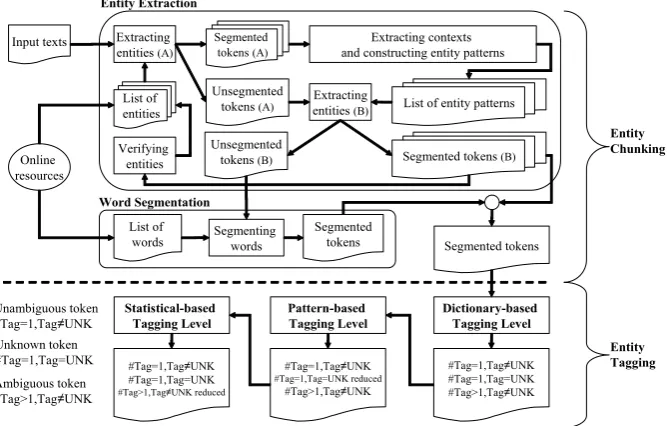
In this paper, we propose a multi-stage anno-tation framework to construct a PoS- and NE-tagged corpus with word segmentation for Thai language with less human effort. First, a list of words and named entities is acquired from online resources. Later, they are used in the two suc-ceeding chunking processes to extract named enti-ties and segment words. Three automatic tagging processes are applied together with designed lex-ical and context features. In the dictionary-based tagging level, ambiguous tokens, unambiguous to-kens, and unknown tokens are discovered. In the next step, the number of unknown tokens is re-duced by the pattern-based tagging. Finally, the number of ambiguous tokens is decreased in the statistical-based tagging level. The remaining part of this paper is organized as follows. In Sect. 2, the writing system in Thai is discussed. The over-all system architecture is proposed in Sect. 3. In Sect. 4, experimental settings and results are re-ported. The experimental results are discussed
in Sect. 5. Finally, a conclusion is illustrated in Sect. 6.
2 Thai Writing System
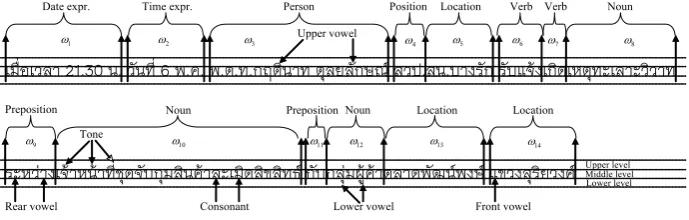
An example of Thai texts is depicted as shown in Fig. 1. The Thai language consists of 44 conso-nants, 21 vowel symbols, 4 tone markers for its 5 tonal levels, and a number of punctuation marks. Thai writing system is left-to-right direction, with-out spaces between words and no uppercase and lowercase characters. Vowels can be written be-fore, after, above, or below consonants, while all tone marks, and diacritics are written above and below the main character.
A Thai word is typically formed by the combi-nation of one or more consonants, one vowel, one tone mark, and one or more final consonants to make one syllable. Thai verbs are not inflected for any of tense, gender, and singular or plural form. Instead, we put some additional words to express their inflection. Moreover, Thai has no distinct boundary maker between words and sen-tences, like space and a full stop in English.
3 The Framework
check-Figure 1: An example of Thai texts
ing all tags in the corpus which is costly and time consuming, our framework can minimize human interposition by indicating which tokens are am-biguous or unknown. Each stage for chunking and tagging is explained in the next section.
3.1 Entity Chunking
For entity chunking, two stages are (1) entity ex-traction and (2) word segmentation. In this step, a list of words and a list of entities are gathered from online resources such as Thai Wikipedia1,
The Royal Institute2, The Government
Informa-tion System3, Company in Thailand4, Longdo
Dict5, and YAiTRON6.
3.1.1 Entity Extraction
In Algorithm 1, we collected the list of entities as entity seeds from online resources. In this step, the list of entities are location (LOC), person name (PER), position (POS), family relationship (FAM), date (DAT), time expressions (TIME) and some parts-of-speech which are longer than two syllables i.e., adverb (ADV), conjunction (CONJ), question phrase (QUE), and verb (VERB). Entity seeds are applied to extract segmented and unseg-mented tokens from the input texts. A segunseg-mented token is a token which appears in the entity seeds while an unsegmented token is a token which dis-appears in the entity seeds. Segmented tokens are used to extract left and right contexts, and con-struct patterns using inner clues and contexts. An inner clue is a set of hint texts which is an apart of named entity. For example, Her Royal High-ness Princess Maha Chakri Sirindhorn is a
per-1http://th.wikipedia.org 2http://www.royin.go.th 3http://www.oic.go.th/ginfo 4http://www.companyinthailand.com 5http://dict.longdo.com
6http://th.lug.wikia.com/wiki/YAiTRON (English-Thai dictionary)
son name appears in the person seeds,Her Royal Highness Princesswill be an inner clue. Gener-ally, one entity may have several entity tags such as “Washington” (person and location). In this paper, constructing patterns using inner clues and contexts will solve the ambiguity in entity tags.
Unsegmented tokens such as named entities outside the list of entity seeds, will be detected and segmented by entity patterns. Segmented tokens or extracted entities from this step will be verified and added to the existing list of entities by experts. This work, the entity extraction is performed be-fore the word segmentation and PoS tagging, since entities in the Thai language are formed by the combination of two or more words, and likely to be transliterated words and unknown words. The remaining unsegmented tokens will be segmented in the word segmentation process.
3.1.2 Word Segmentation
[image:3.595.127.472.65.175.2]Figure 2: The framework of multi-stage annotation for automatic Thai annotated corpus construction
use our collected list of words. The output from the entity extraction and the word segmentation, i.e., segmented tokens, will be used as the input data in the dictionary-based tagging level which is one of entity tagging stages.
3.2 Entity Tagging
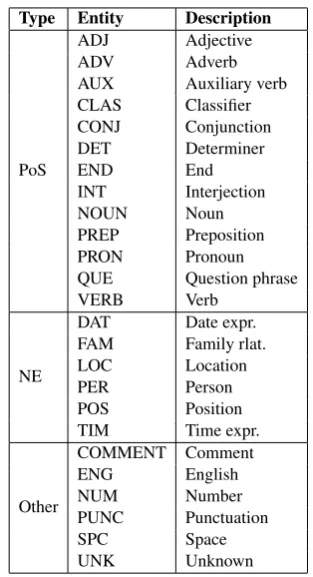
The entity tagging process consists of 3 tag-ging levels; (1) dictionary-based tagtag-ging level, (2) pattern-based tagging level, and (3) statistical-based tagging level. In this work, 25 entity types i.e., 13 parts-of-speech, 6 named entities, and 6 other entities, are defined for constructing tagged corpus as shown in Table 1. “UNK” is one of en-tity types which is used to assign tokens that do not belong to 24 predefined entity types.
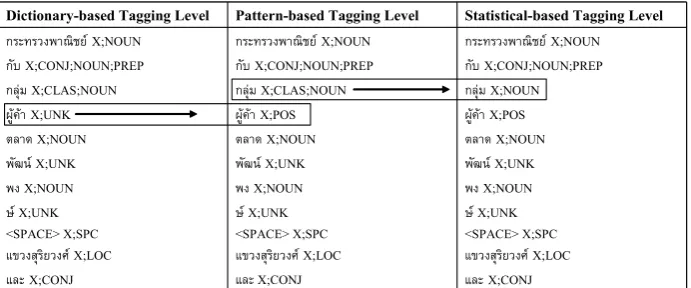
Figure 3 illustrates an example of the transfor-mation of tags among three tagging levels in the entity tagging process. Three entity tagging stages are described in the next section.
3.2.1 Dictionary-based Tagging Level
In this level, unknown tokens, ambiguous tokens and unambiguous tokens are detected.
An unknown tokenis a string which does not belong to 24 predefined entity types. This token will be assigned by “UNK” entity tag (#T ag = 1, T ag=UNK).
An unambiguous token is a string which be-longs to one of existing entity types, except “UNK” (#T ag = 1, T ag̸=UNK).
An ambiguous token is a string which has
more than one possible parts-of-speech in the dic-tionary. (#T ag >1, T ag̸=UNK). A set of entity tags assigned to each ambiguous token is called “multi-entity” tag.
For example, wX;UNK means a token w is assigned a single entity tag as unknown (UNK) since the token does not belong to predefined 24 entity types. xX;NOUN means a token x is
as-signed a single entity tag as noun (NOUN) only.
yX;CLAS;NOUN means a tokenyis possible to
have an entity tag as classifier (CLAS) or noun (NOUN). A set of entity tags i.e., CLAS;NOUN, is a “two-entity” tag. zX;CONJ;NOUN;PREP
means a token z is possible to have an entity
tag as conjunction (CONJ), noun (NOUN), or preposition (PREP). A set of entity tags, i.e., CONJ;NOUN;PREP, is a “three-entity” tag. “X;” is a separator among a token and a set of entity tags, and “;” is a separator among entity tags.
In this paper, the YAiTRON7 dictionary is
ex-ploited to assign the entity tags. YAiTRON: Yet Another (Lex)iTRON is a Thai-English and English-Thai dictionary data, stored in a well-formed XML format. YAiTRON is a ho-mogeneous structure dictionary, adapted from National Electronics and Computer Technol-ogy Center (NECTEC8)’s LEXiTRON9
dictio-nary. YAiTRON covers 32,350 unique words
7http://th.lug.wikia.com/wiki/YAiTRON (English-Thai dictionary)
Figure 3: An example of tag transformation in entity tagging
with 13 parts-of-speech i.e., adjective (ADJ), adverb (ADV), auxiliary verb (AUX), classifier (CLAS), conjunction (CONJ), determiner (DET), end (END), interjection (INT), noun (NOUN), preposition (PREP), pronoun (PRON), question phrase (QUE), and verb (VERB).
3.2.2 Pattern-based Tagging Level
There are some tokens that always have only one PoS when beginning with some specific texts. For example, every token begins with “Ministry of” always be a location, or every token begins with “Minister of” always be a person’s position. We assemble such texts by observing prefix’s tokens from the dictionary. So far we have had 125 pat-terns with 100% correctness; 1 pattern for adverb, 49 patterns for locations, 61 patterns for nouns, 11 patterns for positions and 3 patterns for verbs. An example of Thai grammatical patterns is shown in Fig. 4. Furthermore, other tokens such as com-ment, number, punctuation, space, and English characters, will be automatically assigned with an entity tag as COMMENT, NUM, PUNC, SPC and ENG, respectively. Every unknown token which does not match with these patterns in this tagging level will be assigned with an entity tag as UNK.
3.2.3 Statistical-based Tagging Level
[image:5.595.309.525.254.380.2]In this level, only ambiguous tokens will be trans-formed to unambiguous tokens. Since an ambigu-ous token comprises more than one possible parts-of-speech which specified in the dictionary, we need a PoS classifier to select the best PoS tag among them. In machine learning tasks, several PoS classifiers were trained from the large PoS tagged corpora which are costly and time con-suming to construct. In this work, we exploit na¨ıve Bayes classifier since it only requires a small
Figure 4: An example of Thai grammatical pat-terns
amount of training data to estimate the parameters necessary for classification. A na¨ıve Bayes clas-sifier is a simple probabilistic clasclas-sifier based on applying Bayes’ theorem with strong (naive) inpendence assumptions. In spite of their naive de-sign and apparently over-simplified assumptions, na¨ıve Bayes classifier has worked quite well in many complex real-world situations. In this pa-per, nine context features are defined as shown in Table 2.
Predicting an entity tagtgiven a vector of
con-text features F = (f1, f2, ..., f|F|). One simple way to accomplish this is to assume that once the entity tag is known, all the features are indepen-dent. The result is based on a joint probability model of the form:
p(t|F) =p(tj)
|F|
∏
i=1
p(fi|tj). (1)
Algorithm 1:Entity extraction
Input : texts
Output: segmented tokenssT Band
unsegmented tokensuT B Extracting entities (A):
- Collect list of entitiesefrom online
resources, ordered by longest matching - Labelein the input texts
→segmented tokens (A)sT A →unsegmented tokens (A)uT A
Extracting contexts and constructing entity patterns:
- Extract contexts surroundsT A
→20 characters fromsT A’s leftcL20 →20 characters fromsT A’s rightcR20
- Collect inner clue entities frome →list of inner cluesiClue
- Construct patterns fore
→patternp={cL20}{uT A∈iClue
anduT A∋cL20,cR20}{cR20} Extracting entities (B):
- LabelpinuT A
→segmented tokens (B)sT B →unsegmented tokens (B)uT B Verifying entities:
- VerifysT B
- Add the correctsT Btoe
tbest= arg max tj∈T
p(tj)
|F|
∏
i=1
p(fi|tj). (2)
We train our statistical-based entity tagger by using the traditional na¨ıve Bayes classifier. Since an ambiguous token will be transformed to an un-ambiguous token if the best single entity tag ob-tained from its multi-entity tag, we modify Equa-tion 2 to support our constraint. The best entity tag
t′bestamong a multi-entity tagT′ = (t′1, t′2, ..., t′n)
is
t′best = arg max t′
j∈T′ p(t′j)
|F|
∏
i=1
p(fi|t′j), (3)
t′best= {
t′best ift′best ∈T′ T′ otherwise
Type Entity Description
PoS
ADJ Adjective
ADV Adverb
AUX Auxiliary verb CLAS Classifier CONJ Conjunction DET Determiner
END End
INT Interjection
NOUN Noun
PREP Preposition PRON Pronoun QUE Question phrase
VERB Verb
NE
DAT Date expr. FAM Family rlat.
LOC Location
PER Person
POS Position TIM Time expr.
Other
COMMENT Comment
ENG English
NUM Number
PUNC Punctuation
SPC Space
[image:6.595.337.494.59.348.2]UNK Unknown
Table 1: The list of possible entity tags
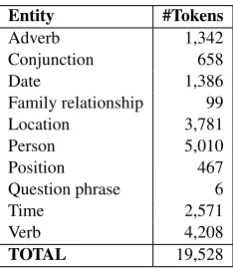
4 Experimental Settings and Results We collected 764 Thai news documents comprised 1,559,330 characters from the web. In the step of entity extraction, we acquired 19,528 segmented tokens as shown in Table 3. In the step of word segmentation, a list of 155,088 unique words ac-quired from online resources were applied to seg-ment unsegseg-mented tokens. Using the longest matching technique, we obtained 316,653 seg-mented tokens. By entity chunking i.e., 336,181 tokens were used as the input data for the entity tagging process.
Token Type Dictionary-based Pattern-based Statistical-based
#T ag= 1, T ag̸=UNK 218,237 254,566 281,205 (Unambiguous tokens) (64.92%) (75.72%) (83.65%)
#T ag= 1, T ag=UNK 81,170 44,841 44,841 (Unknown tokens) (24.14%) (13.34%) (13.34%)
[image:7.595.143.452.63.163.2]#T ag >1, T ag̸=UNK 36,774 36,774 10,135 (Ambiguous tokens) (10.94%) (10.94%) (3.01%) Total tokens (100.00%)336,181 (100.00%)336,181 (100.00%)336,181
Table 4: The experimental results of the entity tagging
Feature Definition
tagL2 The second left entity tag tagL1 The first left entity tag tagR1 The first right entity tag tagR2 The second right entity tag tagL2L1 Two entity tags from left tagR1R2 Two entity tags from right tagL2L1R1 Two entity tags from left and
one entity tag from right tagL1R1R2 One entity tag from left and
two entity tags from right tagL2L1R1R2 Two entity tags from
[image:7.595.94.269.200.345.2]left and right
Table 2: Features for the statistical-based tagging level in the entity tagging process
Entity #Tokens
Adverb 1,342
Conjunction 658
Date 1,386
Family relationship 99
Location 3,781
Person 5,010
Position 467
Question phrase 6
Time 2,571
Verb 4,208
TOTAL 19,528
Table 3: The statistical results of the entity extrac-tion
unknown tokens in the dictionary-based tagging level transformed to unambiguous tokens in the pattern-based tagging level is described in Table 5. Moreover, in the pattern-based tagging level, 13.34% of all tokens were tagged as unknown to-kens. The number of ambiguous tokens reduc-tion in the statistical-based tagging level is 72.44% (reduced from 36,774 ambiguous tokens in the pattern-based tagging level to 10,135 ambiguous tokens in the statistical-based tagging level). In the statistical-based tagging level, 3.01% of all to-ken texts were tagged as ambiguous toto-kens and 13.34% of all token texts were tagged as unknown tokens. Our entity tagging process can increase the
UnK→UnA #Tokens
UNK→UNK 44,841
UNK→COMMENT 14,331
UNK→NUM 6,867
UNK→PUNC 4,350
UNK→NOUN 3,386
UNK→POS 2,738
UNK→VERB 1,947
UNK→SPC 1,058
UNK→LOC 956
UNK→ADV 447
UNK→ENG 249
TOTAL 81,170
Table 5: The statistical results of the tag trans-formation from unknown tokens in the dictionary-based tagging level to unambiguous tokens in the pattern-based tagging level (UnK→UnA)
number of unambiguous tokens up to 83.65%. In this experiment, there were 34 multi-entity tags; 20 two-entity tags, 12 three-entity tags; 1 four-entity tag and, 1 five-four-entity tag. There are some tokens or words that can be classified as classi-fier (CLAS), noun (NOUN), preposition (PREP), or pronoun (PRON) depending on contexts. The maximum number of possible tags for a token is set to 5 that is CLAS;CONJ;NOUN;PREP;VERB. NOUN;VERB is a two-entity tag which is highly occurred in the pattern-based tagging level as an ambiguous token, followed by CLAS;NOUN. All ambiguous tokens with their two-entity tag i.e., INT;NOUN can be transformed to unambiguous tokens. Among three-entity tags, ADJ;ADV;AUX is highly occurred in the pattern-based tagging level, followed by NOUN;PREP;VERB. More than 80% of tokens with one of the following 11 multi-entity tags can be transformed to unambigu-ous tokens by using the proposed context features together with the additional constraint of the joint probability model in the statistical-based tagging level.
[image:7.595.354.480.201.347.2] [image:7.595.123.240.389.525.2]PREP;VERB, CONJ;VERB, NOUN;VERB
• Three-entity tag: CLAS;INT;NOUN, NOUN;PREP;VERB, CLAS;NOUN;VERB,
CLAS;NOUN;PRON, DET;NOUN;VERB
• Five-entity tag:CLAS;CONJ;NOUN;PREP;VERB
5 Discussion
In this section, the experimental results are dis-cussed. The accuracy of each process was inde-pendently verified. This applies to each of the steps including the dictionary-based tagging.
In the entity extraction, we can successfully tag parts-of-speech for tokens longer than two syl-lables (i.e., adverb, conjunction, question phrase and verb) and named entities (i.e., date, fam-ily relationship, location, position and time) with 100% correctness. For tagging person name, we achieved up to 91.95% correctness. Due to the fact that Thai language has no word boundary, ex-tracting entities may not be straightforward. For example, a string whose spelling is equivalent to a short verbal word in a dictionary may not be such a verbal word but just a part of a longer string which indicates another word. From this point of view, it seems better to focus on only a longer verb phrase. Then one potential constraint is to han-dle a verb phrase that is longer than two syllables. This constraint also handles adverb, conjunction and question phrase that are longer than two sylla-bles. Furthermore, named entities i.e., date, fam-ily relationship, location, position and time have explicit boundary, except person name.
In the word segmentation process, the correct-ness decrease when the processed text contains words that do not exist in the dictionary or list of words. Longest matching algorithm can be con-sidered as using some heuristics to solve the am-biguity problem by selecting the longest possible term. From the experimental results, we obtained 13.34% unknown tokens.
In the dictionary-based tagging level, the perfor-mance depends on the reliability of the dictionary. In this work, a token was assigned with possible parts-of-speech defined in well-known dictionar-ies. From this assumption, all unambiguous to-kens, unknown tokens and ambiguous tokens were correctly classified.
In the pattern-based tagging level, our patterns can transform 36,329 unknown tokens to be un-ambiguous tokens with 100% correctness (from
81,170 unknown tokens in the dictionary-based tagging level to 44,841 unknown tokens in the pattern-based tagging level). Among 44,841 un-known tokens from this level could be unun-known words or misspelling words or unregistered word in the dictionary. To solve these problems, human effort is required.
In the statistical-based tagging level, 26,639 ambiguous tokens were transformed to be unam-biguous tokens in this level (from 36,774 ambigu-ous tokens in the pattern-based tagging level to 10,135 ambiguous tokens in the statistical-based tagging level). The accuracy of this tagger is rela-tively high since it selects the best entity tag for ambiguous tokens from theirs possible tags. If the best entity tag can not obtain from its possible tags, ambiguous tokens will not be transformed to unambiguous tokens.
We conclude that the dictionary-based tag-ging level and the pattern-based tagtag-ging level achieved 100% correctness. Based on statistics, the statistical-based tagging level can help to re-duce unambiguous tokens. The performance of the entity chunking stage, especially the word segmentation process, affects the overall perfor-mance of the entity tagging stage. Anyway, our multi-stage annotation framework helps to mini-mize the manual effort in constructing a Thai en-tity annotated corpus. The expert can focus on selecting the correct PoS from all possible parts-of-speech provided by the dictionary for ambigu-ous tokens and correct unknown tokens, that is only 16.35% to complete the annotated corpus construction (3.01% from ambiguous tokens and 13.34% from unknown tokens). However, there might be errors even in unambiguous tokens since the correctness of entity extraction, the correct-ness of word segmentation, and the accuracy of the statistical-based tagger are not 100%. In or-der to construct an annotated corpus where all an-notations are correct, human experts should check not only unknown and ambiguous tokens but also unambiguous tokens. Since the accuracies of the automatically determined word segments and tags are high enough, the proposed system would al-leviate human burden even when experts should check all tokens.
6 Conclusion and Future Work
con-structing a Thai entity annotated corpus. We pro-pose a new tagging strategy that can automatically detect and reduce unknown tokens and ambigu-ous tokens. Even a small decrease in the amount of manual annotation task can achieve significant cost savings in constructing a large-scale entity an-notated corpus. The proposed framework can pro-vide a new and convenient way to construct an-notated corpora, control the quality of the corpus, and reduce the amount of manual annotation. As future work, we plan to create new rules to de-tect more new content entities among various do-mains. The measurement of the tagger’s reliability and developing an annotation verification system are also investigated.
Acknowledgments
This work has been supported by the Thai-land Research Fund (TRF), under Grant No. BRG50800013, a TRF Royal Golden Jubilee Ph.D. Program, under Grant No. PHD/0034/2550, the National Electronics and Computer Technol-ogy Center, Thailand, under Grant No. NT-B-22-KE-38-54-01, Government Research Fund via Thammasat University, Thailand, and the National Research University Project of Thailand Office of Higher Education Commission.
References
Thatsanee Charoenporn, Canasai Kruengkrai, Tha-naruk Theeramunkong, and Virach Sornlertlam-vanich. 2006. Construction of thai lexicon from
existing dictionaries and texts on the web. IEICE
- Trans. Inf. Syst., E89-D:2286–2293, July.
Choochart Haruechaiyasak. 2006. Longlexto: Tok-enizing thai texts using longest matching approach. Zhongqiang Huang, Vladimir Eidelman, and Mary
Harper. 2009. Improving a simple bigram hmm part-of-speech tagger by latent annotation and
self-training. In NAACL ’09: Proceedings of Human
Language Technologies: The 2009 Annual Confer-ence of the North American Chapter of the Associa-tion for ComputaAssocia-tional Linguistics, Companion Vol-ume: Short Papers, pages 213–216, Morristown, NJ, USA. Association for Computational Linguistics. Hitoshi Isahara, Qing Ma, Virach Sornlertlamvanich,
and Naoto Takahashi. 2000. Orchid: building
lin-guistic resources in thai. Lit. Linguist Computing,
15(4):465–478.
Seungwoo Lee, Joohui An, Byung-Kwan Kwak, and Gary Geunbae Lee. 2004. Learning korean named
entity by bootstrapping with web resources. IEICE
- Trans. Inf. Syst., 87(12):2872–2882, December.
D.-G. Lee, G. Hong, S. K. Lee, and H.-C. Rim. 2010. Minimizing Human Intervention for Constructing
Korean Part-of-Speech Tagged Corpus. IEICE
-Trans. Inf. Syst., 93:2336–2338.
Hrafn Loftsson. 2009. Correcting a pos-tagged corpus
using three complementary methods. InEACL ’09:
Proceedings of the 12th Conference of the European Chapter of the Association for Computational Lin-guistics, pages 523–531, Morristown, NJ, USA. As-sociation for Computational Linguistics.
S. Lakshmana Pandian and T. V. Geetha. 2009. Crf models for tamil part of speech tagging and
chunk-ing. InICCPOL ’09: Proceedings of the 22nd
In-ternational Conference on Computer Processing of Oriental Languages. Language Technology for the Knowledge-based Economy, pages 11–22, Berlin, Heidelberg. Springer-Verlag.
Kyung-Mi Park and Hae-Chang Rim. 2008. Semantic classification of bio-entities incorporating
predicate-argument features. IEICE - Trans. Inf. Syst.,
E91-D(4):1211–1214.
R. Sasano, D. Kawahara, and S. Kurohashi. 2010. The Effect of Corpus Size on Case Frame Acquisition
for Predicate-Argument Structure Analysis. IEICE
-Trans. Inf. Syst., 93:1361–1368.
Thanaruk Theeramunkong, Monthika Boriboon,
Choochart Haruechaiyasak, Nichnan Kittiphat-tanabawon, Krit Kosawat, Chutamanee Onsuwan, Issariyapol Siriwat, Thawatchai Suwanapong, and Nattapong Tongtep. 2010. THAI-NEST: A Frame-work for Thai Named Entity Tagging Specification
and Tools. In CILC ’10: Proceedings of the 2nd
Int’l Conference on Corpus Linguistics (CILC10), May 13-15, 2010, pages 895–908, May.
Nattapong Tongtep and Thanaruk Theeramunkong. 2010. Simultaneous character-cluster-based word segmentation and named entity recognition in thai
language. InProceedings of the Fifth International