Integration of Multiple Bilingually-Learned Segmentation Schemes
into Statistical Machine Translation
Michael Paul and Andrew Finch and Eiichiro Sumita MASTAR Project
National Institute of Information and Communications Technology Hikaridai 2-2-2, Keihanna Science City
619-0288 Kyoto, Japan
Abstract
This paper proposes an unsupervised word segmentation algorithm that identi-fies word boundaries in continuous source language text in order to improve the translation quality of statistical machine
translation (SMT) approaches. The
method can be applied to any language pair where the source language is unseg-mented and the target language segmen-tation is known. First, an iterative boot-strap method is applied to learn multi-ple segmentation schemes that are consis-tent with the phrasal segmentations of an SMT system trained on the resegmented bitext. In the second step, multiple seg-mentation schemes are integrated into a single SMT system by characterizing the source language side and merging iden-tical translation pairs of differently seg-mented SMT models. Experimental re-sults translating five Asian languages into English revealed that the method of in-tegrating multiple segmentation schemes outperforms SMT models trained on any of the learned word segmentations and performs comparably to available state-of-the-art monolingually-built segmentation tools.
1 Introduction
The task of word segmentation, i.e., identifying
word boundaries in continuous text, is one of the fundamental preprocessing steps of data-driven
NLP applications likeMachine Translation(MT).
In contrast to Indo-European languages like En-glish, many Asian languages like Chinese do not use a whitespace character to separate meaningful word units. The problems of word segmentation are:
(1) ambiguity, e.g., for Chinese, a single
charac-ter can be a word component in one context, but a word by itself in another context.
(2) unknown words, i.e., existing words can be
combined into new words such as proper
nouns, e.g. “White House”.
Purely dictionary-based approaches like (Cheng et al., 1999) addressed these problems by max-imum matching heuristics. Recent research on unsupervised word segmentation focuses on ap-proaches based on probabilistic methods. For ex-ample, (Brent, 1999) proposes a probabilistic seg-mentation model based on unigram word distri-butions, whereas (Venkataraman, 2001) uses stan-dard n-gram language models. An alternative non-parametric Bayesian inference approach based on the Dirichlet process incorporating unigram and bigram word dependencies is introduced in (Gold-water et al., 2006).
The focus of this paper, however, is to
learn word segmentations that areconsistent with
phrasal segmentations of SMT translation
mod-els. In case of small translation units, e.g.
sin-gle Chinese or Japanese characters, it is likely that such tokens have been seen in the training corpus, thus these tokens can be translated by an SMT engine. However, the contextual infor-mation provided by these tokens might not be enough to obtain a good translation. For exam-ple, a Japanese-English SMT engine might trans-late the two successive characters “ ” (“white”)
and “ ” (“bird”) as “white bird”, while a human
would translate “ ” as “swan”. Therefore, the
longer the translation unit, the more context can be exploited to find a meaningful translation. On the other hand, the longer the translation unit, the less likely it is that such a token will occur in the
train-ing data due to data sparseness of the language
resources utilized to train the statistical translation models. Therefore, a word segmentation that is
“consistent with SMT models” is one that identi-fies translation units that are small enough to be translatable, but large enough to be meaningful in the context of the given input sentence, achieving a
trade-off between thecoverageand thetranslation
task complexityof the statistical models in order to
improve translation quality.
The use of monolingual probabilistic models does not necessarily yield a better MT perfor-mance (Chang et al., 2008). However, improve-ments have been reported for approaches taking into account not only monolingual, but also bilin-gual information, to derive a word segmentation suitable for SMT. Due to the availability of lan-guage resources, most recent research has focused on optimizing Chinese word segmentation (CWS) for Chinese-to-English SMT. For example, (Xu et al., 2008) proposes a Bayesian Semi-Supervised approach for CWS that builds on (Goldwater et al., 2006). The generative model first segments Chi-nese text using an off-the-shelf segmenter and then learns new word types and word distributions suit-able for SMT. Similarly, a dynamic programming-based variational Bayes approach using bilingual information to improve MT is proposed in (Chung and Gildea, 2009). Concerning other languages, for example, (Kikui and Yamamoto, 2002) ex-tended HiddeMarkov-Models, where hidden n-gram probabilities were affected by co-occurring words in the target language part for Japanese word segmentation.
Recent research on SMT is also focusing on the usage of multiple word segmentation schemes for the source language to improve translation qual-ity. For example, (Zhang et al., 2008) combines dictionary-based and CRF-based approaches for
Chinese word segmentation in order to avoid
out-of-vocabulary(OOV) words. Moreover, the
com-bination of different morphological decomposi-tion of highly inflected languages like Arabic or Finnish is proposed in (de Gispert et al., 2009) to reduce the data sparseness problem of SMT ap-proaches. Similarly, (Nakov et al., 2009) utilizes SMT engines trained on different word segmenta-tion schemes and combines the translasegmenta-tion outputs using system combination techniques as a post-process to SMT decoding.
In order to integrate multiple word segmenta-tion schemes into the SMT decoder, (Dyer et al., 2008) proposed to generate word lattices covering all possible segmentations of the input sentence
and to decode the lattice input. An extended ver-sion of the lattice approach that does not require the use (and existence) of monolingual segmenta-tion tools was proposed in (Dyer, 2009) where a maximum entropy model is used to assign prob-abilities to the segmentations of an input word to generate diverse segmentation lattices from a sin-gle automatically learned model.
The method of (Ma and Way, 2009) also uses a word lattice decoding approach, but they itera-tively extract multiple word segmentation schemes from the training bitext. This dictionary-based approach uses heuristics based on the maximum matching algorithm to obtain an agglomeration of segments that are covered by the dictionary. It uses all possible source segmentations that are consis-tent with the extracted dictionary to create a word lattice for decoding.
The method proposed in this papers differs from previous approaches in the following points:
• it works for any language pair where the
source language is unsegmented and the tar-get language segmentation is known.
• it can be applied for the translation of a
source language where no linguistically mo-tivated word segmentation tools are available.
• it applies machine learning techniques to
identify segmentation schemes that improve translation quality for a given language pair.
• it decodes directly from unsegmented text
us-ing segmentation information implicit in the phrase-table to generate the target and thus avoids issues of consistency between phrase-table and input representation.
• it uses segmentations at all iterative levels of
the bootstrap process, rather than only those from the final iteration allowing the consid-eration of segmentations from many levels of granularity.
segmentation that is consistent with the transla-tion model of an SMT system trained on the re-segmented bitext. The process is iterated until no further improvement in translation quality is achieved. In order to integrate multiple word seg-mentation into a single SMT system, the statisti-cal translation models trained on differently seg-mented source language corpora are merged by characterizing the source side of each translation model, summing up the probabilities of identical phrase translation pairs, and rescoring the merged translation model (see Section 2).
The proposed segmentation method is applied to the translation of five Asian languages, i.e., Japanese, Korean, Thai, and two Chinese dialects (Standard Mandarin and Taiwanese Mandarin), into English. The utilized language resources and the outline of the experiments are summa-rized in Section 3. The experimental results re-vealed that the proposed method outperforms not only a baseline system that translates character-ized source language sentences, but also all SMT models trained on any of the learned word seg-mentations. In addition, the proposed method achieves translation results comparable to SMT models trained on linguistically segmented bitext.
2 Word Segmentation
The word segmentation method proposed in this paper is an unsupervised, language-independent approach that treats the task of word segmentation
as a phrase-boundary taggingtask. This method
uses a parallel text corpus consisting of initially unigram segmented source language character se-quences and whitespace-separated target language words. The initial bitext is used to train a
stan-dard phrase-based SMT system (SM Tchr). The
character-to-word alignment results of the SMT
training procedure1 are exploited to identify
suc-cessive source language characters aligned to the same target language word in the respective bitext and to merge these characters into larger transla-tion units, defining its granularity in the given bi-text conbi-text.
The obtained translation units are then used to learn the word segmentation that is most consis-tent with the phrase alignments of the given SMT system. First, each character of the source lan-guage text is annotated with a word-boundary
in-1For the experiments presented in Section 3, the GIZA++
toolkit was used.
dicator where only two tags are used, i.e, “E”
(end-of-word character tag) and “I” (in-word
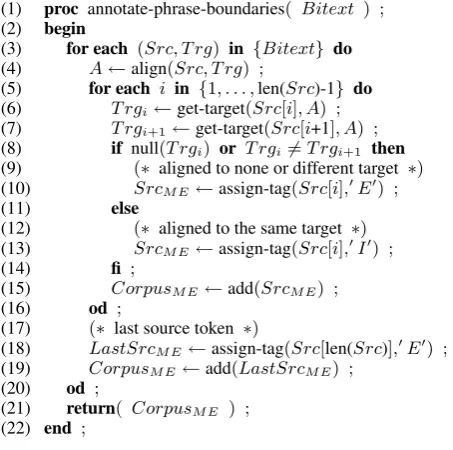
character tag). The annotations are derived from the SMT training corpus as described in Figure 1.
(1) proc annotate-phrase-boundaries( Bitext ) ;
(2) begin
(3) for each (Src, T rg) in {Bitext} do
(4) A←align(Src, T rg) ;
(5) for each i in {1, . . . ,len(Src)-1} do
(6) T rgi←get-target(Src[i], A) ; (7) T rgi+1←get-target(Src[i+1], A) ;
(8) if null(T rgi) or T rgi6=T rgi+1 then
(9) (∗ aligned to none or different target ∗)
(10) SrcM E←assign-tag(Src[i],0E0) ;
(11) else
(12) (∗ aligned to the same target ∗)
(13) SrcM E←assign-tag(Src[i],0I0) ;
(14) fi ;
(15) CorpusM E←add(SrcM E) ;
(16) od ;
(17) (∗ last source token ∗)
(18) LastSrcM E ←assign-tag(Src[len(Src)],0E0) ; (19) CorpusM E←add(LastSrcM E) ;
(20) od ;
(21) return( CorpusM E ) ;
[image:3.595.307.534.130.355.2](22) end ;
Figure 1: ME Training Data Annotation
Using these alignment-based word boundary annotations, a Maximum-Entropy (ME) method is applied to learn the word segmentation consistent with the SMT translation model (see Section 2.1), to resegment the original source language corpus, and to retrain a phrase-based SMT engine that will hopefully achieve a better translation performance than the initial SMT engine. This process should be repeated as long as an improvement in transla-tion quality is achieved. Eventually, the concate-nation of succeeding translation units will result in overfitting, i.e., the newly created token can only be translated in the context of rare training data ex-amples. Therefore, a lower translation quality due to an increase of untranslatable source language phrases is to be expected (see Section 2.2).
However, in order to increase thecoverageand
to reduce the translation task complexity of the
statistical models, the proposed method integrates multiple segmentation schemes into the statistical translation models of a single SMT engine so that longer translation units are preferred for transla-tion, if available, and smaller translation units can be used otherwise (see Section 2.3).
2.1 Maximum-Entropy Tagging Model
predic-Lexical Context Features < t0, w−2> < t0, w−1>
< t0, w0>
< t0, w+1> < t0, w+2>
[image:4.595.308.544.60.237.2]Tag Context Features < t0, t−1> < t0, t−1, t−2>
Table 1: Feature Set of ME Tagging Model
tion. They are versatile tools that can handle large numbers of features, and have shown them-selves to be highly effective in a broad range of NLP tasks including sentence boundary detection or part-of-speech tagging (Berger et al., 1996).
Amaximum entropy classifieris an exponential
model consisting of a number of binary feature functions and their weights (Pietra et al., 1997). The model is trained by adjusting the weights to maximize the entropy of the probabilistic model given constraints imposed by the training data. In
our experiments, we use a conditional maximum
entropy model, where the conditional probability
of the outcome given the set of features is modeled (Ratnaparkhi, 1996). The model has the form:
p(t, c) =γ
K
Y
k=0 αfk(c,t)
k ·p0
where:
t is the tag being predicted;
c is the context oft;
γ is a normalization coefficient;
K is the number of features in the model;
fk are binary feature functions;
ak is the weight of feature functionfk;
p0 is the default model.
The feature set is given in Table 1. Thelexical
context featuresconsist of target words annotated
with a tagt.w0denotes the word being tagged and
w−2, . . . , w+2 the surrounding words. t0 denotes
the current tag,t−1the previous tag, etc. Thetag
context featuressupply information about the
con-text of previous tag sequences. This conditional model can be used as a classifier. The model is trained iteratively, and we used the improved iter-ative scaling algorithm (IIS) (Berger et al., 1996) for the experiments presented in Section 3.
2.2 Iterative Bootstrap Method
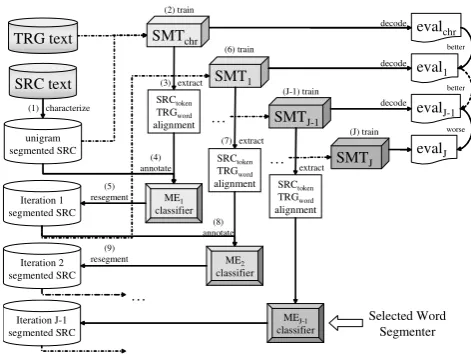
The proposed iterative bootstrap method to learn the word segmentation that is consistent with an SMT engine is summarized in Figure 2. After the ME tagging model is learned from the ini-tial character-to-word alignments of the
respec-tive bitext ((1)-(4)), the obtained ME tagger is
SRC text TRG text
unigram segmented SRC
(1) characterize
evalchr
decode
SMTchr
SRCtoken
TRGword
alignment
(3) extract
ME1
classifier Iteration 1
segmented SRC
(4) annotate (5) resegment
SMT1 eval1
decode
SMTJ-1
SRCtoken
TRGword
alignment
ME2
classifier
(7) extract
(8) annotate
Iteration 2 segmented SRC
(9) resegment
…
evalJ-1
decode
SRCtoken
TRGword
alignment
MEJ-1
classifier
extract
Iteration J-1 segmented SRC
SMTJ evalJ
(6) train (2) train
(J-1) train
(J) train
…
…
Selected Word Segmenter
…
better
better
[image:4.595.77.286.61.115.2]worse
Figure 2: Iterative Bootstrap Method applied to resegment the source language side of
the unsegmented parallel text corpus ((5)). This
results in a resegmented bitext that can be used
to retrain and reevaluate another engine SM T1
((6)), achieving what is hoped to be a better
trans-lation performance than the initial SMT engine (SM Tchr).
The unsupervised ME tagging method can also be applied to the token-to-word alignments
ex-tracted during the training of the SM T1 engine
to obtain an ME tagging model M E1 capable of
handling longer translation units ((7)-(8)). Such
a bootstrap method iteratively creates a sequence
of SMT enginesSM Ti ((9)-(J)), each of which
reduces the translation complexity, because larger chunks can be translated in a single step leading to fewer word order or word disambiguation er-rors. However, at some point, the increased length of translation units learned from the training cor-pus will lead to overfitting, resulting in reduced translation performance when translating unseen sentences. Therefore, the bootstrap method stops
when theJth resegmentation of the training
cor-pus results in a lower automatic evaluation score for the unseen sentences than the one for the
previ-ous iteration. The ME tagging modelM EJ−1that
achieved the highest automatic translation scores is then selected as the best single-iteration word segmenter.
2.3 Integration of Multiple Segmentations
models. In our experiments, equal weights were used; however, it might be interesting to inves-tigate varying the weights according to iteration number, as the latter iterations may contain more useful segmentations.
In addition, we also remove the internal seg-mentation of the source phrases. The advantages are twofold. Primarily it allows decoding directly from unsegmented text. Moreover, the segmenta-tion of the source phrase can differ between mod-els at differing iterations; removing the source seg-mentation at this stage makes the phrase pairs in the translations models at various stages in the it-erative process consistent with one another. Con-sequently, duplicate bilingual phrase pairs appear in the phrase table. These duplicates are combined by normalizing their model probabilities prior to model interpolation.
The rescored translation model covers all trans-lation pairs that were learned by any of the
iterative models. Therefore, the selection of
longer translation units during decoding can re-duce the complexity of the translation task. On the other hand, overfitting problems of single-iteration models can be avoided because multiple smaller source language translation units can be exploited to cover the given input parts and to generate trans-lation hypotheses based on the concatenation of associated target phrase expressions. Moreover, the merging process increases the translation prob-abilities of the source/target translation parts that cover the same surface string but differ only in the segmentation of the source language phrase. Therefore, the more often such a translation pair is learned by different iterative models, the more of-ten the respective target language expression will be exploited by the SMT decoder.
The translation of unseen data using the merged translation models is carried out by (1) character-izing the input text and (2) applying the SMT de-coding in a standard way.
3 Experiments
The effects of using different word segmentations and integrating them into an SMT engine are
in-vestigated using the multilingualBasic Travel
Ex-pressions Corpus (BTEC), which is a collection
of sentences that bilingual travel experts consider useful for people going to or coming from other countries (Kikui et al., 2006). For the word seg-mentation experiments, we selected five Asian languages that do not naturally separate word
BTEC train set dev set test set
# of sen 160,000 1,000 1,000
en voc 15,390 1,262 1,292
len 7.5 7.1 7.2
ja voc 17,168 1,407 1,408
len 8.5 8.2 8.2
ko voc 17,246 1,366 1,365
len 8.0 7.7 7.8
th voc 7,354 1,081 1,053
len 7.8 7.3 7.4
zh voc 11,084 1,312 1,301
[image:5.595.325.509.65.198.2]len 7.1 6.4 6.5
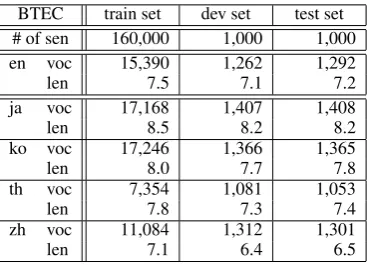
Table 2: Language Resources
units, i.e., Japanese (ja), Korean (ko), Thai (th), and two dialects of Chinese (Standard Mandarin (zh) and Taiwanese Mandarin (tw)).
Table 2 summarizes the characteristics of the
BTEC corpus used for the training (train) of the
SMT models, the tuning of model weights and stop conditions of the iterative bootstrap method
(dev), and the evaluation of translation quality
(test). Besides the number of sentences (sen)
and the vocabulary (voc), the sentence length
(len) is also given as the average number of
words per sentence. The given statistics are ob-tained using commonly-used linguistic segmenta-tion tools available for the respective language, i.e., CHASEN (ja), WORDCUT (th), ICTCLAS (zh), HanTagger (ko). No segmentation was avail-able for Taiwanese Mandarin and therefore no meaningful statistics could be obtained.
For the training of the SMT models, standard word alignment (Och and Ney, 2003) and lan-guage modeling (Stolcke, 2002) tools were used.
Minimum error rate training (MERT) was used to
tune the decoder’s parameters and performed on
thedev set using the technique proposed in (Och
and Ney, 2003). For the translation, a multi-stack phrase-based decoder was used.
For the evaluation of translation quality, we
ap-plied standard automatic metrics, i.e.,BLEU
(Pap-ineni et al., 2002) and METEOR(Lavie and
Agar-wal, 2007). We have tested the statistical
signif-cance of our results2 using the bootstrap method
reported in (Zhang et al., 2004) that (1) performs a random sampling with replacement from the eval-uation data set, (2) calculates the evaleval-uation metric score of each engine for the sampled test sentences and the difference between the two MT system scores, (3) repeats the sampling/scoring step
itera-22000 iterations were used for the analysis of the
tively, and (4) applies theStudent’s t-testat a sig-nificance level of 95% confidence to test whether the score differences are significant.
In addition, human assessment of translation
quality was carried out using theRankingmetrics.
For the Ranking evaluation, a human grader was
asked to “rank each whole sentence translation
from Best to Worst relative to the other choices
(ties are allowed)” (Callison-Burch et al., 2007).
The Rankingscores were obtained as the average
number of times that a system was judged better than any other system and the normalized ranks
(NormRank) were calculated on a per-judge
ba-sis for each translation task using the method of (Blatz et al., 2003).
Section 3.1 compares the proposed method to the baseline system that translates characterized source language sentences and to the SMT en-gines that are trained on iteratively learned as well as language-dependent linguistic word segmenta-tions. The effects of the iterative learning method are summarized in Section 3.2.
3.1 Effects of Word Segmentation
The automatic evaluation scores of the SMT en-gines trained on the differently segmented source language resources are given in Table 3, where
“character” refers to the baseline system of using
character-segmented source text; “single-best”3is
the SMT engine that is trained on the corpus seg-mented by the best-performing iteration of the
bootstrap approach; “proposed” is the SMT engine
whose models integrate multiple word
segmen-tation schemes; and “linguistic” uses
language-dependent linguistically motivated word segmen-tation tools. The reported scores are calculated as the mean score of all metric scores obtained for the iterative sampling method used for statistical sig-nificance testing and listed as percentage figures.
The results show that the proposed method
out-performs the character (single-best) system for
each of the involved languages achieving gains
of 2.0 to 9.1 (0.4 to 1.6) BLEU points and 2.0
to 5.9 (0.7 to 4.6) METEOR points, respectively.
However, the improvements depend on the source language. For example, the smallest gains were obtained for Standard Mandarin, because single characters frequently form words of their own, thus resulting in more ambiguity than Japanese,
3This approximates the approach of (Ma and Way, 2009)
and is given as a way of showing the effect of segmentation at multiple levels of granularity.
where consecutive hiragana orkatakana
charac-ters can form larger meaningful units.
Comparing the proposed method towards lin-guistically motivated segmenters, the results show that the proposed method outperforms the SMT engines using linguistic segmentation tools for tasks such as translating Korean and Standard Mandarin into English. Slightly lower evaluation scores were achieved for the automatically learned word segmentation for Japanese, although the re-sults of the proposed method are quite similar. This is a suprisingly strong result, given the ma-turity of the linguistically motivated segmenters, and given that our segmenters use only the bilin-gual corpus used to train the SMT systems.
The Thai-English experiments expose some is-sues that are related to the definition of what
a “character” is. Our segmentation schemes
are learned directly from the bitext without any language-specific information, and can cope well with most languages. However, Thai seems to be an exceptional case in our experiments, because (1) the Thai script is a segmental writing system which is based on consonants but in which vowel notation is obligatory, so that the characterization of the baseline system affects vowel dependen-cies, (2) it uses tone markers that are placed above the consonant, but are treated as a single charac-ter in our approach, and (3) vowels sounding afcharac-ter a consonant are non-sequential and can occur be-fore, after, above, or below a consonant increasing the number of word form variations in the training corpus and reducing the accuracy of the learned ME tagging models. This is an interesting result that motivates further study on how to incorpo-rate features on language scripts into our machine learning framework. For example, Japanese is
written in three different scripts (kanji, hiragana,
katakana). Therefore, the script class of each
char-acter could be used as an additional feature to ob-tain the initial segmentation of the training corpus. Finally, the results for Taiwanese Mandarin, where no linguistic tool was available to segment the source language text, shows that the proposed method can be applied successfully for the trans-lation of any language where no linguistically-motivated segmentation tools are available.
Table 4 summarizes the subjective evaluation results which were carried out by a paid evalua-tion expert who is a native speaker of English. The
au-BLEU
source word segmentation
language character single-best proposed linguistic
ja 36.93 39.65 41.25 41.46
ko 34.72 37.32 38.51 37.19
th 41.42 50.16 50.53 56.68
zh 36.59 37.02 38.61 38.13
tw 45.71 50.95 52.21 –
METEOR
source word segmentation
language character single-best proposed linguistic
ja 59.78 60.95 65.45 66.03
ko 58.45 60.06 64.31 63.04
th 67.22 71.22 72.58 79.02
zh 61.77 62.38 63.80 62.72
[image:7.595.319.511.66.217.2]tw 70.14 73.64 74.38 –
Table 3: Automatic Evaluation
NormRank
source word segmentation
language character single-best proposed linguistic
ja 2.76 2.85 3.18 3.12
ko 2.68 2.90 3.17 3.09
th 2.65 2.95 3.05 3.43
zh 2.87 3.01 3.07 3.04
[image:7.595.71.299.67.251.2]tw 2.83 2.86 3.24 –
Table 4: Subjective Evaluation
tomatic evaluation. In addition, for Japanese, the translation outputs of the proposed method were judged better than those of the linguistically seg-mented SMT model.
3.2 Effects of Bootstrap Iteration
In order to get an idea of the robustness of the pro-posed method, the changes in system performance for each source language during the iterative boot-strap method is given in Figure 3. The results for
BLEU andMETEORshow that all languages reach
their best performance after the first or second it-eration and then slightly, but consistently decrease with the increased number of iterations. The rea-son for this is the effect of overfitting caused by the concatenation of source tokens that are aligned to longer target phrases, resulting in the segmenta-tion of longer translasegmenta-tion units.
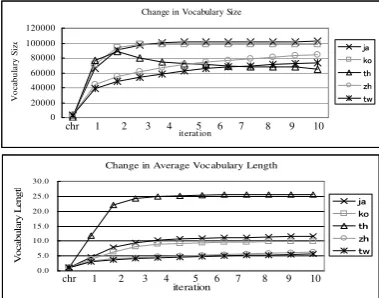
The changes in the vocabulary size and the word length are summarized in Figure 4. The amount of words extracted by the proposed method is much larger than the one of the baseline system, increas-ing the vocabulary size by a factor of 10 for Stan-dard Mandarin and Taiwanese Mandarin, 30 for Japanese and Korean, and 100 for Thai. It is also larger than the vocabulary obtained for the linguis-tic tools by a factor of 1.5 to 2.5 for all investigated
Change in BLEU
20.00 30.00 40.00 50.00 60.00
iteration
BL
EU
(%
)
Change in METEOR
40.00 50.00 60.00 70.00 80.00
iteration
M
ET
EO
R
(%
)
chr 1 2 3 4 5 6 7 8 9 10
chr 1 2 3 4 5 6 7 8 9 10
Figure 3: Change in System Performance
Change in Vocabulary Size
0 20000 40000 60000 80000 100000 120000
iteration
V
oc
ab
ul
ar
y
Si
ze
chr 1 2 3 4 5 6 7 8 9 10
Change in Average Vocabulary Length
0.0 5.0 10.0 15.0 20.0 25.0 30.0
iteration
V
oc
ab
ul
ar
y
Le
ng
th
[image:7.595.319.509.251.400.2]
chr 1 2 3 4 5 6 7 8 9 10
Figure 4: Change in Vocabulary Size and Length
languages. The average vocabulary length also in-creased for each iteration whereby the length of the translation units learned after 10 iterations al-most doubles the word size of the initial iteration.
The overfitting problem of the iterative
boot-strap method is illustrated in the increase of
out-of-vocabulary words, i.e. source language words
contained in the unseen evaluation data set that cannot be translated by the respective SMT. The results given in Figure 5 show a large increase in OOV for the first three iterations, resulting in lower translation qualities as listed in Figure 3.
Table 5 illustrates translation examples using different segmentation schemes for the Japanese-English translation task. The SMT engines that output the best translations are marked with an as-terisk. In the first example, the concatenation of “
!#"%$'&)(
” (already midnight) by thesingle-best
segmentation scheme leads to an OOV word, thus only a partial translation can be achieved. How-ever, the problem can be resolved using the pro-posed method. The second example is best
trans-lated using thesingle-bestword segmentation that
[image:7.595.72.298.280.368.2]Change in OOV Words
0 100 200 300 400 500 600
iteration
O
O
V
W
or
ds
[image:8.595.307.526.65.409.2]
chr 1 2 3 4 5 6 7 8 9 10
Figure 5: Change in Out-of-Vocabulary Size baseline system omits the sentence coordination information, resulting in an unacceptable transla-tion. The third examples illustrates that longer to-kens reduce the translation complexity and thus can be translated better than the other segmenta-tion that cause more ambiguities.
4 Conclusions
This paper proposes a new language-independent method to segment languages that do not use whitespace characters to separate meaningful word units in an unsupervised manner in order to improve the performance of a state-of-the-art SMT system. The proposed method does not need any linguistic information about the source language which is important when building SMT systems for the translation of relatively resource-poor lan-guages which frequently lack morphological anal-ysis tools. In addition, the development costs are far less than those for developing linguistic word segmentation tools or even paying humans to segment the data sets manually, since only the bilingual corpus used to train the SMT system is needed to train the segmenter.
The effectiveness of the proposed method was investigated for the translation of Japanese, Ko-rean, Thai, and two Chinese dialects (Standard Mandarin and Taiwanese Mandarin) into English for the domain of travel conversations. The auto-matic evaluation of the translation results showed
consistent improvements of 2.0 to 9.1BLEUpoints
and 2.0 to 5.9 METEOR points compared to a
baseline system that translates characterized input. Moreover, it improves the best performing SMT engine of the iterative learning procedure by 0.4
to 1.6BLEUpoints and 0.7 to 4.6METEORpoints.
In addition, the proposed method achieved translation results similar to SMT models trained on bitext segmented with linguistically motivated tools, even outperforming these for Korean, Chi-nese, and Japanese in the human evaluation, al-though no external information and only the given bitext was used to train the segmentation models.
linguistic seg: / /
/ / / / /
trans: Yes. Let’s see. It’s midnight.
character∗ seg:
/
/ /
/
/
/ / / / / / / / / /
trans: Yes. Well, it’s already midnight.
single-best seg: /
/ / / /
trans: Yes. Let ’s see.
proposed∗ seg:
/
/ /
/
/
/ / / / / / / / / /
trans: Yes. Well, it’s already midnight.
linguistic seg: "!
/# /$&%(' /) / /# / / ' ' /* /+ /,
/- /.0/ 12' /
trans: I’d like a pair of jeans.
Could you recommend a good shop? character seg: /
/
/!
/# /$ /% /' /) / / /# / / ' /' /* /+ /, /
/- /. // /1 /' /
trans: Could you recommend a good ’d like
a pair of jeans. single-best∗ seg:
"!
/#3$&% /' /)3 #4 / ' ' /* /+5,
/-6.0/ 12' /
trans: I’d like some jeans.
Could you recommend a good shop? proposed seg: /
/
/!
/# /$ /% /' /) / / /# / / ' /' /* /+ /, /
/- /. // /1 /' /
trans: I ’d like a pair of jeans and
could you recommend a good shop? linguistic seg: 7&8 /) /9: /;< /= /> /;< /? /
trans: Will it be ready by this afternoon?
character seg: 7 /8 /) /9 /: /; / /= / /> /; / / ? /
trans: It’ll be ready by this afternoon?
single-best seg: 7&8@) /9:A;< /= />4; / ?4
trans: Will it be ready by this afternoon?
proposed∗ seg:
7 /8 /) /9 /: /; / /= / /> /; / / ? /
trans: Can you have these ready by this
afternoon?
Table 5: Sample Translations
The experiments using Thai are interesting be-cause the script is a segmental writing system us-ing tone markers and vowel dependencies. This exposed some issues that are related to the defini-tion of what a “character” is and motivates further study on how to incorporate features on language scripts into our machine learning framework.
References
Adam Berger, Stephen Della Pietra, and Vincent Della Pietra. 1996. A maximum entropy approach to NLP. Computational Linguistics, 22(1):39–71.
John Blatz, Erin Fitzgerald, George Foster, Simona Gandrabur, Cyril Goutte, Alex Kulesza, Alberto Sanchis, and Nicola Ueffing. 2003. Confidence es-timation for statistical machine translation. InFinal Report of the JHU Summer Workshop.
Michael Brent. 1999. An efficient, probabilistically sound algorithm for segmentation and word discov-ery. Machine Learning, 34:71–105.
Chris Callison-Burch, Cameron Fordyce, Philipp Koehn, Christof Monz, and Jan Schroeder. 2007. (Meta-) Evaluation of Machine Translation. In Pro-ceedings of the 2nd Workshop on SMT, pages 136–
[image:8.595.85.277.66.143.2]Pi-Chuan Chang, Michel Galley, and Christopher Man-ning. 2008. Optimizing Chinese Word Segmen-tation for Machine Translation Performance. In
Proc. of the 3rd Workshop on SMT, pages 224–232,
Columbus, USA.
Kwok-Shing Cheng, Gilbert Young, and Kam-Fai Wong. 1999. A study on word-based and integrat-bit Chinese text compression algorithms. American Society of Information Science, 50(3):218–228.
Tagyoung Chung and Daniel Gildea. 2009. Unsu-pervised Tokenization for Machine Translation. In
Proc. of the EMNLP, pages 718–726, Singapore.
Adrian de Gispert, Sami Virpioja, Mikko Kurimo, and William Byrne. 2009. Minimum Bayes Risk Com-bination of Translation Hypotheses from Alternative Morphological Decompositions. InProc. of HLT, Companion Volume, pages 73–76, Boulder, USA.
Christopher Dyer, Smaranda Muresan, and Philip Resnik. 2008. Generalizing Word Lattice Transla-tion. InProc. of ACL, pages 1012–1020, Columbus,
USA.
Christopher Dyer. 2009. Using a maximum entropy model to build segmentation lattices for MT. In
Proc. of HLT, pages 406–414, Boulder, USA.
Sharon Goldwater, Thomas Griffith, and Mark John-son. 2006. Contextual Dependencies in Unsuper-vised Word Segmentation. In Proc. of the ACL,
pages 673–680, Sydney, Australia.
Geninchiro Kikui and Hirofumi Yamamoto. 2002. Finding Translation Pairs from English-Japanese Untokenized Aligned Corpora. InProc. of the Work-shop on Speech-to-Speech Translation, pages 23–30,
Philadephia, USA.
Geninchiro Kikui, Seiichi Yamamoto, Toshiyuki Takezawa, and Eiichiro Sumita. 2006. Com-parative study on corpora for speech translation.
IEEE Transactions on Audio, Speech and Language,
14(5):1674–1682.
Alon Lavie and Abhaya Agarwal. 2007. METEOR: An automatic metric for MT evaluation with high levels of correlation with human judgments. In
Proc. of the 2nd Workshop on SMT, pages 228–231,
Prague, Czech Republic.
Yanjun Ma and Andy Way. 2009. Bilingually Moti-vated Domain-Adapted Word Segmentation for Sta-tistical Machine Translation. In Proc. of the 12th EACL, pages 549–557, Athens, Greece.
Preslav Nakov, Chang Liu, Wei Lu, and Hwee Tou Ng. 2009. The NUS SMT System for IWSLT 2009. In
Proc. of IWSLT, pages 91–98, Tokyo, Japan.
Franz J. Och and Hermann Ney. 2003. A Systematic Comparison of Statistical Alignment Models. Com-putational Linguistics, 29(1):19–51.
Kishore Papineni, Salim Roukos, Todd Ward, and Wei-Jing Zhu. 2002. BLEU: a Method for Automatic Evaluation of Machine Translation. InProc. of the 40th ACL, pages 311–318, Philadelphia, USA.
Stephen Della Pietra, Vincent Della Pietra, and John Lafferty. 1997. Inducing Features of Random Fields. IEEE Transactions on Pattern Analysis and Machine Intelligence, 19(4):380–393.
Adwait Ratnaparkhi. 1996. A Maximum Entropy Model for Part-Of-Speech Tagging. InProc. of the EMNLP, pages 133–142, Pennsylvania, USA.
Andreas Stolcke. 2002. SRILM an extensible lan-guage modeling toolkit. In Proc. of ICSLP, pages
901–904, Denver, USA.
Anand Venkataraman. 2001. A statistical model for word discovery in transcribed speech. Computa-tional Linguistics, 27(3):351–372.
Jia Xu, Jianfeng Gao, Kristina Toutanova, and Her-mann Ney. 2008. Bayesian Semi-Supervised Chi-nese Word Segmentation for SMT. In Proc. of the COLING, pages 1017–1024, Manchester, UK.
Ying Zhang, Stephan Vogel, and Alex Waibel. 2004. Interpreting Bleu/NIST Scores: How Much Im-provement do We Need to Have a Better System? In
Proc. of the LREC, pages 2051–2054, Lisbon,
Por-tugal.
Ruiqiang Zhang, Keiji Yasuda, and Eiichiro Sumita. 2008. Improved Statistical Machine Translation by Multiple Chinese Word Segmentation. InProc. of the 3rd Workshop on SMT, pages 216–223,