January 2008
Assessing the Impact of Positive
Feedback in Constraint-Based Tutors
A thesis submitted in partial fulfilment of the requirements for the Degree of Master of Science in Computer Science in the University of Canterbury by
Devon K. Barrow
Supervisor: Professor Dr. Antonija Mitrovi´c1 Associate supervisor: Dr Mick Grimley2 Examiner: Professor Dr. Benedict du Boulay3
Across many domains, Intelligent Tutoring Systems (ITSs) are used to facilitate
practice, providing a customized learning environment and personal tutoring experience
for students to learn at their own pace through effective student modeling and feedback.
Most current ITSs are built around cognitive learning theories including Ohlsson’s
the-ory on learning from performance errors and Anderson’s ACT theories of skill
acqui-sition which focus primarily on providing negative feedback or corrective feedback,
facilitating learning by correcting errors. Research into the behavior and methods used
by expert tutors suggest that experienced tutors use positive feedback quite extensively
and successfully. This research investigates positive feedback; learning by capturing
and responding to correct behavior, supported by cognitive learning theories. The
re-search aim is to develop and implement a systematic approach to delivering positive
feedback in Intelligent Tutoring Systems, in particular SQL-Tutor, a constraint-based
tutor which instructs users in the design of Structured Query Language (SQL) database
queries. An evaluation study was conducted at the University of Canterbury involving
a control group of students who used the original version of SQL-Tutor giving only
negative feedback and an experimental group using the modified version of SQL-Tutor
where both negative and positive feedback were given. Results of the study show that
students learn quite similarly from one system to another, however those in the
exper-imental group take significantly less time to solve the same number of problems, in
fewer attempts compared to those in the control group. Students in the experimental
group also learn approximately the same number of concepts as students in the control
but in much less time. This indicates that positive feedback results in increased amount
of learning over a shorter period of time and improves the effectiveness of learning in
Abstract. . . i
List of Figures . . . vi
List of Tables . . . viii
Acknowledgements . . . x
CHAPTER1 Introduction 1 1.1 Intelligent Tutoring Systems Facilitating Learning . . . 1
1.2 Feedback in Learning . . . 3
1.3 Motivation for Research . . . 4
1.4 Overview of Research . . . 5
1.5 Structure of Thesis . . . 7
CHAPTER2 Background 10 2.1 Intelligent Tutoring Systems . . . 10
2.1.1 Architecture of Intelligent Tutoring Systems . . . 11
2.1.2 Student Modelling . . . 17
2.2 Structured Query Language . . . 23
2.3 SQL-Tutor . . . 25
2.3.1 Architecture . . . 26
2.3.2 Student modelling in SQL-Tutor . . . 33
2.4 Feedback in ITS . . . 35
2.4.1 Factors Influencing Effective Feedback in Learning . . . 36
2.4.2 Presentation of Feedback . . . 37
2.4.3 Content of Feedback Messages . . . 38
2.4.4 Scheduling Feedback . . . 39
CHAPTER3 Research Goals and Hypotheses 43 3.1 Goals . . . 43
3.2 Hypotheses . . . 44
3.3 Positive Feedback in Learning . . . 44
CHAPTER4 Systematic Approach to Positive Feedback 48 4.1 Scheduling Positive Feedback . . . 49
4.1.1 Timing of Positive Feedback . . . 49
4.1.2 Frequency of Positive Feedback . . . 53
4.2 Selection and Specification of the Content of Positive Feedback . . . . 54
4.3 Selection and Specification of the Form or Modus of Positive Feedback Presentation . . . 57
CHAPTER5 Design and Implementation 62 5.1 The Choice of Domain and ITS . . . 62
5.2 Changes to SQL-Tutor . . . 64
5.2.1 Interface . . . 64
5.2.2 Student Modelling and the Student Modeler . . . 64
5.2.3 The Pedagogical Module: Problem Selection . . . 65
5.2.4 The Pedagogical Module: Feedback . . . 68
5.3 Constraint-based Student Modeling to Facilitate Case Based Design of Positive Feedback . . . 69
5.4 Scheduling Positive Feedback - Designing Cases for Positive Feedback 71 5.4.1 Positive Feedback Under Uncertainty . . . 72
5.4.2 Positive Feedback Under Paralysis . . . 78
5.5 Selection and Specification of the Content of Positive Feedback . . . . 90
5.6 Selection and Specification of the Form or Modus of Positive Feedback Presentation . . . 92
CHAPTER6 Evaluation 94 6.1 Description . . . 94
6.2 Participants . . . 94
6.3 Method . . . 95
6.4 Results and Discussion . . . 96
6.4.1 Pre and Post-test . . . 96
6.4.2 Positive Feedback . . . 105
6.4.3 Learning Curves . . . 108
CHAPTER7 Conclusions and Further Work 113 7.1 Conclusions . . . 113
7.2 Further Work . . . 117
CHAPTER8 References 121 CHAPTER9 Appendices 130 9.1 Appendix A: Calculating Learned Constraints . . . 130
9.2 Appendix B: Pre- and Post-tests . . . 132
2.1 Architecture of Intelligent Tutoring Systems . . . 12
2.2 Inadequacy of Feedback given by Proprietary RDBMS . . . 24
2.3 The Architecture of the Standalone Version of SQL-Tutor . . . 25
2.4 The Architecture of SQLT-Web, Web-enable Version of SQL-Tutor . . . 28
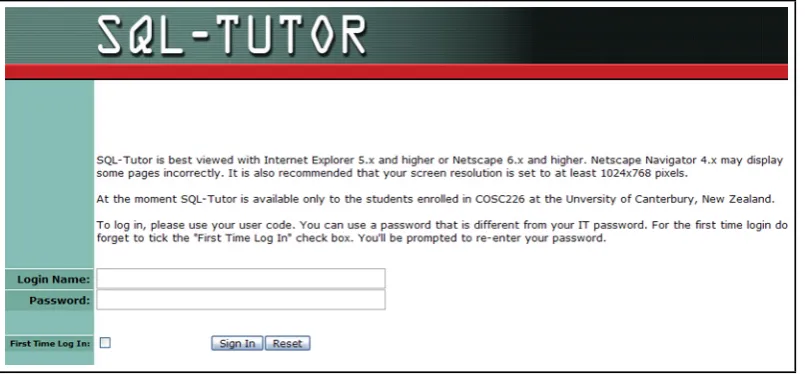
2.5 SQL-Tutor Login Screen . . . 29
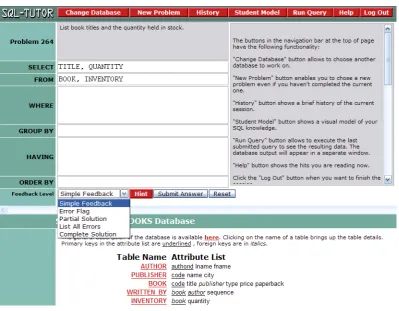
2.6 The Interface of SQLT-Web, Web-enabled Version of SQL-Tutor . . . . 30
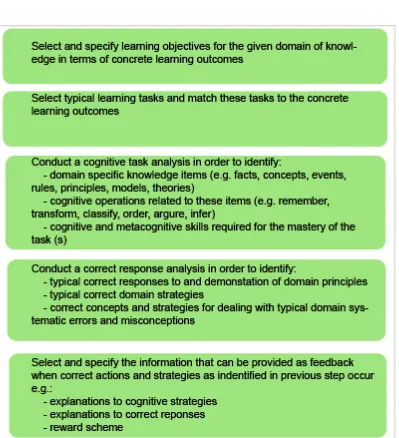
4.1 Designing Positive Feedback Content Using Cognitive Task and Correct-response Analysis . . . 58
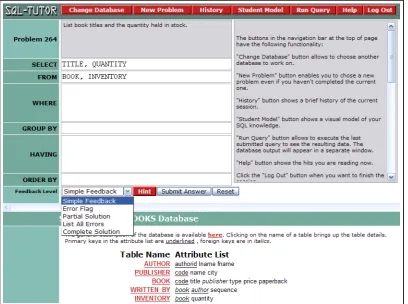
5.1 The Task Environment in the Experimental Group . . . 65
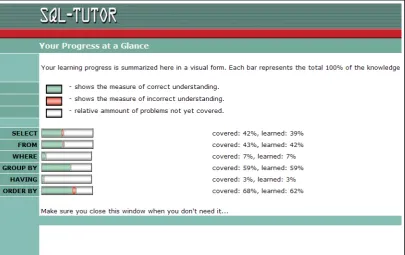
5.2 The Open Student Model in SQL-Tutor . . . 66
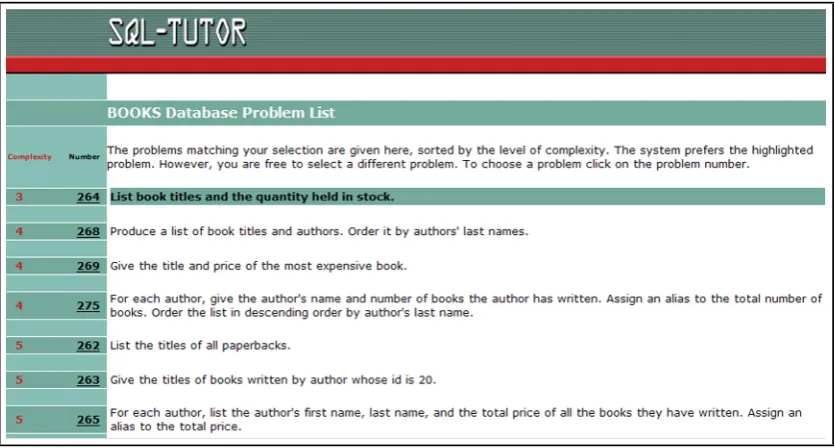
5.3 The Problem List, with the System’s Choice Highlighted . . . 67
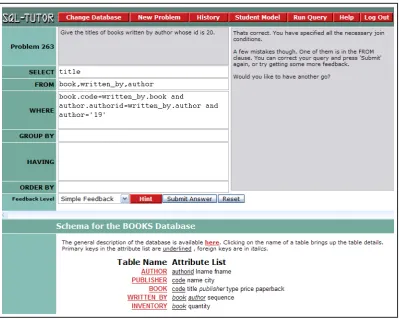
5.4 Giving Negative and Positive Feedback Simultaneously in SQL-Tutor . 69 6.1 Comparing Experimental and Control Groups Regression Analysis: Solved Problems Versus Time Spent in System . . . 101
6.2 Scatter Diagram Showing Solved Problems Versus Time Spent in Sys-tem for Experimental Group . . . 102
6.3 Scatter Diagram Showing Solved Problems Versus Time Spent in Sys-tem for Control Group . . . 103
6.4 The Probability of Constraint Violations for all Constraints . . . 108
6.5 The Probability of Constraint Violations for Constraints Receiving
6.1 Analysis of Pretest and Post-test Results (1) . . . 97
6.2 Analysis of Pretest and Post-test Results (2) . . . 98
6.3 Summary Analysis of Students Interaction with SQL-Tutor . . . 99
6.4 Results from Multiple Regression, by Learned Constraint . . . 104
6.5 Results from Multiple Regression, by Lab-test . . . 105
6.6 Summary of Positive Feedback Messages Categorized by Case . . . 107
6.7 Positive and Negative Feedback in SQL-Tutor . . . 107
6.8 Results Categorized According to More and Less Able Students . . . . 110
Acknowledgments
The author would like to extend sincere thanks to his supervisor, Dr. Antonija
Mitrovi´c for her dedication, support and encouragement throughout the course of this
project without which it would not be possible. He also wishes to thank his
co-supervisor Dr. Michael Grimley whose valued input resulted in the increased quality
and relevance of the research work performed. Thanks to Stellan Ohlson for his valued
contributions to key areas of this research project; these have impacted the course of
this work significantly. To all members of the ICTG group, for your support, sound
ad-vice and countless assistance, thank you! Finally, to my entire family, Joan and Dennis
Armstrong my parents, Amobi my brother and Debbie my sister, who have supported
CHAPTER
1
Introduction
1.1 Intelligent Tutoring Systems Facilitating Learning
Intelligent Tutoring Systems (ITSs) continue to grow in popularity and application.
These systems provide one on one tutoring at relatively low cost and have the added
flexibility with regard to timing, location, and amount of the tutoring experience. ITSs
offer customized feedback to each learner allowing them to learn at their own pace. It
has been shown time and time again, that computerized tutors with a problem-solving
environment are ideal tools for enhancing student learning and offer an effective
sup-plement for classroom teaching. Evaluation of a cognitive tutor for writing programs in
the LISP computer language showed that students in the experimental group completed
problems in one third (1/3) the time of those under control conditions with
improve-ment in learning of 1 standard deviation [Koedinger 1998]. Koedinger in [Koedinger
1998] reports on two different cognitive tutors for geometry proof design. Both were
used in classroom studies and compared to control classes using a traditional geometry
curriculum without the cognitive tutor. In both studies, students in the experimental
classes scored 1 standard deviation (SD) better than students in control classes. Atlas, a
tutoring system for teaching Physics, improves performance by 0.9 standard deviations
[Freedman 1999], while SQL-Tutor, an ITS for teaching the Structured Query
Lan-guage (SQL), improves performance by 0.65 standard deviations in just two hours of
interaction with the system [Mitrovic, Mayo, Suraweera and Martin 2001]. Evaluation
studies of SHERLOCK [Lajoie and Lesgold 1989], a tutor for technical
troubleshoot-ing in avionics shows that between 20 and 25 hours of interaction with the systems is
equivalent to four years on-the-job experience.
Improvements in the quality and effectiveness of tutoring provided by ITSs has
re-sulted in increased use. The American Society for Training and Development (ASTD)
has reported that in the largest companies, employee training time spent with “learning
technologies” has been increasing by over 10% in 2001 [Ong and Ramachandran 2003].
According to the United States National Center for Education Statistics, the use of
com-puters to support education and learning has more than doubled between 1984 (36.2%)
and 1997 (84%) [Planty, Provasnik and Hussar 1999]. Intelligent tutoring systems and
related research components are at the forefront of these technologies. There is however
still considerable work to be done in making such systems more effective.
While a great deal of work has been done with understanding learning and
model-ing the student, the current direction towards improvmodel-ing ITSs and maximizmodel-ing effective
learning is developing a theory of tutoring which would link the various learning
mech-anisms to the types of information the learner needs and hence what the tutor (ITS)
should provide. This approach is being merged with work being done in observing the
typical behavior of expert tutors and effective tutoring, and looking at the types of
in-formation and strategies used in effective human tutoring. Current hypotheses propose
that student learning is correlated with the tutor’s use of knowledge-construction
activ-ities e.g. dynamic plan scaffolding, and refection/generalization techniques [Heffernan
2001]. There is a move to incorporate these techniques into ITSs through modeling of
tutorial actions and strategies as observed with expert human tutoring [Heffernan and
Koedinger 2002][Core, Moore, Zinn and Wiemer-Hastings 2000]. Positive feedback is
one of the teaching strategies which continues to surface throughout tutoring protocols.
Uni-versity of Illinois at Chicago [Ohlsson, Eugenio, Chow, Fossati, Lu and Kershaw 2007]
shows extensive and effective use of positive feedback by experienced human tutors. A
logical step for Intelligent Tutoring Systems (ITSs) therefore seems to be extending the
proposed model of tutoring to incorporate positive feedback.
1.2 Feedback in Learning
At the very heart of the learning experience is the idea of feedback, information
pro-vided in response to a learner’s actions. In [Ohlsson 2004] Ohlsson investigates how
students learn and acquire knowledge both declarative and procedural and concludes
that practice or repetition of a given task usually accompanied by improvement,
indi-cates that instrumental knowledge (knowledge about how to attain goals, achieve effects
or perform tasks) is being acquired. The acquisition of this instrumental knowledge is
through practice and by means of feedback. Feedback helps learners in several ways
including detection of errors, correction of faulty knowledge and misconceptions,
cre-ation of new knowledge directly or indirectly and producing flow [Kulhavy and Stock
1989]. Feedback has to be considered a very important and critical factor in the support
of effective learning in Intelligent Tutoring Systems (ITSs) because such systems seek
to replicate the benefits and effectiveness of human to human tutoring.
The history of feedback research is one that is long and well-documented (see
[Kul-havy and Stock 1989] for an excellent review) both in psychology (e.g. [Thorndike
1913]) and computer science programmed instruction (e.g. [Skinner 1968]). Compared
to recent research, most early research on feedback focused on positive feedback to
strengthen correct responses and neglected errors which did not receive feedback and
were weakened. This approach was driven primarily by behaviorist and
association-istic views in which feedback was regarded as a contingent event serving to reinforce
or weaken student responses. As a result, the focus of feedback was more formal and
technical concentrating on the frequency and delay rather than the complexity of the
empha-sized positive feedback, that is positive consequences for successful performance and
helped move educators toward a more positive instructional stance [Mason and Bruning
2001].
It was quickly realized however that this approach was lacking a critical component
of learning, error detection and correction, and the emergence of information-processing
theory in the 1970s and 1980s sparked a new approach in cognitive science and
psychol-ogy to address this deficiency. This new information-processing approach included the
ACT-R theory [Anderson 1983] [Anderson, Corbett, Koedinger and Pelletier 1995] and
recognized the hidden information in errors. It provided a systematic means for
er-ror correction, viewed as a mental process resulting in an improvement in the learners
knowledge about the task. Today it represents the accepted theoretical basis for
analyz-ing, developing and implementing feedback in computer-based instructional systems
including ITSs (see reviews by [Mory 1995][Kulhavy and Stock 1989] for excellent
discussions of information processing and earlier perspectives on feedback). The
ap-proach however appears to have neglected positive feedback altogether as most systems
concentrate principally on learning by error detection and correction.
In this research we want to investigate the role positive feedback has in learning,
thinking of positive feedback not simply as a form of exhortation but we hypothesize
that positive feedback given under the right circumstances [when the student is guessing
or exhibiting uncertainty] will improve learning.
1.3 Motivation for Research
As previously mentioned, ITSs have proved successful in a number of domains,
includ-ing highly complex domains. Currently the best ITSs achieve 1SD, but this is lower
than 2SD, the measure of improvement achieved by the average student obtaining
hu-man tutoring [Bloom 1984] and researchers continue the search for methods of group
instruction which are as effective as one-to-one human tutoring. Continued research in
such systems. One way of achieving this is by making improvements in the existing
architectures enhancing underlying modules. Another way is expanding on and
inte-grating new ideas about learning and instruction. Because so much is still not known
about the human brain and how exactly people learn and store knowledge, extensive
research takes place utilizing the latter approach, that is, making and evaluating
conjec-tures of learning and instruction.
While significant work has been done in the area of understanding, modeling and
developing effective tutoring, including the development of a cognitive model of human
tutors [Heffernan 2001] and comprehensive studies of expert versus non-expert tutoring
[Heffernan 2001][Lu 2006], no work has been done with regards the systematic use of
positive feedback, a tool quite often used by expert tutors. Instead, most studies have
concentrated on tutor moves or techniques e.g. scaffolding, demonstrating,
knowledge-construction and tutoring strategies such as those proposed in [Heffernan and Koedinger
2002] e.g. concrete articulation strategy and introduced variable strategy. ITSs
includ-ing those built usinclud-ing constraint-based modelinclud-ing and model tracinclud-ing techniques, continue
to be developed based on the principle of learning through error correction and while
most are fully capable of doing so, provide only minimal feedback on correct responses.
This research proposes the development of a systematic approach to delivering
pos-itive feedback in Intelligent Tutoring Systems, in particular SQL-Tutor, a
constraint-based tutor which provides instruction for users in the design of SQL database queries.
It is hoped that this approach can be extended to other tutors to improve learning. This
research seeks answers to the questions, how and why does positive feedback work to
improve learning.
1.4 Overview of Research
Research into the behavior of, and methods used by expert tutors suggest that
experi-enced tutors use positive feedback quite extensively and successfully. If current ITSs
also include this widely used and successful form of feedback. In this research we
investigate the reasons why positive feedback works.
It can be difficult and is quite often puzzling why positive feedback works. This
type of feedback provided to the student on the basis of a correct response, sometimes
contains no information or domain content e.g. “Great Job!” or “Well done, You should
try the next question”. This information is often short, very simplistic and of no
rele-vance to the material being delivered. Furthermore, such feedback by definition follows
the correct actions of the student and as such would seem of nil effect, coming after the
fact. Data however shows that experienced tutors do use it and use it quite effectively.
We therefore ask ourselves why positive feedback works. What function does positive
feedback play and where does it fall within learning theory?
Stellan Ohlsson proposes the following hypothesis1which we will investigate in this research project. The hypothesis suggests that most student steps are tentative, meaning
that the student is guessing or is at least uncertain as to what to do. This is particularly
so during the initial learning phase. Positive feedback therefore works by helping to
remove or reduce the amount of uncertainty associated with student actions. Students
are pressured to provide answers, to come up with solutions either constructively or to
simply make it up. In either case, if such a move happens to be correct then providing
assurance to the student of its accuracy helps to reduce uncertainty and apprehension
[Ohlsson 2007]. With reduced uncertainty we expect to see greater strengthening of
domain concepts and principles as compared to when only negative feedback is
pro-vided. It is the combination of error correction and strengthening which influences the
rate of learning (producing the power law learning curve), not only the error correction
mechanism.
This research answers several questions including when positive feedback should
be given. We have identified a number of critical points within the tutoring experience
where positive feedback can be given. These include:
• When the student is expressing uncertainty but nevertheless does the right thing.
• When the student is too paralyzed to do anything at all.
• When the student has overcome aspects of the domain commonly agreed upon as
being difficult and challenging.
• When the problem or task has been successfully completed and at major goals
within the tutoring session.
Other issues investigated, include what content should be presented in the feedback
mes-sage, how often feedback should be presented and how feedback should be presented
(verbal feedback or text). These factors will help to define our approach to positive
feedback in Intelligent Tutoring Systems (ITSs).
To evaluate our hypothesis, an evaluation study was conducted. Two versions of a
Constraint-Based ITS (SQL-Tutor) were used in the study: a control version in which
only negative feedback was given and an experimental version which gave negative
feedback as well as positive feedback using the systematic approach to positive
feed-back developed through a combination of literature review and an analysis of tutoring
protocols. Participants for the study where students from an undergraduate database
course at the University of Canterbury, who used the system for the second term in
2007. Data such as pre and post-tests, student models, logs of student actions and
in-stances of positive feedback were recorded and statistically analyzed. Learning curves
[Mitrovic and Martin 2004] were plotted, results of data analysis interpreted and
pre-sented, and conclusions reached based on the initial hypothesis. A detailed account of
the research is given in this research report.
1.5 Structure of Thesis
This thesis consists of seven chapters covering all aspects of the research topic. What
literature related to this research including an overview of Intelligent Tutoring Systems
and a review of the role feedback plays in learning and how this is facilitated by such
systems. The chapter while not exhaustive, considers in some detail the factors
influ-encing feedback in learning and focuses on the presentation of feedback, the content of
feedback messages and the scheduling of feedback. In chapter 3 the goals and
hypothe-ses of the research are outlined and some motivation for the project follows through a
review of positive feedback in learning in section 3.3.
In chapter 4 the core work of the research is presented and the approach taken to
positive feedback is considered in detail. Issues such as when and how often
posi-tive feedback should be given are addressed. How the content should be selected and
what should be presented in the positive feedback message and the form and method
of presentation are considered and together the answers and incite provide the
guide-lines for developing the approach to positive feedback. Chapter 5 contains the design
and implementation of the research study, presenting in great detail implementation of
the feedback approach in the chosen tutor, SQL-Tutor including generation of positive
feedback content and the use of constraints to schedule delivery of positive feedback. A
description of the evaluation including methods used and participants follows in chapter
6. The results of the evaluation is also presented from section 6.4 onwards, and detailed
discussion and analysis of all findings given. Conclusions and findings are finally
sum-marized in chapter 7 which also suggests improvements for the research and presents
CHAPTER
2
Background
2.1 Intelligent Tutoring Systems
One-on-one human tutoring continues to be the ideal form of tutoring and has always
been the choice for learning as psychological research has shown that it is more effective
than traditional classroom instruction increasing students learning performance by two
standard deviations [Bloom 1984]. A learning improvement of two standard deviations
indicates that the student exposed to one-on-one tutoring, on average, performs as well
as the top two percent (2%) of those obtaining classroom instruction. The goal of ITSs
is to enable students to acquire deep, robust knowledge and obtain skills that can be
used to solve different kinds of problems. In so doing, such systems hope to achieve
results similar to those observed when being tutored individually by a human tutor.
Computers have been used for over 30 years in education. The first such systems to
be deployed as an attempt to teaching using computers were Computer-based training
(CBT) and computer aided instruction (CAI) [Beck, Stern and Haugsjaa 1996].
In-struction in these types of systems was not individualized and so did not cater to user’s
specific needs. Intelligent Tutoring Systems (ITSs) go beyond training simulations to
answer specific user questions and to provide guidance on an individual basis. Unlike
other computer-based training technologies, ITSs assess each learner’s actions within
these interactive environments and develop a model of their knowledge, skills and
ex-pertise. Based on the learner/student model, the ITS tailors instructional strategies, in
terms of both the content and style, and provide explanations, hints, examples,
demon-strations and practice problems as needed.
A significant amount of current research is directed towards understanding and
mod-eling expert human tutors. The pedagogical module is that part of the tutoring system
which seeks to provide a model of this expert teaching process. Decisions about when to
review, when to present a new topic and which topic to present are all made and affected
by the pedagogical module. Studies such as [Heffernan and Koedinger 2002] include a
model of tutorial reasoning incorporating the effective techniques that an experienced
tutor uses.
In this research we will be using SQL-Tutor, an effective intelligent tutoring system
that uses the constraint-based modeling approach to model student’s knowledge.
2.1.1 Architecture of Intelligent Tutoring Systems
The first proposed ITS architectures consisted of four primary components: a
curricu-lum module (the domain knowledge module), a student model, a tutor or pedagogical
model, and an interface (communication module) between the student and the system
[Nkambou and Kabanza 2001]. Since then, this basic architecture has been extended
upon by many researchers, including [Nkambou and Gauthier 1996]; [Choquet, Danna,
Tchounikine and Trichet 1998]; [Ritter, Brusilovsky and Medvedeva 1998]; [Frasson,
Mengelle, Aimeur and Gouard´eres 1996]; [Nkambou and Gauthier 1996] and
[Nkam-bou and Kabanza 2001]. Figure 2.1 shows the basic architecture of an Intelligent
Tutor-ing System (ITS).
Today’s systems typically consist of a student modeller, domain module,
pedagogi-cal module and interface. Each of these modules provide information to other modules
Figure 2.1: Architecture of Intelligent Tutoring Systems
model database that is specific to each individual learner. It obtains information from
the domain module and processes this information together with information from the
pedagogical module to provide user specific information back to the pedagogical
mod-ule which in turn makes decisions about the tutoring process. The pedagogical modmod-ule
is at the center of the tutoring process and interacts with all components of the system
feeding the results of teaching decisions to the interface which uses its communication
knowledge to present information to the student including domain content and feedback
The student model
The student model, as the model of a learner, represents the computer system’s belief
about the learner’s knowledge. A student model can be defined as a representation of
‘some characteristics and attitudes of the learner, which are useful for achieving the
adequate and individualized interaction established between the computational
environ-ment’ and the learner [Hartley, Paiva and Self 1995]. In order for an ITS to help a
student learn a new concept, the ITS must maintain this detailed model of the individual
student. A student model must contain information such as a description of the student’s
knowledge, learning abilities, strengths and weaknesses [Tsybenko 1995]. ‘Building a
student model involves defining who the leaner is including learner history and physical
limitations; what is to be modeled e.g. the goals, plans, attitudes, capabilities,
knowl-edge, and beliefs of the learner; how the model is to be acquired and maintained; and
why information is being sought from/about the learner e.g. to give assistance to the
learner, to provide feedback to the learner, or to interpret learner behavior’ [Stauffer
1996]. The student model builds and maintains the understanding of the student.
Stu-dent modeling is also viewed as a problem in its general form expressed as follows
[Ohlsson 1993]:
Given a behavioural record (of some sort), infer what the student knows and
does not know about the relevant topic.
The student model must keep track of how well a student is performing on material
being taught, the misconceptions made, the student’s understanding of concepts and
their acquisition and retention rate [Pillay 2003]. Many approaches both successful and
unsuccessful have been taken to addressing this problem. The two most popular and
widely used to date are the Constraint-based Modeling Approach (CBM) and the Model
Tracing Technique (MT) [Ohlsson 1993]. Other approaches include machine learning
The pedagogical module
The pedagogical module decides on the teaching process based on the pedagogical
knowledge it possesses and the student’s state and history. Intelligent Tutoring
Sys-tems provide individualized instruction, one-on-one tutoring through the application of
various teaching strategies and meta-strategies. Teaching strategies can be viewed as
the individual methods and techniques employed to teach a particular concept whereas
meta-strategies refer to the overall tutoring strategy utilized. Decisions made by the
pedagogical module include but are not limited to which teaching strategy should be
employed at any given point in the tutoring experience, the frequency with which
feed-back should be given and which topic should be presented next. Information from the
student model is passed to the pedagogical module as input so that the decisions of the
pedagogical module reflect the differing needs of each student effectively tailoring the
tutoring experience to the particular student. The pedagogical module uses this
infor-mation and based on the overall meta-strategy chooses the most appropriate teaching
or instructional strategies and actions for the particular student and the topic at hand.
Low-level issues the pedagogical module needs to consider as part of the meta-strategy
include [Pillay 2003]:
• Which topic to present to the student?
• Which problems to present to the student?
• How frequently the student should be provided with feedback such as hints and
error listings?
Because the tutor needs to know information about the student to be able to make these
decisions, the pedagogical module relies heavily on the student modeling module.
The domain module
The domain module contains the knowledge and skills to be tutored. Generally, it
the tutor can access it. One related research issue is how to represent knowledge so
that it easily scales up to larger domains [Pillay 2003]. Approaches to the problem
of knowledge representation include production rules which are a set of rules which
match a student’s steps in a traced performance of some task. These can be used to
represent both correct and incorrect knowledge and provide increased modularity
(sin-gle rules instead of entire procedures) and decreased grain size (sin(sin-gle problem solving
steps versus entire paths). ANDES, physics tutor is one example of such a system
and contains approximately 600 rules [Schulze, Shelby, Treacy, Wintersgill, Vanlehn
and Gertner 2000]. Constraint-based modelling based on Ohlsson’s theory of learning
from performance errors [Ohlsson 1996] uses the notion of state constraints to represent
knowledge. Each constraint specifies a property of the domain that must be shared by
all correct solutions and by so doing models correct knowledge explicitly and incorrect
knowledge implicitly. A violated constraint signals an error caused by incomplete and
incorrect knowledge. SQL-Tutor, an ITS for creation of SQL queries is an example of
such a tutor and consists of 650 constraints dealing with syntactic and semantic errors
[Mitrovic et al. 2001].
The communication module
The communication module contains both the interface and optionally, a stored
repre-sentation of the communication knowledge. The general goal of the user interface is
to use the available devices, usually keyboard, mouse, monitor, etc., to display to the
student the necessary information, and use these devices to obtain student responses.
Like the pedagogical module, the communication module deals with strategies,
how-ever these strategies are about the ways in which the system can communicate
knowl-edge, primarily in the form of feedback to the student. It is charged with controlling
interactions between the student and the system. Communication with the student must
be engaged in a manner that reduces cognitive load while simultaneously providing the
indicate to the student where he or she is in a problem and errors made must be clearly
visible to the student. Student history, learning style and other factors should influence
the manner in which information is rendered for the student. The communication
mod-ule is also responsible for informing the pedagogical modmod-ule of the student’s actions
as he/she progresses through the course. Without this type of information it would be
impossible to make decisions regarding the students interaction with the system and as
such provide individualized tutoring.
Richard Mayer in his paper “Cognitive theory and the design of Multimedia
Instruc-tion” [Mayer 2002] notes that at the center of Cognitive theory lies three theory-based
assumptions about how people learn from words and pictures. These are the
• Dual channel assumption
• Limited capacity assumption
• Active processing assumption
According to dual-channel theory, the mind processes visual and auditory content
in separate memory systems. Text is initially processed visually, but it becomes an
auditory element as the mind eventually hears the word [Mayer 2002]. The human
cognitive system is seen as consisting of two distinct channels responsible for
repre-senting and manipulating knowledge: a visual-pictorial channel and an auditory-verbal
channel. Pictures enter the cognitive system through the eyes and may be processed as
pictorial representations in the visual-pictorial channel. Spoken words enter the
cog-nitive system through the ears and may be processed as verbal representations in the
auditoryverbal channel. When auditory and pictorial information are simultaneously
presented, processing occurs independently and channels like highways, allow these
two lanes of information into the brain. It is therefore better to present an explanation in
words and pictures than solely in words [Mayer 2001]. Student with high spatial ability
for instance have been shown to benefit from communication which includes pictorial
Each channel in the human cognitive system has a limited capacity for holding and
ma-nipulating knowledge. When a lot of pictures (or other visual materials) are presented
at one time, the visual-pictorial channel can become overloaded. When a lot of spoken
words (and other sounds) are presented at one time, the auditory-verbal channel can
be-come overloaded. The final assumption is that meaningful learning occurs when
learn-ers engage in active processing within the channels, including selecting relevant words
and pictures, organizing them into coherent pictorial and verbal models, and integrating
them with each other and appropriate prior knowledge. These active learning processes
are more likely to occur when corresponding verbal and pictorial representations are in
working memory at the same time.
The Cognitive Theory of Multimedia Learning is important to ITS development
be-cause most ITSs are deployed as multimedia applications using multiple forms of
me-dia for both input and output. The theory suggests several design principles to improve
multimedia instructional design. These are as follow: Multimedia Principle, Contiguity
Principle, Coherence Principle, Modality Principle, Redundancy Principle,
Personaliza-tion Principle, Interactivity Principle and the Signaling Principle. These principles can
be used in designing effective interfaces for ITSs, reducing cognitive load while
allow-ing students to process as much information as possible. They will be further discussed
in Section 4.3 and more information about these principles is available in [Mayer 2002]
[Moreno and Mayer 2000].
2.1.2 Student Modelling
Intelligent Tutoring Systems (ITSs) are able to adapt to the different levels of user
under-standing and skill to produce learning effects. Student modelling forms a crucial part
of this adaptation process and allows the system to gather information about learners
knowledge level and problem solving skills including areas of weakness and strength,
and also to track the learners progress and performance through the system including
a student model possesses and as is usually the case, what an ITS models about a
stu-dent will depend on the goal of the ITS, the domain and the pedagogical decisions that
need making. Several techniques have been developed and used over time to generate
such models. Some of these are complex and computationally expensive, for example
Bayesian networks [Martin and VanLehn 1995] and the fuzzy logic approach [Kavcic
2002]. Bayesian networks use evidence of the student’s interaction with the ITS to
rea-son probabilistically about what a learner knows. The network consists of a series of
nodes each providing a probabilistic measure of a student’s knowledge of a given chunk
of a domain. Fuzzy logic as described in [Kavcic 2002] uses an overlay approach where
student knowledge is seen as a subset of domain knowledge. More specifically that
ap-proach uses an overlay over the domain model where the user model is a subgraph of
the domain concept graph. Like the Bayesian approach, each node or knowledge chunk
of this subgraph has a measure which explains the user’s knowledge of that knowledge
chunk. This measure is a triple of membership functions for three fuzzy sets of
un-known, known and learned concepts. User knowledge can therefore be represented as a
fuzzy graph with fuzzy relations and fuzzy nodes. Other techniques while
computation-ally inexpensive take a considerable amount of time and expert knowledge to generate
domain and student models and have limitations in what they can model. Below we
will explore two of the more popular and widely used approaches to student modeling,
model tracing and constraint-based modeling.
Model Tracing
Model Tracing is an approach to student modeling which involves trying to relate the
behavioral manifestations of the student’s solution on the computer to some sequence
of production firings in the cognitive model [Anderson et al. 1995] [Anderson 1983].
This approach is used to model short-term knowledge while knowledge tracing (KT)
is used to model long-term student knowledge [Anderson and Corbett 1994]. Model
are given to students in the ways students are expected to solve the problems. In Model
Tracing (MT) the student is monitored step by step for each problem and each step is
modeled by identifying a rule capable of explaining the reason for the student’s action.
This rule is chosen from a library of all relevant correct and incorrect rules. Model
Tracing was developed from the Advanced Computer Tutoring (ACT) theory initially
the ACT* theory [Anderson 1983] and now the ACT-R theory [Anderson and Corbett
1994]. The theory explains a cognitive skill as consisting in large part of units of
goal-related knowledge and the acquisition of such knowledge involves the formulation of
thousands of rules relating task goals and task states to actions and consequences. This
goal-oriented knowledge is represented by a production-rule formalism in which
pro-duction rules take the following form:
If the required goal is<goal>and the current situation is<situation>, then
perform<action>
More specifically, consider the example of a geometry proof generation rule which
might look as follows:
IF the goal is to prove two triangles are congruent THEN set as a subgoal
to prove that corresponding parts are congruent
or a LISP programming rule:
IF the goal is to get the second element of the list and you have coded car
THEN pass to car an argument that is the tail of the list
The theory makes a distinction between two kinds of knowledge; declarative
knowl-edge e.g. knowing the fundamental theorem of arithmetic and procedural knowlknowl-edge
e.g. the ability to ride a bike. It proposes that the student primarily through instruction
and observation receives and encodes goal-independent declarative knowledge
(knowl-edge acquisition) which is then converted into production rules (a representation of a
and inference, generates problem solving behaviour by relating declarative knowledge
to task goals, that is, practicing. These techniques and other interpretive problem
solv-ing procedures are converted into production rules ussolv-ing a learnsolv-ing process referred to
as knowledge compilation. Finally strengthening is achieved through practice which
produces smoother, more rapid, and less errorful execution [Anderson et al. 1995].
The computational complexity involved is equivalent to that of pattern matching and
requires that an observed situation-action pair be matched to an existing rule that applies
in that given situation. This simply means that the student’s action taken in the current
situation must match to some production rule whose situation is the same and whose
specified action is equal to that taken by the student. The idea is that a production rule
which matches the students relevant situation and results in the relevant action will be a
possible explanation for what the student has decided to do in that situation. If a rule is
missing then it is assumed that the students action was incorrect. Therefore a missing
rule may result in incorrect student modeling and as a result incorrect pedagogical
ac-tions being taken. From this observation you should note that it is possible for a correct
solution to be rejected. This is also the case with buggy rules, rules representing
incor-rect student actions. We mentioned above that rules are chosen from a library of both
correct and incorrect rules (buggy rules). Buggy rules match student’s incorrect actions
and try to account for all the ways in which students can misunderstand or misconstrue
a problem task. It is an extensive description of all false knowledge within a given
domain. There is an obvious problem with this approach in that, that “the universe of
mal-knowledge is incomprehensibly more vast than the universe of correct knowledge
and the inference problem correspondingly more complicated” [Ohlsson 1994].
Build-ing such rules, includBuild-ing rules representBuild-ing correct knowledge, often requires extensive
empirical research and is very time consuming and error prone.
Once the libraries have been built however, the process of matching can begin using
some inference algorithm. The result of this will be a short term student model which
will consist of a the set of rules which together explain or match the steps made in the
Constraint-based Modeling
Constraint-Based Modeling (CBM) was first proposed as an approach to student
mod-eling by Ohlsson [Ohlsson 1994], as a solution to overcoming the intractable nature of
student modeling. The approach was successfully implemented and tested and since
then has been used to develop a number of ITSs [Mitrovic and Ohlsson 1999]. In his
theory of learning from errors [Ohlsson 1996] Ohlsson outlines a process of learning
from errors, a process consisting of two phases: error detection and error correction. In
order to first detect and recognize an error a student needs declarative knowledge. When
declarative knowledge possessed by the learner is not encoded or correctly encoded to
procedural knowledge, errors may occur. This supports the fact that even when someone
has been taught the correct way to perform a task, mistakes are still made. The solution
to this being practice works because it allows us to detect these mistakes ourselves or
with assistance, and as a result of identifying these mistakes we encode correctly the
appropriate rule(s) that had previously been violated. The foundation of CBM is the
observation that the common property shared by all correct solutions to a problem is
that they do not violate any of the basic principles of the domain. Unlike model tracing,
CBM is concerned not with the exact sequence of states in the problem space the
stu-dent has traversed, but places importance on the current problem state. The fundamental
concept underlying constraints is that a correct solution cannot be derived by traversing
a problem state which violates the fundamental principles of the domain. Errors are
signified by violated constraints.
A state constraint is an ordered pair (Cr, Cs), whereCr is the relevance condition
and Cs is the satisfaction condition. A solution is correct if it satisfiesCs for all
con-straints whose relevant conditionsCr are met. The members of this ordered pair can be
thought to constitute a set of features or properties unique to a given problem state. The
semantics of a constraint can therefore be viewed as [Mitrovic and Ohlsson 1999]:
If <relevance condition> is true, then <satis f action condition> had
Let us consider the following example of a constraint in the addition of fractions
domain:
If(x+y)/dis given as the answer tox/d1+y/d2, then it has to be the case
thatd=d1=d2 (or else there is an error)
It does not matter what sequence of steps it was which brought the student to this
state. Given that the student is in this state, that is, the student has written the solution
to the fraction addition in common denominator form with no change to the value of the
individual numerators x and y, then d must be equal to denominators d1 and d2. This
means that it is incorrect to add two fractions by adding their numerators if they do not
have the same denominator. In this example, the relevance conditionCr, is the complex
predicate(x+y)/d is given as the answer to x/d1+y/d2 and the predicated=d1=d2
is the condition that must be satisfied.
The process of testing whether a given problem state is consistent with a set of
constraints becomes computationally equivalent to that of pattern matching and is can be
summarized as follows: The student solution is matched to the relevance conditions of
all constraints. The constraints whose relevance condition match the student solution are
considered satisfied if and only if the student solution satisfies the satisfaction condition
Cs. Violated constraints signify errors that violate fundamental concepts of the domain.
Constraint-based modeling significantly reduces the amount of processing required
for the student modeling process. Unlike other student modeling techniques,
Constraint-based modeling does not require a runnable expert module, which is difficult to build
for many domains and compared to the model tracing approach, requires no extensive
bug libraries to enumerate students’ misconceptions about the domain [Mitrovic and
Ohlsson 1999]. Moreover, since CBM evaluates the problem state rather than the path
taken to arrive at the state, it stands robust in the face of creative solutions from students
2.2 Structured Query Language
The Structured Query Language (SQL) is the most popular computer language used
to create, retrieve, update and delete data from relational database management
sys-tems. The language has evolved beyond its original purpose to support object-relational
database management systems, and has been standardized by both the America National
Standards Institute (ANSI) and the International Standards Organization (ISO) [Elmasri
and Navathe 2007].
As a result of its popularity and its commercial relevance, SQL is widely taught at
the tertiary level. Skill in writing SQL queries is a fundamental outcome expected by
industry from any university course in Database Management Systems. SQL while a
fourth generation programming language and designed to reduce programming effort,
still poses quite a bit of difficulty for students. While the syntax has been standardized,
students often have difficulty with fundamental SQL concepts such as multitable joins
(join conditions), aggregation (difference between aggregate and scalar functions) and
grouping. Errors also occur because of limited short term memory and the burden of
having to memorize database schemas. Incorrect table names and attributes result in
incorrect solutions and misconceptions in the student’s understanding of the elements
of SQL and the relational data model in general are what account for most SQL errors.
Some common student errors include missing the join conditions from a multi-table
query or using non-aggregate, non-grouped attribute in a grouped query. For example
many will express “find all books written by an Australian” by:
SELECT book.title
FROM book, author
WHERE author.nationality = ’Australian’
SELECT book.title
FROM book
GROUP BY book.authorname
Students face even greater difficulty when attempting to learn the language through
proprietary RDBMS systems because feedback is limited to syntax only, see Figure 2.2
below and compare the feedback given by INGRES [Mitrovic and Ohlsson 1999] to
that of SQL-Tutor. Semantic support is often provided in the form of online tutorials or
books which do not provide support for practical trials by the student.
Figure 2.2: Inadequacy of Feedback given by Proprietary RDBMS [Mitrovic and Ohlsson 1999]
SQL-Tutor is aimed at bridging this gap providing an interface which allows
feed-back on a semantic level while providing a practical problem solving environment for
2.3 SQL-Tutor
SQL-Tutor1is an intelligent tutoring system developed to assist university-level students acquire the knowledge and skills necessary to create SQL queries. It is designed as a
practice environment with the prerequisite that students be previously exposed to the
SQL concepts in lectures. Work on SQL-Tutor began in 1996, and now there are about
several versions of the system available including the standalone version (see figure
2.3) and the web-enabled version, both developed in Allegro Common Lisp, Franz Inc.
SQL-Tutor was first evaluated in 1998 (see [Mitrovic and Ohlsson 1999]) as an effort to
design a constraint-based tutor for SQL, the database language. Since then the tutor has
undergone a number of improvements and been evaluated through several studies from
1999 to the more recent 2006 study which investigated the effectiveness of problem
[image:38.595.157.442.402.609.2]templates on learning in intelligent tutoring systems [Mathews 2006].
Figure 2.3: The Architecture of the Standalone Version of SQL-Tutor [Mitrovic and Ohlsson 1999]
The system currently covers only the SELECT statement of SQL, but the same
ap-proach could be used with other SQL statements. This focus on the SELECT statement
does not reduce the importance of the system, because most student misconceptions are
caused by queries. Moreover, many of the concepts covered by SELECT are directly
relevant to other SQL statements and other relational database languages in general
[Mitrovic 1998]. The system, like most other intelligent tutoring systems, is not a
sub-stitute for the conventional style of education, but a complement to it.
This research will utilise the Web-enabled version of SQL-Tutor. In this version
each student is assigned their own web session and the tutor selects a problem for the
student to work on. Students submit solutions which are sent to the student modeller
by the pedagogical module for analysis. The student modeller identifies any errors or
mistakes and updates the student model accordingly to reflect student progress within
the domain. Throughout our research we will take advantage of a number of features
only available through the use of constraint-based tutors, SQL-Tutor being the first of
such tutors. This includes the fact that constraint-based tutors are capable of keeping a
history of all satisfied constraints. A detailed discussion of SQL-Tutor can be found in
[Mitrovic 1998] [Mitrovic 2003].
2.3.1 Architecture
SQL-Tutor is implemented in Allegro Common Lisp (ACL), the first version being
made available on SUN workstations and PC compatibles and subsequently on PC
compatibles only. The tutor consists of an interface, a pedagogical module that
de-termines timing and content of pedagogical actions and a constraint-based student
mod-eller which analyzes and tracks how well students are performing. It contains definitions
for several databases and a set of problems along with the ideal solutions for those
prob-lems. Students may work their way through a series of problems for each database, or
ask the system to select a problem on the basis of his/her student model.
This study is based on the web-enabled version (Figure 2.4) which is based on
HTTP/1.1 compliant Open Source web server AllegroServe, capable of hosting static
application to provide a web-based user interface to the application. It is therefore the
optimal platform for a web-based ITS. The client-side of SQL-Tutor or its interface can
be viewed in any common web browser as a set of dynamic HTML pages hosted by
the web server. The main page of the interface contains a navigational frame, feedback
frame and submission frame.
Communication between the interface and the server is built entirely on HTTP
re-quests and responses exchanged by the web browser and the web server. Depending on
the task the requests are initiated either by the applet or the HTML forms embedded
in the pages. The interface makes requests using either GET and POST methods. As
intended by the HTTP protocol, POST method is used for sending data to the server
and GET method is used for retrieving information from the server. For example, when
a user clicks on the Submit Answer button to submit a solution, a POST request
deliv-ers the usdeliv-ers solution to the server and at the same time a GET request is initiated for
updating the feedback frame.
To check the correctness of the student’s solution, SQL-Tutor compares it to the
correct solution, using domain knowledge. SQL-Tutor uses over 650 constraints to
represent domain knowledge and compares submitted solutions to these constraints to
determine its correctness. The student model passes information to the pedagogical
module which then generates the appropriate feedback. In the case where the solution
is correct and the problem has been solved or the student requires a new problem to
work on, the pedagogical module uses the information from the student modeller to
select an appropriate problem.
The core architecture of the system including the interface, remains primarily the
same as the standalone version and this is what we will discuss below.
The Interface
The student is first greeted by a login page where they are required to supply a username
Figure 2.4: The Architecture of SQLT-Web, Web-enable Version of SQL-Tutor [Mitrovic 2003]
an initial screen gives information about how to use the system. Once the student
suc-cessfully logs into the system, their student model is retrieved and the tutoring session
effectively begins. The main window of the student interface is split into three distinct
sections or frames.
The top part of the window consists of the main menu where the student has easy
access to amongst other things help information, student model visualization and
tu-toring history. The upper part also displays the text of the current problem for easy
reference. A listing of the clauses of the SELECT statement is displayed in the
mid-dle of the window outlining the structural elements of the SELECT statement. This
reduces memory load because students need not remember the exact keywords nor the
cho-Figure 2.5: SQL-Tutor Login Screen
sen database. At the bottom is a display of the current database schema with helps to
reduce cognitive load considerably. Displaying the database schema reduces the load
required to constantly remember and reference table and attribute names and their
se-mantics and checking low-level syntactic details. As a result the student is able to focus
on the higher-level aspects of query definition.
The Student Modeller
The initialization of SQL-Tutor involves the creation of two structures from the
com-pilation of semantic and syntactic constraints. These are called the relevance and
sat-isfaction networks and they help to improve the excecution speed and efficiency of
processing constraints. To check the correctness of the student’s solution, SQL-Tutor
compares it to the correct solution that is, the stored ideal solution and this results in a
list of constraint violations. This is a two-step process.
The student’s solution and the corresponding ideal solution are first propagated
through the relevance network. This produces a list of relevant constraints meaning
that their relevance conditions match the current solution state. This generated listing
of constraints is then used as input in the second step. In the second step, the
[image:42.595.100.503.114.301.2]Figure 2.6: The Interface of SQLT-Web, Web-enabled Version of SQL-Tutor
solution state. This is accomplished by propagating both the students solution and the
ideal solution through the satisfaction network. A constraint is said to be satisfied if the
satisfaction condition matches either the student’s solution or ideal solution or a
combi-nation of both. If the satisfaction condition fails to match then the constraint is said to
be violated. The history of constraint usage is then stored in the student model.
The student model can be made to record extensive parameters however, it
com-monly records information about how often a constraint was relevant for both the ideal
and student solution and how often it was satisfied or violated. This information is
ac-cumulated in three indicators, called relevant, used and correct. This record is used by
The Pedagogical Module
In SQL-Tutor like in most other ITSs, the student model is used as input to the
ped-agogical module to produce individualized results. The pedped-agogical module uses this
student model information to generate feedback messages and also to select SQL query
problems that exercise particular learning components and as a result test the student’s
acquisition of a particular skill. This is done based on the student’s level of
understand-ing and domain knowledge.
Feedback SQL-Tutor tracks typical student behaviour and considers variations of cor-rect and incorcor-rect answers. It is able to identify errors in student conceptual thinking
and points out the inferences that lead to the error occurring in the first place, that is,
SQL-Tutor provides error specific feedback. It does not evaluate a students solution
until it has been submitted and as such provides no feedback unless the student has
explicitly submitted their problem solution. When the student submits a solution, it
propagates through the relevance network as previously described. It is possible for a
students solution to violate one ore more constraints. SQL-Tutor selects one constraint
from a list of all violated constraints and provides feedback for this violated constraint.
Selection of this constraint is based on the student model which contains a history of
each constraint including the times when that constraint was relevant and satisfied or
vi-olated. Constraints are ordered and the constraint chosen is the first one to be vivi-olated.
The feedback message is generated for only one constraint because it is assumed that it
is easier for the student to work out one error at a time rather than deal with multiple
errors and constraints thus producing multiple feedback messages which might be too
overwhelming. If a student has violated a constraint several times then it shows a degree
of faulty declarative knowledge, incorrect knowledge encoding or execution regarding
that particular concept and so it would be appropriate to target that concept for remedial
This remedial action is taken in the form of feedback. SQL-Tutor has a default policy
which starts with a minimal feedback level and goes upwards providing more
informa-tion on each successive submission. The ITS is able to process each step and decide
how much feedback to give based on this step-by-step analysis. SQL-Tutor offers six
levels of feedback to the student each level determining how much information is
pro-vided to the student (see Figure 5.1). These six levels of feedback are positive/negative
feedback, error flag, hint, all errors, partial solution and complete solution. Regardless
of the level, the student is always given the total number of errors resulting from their
submission. Of the six levels of feedback,positive/negativeis at the lowest level
provid-ing the student with only verification knowledge, that is, whether the solution is correct
or incorrect. If the student makes an error in an SQL clause, this is indicated by an
error flagwarning which tells the student the clause where the error has occurred. The
student can also receive anhintmessage which is level 3 feedback. The hint message
provides more information about the type of error. It achieves this at two levels. At first
the content of the hint message is topic specific, reciting the general principles of the
do-main that have been violated. In the second instance, the hint message is more response
specific, pointing the user more directly to the error and how it can be corrected. Theall
errorsmessage type provides hint messages for all student errors whilepartial solution
feedback displays the correct content of the clause in question. Finally, the complete
solutiondisplays the pre-specified ideal solution corresponding to the current problem.
Problem Selection SQL-Tutor provides a selection of the various SQL clauses and a wide range of problems to be tested. While the user is able to select the clause and
problem to be tested, the system also makes suggestions based on the progress of the
student as judged by the student model. The student can work through the system
generated order of problems by simply selecting the systems choice option or using the
menu of problems to select their own choice. This feature provides the flexibility of
they require. Students can go through problems in a pre-specified order as they appear
numbered by clicking thenextoption.
When the system choice is used, the ITS examines the student model and selects
the next problem as follows: First, it uses the number of violations of each constraint to
identify a constraint that the student has not yet learned. It then finds a problem whose
solution is modeled by that constraint, and presents that problem to the student. In so
doing the system is able to choose a problem that exercises the concept which generated
the initial error and which can support and test further the student’s acquisition of that
particular concept or skill. If the student has been selecting problems themselves, then
the system can also identify constraints that have not been relevant to any of these
selec-tions, and select a problem for which that constraint is applicable. Allowing the system
to select problems gives a good coverage of all concepts which the student should
pos-sess. Student-determined problem selection on the other hand can have unpredictable
effects on the coverage of domain concepts but would be suitable for students who know
exactly the areas where they lack knowledge.
2.3.2 Student modelling in SQL-Tutor
The student model used in SQL-Tutor is the constraint-based model which represents
knowledge about the SQL domain as a set of constraints on correct solutions. The
constraints partition the universe of possible solutions into the correct and the incorrect
ones [Mitrovic and Ohlsson 1999]. Each constraint represents a domain concept which
cannot be violated if the student is to produce a correct solution. See [2.1.2] for more
on constraint-based modeling as previously discussed.
The very first constraints used in SQL-Tutor were formulated by Dr. Antonija
Mitro-vic [MitroMitro-vic and Ohlsson 1999]. These were developed using two main sources of
information: analysis of the target domain and comparative analysis of correct and
in-correct student solutions recorded while. Recall that a state constraint is an ordered
In SQL-Tutor, relevance and satisfaction conditions are patterns that match parts of the
students solution or the ideal solution, while others are Lisp predicates. Relevance and
satisfaction patterns can be arbitrary logical formulas, containing any number of atomic
predicates. Each constraint is associated with a number which allows the system to
uniquely identify each constraint. Constraints also contain a field which holds a natural
language description of the domain state the constraint represents. This can be used in
providing error-specific feedback to the student. Finally each constraint specifies the
name of the clause to which the constraint applies.
The system distinguishes between two types of constraints, syntactic and
seman-tics constraints. Syntactic constraints refer only to the students solution and represent
syntactic properties of queries e.g. use of incorrect command keywords or incorrect
command formats. Semantic constraints operate on the relation between the students
solution and the ideal solution and represent the semantic properties of queries.
Con-straint 3 (see Code 1), the number 3 uniquely identifying that particular conCon-straint, is an
example of a syntactic constraint, a constraint on the form of a query. It specifies that
part of the SQL domain which requires that the FROM clause of a SQL query never be
empty. This constraints is always relevant and its relevance condition reduces to “t”, the
Lisp symbol for a condition that is always satisfied. The satisfaction condition of the
constraint checks that the FROM clause of the student submitted query is not null, that
is, the FROM clause of the student solution (represented by the variabless) is
manda-tory. This is a straightforward combination of atomic Lisp predicates. The second field
of the constraint is the textual description which forms part of the instructional
feed-back message given to the student when the constraint is violated. The last part of the
constraint is the name of the clause (the FROM clause in this case) and is included in
any instructional message [Mitrovic and Ohlsson 1999].
Constraint 360 (see Code 2) is an example of a semantic constraint. Such
con-straints test the intended result the query is meant to have as interpreted from the query
statement. They test whether the commands and symbols used by the student achieve

![Figure 2.3: The Architecture of the Standalone Version of SQL-Tutor[Mitrovic and Ohlsson 1999]](https://thumb-us.123doks.com/thumbv2/123dok_us/9975497.498234/38.595.157.442.402.609/figure-architecture-standalone-version-sql-tutor-mitrovic-ohlsson.webp)
![Figure 2.4: The Architecture of SQLT-Web, Web-enable Version of SQL-Tutor[Mitrovic 2003]](https://thumb-us.123doks.com/thumbv2/123dok_us/9975497.498234/41.595.150.447.111.427/figure-architecture-sqlt-web-enable-version-tutor-mitrovic.webp)