Stacked Ensembles of Information Extractors
for Knowledge-Base Population
Nazneen Fatema Rajani∗ Vidhoon Viswanathan∗ Yinon Bentor Raymond J. Mooney Department of Computer Science
University of Texas at Austin Austin, TX 78712, USA
{nrajani,vidhoon,yinon,mooney}@cs.utexas.edu
Abstract
We present results on using stacking to en-semble multiple systems for the Knowl-edge Base Population English Slot Fill-ing (KBP-ESF) task. In addition to us-ing the output and confidence of each sys-tem as input to the stacked classifier, we also use features capturing how well the systems agree about the provenance of the information they extract. We demon-strate that our stacking approach outper-forms the best system from the 2014 KBP-ESF competition as well as alternative en-sembling methods employed in the 2014 KBP Slot Filler Validation task and several other ensembling baselines. Additionally, we demonstrate that including provenance information further increases the perfor-mance of stacking.
1 Introduction
Using ensembles of multiple systems is a stan-dard approach to improving accuracy in machine learning (Dietterich, 2000). Ensembles have been applied to a wide variety of problems in natural language processing, including parsing (Hender-son and Brill, 1999), word sense disambiguation (Pedersen, 2000), and sentiment analysis (White-head and Yaeger, 2010). This paper presents a de-tailed study of ensembling methods for the TAC
Knowledge Base Population (KBP) English Slot Filling(ESF) task (Surdeanu, 2013; Surdeanu and Ji, 2014).
We demonstrate new state-of-the-art results on this KBP task using stacking (Wolpert, 1992), which trains a final classifier to optimally com-bine the results of multiple systems. We present results for stacking all systems that competed in both the 2013 and 2014 KBP-ESF tracks, training
∗ These authors contributed equally
on 2013 data and testing on 2014 data. The re-sulting stacked ensemble outperforms all systems in the 2014 competition, obtaining an F1 of48.6%
compared to39.5%for the best performing system in the most recent competition.
Although the associated KBP Slot Filler Val-idation (SFV) Track (Wang et al., 2013; Yu et al., 2014; Sammons et al., 2014) is officially fo-cused on improving the precision of individual ex-isting systems by filtering their results, frequently participants in this track also combine the results of multiple systems and also report increased re-call through this use of ensembling. However, SFV participants have not employed stacking, and we demonstrate that our stacking approach out-performs existing published SFV ensembling sys-tems.
KBP ESF systems must also provide prove-nance information, i.e. each extracted slot-filler must include a pointer to a document passage that supports it (Surdeanu and Ji, 2014). Some SFV systems have used this provenance information to help filter and combine extractions (Sammons et al., 2014). Therefore, we also explored enhancing our stacking approach by including additional in-put features that capture provenance information. By including features that quantify how much the ensembled systems agree on provenance, we fur-ther improved our F1 score for the 2014 ESF task to50.1%.
The remainder of the paper is organized as fol-lows. Section 2 provides background information on existing KBP-ESF systems and stacking. Sec-tion 3 provides general background on the KBP-ESF task. Section 4 describes our stacking ap-proach, including how provenance information is used. Section 5 presents comprehensive exper-iments comparing this approach to existing re-sults and several additional baselines, demonstrat-ing new state-of-the-art results on KBP-ESF. Sec-tion 6 reviews prior related work on ensembling
for information extraction. Section 7 presents our final conclusions and proposed directions for fu-ture research.
2 Background
For the past few years, NIST has been conducting the English Slot Filling (ESF) Task in the Knowl-edge Base Population (KBP) track among various other tasks as a part of the Text Analysis Con-ference(TAC)(Surdeanu, 2013; Surdeanu and Ji, 2014). In the ESF task, the goal is to fill spe-cific slots of information for a given set of query entities (people or organizations) based on a sup-plied text corpus. The participating systems em-ploy a variety of techniques in different stages of the slot filling pipeline, such as entity search, relevant document extraction, relation modeling and inference. In 2014, the top performing sys-tem,DeepDive with Expert Advicefrom Stanford University (Wazalwar et al., 2014), employed dis-tant supervision (Mintz et al., 2009) and Markov Logic Networks (Domingos et al., 2008) in their learning and inferencing system. Another system,
RPI BLENDER (Hong et al., 2014), used a re-stricted fuzzy matching technique in a framework that learned event triggers and employed them to extract relations from documents.
Given the diverse set of slot-filling systems available, it is interesting to explore methods for ensembling these systems. In this regard, TAC also conducts a Slot Filler Validation (SFV) task who goal is to improve the slot-filling performance using the output of existing systems. The input for this task is the set of outputs from all slot-filling systems and the expected output is a filtered set of slot fills. As with the ESF task, partici-pating systems employ a variety of techniques to perform validation. For instance,RPI BLENDER
used a Multi-dimensional Truth Finding model (Yu et al., 2014) which is an unsupervised vali-dation approach based on computing multidimen-sional credibility scores. The UI CCG system (Sammons et al., 2014) developed two different validation systems using entailment and majority voting.
However, stacking (Sigletos et al., 2005; Wolpert, 1992) has not previously been employed for ensembling KBP-ESF systems. In stacking, a meta-classifier is learned from the output of multi-ple underlying systems. In our work, we translate this to the context of ensembling slot filling
sys-tems and build astacked meta-classifierthat learns to combine the results from individual slot filling systems. We detail our stacking approach for en-sembling existing slot filling systems in Section 4.
3 Overview of KBP Slot Filling Task
The goal of the TAC KBP-ESF task (Surdeanu, 2013; Surdeanu and Ji, 2014) is to collect infor-mation (fills) about specific attributes (slots) for a set of entities (queries) from a given corpus. The queries vary in each year of the task and can be either a person (PER) or an organization (ORG) entity. The slots are fixed and are listed in Ta-ble 1 by entity type. Some slots (like per:age) are
single-valued while others (like per:children) are
list-valuedi.e., they can take multiple slot fillers.
3.1 Input and Output
The input for the task is a set of queries and the corpus in which to look for information. The queries are provided in an XML format containing basic information including an ID for the query, the name of the entity, and the type of entity (PER or ORG). The corpus consists of documents for-mat from discussion forums, newswire and the In-ternet. Each document is identified by a unique document ID.
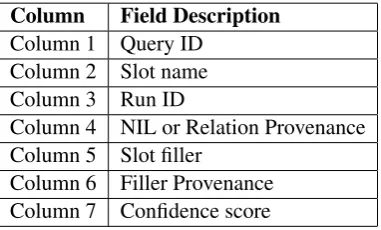
The output for the task is a set of slot fills for each input query. Depending on the type, each query should have aNIL or one or more lines of output for each of the corresponding slots. The output line for each slot fill contains the fields shown in Table 2. The query ID in Column 1 should match the ID of the query given as input. The slot name (Column 2) is one of the slots listed in Table 1 based on entity type. Run ID (Column 3) is a unique identifier for each system. Column 4 contains aNILfiller if the system could not find any relevant slot filler. Otherwise, it contains the
relation provenance. Provenance is of the form
confi-Person Organization
per:alternate names per:cause of death org:country of headquarters org:founded by per:date of birth per:countries of residence org:stateorprovince of headquarters org:date dissolved per:age per:statesorprovinces of residence org:city of headquarters org:website per:parents per:cities of residence org:shareholders org:date founded per:spouse per:schools attended org:top members employees org:members per:city of birth per:city of death org:political religious affiliation org:member of per:origin per:stateorprovince of death org:number of employees members org:subsidiaries per:other family per:country of death org:alternate names org:parents per:title per:employee or member of
[image:3.595.81.522.61.205.2]per:religion per:stateorprovince of birth per:children per:country of birth per:siblings per:date of death per:charges
Table 1: Slots for PER and ORG queries
dence score which systems can provide to indicate their certainty in the extracted information.
3.2 Scoring
The scoring for the ESF task is carried out as fol-lows. The responses from all slot-filling systems are pooled and a key file is generated by having human assessors judge the correctness of these re-sponses. In addition, LDC includes a manual key of fillers that were determined by human judges. Using the union of these keys as the gold standard, precision, recall, and F1 scores are computed.
Column Field Description
Column 1 Query ID Column 2 Slot name Column 3 Run ID
Column 4 NIL or Relation Provenance Column 5 Slot filler
Column 6 Filler Provenance Column 7 Confidence score
Table 2: SF Output line fields
4 Ensembling Slot-Filling Systems
Given a set of query entities and a fixed set of slots, the goal of ensembling is to effectively combine the output of different slot-filling systems. The put to the ensembling system is the output of in-dividual systems (in the format described in previ-ous section) containing slot fillers and additional information such as provenance and confidence scores. The output of the ensembling system is similar to the output of an individual system, but it productively aggregates the slot fillers from dif-ferent systems.
4.1 Algorithm
This section describes our ensembling approach which trains a final binary classifier using features that help judge the reliability and thus correctness of individual slot fills. In a finalpost-processing
step, the slot fills that get classified as “correct” by the classifier are kept while the others are set to NIL.
4.1.1 Stacking
Stacking is a popular ensembling method in ma-chine learning (Wolpert, 1992) and has been suc-cessfully used in many applications including the top performing systems in the Netflix competition (Sill et al., 2009). The idea is to employ multiple learners and combine their predictions by training a “meta-classifier” to weight and combine multi-ple models using their confidence scores as fea-tures. By training on a set of supervised data that is disjoint from that used to train the individual models, it learns how to combine their results into an improved ensemble model. We employ a single classifier to train and test on all slot types using an L1-regularized SVM with a linear kernel (Fan et al., 2008).
4.1.2 Using Provenance
[image:3.595.87.278.428.543.2]field is common to both specifications. Hence, we use the filler provenance that is common be-tween 2013 and 2014 formats. As described ear-lier, every provenance has adocid and startoffset-endoffset that gives information about the docu-ment and offset in the docudocu-ment from where the slot fill has been extracted. The UI-CCG SFV sys-tem Sammons et al. (2014) effectively used this provenance information to help validate and filter slot fillers. This motivated us to use provenance in our stacking approach as additional features as input to the meta-classifier.
We use provenance in two ways, first using the docid information, and second using the off-set information. We use the docids to define a document-based provenance score in the follow-ing way: for a given query and slot, if N sys-tems provide answers and a maximum of n of those systems give the same docid in their filler provenance, then the document provenance score for thosenslot fills isn/N. Similarly, other slot fills are given lower scores based on the fraction of systems whose provenance document agree with theirs. Since this provenance score is weighted by the number of systems that refer to the same provenance, it measures the reliability of a slot fill based on the document from where it was ex-tracted.
Our second provenance measure uses offsets. The degree of overlap among the various systems’ offsets can also be a good indicator of the reliabil-ity of the slot fill. The Jaccard similarreliabil-ity coeffi-cient is a statistical measure of similarity between sets and is thus useful in measuring the degree of overlap among the offsets of systems. Slot fills have variable lengths and thus the provenance off-set ranges are variable too. A metric such as the Jaccard coefficient captures the overlapping off-sets along with normalizing based on the union and thus resolving the problem with variable offset ranges. For a given query and slot, ifN systems that attempt to fill it have the samedocid in their document provenance, then the offset provenance (OP) score for a slot fill by a systemxis calculated as follows:
OP(x) = 1
|N|× X
i∈N,i6=x
|offsets(i)∩offsets(x)| |offsets(i)∪offsets(x)|
Per our definition, systems that extract slot fills fromdifferentdocuments for the same query slot have zero overlap among offsets. We note that the
offset provenance is always used along with the document provenance and thus useful in discrim-inating slot fills extracted from a different docu-ment for the same query slot. Like the docudocu-ment provenance score, the offset provenance score is also a weighted feature and is a measure of relia-bility of a slot fill based on the offsets in the docu-ment from where it is extracted. Unlike past SFV systems that use provenance for validation, our ap-proach does not need access to the large corpus of documents from where the slot fills are extracted and is thus very computationally inexpensive.
4.2 Eliminating Slot-Filler Aliases
When combining the output of different ESF sys-tems, it is possible that some slot-filler entities might overlap with each other. An ESF system could extract a fillerF1 for a slotSwhile another
ESF system extracts another fillerF2for the same
slotS. If the extracted fillersF1andF2arealiases
(i.e. different names for the same entity), the scor-ing system for the TAC KBP SF task considers them redundant and penalizes the precision of the system.
In order to eliminate aliases from the output of ensembled system, we employ a technique derived by inverting the scheme used by the LSV ESF sys-tem (Roth et al., 2013) for query expansion. LSV ESF uses a Wikipedia anchor-text model (Roth and Klakow, 2010) to generate aliases for given query entities. By including aliases for query names, the ESF system increase the number of candidate sentences fetched for the query.
Common systems dataset All 2014 SFV systems dataset
Figure 1: Precision-Recall curves for identifying the best voting performance on the two datasets
5 Experimental Evaluation
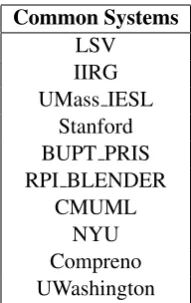
This section describes a comprehensive set of ex-periments evaluating ensembling for the KBP ESF task. Our experiments are divided into two sub-sets based on the datasub-sets they employ. Since our stacking approach relies on 2013 SFV data for training, we build a dataset of one run for ev-ery team that participated in both the 2013 and 2014 competitions and call it thecommon systems dataset. There are 10 common teams of the 17
teams that participated in ESF 2014. The other dataset comprises of all 2014 SFV systems (in-cluding all runs of all17teams that participated in 2014). There are10systems in the common sys-tems dataset, while there are65systems in the all 2014 SFV dataset. Table 3 gives a list of the com-mon systems for 2013 and 2014 ESF task. ESF systems do change from year to year and it’s not a perfect comparison, but systems generally get bet-ter every year and thus we are probably only un-derperforming.
Common Systems
LSV IIRG UMass IESL
Stanford BUPT PRIS RPI BLENDER
CMUML NYU Compreno UWashington
Table 3: Common teams for 2013 and 2014 ESF
5.1 Methodology and Results
For our unsupervised ensembling baselines, we evaluate on both the common systems dataset as well as the entire 2014 SFV dataset. We compare our stacking approach to three unsupervised base-lines. The first isUnionwhich takes the combina-tion of values for all systems to maximize recall. If the slot type is list-valued, it classifies all slot fillers as correct and always includes them. If the slot type is single-valued, if only one systems at-tempts to answer it, then it includes that system’s slot fill. Otherwise if multiple systems produce a response, it only includes the slot fill with the highest confidence value as correct and discards the rest.
The second baseline is Voting. For this ap-proach, we vary the threshold on the number of systems that must agree on a slot fill from one to all. This gradually changes the system from the union to intersection of the slot fills, and we identify the threshold that results in the highest F1 score. We learn a threshold on the 2013 SFV dataset (containing 52 systems) that results in the best F1 score. We use this threshold for the voting baseline on 2014 SFV dataset. As we did for the 2013 common systems dataset, we learn a thresh-old on the 2013 common systems that results in the best F1 score and use this threshold for the voting baseline on 2014 common systems.
[image:5.595.133.229.574.726.2]Figure 2: Our system pipeline for evaluating supervised ensembling approaches
Baseline Precision Recall F1
[image:6.595.101.498.249.388.2]Union 0.067 0.762 0.122 Voting (threshold learned on 2013 data) 0.641 0.288 0.397 Voting (optimal threshold for 2014 data) 0.547 0.376 0.445
Table 4: Performance of baselines on all 2014 SFV dataset (65 systems)
Approach Precision Recall F1
Union 0.176 0.647 0.277
Voting (threshold learned on 2013 data) 0.694 0.256 0.374 Best ESF system in 2014 (Stanford) 0.585 0.298 0.395 Voting (optimal threshold for 2014 data) 0.507 0.383 0.436
Stacking 0.606 0.402 0.483
Stacking + Relation 0.607 0.406 0.486 Stacking + Provenance (document) 0.499 0.486 0.492 Stacking + Provenance (document) + Relation 0.653 0.400 0.496 Stacking + Provenance (document and offset) + Relation 0.541 0.466 0.501
Table 5: Performance on the common systems dataset (10 systems) for various configurations. All approaches except the Stanford system are our implementations.
Precision-Recall curve for two datasets for finding the best possible F1 score using the voting base-line. We find that for the common systems dataset, a threshold of3(of10) systems gives the best F1 score, while for the entire 2014 SFV dataset, a threshold of10 (of65) systems gives the highest F1. Note that this gives an upper bound on the best results that can be achieved with voting, as-suming an optimal threshold is chosen. Since the upper bound can not be predicted without using the 2014 dataset, this baseline has an unfair ad-vantage. Table 4 shows the performance of all3
baselines on the all 2014 SFV systems dataset. For all our supervised ensembling approaches, we train on the 2013 SFV data and test on the 2014 data for the common systems. We have
5 different supervised approaches. Our first ap-proach is stacking the common systems using their confidence scores to learn a classifier. As discussed earlier, in stacking we train a meta-classifier that combines the systems using their confidence scores as features. Since the com-mon systems dataset has10systems, this classifier
our unsupervised baselines for the common sys-tems dataset.
[image:7.595.330.497.410.544.2]Analysis by Surdeanu and Ji (2014) suggests that 2014 ESF queries are more difficult than those for 2013. They compare two systems by running both on 2013 and 2014 data and find there is a con-siderable drop in the performance of both the sys-tems. We note that they run the same exact system on 2013 and 2014 data. Thus, in order to have a better understanding of our results, we plot a learn-ing curve by trainlearn-ing on different sizes of the 2013 SFV data and using the scorer to measure the F1 score on the 2014 SFV data for the 10 common systems. Figure 3 shows the learning curve thus obtained. Although there are certain parts of the dataset when the F1 score drops which we sus-pect is due to overfitting the 2013 data, there is still a strong correlation between the 2013 training data size and F1 score on the 2014 dataset. Thus we can infer that training on 2013 data is useful even though the 2013 and 2014 data are fairly dif-ferent. Although the queries change, the common systems remain more-or-less the same and stack-ing enables a meta-classifier to weigh those com-mon systems based on their 2013 performance.
Figure 3: Learning curve for training on 2013 and testing on 2014 common systems dataset
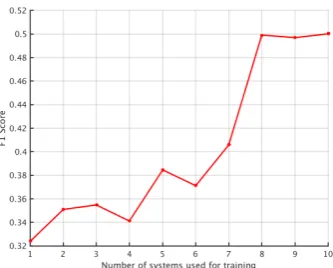
To further validate our approach, we divide the 2013 SFV data based on the systems that extracted those slot fills. Then we sort the systems, from higher to lower, based on the number of false pos-itives produced by them in the ensembling ap-proach. Next we train a classifier in an incremen-tal fashion adding one system’s slot fills for train-ing at each step and analyztrain-ing the performance on 2014 data. This allows us to analyze the results at the system level. Figure 4 shows the plot of
F1 score vs. the number of systems at each step. The figure shows huge improvement in F1 score at steps 6 and 7. At step 6 the Stanford system is added to the pool of systems which is the best performing ESF system in 2014 and fourth best in 2013. At step 7, the UMass system is added to the pool and, although the system on it own is weak, it boosts the performance of our ensem-bling approach. This is because the UMass system alone contributes approximately24%of the 2013 training data (Singh et al., 2013). Thus adding this one system significantly improves the training step leading to better performance. We also no-tice that our system becomes less conservative at this step and has higher recall. The reason for this is that the systems from1to5had very high pre-cision and low recall whereas from system6 on-wards the systems have high recall. Thus adding the UMass system enables our meta-classifier to have a higher recall for small decrease in precision and thus boosting the overall F1 measure. With-out it, the classifier produces high precision but low recall and decreases the overall F1 score by approximately6points.
Figure 4: Incrementally training on 2013 by adding a system at each step and testing on 2014 common systems dataset
[image:7.595.97.262.440.574.2]Approach Precision Recall F1
[image:8.595.112.489.62.108.2]Stacking + Filler provenance + Relation 0.606 0.415 0.493 Stacking + Filler and Relation provenance + Relation 0.609 0.434 0.506
Table 6: 10-fold Cross-Validation on 2014 SFV dataset (65 systems)
Baseline Precision Recall F1
Union 0.054 0.877 0.101 Voting (threshold learned on 2013 data) 0.637 0.406 0.496 Voting (optimal threshold for 2014 data) 0.539 0.526 0.533
Table 7: Baseline performance on all 2014 SFV dataset (65 systems) using unofficial scorer
Approach Precision Recall F1
Union 0.177 0.922 0.296
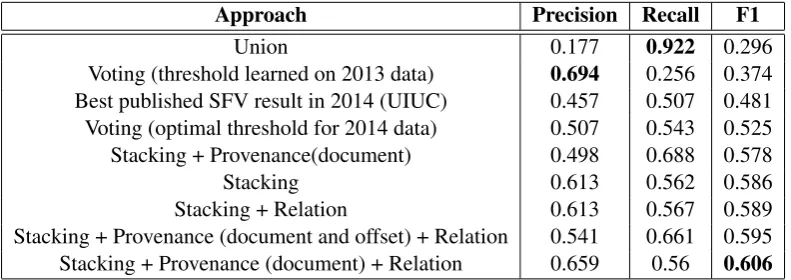
Voting (threshold learned on 2013 data) 0.694 0.256 0.374 Best published SFV result in 2014 (UIUC) 0.457 0.507 0.481 Voting (optimal threshold for 2014 data) 0.507 0.543 0.525 Stacking + Provenance(document) 0.498 0.688 0.578
Stacking 0.613 0.562 0.586
[image:8.595.135.465.141.201.2]Stacking + Relation 0.613 0.567 0.589 Stacking + Provenance (document and offset) + Relation 0.541 0.661 0.595 Stacking + Provenance (document) + Relation 0.659 0.56 0.606
Table 8: Performance on the common systems dataset (10 systems) for various configurations using the unofficial scorer. All approaches except the UIUC system are our implementations.
SFV data.
The TAC KBP official scoring key for the ESF task includes human annotated slot fills along with the pooled slot fills obtained by all participating systems. However, Sammons et al. (2014) use an unofficial scoring key in their paper that does not include human annotated slot fills. In order to compare to their results, we also present results using the same unofficial key. Table 7 gives the performance of our baseline systems on the 2014 SFV dataset using the unofficial key for scoring. We note that ourUniondoes not produce a recall of1.0 on the unofficial scorer due to our single-valued slot selection strategy for multiple systems. As discussed earlier for the single-valued slot, we include the slot fill with highest confidence (which may not necessarily be correct) and thus may not match the unofficial scorer.
Table 8 gives the performance of all our super-vised approaches along with the baselines on the common systems dataset using the unofficial key for scoring. UIUC is one of the two teams par-ticipating in the SFV 2014 task and the only team to report results, but they report 6 different
sys-tem configurations and we show their best perfor-mance.
5.2 Discussion
Our results indicate that stacking with provenance information and relation type gives the best perfor-mance using both the official ESF scorer as well as the unofficial scorer that excludes the human-generated slot fills. Our stacking approach that uses the 10 systems common between 2013 and 2014 also outperforms the ensembling baselines that have the advantage of usingall 65of the 2014 systems. Our stacking approach would presum-ably perform even better if we had access to 2013 training data for all 2014 systems.
[image:8.595.102.498.234.374.2]unof-ficial scorer.
As expected theUnionbaseline has the highest recall. Among the supervised approaches, stack-ing with document provenance produces the high-est precision and is significantly higher (approx-imately 5%) than the approach that produces the second highest precision. As discussed earlier, we also scored our approaches on the unofficial scorer so that we can compare our results to the UIUC system that was the best performer in the 2014 SFV task. Our best approach beats their best sys-tem configuration by a F1 score of12points. Our stacking approach also outperforms them on pre-cision and recall by a large margin.
6 Related Work
Our system is part of a body of work on increas-ing the performance of relation extraction through ensemble methods.
The use of stacked generalizationfor informa-tion extracinforma-tion has been demonstrated to outper-form both majority voting and weighted voting methods (Sigletos et al., 2005). In relation ex-traction, a stacked classifier effectively combines a supervised, closed-domain Conditional Ran-dom Field-based relation extractor with an open-domain CRF Open IE system, yielding a 10% in-crease in precision without harming recall (Banko et al., 2008). To our knowledge, we are the first to apply stacking to KBP and the first to use prove-nance as a feature in a stacking approach.
Many KBP SFV systems cast validation as a single-document problem and apply a vari-ety of techniques, such as rule-based consistency checks (Angeli et al., 2013), and techniques from the well-known Recognizing Textual Entailment (RTE) task (Cheng et al., 2013; Sammons et al., 2014). In contrast, the 2013JHUAPLsystem ag-gregates the results of many different extractors using a constraint optimization framework, ex-ploiting confidence values reported by each input system (Wang et al., 2013). A second approach in theUI CCGsystem (Sammons et al., 2014) aggre-gates results of multiple systems by using majority voting.
In the database, web-search, and data-mining communities, a line of research into “truth-finding” or “truth-discovery” methods addresses the related problem of combining evidence for facts from multiple sources, each with a latent credibility (Yin et al., 2008). TheRPI BLENDER
KBP system (Yu et al., 2014) casts SFV in this framework, using a graph propagation method that modeled the credibility of systems, sources, and response values. However they only report scores on the 2013 SFV data which contain less com-plicated and easier queries compared to the 2014 data. Therefore, we cannot directly compare our system’s performance to theirs.
Google’s Knowledge Vault system (Dong et al., 2014) combines the output of four diverse extrac-tion methods by building a boosted decision stump classifier (Reyzin and Schapire, 2006). For each proposed fact, the classifier considers both the confidence value of each extractor and the number of responsive documents found by the extractor. A separate classifier is trained for each predicate, and Platt Scaling (Platt, 1999) is used to calibrate confidence scores.
7 Conclusion
This paper has presented experimental results showing that stacking is a very promising ap-proach to ensembling KBP systems. From our literature survey, we observe that we are the first to employ stacking and combine it with prove-nance information to ensemble KBP systems. Our stacked meta-classifier provides an F1 score of 50.1% on 2014 KBP ESF, outperforming the best ESF and SFV systems from the 2014 competition, and thereby achieving a new state-of-the-art for this task. We found that provenance features in-creased accuracy, highlighting the importance of provenance information (even without accessing the source corpus) in addition to confidence scores for ensembling information extraction systems.
8 Acknowledgements
We thank the anonymous reviewers for their valu-able feedback. This research was supported by the DARPA DEFT program under AFRL grant FA8750-13-2-0026.
References
Gabor Angeli, Arun Chaganty, Angel Chang, Kevin Reschke, Julie Tibshirani, Jean Y Wu, Osbert Bas-tani, Keith Siilats, and Christopher D Manning. 2013. Stanford’s 2013 KBP system. InProceedings of the Sixth Text Analysis Conference (TAC2013).
relation extraction. InACL08, volume 8, pages 28– 36.
Xiao Cheng, Bingling Chen, Rajhans Samdani, Kai-Wei Chang, Zhiye Fei, Mark Sammons, John Wi-eting, Subhro Roy, Chizheng Wang, and Dan Roth. 2013. Illinois cognitive computation group UI-CCG TAC 2013 entity linking and slot filler validation systems. InProceedings of the Sixth Text Analysis Conference (TAC2013).
T. Dietterich. 2000. Ensemble methods in machine learning. In J. Kittler and F. Roli, editors, First International Workshop on Multiple Classifier Sys-tems, Lecture Notes in Computer Science, pages 1– 15. Springer-Verlag.
Pedro Domingos, Stanley Kok, Daniel Lowd, Hoifung Poon, Matthew Richardson, and Parag Singla. 2008. Markov logic. In Luc De Raedt, Paolo Frasconi, Kristian Kersting, and Stephen Muggleton, editors,
Probabilistic Inductive Logic Programming, volume 4911 of Lecture Notes in Computer Science, pages 92–117. Springer.
Xin Dong, Evgeniy Gabrilovich, Geremy Heitz, Wilko Horn, Ni Lao, Kevin Murphy, Thomas Strohmann, Shaohua Sun, and Wei Zhang. 2014. Knowl-edge vault: A web-scale approach to probabilistic knowledge fusion. InProceedings of the 20th ACM SIGKDD International Conference on Knowledge Discovery and Data Mining, pages 601–610. ACM. Rong-En Fan, Kai-Wei Chang, Cho-Jui Hsieh, Xiang-Rui Wang, and Chih-Jen Lin. 2008. LIBLINEAR: A library for large linear classification. Journal of Machine Learning Research, 9:1871–1874.
Mark Hall, Eibe Frank, Geoffrey Holmes, Bernhard Pfahringer, Peter Reutemann, and Ian H Witten. 2009. The WEKA data mining software: an update.
ACM SIGKDD explorations newsletter, 11(1):10– 18.
John C. Henderson and Eric Brill. 1999. Exploiting diversity in natural language processing: Combin-ing parsers. In Proceedings of the Conference on Empirical Methods in Natural Language Processing and Very Large Corpora (EMNLP/VLC-99), pages 187–194, College Park, MD.
Yu Hong, Xiaobin Wang, Yadong Chen, Jian Wang, Tongtao Zhang, Jin Zheng, Dian Yu, Qi Li, Boliang Zhang, Han Wang, et al. 2014. RPI BLENDER TAC-KBP2014 knowledge base population system.
Proceedings of the Seventh Text Analysis Conference (TAC2014).
Mike Mintz, Steven Bills, Rion Snow, and Dan Ju-rafsky. 2009. Distant supervision for relation ex-traction without labeled data. InProceedings of the Joint Conference of the 47th Annual Meeting of the ACL and the 4th International Joint Conference on Natural Language Processing of the AFNLP: Vol-ume 2-VolVol-ume 2, pages 1003–1011. Association for Computational Linguistics.
Ted Pedersen. 2000. A simple approach to building en-sembles of naive Bayesian classifiers for word sense disambiguation. In Proceedings of the Meeting of the North American Association for Computational Linguistics, pages 63–69.
John C. Platt. 1999. Probabilistic outputs for sup-port vector machines and comparisons to regularized likelihood methods. In Peter J. Bartlett, Bernhard Sch¨olkopf, Dale Schuurmans, and Alex J. Smola, editors,Advances in Large Margin Classifiers, pages 61–74. MIT Press, Boston.
Lev Reyzin and Robert E Schapire. 2006. How boost-ing the margin can also boost classifier complexity. InProceedings of the 23rd International Conference on Machine Learning, pages 753–760. ACM. Benjamin Roth and Dietrich Klakow. 2010.
Cross-language retrieval using link-based Cross-language mod-els. InProceedings of the 33rd International ACM SIGIR Conference on Research and Development in Information Retrieval, pages 773–774. ACM. Benjamin Roth, Tassilo Barth, Michael Wiegand, et al.
2013. Effective slot filling based on shallow distant supervision methods. Proceedings of the Seventh Text Analysis Conference (TAC2013).
Mark Sammons, Yangqiu Song, Ruichen Wang, Gourab Kundu, et al. 2014. Overview of UI-CCG systems for event argument extraction, entity dis-covery and linking, and slot filler validation. Pro-ceedings of the Seventh Text Analysis Conference (TAC2014).
Georgios Sigletos, Georgios Paliouras, Constantine D Spyropoulos, and Michalis Hatzopoulos. 2005. Combining information extraction systems using voting and stacked generalization. The Journal of Machine Learning Research, 6:1751–1782.
Joseph Sill, G´abor Tak´acs, Lester Mackey, and David Lin. 2009. Feature-weighted linear stacking. arXiv preprint arXiv:0911.0460.
Sameer Singh, Limin Yao, David Belanger, Ariel Ko-bren, Sam Anzaroot, Michael Wick, Alexandre Pas-sos, Harshal Pandya, Jinho Choi, Brian Martin, and Andrew McCallum. 2013. Universal schema for slot filling and cold start: UMass IESL.
Mihai Surdeanu and Heng Ji. 2014. Overview of the English slot filling track at the TAC2014 Knowledge Base Population Evaluation. InProceedings of the Seventh Text Analysis Conference (TAC2014). Mihai Surdeanu. 2013. Overview of the TAC2013
knowledge base population evaluation: English slot filling and temporal slot filling. InProceedings of the Sixth Text Analysis Conference (TAC 2013). I-Jeng Wang, Edwina Liu, Cash Costello, and Christine
Anurag Wazalwar, Tushar Khot, Ce Zhang, Chris Re, Jude Shavlik, and Sriraam Natarajan. 2014. TAC KBP 2014 : English slot filling track DeepDive with expert advice. In Proceedings of the Seventh Text Analysis Conference (TAC2014).
Matthew Whitehead and Larry Yaeger. 2010. Senti-ment mining using ensemble classification models. In Tarek Sobh, editor,Innovations and Advances in Computer Sciences and Engineering. Springer Ver-lag, Berlin.
David H. Wolpert. 1992. Stacked generalization. Neu-ral Networks, 5:241–259.
Xiaoxin Yin, Jiawei Han, and Philip S Yu. 2008. Truth discovery with multiple conflicting informa-tion providers on the web. Knowledge and Data En-gineering, IEEE Transactions on, 20(6):796–808. Dian Yu, Hongzhao Huang, Taylor Cassidy, Heng Ji,