PERSPECTIVES ON INFLUENCE OF SINGLE PARENTING ON STUDENT INVOLVEMENT IN
STUDENT DELINQUENCY IN SECONDARY SCHOOLS IN KENYA: A CASE STUDY OF
KAKAMEGA EAST SUB COUNTY
Department of Educational Management and Foundations, Maseno University, Kenya
ARTICLE INFO ABSTRACT
Parents and particularly mothers are the primary
They are therefore responsible for shaping of children’s behaviour whereas fathers succeed them as the children grow up and eventually takeover as children enter into their adolescent stage. This mean that enhancing of discipline among children is enhanced by both parents. Nevertheless single parenting is highly suspected to be less effective in dealing with discipline of children as opposed to dual parenting. In Kakamega East Sub County between 2006
delinquency had been reported. That is, behaviour such as smoking bhang, smoking cigarettes, chewing miraa, fighting, absenteeism, truancy, theft, sneaking out of school were prevalent in schools. In some cases they had resul
centres countrywide such as Kakamega Rehabilitation centre, Mary immaculate Rehabilitation centre, Bahati Rehabilitation centre, Dagoretti Rehabilitation School among others. One hundr
the schools had experienced cases of delinquency and the gravity of delinquency was high as it led to dropout of students and high repetition rate. Thus, it affected completion rates and quality of graduates. The objective of this study was t
parenting on student delinquency in secondary schools in Kakamega East Sub County. The study established that respondents disagreed marginally on the view that single parenting influences student involvem
student delinquency. The study recommended that school administrators should involve single parents in dealing with cases of student delinquency.
Copyright © 2018, Olive Taabu Baraza. This is an open use, distribution, and reproduction in any medium, provided
INTRODUCTION
Family plays an important role in one’s life. It not only provides people with physical, economic, and emotional support, but it is also the smallest basic unit of socialization where people first socialize with others. Families play a very important role in instilling discipline in their children based on the accepted norms in the society. In a school set up, student discipline is a matter of concern. The importance of school discipline is emphasized repeatedly in surveys, polls and literature about education and student achievement (Gary & Angus, 2011). Studies that have been done indicate that single parent families can have both positive and negative effects on the children. According to Magar (2012), development of close bonds with parents can be one big positive effect of single parenting. Single parenting involves looking after the child's
*Corresponding author: Olive Taabu Baraza,
Department of Educational Management and Foundations, Maseno University, Kenya.
ISSN: 0975-833X
International
Vol.
Article History:
Received 15th November, 2017
Received in revised form
12th December, 2017
Accepted 16th January, 2018
Published online 28th February, 2018
Citation: Olive Taabu Baraza, 2018. “Perspectives on influence of single parenting on student involvement in student delinquency in secondary schools in
Kenya: A case study of kakamega east sub county”, International Journal of Current Research
Key words:
Perspectives, Influence, Single Parenting, Student Involvement, Delinquency, Secondary Schools, Kenya,
Kakamega East Sub County.
RESEARCH ARTICLE
PERSPECTIVES ON INFLUENCE OF SINGLE PARENTING ON STUDENT INVOLVEMENT IN
STUDENT DELINQUENCY IN SECONDARY SCHOOLS IN KENYA: A CASE STUDY OF
KAKAMEGA EAST SUB COUNTY
*Olive Taabu Baraza
Department of Educational Management and Foundations, Maseno University, Kenya
ABSTRACT
Parents and particularly mothers are the primary educators and trainers of children in African families. They are therefore responsible for shaping of children’s behaviour whereas fathers succeed them as the children grow up and eventually takeover as children enter into their adolescent stage. This mean that enhancing of discipline among children is enhanced by both parents. Nevertheless single parenting is highly suspected to be less effective in dealing with discipline of children as opposed to dual parenting. In Kakamega East Sub County between 2006
delinquency had been reported. That is, behaviour such as smoking bhang, smoking cigarettes, chewing miraa, fighting, absenteeism, truancy, theft, sneaking out of school were prevalent in schools. In some cases they had resulted in juvenile crime. This has led to establishment of rehabilitation centres countrywide such as Kakamega Rehabilitation centre, Mary immaculate Rehabilitation centre, Bahati Rehabilitation centre, Dagoretti Rehabilitation School among others. One hundr
the schools had experienced cases of delinquency and the gravity of delinquency was high as it led to dropout of students and high repetition rate. Thus, it affected completion rates and quality of graduates. The objective of this study was to establish the perspectives on influence of single parenting on student delinquency in secondary schools in Kakamega East Sub County. The study established that respondents disagreed marginally on the view that single parenting influences student involvement in student delinquency. The study concluded that single parenting had influence on student delinquency. The study recommended that school administrators should involve single parents in dealing with cases of student delinquency.
open access article distributed under the Creative Commons Attribution provided the original work is properly cited.
Family plays an important role in one’s life. It not only provides people with physical, economic, and emotional support, but it is also the smallest basic unit of socialization where people first socialize with others. Families play a very in instilling discipline in their children based on the accepted norms in the society. In a school set up, student discipline is a matter of concern. The importance of school discipline is emphasized repeatedly in surveys, polls and tion and student achievement (Gary & Angus, 2011). Studies that have been done indicate that single parent families can have both positive and negative effects on the children. According to Magar (2012), development of close ig positive effect of single parenting. Single parenting involves looking after the child's
Department of Educational Management and Foundations, Maseno
requirements singly, which amounts to a large time to be spent with the child. If the parent is successful in turning these moments into deep bonding sessions, it would create a permanent goodwill and strong relationship between the parent and the child. This is supported by Kunz (2010), on the effects of single parenting on child’s behavior who found out that children in single parent families often form close bonds with their parent, as they are closely dependent on each other throughout the child's life. Children from single
may also form closer bonds with extended family members or family friends, as these people often help raise them. Single parenting however, can also have negative effects on children. In U.S.A, Silbereisen and Sharma (
in Germany from perspective of adolescent in mother single parent families, observed that adolescent from mother headed single parent families and step
significantly less comfortable with their family environm comparison to adolescents living with biological parents. Further study by Ketteringham (2007) in U.S.A, observed that single parent fathers do not communicate with their children as
International Journal of Current Research
Vol. 10, Issue, 02, pp.66116-66125, February, 2018
Perspectives on influence of single parenting on student involvement in student delinquency in secondary schools in
International Journal of Current Research, 10, (02), 66116-66125.
PERSPECTIVES ON INFLUENCE OF SINGLE PARENTING ON STUDENT INVOLVEMENT IN
STUDENT DELINQUENCY IN SECONDARY SCHOOLS IN KENYA: A CASE STUDY OF
Department of Educational Management and Foundations, Maseno University, Kenya
educators and trainers of children in African families. They are therefore responsible for shaping of children’s behaviour whereas fathers succeed them as the children grow up and eventually takeover as children enter into their adolescent stage. This means that enhancing of discipline among children is enhanced by both parents. Nevertheless single parenting is highly suspected to be less effective in dealing with discipline of children as opposed to dual parenting. In Kakamega East Sub County between 2006 and 2011 many cases of student delinquency had been reported. That is, behaviour such as smoking bhang, smoking cigarettes, chewing miraa, fighting, absenteeism, truancy, theft, sneaking out of school were prevalent in schools. ted in juvenile crime. This has led to establishment of rehabilitation centres countrywide such as Kakamega Rehabilitation centre, Mary immaculate Rehabilitation centre, Bahati Rehabilitation centre, Dagoretti Rehabilitation School among others. One hundred percent of the schools had experienced cases of delinquency and the gravity of delinquency was high as it led to dropout of students and high repetition rate. Thus, it affected completion rates and quality of o establish the perspectives on influence of single parenting on student delinquency in secondary schools in Kakamega East Sub County. The study established that respondents disagreed marginally on the view that single parenting influences student ent in student delinquency. The study concluded that single parenting had influence on student delinquency. The study recommended that school administrators should involve single parents
ribution License, which permits unrestricted
requirements singly, which amounts to a large time to be spent with the child. If the parent is successful in turning these moments into deep bonding sessions, it would create a permanent goodwill and strong relationship between the parent his is supported by Kunz (2010), on the effects of single parenting on child’s behavior who found out that children in single parent families often form close bonds with their parent, as they are closely dependent on each other Children from single-parent families may also form closer bonds with extended family members or family friends, as these people often help raise them. Single parenting however, can also have negative effects on children. In U.S.A, Silbereisen and Sharma (2007), on revisiting an era in Germany from perspective of adolescent in mother-headed single parent families, observed that adolescent from mother-headed single parent families and step-mother were significantly less comfortable with their family environment in comparison to adolescents living with biological parents. Further study by Ketteringham (2007) in U.S.A, observed that single parent fathers do not communicate with their children as
INTERNATIONAL JOURNAL OF CURRENT RESEARCH
much as mothers. This leads to children from single father households being more likely to use marijuana and use illicit drugs, to have been drunk three or four times and to have had sex at an earlier age. This contradict the fact that most people think that fathers are more strict than mothers, when in fact they tend to be less stricter than mothers. This study is supported by Fenster (2011) who observed that once a child is subjected to growing up in a broken family, her propensity towards using drugs, alcohol, and engaging in unprotected sex becomes much higher than for a teenager who lives in a home where both of her parents are still married. According to him, statistics show that a teen girl who is the product of divorced parents is more likely to become pregnant. Otieno and Ofulla (2009), found out that in Kisumu city students were exposed to drugs and it affected all age groups. Oluwatosin and Joseph (2011), in their study on effects of single parenthood on academic performance of secondary school students in Ekiti estate, found out that the interaction between the truancy behaviour of students from single parent homes and those from intact parent homes are significantly different from each other. This means that, there is difference between the truancy behaviour of students from single parent homes and those from intact parent homes. They further observed that type of home has significant influence on truancy behaviour of students. They recommended that Students of single parenthood should be encouraged on the three basic dimensions of self-concepts, namely; sense of belonging, sense of worth and sense of competence. They need a positive identity or an enhanced self-concept for the overall adjustment. The study focused on truancy behavior. Issues on stealing, joining gangs, cheating in the examinations, sexual harassment and use of vulgar language were not addressed.
According Kilonzo (2011, as cited by Tesha 2011), on facing negative effects of single parenthood, observed that, there are cases whereby a male child raised by his mother alone would sometimes lack maleness characters and ultimately develops female related characters, such as feeling shy. This happens just because the child lacks the presence of his father since his childhood. The study revealed that in some cases, children raised by a single parent, particularly a child raised by a single mother, may develop homosexuality type of behavior due to the fact that a child develops love affection with those people she was raised by in the family giving an example of a girl. The study further explained that experience had also indicated that some girls who have been raised in single parent families can face problems in their marriage lifetime simply because they were raised, seeing that the presence of only one parent can be appropriate. Truancy is also a problem in Tanzania. According to Nderu (2012, as cited by Temba 2012), pupils who miss classes are from pastoral communities, adding that truancy was rampant during dry seasons when Maasai children are forced by their parents to look for pasture and water for the livestock. Maasai lead nomadic life, moving from one place to another in search of pasture and water. They move along with the entire family, affecting children in school. In Kenya, there are increasing numbers of single mothers. This is because Kenyan parents do not accept daughters back in their homes once they are married, and because of the changing social and economic environment, individual relationships have gained popularity and marriage has ceased to represent ties between social groups; rather it is an alliance between individuals. It was further noted that many women in Kenya view marriage as an option that is detrimental to their attempts to have careers, professional occupations and independent lifestyles. Autonomy
is first on the agenda as many single mothers choose to have children with married or younger men who will not have total influence or authority over them. Also, the increase in single parent families in Kenya is attributed to high incidences of teenage pregnancy and premarital and extra marital sex (Womensphere, 2008). Simatwa (2012) identified cases of student indiscipline experienced in schools as indecency, gross neglect of work, theft, lying, insubordination, bullying, drug abuse and other delinquent activities like truancy. Muola, Ndung’u and Ngesa (2009), in a study of the relationship between family functions and juvenile delinquency a case of Nakuru municipality, Kenya found that a weak relationship between juvenile delinquency and socio-economic status was observed. The delinquency level of boys was significantly higher than that of girls. It was concluded that there is a relationship between family functions and juvenile delinquency. Interview schedules and a questionnaire were used to collect data from the respondents. Data was analyzed using descriptive statistics, Pearson’s moment correlation and t-test. Juvenile delinquency was found to be significantly related to marital stability, family size, marital adjustment and mode of discipline. The studies reviewed indicate that single parenting influences delinquency in U.S.A (Golden 2012, Bauer & Shear, 2010), in Nigeria (Oluwatosin & Joseph, 2011) and in Kenya (Muola, Ndug’u & Ngesa, 2009). According to Kimani and Kombo (2010), both daughters and sons were affected in the situations of an absent father especially when family’s provision is inadequate or when mothers are too stressed to give them adequate attention. Studies by Zirpoli (2010), Luiseli, Putnam, Handler and Feinberg (2010) and Kimani and Kombo (2010) indicated that, children are exposed to environmental variables that place them at risk for ant-social behavior like bullying. The findings were a reflection of anti-social behavior in U.S.A and Nakuru, Kenya and not Kakamega East Sub County, Kenya. Kiprop and Chepkilot (2011), noted that the role of parents in the life of the child was of paramount significance. They further observed that those who were involved in their children’s lives had a better understanding of what was acceptable and expected in school environment. According to the data at the Sub County Education Officer in Kakamega East Sub County (2011), there were 2500 students from single parenthood and 8196 students from dual parenthood students in secondary schools in Kakamega East Sub County. National Council of Churches of Kenya (2008) notes that the wave of students’ unrest sweeping across Kenyan schools is evidence of breakdown of social values and Kakamega East Sub County is not exceptional. With the available data pointing towards the existence of incidences of indiscipline within Kakamega East Sub County, it was important to find out the perceptions on the influence of single parenting on student discipline in secondary schools in the District. Table 1 shows cases of indiscipline for the last five years in Kakamega East Sub County.
Table 1. Cases of Students’ Indiscipline in Kakamega East from 2006-2011
Nature of indiscipline
No. of
Schools
Schools involved
Percentages
of schools
involved
Gravity
Student delinquency (Truancy, Sneaking, Stealing,
insubordination and fighting)
35 35 100
Dropout, Theft,
Injured by
other students,
Injured a
teacher, Physical injury
From Table 1 it can be shown that students in Kakamega East Sub County experienced cases of student discipline from 2006-2011 particularly cases of student delinquency.
Research Objective
The research objective was to: establish the perspectives on influence of single parenting on student delinquency in Secondary Schools in Kakamega East Sub County.
Synthesis of literature on influence of single parenting on student involvement in student deliquency
According to Wickliffe (2013), family relationships, duties, responsibilities and privileges, and the amount of control exercised over children all play roles in forming character and influencing behavior. The attitudes and actions of parents can create an important influence in the lives of children. Families in crisis will most likely affect the behavior of juveniles. If one member of a family becomes sick or alcoholic, a child may react based on the family structural problems. Ferrell (2009), on the effects of single parent households versus two parent households on student academic success, attendance, and suspensions, found out that there was a relationship between the number of times a student was absent and the type of household in which the student lived. The highest number of absences was found in the single parent households. The study also found that there was no relationship between the number of times a student was suspended and the type of household in which the student lived. He used causal comparative research design research design. However, the research was limited to student achievement, attendance and suspensions. Cooperkline (2009), in his study on school absenteeism, disruptive classroom behavior and disruptive family processes, concluded that disruptive classroom behavior is a predictor of chronic school absenteeism. According to him, knowing how a child behaves in the classroom affects his or her rate of truancy, raises awareness about predictive factors of truancy that occur in the school. In addition, knowing that disruptive behavior in the classroom can lead to truancy, places a responsibility on school systems to work with disruptive children early before the disruption reaches a level that causes truancy. He also observed that negative family factors predict disruptive classroom behavior and chronic school absenteeism places an extreme emphasis on the role of families in relation to the success of their children and prevention of time spent in the juvenile justice system. The study used the Pearson correlation analysis. This study focused on truancy and disruptive classroom behavior. The study, however, did not look at stealing, use of vulgar language, cheating in the examination and joining gangs. In a research by Demuth and Brown (2004), on family structure, family processes, and adolescent delinquency: the significance of parental absence versus parental gender, it was found that adolescents in single parent families are significantly delinquent than their counterpart residing with biological married parents. Furthermore, family processes fully account for the higher levels of delinquency exhibited by adolescents from father versus single-mother families. In Britain, Clark (2009), observed that more than half of pupils are habitual truants at the country's worst schools for attendance. Further study by Gyngell (2012), showed that truancy is undoubtedly associated with social and economic deprivation and that it is disproportionately related to single parent and fatherless families whose children are generally at risk. However, not all single parents and fatherless
children are poor. There could be another cause of truancy. According to Golden (2012), another effect of single parenthood on children may be an overall higher rate of delinquency. This delinquency includes drug and alcohol use, truancy, criminal activity and high risk sexual behavior. Children of single parents are more likely to become teen parents, drop out of school, join a gang and go to jail. They are also more likely to become single parents themselves. According to Oluwatosin and Joseph (2011), in a study on effects of single parenthood on the academic performance of secondary schools, it was concluded that the interaction between truancy behavior of students from single parent homes and those from intact parent homes are significantly different from each other. It can also be stated as type of home has significant influence on truancy behavior of student. It was recommended that students of single parenthood should be encouraged on three basic dimensions of self-concept namely: sense of belonging, sense of worth and sense of competence and concluded that such students need a positive identity or an enhanced self-concept for the overall adjustment. Further study by Kudrat, Nsisong, Abayomi and Ezeh (2010), in their study on Family types and juvenile delinquency issues among secondary students in Akwa Ibom, Nigeria, found that three family variables namely: family stability, family cohesiveness, and family adaptability impact strongly on juvenile delinquency among secondary school students in Uyo metropolis. The self report Family Delinquency Questionnaire (FADEC) was used for data collection. Frequencies and simple percentages were used to answer the research questions while the hypothesis were tested statically using the chi square statistic. Since children who are inadequately supervised by parents, whose parents fail to teach them the difference between right and wrong, whose parents do not monitor their whereabouts and activities, whose parents discipline them erratically and harshly, and those who experience some measure of violence in the home are more likely to become delinquent. It has therefore become apparent that a healthy home environment is the single most important factor necessary to keep children from becoming delinquent.
significant for all offences in the study except murder. The research adopted an ex post facto design. The collected data was coded and analyzed using descriptive and inferential statistics namely; frequency tables and correlations respectively. Frequency distributions and Pearson Correlation tables were used to present the findings of the study. The study was limited to murder, street life and sex offences. Muola, Ndung’u and Ngesa (2009), in a study of the relationship between family functions and juvenile delinquency, a case of Nakuru Municipality in Kenya, found that there was a weak relationship between juvenile delinquency and socio-economic status was observed. The delinquency level of boys was significantly higher than that of girls. It was concluded that there is a relationship between family functions and juvenile delinquency. Interview schedules and a questionnaire were used to collect data from the respondents. Data were analyzed using descriptive statistics, Pearson’s moment correlation and t-test. Juvenile delinquency was found to be significantly related to marital stability, family size, marital adjustment and mode of discipline. From the studies reviewed, Ferrell (2009), in a study on the effects of single parent households on student academic success, attendance and suspension, found out that there was a relationship between the number of times a student was absent and the type of household in which the student lived. The highest number of absence was found in the single parent households. This study focused on truancy. Demuth and Brown (2004), in a research on family structure, family processes, and adolescent delinquency in USA, found out that adolescents in single parent families are significantly delinquent than their counterpart residing with biological married parents. In Kenya, Kimani (2010), on influence of family structure in Nakuru children’s remand home, found out that children who live in an intact family had a lower prevalence to go to the street and also take cannabis. Single family unit structures had a high prevalence to sexual crime like involvement in sex and defilement cases. The reviewed literature did not also focus on influence of single parenting on student involvement in examination cheating, use of vulgar language, sexual harassment and stealing in Kakamega East District.
CONCEPTUAL FRAMEWORK
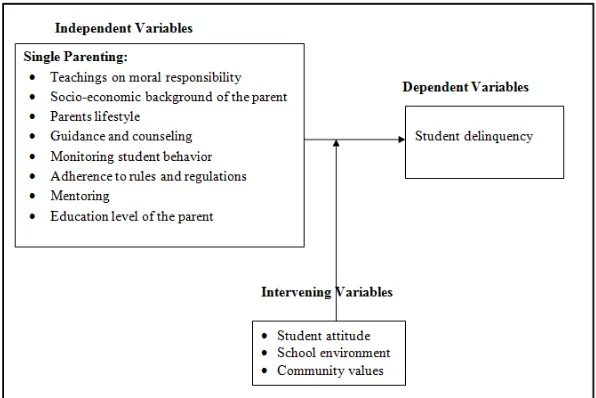
The conceptual framework postulates that single parenting does influence student delinquency.
Single parent can influence student discipline positively or negatively. A single parent who teaches moral responsibility, offers guidance and counseling to his or her children, monitors student behaviour, ensures children adhere to rules and regulations and mentors him or her child discourages their children to bully others, to get involved in drug abuse and to be delinquent while a single parent who does not offer guidance and counseling, teach moral responsibility, mentor, monitor children behaviour nor ensures a child adheres to the rules and regulations encourages their children to bully others, get involved in drug abuse and to be delinquent. However, the intervening variables namely students attitude, community values and school environment moderates the influence of single parenting on students involvement in delinquent tendencies. In situations where the intervening variables mitigate the single parenting influence on students’ debut into antisocial behaviour, student involvement will be minimal and vice versa. The conceptual framework helped in focusing on the variables of the study in data collection on the influence of single parenting on student involvement in delinquency activities.
RESEARCH METHODOLOGY
[image:4.595.159.457.583.782.2]The study used descriptive survey research design. The study population consisted of 10696 students, 35 deputy principals, 35 guidance and counseling teachers, 180 class teachers and 1 Sub County Education Officer. The study used saturated sampling technique to select 32 Deputy principals, 32 Guidance and Counseling teachers, 140 class teachers and one Sub County Education Officer. Simple random sampling was used to select 370 students. Data were collected by use of questionnaires and interview schedules. Face and content validity of the instruments was determined by experts in educational administration whose input was incorporated. Reliability of instruments was established through a test re-test method in 3(9.6%) of the schools that were not involved in the main study. Pearson r for the deputy principals’ questionnaire was 0.84, class teachers’ questionnaire was 0.79 and students’ questionnaire was 0.89. The instruments were therefore, reliable. Quantitative data from closed-ended items of the questionnaire were analyzed using descriptive statistics in form of frequency counts and percentages. Qualitative data from the open-ended items in the questionnaire and interviews was organized and analyzed in emergent themes and sub-themes.
RESULTS
Research Question
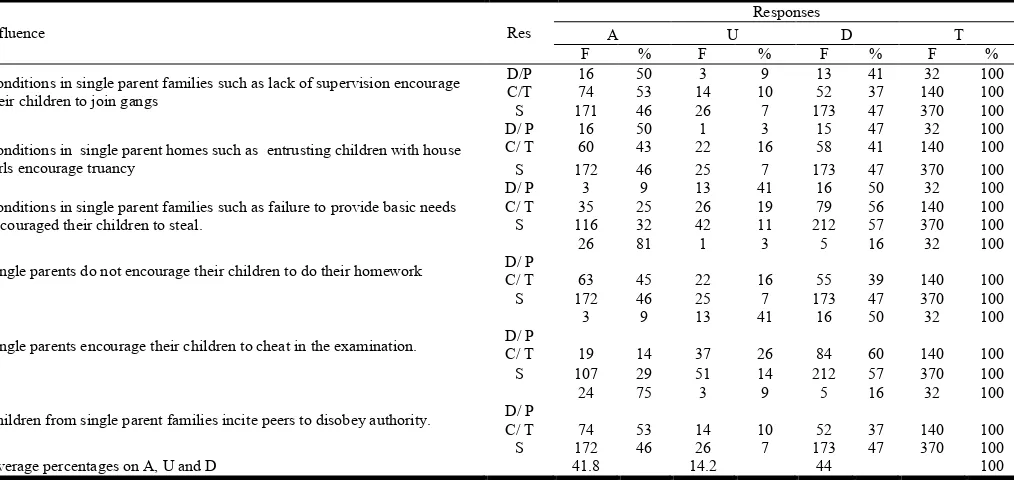
The research question responded to was: What are the perspectives on influence of single parenting on student delinquency in secondary schools in Kakamega East Sub County? The responses to this research question were as shown in Table 2. From Table 2, sixteen (50%) agreed, 13(41%) disagreed while 3(9%) were undecided in the view that conditions in single parent families such as lack of supervision encouraged their children to join gangs. This means that majority of the deputy principals were of the view that conditions in single parent families such as lack of supervision encourages their children to join gangs. However, 13(41%) were of the opinion that conditions in single parent families such as lack of supervision do not encourage their children to join gangs and 3(9%) of the deputy principals were undecided. ccording to the class teachers, the influence was as follows: 74(53%) agreed, 52(37%) disagreed while 14(10%) were undecided. This means that majority of the class teachers were also of the view that conditions in single parent families such as lack of supervision encourage their children join gangs. However, 52(37%) of the class teachers were of the view that conditions in single parent families such as lack of supervision do not encourage their children to join gangs. According to the students, the influence was as follows: 173(47%) disagreed, 171(46%) agreed while 26(7%) were undecided. This means that 173(47%) of the students were of the opinion that conditions in single parent families such as lack of supervision do not encourage their children to join gangs. However, 171(46%) of the students were of the opinion that conditions in single parent families such as lack of supervision do encourage their children to join gangs while 26(7%) were undecided. Sixteen (50%) agreed, 15(47%) disagree while 1(3%) in the view that single parent homes such as entrusting children with house girls encourage truancy. This means that majority of the deputy principals were of the opinion that conditions in single parent families such as entrusting children with house girls encouraged truancy.
[image:5.595.49.556.556.797.2]However, 15(47%) were for the view that conditions in single parent families such as entrusting children with house girls do not encourage truancy while only one deputy principal was undecided. It can be noted that the difference between students who agreed and those who disagreed is small. According to the class teachers, the influence was as follows: 60(43%) agreed, 58(41%) disagree while 22(16%) were undecided. This means majority of the class teachers were of the view that conditions in single parent families such as entrusting children with house girls encouraged truancy. However, 58(41%) of the class teachers were of the opinion that conditions in single parent families such as entrusting children with house girls do not encourage truancy while 22(16%) were undecided. According to the students, the influence was as follows: 173(47%) disagreed, 172(47%) agreed while 25(7%) were undecided. This means that majority of students were of the opinion that conditions in single parent homes such as entrusting children with house girls does not encourage truancy. However, 172(46%) were of the opinion that conditions in single parent homes such as entrusting children with house girls do encourage truancy while 25(7%) were undecided. Sixteen (50%) disagreed, 3(9%) agreed while 13(41%) were undecided on the view that conditions in single parent families such as failure of provision of basic needs encourage their children to steal. This means that majority of the deputy principals were of view that conditions in single parent families such as failure of provision of basic needs do not encourage their children to steal. However, 3(9%) were of the view that single parent families encouraged their children to steal while 13(41%) were undecided. Class teachers, the influence was as follows: 79(56%) disagreed, 35(25%) agreed while 26(19%) were undecided. This means majority of the class teachers were of the view that conditions in single parent families such as failure of provision of basic needs do not encourage their children to steal. However, 35(25%) were of the opinion that conditions in single parent family homes such as failure of provision of basic needs encouraged their children to steal while 26(19%) were undecided. According to students, the influence was as follows: 212(57%) disagreed, 116(32%) agreed while 42(11%) were undecided.
Table 2. Perceptions of Deputy Principals, Class teachers and the Students on Influence of Single Parenting on Student Delinquency
Influence Res
Responses
A U D T
F % F % F % F %
Conditions in single parent families such as lack of supervision encourage their children to join gangs
D/P 16 50 3 9 13 41 32 100
C/T 74 53 14 10 52 37 140 100
S 171 46 26 7 173 47 370 100
Conditions in single parent homes such as entrusting children with house girls encourage truancy
D/ P 16 50 1 3 15 47 32 100
C/ T 60 43 22 16 58 41 140 100
S 172 46 25 7 173 47 370 100
Conditions in single parent families such as failure to provide basic needs encouraged their children to steal.
D/ P 3 9 13 41 16 50 32 100
C/ T 35 25 26 19 79 56 140 100
S 116 32 42 11 212 57 370 100
Single parents do not encourage their children to do their homework D/ P
26 81 1 3 5 16 32 100
C/ T 63 45 22 16 55 39 140 100
S 172 46 25 7 173 47 370 100
Single parents encourage their children to cheat in the examination. D/ P
3 9 13 41 16 50 32 100
C/ T 19 14 37 26 84 60 140 100
S 107 29 51 14 212 57 370 100
Children from single parent families incite peers to disobey authority. D/ P
24 75 3 9 5 16 32 100
C/ T 74 53 14 10 52 37 140 100
S 172 46 26 7 173 47 370 100
Average percentages on A, U and D 41.8 14.2 44 100
This means that majority of the students were of the view that conditions in single parent families such as failure of provision of basic needs do not encourage their children to steal. However, 116(32%) were of the opinion that conditions in single parent homes do encourage their children to steal while 42(11%) were undecided. Twenty six (81%) agreed, 5(16%) disagreed while 1(3%) were undecided on the view that single parents do not encourage their children to do their homework. This means that majority of the deputy principals were of the view that single parents do not encourage their children to do their homework. However, 5(16%) were of the opinion that single parents encouraged their children to do homework while one deputy principal was undecided. According to the class teachers, the influence was as follows: 63(45%) agreed, 55(39%) disagreed while 22(16%) were undecided. This means that majority of the class teachers were of the opinion that single parents do not encourage their children to do homework. However, 55(39%) of the class teachers were of the opinion that single parents encouraged their children to do their homework while 22(16%) were undecided. According to the students, the influence was as follows: 173(47%) disagreed, 172(46%) agreed while 25(7%) were undecided. This means that majority of the students were of the opinion that single parents do encourage their children to do homework. However, 172(46%) of the class teachers were of the view that single parents do not encourage their children to do their homework while 25(7%) were undecided.
Sixteen (50%) disagreed, 13(41%) agreed while 3(9%) were undecided on the view that single parents encourage their children to cheat in the examinations. This means majority of the deputy principals were of the opinion that single parents do not encourage their children to cheat in their examinations. However, 13(41%) were of the opinion that single parents encouraged their children to cheat in the examinations. According to the class teachers, the influence was as follows: 84(60%) disagreed, 37(26%) were undecided while 19 (14%) agreed. This means that majority of the class teachers were of the opinion that single parents do not encourage their children to cheat in the examinations. However, 37(26%) were undecided while 19(14%) were of the opinion that single parents encouraged their children to cheat in the examinations. According to the students, the influence was as follows: 212(57%) disagreed, 107(29%) agreed while 51(14%). This means that majority of the students were of the view that single parent families do not encourage their children to cheat in the examinations, 107(29%) were of the view that single parents encouraged their children to cheat in the examinations while 3(9%) were undecided. Twenty four (75%) agreed, 5(16%) disagreed while 3(9%) were undecided in the view that children from single parent children incite others to disobey authority. This means that majority of the deputy principals were of the view that single parent children did not incited peers to disobey authority. However, 5(16%) of the deputy principals were of the opinion that single parent children incited peers to disobey authority while 3(9%) were undecided. According to the class teachers, the influence was as follows: 74(53%) agreed, 52(37%) disagreed while 14(10%) were undecided. This means that majority of the class teachers were of the view that children from single parent families incite peers to disobey authority. However, 37% of them were of the view that children from single parent families do not incite peers to disobey authority while 14(10%) were undecided. According to the students, the influence was as follows: 173(47%) disagreed, 171(46%) agreed while 26(7%) were
undecided. This means that majority of the students were of the view that children from single parent families do not incite peers to disobey authority. However, 171(46%) were of the opinion that children from single parent families incited peers to disobey authority while 26(7%) were undecided
DISCUSSION
student’s school activities. Children of involved parents have better attendance records, less dropout rates, very good and higher aspirations and positive attitude towards school work and this enhances good performance in academics. Some single parents do not attend school functions. This makes them not to be aware of the activities in the school. The children take advantage of that to be absent from school. Lack of commitment to their children academics also makes children to be absent in school. The guidance and counseling teachers’ views agreed with the views of the deputy principals and class teachers that conditions in single parent families do encourage truancy. However, the views of the guidance and counseling teachers did not agree with the views of the majority of students who were of the opinion that conditions in single parent homes like entrusting children with house girls do not encourage truancy. These findings agrees with Gyngell (2012), who observed that truancy is undoubtedly associated with social and economic deprivation and that it is disproportionately related to single parent and fatherless families whose children are generally at risk. Further research by Kudirat et al (2010), concluded that a healthy home environment is the single most important factor necessary to keep children from becoming delinquent. The results corroborates with the research by Ferrell (2009), who found out that there was a relationship between the number of times a student was absent and the type of household in which the students lived. The highest number of absences was found in the single-parent households. The results are further supported by Whitehead (2008), that found out that single parents had a much higher poverty rate than either two parent biological families or step families. The risk of dropping out of school was higher in single parent families than in two parent families. However, he noted that when socio-economic status is controlled, there were no meaningful difference between single parent and two parent families.
The trend is that the three respondents were of the view that conditions in single parent families such as failure of provision of basic needs does not encourage their children to steal. During the interviews, it was observed that most children opt to steal in order to posses what they lacked. One guidance and counseling teacher said, Some of the students from single parent families steal because the conditions in single parent homes encourage their children to do so as they heavily lack many items that their peers from dual and stable parent families have. The desires to own and identify with these items force them to steal. However, not all single parents are poor. Some single parents are very rich. It should not be assumed that single parent children steal because of lacking basic needs. Some steal because they want to seek attention from authority. They may want to be suspended from school or just to punish other students. The guidance and counseling teachers’ views agreed with the questionnaires findings that conditions in single parent families such as failure of provision of basic needs do encourage their children to steal. The results are in agreement with Dalcour (2009), who observed that socio-economic status heavily affects the quality of education children receive. Low income children begin with lower level of readiness than their middle class counterparts. Their parents may not be able to buy those toys and provide access in enriching activities those parents with higher income. The number of students who disagreed outnumbered those who agreed by a small margin. The deputy principals and class teachers concurred that single parents do not encourage their children to do homework. This could be because most of the time they interact with students
from different backgrounds. Their experience in teaching could also have contributed to their decision. However, majority of the students were of a different opinion. They were of the view that single parents encouraged their children to do homework. The students could be basing on what is done in their homes. During the interview, it came out strongly that single parents do not pay much attention to their work. The single parents have more responsibilities, a situation that may see them have less or no time to personally supervise and attend to their children as far as doing and completing homework is concerned. In this respect, one guidance and counseling teacher remarked, “A single parent serves roles of both parents in the family that is roles of a father and a mother. The parent has to ensure that the children have the basic needs and so the parent lacks sufficient time to attend to the children’s school work. This makes their children not to complete the work as there is no one to monitor the work. The closer the children are monitored or perceive that they are monitored by their parents, the better they attend to their school work. Monitoring is the best way to enhance success in school and unfortunately it is lacking in most single parent families.
cannot imagine a student failing after spending a lot of money on him or her. The current situation in the country demands that a child should pass to have a bright future. This makes parents both single and dual to help their children to cheat in the national examinations. Parents will always want what is good for their children and so they go to an extent of using illegal ways to acquire examinations for their children. The guidance and counseling teachers’ views and the questionnaire findings were not in agreement. The views from the interviews revealed that single parents do not encourage their children to cheat in the examinations. The findings from the interviews are in line with assertion of Offorma (2006), who stated that parents now believe that their children cannot do well in both internal and external examination. They are thus ready to go extra miles including hiring people to write examination for their children as well as bribing teachers and examiners to assist their children to succeed in the examination. This is quite true when parents and guardians are seen hovering around examination premises looking for who will assist their children.
The trend is that the majority of the deputy principals and class teachers were of the view that children of single parents incited peers to disobey authority. They deal with student discipline and so their views could have been based on their experience. However, majority of the students were of the opinion that children of single parents do not incite peers to disobey authority. Students are inexperienced in the matters of discipline and so their decision is best on the little knowledge they have. During the interviews with the guidance and counseling teachers, it emerged that single parents may not directly influence their children to incite others to disobey authority but because most of them lack attention from home they seek it elsewhere and so getting involved in trouble with the authority. In this respect, one guidance and counseling teacher sad, “Most students from single parent families are starved for attention from home because most of their parents work for long hours. The student may be more disruptive because they are seeking attention from the teachers and because they don’t want to be alone, many of them struggling to attract attention, they tend to strongly assert themselves amongst their peers, influencing them negatively through incitement.” Students not necessarily from single parents who lack attention cause trouble in school. The guidance and counseling teachers’ views are in agreement with the views from the deputy principals’ and class teachers’ questionnaires that children of single parents incited peers to disobey authority. The findings support Magnier (2007), who observed that single parents make children more aggressive and rebellious. According to the data from the Sub County Education Officer, from 2006-2011, thirty- five (100%) schools were involved in truancy, in stealing and in sneaking. From the data findings, it can be concluded that most of the students could have been brought up by single parents. These children could have lacked attention from their parents and basic needs. The overall view based on average percentages indicates that three categories of respondents disagreed marginally on the view that single parenting influences on student involvement in delinquency as overall percentage for disagreed was 44, agreed 41.8 and undecided 14.2. However, does not mean single parenting does not influence student involvement in delinquent activities. It has more influence on some delinquent activities like encouraging their children to join gangs, truancy, stealing, not doing homework, cheating in the exams and inciting peers to disobey authority.
Conclusion: The overall view based on average percentages
indicates that three categories of respondents disagreed marginally on the view that single parenting influences on student involvement in delinquency as overall percentage for disagreed was 44, agreed 41.8 and undecided 14.2. Based on the findings of the study single parenting is just but one of the factors that contribute to delinquency. Thus, it is not the single factor that influence delinquency but one of the many factors. Other factors could be school and home environment, poverty, culture and school location.
Recommendations: With regard to the findings that single
parents encourage their children to cheat in the examination, the study recommended that single parents should encourage their children to work extra hard in their academics in order to pass examinations without relying on assistance from illegal means. In light of the findings that single parents lack sufficient time to attend to the children’s schoolwork as they serve the role of a father and a mother, the study recommended that single parents be encouraged to create time to check their children’s homework as this is will make them complete their homework and is likely to improve the academic performance of their children.
REFERENCES
Agrawal, A., Madden, P.F., Heath, A.C., Lynskey, M.T., Buchilz, K. and Martin, G.N. 2005. Correlates of regular smoking in population based sample of Australian twins. US National Library of medicine National Institute of Health, Vol. 100 (11):1709-1719.
Anamikas, S. 2012. Happy Parenting http://anamikas. hubpages.com. Retrieved on 20/11/2012 at 4pm.
Ashley, T.K. 2009. Single versus dual parent homes. National
undergraduate research clearinghouse, 12.
http://www.webclearinghousenet/volume Retrieved on April 29.2012.
Bauer, A. M. and Shea, T. M. 2010. Family Factors Related to Emotional/Behavioral Disorders. Pearson Allyn Bacon
Prentice Hall
http://www.education.com/reference/article/family-factors-emotional-behavioral-disorders/ Retrieved on 12/12/12 Bosworth, K. 2011. Family Factors That Influence Students'
Behavior in School
http://www.ehow.com/info-10074647-family-factors-influence-students-behaviour-in-school.html Retrieved on 5/5/2010.
Clark, L. 2009. At least half of students play truant at Britain's worst schools with GCSE pupils worst offenders http://www.dailymail.co.uk.news/article-1184602/At-half- students-play-truant-Britains-worst-schools-GCSE-pupils-worst-offenders.html. Retrieved on 12/5/12.
Cooperkline, J. 2009. School absenteeism, disruptive classroom behavior, and disruptive family processes in a sample of court-involved youth Honor Thesis. https://kb.osu.edu/ dspace/bitstream/handle/1811/37072/thesis_1.pdf?...1. Retrieved on 5/5/2012.
Dalcour, J. 2009. The Effect of socioeconomic status on
children
http://www.ehow.com/info-8491768-effects-soc-economic-status-children.html as retrieved on 29/11/2011. Demuth, S., and Brown, S. 2004. Family structure, family
processes and adolescent delinquency: The significance of parental absence versus parental gender Journal of research in crime and delinquency, Vol. 41(1): 58-81.
Fenster, M. 2011. Divorce, Single Parenting, and Teen Pregnancy Make A Triangle. http://ezinearticles.com/? Divorce,-Single-Parenting,-And-Teen-Pregnancy-Make-A-Triangle &id=6189674 Retrieved on 12/5/12.
Ferrell, T.R. 2009. The effects of single-parent households versus two-parent Households on student academic success, attendance, and Suspensions. A Dissertation Submitted to the Education Faculty of Lindenwood University. UMI Microform 3354734. ProQuest LLC, 789 U.S.A. East Eisenhower Parkway.
Fraenkel, J. R. and Wallen, E.N. 2009. How to Design and
Evaluate Research in Education, New York: McGraw-Hill
Companies.
Gall, M.D., Gall, J. P and Borg, W. R. 2007. Educational research: An introduction Boston: Allyn & Bacon. Gary, E. M. and Angus, M. 2011. Discipline as a problem in
schools http://cnx.org/content/m14625/. Retrieved on
5/2/2012.
Ghana News Agency, 2011. Children with single parents face
many challenges http://www.modernghana.com/
news/315520/1/children-with-single-parents-face-many-challenges-.html. Retrieved on 5/5/2012 at 2.00pm. Golden, J. 2012. Single Parents and the Effects on Their
Children Nairobi: Government Printer. .http://www.ehow. com/info_8005089_effects-single-parents-children.html Gyngell, K. 2012. Docking benefit wont tackle truancy parents
problem
http://www.dailymail.co,uk/debate/article-2130921/docking-won-t-tackle-parents-problem.html Retrieved on 5/5/2012.
Hartlage, F. and Gennaro, F.V. (ud) Gangs. http://go.grolier.com/print?id=0115995-0&type = 0ta and product_id =gme&authcode=gme.
Hemovich, V. and Crano, D.W. 2009. National Center for Biotechnology Information, U.S. National Library of Medicine 8600 Rockville Pike, Bethesda MD, 20894 USA http://www.ncbi.nlm.nih.gov/pmc/articles/PMC3075408/ Vol. 3(1)2, 161–171.
Heritage Foundation, 2012. Keeping Teens safe http://www.familyfacts.org/briefs/24/keeping-teens-safe-how-the-intactfamily -buffers-against-teen-substance-use.html as retrieved on 22/10/2012.
http://www.healthofchildren.com/T/Truancy.html.retrieved
on 17/05/2012. http://www.jaapl.org/content/39/1/44.full retrieved on 19/5/2012Imaobong, D. and Mfonobong, U. 2009. Child Rearing Styles and Students’ School Discipline JERA/RARE1, 9-15. Jablonska, B. and Lindberg, L. 2007. Risk behaviours,
Victimization and Mental Distress among Adolescents in different family structures. US National Library of medicine National Institute of Health Vol. 42 (8):656-663.
Kariuki, J. 2008. Towards the progressive realization of Children’s Right in Kenya.” Strikes in schools rights or outrage?’’Imprint (1) 2.
Kathuri, N. J. and Pals, D. A. 1993. Introduction to Educational Research. Njoro: Educational Media centre. Egerton University.
Kenya Population and Housing Census. 2009. Kakamega East
District, http://www.kakamega.meltingpotltd.com.
Retrieved, on 11/02/2012 at 07.11am.
Ketteringham, K. 2007. Single Parent Household. How does it
affect the children? Retrieved from www.associated
content.com/article2 on 29/3/2012.
Kimani, A. K. 2011. Influence of family structure on juvenile
delinquency in Nakuru remand home. http://www.free
onlineresearchpapera.com/family-structure-juvenile Retrieved on 5/5/12 at 7pm.
Kimani, E. and Kombo, K. 2010. Challenges facing Nuclear Families with absent fathers in Gatundu North District, Kenya. The African Educational Research Network Vol. 10 (1):11-25.
Kindiki, J. N. 2009, May. Effectiveness of Communication on Students Discipline in secondary schools in Kenya. Educational Research and Reviews Vol. 4 (5): 252-259, http://www.academicjournals.org/ERR.
Kiprop, C.J. and Chepkilot, R.K. 2011, October. Factors influencing Kenyan school discipline in the post-caning era. International Journal of Current Research Vol. 3(11): 270-276, Retrieved from http://www.journalcra.com.
Kudirat, B. S., Nsisong, A. U., Abayomi, A. O., Felicia, N.M. and Ezeh, L. N. 2010. Family types and juvenile delinquency issues among secondary students in Akwa Ibom Nigeria. Counseling Implications. JSOC Science Vol. 23(1): 21-28.
Kunz, M. 2010. The Effects of a Single Parent Home on a Child's Behavior http://www.livestrong.com/article/83670-effects-single-parent-home-childs Retrieved on 12/12/12. Lianga, B., Flisherb, J.A. and Lombardc, C.J. 2007. Bullying,
violence, and risk behavior in South African school students. Child abuse and neglect Vol.3 (1): 161-171. Luiselli, K.J., Putnam, R.F., Handler, M.W. and Feinberg, A.B.
2010. Whole school positive behavior support: discipline effects on student problems and academic performance. Educational Psychology, Vol. 25(2):183-198.
Magar, P. 2012. Single Parenting Effects. http://www.buzzle. com/articles/single-parenting-effects.html.Retrieved on 29th January 2013.
Magnier, J. 2007. The effect of single parenting on children, article word count659 http://ezinearticles.com. Retrieved on 27/5/2011.
Maina, G. and Mburu, J. 2006. Social Sciences http://www.cydabatt.com Retrieved on 2/3/2012.
Maithya, W.R. 2009. Drug abuse in secondary schools in Kenya: Developing a programme for prevention and intervention. A thesis submitted in accordance with the requirement for the Degree of Doctor of Education in the Subject of Socio-Education. University of South African. Maphosa, C. and Shumba, A. 2010. Educators’ disciplinary
capabilities after the banning of corporal punishment in South African schools. South African Journal of Education Vol. 3(1):387-399.
Mjasir, J. 2011. Truancy blamed on student dropouts http:// dailynews.co.tz/home/?n=19826&cat=home. Retrieved on 5/5/2012 at 7pm
Mmbali, O. S. 2009. The effect of gender relations on the environment in rural Kenya: Asocial economic perspective http://www.cydabatt.com. Retrieved on 4/4/2012
Muindi, B. 2010. Truancy blamed on abuse in schools http://allafrica.com/stories/20105810270066.html Retrieved on 5/5/2012
Muola, J.M., Ndung’u, N.M. and Ngesa, F. 2009. The Relationship between Family Functions and Juvenile Delinquency: A Case of Nakuru Municipality, Kenya. African Research Review Vol. 3 No. 5. Retrieved from http://dx.doi.org/10.4314.afrrev.v3i5.51142.
Muturi, J. 2012. How divorce affects children. The Standard: Nairobi. Standard Media Group p. 3.
Nachmias, C. and Nachmias, D. 1996. Study Guide for Research Methods in the Social Sciences. New York: St. Martins Press.
Nakpodia, E.D. 2010. Teachers’ disciplinary approaches to students’ discipline problem in Nigerian secondary schools. International journal Vol. 5(6): 144-151.
National Center for School Engagement, 2007. Blueprints for Violence Prevention Programs that Reduce Truancy and/or Improve School Attendance. An initiative of the Colorado
Foundation for Families and Children:
www.schoolengagement.org
National Council of Churches of Kenya, 2008. http://allafrica. com/stories/200807250910htm Retrieved on 27/5/2011 Odu, B.K. and Paulina, B.F. 2008. The influence of family
structure on the social behaviour of adolescent in Ekiti State. Nigeria: Pakistan journal of social sciences 5(1): 31-37.
Offorma, G.C. 2006. Curriculum Issues in the 21st Century. Keynote address presented at the 2nd Annual Conference Curriculum organization of Nigeria, Calabar Chapter, held in CRUTECH, Cal.
Okiemute, R. 2011. Moral Conducts of Students in Secondary Schools in Delta State: An Assessment of the Effects of Native Culture on Discipline, Order and Control African Journal of Education and Technology, Abraka: Nigeria. Vol. 1 (1): 45 – 52.
Okwemba, A. 2007. Bullying in Kenyan schools higher than
world rate http://www.awcfs.org/new/features/education/
238-bullying-in-kenyan-schools-higher-than-world-rate Retrieved on 5/5/2012 at 8.00pm.
Oluwatosin, T.M. and Joseph, D.T. 2011. Effects of single-parenthood on the academic performance of secondary school students in Ekiti State. Nigeria: International Review of Social Sciences and Humanities Vol. 2(1): 240-248.
Oriwa, A.T. 2010. Beneficiary’s involvement in constituency development fund financed projects. A Case of Nyando Constituency, Kenya. Unpublished Master’s Thesis. University of Nairobi.
Otieno, A.O. and Ofulla, A.V.O. 2009. Drug abuse in Kisumu town Western Kenya: Vol.9.846-858.
Republic of Kenya. 1980. The Education Act CAP 211, Laws of Kenya. Nairobi: Government Printer.
Retner, R. 2010. Bullies on bullying: Why we do it. http://www.livescience.com/11163-bullies-bullying.html Retrieved on 5/5/2012 at 4.00am.
Salami, S.O. and Alawode, E. A. (nd). Influence of single-parenting on the academic achievement of adolescents in
secondary schools: Implications for counseling.
Department of Guidance and counseling university of
Ibadan. www.omloin.edu.ng/.../influence%20og%20
Retrieved on 02/07/2012 at 5.00am.
Sharma, D. and Silbereisen, R. 2007. Revisiting an era in Germany from the perspective of adolescents in mother-headed single parent families. International journal of Psychology 42 (1): 46-58.
Simatwa, E.M.W. 2012. Management of Student Discipline in Secondary Schools in Kenya: A case study of Bungoma County. Educ. Res 2012 Vol. 3(2):172-189 (ISSN: 2141-5161).
Spriggs, A.L. 2008. Adolescent Bullying Involvement and
Perceived Family, Peer and School Relations:
Commonalities and Differences across Race/Ethnicity http://www.ncbi.nlm.nih.gov/pmc/articles/PMC1989108/ Retrieved on 12/12/12 at 5.00am.
Temba, P. 2012. Truancy Rampant in Mwanza. http://allafrica. com/stories/201203290021.html retrieved on 5/5/2012. Tesha, D. 2011. Tanzania: Facing the Negative Effects of
Single parenthood http://allafrica.com Retrieved on
27/3/2012.
Tregus, H. 2010. The Effects of parental separation on students
academic performance in secondary schools
http://www.ehow.com/infor-8078157-effects-acdemic performance-secondary-schools.html.
Uwaifo, V. O. 2008. The Effects of Family Structure and Parenthood on the Academic Performance of Nigerian University Students. Department of Vocational and Technical Education, Ambrose Alli University, Ekpoma, Edo State, Nigeria. Study Home Community Science. Vol. 2(2): 121-124.
Whitehead, T. 2008. Educational Risk Factors for Students in Single and Dual parenthood. Masters Thesis: Wichita State University College of Liberal Arts and Science. Retrieved from soar.wichita.edu.handle.10057/2061.
Wickliffe A. J. 2013. Why Juveniles Commit Crimes http://www.yale.edu/ynhti/curriculum/units/2000/2/00.02.0 7.x.html retrieved on 12/10/13 at 9.00pm.
Womenspere, 2008. Supporting Single Mothers in Kenya. http:// women sphere. word press. com Retrieved on 8/12/2011.
Zirpoli, T. J. 2010. Environmental Influences on Young
Children's Behavior http://www.education.com/reference/
article/environmental-influence-children-behavior/ Retrieved on 12/12/12 at 5.00am.