ISSN Online: 2156-8561 ISSN Print: 2156-8553
Quantification of Flavonoids in Brazilian
Orange Peels and Industrial Orange Juice
Processing Wastes
Regina M. S. Pereira
1, Begoña Giménez-Cassina López
2, Susana N. Diniz
1,
Alyne Alexandrino Antunes
3, Daniel Moreno Garcia
4, Carlos Rocha Oliveira
5,
Maria Cristina Marcucci
1*1Post-Graduated School in Pharmacy and Biotechnology, Anhanguera University of São Paulo—UNIAN-SP, São Paulo, Brazil 2Department of Plant Biology and Pharmacy Course, Institute of Biology, University of Campinas, UNICAMP, Campinas, Brazil 3Centro Interdisciplinar de Investigação Bioquímica, Universidade de Mogi das Cruzes—UMC, Mogi das Cruzes, Brazil 4Departamento de Farmacologia, Escola Paulista de Medicina, Universidade Federal de São Paulo, São Paulo, Brazil 5Escola de Ciências da Saúde, Universidade Anhembi Morumbi, São Paulo, Brazil
Abstract
The flavonoid content in orange peels of different Brazilian citrus varieties such as bahia, lima, lima-of-persian, morcote, pera, ponkan, seleta, cravo, kinkan and pomelo was assessed. Industry processing juice wastes such as ba-gasse, bagasse residues, animal feeding baba-gasse, pulp WEUE and CORE-wash were also analyzed. The HPLC analysis indicates that the most abundant fla-vonoids found in these Brazilian citrus peels are hesperidin and naringin. The solvents used are selective for flavonoid extraction, and depending on their polarity, glycoside or aglycone flavonoids are extracted. The use of multiva-riate analysis shows that DMSO is the best solvent to extract glycosides flava-nones while hexane displays high selectivity in the extraction of polymethox-ylated flavones. The flavonoids present in the orange wastes, obtained at dif-ferent stages of the industrial processing, are qualitative and quantitatively different. The identification and quantification of the flavonoid composition in each Brazilian citrus variety were evaluated and allowed the selection of the best solvent for the extraction of each specific class of flavonoids. These com-pounds were found to be more abundant in the fruit peels than in their juices, revealing their great industrial potential. The residual portion of the process- ing juices is also rich in flavonoids, depending on the processing step.
Keywords
Citrus, Orange Peel, Flavonoid, Brazilian Orange, Orange Juice Processing Wastes
How to cite this paper: Pereira, R.M.S., López, B.G.-C., Diniz, S.N., Antunes, A.A., Garcia, D.M., Oliveira, C.R. and Marcucci, M.C. (2017) Quantification of Flavonoids in Brazilian Orange Peels and Industrial Orange Juice Processing Wastes. Agricul-tural Sciences, 8, 631-644.
https://doi.org/10.4236/as.2017.87048 Received: March 15, 2017
Accepted: July 24, 2017 Published: July 27, 2017
Copyright © 2017 by authors and Scientific Research Publishing Inc. This work is licensed under the Creative Commons Attribution International License (CC BY 4.0).
http://creativecommons.org/licenses/by/4.0/
1. Introduction
Flavonoids in citrus are a major class of secondary metabolites that have signifi-cant impact in human life [1]-[6]. These compounds are present in many sources, including citrus fruits [7][8][9][10][11]. The therapeutic or even toxic activity, e.g., antioxidant, inflammatory, antibacterial, antimutagenic, anti-viral and antimetastatic effects, has been reported in a great number of these flavonoids [12][13][14][15]. Hesperidin, the most abundant flavonoid in Citrus aurantium, influences vascular permeability [16] [17]; naringin and hesperetin inhibit the in vitro proliferation of human breast cancer cells [6][8][18]; tange-retin and nobiletin are the most active antimutagen flavonoids tested so far, and many display chemopreventive potential [19] [20] [21]. The pharmacological potential of these polyphenolic compounds is the reason why the interest of the pharmaceutical industry on these compounds has increased over the last years [14][22].
Therefore, the analysis of citrus flavonoids has become essential. There are several studies published on the HPLC analysis of citrus flavonoids [8][23][24] [25]. However, there are few reports on the HPLC analysis of citrus Brazilian fruit peels [10][26].
In Brazil, there are many different species and varieties of citrus. The most common are: lima orange, lima-of-persian, seleta, morcote, mexerica poncan, bahia and pera.
The purpose of this paper is to assess different methods for the extraction of the flavanones: hesperidin, hesperetin, naringin, naringenin and the polymath- oxylated flavone tangeretin, in ten different Brazilian citrus. The compounds were identified by comparison with standards and quantified by HPLC analysis. Furthermore, these results were analyzed using multivariate analysis, allowing the identification of the best extraction method. We also analyzed and quantified flavonoids in industrial juice processing waste named “bagacilio” (BCGD), ba-gasse (BCD), animal feeding baba-gasse (BRD), pulp WEUE (PUD) and CORE- wash (CRD).
2. Materials and Methods
2.1. Chemicals and Reagents
The standards used in the identification and quantification of the peaks in orange peels by HPLC were purchased from Sigma (USA) (quercetin, hesperi-din, hesperetin, naringin and naringenin) and tangeretin from Chromadex (USA). Solvents such as DMSO (dimethylsulfoxide) were purchased from Ecibra (Brazil), hexane from Synth (Brazil) and methanol from Merck (Germany).
2.2. Oranges
(Citrus sinensis L. Osbeck), ponkan (Citrus reticulata Blanco var. poncan), seleta (Citrus sinensis L. Osbeck var. seleta), cravo (Citrus reticulata Blanco), kinkan (Fortunella margarita) and pomelo (Citrus paradisi Macfayden), and purchased at local markets in São Paulo, Brazil.
2.3. Sample Preparation
The orange peels were further grounded to a fine powder using a blender (Arno, Brazil) and dried at 70˚C using drying oven (Fanem™, Brazil). This fine powder (60 mesh, 0.25 mm) was extracted for 24 hours in 500 mg portions with 10 mL of DMSO, hexane, methanol or DMSO after hexane extraction. This last portion, after extracting with hexane, filtering and drying, was re-extracted with DMSO (500 mg with 10 mL of DMSO). The extracts were filtered using a 0.45 µm filter (minisart, Sartorius, Germany) and analyzed by HPLC in triplicate. Samples of orange peel residues were dried at 70˚C and processed using the same procedure as the orange peels.
2.4. Chromatographic Analysis
Orange samples were analyzed by HPLC in a D-7000 Merck-Hitachi equipment (Merck-Hitachi, Darmstadt, Germany) with a L-7100 pump and a L-7200 auto-sampler. The chromatographic conditions were: reverse phase column (Lichro-chart 100 RP-18; 12.5 × 0.4 cm, diameter of particle of 5µm, Merck, Darmstadt,
Germany) and oven temperature of 35˚C. The mobile phase was water-formic acid (5% (v/v) of formic acid, solvent A) and methanol (solvent B), with a flow of 1 mL∙min−1, using a linear gradient (starting with 30% of solvent B, increasing
to 80% in 20 minutes and going back to 30% of solvent B in 22 minutes remain-ing in this conditions until 25 minutes). The time of the analysis was 25 minutes and the detection was performed using a diode array detector (HPLC-DAD) (Merck-Hitachi, L-7450) and the wavelengths used were 280 nm and 340 nm. The software used for data analysis was the Chromatography Dates Station - DAD Manager).
2.5. Statistical Analysis
In the research for possible differences between the groups, analysis of variance (ANOVA) followed by Tukey-Kramer multiple comparison test (parametric data) and Kruskal-wallis (nonparametric data) was used. When the comparison was only between two groups Student unpaired t test was used. P < 0.05 was con-sidered statistically significant (GraphPad, Prism 6.0, San Diego, CA, USA).
2.6. Multivariate Statistical Analysis
new system of cartesian coordinates and the loadings that represents the weight of each variable in this new axles of coordinates. In the present work, the analy-sis of the composition of the orange peels and the industry processing wastes was assessed using The Unscrambler 10.2 software (CAMO, USA). PCA and Hierarchical Clustering Analysis (HCA) using Ward`s method on previously normalized data, were performed.
3. Results and Discussion
3.1. Extraction of Flavonoids in Orange Peels
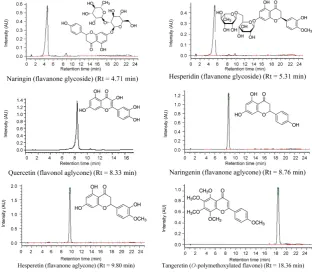
Orange peels are a good source of flavonoids such as glycosides and polyme-thoxylated flavones [11].Orange peel extracts of different citrus varieties were prepared in methanol, hexane and DMSO. The flavonoid content in the orange peels was quantified using external standards such as quercetin, hesperidin, hes-peretin, naringin, naringenin and tangeretin (Figure 1).
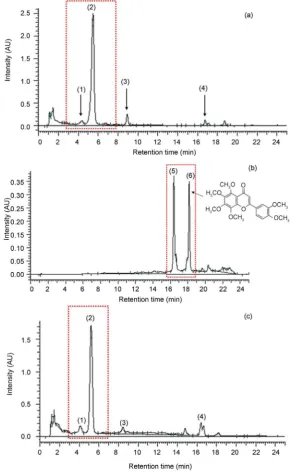
Typical chromatograms of the extracts are shown in Figure 2. The most ab-undant flavonoid extracted by DMSO and methanol, in all orange peels studies, was hesperidin (Table 1).
[image:4.595.217.530.433.705.2]More polar solvents like methanol or DMSO display better extraction effi-ciency of glycoside flavanones such as naringin, hesperidin and naringenin. Quercetin (aglycone flavonol) was identified in some orange peels extracted with these same solvents. Quercetin was identified in peels of Navel variety citrus [27]. However, hexane is the solvent of choice to extract polymethoxylated fla-vones, such as tangeretin. Nobiletin, which is also a polymethoxylated flavone,
was identified in the extracts by comparison with the UV-Vis spectra library, but it was not quantified (Figure 2).
3.2. Effect of the Extracting Solvents on the Orange Peels
Composition
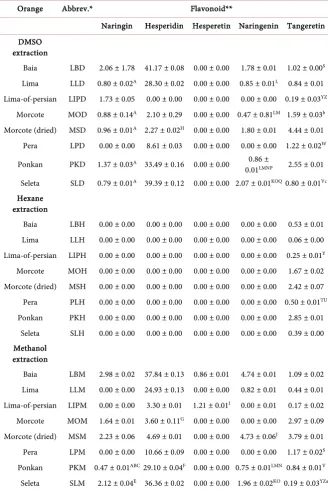
[image:5.595.227.519.206.680.2]The multivariate analysis, showed a selective extraction of flavonoids using dif-ferent solvents. The extractions of the orange peels were named in accordance with the solvent used in the extraction and type of orange (Table 1).
Table 1. Flavonoids in orange peels (expressed in mg of each flavonoid per gram of dried peel)*.
Orange Abbrev.* Flavonoid**
Naringin Hesperidin Hesperetin Naringenin Tangeretin DMSO
extraction
Baia LBD 2.06 ± 1.78 41.17 ± 0.08 0.00 ± 0.00 1.78 ± 0.01 1.02 ± 0.00S
Lima LLD 0.80 ± 0.02A 28.30 ± 0.02 0.00 ± 0.00 0.85 ± 0.01L 0.84 ± 0.01
Lima-of-persian LIPD 1.73 ± 0.05 0.00 ± 0.00 0.00 ± 0.00 0.00 ± 0.00 0.19 ± 0.03YZ
Morcote MOD 0.88 ± 0.14A 2.10 ± 0.29 0.00 ± 0.00 0.47 ± 0.81LM 1.59 ± 0.03b
Morcote (dried) MSD 0.96 ± 0.01A 2.27 ± 0.02H 0.00 ± 0.00 1.80 ± 0.01 4.44 ± 0.01
Pera LPD 0.00 ± 0.00 8.61 ± 0.03 0.00 ± 0.00 0.00 ± 0.00 1.22 ± 0.02W
Ponkan PKD 1.37 ± 0.03A 33.49 ± 0.16 0.00 ± 0.00 0.86 ±
0.01LMNP 2.55 ± 0.01
Seleta SLD 0.79 ± 0.01A 39.39 ± 0.12 0.00 ± 0.00 2.07 ± 0.01KOQ 0.80 ± 0.01Vc
Hexane extraction
Baia LBH 0.00 ± 0.00 0.00 ± 0.00 0.00 ± 0.00 0.00 ± 0.00 0.53 ± 0.01 Lima LLH 0.00 ± 0.00 0.00 ± 0.00 0.00 ± 0.00 0.00 ± 0.00 0.06 ± 0.00 Lima-of-persian LIPH 0.00 ± 0.00 0.00 ± 0.00 0.00 ± 0.00 0.00 ± 0.00 0.25 ± 0.01Y
Morcote MOH 0.00 ± 0.00 0.00 ± 0.00 0.00 ± 0.00 0.00 ± 0.00 1.67 ± 0.02 Morcote (dried) MSH 0.00 ± 0.00 0.00 ± 0.00 0.00 ± 0.00 0.00 ± 0.00 2.42 ± 0.07 Pera PLH 0.00 ± 0.00 0.00 ± 0.00 0.00 ± 0.00 0.00 ± 0.00 0.50 ± 0.01TU
Ponkan PKH 0.00 ± 0.00 0.00 ± 0.00 0.00 ± 0.00 0.00 ± 0.00 2.85 ± 0.01 Seleta SLH 0.00 ± 0.00 0.00 ± 0.00 0.00 ± 0.00 0.00 ± 0.00 0.39 ± 0.00 Methanol
extraction
Baia LBM 2.98 ± 0.02 37.84 ± 0.13 0.86 ± 0.01 4.74 ± 0.01 1.09 ± 0.02 Lima LLM 0.00 ± 0.00 24.93 ± 0.13 0.00 ± 0.00 0.82 ± 0.01 0.44 ± 0.01 Lima-of-persian LIPM 0.00 ± 0.00 3.30 ± 0.01 1.21 ± 0.01I 0.00 ± 0.01 0.17 ± 0.02
Morcote MOM 1.64 ± 0.01 3.60 ± 0.11G 0.00 ± 0.00 0.00 ± 0.00 2.97 ± 0.09
Morcote (dried) MSM 2.23 ± 0.06 4.69 ± 0.01 0.00 ± 0.00 4.73 ± 0.06J 3.79 ± 0.01
Pera LPM 0.00 ± 0.00 10.66 ± 0.09 0.00 ± 0.00 0.00 ± 0.00 1.17 ± 0.02S
Ponkan PKM 0.47 ± 0.01ABC 29.10 ± 0.04F 0.00 ± 0.00 0.75 ± 0.01LMN 0.84 ± 0.01V
Seleta SLM 2.12 ± 0.04E 36.36 ± 0.02 0.00 ± 0.00 1.96 ± 0.02KO 0.19 ± 0.03YZa
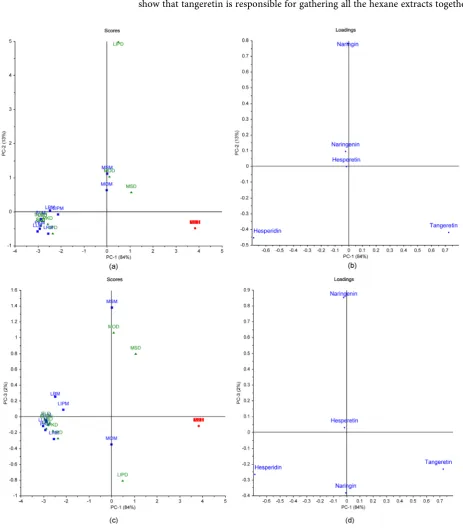
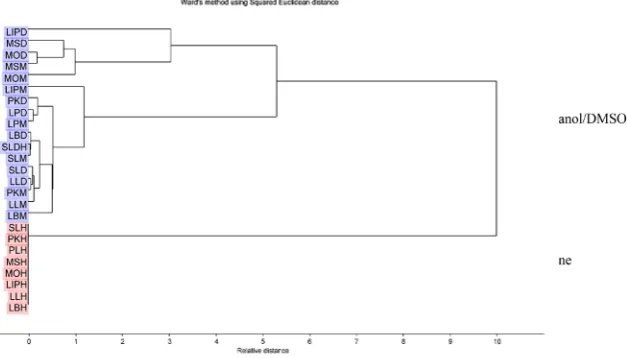
In the PCA of Figure 3 it is possible to observe the separation of the extracts in three groups according to their chemical composition and extracting solvent. PC1 and PC2 can explain 97% of the data variance, and the accumulated va-riance of PC3 is 99%. The hexane extracts are clustered together while there is no clear separation between the methanol and DMSO extracts. The loadings plot show that tangeretin is responsible for gathering all the hexane extracts together
and higher levels of hesperidin are observed in one of the other groups. The presence and the quantity of naringenin, hesperetin, hesperidin and naringin in the methanol and DMSO extracts, have clustered these samples into two groups. The hierarchical clustering analysis (HCA), using Ward`s method, clustered the samples in two groups with a relative distance lower than 5.5 (Figure 4), one belonging to the hexane extract and the other one included the other two ex-tracting solvents. The relative distance is the parameter that determines how similar the samples are, and low values indicate more similarity as it can be ob-served in samples extracted with methanol and DMSO. Among the ten orange varieties analyzed, it was possible to treat six of them with two different solvents (Table 1), DMSO and methanol. When DMSO was used, the main flavonone extracted was hesperidin in orange peels of bahia (LBD), lima (LLD), seleta (SLD) and ponkan (PKD). The extraction with methanol yielded higher amounts of hesperidin and hesperetin in lima-of-persian peels (LIPM) and thus it was the most efficient solvent for the extraction of these substances. Naringin and tangeretin, on the other hand, were only observed in the DMSO extracts, revealing a selective separation with these solvents (Table 1).
The extraction of hesperetin in bahia (LBM) and lima-of-persian (LIPM) oranges, was only observed in methanol, which supports the statement that me-thanol is the best solvent to extract hesperidin aglycones, when compared to DMSO and hexane.
The amount of naringenin found in all the orange peels studied was very low, only being observed in the extraction with DMSO. This solvent was also more efficient than methanol in the extraction of tangeretin, however, hexane was the most efficient and selective solvent in the extraction of tangeretin and other po-lymetoxylated flavanones. None of the flavanones were detected in the hexane extract (Figure 2). This study also shows that hexane is a very selective solvent to extract polymethoxy flavones.
[image:8.595.218.532.525.704.2]An attempt to increase the flavonones extraction was made using DMSO, after
extracting seleta peels with hexane obtaining the following concentrations (in mg∙g−1): naringin from 0.792 ± 0.002 to 2.301 ± 0.077, hesperidin from 39.388 ±
0.119 to 47.339 ± 1.128, naringenin from 2.074 ± 0.006 to 2.318 ± 0.023 (small change). This study shows that this consecutive extraction was more efficient in the extraction of naringin, hesperidin and naringenin, than when using DMSO alone (Table 1).
This selective extraction of flavonoids is a step forward to separate glycosides flavanones (hesperidin and naringin) from their aglycones (hesperetin and nari-genin) and polymethoxylated flavones (tangeretin) (Figure 3).
The amount of flavanones and polymethoxyflavones found in orange peels was always higher than those found in their corresponding juices according to the literature. That is the case of the pera variety (Citrus sinensis Osbeck) whose concentration of hesperidin found in the orange juice was 0.269 mg∙g−1 [28]
which is lower than the amount found in the respective peel that was 8.61 mg∙g−1
(Table 1). The bahia variety orange juice presented 0.427 mg∙g−1 of this
sub-stance [28] while the concentration in the orange peels was 41.17 mg∙g−1 (LBD, Table 1). The same situation was observed in the lima variety juice which pre-sented 0.223 mg∙g−1 of hesperidin and its peel contained 28.30 mg∙g−1 (LLD, Ta-ble 1). The hesperidin content of the orange juice of the Citrus sinensis Osbeck variety, was similar to that reported in the literature, however the amount of na-ringin and naringenin was much lower [29]. Similar behavior was observed in other citrus fruit juices from industries all over the world [30].
Molina-Calle et al.[21] reported that the most abundant glycoside flavanones in citrus peels from Spain were naringin, hesperidin and neohesperidin. M’hiri
et al.[31] used different operating conditions, such as ultrasound, microwave, supercritical CO2 and high pressure for the flavonoid extraction from oranges
(Citrus sinensis) of the Maltese variety. They found that the best condition to extract hesperidin was ultrassonic extration at 125W (8.362 ± 0.296 mg∙g−1) and
microwave, 200 W (9.289 ± 0.007 mg∙g−1). The most abundant flavonoids were
hesperidin and neohesperidin.
It was reported that capillary electrophoresis (CE) coupled to mass spectro-metry (MS) is a good technique to identify and quantify flavonoids in bitter and sweet orange peel samples. The authors found 5.1 ± 0.2 and 7.9 ± 0.7 mg∙g−1 of
naringin and neohesperidin in bitter orange peel and 26.9 ± 2.1 and 35.2 ± 3.6 mg∙g−1 of narirutin and hesperidin in sweet orange peel, respectively. In this
study the amounts found were between 0.47 ± 0.01 mg∙g−1 (PKM) to 2.98 ± 0.02
mg∙g−1 (LBM) of naringin and between 2.10 ± 0.29 mg/g (MOD) to 41.17 ± 0.08
mg∙g−1 (LBD) of hesperidin, showing a similar amount of the latter as reported
in the literature [32][33].
Liu et al.[23] analyzed the dried ripe pericarp of Citrus reticulata Blanco (the mandarin orange) collected in different parts of China and found contents of naringin between 0.556 ± 0.009 mg∙g−1 and 4.202 ± 0.040 mg∙g−1, amounts of
hesperidin from 50.137 ± 0.301 mg∙g−1 to 100.525 ± 1.398 mg∙g−1 and tangeretin
concen-tration range of those described by these authors.
Chen et al.[34] reported that the most abundant flavonoid in oranges peels from different places such as China, Canada, and the United States, was hesperi-din, as it was observed in the current study. Orange peels showed both antioxi-dant and anti-inflammatory activities. The presence of hesperidin as a major component in Citrus peels was confirmed by Guccione et al. [35] using HPLC- DAD and HPLC-MS techniques.
3.3. Extraction of Orange Peels only with DMSO
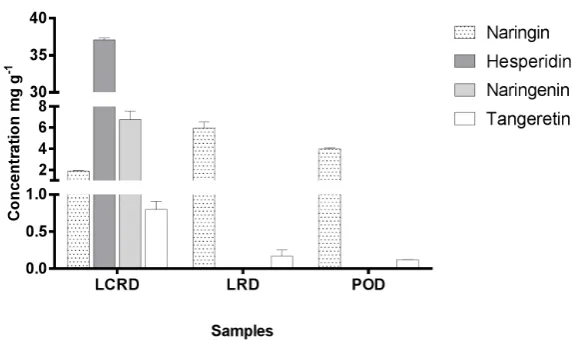
Orange peels from other citrus species were extracted only with DMSO: cravo (Citrus reticulata Blanco) (LCRD), kinkan (Fortunella margarita) (LRD) [36] and pomelo (Citrus paradisi Macfayden) (POD). The amount of naringin was (mg∙g−1): 1.892 ± 0.015 (LCRD), 5.978 ± 0.580 (LRD) and 3.980 ± 0.107 (POD).
Hesperidin and naringenin were found only in LCRD, in amounts of 37.076 ± 0.237 mg∙g−1 and 6.762 ± 0.805 mg∙g−1, respectively. Tangeretin was identified
and quantified in all samples (in mg∙g−1), 0.730 ± 0.203 (LCRD), 0.168 ± 0.017
(LRD) and 0.120 ± 0.002. Cravo peels extracted with DMSO (LCRD) showed the highest content of flavonoids (Figure 5).
3.4. Flavonoids in Industrial Orange Juice Processing Wastes
In the orange juice production industry, the process to obtain final products from available raw materials, involves a large amount of wastes. Several steps are performed and beyond juice, everything is used with a commercial purpose.
[image:10.595.229.520.532.702.2]Industrial orange juice processing wastes were extracted in DMSO. In this study, naringin, hesperidin and tangeretin, and flavonoids found in different amounts at each stage of the process were quantified. Naringenin and quercetin were not present at any of the steps (considering a detection limit of 0.003 mg/g) and hesperetin was only found in the CORE. The portion used in animal feed (BRD) was rich in hesperidin (greater amount), naringin and tangeretin (Table 2).
Figure 5. Concentration of flavonoids (mg∙g−1) found in orange peels extracted only with
Table 2. Flavonoids in wastes of orange juice (expressed in mg of each flavonoid per gram of wastes from orange juice).
Flavonoids**
Material* Naringin Hesperidin Hesperetin Naringenin Tangeretin BCGD 1.414 ± 0.004 22.631 ± 0.008 0.000 ± 0.000 0.000 ± 0.000 0.056 ± 0.001
BCD 3.197 ± 0.009A 42.728 ± 0.075C 0.000 ± 0.000 0.000 ± 0.000 0.136 ± 0.001E
BRD 5.072 ± 0.023A 44.236 ± 0.016C 0.000 ± 0.000 0.000 ± 0.000 1.930 ± 0.002EF
PUD 0.956 ± 0.011B 11.496 ± 0.007D 0.000 ± 0.000 0.000 ± 0.000 0.000 ± 0.000
CRD 5.807 ± 0.040A 34.206 ± 0.013C 2.149 ± 0.004 0.000 ± 0.000 0.000 ± 0.000
*Results in triplicates (± SD). Legend: BCGD, “Bagacilio”; BCD, Bagasse; BRD, Bagasse for animal food; PUD, Pulp WEUE and CRD, CORE. Means within a column of Narigin sharing the letter A are significant-ly increased (p > 0.05) by One-Way ANOVA compared to BCGD, B are significantsignificant-ly reduced (p > 0.05) by One-Way ANOVA compared to BCGD. Means within a column of Hesperidin sharing the letter C are sig-nificantly increased (p > 0.05) by One-Way ANOVA compared to BCGD, D are sigsig-nificantly reduced (p > 0.05) by One-Way ANOVA compared to BCGD. Means within a column of Tangeretin sharing the letter E are significantly increased (p > 0.05) by One-Way ANOVA compared to BCGD, F are significantly in-creased (p > 0.05) by One-Way ANOVA compared to BCD.
The finding that the concentration of these important compounds is higher in these fruit peels than in their juice clearly indicates that orange peels are an im-portant industry source [37][38]. The demonstrated possibilities of simple and selective extraction of these compounds entitles them as an alternative for in-dustrial production.
4. Conclusion
The extraction of flavanones and polymethoxylated flavones from orange peels of different citrus species, using different solvent systems, allowed the identifica-tion and quantificaidentifica-tion of the flavonoid composiidentifica-tion in each Brazilian citrus va-riety and the selection of the best solvent for the extraction of each specific class of flavonoids. It was determined that hexane is a selective solvent to extract po-lymethoxy flavones like tangeretin. The consecutive extraction using hexane and then DMSO was more efficient in the extraction of naringin, hesperidin and na-ringenin, than when using DMSO alone. The extracting procedures used in this work showed that these compounds are more abundant in the fruit peels than in their juices, revealing their great industrial potential. Industrial orange juice processing wastes, in all the processing steps, are also rich in hesperdin, with similar (or proportional) amounts as the ones found in the peels, and thus they are a promising source of this flavonoid. The combination of techniques such as HPLC-DAD and PCA is a powerful tool to evaluate clusters and confirm, in this case, what solvent is most effective extracting flavonoids in orange peels.
Acknowledgements
[image:11.595.207.539.101.222.2]References
[1] Hertog, M.G.L., Feskens, E.J.M., Kromhout, D., Hollman, P.C.H. and Katan, M.B. (1993) Dietary Antioxidant Flavonoids and Risk of Coronary Heart Disease: The Zutphen Elderly Study. The Lancet, 342, 1007-1011.
https://doi.org/10.1016/0140-6736(93)92876-U
[2] Benavente-García, O., Castillo, J., Marin, F.R., Ortuño, A. and Del Río, J.A. (1997) Uses and Properties of Citrus Flavonoids. Journal of Agricultural and Food Chemi-stry, 45, 4505-4515. https://doi.org/10.1021/jf970373s
[3] Yao, L.H., Jiang, Y.M., Shi, J., Tomás-Barberán, F.A., Datta, N., Singanusong, R. and Chen, S.S. (2004) Flavonoids in Food and Their Health Benefits. Plant Foods for Human Nutrition, 59, 113-122. https://doi.org/10.1007/s11130-004-0049-7
[4] Benavente-García, O. and Castillo, J. (2008) Update on Uses and Properties of Ci-trus Flavonoids: New Findings in Anticancer, Cardiovascular, and Anti-Inflam- matory Activity. Journal of Agricultural and Food Chemistry, 56, 6185-6205.
https://doi.org/10.1021/jf8006568
[5] Manthey, J.A., Guthrie, N. and Grohmann, K. (2001) Biological Properties of Citrus Flavonoids Pertaining to Cancer and Inflammation. Current Medicinal Chemistry, 8, 135-153. https://doi.org/10.2174/0929867013373723
[6] Tripoli, E., Guardia, M.L., Giammanco, S., Majo, D.D. and Giammanco, M. (2007) Citrus Flavonoids: Molecular Structure, Biological Activity and Nutritional Proper-ties: A Review. Food Chemistry, 104, 466-479.
[7] Cavia-Saiz, M., Busto, M.D., Pilar-Izquierdo, M.C., Ortega, N., Perez-Mateos, M. and Muñiz, P. (2010) Antioxidant Properties, Radical Scavenging Activity and Biomolecule Protection Capacity of Flavonoid Naringenin and Its Glycoside Narin-gin: A Comparative Study. Journal of Science of Food and Agriculture, 90, 1238- 1244. https://doi.org/10.1002/jsfa.3959
[8] Madeira Jr., J.V. and Macedo, G.A. (2015) Simultaneous Extraction and Biotrans-formation Process to Obtain High Bioactivity Phenolic Compounds from Brazilian Citrus Residues. Biotechnology Progress, 31, 1273-1279.
https://doi.org/10.1002/btpr.2126
[9] Sergent, T., Vanderstraeten, J., Winand, J., Beguin, P. and Schneider, Y.J. (2012) Phenolic Compounds and Plant Extracts as Potential Natural Anti-Obesity Sub-stances. Food Chemistry, 135, 68-73.
[10] Arabbi, P.R., Genovese, M.I. and Lajolo, F.M. (2004) Flavonoids in Vegetable Foods Commonly Consumed in Brazil and Estimated Ingestion by the Brazilian Popula-tion. Journal of Agricultural and Food Chemistry, 52, 1124-1131.
https://doi.org/10.1021/jf0499525
[11] Hernández-Carranza, P., Ávila-Sosa, R., Guerrero-Beltrán, J.A., Navarro-Cruz, A.R., Corona-Jiménez, E. and Ochoa-Velasco, C.E. (2016) Optimization of Anti-oxidant Compounds Extraction from Fruit By-Products: Apple Pomace, Orange and Banana Peel. Journal of Food Processing and Preservation, 40, 103-115.
https://doi.org/10.1111/jfpp.12588
[12] Ghasemi, K., Ghasemi, Y. and Ebrahimzadeh, M.A. (2009) Antioxidant Activity, Phenol and Flavonoid Contents of 13 Citrus Species Peels and Tissues. Pakistan Journal of Pharmaceutical Sciences, 22, 277-281.
[13] Bocco, A., Cuvelier, M.E., Richard, H. and Berset, C. (1998) Antioxidant Activity and Phenolic Composition of Citrus Peel and Seed Extracts. Journal of Agricultural and Food Chemistry, 46, 2123-2129. https://doi.org/10.1021/jf9709562
Boskou, D. (2006) Radical Scavenging Activity of Various Extracts and Fractions of Sweet Orange Peel (Citrus sinensis). Food Chemistry, 94, 19-25.
[15] Hirano, T., Abe, K., Gotoh, M. and Oka, K. (1995) Citrus Flavone Tangeretin Inhi-bits Leukaemic HL-60 Cell Growth Partially through Induction of Apoptosis with Less Cytotoxicity on Normal Lymphocytes. British Journal of Cancer, 72, 1380- 1388. https://doi.org/10.1038/bjc.1995.518
[16] Itoigawa, M., Takeya, K. and Furukawa, H. (1994) Cardiotonic Flavonoids from Ci-trus Plants (Rutaceae).Biological and Pharmaceutical Bulletin, 17, 1519-1521.
https://doi.org/10.1248/bpb.17.1519
[17] Ehler, S.A. (2011) Citrus and Its Benefits. Journal of Botany, 5, 201-207.
[18] So, F.V., Guthrie, N., Chambers, A.F., Moussa, M. and Carroll, K.K. (1996) Inhibi-tion of Human Breast Cancer Cell ProliferaInhibi-tion and Delay of Mammary Tumorige-nesis by Flavonoids and Citrus Juices. Nutrition and Cancer, 26, 167-181.
https://doi.org/10.1080/01635589609514473
[19] Ramos, S. (2007) Effects of Dietary Flavonoids on Apoptotic Pathways Related to Cancer Chemoprevention. Journal of Nutritional Biochemistry, 18, 427-442.
https://doi.org/10.1016/j.jnutbio.2006.11.004
[20] Meiyanto, E., Hermawan, A. and Anindyajati, A. (2012) Natural Products for Can-cer-Targeted Therapy: Citrus Flavonoids as Potent Chemopreventive Agents. Asian Pacific Journal of Cancer Prevention, 13, 427-436.
https://doi.org/10.7314/APJCP.2012.13.2.427
[21] Molina-Calle, M., Priego-Capote, F. and Luque de Castro, M.D. (2015) Develop-ment and Application of a Quantitative Method for Determination of Flavonoids in Orange Peel: Influence of Sample Pretreatment on Composition. Talanta, 144, 349- 355.
[22] Nijveldt, R.J., van Nood, E., van Hoorn, D.E., Boelens, P.G., van Norren, K. and van Leeuwen, P.A. (2001) Flavonoids: A Review of Probable Mechanisms of Action and Potential Applications. American Journal of Clinical Nutrition, 74, 418-425. [23] Liu, E.H., Zhao, P., Duan, L., Zheng, G.D., Guo, L., Yang, H. and Li, P. (2013)
Si-multaneous Determination of Six Bioactive Flavonoids in Citri reticulatae Pericar-pium by Rapid Resolution Liquid Chromatography Coupled with Triple Quadru-pole Electrospray Tandem Mass Spectrometry. Food Chemistry, 141, 3977-3983. [24] Abad-García, B., Garmón-Lobato, S., Berrueta, L.A., Gallo, B. and Vicente, F. (2012)
On Line Characterization of 58 Phenolic Compounds in Citrus Fruit Juices from Spanish Cultivars by High-Performance Liquid Chromatography with Photodi-ode-Array Detection Coupled to Electrospray Ionization Triple Quadrupole Mass Spectrometry. Talanta, 99, 213-224.
[25] Ćirić, A., Prosen, H., Jelikić-Stankov, M. and Durđević, P. (2012) Evaluation of Ma-trix Effect in Determination of Some Bioflavonoids in Food Samples by LC-MS/MS method. Talanta, 99, 780-790.
[26] Da Rocha, A.S. (2006) Características bioquímicas em cascas, folhas e talos de vege- tais pós-colheita em sistema de produção convencional e orgânico. Dissertation, Unesp, Botucatu, SP, Brasil.
[27] Omoba, O.S., Obafaye, R.O., Salawu, S.O., Boligon, A.A. and Athayde, M.L. (2015) HPLC-DAD Phenolic Characterization and Antioxidant Activities of Ripe and Un-ripe Sweet Orange Peels. Antioxidants, 4, 498-512.
https://doi.org/10.3390/antiox4030498
[29] Cerqueira, L.C.R., David, J.M., Borges, R.S.Q., Ferreira, S.L.C., David, J.P., Reis, P.S., and Bruns, R.E. (2014) Determination of Flavanones in Orange Juices Obtained from Different Sources by HPLC/DAD. Journal of Analytical Methods in Chemi-stry, 14, 13-18.
[30] Mouly, P., Gaydou, E.M. and Auffray, A. (1998) Simultaneous Separation of Flava-none Glycosides and Polymethoxylated Flavones in Citrus Juices Using Liquid Chromatography. Journal of Chromatography A, 800, 171-179.
[31] M’hiri, N., Ioannou, I., Mihoubi Boudhrioua, N. and Ghoul, M. (2015) Effect of Different Operating Conditions on the Extraction of Phenolic Compounds in Orange Peel. Food and Bioproducts Processing, 96, 161-170.
https://doi.org/10.1016/j.fbp.2015.07.010
[32] Sawalha, S.M.S., Arráez-Román, D., Segura-Carretero, A. and Fernández-Gutiérrez, A. (2009) Quantification of Main Phenolic Compounds in Sweet and Bitter Orange Peel Using CE-MS/MS. Food Chemistry, 116, 567-574.
[33] Massenti, R., Lo Bianco, R., Sandhu, A.K., Gu, L. and Sims, C. (2016) Huanglongb-ing Modifies Quality Components and Flavonoid Content of “Valencia” Oranges.
Journal of Science and Food Agriculture, 96, 73-78.
https://doi.org/10.1002/jsfa.7061
[34] Chen, X.M., Tait, A.R. and Kitts, D.D. (2017) Flavonoid Composition of Orange Peel and Its Association with Antioxidante and Anti-Inflammatory Activities. Food Chemistry, 218, 15-21.
[35] Guccione, C., Bergonzi, M.C., Piazzini, V. and Bilia, A.R. (2016) A Simple and Rapid HPLC-PDA MS Method for the Profiling of Citrus Peels and Traditional Italian Liquors. Planta Medica, 82, 1039-1045.
https://doi.org/10.1055/s-0042-108735
[36] Diniz, A.B. and Oliveira, D.R. (2015) Composição química da laranja kinkan e de frutas cítricas. Demetra, 10, 835-844.
[37] Shahwar, D., Raza, M.A. and Atta, U.R. (2013) Identification of Flavonoids with Trypsin Inhibitory Activity Extracted from Orange Peel and Green Tea Leaves.
Journal of Science of Foods and Agriculture, 93, 1420-1426.
https://doi.org/10.1002/jsfa.5910
[38] Munhoz, J.R. and Morabito, R. (2010) Otimização no planejamento agregado de produção em indústrias de processamento de suco concentrado congelado de laranja. Gestão & Produção, 17, 465-481.
Submit or recommend next manuscript to SCIRP and we will provide best service for you:
Accepting pre-submission inquiries through Email, Facebook, LinkedIn, Twitter, etc. A wide selection of journals (inclusive of 9 subjects, more than 200 journals)
Providing 24-hour high-quality service User-friendly online submission system Fair and swift peer-review system
Efficient typesetting and proofreading procedure
Display of the result of downloads and visits, as well as the number of cited articles Maximum dissemination of your research work
Submit your manuscript at: http://papersubmission.scirp.org/