Abstract—This paper is devoted to development of methodology of system analysis of power distribution systems and development of methods of synthesis of objective laws in the power distribution among drive wheels of a multipurpose wheel vehicle.
The methodology of system analysis provides for formulation of the problem; structural analysis of power distribution systems; the synthesis of objective laws in the power distribution; development of methods for their implementation. The methodology is based on the theory of the synthesis of technical systems. In this paper it has been solved the inverse problem of dynamics, namely: in accordance with specified requirements to effectiveness of the multipurpose wheeled vehicle, expressed in the form of formulated performance criteria, it is necessary to determine parameters of characteristics of control actions. The main stages of the methodology for determining of the objective laws of the power distribution among the drive wheels of the machine are: formulation of the optimization problem; computational procedure and definition of the basic laws of the power distribution; adaptation of the basic laws, and assessment of the effectiveness of proposed solutions.
We have developed a new principle of power distribution, providing the required level of mobility of the multipurpose wheeled vehicle (the principle of the modified regulation of slippage of the drive wheels): power delivered to the drive wheels has to be distributed among them in such a way as to ensure in every moment of time their proportional slipping.
Application of the methodology of system analysis allows us to improve the quality of design of the systems of power distribution among drive wheels and to design multi-purpose wheeled vehicles with optimal parameters.
Index Terms—Analysis, mechanical transmission, power distribution, truck
Manuscript received March 10, 2015; revised April 6, 2015. The work was conducted with the financial support of the Ministry of Education and Science of the Russian Federation in the framework of the complex project "Development of scientific and technical solutions for control of power distribution in transmissions of trucks to improve their energy efficiency and fuel economy" according to the contract no. 14.574.21.0106 d.d. 08.09.2014 between the Ministry of Education and Science of the Russian Federation and the applied R&D works performer - Federal State Educational Institution of Higher Professional Education "South Ural State University" (National Research University). Unique identifier for the applied R&D (project) is RFMEFI57414X0106.
A. V. Keller is with the South Ural State University, 76 Prospekt
Lenina, Chelyabinsk, 454080, Russian Federation (e-mail:
S. V. Aliukov is with the South Ural State University, 76 Prospekt Lenina, Chelyabinsk, 454080, Russian Federation (corresponding author, home phone: +7-351-267-97-81; sell phone: 8-922-6350-198; e-mail: [email protected]).
I. INTRODUCTION
ETHODS of system analysis for systems of power distribution and development of the methods for the synthesis of the power distribution among drive wheels of multipurpose wheel vehicles are extremely important to design multipurpose wheel vehicle with optimal parameters and characteristics in a proper way [1,2].
In this paper we consider methodology of the system analysis of power distribution system. This system provides the following stages: formulation of the problem; structural analysis of the power distribution system; synthesis of lows for the power distribution; development of methods for their implementation. Application of the methods of the system analysis will allow improving the quality of design of the power distribution systems and creating the multipurpose wheeled vehicles with optimal parameters [3].
II. BASIS OF THE METHODOLOGY
The basis of the methodology for determining the patterns of the power distribution among the drive wheels of the vehicles is the theory of synthesis of technical systems. This solves the inverse problem of dynamics: to specify performance parameters of control actions depending on requirements for effectiveness of the multipurpose wheeled vehicles, expressed in the form of formulated performance criteria [4].
The main stages (Fig. 1) of the methods for determining patterns of the power distribution among the drive wheels of the vehicles are: formulation of the problem of optimization; computational procedure and definition of the basic patterns of power distribution; adaptation of the basic patterns and assessment of the effectiveness of the proposed solutions.
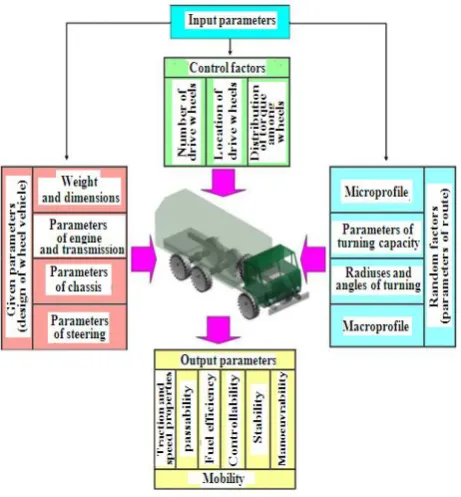
On the stages of setting objectives and determining the basic patterns of the power distribution among the drive wheels, the vehicles is considered as an object of multi-objective optimization (Fig. 2).
A. Formulation of optimization problem
In this paper the basic requirements for the power distribution system among the drive wheels MKM have been formulated to provide the required level of mobility [5,6].
Depending on their functions the multipurpose wheeled vehicles are divided into 4 groups, each of which has its own performance indicators: weight-mounted or (and) towing capacity; the average velocity on route υср,, and energy costs
Еdv on the motion.
To determine the patterns of the power distribution there were formulated four optimization problems. The most
Efficient Power Distribution in an All-wheel
Drive Truck
A. Keller, S. Aliukov
common is the fourth problem, namely: to find an admissible control of the power distribution carrying the vehicle with maximum load (mounted, trailer load, and so on) from the start point to the end point in the minimum time and with the lowest possible energy consumption.
[image:2.595.55.286.495.744.2]Fig. 1. Stages of the synthesis of laws of the power distribution
Fig. 2. Block diagram of the operation of multipurpose vehicle
Optimization criteria are the following:
;
1 кр
Р p k
вк P
вк n
f
;
2 ср
p k
вк P
вк n
f
,
3
Едв p kвк P
вк n
f
(1)
here пвкis number of driving wheels of the total number of wheels of the vehicles; Рвк is location of the drive wheels; kр
is coefficient of the power distribution among the drive wheels.
The objective function is the following:
p k
вк P
вк n i f i p k p k
вк P
вк n
F minmax
4
.
(2)
There are some restrictions:
- providing the principle possibility of motion of the vehicle;
- imposed on the grip of the wheel with the supporting surface;
- restrictions on the allowable values of wheel slippage, which determine the depth of formed gauge;
- restrictions on the allowable velocity.
Average velocity is determined by the value of accelerations realized in terms of conditions of motion which, in turn, are determined on the one hand by implemented traction control, and on the other hand by loss of engine power. Therefore, the four problems of searching the average velocity and the lowest power consumption are equivalent.
B. Number of drive wheels depending on some conditions
Number of drive wheels is determined by selecting the highest (rounded up to an even integer) number from received ones under the following conditions (3)-(5): - mobility:
,
1
n i zi iconp n
R
P
n
(3)- controllability:
, 5
3 2
1 2 2
2
n i
i z
conp y
R m R
P n
(4)
- economy:
, 1 4
1 2
1 2
mp conp э
P P
n (5)
here ∑Рсопр is sum of external and internal forces of
resistance to movement; Rzi , mi are vertical load and weight,
respectively, attributable to the i-th wheel; φi is friction
coefficient of i-th wheel with supporting surface, υ is velocity of the vehicle; λ is coefficient of tangential elasticity; R is turning radius; Ртр is friction force in the
transmission aggregate.
to the parameters of the vehicle, the external environment, and by control actions of driver. To this end information obtained in the process of simulation is exposed to correlation and regression analysis.
Besides, we would like you to notice that as a continuously variable transmission we can use the inertial transmission with high load ability [7].
III. MATHEMATICAL MODEL OF THE SYSTEMS OF POWER
DISTRIBUTION
Evaluation of the effectiveness of the systems of power distribution is proposed to provide during the simulation of motion of the vehicle on standard routes (on the example of road network of likely strategic directions). To compare the performance of the mobility, modeling of motion of the vehicle with serial and optimal power distribution on a standard route is done. Besides, indicators of mobility are, defined and their values are compared with each other [8].
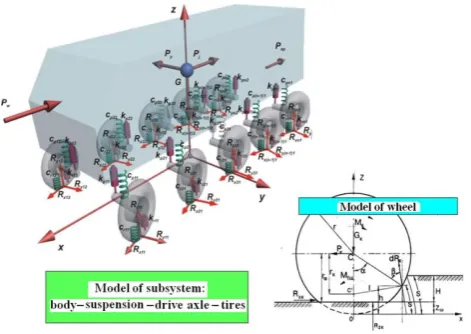
[image:3.595.53.289.423.590.2]As an example of the developed methodology in this paper there were synthesized patterns of the power distribution among propulsion of vehicle of the following types: 4x4, 6x6, 8x8. For this aim it has been developed the mathematical model of the motion of the vehicles on the basis of the design scheme shown in Fig. 3 with usage of methods of theoretical mechanics and applied theory of vehicles. As a prototype for the compilation of the model vehicles of the family "Mustang," namely KAMAZ-4350, KAMAZ-5350, KAMAZ-6350 were used in this investigation.
Fig. 3. Block diagram of the system: "multipurpose wheeled vehicle - environment"
In drawing up the mathematical model of the vehicle on operation mode, the method of system decomposition was used. For this aim , the system which was under consideration, namely "multipurpose wheeled vehicle - environment" was divided into three subsystems: the "engine - transmission - driving wheels"; "carrier system (body) - suspension - drive axles - tires"; "external environment." Since these equations of the subsystem "wheel" contain derivatives of the generalized coordinates of all selected subsystems, they combine the individual autonomous subsystems into a single system (6).
The mathematical model of the "wheel" subsystem describes the relationship between kinematic and force
factors that arise when the wheel rolls.
A. Distinctive features of the model
Distinctive features of the model are:
- neutral mode of rolling of wheels is accepted as a mode of rolling without slipping;
- the effect of various design and operational parameters on the coefficients of tangential elasticity of the system "tire-wheel" and the rolling resistance is taken into account by functional factors, which are the product of partial correction functions.
Values of the partial functions for correction of coefficient of rolling resistance, taking into account the impact of changes of normal load and air pressure, the torque, the type and size of the bearing surface irregularities are established in the course of experimental studies.
B. The mathematical model
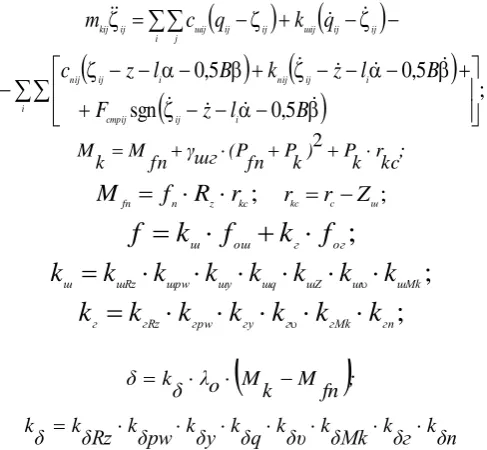
In the whole, the system "multipurpose wheeled vehicle - environment" is described by the following system of equations:
;
sgn
1
уij уij тр тр ддij yij дij дijдij
М
М
и
M
M
М
J
тмij;
c kij ij zkij xkij mp ддij yij kij
kij
M
M
u
R
R
f
r
М
J
; 2 i j c
kij r i Н kij J
nтмп дпр F упр F w F м mg
i j Rxkij Rzkij fcpij cpij Rykij kij
c х
i j c
kij r kij J т
(
)
м;
i j xkij zkij ij kij ykij
c
R
R
f
R
mg
у
т
(6)
i j i ij cmpij i ij nij i ij nij c;
β
B
,
α
l
z
ζ
F
β
B
,
α
l
z
ζ
k
Bβ
,
α
l
z
ζ
c
z
m
5
0
sgn
5
0
5
0
i
j
;
β
c
gh
n
m
i j ij
Y
c
h
β
B
,
α
i
l
z
ij
ζ
cmpij
F
β
B
,
α
i
l
z
ij
ζ
nij
k
Bβ
,
α
i
l
z
ij
ζ
nij
c
B
,
β
x
mρ
5
0
sgn
5
0
5
0
5
0
2
0
,
5
;
sgn
5
,
0
5
,
0
2
i j i
i ij cmpij i ij nij i ij nij y
l
B
l
z
F
B
l
z
k
B
l
z
c
m
;
5
,
0
2
i j cnij i j yij
i j xij zkij ij ij
z
B
R
R
f
R
M
i
i ij cmpij
i ij nij i
ij nij
i j ij ij
шij ij ij шij ij
kij
B
l
z
F
B
l
z
k
B
l
z
c
q
k
q
c
т
;
5
,
0
sgn
5
,
0
5
,
0
; kc r k P ) k P fn (P шг γ fn M k
M 2
;
kc z n
fn
f
R
r
M
r
kc
r
c
Z
ш;
;
ог г ош
ш
f
k
f
k
f
;
шMk ш шZ шq шy шpw шRz
ш
k
k
k
k
k
k
k
k
;
гп гMk г гy гpw гRz
г
k
k
k
k
k
k
k
;fn M k M o λ δ k
δ
δп k δг k δMk k δυ k δq k δy k δpw k δRz k δ
k
IV. RESULTS OF NUMERICAL SOLUTION
[image:4.595.48.292.49.274.2]With help of numerical solution of the optimization problem in MathCAD environment it was found that the relationship among slipping drive wheels has three distinct zones (Fig. 4): the negative slippage (sliding) of the drive wheels of the front axle (front axles); equality of slipping; proportionality slipping.
Fig. 4. Optimum ratio of the coefficients of slipping of multipurpose wheeled vehicle 4x4 (a) and 6X6 (b)
Based on the investigation a new principle of distribution of power among propulsions of multipurpose wheeled vehicle has been established (the principle of the modified control slippage of the drive wheels): the power delivered to the drive wheels should be distributed among them in such a way that at any given time to ensure the proportionality of their slipping:
i i
k
k
1
2
2
...
, (7)here k is coefficient of proportionality depending on the ratio of the coefficients λi of tangential elasticity of the pair "tire -
support surface," normal reactions of the support surface, and the external forces of resistance to movement.
The law of variation of the coefficient of proportionality k can be represented by the following system of equations:
Graphical representation of the law of variation of the coefficient of proportionality k is shown in Fig. 5.
V. IMPLEMENTATION OF THE OBTAINED RESULTS
For implementation of the principle of the modified control slipping of drive wheels, torque which let down to the drive wheel must be equal to the sum of moment of resistance on the rolling wheels Мfci and part of the torque for overcoming of external resistance forces МΣc. This part is proportional of towing capabilities of the wheel.
Value of the coefficient of the power distribution kpi ,
characterizing part of the engine's torque Мдв, attributable to the i - th wheel, can be found:
дв
ka n n
j
j j i i fci
pi
M
P
r
k
k
M
k
1 11
1
1
.
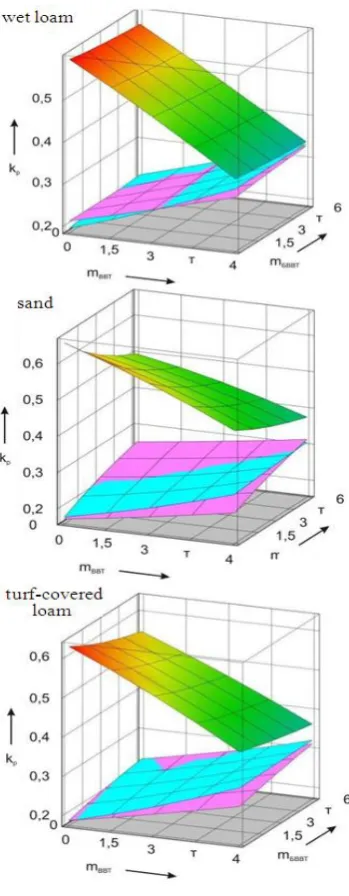
(9) [image:5.595.83.258.309.758.2]Fig. 6 shows the coefficients of the power distribution among the drive wheels of the vehicle with a different number of drive axes while moving in a variety of road conditions.
Fig. 6. Dependence of optimal power distribution in the vehicle of 6X6 type from mass of mounted and towed cargo
VI. CONCLUSIONS
1. In this paper we have developed a method of system analysis of the power distribution among drive wheels. Main objective of this method is the effective control for operation of the system. The technique provides a statement of the problem, structural analysis of the system of the power distribution, synthesis patterns of the power distribution, development of methods for their implementation. Application of the method of system analysis will improve the quality of system design of the power distribution and will create all-wheel drive vehicles with optimal parameters.
2. The system of the power distribution is hierarchically organized and purposeful functioning integrated finite set of data-related and interactive branching node points, combined with the control systems of the power plant, braking control, and control of air pressure in the tires. Number of the branching node points on one is less than the number of driving wheels.
3. For the analysis of the power distribution system in it three levels were allotted: low (level B), including the basic elements of the branching node points, medium (level B), containing the subsystems of the power distribution: axle and cross-axle differentials, power plant control system, etc., and highest - information level (level A) forming the principles of operation of the power distribution system.
4. It has been developed a method for the synthesis of patterns of the power distribution among the drive wheels of the vehicle and their adaptation to the real traffic conditions (with respect to probable strategic directions). The main stages of the methodology are: formulation of the optimization problem; computational procedure and the definition of the basic patterns of the power distribution; adaptation of the basic patterns and assessment of the effectiveness of the proposed solutions.
5. It has been established a new principle of power distribution, providing the required level of mobility of the vehicle (the principle of the modified control slippage of the drive wheels): the power, delivered to the drive wheels, shall be distributed among them in such a way that at any given time to ensure the proportionality of their slipping.
6. It has been founded that the optimal power allocation among the driving axles of the vehicle should be changed within the following intervals:
for vehicle 4x4: 0,761 ... 1,399 when driving on non-deformable ground; and 0,364...1,204 when driving on deformable ground;
for vehicle 6X6: 1.189 ... 2.23 when driving on non-deformable ground; and 0,526...1,654 when driving on deformable ground;
for vehicle 8x8: 0,959 ... 1,851 when driving on non-deformable ground; and 0,346...1,016 when driving on deformable ground.
with acceleration on roads with different traction under wheels of the various boards.
REFERENCES
[1] A. Keller, and I. Murog, “Principles and methods of distribution of
power among drive wheels of automobile chassis base,” Chelyabinsk, 2009, (in Russian).
[2] I. Pliev, “Multi-purpose vehicles,” Moscow, Moscow State Industrial
University, 2011, (in Russian).
[3] A. Buchacz, “Modelling, synthesis, modification, sensitivity and
analysis of mechanic and mechatronic systems,” Journal of Achievements in Materials and Manufacturing Engineering, # 1, 2007.
[4] R, Rajamani, “Vehicle Dynamics and Control,” New York, Springer,
2006.
[5] Thomas D. Gillespie, “Fundamentals of Vehicle Dynamics,” SAE
Publications Book, 1992.
[6] M. Hoeck, “The Influence of Various 4WD Driveline Configurations
on Handling and Traction on Low Friction Surfaces,” SAE, 1999.
[7] S. Alyukov, and S. Gladyshev, "Dynamics of an Inertial Continuously
Variable Transmission with High Load Ability," SAE Technical Paper 2013-01-2442, 2013, doi:10.4271/2013-01-2442.
[8] Y. Kim, K. Yun, K. Min, J., Mok, “A lateral dynamic model of an all