Proceedings of the 2019 Conference on Empirical Methods in Natural Language Processing
1236
An Empirical Study of Incorporating Pseudo Data
into Grammatical Error Correction
Shun Kiyono1,2 Jun Suzuki2,1 Masato Mita1,2 Tomoya Mizumoto1,2∗ Kentaro Inui2,1 1 RIKEN Center for Advanced Intelligence Project 2 Tohoku University
{shun.kiyono, masato.mita, tomoya.mizumoto}@riken.jp;
{jun.suzuki,inui}@ecei.tohoku.ac.jp
Abstract
The incorporation of pseudo data in the train-ing of grammatical error correction models has been one of the main factors in improving the performance of such models. However, con-sensus is lacking on experimental configura-tions, namely, choosing how the pseudo data should be generated or used. In this study, these choices are investigated through exten-sive experiments, and state-of-the-art perfor-mance is achieved on the CoNLL-2014 test set (F0.5 = 65.0) and the official test set of the
BEA-2019 shared task (F0.5 = 70.2) without
making any modifications to the model archi-tecture.
1 Introduction
To date, many studies have tackled grammatical error correction (GEC) as a machine translation (MT) task, in which ungrammatical sentences are regarded as the source language and grammatical sentences are regarded as the target language. This approach allows cutting-edge neural MT models to be adopted. For example, the encoder-decoder (EncDec) model (Sutskever et al.,2014;Bahdanau et al.,2015), which was originally proposed for MT, has been applied widely to GEC and has achieved remarkable results in the GEC research field (Ji et al.,2017;Chollampatt and Ng,2018; Junczys-Dowmunt et al.,2018).
However, a challenge in applying EncDec to GEC is that EncDec requires a large amount of training data (Koehn and Knowles, 2017), but the largest set of publicly available parallel data (Lang-8) in GEC has only two million sentence pairs (Mizumoto et al.,2011). Consequently, the method of augmenting the data by incorporat-ing pseudo trainincorporat-ing data has been studied inten-sively (Xie et al.,2018;Ge et al.,2018;Lichtarge et al.,2019;Zhao et al.,2019).
∗
Current affiliation: Future Corporation
When incorporating pseudo data, several deci-sions must be made about the experimental con-figurations, namely, (i) the method of generating the pseudo data, (ii) the seed corpus for the pseudo data, and (iii) the optimization setting (Section2). However, consensus on these decisions in the GEC research field is yet to be formulated. For exam-ple,Xie et al. (2018) found that a variant of the backtranslation (Sennrich et al., 2016b) method (BACKTRANS (NOISY)) outperforms the gener-ation of pseudo data from raw grammatical sen-tences (DIRECTNOISE). By contrast, the current state of the art model (Zhao et al.,2019) uses the DIRECTNOISEmethod.
In this study, we investigate these decisions re-garding pseudo data, our goal being to provide the research community with an improved understand-ing of the incorporation of pseudo data. Through extensive experiments, we determine suitable set-tings for GEC. We justify the reliability of the proposed settings by demonstrating their strong performance on benchmark datasets. Specifically, without any task-specific techniques or architec-ture, our model outperforms not only all previous single-model results but also all ensemble results except for the ensemble result byGrundkiewicz et al.(2019)1. By applying task-specific techniques, we further improve the performance and achieve state-of-the-art performance on the CoNLL-2014 test set and the official test set of the BEA-2019 shared task.
2 Problem Formulation and Notation
In this section, we formally define the GEC task discussed in this paper. LetDbe the GEC train-ing data that comprise pairs of an ungrammatical source sentenceXand grammatical target sentence
1The paper (Grundkiewicz et al. 2019) has not been
Y, i.e.,D={(Xn,Yn)}n. Here,|D|denotes the
number of sentence pairs in the datasetD.
LetΘrepresent all trainable parameters of the model. Our objective is to find the optimal param-eter setΘb that minimizes the following objective
functionL(D,Θ)for the given training dataD:
L(D,Θ) =− 1 |D|
X
(X,Y)∈D
log(p(Y|X,Θ)), (1)
wherep(Y|X,Θ)denotes the conditional proba-bility ofY givenX.
In the standard supervised learning setting, the parallel dataDcomprise only “genuine” parallel dataDg (i.e.,D=Dg). However, in GEC,
incor-porating pseudo dataDp that are generated from grammatical sentencesY ∈ T, whereT represents seed corpus(i.e., a set of grammatical sentences), is common (Xie et al., 2018; Zhao et al., 2019; Grundkiewicz et al.,2019).
Our interest lies in the following three nontrivial aspects of Equation1. Aspect (i): multiple meth-ods for generating pseudo dataDp are available
(Section3). Aspect (ii): options for the seed cor-pusT are numerous. To the best of our knowledge, how the seed corpus domain affects the model per-formance is yet to be shown. We compare three corpora, namely, Wikipedia, Simple Wikipedia (SimpleWiki) and English Gigaword, as a first trial. Wikipedia and SimpleWiki have similar domains, but different grammatical complexities. Therefore, we can investigate how grammatical complexity affects model performance by comparing these two corpora. We assume that Gigaword contains the smallest amount of noise among the three cor-pora. We can therefore use Gigaword to investigate whether clean text improves model performance. Aspect (iii): at least two major settings for incor-poratingDpinto the optimization of Equation1are
available. One is to use the two datasets jointly by concatenating them asD=Dg∪ Dp, which here-inafter we refer to as JOINT. The other is to use
Dpfor pretraining, namely, minimizingL(Dp,Θ) to acquireΘ0, and then fine-tuning the model by minimizingL(Dg,Θ0); hereinafter, we refer to this setting as PRETRAIN. We investigate these aspects through our extensive experiments (Section4).
3 Methods for Generating Pseudo Data
In this section, we describe three methods for gener-ating pseudo data. In Section4, we experimentally compare these methods.
BACKTRANS (NOISY) and BACKTRANS (SAM -PLE) Backtranslation for the EncDec model was proposed originally bySennrich et al.(2016b). In backtranslation, a reverse model, which generates an ungrammatical sentence from a given grammat-ical sentence, is trained. The output of the reverse model is paired with the input and then used as pseudo data.
BACKTRANS(NOISY) is a variant of backtrans-lation that was proposed byXie et al.(2018)2. This method addsrβrandomto the score of each hypoth-esis in the beam for every time step. Here, noiser
is sampled uniformly from the interval[0,1], and
βrandom ∈R≥0is a hyper-parameter that controls the noise scale. If we setβrandom = 0, then BACK
-TRANS(NOISY) is identical to standard backtrans-lation.
BACKTRANS (SAMPLE) is another variant of backtranslation, which was proposed byEdunov et al.(2018) for MT. In BACKTRANS(SAMPLE),
sentences are decoded by sampling from the distri-bution of the reverse model.
DIRECTNOISE Whereas BACKTRANS(NOISY) and BACKTRANS (SAMPLE) generate
ungram-matical sentences with a reverse model, DIRECT -NOISE injects noise “directly” into grammatical sentences (Edunov et al.,2018;Zhao et al.,2019). Specifically, for each token in the given sentence, this method probabilistically chooses one of the fol-lowing operations: (i) masking with a placeholder tokenhmaski, (ii) deletion, (iii) insertion of a ran-dom token, and (iv) keeping the original3. For each token, the choice is made based on the categorical distribution (µmask, µdeletion, µinsertion, µkeep).
4 Experiments
The goal of our experiments is to investigateaspect (i)–(iii)introduced in Section2. To ensure that the experimental findings are applicable to GEC in general, we design our experiments by using the following two strategies: (i) we use an off-the-shelf EncDec model without any task-specific architec-ture or techniques; (ii) we conduct hyper-parameter tuning, evaluation and comparison of each method or setting on the validation set. At the end of exper-iments (Section4.5), we summarize our findings and propose suitable settings. We then perform a single-shot evaluation of their performance on the test set.
2
Dataset #sent (pairs) #refs. Split Scorer
BEA-train 561,410 1 train -BEA-valid 2,377 1 valid ERRANT
CoNLL-2014 1,312 2 test ERRANT &M2scorer
JFLEG 1,951 4 test GLEU
BEA-test 4,477 5 test ERRANT
SimpleWiki∗ 1,369,460 - - -Wikipedia∗ 145,883,941 - - -Gigaword∗ 131,864,979 - -
-Table 1: Summary of datasets used in our experiments. Dataset marked with “*” is a seed corpusT.
4.1 Experimental Configurations
Dataset The BEA-2019 workshop official dataset4 is the origin of the training and valida-tion data of our experiments. Hereinafter, we refer to the training data as BEA-train. We create val-idation data (BEA-valid) by randomly sampling sentence pairs from the official validation split5.
As a seed corpus T, we use SimpleWiki6, Wikipedia7 or Gigaword8. We apply the noizing methods described in Section3to each corpus and generate pseudo dataDp. The characteristics of
each dataset are summarized in Table1.
Evaluation We report results on BEA-valid, the official test set of the BEA-2019 shared task (BEA-test), the CoNLL-2014 test set (CoNLL-2014) (Ng et al.,2014), and the JFLEG test set (JFLEG) (Napoles et al.,2017). All reported results (except ensemble) are the average of five distinct tri-als using five different random seeds. We report the scores measured by ERRANT (Bryant et al.,2017; Felice et al.,2016) for BEA-valid, BEA-test, and CoNLL-2014. As the reference sentences of BEA-test are publicly unavailable, we evaluate the model outputs onCodaLab9 for BEA-test. We also re-port results measured by theM2scorer (Dahlmeier and Ng,2012) on CoNLL-2014 to compare them with those of previous studies. We use the GLEU metric (Napoles et al.,2015,2016) for JFLEG. Model We adopt the Transformer EncDec model (Vaswani et al.,2017) using thefairseq
toolkit (Ott et al.,2019) and use the “Transformer (big)” settings ofVaswani et al.(2017).
Optimization For the JOINT setting, we
opti-4
Details of the dataset is in AppendixB.
5The detailed data preparation process is in AppendixC.
6https://simple.wikipedia.org
7
We used2019-02-25dump file athttps://dumps. wikimedia.org/other/cirrussearch/.
8
We used the English Gigaword Fifth Edition (LDC Cata-log No.: LDC2011T07).
9https://competitions.codalab.org/
competitions/20228
Method Prec. Rec. F0.5
Baseline 46.6 23.1 38.8
[image:3.595.318.513.63.130.2]BACKTRANS(SAMPLE) 44.6 27.4 39.6 BACKTRANS(NOISY) 42.5 31.3 39.7 DIRECTNOISE 48.9 25.7 41.4
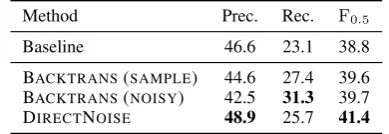
Table 2: Performance of models on BEA-valid: a value inboldindicates the best result within the column. The seed corpusT is SimpleWiki.
mize the model with Adam (Kingma and Ba,2015). For the PRETRAINsetting, we pretrain the model
with Adam and then fine-tune it on BEA-train using Adafactor (Shazeer and Stern,2018)10.
4.2 Aspect (i): Pseudo Data Generation
We compare the effectiveness of the BACK
-TRANS (NOISY), BACKTRANS (SAMPLE),
and DIRECTNOISE methods for
generat-ing pseudo data. In DIRECTNOISE, we set (µmask, µdeletion, µinsertion, µkeep) = (0.5,0.15,0.15,0.2)11. We use βrandom = 6 for BACKTRANS(NOISY)12. In addition, we use (i) the JOINTsetting and (ii) all of SimpleWiki as the seed corpusT throughout this section.
The results are summarized in Table2. BACK
-TRANS(NOISY) and BACKTRANS(SAMPLE) show competitive values ofF0.5. Given this result, we
exclusively use BACKTRANS(NOISY) and discard BACKTRANS(SAMPLE) for the rest of the exper-iments. The advantage of BACKTRANS(NOISY) is that its effectiveness in GEC has already been demonstrated byXie et al.(2018). In addition, in our preliminary experiment, BACKTRANS(NOISY) decoded ungrammatical sentence 1.2 times faster than BACKTRANS(SAMPLE) did. We also use DI -RECTNOISEbecause it achieved the best value of F0.5 among all the methods.
4.3 Aspect (ii): Seed CorpusT
We investigate the effectiveness of the seed corpus
T for generating pseudo dataDp. The three
cor-pora (Wikipedia, SimpleWiki and Gigaword) are compared in Table3. We set|Dp|= 1.4M. The difference inF0.5is small, which implies that the seed corpusT has only a minor effect on the model performance. Nevertheless, Gigaword consistently outperforms the other two corpora. In particular,
10
The detailed hyper-parameters are listed in AppendixD. 11
These values are derived from preliminary experiments (AppendixE).
12β
Method Seed CorpusT Prec. Rec. F0.5
Baseline N/A 46.6 23.1 38.8
BACKTRANS(NOISY) Wikipedia 43.8 30.8 40.4 BACKTRANS(NOISY) SimpleWiki 42.5 31.3 39.7 BACKTRANS(NOISY) Gigaword 43.1 33.1 40.6
[image:4.595.306.524.64.184.2]DIRECTNOISE Wikipedia 48.3 25.5 41.0 DIRECTNOISE SimpleWiki 48.9 25.7 41.4 DIRECTNOISE Gigaword 48.3 26.9 41.7
Table 3: Performance on BEA-valid when changing the seed corpusT used for generating pseudo data (|Dp|=
1.4M).
DIRECTNOISE with Gigaword achieves the best value ofF0.5among all the configurations.
4.4 Aspect (iii): Optimization Setting
We compare the JOINTand PRETRAIN
optimiza-tion settings. We are interested in how each setting performs when the scale of the pseudo data Dp
compared with that of the genuine parallel data
Dg is (i) approximately the same (|Dp| = 1.4M)
and (ii) substantially bigger (|Dp|= 14M). Here,
we use Wikipedia as the seed corpusT instead of SimpleWiki or Gigaword for two reasons. First, SimpleWiki is too small for the experiment (b) (see Table1). Second, the fact that Gigaword is not freely available makes it difficult for other re-searchers to replicate our results.
(a) Joint Training or Pretraining Table 4 presents the results. The most notable result here is that PRETRAINdemonstrates the properties of more pseudo data and better performance, whereas JOINT does not. For example, in BACKTRANS
(NOISY), increasing|Dp|(1.4M→14M) improves
F0.5 on PRETRAIN(41.1 → 44.5). By contrast, F0.5 does not improve on JOINT (40.4 → 40.3). An intuitive explanation for this case is that when pseudo dataDpare substantially more than genuine
dataDg, the teaching signal fromDpbecomes dom-inant in JOINT. PRETRAINalleviates this problem because the model is trained with onlyDgduring
fine-tuning. We therefore suppose that PRETRAIN
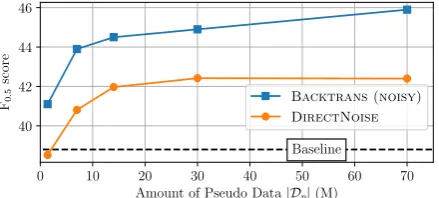
is crucial for utilizing extensive pseudo data. (b) Amount of Pseudo Data We investigate how increasing the amount of pseudo data affects the PRETRAIN setting. We pretrain the model with different amounts of pseudo data{1.4M, 7M, 14M, 30M, 70M}. The results in Figure 1 show that BACKTRANS (NOISY) has superior sample effi-ciency to DIRECTNOISE. The best model (pre-trained with 70M BACKTRANS(NOISY)) achieves
Optimization Method |Dp| Prec. Rec.F0.5
N/A Baseline 0 46.6 23.1 38.8
PRETRAIN BACKTRANS(NOISY) 1.4M 49.6 24.3 41.1 PRETRAIN DIRECTNOISE 1.4M 48.4 21.2 38.5 JOINT BACKTRANS(NOISY) 1.4M 43.8 30.8 40.4 JOINT DIRECTNOISE 1.4M 48.3 25.5 41.0
[image:4.595.308.528.238.337.2]PRETRAIN BACKTRANS(NOISY) 14M 50.6 30.1 44.5 PRETRAIN DIRECTNOISE 14M 49.8 25.8 42.0 JOINT BACKTRANS(NOISY) 14M 43.0 32.3 40.3 JOINT DIRECTNOISE 14M 48.7 23.5 40.1
Table 4: Performance of the model with different opti-mization settings on BEA-valid. The seed corpusT is Wikipedia.
0 10 20 30 40 50 60 70
Amount of Pseudo Data|Dp|(M)
40 42 44 46
F0
.
5
score
Baseline
Backtrans (noisy) DirectNoise
Figure 1: Performance on BEA-valid for different amounts of pseudo data (|Dp|). The seed corpusT is
Wikipedia.
F0.5= 45.9.
4.5 Comparison with Current Top Models
The present experimental results show that the fol-lowing configurations are effective for improving the model performance: (i) the combination of JOINTand Gigaword (Section4.3), (ii) the amount of pseudo data Dp not being too large in JOINT
(Section4.4(a)), and (iii) PRETRAINwith BACK
-TRANS(NOISY) using large pseudo dataDp
(Sec-tion 4.4(b)). We summarize these findings and attempt to combine PRETRAINand JOINT. Specif-ically, we pretrain the model using 70M pseudo data of BACKTRANS(NOISY). We then fine-tune
the model by combining BEA-train and relatively small DIRECTNOISEpseudo data generated from Gigaword (we set|Dp|= 250K). However, the per-formance does not improve on BEA-valid. There-fore, the best approach available is simply to pre-train the model with large (70M) BACKTRANS
(NOISY) pseudo data and then fine-tune using BEA-train, which hereinafter we refer to as PRETLARGE. We use Gigaword for the seed corpusT because it has the best performance in Table3.
CoNLL-2014 (M2scorer)
CoNLL-2014
(ERRANT) JFLEG
BEA-test (ERRANT)
Model Ensemble Prec. Rec. F0.5 Prec. Rec. F0.5 GLEU Prec. Rec. F0.5
Chollampatt and Ng(2018) 60.9 23.7 46.4 - - - 51.3 - -
-Junczys-Dowmunt et al.(2018) - - 53.0 - - - 57.9 - -
-Grundkiewicz and Junczys-Dowmunt(2018) 66.8 34.5 56.3 - - - 61.5 - -
-Lichtarge et al.(2019) 65.5 37.1 56.8 - - - 61.6 - -
-Chollampatt and Ng(2018) X 65.5 33.1 54.8 - - - 57.5 - -
-Junczys-Dowmunt et al.(2018) X 61.9 40.2 55.8 - - - 59.9 - -
-Lichtarge et al.(2019) X 66.7 43.9 60.4 - - - 63.3 - -
-Zhao et al.(2019) X 71.6 38.7 61.2 - - - 61.0 - -
-Grundkiewicz et al.(2019) X - - 64.2 - - - 61.2 72.3 60.1 69.5
PRETLARGE 67.9 44.1 61.3 61.2 42.0 56.0 59.7 65.5 59.4 64.2
[image:5.595.77.521.62.219.2]PRETLARGE+SSE+R2L X 72.4 46.1 65.0 67.3 44.0 60.9 61.4 72.1 61.8 69.8 PRETLARGE+SSE+R2L+SED X 73.3 44.2 64.7 68.1 42.1 60.6 61.2 74.7 56.7 70.2
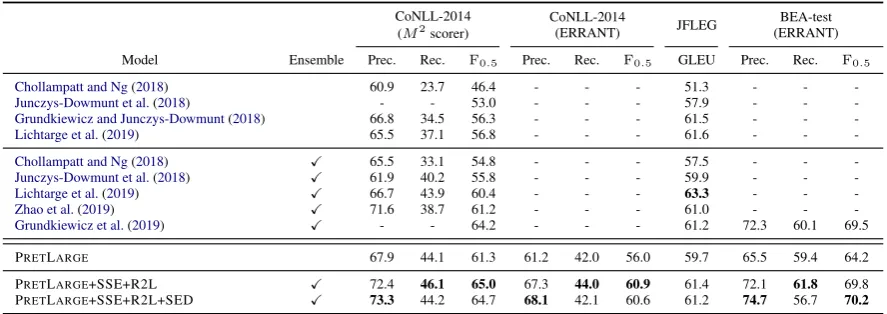
Table 5: Comparison of our best model and current top models: aboldvalue indicates the best result within the column.
our PRETLARGEachievesF0.5 = 61.3on CoNLL-2014. This result outperforms not only all previous single-model results but also all ensemble results except for that byGrundkiewicz et al.(2019).
To further improve the performance, we incorpo-rate the following techniques that are widely used in shared tasks such as BEA-2019 and WMT13: Synthetic Spelling Error(SSE) Lichtarge et al. (2019) proposed the method of probabilistically injecting character-level noise into the source sen-tence of pseudo dataDp. Specifically, one of the following operations is applied randomly at a rate of 0.003 per character: deletion, insertion, replace-ment, or transposition of adjacent characters. Right-to-left Re-ranking(R2L) Following Sen-nrich et al. (2016a, 2017); Grundkiewicz et al. (2019), we train four right-to-left models. The en-semble of four left-to-right models generaten-best candidates and their corresponding scores (i.e., con-ditional probabilities). We then pass each candidate to the ensemble of the four right-to-left models and compute the score. Finally, we re-rank then-best candidates based on the sum of the two scores. Sentence-level Error Detection (SED) SED classifies whether a given sentence contains a gram-matical error.Asano et al.(2019) proposed incor-porating SED into the evaluation pipeline and re-ported improved precision. Here, the GEC model is applied only if SED detects a grammatical er-ror in the given source sentence. The motivation is that SED could potentially reduce the number of false-positive errors of the GEC model. We use the re-implementation of the BERT-based SED model (Asano et al.,2019).
Table 5 presents the results of applying SSE,
13http://www.statmt.org/wmt19/
R2L, and SED. It is noteworthy that PRET -LARGE+SSE+R2L achieves state-of-the-art per-formance on both CoNLL-2014 (F0.5 = 65.0) and BEA-test (F0.5 = 69.8), which are better than those of the best system of the BEA-2019 shared task (Grundkiewicz et al.,2019). In addition, PRET -LARGE+SSE+R2L+SED can further improve the performance on BEA-test (F0.5= 70.2). However, unfortunately, incorporating SED decreased the performance on CoNLL-2014 and JFLEG. This fact implies that SED is sensitive to the domain of the test set since the SED model is fine-tuned with the official validation split of BEA dataset. We leave this sensitivity issue as our future work.
5 Conclusion
In this study, we investigated several aspects of incorporating pseudo data for GEC. Through ex-tensive experiments, we found the following to be effective: (i) utilizing Gigaword as the seed corpus, and (ii) pretraining the model with BACKTRANS
(NOISY) data. Based on these findings, we pro-posed suitable settings for GEC. We demonstrated the effectiveness of our proposal by achieving state-of-the-art performance on the CoNLL-2014 test set and the BEA-2019 test set.
Acknowledgements
We thank the three anonymous reviewers for their insightful comments. We are deeply grateful to Takumi Ito and Tatsuki Kuribayashi for kindly sharing the re-implementation of BACKTRANS
(NOISY). The work of Jun Suzuki was
References
Hiroki Asano, Masato Mita, Tomoya Mizumoto, and Jun Suzuki. 2019. The AIP-Tohoku System at the BEA-2019 Shared Task. InProceedings of the Four-teenth Workshop on Innovative Use of NLP for Build-ing Educational Applications (BEA 2019), pages 176–182.
Dzmitry Bahdanau, Kyunghyun Cho, and Yoshua Ben-gio. 2015. Neural Machine Translation by Jointly Learning to Align and Translate. InProceedings of the 3rd International Conference on Learning Rep-resentations (ICLR 2015).
Christopher Bryant, Mariano Felice, and Ted Briscoe. 2017. Automatic Annotation and Evaluation of Er-ror Types for Grammatical ErEr-ror Correction. In Pro-ceedings of the 55th Annual Meeting of the Asso-ciation for Computational Linguistics (ACL 2017), pages 793–805.
Shamil Chollampatt and Hwee Tou Ng. 2018. A Mul-tilayer Convolutional Encoder-Decoder Neural Net-work for Grammatical Error Correction. In Proceed-ings of the Thirty-Second AAAI Conference on Arti-ficial Intelligence (AAAI 2018), pages 5755–5762.
Daniel Dahlmeier and Hwee Tou Ng. 2012. Better Evaluation for Grammatical Error Correction. In Proceedings of the 2012 Conference of the North American Chapter of the Association for Computa-tional Linguistics (NAACL 2012), pages 568–572.
Daniel Dahlmeier, Hwee Tou Ng, and Siew Mei Wu. 2013. Building a Large Annotated Corpus of Learner English: The NUS Corpus of Learner En-glish. In Proceedings of the 8th Workshop on Building Educational Applications Using NLP (BEA 2013), pages 22–31.
Sergey Edunov, Myle Ott, Michael Auli, and David Grangier. 2018. Understanding Back-Translation at Scale. In Proceedings of the 2018 Conference on Empirical Methods in Natural Language Processing (EMNLP 2018), pages 489–500.
Mariano Felice, Christopher Bryant, and Ted Briscoe. 2016. Automatic Extraction of Learner Errors in ESL Sentences Using Linguistically Enhanced Alignments. InProceedings of COLING 2016, the 26th International Conference on Computational Linguistics: Technical Papers, pages 825–835.
Tao Ge, Furu Wei, and Ming Zhou. 2018. Fluency Boost Learning and Inference for Neural Grammati-cal Error Correction. InProceedings of the 56th An-nual Meeting of the Association for Computational Linguistics (ACL 2018), pages 1055–1065.
Sylviane Granger. 1998. The computer learner corpus: A versatile new source of data for SLA research. In Sylviane Granger, editor, Learner English on Com-puter, pages 3–18. Addison Wesley Longman, Lon-don and New York.
Roman Grundkiewicz and Marcin Junczys-Dowmunt. 2018. Near Human-Level Performance in Grammat-ical Error Correction with Hybrid Machine Transla-tion. InProceedings of the 2018 Conference of the North American Chapter of the Association for Com-putational Linguistics (NAACL 2018), pages 284– 290.
Roman Grundkiewicz, Marcin Junczys-Dowmunt, and Kenneth Heafield. 2019. Neural grammatical error correction systems with unsupervised pre-training on synthetic data. InProceedings of the Fourteenth Workshop on Innovative Use of NLP for Building Ed-ucational Applications (BEA 2019), pages 252–263.
Jianshu Ji, Qinlong Wang, Kristina Toutanova, Yongen Gong, Steven Truong, and Jianfeng Gao. 2017. A Nested Attention Neural Hybrid Model for Gram-matical Error Correction. In Proceedings of the 55th Annual Meeting of the Association for Compu-tational Linguistics (ACL 2017), pages 753–762.
Marcin Junczys-Dowmunt, Roman Grundkiewicz, Shubha Guha, and Kenneth Heafield. 2018. Ap-proaching Neural Grammatical Error Correction as a Low-Resource Machine Translation Task. In Pro-ceedings of the 2018 Conference of the North Amer-ican Chapter of the Association for Computational Linguistics (NAACL 2018), pages 595–606.
Diederik Kingma and Jimmy Ba. 2015. Adam: A Method for Stochastic Optimization. In Proceed-ings of the 3rd International Conference on Learn-ing Representations (ICLR 2015).
Philipp Koehn and Rebecca Knowles. 2017. Six Chal-lenges for Neural Machine Translation. In Proceed-ings of the First Workshop on Neural Machine Trans-lation, pages 28–39.
Jared Lichtarge, Chris Alberti, Shankar Kumar, Noam Shazeer, Niki Parmar, and Simon Tong. 2019. Cor-pora Generation for Grammatical Error Correction. InProceedings of the 2019 Conference of the North American Chapter of the Association for Computa-tional Linguistics (NAACL 2019).
Tomoya Mizumoto, Mamoru Komachi, Masaaki Na-gata, and Yuji Matsumoto. 2011. Mining Revi-sion Log of Language Learning SNS for Auto-mated Japanese Error Correction of Second Lan-guage Learners. InProceedings of the 5th Interna-tional Joint Conference on Natural Language Pro-cessing (IJCNLP 2011), pages 147–155.
Courtney Napoles, Keisuke Sakaguchi, Matt Post, and Joel Tetreault. 2015. Ground Truth for Grammati-cal Error Correction Metrics. InProceedings of the 53rd Annual Meeting of the Association for Compu-tational Linguistics and the 7th International Joint Conference on Natural Language Processing (ACL & IJCNLP 2015), pages 588–593.
Courtney Napoles, Keisuke Sakaguchi, and Joel Tetreault. 2017. JFLEG: A Fluency Corpus and Benchmark for Grammatical Error Correction. In Proceedings of the 15th Conference of the European Chapter of the Association for Computational Lin-guistics (EACL 2017), pages 229–234.
Hwee Tou Ng, Siew Mei Wu, Ted Briscoe, Christian Hadiwinoto, Raymond Hendy Susanto, and Christo-pher Bryant. 2014. The CoNLL-2014 Shared Task on Grammatical Error Correction. InProceedings of the Eighteenth Conference on Computational Natu-ral Language Learning: Shared Task, pages 1–14.
Myle Ott, Sergey Edunov, Alexei Baevski, Angela Fan, Sam Gross, Nathan Ng, David Grangier, and Michael Auli. 2019. fairseq: A Fast, Extensible Toolkit for Sequence Modeling. InProceedings of the 2019 Conference of the North American Chap-ter of the Association for Computational Linguistics (NAACL 2019).
Rico Sennrich, Alexandra Birch, Anna Currey, Ulrich Germann, Barry Haddow, Kenneth Heafield, An-tonio Valerio Miceli Barone, and Philip Williams. 2017. The university of Edinburgh’s neural MT sys-tems for WMT17. In Proceedings of the Second Conference on Machine Translation (WMT 2017), pages 389–399.
Rico Sennrich, Barry Haddow, and Alexandra Birch. 2016a. Edinburgh neural machine translation sys-tems for WMT 16. InProceedings of the First Con-ference on Machine Translation: Volume 2, Shared Task Papers (WMT 2016), pages 371–376.
Rico Sennrich, Barry Haddow, and Alexandra Birch. 2016b. Improving Neural Machine Translation Models with Monolingual Data. InProceedings of the 54th Annual Meeting of the Association for Com-putational Linguistics (ACL 2016), pages 86–96.
Rico Sennrich, Barry Haddow, and Alexandra Birch. 2016c. Neural Machine Translation of Rare Words with Subword Units. InProceedings of the 54th An-nual Meeting of the Association for Computational Linguistics (ACL 2016), pages 1715–1725.
Noam Shazeer and Mitchell Stern. 2018. Adafactor: Adaptive Learning Rates with Sublinear Memory Cost. InProceedings of the 35th International Con-ference on Machine Learning (ICML 2018), pages 4603–4611.
Ilya Sutskever, Oriol Vinyals, and Quoc V. Le. 2014. Sequence to Sequence Learning with Neural Net-works. InAdvances in Neural Information Process-ing Systems 28 (NIPS 2014), pages 3104–3112.
Christian Szegedy, Vincent Vanhoucke, Sergey Ioffe, Jon Shlens, and Zbigniew Wojna. 2016. Rethinking the inception architecture for computer vision. In 2016 IEEE Conference on Computer Vision and Pat-tern Recognition (CVPR 2016), pages 2818–2826.
Toshikazu Tajiri, Mamoru Komachi, and Yuji Mat-sumoto. 2012. Tense and Aspect Error Correction for ESL Learners Using Global Context. In Pro-ceedings of the 50th Annual Meeting of the Asso-ciation for Computational Linguistics (ACL 2012), pages 198–202.
Ashish Vaswani, Noam Shazeer, Niki Parmar, Jakob Uszkoreit, Llion Jones, Aidan N Gomez, Łukasz Kaiser, and Illia Polosukhin. 2017. Attention Is All You Need. InAdvances in Neural Information Pro-cessing Systems 31 (NIPS 2017), pages 5998–6008.
Ziang Xie, Guillaume Genthial, Stanley Xie, Andrew Ng, and Dan Jurafsky. 2018. Noising and Denois-ing Natural Language: Diverse Backtranslation for Grammar Correction. In Proceedings of the 2018 Conference of the North American Chapter of the Association for Computational Linguistics (NAACL 2018), pages 619–628.
Helen Yannakoudakis, Øistein E. Andersen, Ardeshir Geranpayeh, Ted Briscoe, and Diane Nicholls. 2018. Developing an Automated Writing Placement sys-tem for ESL Learners. Applied Measurement in Ed-ucation, 31(3):251–267.
Helen Yannakoudakis, Ted Briscoe, and Ben Medlock. 2011. A New Dataset and Method for Automatically Grading ESOL Texts. InProceedings of the 49th An-nual Meeting of the Association for Computational Linguistics (ACL 2011), pages 180–189.