A Study of Reinforcement Learning for Neural Machine Translation
Lijun Wu1∗, Fei Tian2, Tao Qin2, Jianhuang Lai1 and Tie-Yan Liu2 1School of Data and Computer Science, Sun Yat-sen University
2Microsoft Research
[email protected]; [email protected];
{fetia,taoqin,tyliu}@microsoft.com
Abstract
Recent studies have shown that reinforcemen-t learning (RL) is an effecreinforcemen-tive approach for improving the performance of neural machine translation (NMT) system. However, due to its instability, successfully RL training is challenging, especially in real-world systems where deep models and large datasets are lever-aged. In this paper, taking several large-scale translation tasks as testbeds, we conduct a sys-tematic study on how to train better NMT mod-els using reinforcement learning. We provide a comprehensive comparison of several impor-tant factors (e.g., baseline reward, reward shap-ing) in RL training. Furthermore, to fill in the gap that it remains unclear whether RL is still beneficial when monolingual data is used, we propose a new method to leverage RL to fur-ther boost the performance of NMT system-s trained with system-source/target monolingual da-ta. By integrating all our findings, we obtain competitive results on WMT14 English- Ger-man, WMT17 English-Chinese, and WMT17 Chinese-English translation tasks, especial-ly setting a state-of-the-art performance on WMT17 Chinese-English translation task.
1 Introduction
Recently, neural machine translation (NMT) ( Bah-danau et al.,2015;Hassan et al.,2018;Wu et al.,
2016;He et al.,2017;Xia et al.,2016,2017;Wu et al.,2018b,a) has become more and more popular given its superior performance without the demand of heavily hand-crafted engineering efforts. It is usually trained to maximize the likelihood of each token in the target sentence, by taking the source sentence and the preceding (ground-truth) target tokens as inputs. Such training approach is referred as maximum likelihood estimation (MLE) (Scholz,
1985). Although easy to implement, the token-level
∗
This work was conducted at Microsoft Research Asia.
objective function during training is inconsisten-t wiinconsisten-th sequence-level evaluainconsisten-tion meinconsisten-trics such as BLEU (Papineni et al.,2002).
To address the inconsistency issue, reinforce-ment learning (RL) methods have been adopted to optimize sequence-level objectives. For example, policy optimization methods such as REINFORCE (Ranzato et al.,2016;Wu et al.,2017b) and actor-critic (Bahdanau et al., 2017) are leveraged for sequence generation tasks including NMT. In ma-chine translation community, a similar method is proposed with the name ‘minimum risk training’ (Shen et al.,2016). All these works demonstrate the effectiveness of RL techniques for NMT mod-els (Wu et al.,2016).
However, effectively applying RL to real-world NMT systems has not been fulfilled by previous works. First, most of, if not all, previous works verified their methods based on shallow recurrent neural network (RNN) models. However, to obtain state-of-the-art (SOTA) performance, it is essential to leverage recently derived deep models (Gehring et al.,2017;Vaswani et al.,2017), which are much more powerful.
Second, it is not easy to make RL practically ef-fective given quite a few widely acknowledged lim-itations of RL method (Henderson et al.,2018) such as high variance of gradient estimation (Weaver and Tao,2001), and objective instability (Mnih et al.,
2013). Therefore, several tricks are proposed in previous works. However, it remains unclear, and no agreement is achieved on how to use these tricks in machine translation. For example, baseline re-ward method (Weaver and Tao,2001) is suggested in (Ranzato et al.,2016;Nguyen et al.,2017;Wu et al.,2016) but not leveraged in (He and Deng,
2012;Shen et al.,2016).
2016) with MLE training, while it remains nearly empty on how to combine RL with monolingual data in NMT.
In this paper, we try to fulfill these gaps and s-tudy how to practically apply RL to obtain strong NMT systems with quite competitive, even state-of-the-art performance. Several comprehensive s-tudies are conducted on different aspects of RL training to figure out how to: 1) set efficient re-wards; 2) combine MLE and RL objectives with different weights, which aims to stabilize the train-ing procedure; 3) reduce the variance of gradient estimation.
In addition, given the effectiveness of leveraging monolingual data in improving translation quali-ty, we further propose a new method to combine the strength of both RL training and source/target monolingual data. To the best of our knowledge, this is the first work that tries to explore the power of monolingual data when training NMT model with RL method.
We obtain some useful findings through the ex-periments on WMT17 Chinese-English (Zh-En), WMT17 English-Chinese (En-Zh) and WMT14 English-German (En-De) translation tasks. For in-stance, multinomial sampling is better than beam search in reward computation, and the combination of RL and monolingual data significantly enhances the NMT model performance. Our main contribu-tions are summarized as follows.
• We provide the first comprehensive study on different aspects of RL training, such as how to setup reward and baseline reward, on top of quite competitive NMT models.
• We propose a new method that effectively leverages large-scale monolingual data, from both the source and target side, when training NMT models with RL.
• Combined with several of our findings and method, we obtain the SOTA translation quali-ty on WMT17 Zh-En translation task, surpass-ing strong baseline (Transformer big model + back translation) by nearly 1.5 BLEU points. Furthermore, on WMT14 En-De and WMT17 En-Zh translation tasks, we can also obtain strong competitive results.
We hope that our studies and findings will ben-efit the community to better understand and lever-age reinforcement learning for developing strong
NMT models, especially in real-world scenarios faced with deep models and large amount of train-ing data (includtrain-ing both parallel and monolin-gual data). Towards this end, we open source all our codes/dataset at https://github.com/ apeterswu/RL4NMTto provide a clear recipe for performance reproduction.
2 Background
In this section, we first introduce the attention-based sequence-to-sequence learning framework for neural machine translation (NMT), and then introduce the basis of applying reinforcement learn-ing to trainlearn-ing NMT models.
2.1 Neural Machine Translation
Typical NMT models are based on the encoder-decoder framework with attention mechanism. The encoder first maps a source sentence x = (x1, x2, ..., xn) to a set of continuous represen-tations z = (z1, z2, ..., zn). Given z, the de-coder then generates a target sentence y = (y1, y2, ..., ym)of word tokens one by one. At each decoding steptof model training, the probability of generating a tokenytis maximized conditioned onxandy<t = (y1, ..., yt−1). GivenN training
sentence pairs{xi, yi}N
i=1, maximum likelihood
es-timation (MLE) is usually adopted to optimize the model, and the training objective is defined as:
Lmle= N X
i=1
logp(yi|xi)
=
N X
i=1
m X
t=1
logp(yit|y1i, ..., yti−1, xi),
(1)
wheremis the length of sentenceyi.
Among all the encoder-decoder models, the re-cently proposed Transformer (Vaswani et al.,2017) architecture achieves the best translation quality so far. The main difference between Transformer and previous RNNSearch (Bahdanau et al.,2015) or ConvS2S (Gehring et al.,2017) is that Transformer relies entirely on self-attention (Lin et al.,2017) to compute representations of source and target side sentences, without using recurrent or convolutional operations.
2.2 Training NMT with Reinforcement Learning
inference of NMT, by directly optimizing the e-valuation measure (e.g., BLEU) at training time. Specifically, NMT model can be viewed as an a-gent, which interacts with theenvironment(the pre-vious wordsy<t and the context vectorzavailable at each stept). The parameters of the agent define apolicy, i.e., a conditional probabilityp(yt|x, y<t). The agent will pick an action , i.e., a candidate word out from the vocabulary, according to the pol-icy. A terminalrewardis observed once the agent generates a complete sequenceyˆ. The reward for machine translation is the BLEU (Papineni et al.,
2002) score, denoted asR(ˆy, y), which is defined by comparing the generatedyˆwith the ground-truth sentence y. Note that here the rewardR(ˆy, y)is the sentence-level reward, i.e., a scalar for each complete sentenceyˆ. The goal of the RL training is to maximize the expected reward:
Lrl= N X
i=1
Eyˆ∼p(ˆy|xi)R(ˆy, yi)
=
N X
i=1
X
ˆ
y∈Y
p(ˆy|xi)R(ˆy, yi),
(2)
where Y is the space of all candidate transla-tion sentences, which is exponentially large due to the large vocabulary size, making it impossi-ble to exactly maximize Lrl. In practice, REIN-FORCE (Williams,1992) is usually leveraged to approximate the above expectation via samplingyˆ from the policyp(y|x), leading to the objective as maximizing:
ˆ
Lrl = N X
i=1
R(ˆyi, yi),yˆi ∼p(y|xi),∀i∈[N]. (3)
Throughout the paper we will use REINFORCE as our policy optimization method for RL training.
3 Strategies for RL Training
Although training NMT with RL can fill in the gap between training objectives and evaluation metrics, it is not easy to successfully put RL training into practice. A key challenge is that RL methods are highly unstable and inefficient, due to the noise in gradient estimation and reward computation. To our best knowledge, currently there is no consen-sus, or even a systematic study on how to configure different setups for RL training to avoid such prob-lems, especially for training deep NMT models on large scale datasets. We therefore aim to shed light
on practical applications of RL for NMT training. For this purpose, we provide a comprehensive re-view of several important methods to stabilize RL training process in this section.
3.1 Reward Computation
It is critical to set up appropriate rewards for RL training, i.e., theR(ˆy, y)in Eqn. (3). There are two important aspects to consider in configuring the rewardR(ˆy, y): how to sample training instanceyˆ and whether to use reward shaping.
Generateyˆ There are two strategies to sampleyˆ for computing the BLEU rewardR(ˆy, y). The first one isbeam search(Sutskever et al.,2014), it is a breadth-first search method that maintains a “beam” of the top-K scoring candidates (prefix hypothe-sis sentences) at each generation step. Then, for each candidate sentence in the beam,Kmost likely words are appended, resulting in a pool ofK×K
new candidates. Out from this pool, the top-K
translations with largest probabilities are selected, and the beam search process continues. The second strategy ismultinomial sampling(Chatterjee and Cancedda,2010), which produces each word one by one through multinomial sampling over the mod-el’s output distribution. Both sampling strategies terminate the expansion of a candidate sentence when an ‘end of sentence’ (<EOS>) token is met.
The choice of different sampling strategies re-flects theexploration-exploitationdilemma. Beam search strategy generates more accurateyˆby ex-ploiting the probabilistic space output via curren-t NMT model, while mulcurren-tinomial sampling pays more attention to explore more diverse candidates.
Whether to Use Reward Shaping From Eqn. (3) we can see that for the entire sequenceyˆ, there is only one terminal rewardR(ˆy, y)available for model training. Note that the agent needs to take tens of actions (with the number depending on the length ofyˆ) to generate a complete sentenceyˆ, but only one reward is available for all those actions. Consequently, RL training is inefficient due to the sparsity of rewards, and the model updates each token in the training sentence with the same reward value without distinction. Reward shaping (Ng et al.,1999) is a strategy to overcome this shortcom-ing. In reward shaping, intermediate reward at each decoding steptis imposed and denoted asrt(ˆyt, y).
Bahdanau et al.(2017) sets up the intermediate re-ward as rt(ˆyt, y) = R(ˆy1...t, y) −R(ˆy1...t−1, y),
of yˆ1...t with respect to y. Note that we have
R(ˆy, y) = Pm
t=1rt(ˆyt, y), wherem is the length
ofyˆ. During RL training, the cumulative reward
Pm
τ=trτ(ˆyτ, y)is used to update the policy at time stept. It is verified that using the shaped rewardrt instead of awarding the whole scoreR(ˆy, y)does not change the optimal policy (Ng et al.,1999).
3.2 Variance Reduction of Gradient Estimation
As mentioned before, the REINFORCE algorithm suffers from high variance in gradient estimation, mainly caused by using single sampleyˆto estimate the expectation. To reduce the variance,Ranzato et al.(2016) subtracts an average reward from the returned reward at each time stept, and the actual reward used to update the policy is
R(ˆy, y)−rˆt, (4)
whererˆtis the estimated average reward at stept, named asbaseline reward(Weaver and Tao,2001). Together with reward shaping, the updated reward becomesPm
τ=trτ(ˆyτ, y)−rˆtat stept.
Intuitively speaking, a baseline rewardrˆtis es-tablished, which either encourages a word choice ˆ
yt if the induced reward R satisfiesR > ˆrt, or discourages it if R < rˆt. Here R is either the terminal rewardR(ˆy, y)or the cumulative reward
Pm
τ=trτ(ˆyτ, y). Such estimated baseline reward
ˆ
rtis designed to decrease the high variance of the gradient estimator.
In practice, the baseline reward rˆt can be ob-tained through different approaches. For exam-ple, one may sample multiple sentences and use the mean terminal reward for these sentences as baseline reward. In our work, we adopt the func-tion learning approach, using simple network (e.g., multi-layer perceptron) to build the learning func-tion, which is the same as used in (Ranzato et al.,
2016;Bahdanau et al.,2017).
3.3 Combine MLE and RL Objectives
The last important strategy we would like to men-tion is the combinamen-tion of MLE training objective with RL objective, which is assumed to further sta-bilize RL training process (Wu et al.,2016;Li et al.,
2017;Wu et al.,2017a).
A simple way is to linearly combine the MLE (Eqn. (1)) and RL (Eqn. (3)) objectives as follows:
Lcom =α∗Lmle+ (1−α)∗Lˆrl, (5)
whereαis the hyperparamter controlling the trade-off between MLE and RL objectives. We will em-pirically evaluate how different values ofαimpact the final translation accuracy.
4 RL Training with Monolingual Data
Previous works typically conduct RL training with only bilingual data for NMT. Monolingual data has been proved to be able to significantly improve the performance of NMT systems (Sennrich et al.,
2015a;Xia et al., 2016; Cheng et al., 2016). It remains an open problem whether it is possible to combine the benefits of RL training and monolin-gual data such that even more competitive results can be obtained. In this section we provide several solutions for combination and will study them in next section. Note that all the settings discussed in this section are semi-supervised learning, i.e., both bilingual and monolingual data are available.
4.1 With Source-Side Monolingual Data
We first provide a solution to RL training with source-side monolingual data. As shown in Eqn. (3), in RL training we need to calculate the re-ward signalR(ˆy, y) for each generated sentence
ˆ
y, and therefore the reference sentenceyseems to be a must-have, which unfortunately is missing for source-side monolingual data.
We tackle this challenge via generating pseu-do target reference y by bootstrapping with the model itself. Apparently, for the source-side mono-lingual data, the pseudo target referenceyshould have good translation quality. Therefore, for each source-side monolingual sentence, we use the N-MT model trained from the bilingual data to beam search a target sentence and treat it as the pseu-do target reference y. Afterwardsyˆ is obtained via multinomial sampling to calculate the reward. Although multinomial sampling is usually not as good as sampling via beam search, the combination of beam search (to get the pseudo target reference sentence) and the multinomial sampling (to gener-ate the action sequence of the agent) achieves good exploration-exploitation trade-off, since the pseudo target reference exploits the accuracy of current NMT model whileyˆachieves better exploration.
4.2 With Target-Side Monolingual Data
this challenge via back translation (Sennrich et al.,
2015a). We first train a reverse NMT model from the target language to the source language with bilingual data. For each target-side monolingual sentence, using the reverse NMT model, we back translate it to get its pseudo source sentencex. We then pair the target monolingual data and its back-translated sentence as a pseudo bilingual sentence pair, which can be used for RL training in the same way as the genuine bilingual sentence pairs.
4.3 With both Source-Side and Target-Side Monolingual Data
A natural extension of previous discussions is to combine both the source-side and target-side mono-lingual data for RL training. We consider two com-binations, thesequentialmethod and the unified
method. The former one sequentially leverages the source-side and target-side monolingual data for RL training. Specifically, we first train an MLE model using the bilingual data and source-side (or target-side) monolingual data; based on this MLE model, we then use REINFORCE for training with target-side (or source-side) monolingual data. For
unifiedapproach, we pack the paired data out from three domains together: the genuine bilingual data, the source monolingual data with its pseudo target references (introduced in subsection4.1), and the target monolingual data with its back-translated samples (introduced in subsection4.2). Then we treat the combined data as normal bilingual data on which the NMT model is trained via MLE or RL principles. Our goal is to investigate the model per-formance with different training data and find the best recipe of how to use these data in RL training. More details are introduced in next section.
5 Experiments
In this section, we provide a systematic study on aforementioned RL training strategies and the solu-tions of leveraging monolingual data. The RL train-ing strategies are evaluated on biltrain-ingual dataset-s from three trandataset-slation tadataset-skdataset-s, WMT14 Englidataset-sh- English-German De), WMT17 English-Chinese (En-Zh) and WMT17 Chinese-English (Zh-En), and we further conduct the experiments to leverage mono-lingual data in WMT17 Zh-En translation.
5.1 Experimental Settings
For the bilingual datasets, WMT17 (Bojar et al.,
2017) En-Zh1and WMT17 Zh-En use the same dataset, which contains about24Msentences pairs, including CWMT Corpus 2017 and UN Parallel Corpus V1.0. The Jieba2segmenter is used to per-form Chinese word segmentation. We use byte pair encoding (BPE) (Sennrich et al.,2015b) to pre-process the source and target sentences, forming source-side and target-side dictionary with40,000 and37,000types, respectively. We use the news-dev2017 as the dev set and newstest2017 as the test set. For the WMT14 En-De dataset, it con-tains about4.5M training pairs,newstest2012and
newstest2013are concatenated as the dev set and
newstest2014acts as test set. Same as (Vaswani et al.,2017), we also perform BPE to process the En-De dataset, the shared source-target vocabulary contains about37,000tokens.
For the monolingual dataset on Zh-En translation task, similar to (Sennrich et al.,2017), the Chinese monolingual data comes from LDC Chinese Gi-gaword (4th edition) and the English monolingual data comes from News Crawl 2016 articles. After preprocessing (e.g., language detection and filter-ing sentences with more than80words), we keep 4MChinese sentences and7M English sentences.
We adopt the Transformer model with trans-former big setting as defined in (Vaswani et al.,
2017) for Zh-En and En-Zh translations, which achieves SOTA translation quality in several oth-er datasets. For En-De translation, we utilize the
transformer base v1setting. These settings are ex-actly same as used in the original paper, except we set thelayer prepostprocess dropoutfor Zh-En and En-Zh translation to be0.05. The optimizer used for MLE training is Adam (Kingma and Ba,
2015) with initial learning rate is0.1, and we fol-low the same learning rate schedule in (Vaswani et al.,2017). During training, roughly4,096source tokens and4,096target tokens are paired in one mini batch. Each model is trained using8 NVIDI-A Tesla M40 GPUs. For RL training, the model is initialized with parameters of the MLE model (trained with only bilingual data), and we continue training it with learning rate0.0001. Same as ( Bah-danau et al.,2017), to calculate the BLEU reward, we start all n-gram counts from1instead of0and
1
http://www.statmt.org/wmt17/ translation-task.html
Training Strategy En-De En-Zh Zh-En
MLE 27.02 34.12 24.29
[image:6.595.312.520.62.99.2]RL (beam + terminal) 27.06 34.25 24.42 RL (multinomial + terminal) 27.22 34.46 24.70 RL (beam + shaping) 27.04 34.28 24.47 RL (multinomial + shaping) 27.23 34.47 24.72
Table 1: Results of different strategies for reward com-putation. ‘beam’ refers to ‘beam search and ‘multino-mial’ to ‘multinomial sampling’. While generating yˆ
through beam search, we use width 4. ‘shaping’ refers to using reward shaping and ‘terminal’ refers not.
multiply the resulting score by the length of the target reference sentence. For inference, we use beam search with width 6. We run each setting for at least 5 times and report the averaged case sensitive BLEU scores3(Papineni et al.,2002) on test set. The test set BLEU is chosen via the best configuration based on the validation set.
5.2 Results of of RL Training Strategies
We first evaluate different strategies for RL training, based only on bilingual datasets from previously introduced three translation tasks.
Reward Computation As reviewed in subsec-tion3.1, for reward computation, we need to con-sider how to sampleyˆand whether to use reward shaping.
The results are shown in Table1, where “RL” stands for RL training with the REINFORCE algo-rithm. We also report the performance of the pre-trained NMT model with the MLE loss. From the table, an interesting finding is thatyˆsampled via beam search strategy is worse than that by multi-nomial sampling, with a gap of roughly0.2-0.3 BLEU points on the test set (with significant test scoreρ <0.05). We therefore conjecture that ex-ploration is more important than exploitation in reward computing: multinomial sampling brings more data diversity to the training of NMT mod-el, while sentences generated by beam search are usually very similar to each other. Furthermore, we find that there is no big difference between the leverage of reward shaping or terminal reward, with only slightly better performance of reward shaping. We therefore use multinomial sampling and reward shaping in later experiments.
3Calculated by Sacr´eBLEU toolkit, which produces
exact-ly the same evaluation result as that in WMT17 Zh-En cam-paign. https://github.com/awslabs/sockeye/ tree/master/contrib/sacrebleu
Training Strategy En-De En-Zh Zh-En
RL 27.23 34.47 24.72
[image:6.595.72.298.62.133.2]RL (baseline function) 27.25 34.43 24.73
Table 2: Results of variance reduction of gradient esti-mation.
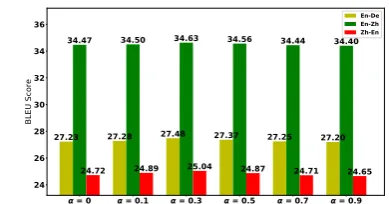
= 0 = 0.1 = 0.3 = 0.5 = 0.7 = 0.9 24
26 28 30 32 34 36
BLEU Score
27.23 27.28 27.48 27.37 27.25 27.20 34.47 34.50 34.63 34.56 34.44 34.40
24.72 24.89 25.04 24.87 24.71 24.65 En-De En-Zh Zh-En
Figure 1: Results of different weights αto combine MLE and RL objectives.
Variance Reduction of Gradient Estimation Next we evaluate the strategies for reducing vari-ance of gradient estimation (see section3.2). We want to know whether thebaseline rewardis nec-essary. To compute the baseline reward, similar to (Ranzato et al.,2016;Bahdanau et al.,2017), we build a two-layer MLP regressor with Relu (Nair and Hinton,2010) activation units. The function takes the hidden states from decoder as input, and the parameters of the regressor are trained to mini-mize the mean squared loss of Eqn. (4). We first pre-train the baseline function for20k steps/mini-batches, and then jointly train NMT model (with RL) and the baseline reward function.
Table2shows that the learning of baseline re-ward does not help RL training. This contradicts with previous observations (Ranzato et al.,2016), and seems to suggest that the variance of gradient estimation in NMT is not as large as we expected. The reason might be that the probability mass on the target-side language space induced by the NMT model is highly concentrated, making the sampled ˆ
yrepresentative enough in terms of estimating the expectation. Therefore, for the economic perspec-tive, it is not necessary to add the additional steps of using baseline reward on RL training for NMT.
[image:6.595.311.506.153.255.2][Data] (Objective) Valid Test
[B] (MLE) 22.32 24.29
[image:7.595.313.520.61.133.2] [image:7.595.80.283.61.133.2] [image:7.595.314.519.187.271.2][B] (MLE) + [B] (RL) 22.87 25.04 [B] (MLE) + [Ms] (RL) 23.03 25.22 [B & Ms] (MLE) 24.31 25.31 [B & Ms] (MLE) + [B & Ms] (RL) 24.58 25.60
Table 3: Results with source monolingual data. “B” de-notes bilingual data, “Ms” dede-notes source-side mono-lingual data, “&” denotes data combination.
The results show that combining the MLE ob-jective with the RL obob-jective achieves better per-formance (27.48for En-De,34.63for En-Zh and 25.04for Zh-En withα= 0.3). This indicates that MLE objective is helpful to stabilize the training and improve the model performance, as we expect-ed. However, further increasingαdoes not bring more gain. The best trade-off between MLE and RL objectives in our experiment isα= 0.3. There-fore, we setα= 0.3in the following experiments.
5.3 Results of RL Training with Monolingual Data
In this subsection, we report the results on both valid and test set of RL training using bilingual and monolingual data in Zh-En translation. From Table3to Table6, “RL” denotes the model trained with RL using multinomial sampling, reward shap-ing, no baseline reward, and combined objective, based on the observations in the last subsection. “B” denotes bilingual data, “Ms” denotes source-side monolingual data and “Mt” denotes target-source-side monolingual data, “&” denotes data combination.
With Source-Side Monolingual Data As dis-cussed before, we use beam search with beam width 4 to sample the pseudo target sentence y
for each monolingual sentencex. We consider sev-eral settings for RL training: 1) only source-side monolingual data; 2) the combination of bilingual and source-side monolingual data. We first train an MLE model using the augmented dataset com-bining the genuine bilingual data with the pseudo bilingual data generated from the monolingual da-ta, and then perform RL training on this combined dataset. The results are shown in Table3.
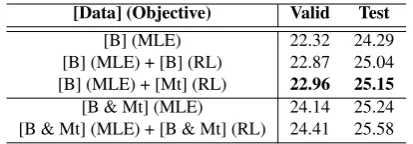
With Target-Side Monolingual Data For target-side monolingual data, we first pre-train a translation model from English to Chinese4, and use it to back translate target-side monolingual
4The BLEU score of the En-Zh model is34.12.
[Data] (Objective) Valid Test
[B] (MLE) 22.32 24.29
[B] (MLE) + [B] (RL) 22.87 25.04 [B] (MLE) + [Mt] (RL) 22.96 25.15 [B & Mt] (MLE) 24.14 25.24 [B & Mt] (MLE) + [B & Mt] (RL) 24.41 25.58
Table 4: Results with target monolingual data. “B” de-notes bilingual data, “Mt” dede-notes target-side monolin-gual data, “&” denotes data combination.
[Data] (Objective) Valid Test
[B & Ms] (MLE) 24.31 25.31 [B & Ms] (MLE) + [B & Ms] (RL) 24.58 25.60 [B & Ms] (MLE) + [Mt] (RL) 24.61 25.72 [B & Mt] (MLE) 24.14 25.24 [B & Mt] (MLE) + [B & Mt] (RL) 24.41 25.58 [B & Mt] (MLE) + [Ms] (RL) 24.75 25.92
Table 5: Results of sequential approach for monolin-gual data. “B” denotes bilinmonolin-gual data, “Ms” denotes source-side monolingual data and “Mt” denotes target-side monolingual data, “&” denotes data combination.
[Data] (Objective) Valid Test
[B & Ms & Mt] (MLE) 25.58 26.13 + [B & Ms & Mt] (RL) 25.90 26.73
Table 6: Results ofunifiedapproach for monolingual data. “+” means to initialize the RL model using above MLE model, which is trained on the combination of bilingual data, source-side monolingual data and target-side monolingual data.
sentence y to get pseudo source sentence x. Similarly, we consider several settings for RL training: 1) only target-side monolingual data; 2) the combination of bilingual data and target-side monolingual data. We train an MLE model using both the genuine and the generated pseudo bilingual data, and then perform RL training on this data. The results are presented in Table4.
From Table3and 4, we have several observa-tions. First, monolingual data helps RL training, improving BLEU score from25.04to25.22(ρ <
0.05) in Table3. Second, when we only add mono-lingual data for RL training, the model achieves similar performance compared to MLE training with bilingual and monolingual data (e.g.,25.15vs. 25.24(ρ <0.05) in Table4).
With both Source-Side and Target-Side Mono-lingual Data We have two approaches to use both source-side and target-side monolingual da-ta, as described in subsection4.3. The results are reported in Table5and Table6.
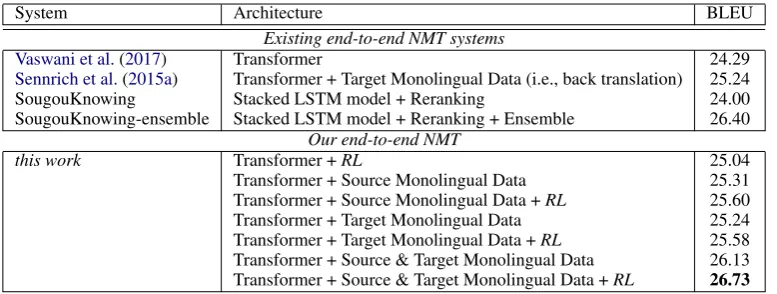
sequen-System Architecture BLEU
Existing end-to-end NMT systems
Vaswani et al.(2017) Transformer 24.29
Sennrich et al.(2015a) Transformer + Target Monolingual Data (i.e., back translation) 25.24
SougouKnowing Stacked LSTM model + Reranking 24.00
SougouKnowing-ensemble Stacked LSTM model + Reranking + Ensemble 26.40
Our end-to-end NMT
this work Transformer +RL 25.04
Transformer + Source Monolingual Data 25.31
Transformer + Source Monolingual Data +RL 25.60
Transformer + Target Monolingual Data 25.24
[image:8.595.106.495.61.208.2]Transformer + Target Monolingual Data +RL 25.58 Transformer + Source & Target Monolingual Data 26.13 Transformer + Source & Target Monolingual Data +RL 26.73
Table 7: Comparisons of different competitive end-to-end NMT systems. SougouKnowing results come from
http://matrix.statmt.org/matrix/systems_list/1878.
tial training of monolingual data can benefit the model performance. Taking the last three rows as an example, the BLEU score of the MLE model trained on the combination of bilingual data and target-side monolingual data is25.24; based on this model, RL training using the source-side monolin-gual data further improves the model performance by0.7(ρ <0.01) BLEU points. From Table6, we can observe on top of a quite strong MLE baseline (26.13), through theunified RL training, we can still improve the test set by0.6points to26.73(ρ <
0.01), which shows the effectiveness of combining source/target monolingual data and reinforcement learning.
5.4 Comparison with Other Models
At last, as a summary of our empirical result-s, we compare several representataive end-to-end NMT systems to our work in Table 7, which includes the Transformer (Vaswani et al., 2017) model, with/without back-translation (Sennrich et al., 2015a) and the best NMT system in WMT17 Chinese-English translation challenge5 (SougouKnowing-ensemble). The results clear-ly show that after combing both source-side and target-side monolingual data with RL training, we obtain the state-of-the-art BLEU score26.73, even surpassing the best ensemble model in WMT17 Zh-En translation challenge.
6 Related Work
Our work is mainly related with the literature of us-ing reinforcement learnus-ing to directly optimize the evaluation measure for neural machine translation. Several representative works are (Ranzato et al.,
5http://matrix.statmt.org/matrix/
systems_list/1878
2016;Shen et al.,2016;Bahdanau et al.,2017). In (Ranzato et al.,2016), the authors propose to train a neural translation model with the objective grad-ually shifting from maximizing token-level likeli-hood to optimizing the sentence-level BLEU score.
Shen et al.(2016) proposes to adopt minimum risk training (Goel and Byrne,2000) to minimize the task specific expected loss (i.e., induced by BLEU score) on NMT training data. Instead of the RE-INFORCE (Williams,1992) algorithm used in the above two works,Bahdanau et al.(2017) further optimizes the policy by actor-critic algorithm.Wu et al.(2016) introduces a simple RL based method to optimize the stacked LSTM model for NMT, achieving better BLEU scores on English-French translation but not on English-German. Edunov et al.(2017) presents a comparative study of sev-eral classical structural prediction losses for NMT model, which also includes sequence-level loss but not exactly the same as RL.
Our work is also related with the research works that leverage monolingual data for improving N-MT models (Zhang and Zong,2016;Sennrich et al.,
2015a;Wang et al.,2018;Xia et al.,2016;Cheng et al.,2016).Zhang and Zong(2016) exploits the source-side monolingual data in NMT.Sennrich et al. (2015a) proposes back-translation method to leverage target-side monolingual data for NMT.
7 Conclusion
In this work, we presented a study of how to ef-fectively train NMT models using reinforcement learning. Different RL strategies were evaluated in German-English, English-Chinese and Chinese-English translation tasks on large-scale bilingual datasets. We found that (1) multinomial sampling is better than beam search, (2) several previous tricks such as reward shaping and baseline reward does not make significant difference, and (3) the combination of the MLE and RL objectives is im-portant. In addition, we explored the source/target monolingual data for RL training. By combing the power of RL and monolingual data, we achieve the state-of-the-art BLEU score on WMT17 Chinese-English translation task. We hope that our study and results can benefit the community and bring some insights on how to train deep NMT models with reinforcement learning and big data.
References
Dzmitry Bahdanau, Philemon Brakel, Kelvin Xu, Anirudh Goyal, Ryan Lowe, Joelle Pineau, Aaron Courville, and Yoshua Bengio. 2017. An actor-critic algorithm for sequence prediction. Fifth Internation-al Conference on Learning Representations.
Dzmitry Bahdanau, Kyunghyun Cho, and Yoshua Ben-gio. 2015. Neural machine translation by jointly learning to align and translate. Third International
Conference on Learning Representations.
Ondˇrej Bojar, Rajen Chatterjee, Christian Federman-n, Yvette Graham, Barry Haddow, Shujian Huang, Matthias Huck, Philipp Koehn, Qun Liu, Varvara Lo-gacheva, Christof Monz, Matteo Negri, Matt Post, Raphael Rubino, Lucia Specia, and Marco Turchi. 2017. Findings of the 2017 conference on machine translation. In Proceedings of the Second Confer-ence on Machine Translation, Volume 2: Shared
Task Papers, pages 169–214, Copenhagen, Denmark.
Association for Computational Linguistics.
Samidh Chatterjee and Nicola Cancedda. 2010. Mini-mum error rate training by sampling the translation lattice. InProceedings of the 2010 Conference on
Empirical Methods in Natural Language Processing,
pages 606–615. Association for Computational Lin-guistics.
Yong Cheng, Wei Xu, Zhongjun He, Wei He, Hua Wu, Maosong Sun, and Yang Liu. 2016. Semi-supervised learning for neural machine translation.
meeting of the association for computational linguis-tics, pages 1965–1974.
Sergey Edunov, Myle Ott, Michael Auli, David Grangi-er, and Marc’Aurelio Ranzato. 2017. Classical
struc-tured prediction losses for sequence to sequence learning.Proceedings of NAACL-HLT 2018.
Jonas Gehring, Michael Auli, David Grangier, Denis Yarats, and Yann N Dauphin. 2017. Convolutional sequence to sequence learning. Proceedings of the 34th international conference on machine learning.
Vaibhava Goel and William J Byrne. 2000. Minimum bayes-risk automatic speech recognition. Computer Speech & Language, 14(2):115–135.
Hany Hassan, Anthony Aue, Chang Chen, Vishal Chowdhary, Jonathan Clark, Christian Federman-n, Xuedong Huang, Marcin Junczys-Dowmunt, William Lewis, Mu Li, et al. 2018. Achieving hu-man parity on automatic chinese to english news translation.arXiv preprint arXiv:1803.05567.
Di He, Hanqing Lu, Yingce Xia, Tao Qin, Liwei Wang, and Tieyan Liu. 2017. Decoding with value network-s for neural machine trannetwork-slation. In Advances in
Neural Information Processing Systems, pages 178–
187.
Xiaodong He and Li Deng. 2012. Maximum expect-ed bleu training of phrase and lexicon translation models. In Proceedings of the 50th Annual Meet-ing of the Association for Computational LMeet-inguistics:
Long Papers-Volume 1, pages 292–301. Association
for Computational Linguistics.
Peter Henderson, Riashat Islam, Philip Bachman, Joelle Pineau, Doina Precup, and David Meger. 2018. Deep reinforcement learning that matters.
Thirthy-Second AAAI Conference On Artificial Intel-ligence.
Diederik P Kingma and Jimmy Ba. 2015. Adam: A method for stochastic optimization. Third Interna-tional Conference on Learning Representations.
Jiwei Li, Will Monroe, Tianlin Shi, Alan Ritter, and Dan Jurafsky. 2017. Adversarial learning for neural dialogue generation. Proceedings of the 2017 Con-ference on Empirical Methods in Natural Language Processing.
Zhouhan Lin, Minwei Feng, Cicero Nogueira dos Santos, Mo Yu, Bing Xiang, Bowen Zhou, and Yoshua Bengio. 2017. A structured self-attentive sentence embedding. Fifth International Confer-ence on Learning Representations.
Volodymyr Mnih, Koray Kavukcuoglu, David Silver, Alex Graves, Ioannis Antonoglou, Daan Wierstra, and Martin Riedmiller. 2013. Playing atari with deep reinforcement learning. Advances in neural in-formation processing systems, workshop.
Vinod Nair and Geoffrey E Hinton. 2010. Rectified linear units improve restricted boltzmann machines. InProceedings of the 27th international conference
Andrew Y Ng, Daishi Harada, and Stuart Russell. 1999. Policy invariance under reward transforma-tions: Theory and application to reward shaping. In
ICML, volume 99, pages 278–287.
Khanh Nguyen, Hal Daum´e III, and Jordan Boyd-Graber. 2017. Reinforcement learning for bandit neural machine translation with simulated human feedback. Proceedings of the 2017 Conference on Empirical Methods in Natural Language Process-ing.
Kishore Papineni, Salim Roukos, Todd Ward, and Wei-Jing Zhu. 2002. Bleu: a method for automatic e-valuation of machine translation. InProceedings of the 40th annual meeting on association for compu-tational linguistics, pages 311–318. Association for Computational Linguistics.
Marc’Aurelio Ranzato, Sumit Chopra, Michael Auli, and Wojciech Zaremba. 2016. Sequence level train-ing with recurrent neural networks. Fourth Interna-tional Conference on Learning Representations.
FW Scholz. 1985. Maximum likelihood estimation.
Encyclopedia of statistical sciences.
Rico Sennrich, Alexandra Birch, Anna Currey, Ulrich Germann, Barry Haddow, Kenneth Heafield, An-tonio Valerio Miceli Barone, and Philip Williams. 2017. The university of edinburgh’s neural mt sys-tems for wmt17. InProceedings of the Second Con-ference on Machine Translation, pages 389–399. As-sociation for Computational Linguistics.
Rico Sennrich, Barry Haddow, and Alexandra Birch. 2015a. Improving neural machine translation mod-els with monolingual data. Proceedings of the 54th Annual Meeting of the Association for Computation-al Linguistics.
Rico Sennrich, Barry Haddow, and Alexandra Birch. 2015b. Neural machine translation of rare words with subword units.Proceedings of the 54th Annual Meeting of the Association for Computational Lin-guistics.
Shiqi Shen, Yong Cheng, Zhongjun He, Wei He, Hua Wu, Maosong Sun, and Yang Liu. 2016. Minimum risk training for neural machine translation. meet-ing of the association for computational lmeet-inguistics, pages 1683–1692.
Ilya Sutskever, Oriol Vinyals, and Quoc V Le. 2014. Sequence to sequence learning with neural network-s. InAdvances in neural information processing sys-tems, pages 3104–3112.
Ashish Vaswani, Noam Shazeer, Niki Parmar, Jakob Uszkoreit, Llion Jones, Aidan N Gomez, Łukasz Kaiser, and Illia Polosukhin. 2017. Attention is all you need. InAdvances in Neural Information Pro-cessing Systems, pages 6000–6010.
Yijun Wang, Yingce Xia, Li Zhao, Jiang Bian, Tao Qin, Guiquan Liu, and T Liu. 2018. Dual transfer learn-ing for neural machine translation with marginal distribution regularization. In Proceedings of the Thirty-Second AAAI Conference on Artificial Intel-ligence.
Lex Weaver and Nigel Tao. 2001. The optimal reward baseline for gradient-based reinforcement learning. InProceedings of the Seventeenth conference on Un-certainty in artificial intelligence, pages 538–545. Morgan Kaufmann Publishers Inc.
Ronald J Williams. 1992. Simple statistical gradient-following algorithms for connectionist reinforce-ment learning. In Reinforcement Learning, pages 5–32. Springer.
Lijun Wu, Xu Tan, Di He, Fei Tian, Tao Qin, Jianhuang Lai, and Tie-Yan Liu. 2018a. Beyond error propaga-tion in neural machine translapropaga-tion: Characteristics of language also matter. InProceedings of the 2018 Conference on Empirical Methods in Natural Lan-guage Processing.
Lijun Wu, Fei Tian, Li Zhao, Jianhuang Lai, and Tie-Yan Liu. 2018b. Word attention for sequence to se-quence text understanding. InAAAI.
Lijun Wu, Yingce Xia, Li Zhao, Fei Tian, Tao Qin, Jianhuang Lai, and Tie-Yan Liu. 2017a. Adversar-ial neural machine translation. arXiv preprint arX-iv:1704.06933.
Lijun Wu, Li Zhao, Tao Qin, Jianhuang Lai, and Tie-Yan Liu. 2017b. Sequence prediction with unlabeled data by reward function learning. IJCAI-17, pages 3098–3104.
Yonghui Wu, Mike Schuster, Zhifeng Chen, Quoc V Le, Mohammad Norouzi, Wolfgang Macherey, Max-im Krikun, Yuan Cao, Qin Gao, Klaus Macherey, et al. 2016. Google’s neural machine translation sys-tem: Bridging the gap between human and machine translation.arXiv preprint arXiv:1609.08144.
Yingce Xia, Di He, Tao Qin, Liwei Wang, Nenghai Yu, Tieyan Liu, and Weiying Ma. 2016. Dual learning for machine translation. neural information process-ing systems, pages 820–828.
Yingce Xia, Fei Tian, Lijun Wu, Jianxin Lin, Tao Qin, Nenghai Yu, and Tie-Yan Liu. 2017. Deliberation networks: Sequence generation beyond one-pass de-coding. InAdvances in Neural Information Process-ing Systems, pages 1784–1794.