From Segmentation to Analyses:
A Probabilistic Model for Unsupervised Morphology Induction
Toms Bergmanis School of Informatics University of Edinburgh
Sharon Goldwater School of Informatics University of Edinburgh
Abstract
A major motivation for unsupervised mor-phological analysis is to reduce the sparse data problem in under-resourced languages. Most previous work focuses on segmenting surface forms into their constituent morphs (e.g.,taking: tak +ing), but surface form segmentation does not solve the sparse data problem as the analyses oftakeandtaking
are not connected to each other. We extend the MorphoChains system (Narasimhan et al., 2015) to provide morphological anal-yses that can abstract over spelling dif-ferences in functionally similar morphs. These analyses are not required to use all the orthographic material of a word ( stop-ping: stop +ing), nor are they limited to only that material (acidified: acid +ify +ed). On average across six typologically varied languages our system has a similar or better F-score on EMMA (a measure of underlying morpheme accuracy) than three strong baselines; moreover, the total num-ber of distinct morphemes identified by our system is on average 12.8% lower than for Morfessor (Virpioja et al., 2013), a state-of-the-art surface segmentation system.
1 Introduction
Most previous work on unsupervised morphologi-cal analysis has focused on the problem of segmen-tation: segmenting surface forms into their con-stituent morphs (Goldsmith, 2001; Creutz and La-gus, 2007; Poon et al., 2009; Lee et al., 2011; Virpi-oja et al., 2013; Sirts and Goldwater, 2013). How-ever, the focus on surface segmentation is largely due to ease of model definition and implementa-tion rather than linguistic correctness. Even in lan-guages with primarily concatenative morphology, spelling (or phonological) changes often occur at
morpheme boundaries, so that a single morpheme may have multiple surface forms. For example, the past tense in English may surface as-ed(walked),
-d(baked),-ted(emitted),-ped(skipped), etc. A major motivation for unsupervised morpholog-ical analysis is to reduce the sparse data problem in under-resourced languages. While surface segmen-tation can help, the example above illustrates its limitations: for more effective parameter sharing, a system should recognize that-ed,-d,-ted, and-ped
share the same linguistic function. The importance of identifying underlying morphemes rather than surface morphs is widely recognized, for example by the MorphoChallenge organizers, who in later years provided datasets and evaluation measures to encourage this deeper level of analysis (Kurimo et al., 2010). Nevertheless, only a few systems have attempted this task (Goldwater and Johnson, 2004; Naradowsky and Goldwater, 2009), and as far as we know, only one, the rule-based MORSEL (Lig-nos et al., 2009; Lig(Lig-nos, 2010), has come close to the level of performance achieved by segmentation systems such as Morfessor (Virpioja et al., 2013).
We present a system that adapts the unsupervised MorphoChains segmentation system (Narasimhan et al., 2015) to provide morphological analyses that aim to abstract over spelling differences in func-tionally similar morphemes. Like MorphoChains, our system uses an unsupervised log-linear model whose parameters are learned using contrastive esti-mation (Smith and Eisner, 2005). The original Mor-phoChains system learns to identify child-parent pairs of morphologically related words, where the child (e.g., stopping) is formed from the parent (stop) by adding an affix and possibly a spelling transformation (both represented as features in the model). However, these spelling transformations are never used to output underlying morphemes, instead the system just returns a segmentation by post-processing the inferred child-parent pairs.
We extend the MorphoChains system in
eral ways: first, we use the spelling transforma-tion features to output underlying morphemes for each word rather than a segmentation; second, we broaden the types of morphological changes that can be identified to include compounds; and third, we modify the set of features used in the log-linear model to improve the overall performance. We eval-uate using EMMA (Spiegler and Monson, 2010), a measure that focuses on the identity rather than the spelling of morphemes. On average across six typo-logically varied languages (English, German, Turk-ish, FinnTurk-ish, Estonian, Arabic), our system outper-forms both the original MorphoChains system and the MORSEL system, and performs similarly to the surface segmentation system Morfessor. These results are (to our knowledge) the best to date from a system for identifying underlying morphemes; moreover, the total number of distinct morphemes identified by our system is on average 12.8% lower than for Morfessor, suggesting that it does a bet-ter job of abstracting over surface spellings and inducing a compact representation of the data. 2 Morphological Chains and Analyses We base our work on the MorphoChains segmen-tation system (Narasimhan et al., 2015),1 which
defines amorphological chain as a sequence of child-parent pairs. Each pair consists of two mor-phologically related words where the child must be longer than the parent. To analyse a word we want to find the best parent for that word; we do so recur-sively until we conclude that thestop conditionis met (i.e. a word doesn’t have a morphological par-ent). The wordstandardizes, for example, produces the following chain:
standardizes→standardize→standard
which consists of the child-parent pairs ( standard-izes, standardize), (standardize, standard) and (standard, NONE). Each child-parent pair is an-notated with atypeindicating the kind of trans-formationthat relates the child-parent pair. The set of transformations defined by MorphoChains is:suffixationas in (dogs, dog),prefixationas in (undone,done),deletionas in (baked,bake)2,
rep-etitionas in (stopped,stop), andmodificationas in
1We modified the implementation available athttps:
//github.com/karthikncode/MorphoChain.
2The system could in principle learn thatbakeis the parent
ofbakedwith typesuffix, which would imply the analysisbake +d. However, we hope it learns instead the typedelete, which implies the (correct) analysisbake +ed. Similar alternative analyses are possible for the other example types shown.
Word MorphoChains Our Model stopping stopp +ing stop +ing doubled double +d double +ed acidified acid +ifi +ed acid +ify +ed
Table 1: Examples outputs of two models.
(worried,worry). We add a sixth type, compound-ingas in (darkroom,room). The delete, repeat, and modify types all assume the change occurs to the final character of the stem, while compounding can simply concatenate the two stems, or can introduce an extra character (as in higher-rate or German
schilddruese +n+ krebs(‘thyroid cancer’). Any word (undone) has many possible parents, some linguistically plausible (undo, done) and others not (und, ndone). Our system, like Mor-phoChains, learns a log-linear model to discrimi-nate plausible from implausible parents amongst the completeparent candidate setfor each word. The candidate set is generated by taking all possible splits of the word and applying all possible transfor-mation types. For example, some parent candidates for the worddogsinclude (dog, suffix), (do, suffix), (gs, prefix), (doga, delete), (dogb, delete), (doe, delete), and (doe, modify). The last two imply analyses ofdoe +gsanddoe +s, respectively.
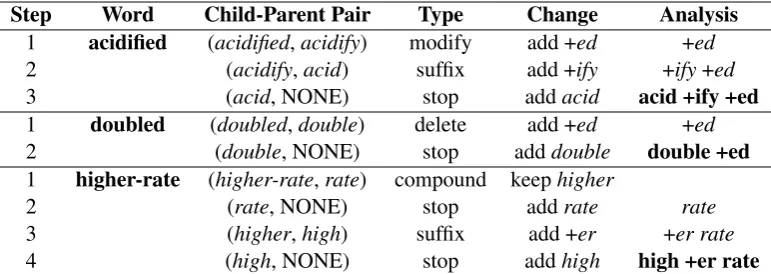
The examples above indicate how analyses can be induced recursively by tracking the transfor-mation type and orthographic change associated with each parent-child pair. However, the original MorphoChains algorithm did not do so, instead it only used the transformation types to predict morph boundaries. Table 1 contrasts the word seg-mentation into morphs produced by the original MorphoChains model and the morpheme analysis produced by our model. Table 2 provides additional examples of our recursive analysis process. 2.1 Model
We predict child-parent pairs using a log-linear model, following Narasimhan et al. (2015). The model consists of a set of features represented by a feature vectorφ:W × Z →Rd, whereW is a set
of words andZ is the set of(parent, type)pairs for words inW. The model defines the conditional probability of a particular(parent, type)pairz∈ Zgiven wordw∈ Was:
P(z|w) = P eθ·φ(w,z)
Step Word Child-Parent Pair Type Change Analysis 1 acidified (acidified,acidify) modify add +ed +ed
2 (acidify,acid) suffix add +ify +ify+ed
3 (acid, NONE) stop addacid acid +ify +ed 1 doubled (doubled,double) delete add +ed +ed
2 (double, NONE) stop adddouble double +ed 1 higher-rate (higher-rate,rate) compound keephigher
2 (rate, NONE) stop addrate rate
3 (higher,high) suffix add +er +er rate
[image:3.595.106.492.62.199.2]4 (high, NONE) stop addhigh high +er rate Table 2: Examples of step-by-step derivations of morphological analysis of English words.
whereC(w)⊂ Z denotes the set of parent candi-dates forwandθis a weight vector.
Our goal is to learn the feature weights in an unsupervised fashion. Following Narasimhan et al. (2015), we do so using Contrastive Estimation (CE) (Smith and Eisner, 2005). In CE every training ex-amplew ∈ W serves as both a positive example and a set of implied negative examples—strings that are similar towbut don’t occur in the corpus. The negative examples are the source of the proba-bility mass allocated to the positive examples. The word w and its negative examples constitute the neighbourhoodN(w)ofw.
Given the list of wordsWand their neighbour-hoods, the CE likelihood is defined as:
LCE(θ,W) =
Y
w∗∈W
P
z∈C(w∗)eθ·φ(w∗,z) P
w∈N(w∗)Pz∈C(w)eθ·φ(w,z). (2)
We use the same neighbourhood functions as Narasimhan et al. (2015). Specifically, for each wordwin the corpusW, we create neighbours in two ways: by swapping two adjacent characters of w(walking→walkign) and by swapping two pairs of adjacent characters, where one pair is at the be-ginning of the word, and the other at the end of the word (walking→awlkign).
We use LBFGS-B (Zhu et al., 1997) to optimize the regularized log-likelihood of the model:
LLCE(θ,W) =
X
w∗∈W
log X
z∈C(w∗)
eθ·φ(w∗,z)
−log X
w∈N(w∗) X
z∈C(w)
eθ·φ(w,z)
−λkθk2 (3)
2.2 Features
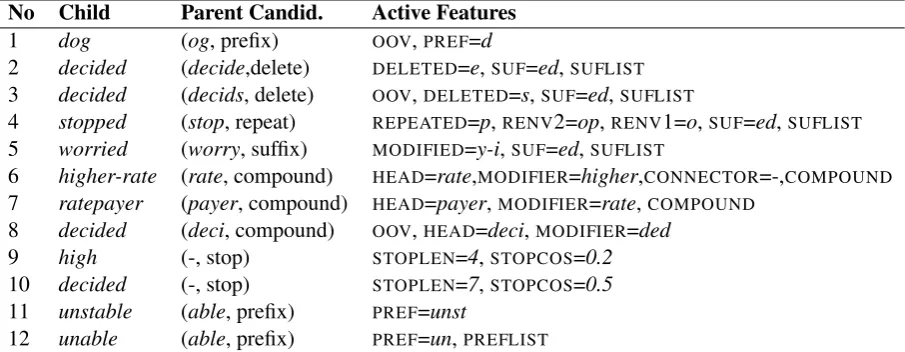
MorphoChains used a rich set of features from which we have kept some, discarded others and added new ones to improve overall performance. This section describes our set of features, with ex-amples shown in Table 3.
Presence in Training Data We want fea-tures that signal which parents are valid words. Narasimhan et al. (2015) used each word’s log fre-quency. However the majority of words in the train-ing data (word frequency lists) occur only once, which makes their frequency information unreli-able.3Instead, we use an out-of-vocabulary feature
(OOV) for parents that don’t occur in the training
data.
Semantic Similarity Morphologically related words exhibit semantic similarity among their word embeddings (Schone and Jurafsky, 2000; Baroni et al., 2002). Semantic similarity was an important feature in MorphoChains: Narasimhan et al. (2015) concluded that up to 25 percent of their model’s precision was due to the semantic similarity fea-ture. We use the same feature here (COS). For a
child-parent pair (wA,wB) with word embeddings
vwA and vwB respectively we compute semantic
similarity as:
cos(wA, wB) = kvvwA ·vwB
wAkkvwBk (4)
Affixes Candidate pairs where the child contains a frequently occurring affix are more likely to be correct. To identify possible affixes to use as fea-tures, Narasimhan et al. (2015) counted the number of words that end (or start) with each substring
3The prevalence of singleton word types in the
No Child Parent Candid. Active Features 1 dog (og, prefix) OOV,PREF=d
2 decided (decide,delete) DELETED=e,SUF=ed,SUFLIST
3 decided (decids, delete) OOV,DELETED=s,SUF=ed,SUFLIST
4 stopped (stop, repeat) REPEATED=p,RENV2=op,RENV1=o,SUF=ed,SUFLIST
5 worried (worry, suffix) MODIFIED=y-i,SUF=ed,SUFLIST
6 higher-rate (rate, compound) HEAD=rate,MODIFIER=higher,CONNECTOR=-,COMPOUND
7 ratepayer (payer, compound) HEAD=payer,MODIFIER=rate,COMPOUND
8 decided (deci, compound) OOV,HEAD=deci,MODIFIER=ded
9 high (-, stop) STOPLEN=4,STOPCOS=0.2
10 decided (-, stop) STOPLEN=7,STOPCOS=0.5
11 unstable (able, prefix) PREF=unst
[image:4.595.74.527.63.239.2]12 unable (able, prefix) PREF=un,PREFLIST
Table 3: Examples illustrating which of the binary features in the model are active for various potential child-parent pairs. Not shown here is the real-valued semantic similarity featureCOS, used in all examples
except 9 and 10, where it is replaced by the binary featureSTOPCOS=y, foryin increments of 0.1.
Prefixes
al, ar, ba, be, bo, ca, car, co, de, dis, en, ha, ho, in, inter, la, le, li, lo, ma, mar, mc, mi, mis, mo, out, over, pa, po, pre, pro, ra, re, ro, se, ta, to, un, under, up
Suffixes
a, age, al, an, ar, ary, as, ation, b, ble, ch, e, ed, el, en, er, ers, es, est, et, ful, i, ia, ic, ie, ies, in, ing, ings, is, ism, ist, ists, land, le, led, les, less, ley, ling, ly, m, man, ment, ments, ner, ness, o, or, p, s, se, son, t, ted, ter, ters, th, ting, ton, ts, y Table 4: The likely English affixes found by using Letter Successor Entropy.
and selected the most frequent ones. However, all words that end with ing also end withngand g, which means that they also become affix candi-dates. Furthermore, there are more words that end withngorgthan withing, therefore valid affixes might be excluded from the list because of their more frequent substrings.
We therefore modify the affix features in two ways. First, we identify a more precise set of likely affixes using Letter Successor Entropy (LSE) val-ues (Hafer and Weiss, 1974), which are typically high at morph boundaries. LSE is computed at each point in the word as the entropy of the dis-tribution over the next character given the word prefix so far. When selecting likely affixes, we use an LSE threshold value of 3.0 as suggested by Hafer and Weiss (1974), and we require that the affix has appeared in at least 50 types with a
cor-pus frequency of at least 100. We then define two features (PREFLIST,SUFLIST), which are active if
the proposed prefix or suffix for a parent-child pair is in the set of likely prefixes or suffixes. Table 4 shows the list of likely English affixes found by us-ing LSE (62 suffixes and 42 prefixes). For German and Turkish, our other two development languages (see§3), the lists contain 498 suffixes/183 prefixes and 181 suffixes/35 prefixes, respectively.4
In addition, we use a much larger set of affix fea-tures,PREF=xandSUF=x, wherexis instantiated
with all possible word prefixes (suffixes) for which bothwandxw(wx) are words in the training data. Transformations To help distinguish between probable and improbable transformations, we intro-duce transformation-specific features. For deletion we use the deleted letter (DELETED). For
repeti-tion we use the repeated letter and its preceding 2- and 1-character contexts (REPEATED, RENV2 RENV1). For modification we use the combination
of the involved letters (MODIFIED). Finally, for
compounding we use the headword (i.e. the parent of the compound), the modifier and the connector, if such exists (HEAD, MODIFIER, CONNECTOR).
Since these compound features can be very sparse, we also add a singleCOMPOUNDfeature, which is
active when both parts of the compound are present in the training data.
Stop Condition To identify words with no par-ents we use two types of binary features suggested
4In MorphoChains, the number of affixes was set manually
by Narasimhan et al. (2015). STOPCOS=y is the
maximum cosine similarity between the word and any of its parent candidates (using bins of size 0.1), andSTOPLEN=x is instantiated for all
pos-sible word lengthsx in the training data. For il-lustration, if we are considering whetherdecided
is a word with no parents (Table 3 Example 10), the binary featuresSTOPLEN=7andSTOPCOS=0.5
become active.
We discard the starting and ending character un-igram and bun-igram features used by MorphoChains, because of the large number5and the sparsity of
these features. 2.3 Data Selection
Most unsupervised morphology learners are sensi-tive to the coverage and the quality of training data. In a large corpus, however, many word types oc-cur only once because of the Zipfian distribution of word types. Low-frequency types can be either rare but valid words or they can be foreign words, ty-pos, non-words, etc. This makes learning from low-frequency words unreliable, but discarding them dramatically reduces the size of the training data (including many valid words).
To seek balance between the quality and the cov-erage of the training data we try to identify which low-frequency words are likely to provide useful statistical support for our model, so we can include those in the training data and discard the other low-frequency words. First, we set a low-frequency-based pruning threshold(PT) at the frequency for which at least 50% of the words above this frequency have a word embedding (see§3); next we set a learn-ing threshold(LT) at the median frequency of the words with frequencies above PT; finally we adopt the algorithm by Neuvel and Fulop (2002) to de-cide which words with frequencies below PT can be useful to analyse the words with frequencies above LT. We filter out any remaining words with frequencies below PT.
The outline of the adapted version of the algo-rithm by Neuvel and Fulop (2002) is:
1)For every word pair in the top 20k most frequent words in training data:
1.1) We find the pair’s orthographic sim-ilarities as the longest common subsequence: receive⇔reception.
1.2) We find the pair’s orthographic
differ-5For English there can be 676 different letter bigrams of
which 99% occur at least once at the beginning of some word in the word frequency list.
ences with respect to their orthographic similar-ities:receive⇔reception.
2)For all word-pairs with the same orthographic differences we merge their similarities and differ-ences into Word Formation Strategies (WFS): so receive⇔reception, conceive⇔conception, deceive⇔deception give *##ceive⇔*##ception, where * and # stand for the optional and mandatory character wild cards respectively.
3)We discard those WFS that that are suggested by less than 10 word pairs;
4) For each WFS and for each word with a fre-quency below PT:
4.1)if a wordwmatches either of the sides of a WFS and the other side of a WFS predicts a word
w’with a frequency above the LT, we keepwin the training data, otherwise we discard it.
For more detailed description of the algorithm see Neuvel and Fulop (2002).
3 Experiments
Data We conduct experiments on six languages: Arabic, English, Estonian, Finnish, German and Turkish. For the word embeddings required by our system and the MorphoChains baseline, we usedword2vec(Mikolov et al., 2013) to train a Continuous Bag of Words model on a sub-sample of the Common Crawl (CC) corpus6for each
lan-guage (Table 5 lists corpus sizes). We trained 100-dimensional embeddings for all words occurring at least 25 times, using 20 iterations and default parameters otherwise.
For all languages except Estonian, we train and evaluate all systems on the data from the Morpho Challenge 2010 competition.7 The training data
consists of word lists with word frequencies. The official test sets are not public, but a small labelled training and development set is provided for each language in addition to the large unannotated word list, since the challenge included semi-supervised systems. Thus, for experiments on Arabic, English, Finnish, German and Turkish we evaluated on the annotated training and development gold standard analyses form the Morpho Challenge 2009/2010 competition data sets. The gold standard labels include part of speech tags and functional labels for inflectional morphemes, with multiple analyses given for words with part of speech ambiguity or
6Common Crawlhttp://commoncrawl.org 7Morpho Challenge 2010: http://research.ics.
Lang (#types)Train (#cases)Test Embeddings(#tokens)
ARA MC-10(19K) MC-09(690) (461M)CC
ENG MC-10(878K) MC-10(1569) (1.78B)CC
EST (470K)CC S&G2013(1500) (329M)CC
FIN MC-10(2.9M) MC-10(1835) (1.18B)CC
GER MC-10(2.3M) MC-10(1779) (856M)CC
TUR MC-10(617K) MC-10(1760) (1.21B)CC
Table 5: Data statistics. MC-09/10: Morpho Chal-lenge 2009/2010. CC: A sub-sample of Common Crawl. S&G2013: Sirts and Goldwater (2013)
functionally different but orthographically equiva-lent inflectional morphemes. For example, rocki-nessis analysed asrock N y s ness s, whilerocks
has two analyses:rock N +PLandrock V +3SG. For Estonian we train on word lists extracted from Common Crawl and test on data prepared by Sirts and Goldwater (2013). The Estonian test set contains only surface segmentation into morphs (e.g. kolmandalis analysedkolmanda l). Table 5 provides information about each dataset.
Since we are developing an unsupervised system, we want to make sure that it generalizes to new lan-guages. We therefore divide the languages into threedevelopment languages(English, German, Turkish) and three test languages(Finnish, Esto-nian, Arabic). We used the development languages to choose features, design the data selection pro-cedure and select best values for hyperparameters. The system that performed best on those languages was then used unmodified on the test languages.
Hyperparameters In addition to threshold val-ues described above, we use the sameλ= 1 (Equa-tion 3) as Narasimhan et al. (2015). To control for under segmentation we downscale weights of the stop features by a factor of0.8. We set the maxi-mum affix length to 8 characters and the minimaxi-mum word length to 1 character.
Evaluation Metric We test our model on the task of unsupervised morpheme analysis induction. We follow the format of Morpho Challenge 2010 and use Evaluation Metric for Morphological Analysis
(EMMA) (Spiegler and Monson, 2010) to evaluate predicted outputs. EMMA works by finding the optimal one-to-one mapping between the model’s output and the reference analysis (i.e., the spelling of the morphemes in the analysis doesn’t matter). These are used to compute precision, recall, and F-score against the reference morphemes.
Baselines We compare our model to three other systems: Morfessor 2.0 (Virpioja et al., 2013), MORSEL (Lignos et al., 2009; Lignos, 2010) and MorphoChains (Narasimhan et al., 2015). We also use a trivial baselineWordswhich outputs the input word.
Morfessor (Morf.2.0) is a family of probabilistic algorithms that perform unsupervised word seg-mentation into morphs.Since the release of the ini-tial version of Morfessor, it has become popular as an automatic tool for processing morphologically complex languages.
MORSEL is a rule-based unsupervised morphol-ogy learner designed for affixal morpholmorphol-ogy. Like our own system, it outputs morphological analy-ses of words rather than segmentations. MORSEL achieved excellent performance on the Morpho Challenge 2010 data sets.
MorphoChains (MC) is the model upon which our own system is based, but as noted above it performs segmentation rather than analysis. In con-trast to Morfessor and MORSEL, which analyse words based only on orthographic patterns, Mor-phoChains (like our extension) uses both ortho-graphic and the semantic information.
All three baselines have multiple hyperparame-ters. Since performance tends to be most sensitive to the treatment of word frequency (including pos-sibly discarding low-frequency words), for each system we tuned the hyperparameters related to word frequency to optimize average performance on the development languages, and kept these hy-perparameters fixed for the test languages.
4 Results and Discussion
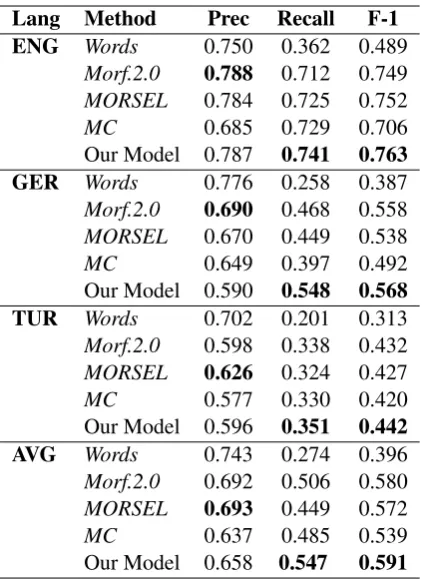
Table 6 gives the performance of all models on the three development languages. Our model outper-forms all baselines on every language, and is a clear improvement over the original MorphoChains.8
8In the results reported by Narasimhan et al. (2015),
Lang Method Prec Recall F-1 ENG Words 0.750 0.362 0.489
Morf.2.0 0.788 0.712 0.749
MORSEL 0.784 0.725 0.752
MC 0.685 0.729 0.706 Our Model 0.787 0.741 0.763 GER Words 0.776 0.258 0.387
Morf.2.0 0.690 0.468 0.558
MORSEL 0.670 0.449 0.538
MC 0.649 0.397 0.492 Our Model 0.590 0.548 0.568 TUR Words 0.702 0.201 0.313
Morf.2.0 0.598 0.338 0.432
MORSEL 0.626 0.324 0.427
MC 0.577 0.330 0.420 Our Model 0.596 0.351 0.442 AVG Words 0.743 0.274 0.396
Morf.2.0 0.692 0.506 0.580
MORSEL 0.693 0.449 0.572
[image:7.595.76.291.60.350.2]MC 0.637 0.485 0.539 Our Model 0.658 0.547 0.591
Table 6: Results on development languages. Scores calculated using EMMA.Words=Trivial baseline which outputs the input word.
To see where the benefit is coming from, we per-formed ablation tests (Table 7). Results show the importance of the LSE-based affix features (Model-A). Using these features gives gains of +1.0%, 3.8% and 0.6% F-1 absolute on English, German and Turkish respectively over using the raw affix oc-currence frequencies as used by Narasimhan et al. (2015). We can see that our data selection scheme (Model-D) is important for English (+3.5%) and German (+1.1%). Although we expected that the data selection scheme would have the biggest im-pact on Turkish because of its small training data, it has very little effect on this language. As expected, the compounding transformation (Model-C) has a prominent impact on German (+2.7%) and a mod-est effect on English and Turkish. The three fea-turesPREFLIST,SUFLIST,COMPOUND(Model-B)
have the least impact on the model’s performance (on average 0.5% F-1 absolute), however the effect is substantial considering that this gain is achieved
their hyperparameters separately for each language. Finally, it is not clear how they tuned the frequency-related hyperpa-rameters for Morfessor. We found that Morfessor performed better than MorphoChains when either low frequency words are pruned from its input, or its log-frequency option is used rather than raw frequency.
Lang Method Prec Recall F-1 ENG Model-D 0.710 0.746 0.728
Model-C 0.811 0.705 0.754 Model-B 0.775 0.738 0.756 Model-A 0.755 0.751 0.753 Full Model 0.787 0.741 0.763 GER Model-D 0.633 0.497 0.557 Model-C 0.666 0.456 0.541 Model-B 0.608 0.530 0.566 Model-A 0.636 0.455 0.530 Full Model 0.590 0.548 0.568 TUR Model-D 0.554 0.365 0.440 Model-C 0.601 0.344 0.438 Model-B 0.604 0.344 0.437 Model-A 0.588 0.346 0.436 Full Model 0.596 0.351 0.442 Table 7: Ablation analysis. -D=no data selection, -C=no compound transformations, -B=no PRE
-FLIST,SUFLIST,COMPOUNDfeatures, -A=no other
LSE-based affix features.
by merely 3 features as opposed to a new feature type with many instantiations.
Table 8 shows some example outputs for English, German and Turkish. These analyses include some correctly identified spelling changes (Example 1) compounds (Example 4), and purely concatenative morphology (Example 6). In Example 2,+bleis counted as incorrect because our model predicts
+bleboth fordeplorableandreproduciblewhile the reference analysis usesable sandible s, respec-tively. Since EMMA uses one-to-one alignment, it deems one of the alignments wrong. The op-posite problem occurs in Example 4: our model analysesausin two ways, either as a prefixaus+
or as a separate wordaus (part of a compound), whereas the reference analysis always treats it as a separate wordaus. Example 6 illustrates an over-segmentation error, caused by encountering two similar forms of the verbgiy,giymeyinandgiymeyi.
[image:7.595.309.523.62.280.2]No Lang. Test Word Reference Analysis Our Model
[image:8.595.114.488.62.159.2]1 ENG acknowledging ac p knowledge N +PCP1 ac+ knowledge +ing 2 ENG reproducible re p produce Vible s re+ produce +ble 3 GER wohnstuben wohn V stube N +PL wohn stube +n 4 GER ausdrueckliche ausdrueck V lich +ADJ-e aus+ drueck +lich +e 5 TUR budaklara budak +PL +DAT budak +lar +a 6 TUR giymeyin giy +NEG ma+P2 PL giy +me +yi +n
Table 8: Examples morpheme analyses produced by our model on the development languages. Reference analyses inboldcorrespond to the predicted analyses that are incorrect. See text for further explanation.
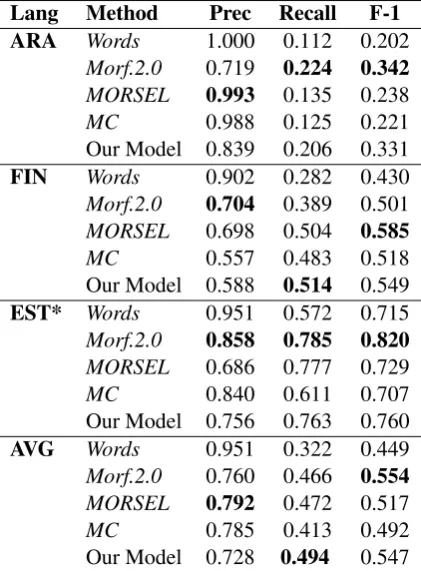
Lang Method Prec Recall F-1 ARA Words 1.000 0.112 0.202
Morf.2.0 0.719 0.224 0.342
MORSEL 0.993 0.135 0.238
MC 0.988 0.125 0.221 Our Model 0.839 0.206 0.331 FIN Words 0.902 0.282 0.430
Morf.2.0 0.704 0.389 0.501
MORSEL 0.698 0.504 0.585
MC 0.557 0.483 0.518 Our Model 0.588 0.514 0.549 EST* Words 0.951 0.572 0.715
Morf.2.0 0.858 0.785 0.820
MORSEL 0.686 0.777 0.729
MC 0.840 0.611 0.707 Our Model 0.756 0.763 0.760 AVG Words 0.951 0.322 0.449
Morf.2.0 0.760 0.466 0.554
MORSEL 0.792 0.472 0.517
MC 0.785 0.413 0.492 Our Model 0.728 0.494 0.547 Table 9: Results on test languages. Scores calcu-lated using EMMA. *=reference analysis contains word segmentation.
better than the others. Overall, our model performs consistently near the top even if not the best for any of the three languages.
Lexical Inventory Size One of the motivations for unsupervised morphological analysis is to re-duce data sparsity in downstream applications, which implies that for a given level of accuracy, systems that produce a more compact representa-tion (i.e., a smaller morpheme inventory) should be preferred. To see how compactly each model repre-sents the test set, we count the number of unique morphemes (or morphs, or labels) in the predicted output of each model and compare it with the ber of labels in the reference analysis and the
num-Method ENG GER TUR FIN EST
Morf.2.0 1439 2005 1873 2586 1620
MC 1442 2004 1912 2718 1635
MORSEL1373 1865 1748 2177 1562
Ours 1336 1600 1725 2114 1616
Ref.Anal 1257 1520 1361 1966 1548
Words 1569 1779 1760 1835 1500 Table 10: The number of distinct morphemes iden-tified by each model. The number of distinct labels used in the reference analysis and the number of words in unanalysed test sets are given for compar-ison.
ber of words in the test set. Table 10 summarizes this information9. For all languages except
Esto-nian our model finds the most compact set of items. The number of distinct morphemes identified by our model is only about 5%, 4.5% and 8.0% larger than in the reference analysis for English, German and Finnish respectively. On average our model identified 12.8% and 14.8% fewer morphemes than Morfessor and MorphoChains respectively, while on average performing no worse or better than the two word segmentation systems. MORSEL pro-duces the second most compact output with only a 3.2% larger set of distinct morphemes than our model, leaving the two word segmentation systems, Morfessor and MorphoChains, in the third and the forth place respectively. These results suggest that systems that attempt to output morphological anal-ysis succeed in reusing the same morphemes more frequently than the systems that perform surface segmentation.
5 Conclusion
We presented an unsupervised log-linear model that learns to identify morphologically related words
9Arabic is excluded because of the low overall
[image:8.595.76.287.213.499.2]and the affixes and spelling transformations that relate them. It uses these to induce morpheme-level analyses of each word and an overall com-pact representation of the corpus. In tests on six languages, our system’s EMMA scores are consid-erably better than its inspiration, the segmentation system MorphoChains, and it also outperformed the rule-based analysis system MORSEL. Our sys-tem achieved similar EMMA performance to Mor-fessor but with a more compact representation—the first probabilistic system we are aware of to do so well. In future work, we hope to investigate further improvements to the system and perform extrinsic evaluation on downstream tasks.
References
Marco Baroni, Johannes Matiasek, and Harald Trost. 2002. Unsupervised discovery of morphologically related words based on orthographic and semantic similarity. In Proceedings of the ACL-02 Work-shop on Morphological and Phonological Learning, pages 48–57. Association for Computational Lin-guistics, July.
Mathias Creutz and Krista Lagus. 2007. Unsuper-vised models for morpheme segmentation and mor-phology learning. ACM Transactions of Speech and Language Processing, 4(1):1–34, February.
John Goldsmith. 2001. Unsupervised learning of the morphology of a natural language. Computational Linguistics, 27(2):153–198, June.
Sharon Goldwater and Mark Johnson. 2004. Priors in Bayesian learning of phonological rules. In Pro-ceedings of the Seventh Meeting of the ACL Special Interest Group in Computational Phonology, pages 35–42, Barcelona, Spain, July. Association for Com-putational Linguistics.
Margaret A. Hafer and Stephen F. Weiss. 1974. Word segmentation by letter successor varieties. Informa-tion storage and retrieval, 10(11):371–385.
Mikko Kurimo, Sami Virpioja, Ville Turunen, and Krista Lagus. 2010. Morpho Challenge 2005-2010: Evaluations and results. InProceedings of the 11th Meeting of the ACL Special Interest Group on Com-putational Morphology and Phonology, pages 87– 95, Uppsala, Sweden, July. Association for Compu-tational Linguistics.
Yoong Keok Lee, Aria Haghighi, and Regina Barzilay. 2011. Modeling syntactic context improves mor-phological segmentation. InProceedings of the Fif-teenth Conference on Computational Natural Lan-guage Learning, pages 1–9, Portland, Oregon, USA, June. Association for Computational Linguistics.
Constantine Lignos, Erwin Chan, Mitchell P. Marcus, and Charles Yang. 2009. A rule-based unsupervised morphology learning framework. In CLEF (Work-ing Notes).
Constantine Lignos. 2010. Learning from unseen data. In Mikko Kurimo, Sami Virpioja, and Ville T. Turunen, editors,Proceedings of the Morpho Chal-lenge 2010 Workshop, pages 35–38, Helsinki, Fin-land, September 2–3. Aalto University School of Sci-ence and Technology.
Tomas Mikolov, Kai Chen, Greg Corrado, and Jeffrey Dean. 2013. Efficient estimation of word represen-tations in vector space. InProceedings of the Work-shop at the 2013 International Conference on Repre-sentation Learning.
Jason Naradowsky and Sharon Goldwater. 2009. Im-proving morphology induction by learning spelling rules. InProceedings of the 21st International Joint Conference on Artificial Intelligence, pages 1531– 1536.
Karthik Narasimhan, Regina Barzilay, and Tommi Jaakkola. 2015. An unsupervised method for uncov-ering morphological chains. Transactions of the As-sociation for Computational Linguistics, 3:157–167.
Sylvain Neuvel and Sean A. Fulop. 2002. Unsuper-vised learning of morphology without morphemes. In Proceedings of the ACL-02 Workshop on Mor-phological and Phonological Learning, pages 31– 40. Association for Computational Linguistics, July.
Hoifung Poon, Colin Cherry, and Kristina Toutanova. 2009. Unsupervised morphological segmentation with log-linear models. InProceedings of Human Language Technologies: The 2009 Annual Confer-ence of the North American Chapter of the Associa-tion for ComputaAssocia-tional Linguistics, pages 209–217, Boulder, Colorado, June. Association for Computa-tional Linguistics.
Patrick Schone and Daniel Jurafsky. 2000. Knowledge-free induction of morphology us-ing latent semantic analysis. In Proceedings of the 2nd Workshop on Learning Language in Logic and the 4th Conference on Computational Natural Language Learning, pages 67–72, Lisbon, Portugal. Association for Computational Linguistics.
Kairit Sirts and Sharon Goldwater. 2013. Minimally-supervised morphological segmentation using Adap-tor Grammars. Transactions of the Association for Computational Linguistics, 1(May):231–242.
Sebastian Spiegler and Christian Monson. 2010. EMMA: A novel evaluation metric for morpholog-ical analysis. In Proceedings of the 23rd Inter-national Conference on Computational Linguistics (Coling 2010), pages 1029–1037, Beijing, China, August. Coling 2010 Organizing Committee. Sami Virpioja, Peter Smit, Stig-Arne Gr¨onroos, Mikko
Kurimo, et al. 2013. Morfessor 2.0: Python imple-mentation and extensions for morfessor baseline. Ciyou Zhu, Richard H. Byrd, Peihuang Lu, and Jorge