Just Talking - Modelling Casual Conversation
Emer GilmartinADAPT Centre Trinity College Dublin
Carl Vogel
Computational Linguistics Group Trinity College Dublin
Christian Saam ADAPT Centre Trinity College Dublin
Nick Campbell SCL
Trinity College Dublin
Vincent Wade ADAPT Centre Trinity College Dublin
Abstract
Casual conversation has become a focus for dialogue applications. Such talk is ubiquitous and its structure differs from that found in the task-based interactions that have been the focus of dialogue sys-tem design for many years. It is unlikely that such conversations can be modelled as an extension of task-based talk. We review theories of casual conversation, report on our studies of the structure of casual dia-logue, and outline challenges we see for the development of spoken dialog systems capable of carrying on casual friendly con-versation in addition to performing well-defined tasks.
1 Introduction
People talk. Human society depends on spoken (or written) interaction. Instrumental or task-based conversation is the medium for practical activi-ties such as service encounters (shops, doctor’s appointments), information transfer (lectures), or planning and execution of business (meetings). Much daily talk does not seem to contribute to a clear short-term task, but builds and maintains cial bonds, and is described as ‘interactional’, so-cial, or casual conversation. Casual conversation happens in a wide variety of settings, including ‘bus-stop’ conversations between strangers, gos-sipy tea break chats between workmates, family and friends ‘hanging out’ at home or in cafes and bars engaged in Schelgoff’s ‘continuing state of incipient talk’ (Schegloff and Sacks, 1973), or in-deed in stretches of smalltalk and chat preceding or punctuating business interactions. Much re-search is focused on dyadic task based dialogue interactions. Early dialogue system researchers recognised the complexity of dealing with social
talk (Allen et al., 2000), and initial prototypes con-centrated on practical tasks such as travel book-ings or logistics (Walker et al., 2001; Allen et al., 1995). Implementation of artificial task-based di-alogues is facilitated by a number of factors. In these tasks, the lexical content of utterances drives successful completion of the task, conversation length is governed by task-completion, and par-ticipants are aware of the goals of the interac-tion. Such dialogues have been modelled as fi-nite state and later slot-based systems, first using hand-written rules and later depending on data-driven stochastic methods to decide the next ac-tion. Task-based systems have proven invaluable in many practical domains. However, dialog tech-nology is quickly moving beyond short task-based interactions, and interest is focussing on realistic artificial dialog for roles such as social compan-ions, educators, and helpmates. To model and gen-erate a wider variety of social talk and indeed to improve the quality and user engagement of task-oriented interactions, there is a need for under-standing of social conversation. Stochastic mod-els require appropriate data. This paper provides an overview of our recent work in this area, based on corpus studies of casual conversation. Below we describe the concept of social talk and previ-ous work in the area. We then describe our dataset, annotation and the results of our preliminary anal-yses, discussing how these may aid the design of conversational agents.
2 Casual Conversation
Social talk or casual conversation, ‘talk for the sake of talking’, or ‘phatic communion’ has been described as an emergent behaviour whenever hu-mans gather (Malinowski, 1936), and there are theories which posit that such talk is an ‘unmarked case’ or base form for human spoken interaction
(Dunbar, 1998). Examples of such talk include short conversations when people meet, intermit-tent talk between workers on topics unrelated to the job in hand throughout the workday, or longer dinner table or pub conversations. Subgenres of casual conversation include smalltalk, gossip, and conversational narrative. The duration of such in-teractions can vary from short ‘bus stop’ conver-sations to ongoing interactions which lapse and start again over the course of several hours. Re-searchers have theorized that such talk functions to build social bonds and avoid unfriendly or threat-ening silence, as in the phatic component in Jakob-son’s model of communication (Jakobson, 1960), distinctions between interactional and instrumen-tal language (Brown and Yule, 1983), and theories that language evolved to maintain social cohesion (Dunbar, 1998). Social talk differs in many ways from task-based conversations. A chat between a concierge of an apartment building and a tenant about football differs in many respects from a cus-tomer ordering pizza from an employee. In the chat there is no important information exchanged which is vital to the success of a short-term task, the topic could be the weather or football. In the pizza ordering scenario, information on the type of pizza and the price are vital to a successful transac-tion, and the goal – sale of a pizza – is short-term, achievable within the conversation, and known to both parties. In the chat, the goal could be de-scribed as the maintenance of a social relationship – fulfillment of this goal is a process which ex-tends past the temporal boundaries of the current conversation. Casual conversation seems to be based on avoidance of silence and engagement in unthreatening but entertaining verbal display and interaction, as observed by Schneider (Schneider, 1988), who noted ‘idling’ – sequences of repeti-tions of agreeing tails such as ‘Yes, of course’ or ‘MmHmm’, which seem to keep the conversation going rather than add any new information. He proposed a set of maxims peculiar to this genre, concentrated on the importance of avoiding si-lence and maintaining politeness. While instru-mental talk is often dyadic, casual conversation is very often multiparty. In terms of function, Slade and Eggins view casual conversation as the space in which people form and refine their social real-ity (Eggins and Slade, 2004) citing gossip between workmates, where participants reaffirm their soli-darity, and dinner table talk between friends. In
task-based encounters, participants have clear pre-defined roles (‘customer-salesperson’, ‘teacher-student’) which can strongly influence the tim-ing and content of their contributions to the ex-change. However, in casual talk, all participants have equal speaker rights and can contribute at any time (Wilson, 1989) (Cheepen, 1988). The form of such talk is also different to that of task-based ex-changes - there is less reliance on question-answer sequences and more on commentary, storytelling, and discussion (Thornbury and Slade, 2006; Wil-son, 1989). Instead of asking each other for infor-mation, participants seem to collaborate to fill the floor and avoid uncomfortable silence. Topics are managed locally – a meeting has an agenda and chairperson to impose the next topic, while casual topics are often introduced by means of a state-ment or comstate-ment by a participant which may or may not be taken up by other participants. Instru-mental and interactional exchanges differ in dura-tion; task-based conversations are bounded by task completion and tend to be short, while casual con-versation can go on indefinitely. There are a num-ber of syntactical, lexical, and discourse differ-ences between (casual) conversation and more for-mal spoken and written genres (Biber et al., 1999). Our work explores the architecture of casual talk.
3 The Architecture of Casual Talk
Figure 1: A simplified view of the phases of casual talk described by Ventola - Greeting, Approach, Centre, and Leavetaking.
G Greeting.
Ad Address. (“Hello,Mary”)
Id Identification (of self)
Ap Approach. Smalltalk. Direct (ApD) – asking about interactants themselves, or indirect (ApI) – talking about immediate situation (weather, surroundings).
C Centring. Participants fully involved in conversation, talking at length.
Lt Leave-taking. Signalling desire or need to end conversation.
Gb Goodbye. Can be short or extended.
In this model, lighter talk in the form of Ap-proach phases occurs not only at the extremes of conversations, but can recur between Centring phases throughout a longer conversation. Figure 1 shows a simplified schematic of the main phases described by Ventola.
Another model is provided by Slade and Eg-gins, who contend that casual talk can be seen as sequences of ‘chat’ and ‘chunk’ elements (Eg-gins and Slade, 2004, p. 230). Chunks are seg-ments where (i) ‘one speaker takes the floor and is allowed to dominate the conversation for an ex-tended period’, and (ii) the chunk appears to move through predictable stages – that is, it is generic. ‘Chat’ segments, on the other hand, are highly in-teractive and appear to be managed locally, un-folding move by move or turn by turn. In a study
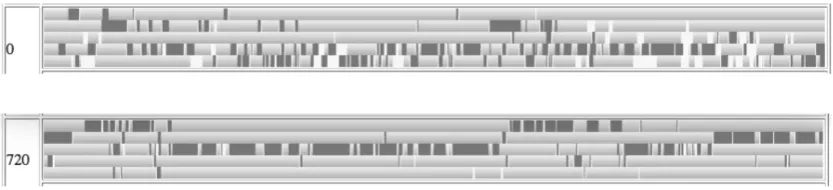
of three hours of conversational data collected dur-ing work coffee breaks, Slade found that around fifty percent of all talk was chat, while the rest comprised longer form chunks from the following genres: storytelling, observation/comment, opin-ion, gossip, joke-telling and ridicule. In chat phases, several participants contribute utterances with many questions and short comments. Chat is highly interactive with frequent turn changes, and often occurs at the start of an interaction. The conversational floor is shared among the par-ticipants and no single participant dominates for extended periods. Chat is often used to ‘break the ice’ among strangers involved in casual talk (Laver, 1975). As the conversation progresses, chat phases are interspersed with chunk phases. The ‘ownership’ of chunks seems to pass around the participants in the talk, with chat linking one chunk to the next (Eggins and Slade, 2004). Figure 2 shows examples drawn from our data of typical chat and chunk phases in a 5-party conversation.
Both Ventola’s and Slade and Eggins’ models treat conversation as composed of phases, with parallels between Ventola’s approach phases and Slade and Eggins’ chat phases. It is likely that the various conversational phases are subject to different norms of turntaking and that phenomena such as laughter or disfluency may appear in dif-ferent distributions in difdif-ferent phases. Although Ventola’s and Slade and Eggins’ respective work is based on real dialogue in the form of ortho-graphic transcripts, analyses of longer casual talk have been largely theoretical or based on qualita-tive descriptions. Our work aims to expand our knowledge of the form of these phases so that they can be modelled for artificial dialogue. In our in-vestigations, we first segmented our data into chat and chunk phases to analyse the characteristics of these two types of talk, and in later work plan to refine our analysis by further segmenting our data into Ventola’s phases. Below we outline the lim-itations of available corpora for work on longer form multiparty casual talk, describe our dataset, annotation, and experiments.
4 Corpora used for Casual Conversation Research
inter-Figure 2: Examples of chat (top) and chunk (bottom) phases in two stretches from a 5-party conversation. Each row denotes the activity of one speaker across 120 seconds. Speech is dark grey, and laughter is white on a light grey background (silence).The chat frame, taken at the beginning of the conversation, can be seen to involve shorter contributions from all participants with frequent laughter. The chunk frame shows longer single speaker stretches.
actions specific to particular domains where lex-ical content was fundamental to achievement of a practical goal. Such corpora include informa-tion gap dialogs such as the HCRC MapTask cor-pus of dyadic information gap task-based conver-sations (Anderson et al., 1991) or the LUCID Di-aPix corpus of ‘spot the difference’ games (Baker and Hazan, 2011), as well as real or staged meet-ings (e.g., ICSI and AMI multiparty meeting cor-pora (Janin et al., 2003; McCowan et al., 2005)) or genres such as televised political interviews (Beat-tie, 1983). Because of their task-focused nature, these data, while spontaneous and conversational, cannot be considered true casual talk, and results obtained from their analysis may not generalize to casual conversations.
There are some corpora of casual talk, including telephonic corpora (SWITCHBOARD (Godfrey et al., 1992) and the ESP-C collection of Japanese telephone conversations (Campbell, 2007)), and face-to-face talk datasets (e.g., Santa Barbara Cor-pus (DuBois et al., 2000), and sections of the ICE corpora (Greenbaum, 1991) and British National Corpus (BNC-Consortium, 2000)). These corpora are audio only and thus cannot be used to inform research on facial expression, gestural or postural research.
Several multimodal corpora of mostly dyadic ‘first encounters’ have appeared recently, where strangers are recorded engaged in casual conver-sation for periods of 5 to 20 minutes or so (Ed-lund et al., 2010; Aubrey et al., 2013; Paggio et al., 2010) in several languages including Swedish, Danish, Finnish, and English. These corpora are very valuable for the study of dyadic interaction, particularly at the opening and early stages of
in-teraction. However, the substance of longer casual conversation beyond these first encounters or ap-proach stages has not been focused on in the field.
5 Dataset and Annotation
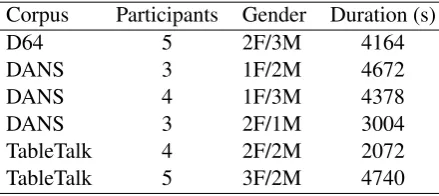
We compiled a dataset of six informal multiparty conversations, each around an hour long. The requirements for the data were that participants could speak freely, that there was no task or topic imposed by the experimenter, and that recordings were multimodal so that analyses of visual cues could be carried out on the same data and used to build a more comprehensive understanding of multimodal face-to-face interaction. Suitable con-versations were drawn from three multimodal cor-pora, d64, DANS, and TableTalk (Oertel et al., 2010; Hennig et al., 2014; Campbell, 2008). In each of these, participants were recorded in casual conversation in a living room setting or around a table, with no instructions on topic of type of conversation to be carried out - participants were also clearly informed that they could speak or stay silent as the mood took them. Table 1 shows de-tails of participant numbers, gender, and conversa-tion duraconversa-tion for each of the six conversaconversa-tions.
5.1 Data Preparation
[image:4.595.92.509.74.169.2]Table 1: Source corpora and details for the conver-sations used in dataset
Corpus Participants Gender Duration (s)
D64 5 2F/3M 4164
DANS 3 1F/2M 4672
DANS 4 1F/3M 4378
DANS 3 2F/1M 3004
TableTalk 4 2F/2M 2072 TableTalk 5 3F/2M 4740
coarse and theory dependent utterance or inter-pausal unit (IPU) level. Labels covered speech (SP), silence (SL), coughs (CG), breaths (BR), and laughter (LG). The speech label was applied to verbal and non-verbal vocal sounds (except laugh-ter) to include contributions such as filled pauses, short utterances such as ‘oh’ or ‘mmhmm’, and sighs. Laughter was annotated inline with speech. Annotators worked on 10 second and four-second Praat windows of the audio. Doubtful cases were resolved using Elan (Wittenburg et al., 2006) with the video recordings. Manual segmentation into speech and silence can be problematic, as humans listening to speech can miss or indeed imagine the existence of objectively measured silences of short duration (Martin, 1970), and are known to have difficulty recalling disfluencies from audio they have heard (Deese, 1980). However these results were based on speakers timing pauses with a stop-watch in a single hearing. In the current work, us-ing Praat and Elan, speech could be slowed down and replayed and, by using the four-second win-dow, annotators could see silences or more ac-curately differences in amplitude on the speech waveform and spectrogram. Although breath is extremely interesting as a feature of conversation (Wlodarczak et al., 2015), it was not possible to annotate breath accurately for all participants and thus the breath intervals annotated were converted to silence for the purposes of this study. Simi-larly, coughs were relabelled as silence for the cur-rent work. After segmentation, the data were tran-scribed, and marked into chat and chunk phases as described below.
5.2 Annotation of Chat and Chunk Phases
Chat and chunk phases were marked using an an-notation scheme devised from the definitions of chat and chunk phases given in Slade and Eg-gins work (EgEg-gins and Slade, 2004; Slade, 2007).
For an initial classification, conversations were di-vided by first identifying the chunks and consider-ing everythconsider-ing else chat. In the first instance, this was done using the first, structural part of Slade and Eggins’ definition of a chunk as ‘a segment where one speaker takes the floor and is allowed to dominate the conversation for an extended pe-riod’(Eggins and Slade, 2004). The following guidelines were created to aid in the placing of chat/chunk boundaries.
Start A chunk starts when a speaker has es-tablished himself as leading the chunk.
Stop To avoid orphaned sections, a chunk is ended at the moment the next element (chunk or chat) starts.
Aborted In cases where a chunk is attempted, but aborted before it is established, this is left as chat. In cases where there is a di-version to another element mid-chunk and a return later, all three elements are annotated as though they were single chunks/stretches of chat.
Overlap When a new chunk begins where a pre-vious chunk is still tailing off, the new chunk onset is the marker of interest and the old chunk is finished at the on-set of the new one.
Once the chunk was identified, it could be clas-sified by genre. For annotation, a set of codes for the various types of chunk and chat was created. Each code is a hyphen-separated string contain-ing at least a Type signifier for chat or chunk, an Ownership label, and optional sub-elements fur-ther classifying the chunks with reference to Slade and Eggins taxonomy. A total of 213 chat and 358 chunk phases were identified across the six con-versations.
6 Results
Our analysis of social talk focuses on a number of dimensions; chat and chunk duration, laughter and overlap in chat and chunk phases, distribution of chat and chunk phases across conversations, and turntaking/utterance characteristics.
6.1 Chat and Chunk Duration
Figure 3: Boxplots of phase duration in Chat (grey) vs Chunk (black) in raw and log trans-formed data
but heavily right skewed. It was decided to use geometric means to describe central tendencies in the data. The antilogs of geometric means for du-ration of chat and chunk phases in the dataset were 28.1 seconds for chat and 34 seconds for chunks.
The chat and chunk phase durations (raw and log) are contrasted in the boxplots in Fig 3, where it can be seen that there is considerably more vari-ance in chat durations.
6.2 Speaker, Gender, and Conversation Effects
The raw chunk data were checked for speaker de-pendency using the Kruskal-Wallis rank sum test, a non-parametric alternative to a one-way analysis of variance (ANOVA), and no significant differ-ence in means due to speaker was found (Kruskal-Wallis chi-squared = 36.467, df = 24, p-value = 0.04941). Wilcoxon Rank Sum tests on chunk du-ration data showed no significant difference be-tween duration distributions for chunks owned by male or female participants (W = 17495, p-value = 0.1073). Kruskal-Wallis rank sum tests on chunk duration showed no significant differ-ence between duration distributions for chunks from different conversations (Kruskal-Wallis chi-squared = 9.2077, df = 5, p-value = 0.1011). How-ever, the Kruskal-Wallis rank sum tests applied to chat duration showed significant differences be-tween duration distributions for chats from differ-ent conversations (Kruskal-Wallis chi-squared = 15.801, df = 5, p-value = 0.007436).
6.3 Laughter Distribution in Chat and Chunk phases
Comparing the production by all participants in all conversations, where a participant may produce ei-ther laughter or speech, laughter accounts for
ap-proximately 9.5% of total duration of speech and laughter production in chat phases and 4.9% of to-tal duration of speech and laughter production in chunk phases.
6.4 Chunk owner vs Others in Chunk
In the chunks overall, the dominant speakers or chunk owners produced 81.81% (10753.12s) of total speech and laughter, while non-owners pro-duced 18.19% (2390.7s).
6.5 Overlap
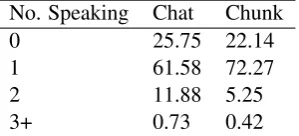
There is considerable overlapping of speech in the corpora. For the purposes of this analysis laughter was treated as silence and overlap considered as overlapping speech only. Table 2 and Fig 4 show the occupancy of the conversational floor for all conversations in chat and chunk phases. The num-ber of speakers ranges from 0 (global silence), 1 (single speaker), 2 (2 speakers in overlap) to 3+ (3 or more speakers in overlap).
[image:6.595.87.253.74.180.2]No. Speaking Chat Chunk 0 25.75 22.14 1 61.58 72.27 2 11.88 5.25 3+ 0.73 0.42
Table 2: Floor occupancy (%) in chat and chunk for all conversations
It can be seen that overlap is twice as com-mon in chat as in chunk phases, and that silence is slightly more common in chat phases.
Figure 4: Distribution of the floor in terms of % duration in chat (left) and in chunk (right) phases. X-axis shows number of speakers (0,1,2,3+) speaking concurrently.
6.6 Chat and Chunk Position
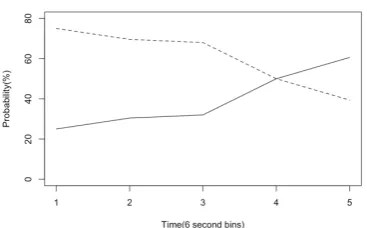
[image:6.595.343.493.355.423.2] [image:6.595.308.516.530.633.2]de-Figure 5: Probability of chunk-chunk transition (solid) and chunk-chat transition (dotted) as con-versation elapses (x-axis = time) for the first 30 minutes of conversation
velops, chunks start to occur much more fre-quently, and the structure is an alternation of single-speaker chunks interleaved with shorter chat segments. Figure 5 shows the probability of a chunk phase being followed by chat or by chunk as conversation continues. It can be seen that there is a greater tendency for the conversation to go di-rectly from chunk to chunk the longer the conver-sation continues.
6.7 Utterances and Turntaking
We are studying the patterning of speaker contri-butions in both phases. Overall we have found that utterances cluster into two groups: short ut-terances with a mean of around 300ms and longer utterances with mean around 1.4s. In chunk owner speech, utterance mean is higher than utterance means in chat.
We performed a prosodic analysis of phrase fi-nal intonation in a subset of the data using the IViE annotation system, finding that falling nu-clei (H*+L%,!H*+L%) dominated across the data, and particularly in chunks, with relatively few fall-rise tones (H*+LH%) and small numbers of other tunes.
7 Discussion
We have found differences in the distributions of durations of chat and chunk phases, with chat du-rations varying more while chunk dudu-rations have a more consistent clustering around the mean. Chat phase durations tend to be shorter than chunk du-rations. These findings are not speaker or gender specific in our preliminary experiments and may indicate a natural limit for the time one speaker should dominate a conversation. The dimensions
of chat and chunk durations observed would in-dicate that social talk should ‘dose’ or package information to fit chat and chunk segments of roughly these lengths. In particular, the tendency towards chunks of around half a minute could help in the design of narrative or education-delivering speech applications, by allowing designers to par-tition content optimally. Both laughter and over-lap are far more prevalent in chat than in chunk phases, reflecting their light and interactive na-ture. Interestingly, the rarity of more than two speakers talking concurrently was noted in recent work on turn distribution in multiparty storytelling (R¨uhlemann and Gries, 2015) – our results would seem to show the same phenomenon in casual con-versation, where it much more likely for a speaker to be overlapped by one other speaker than by two or more others. Laughter has previously been shown to appear more often in social talk than in meeting data, and to happen more around topic endings/topic changes [self]. This is consistent our with observations on chat and chunk phases – laughter is more common in chat phases – which provide a ‘buffer’ between single speaker (and topic) chunks.
[image:7.595.83.267.69.183.2]ques-tion.
We have noted that many between speaker silences (pauses) during chunk owner speech in chunks are shorter than between speaker si-lences in chat, probably due to backchannelling in chunks, this would pose a problem for endpointing in dialog systems which relied simply on speak-ing at a certain delay after detection of silence, as the system would butt in during chat or wait too long during chunks depending on the time delay set. The majority of phrase final intonation curves are the same for chat and chunk reflecting the na-ture of casual conversation where utterances are predominantly comments or statements rather than question/answer pairs, exacerbating the endpoint-ing/turntaking problem. Knowledge of the type of phase the dialog is in would allow systems to use more nuanced endpointing and turntaking mecha-nisms. A major limitation of the current work is the scarcity of data. Data for casual conversations which are longer than 15 minutes are hard to find. We hope that the current study will encourage the production of corpora of longer form casual con-versation. We are currently extending our explo-rations to dyadic conversations, and also working on a dialog act annotation scheme for non-task based talk.
8 Conclusions
There is increasing interest in spoken dialogue systems that act naturally and perform functions beyond information search and narrow task-based exchanges. The design of these new systems needs to be informed by relevant data and analysis of hu-man spoken interaction in the domains of interest. Many of the available multiparty data are based on meetings or first encounters. While first en-counters are very relevant to the design of human machine first encounters, there is a lack of data on longer human conversations. We hope that the en-couraging results of our analysis of casual social talk will help make the case for the creation and analysis of corpora of longer social dialogues. We also hope that our further explorations into the ar-chitecture of longer form conversation will add to this body of knowledge.
Acknowledgments
This work is supported by the European Co-ordinated Research on Long-term Challenges in Information and Communication Sciences and
Technologies ERA-NET (CHISTERA) JOKER project, JOKe and Empathy of a Robot/ECA: Towards social and affective relations with a robot, and by Science Foundation Ireland (Grant 13/RC/2106) and the ADAPT Centre (www.adaptcentre.ie) at Trinity College, Dublin.
References
J. Allen, D. Byron, M. Dzikovska, G. Ferguson, L. Galescu, and A. Stent. 2000. An architecture for a generic dialogue shell. Natural Language Engi-neering, 6(3&4):213–228.
James F. Allen, Lenhart K. Schubert, George Ferguson, Peter Heeman, Chung Hee Hwang, Tsuneaki Kato, Marc Light, Nathaniel Martin, Bradford Miller, Massimo Poesio, and David R. Traum. 1995. The trains project: a case study in building a conversa-tional planning agent. Journal of Experimental & Theoretical Artificial Intelligence, 7(1):7–48.
A.H. Anderson, M. Bader, E.G. Bard, E. Boyle, G. Do-herty, S. Garrod, S. Isard, J. Kowtko, J. McAllister, J. Miller, et al. 1991. The HCRC map task corpus. Language and Speech, 34(4):351–366.
A. J. Aubrey, D. Marshall, P. L. Rosin, J. Vandeven-ter, D. W. Cunningham, and C. Wallraven. 2013. Cardiff Conversation Database (CCDb): A Database of Natural Dyadic Conversations. InComputer Vi-sion and Pattern Recognition Workshops (CVPRW), 2013 IEEE, pages 277–282.
Rachel Baker and Valerie Hazan. 2011. DiapixUK: task materials for the elicitation of multiple sponta-neous speech dialogs. Behavior research methods, 43(3):761–770.
Geoffrey Beattie. 1983. Talk: An analysis of speech and non-verbal behaviour in conversation. Open University Press.
Douglas Biber, Stig Johansson, Geoffrey Leech, Su-san Conrad, Edward Finegan, and Randolph Quirk. 1999. Longman Grammar of Spoken and Written English, volume 2. Longman London.
BNC-Consortium. 2000. British national corpus. URL http://www. hcu. ox. ac. uk/BNC.
Paul Boersma and David Weenink. 2010.Praat: doing phonetics by computer [Computer program], Ver-sion 5.1. 44.
Gillian Brown and George Yule. 1983. Teaching the Spoken Language, volume 2. Cambridge University Press.
Nick Campbell. 2007. Approaches to conversational speech rhythm: Speech activity in two-person tele-phone dialogues. In Proc XVIth International Congress of the Phonetic Sciences, Saarbrucken, Germany, pages 343–348.
Christine Cheepen. 1988. The predictability of infor-mal conversation. Pinter London.
James Deese. 1980.Pauses, prosody, and the demands of production in language. Mouton Publishers.
John W. DuBois, W. L. Chafe, C. Meyer, and S. A. Thompson. 2000. Santa Barbara Corpus of Spoken American English. CD-ROM. Philadelphia: Lin-guistic Data Consortium.
R. Dunbar. 1998. Grooming, gossip, and the evolution of language. Harvard Univ Press.
Jens Edlund, Jonas Beskow, Kjell Elenius, Kahl Hellmer, Sofia Str¨ombergsson, and David House. 2010. Spontal: A Swedish Spontaneous Dialogue Corpus of Audio, Video and Motion Capture. In LREC.
S. Eggins and D. Slade. 2004. Analysing Casual Con-versation. Equinox Publishing Ltd.
John J. Godfrey, Edward C. Holliman, and Jane Mc-Daniel. 1992. SWITCHBOARD: Telephone speech corpus for research and development. InAcoustics, Speech, and Signal Processing, 1992. ICASSP-92., 1992 IEEE International Conference on, volume 1, pages 517–520.
Sidney Greenbaum. 1991. ICE: The international cor-pus of English. English Today, 28(7.4):3–7.
Shannon Hennig, Ryad Chellali, and Nick Campbell. 2014. The D-ANS corpus: the Dublin-Autonomous Nervous System corpus of biosignal and multimodal recordings of conversational speech. Reykjavik, Iceland.
R. Jakobson. 1960. Linguistics and poetics. In Th. A. Sebeok, editor, Style in language, pages 350–377. MA: MIT Press, Cambridge.
Adam Janin, Don Baron, Jane Edwards, Dan Ellis, David Gelbart, Nelson Morgan, Barbara Peskin, Thilo Pfau, Elizabeth Shriberg, and Andreas Stol-cke. 2003. The ICSI meeting corpus. In Acous-tics, Speech, and Signal Processing, 2003. Proceed-ings.(ICASSP’03). 2003 IEEE International Confer-ence on, volume 1, pages I–364.
John Laver. 1975. Communicative Functions of Phatic Communion. In Adam Kendon, Richard M. Harris, and Mary R. Key, editors,Organization of behavior in face-to-face interaction, pages 215–238. Mouton, Oxford, England.
Bronislaw Malinowski. 1936. The Problem of Mean-ing in Primitive Languages. In The meaning of meaning: a study of the influence of language upon
thought and of the science of symbolism, 4th ed. rev edition, pages 296–336. Kegan Paul, Trench, Tr¨ubner, London.
James G. Martin. 1970. On judging pauses in sponta-neous speech. Journal of Verbal Learning and Ver-bal Behavior, 9(1):75–78.
Iain McCowan, Jean Carletta, W. Kraaij, S. Ashby, S. Bourban, M. Flynn, M. Guillemot, T. Hain, J. Kadlec, and V. Karaiskos. 2005. The AMI Meet-ing Corpus. InProceedings of the 5th International Conference on Methods and Techniques in Behav-ioral Research, volume 88.
Catharine Oertel, Fred Cummins, Jens Edlund, Petra Wagner, and Nick Campbell. 2010. D64: A corpus of richly recorded conversational interaction. Jour-nal on Multimodal User Interfaces, pages 1–10.
Patrizia Paggio, Jens Allwood, Elisabeth Ahls´en, and Kristiina Jokinen. 2010. The NOMCO multimodal Nordic resource–goals and characteristics.
Christoph R¨uhlemann and Stefan Gries. 2015. Turn or-der and turn distribution in multi-party storytelling. Journal of Pragmatics, 87:171–191.
E.A. Schegloff and H. Sacks. 1973. Opening up clos-ings.Semiotica, 8(4):289–327.
Klaus P. Schneider. 1988. Small Talk: Analysing Phatic Discourse, volume 1. Hitzeroth Marburg.
Diana Slade. 2007.The texture of casual conversation: A multidimensional interpretation. Equinox.
Scott Thornbury and Diana Slade. 2006. Conversation: From description to pedagogy. Cambridge Univer-sity Press.
Eija Ventola. 1979. The Structure of Casual Conver-sation in English. Journal of Pragmatics, 3(3):267– 298.
Marilyn A. Walker, Rebecca Passonneau, and Julie E. Boland. 2001. Quantitative and qualitative evalu-ation of darpa communicator spoken dialogue sys-tems. In Proceedings of the 39th Annual Meeting on Association for Computational Linguistics, ACL ’01, pages 515–522, Stroudsburg, PA, USA. Associ-ation for ComputAssoci-ational Linguistics.
John Wilson. 1989. On the boundaries of conversation, volume 10. Pergamon.
Peter Wittenburg, Hennie Brugman, Albert Russel, Alex Klassmann, and Han Sloetjes. 2006. Elan: a professional framework for multimodality research. InProceedings of LREC, volume 2006.