Sinuhe
— Statistical Machine Translation using a Globally Trained
Conditional Exponential Family Translation Model
Matti K¨a¨ari¨ainen
Department of Computer Science FI-00014 University of Helsinki, Finland
Abstract
We present a new phrase-based con-ditional exponential family translation model for statistical machine translation. The model operates on a feature repre-sentation in which sentence level transla-tions are represented by enumerating all the known phrase level translations that occur inside them. This makes the model a good match with the commonly used phrase extraction heuristics. The model’s predictions are properly normalized prob-abilities. In addition, the model automati-cally takes into account information pro-vided by phrase overlaps, and does not suffer from reference translation reacha-bility problems.
We have implemented an open source translation system Sinuhe based on the proposed translation model. Our experi-ments on Europarl and GigaFrEn corpora demonstrate that finding the unique MAP parameters for the model on large scale data is feasible with simple stochastic gra-dient methods. Sinuheis fast and mem-ory efficient, and the BLEU scores ob-tained by it are only slightly inferior to those ofMoses.
1 Introduction
In current phrase-based statistical machine transla-tion systems such asMoses1(Koehn et al., 2007),
the translation model is defined in terms of phrase pairs (biphrases) extracted from a bilingual cor-pus as follows. The corcor-pus is first word-aligned using a word alignment heuristic (Och and Ney,
1Throughout this paper, we refer toMosesfor
concrete-ness, but most of the discussion applies to other standard phrase-based statistical machine translation systems as well.
2003). The phrase extraction heuristic then ex-tracts all the biphrases that are compatible with the word alignment (Och et al., 1999). This way, each sentence pair may generate any number of potentially overlapping biphrases. However, when defining the phrase-based sentence level transla-tion model, phrase overlaps are explicitly disal-lowed: The source sentence is segmented into dis-joint phrases, which are translated independently using conditional phrase-level translation models that have been estimated from extracted biphrase counts.
The disparity between the phrase extraction heuristic and the use of the extracted biphrases can be addressed in at least three ways. One approach is to simply ignore the disparity as is done, e.g., in Moses. While empirically succes-ful, this approach is hard to justify theoretically, and begs the question of whether more principled methods might lead to better translation results. The other extensively studied approach is to re-place the phrase extraction heuristic with a method that better matches the use of the extracted phrases (see, e.g., (Marcu and Wong, 2002; DeNero et al., 2008) and the references therein). While theo-retically sound, this approach is computationally challenging both in practice (DeNero et al., 2008) and in theory (DeNero and Klein, 2008), may suf-fer from resuf-ference reachability problems (DeNero et al., 2006), and in the end may lead to inferior translation quality (Koehn et al., 2003).
In this paper, we study a third alternative. We propose a new translation model that is compati-ble with the phrase extraction heuristic. The pro-posed machine learning inspired translation model takes the form of a conditional exponential family probability distribution over a feature representa-tion for word-aligned sentence pairs. The feature representation represents a word-aligned sentence pair by essentially enumerating the (multi)set of biphrases that would have been extracted from it,
together with the source positions at which the biphrases occur. The model’s predictions are con-ditional probabilities for such sets of biphrases given the source sentence.
The chosen feature representation has many ad-vantages. Since all word-aligned sentence pairs can be represented, reference reachability prob-lems are automatically circumvented. For exam-ple, if the translation of a sentence consisted solely of words that do not occur in the phrase table, then the feature vector for the translation would be the all zero vector. As the training data receives non-zero probability, maximum likelihood or maxi-mum a posteriori (MAP) parameters for the model can be estimated in a principled way without re-sorting to pseudo-references. The fact that the model is not restricted to using disjoint biphrases means that the information in biphrase overlaps is automatically taken into account. This may help in smoothing the model’s predictions on long and rare phrases, and in enhancing fluency at places that otherwise would be phrase boundaries. Also, the model can be extended in a principled way by introducing additional features (e.g., translations from a dictionary, biphrases with gaps, biphrases over POS tags,. . . ).
The proposed model has one parameter per biphrase feature, so the total number of parame-ters is easily millions or more. Still, the model structure is designed so that feature expectations and related quantities can be computed efficiently by dynamic programming. It is thus feasible to compute the gradient of the MAP objective, and simple gradient ascent can be used to efficiently find the globally optimal model parameters (with respect to a suitably scaled Gaussian prior used for regularization). Exact inference is also possible by dynamic programming when translations are pre-dicted by the translation model alone. When other features like a language model are included, one needs to resort to beam search type approximate dynamic programming for decoding.
We have implemented a translation system calledSinuhebased on the proposed translation model. The system has been released under the GPLv3 open source license (K¨a¨ari¨ainen, 2009). Our experiments on Europarl and GigaFrEn cor-pora demonstrate that the proposed translation model scales well to large data, and offers trans-lation quality that is only slightly worse than that of the baseline systemMoses. In terms of
trans-lation speed,Sinuheis already clearly better. The rest of this paper is organized as follows. After briefly reviewing related work in Section 2, we describe the proposed translation model in Sec-tion 3. Finally, experimental results are presented in Section 4, and conclusions in Section 5.
2 Related work
The proposed translation model is strongly influ-enced by machine learning techniques for solv-ing sequence prediction tasks, most notably the work on conditional random fields (Lafferty et al., 2001). The modelling task in machine translation is, however, more complicated than sequence la-belling (not one-to-one, reorderings), so the stan-dard methods cannot be directly applied here. The model we propose is also related to standard phrase-based translation models through the use of the same phrase-level translation features. How-ever, the way we use the features is quite different. There exists a number of discriminative ap-proaches whose model structure, training crite-ria, or both, are similar to ours. However, to our knowledge, none of the other systems operates directly on biphrase features, scales up to bilin-gual corpora with millions of sentence pairs, and achieves translation quality comparable to fully tuned standard phrase-based systems. The ap-proach most closely resembling ours is the in-dependently developed global discriminative log-linear model based on synchronous context-free grammars (Blunsom and Osborne, 2008; Blun-som et al., 2008). The version presented in (Blun-som and Osborne, 2008) operates on millions of rule count features analogous to our biphrase fea-tures, and integrates a language model into train-ing and decodtrain-ing. The system can be trained on tens of thousands of short sentences yielding bet-ter translations than a baseline systemHieroon this data. The version presented in (Blunsom et al., 2008) scales to more than a hundred thousand short training sentences, but does not integrate a language model and thus has performance that im-proves upon Hiero without a language model only. Both versions deal with derivational ambi-guity by treating derivations as a latent variables that are integrated out to get conditional proba-bilities for translations2. The downside of this
2In our translation model, coping with multiple
is that approximations are needed in computing the maximum probability translation in decoding, and also in computing model expectations in train-ing when a language model is used. In addi-tion, since the models operate directly on transla-tions, using probabilistic training criteria for learn-ing the model parameters is possible only if all reference translations in the training data can be generated by the model. In practice, this problem can be circumvented by discarding the training sentence pairs with unreachable reference transla-tions, but this may mean a significant reduction in the amount of training data (24% in (Blunsom et al., 2008)).
Another closely related approach is the in-dependently developed discriminative block bi-gram prediction model presented in (Tillmann and Zhang, 2007). This work proposes a global phrase-based translation model very similar to ours, but due to computational reasons, resorts to a localized approximation thereof, and is restricted to biphrases of length at most two. In (Liang et al., 2006) a standard phrase-based model is aug-mented with more than a million features whose weights are trained discriminatively by a variant of the perceptron algorithm. Reference reachabil-ity is again a problem, and the method has not been scaled up to use biphrase features directly.
3 The proposed translation model
3.1 Biphrase extraction
The biphrases used inSinuheare extracted from the training data with theMosesphrase extraction heuristics. The sentence-aligned training corpusS is first word-aligned by running Giza++ in both directions and then symmetrizing the alignments. This maps the original aligned sentence pairs
(x, y) into word-aligned sentence pairs (x, a, y), whereais a many-to-many alignment between the words inx andy. Second, using a heuristic pro-posed in (Och et al., 1999), all the aligned phrase pairs (x0, a0, y0) satisfying the following criteria
are extracted: (1)x0 andy0consist of consecutive
words ofxandy, and both have length at mostk, (2)a0is the alignment between words ofx0andy0
induced bya, (3)a0 contains at least one link, and
(4) there are no links inathat have just one end in x0 ory0. Each aligned training sentence (x, a, y)
thus generates a number of potentially overlapping in (DeNero et al., 2006), the ambiguity in word alignment is less prevalent than in phrase segmentation.
aligned biphrase features(x0, a0, y0). In our
exper-iments, we chosek = 7which is the default in Moses. Unlike in Moses, we do not map the aligned biphrases (x0, a0, y0) back to non-aligned
biphrases(x0, y0).
To reduce the number of extracted biphrases, for each source phrase x0, only biphrases (x0, a0, y0)
whose occurrence count is among the topK = 20
in the training data are retained (rank ties bro-ken by including all biphrases with rank equal to the limitK). For technical reasons related to our dynamic programming algorithms, we also drop biphrases whose source phrase begins or ends with unlinked words. Finally, we drop all biphrases that occur only once in the training data. This can be motivated by a leave-one-out argument (cf the derivation of Good-Turing estimates): Dropping the biphrases that occur only once in the train-ing data means that the feature representation for a training sentence pair (see Section 3.2) contains only biphrases that occur also in other training ex-amples. Without the leave-one-out pruning, the feature vectors for training sentence pairs would be maximally dense, whereas such feature density cannot be expected on test data. Our system can also be used without the leave-one-out pruning, but according to our preliminary experiments this has little effect on translation quality. An excep-tion seems to be morphologically rich languages with scarce training data on which pruning seems to reduce translation quality.
All the pruning steps combined reduce the phrase table size considerably, but in our experi-ments, millions of biphrases per language pair still remain (2-4 million for Europarl data and over 95 million for GigaFrEn data).
3.2 Features
Our primary feature representation is a binary fea-ture vector that indicates which aligned biphrases in the phrase table occur in an aligned sentence pair and where. More specifically, a source sen-tencexaligned to a target sentenceyby an align-ment ais represented by a binary feature vector φ(x, a, y)whose componentφ(x, a, y)(x0,a0,y0),iis
1 iff the aligned biphrase (x0, a0, y0) occurs at
source position i in (x, a, y), and 0 otherwise. Here,(x0, a0, y0)occurs in(x, a, y)at source
posi-tioniiff the phrase extraction process described in Section 3.1 would have extracted it from(x, a, y)
The weights for the aligned biphrases are tied together by mapping the binary feature vector φ (indexed by pairs of an aligned biphrase and a source position) to an integral feature vectorφ˜ (in-dexed by aligned biphrases only) using the for-mulaφ˜(x0,a0,y0) = Piφ(x0,a0,y0),i. The “real”
fea-tures that drive the translation process are thus the lowest level binary featuresφ, whereas the higher level representationφ˜is convenient in defining the conditional probabilities given by the translation model.
3.3 The model
Instead of modelling the conditional distribution P(y|x) directly, we model the conditional dis-tributionP(φ(x, a, y)|x) by the following condi-tional exponential model:
P(φ(x, a, y)|x) = exp(P w·φ˜(x, a, y))
φ∈Φxexp(w·φ˜)
.
Here,wis a parameter vector with one component for each aligned biphrase feature in the phrase ta-ble. The setΦxdefines the set of possible predic-tions given x, and includes all feature vectors φ satisfying the following criteria:
1. There exists a translationy0and an alignment
a0 such that all active features in φoccur in
(x, a0, y0)
2. Features corresponding to aligned biphrases that occur inside aligned biphrases whose features are active inφare also active inφ. Thus, the set Φx has a feature representation for all possible aligned sentence pairs (x, a0, y0) that
have x as the source side, so all reference trans-lations y0 word-aligned to x in any way a0 are
representable by features in Φx. By condition 1, the predictions given by the model never con-tain conflicting biphrases, so given any prediction of the model, there always exists a translation y0
where all the predicted biphrases do occur. How-ever, since our dynamic programming algorithms can only force active super-phrases implying ac-tive phrases (condition 2) but not acac-tive sub-phrases implying active super-sub-phrases, the setΦx also contains some feature vectors in which the lat-ter type of implications are not enforced. Having such redundant representations for some transla-tions is a waste of probability mass, but we hope it has little effect in practice.
The choice of modelling P(φ(x, a, y)|x) in-stead of modellingP(y|x)directly is crucial, both from a modelling and from a computational per-spective. From the modelling perspective, the cru-cial point is that in our approach, any aligned sen-tence pair(x, a, y)has an associated feature vec-tor φ(x, a, y) ∈ Φx that is reachable (i.e., re-ceives non-zero probability) by the model. This means it is straightforward to use probabilistic cri-teria in learning the model parameters. In con-trast, systems modellingP(y|x)directly are often plagued by the reference reachability problem. To use probabilistic training criteria for such systems one needs to circumvent the reference reachability problem, e.g., by using pseudo-references or by dropping out the non-reachable portion of training data.
Working with the feature vectorsφ(x, a, y) in-stead of working withaandydirectly means that we model the ordering and choice of words in y only partially. This way, when computing the nor-malizing constants and feature expectations, we can partition the unbounded set of potential trans-lations y and alignments a into a smaller set of equivalence classes given by φ(x, a, y). Though the number of feature vectors φ ∈ Φx may be large (exponential in length ofx), all the necessary computations can be done exactly and efficiently by dynamic programming. For more details, see Section 3.4.3.
3.4 Learning the model parameters 3.4.1 The objective
We use maximum a posteriori (MAP) estimation to estimate the model parameters w. To con-trol overfitting, we regularize the parameters by a suitably scaled Gaussian prior. This can be also viewed asL2regularization. The prior guarantees that the MAP parameters are unique, and mod-els our belief that the observed feature occurrence counts randomly deviate from their “true” values roughly proportionally to the standard deviations of the occurrence count distributions. The prior variance σ2
(x0,a0,y0) for feature (x0, a0, y0) is given
by the formula σ2
(x0,a0,y0) = α/ρ(x0,a0,y0) , where
α > 0 is a free regularization parameter, and ρ2
(x0,a0,y0) is an empirical estimate of the variance
of the occurrence count of(x0, a0, y0)in the
vari-ance of a feature we use the occurrence count of the corresponding biphrase in the training data. This could be justified by assuming that the oc-currence counts follow a Poisson distribution. We have also run preliminary experiments with other forms of regularization (different ways of comput-ingσ(x0,a0,y0), exponential priors corresponding to
L1regularization, no regularization), and it looks like the system is not very sensitive to the chosen prior.
Combining the prior with the model, we see that the negative log-posteriorL(w)is given by the for-mula
X
(x0,a0,y0)
w2 (x0,a0,y0)
2σ2 (x0,a0,y0)
− X
(x,a,y)∈S
logP(φ(x, a, y)|x) +C,
where the sum over (x0, a0, y0) is understood to
go over all aligned biphrase features in the model. This is our criterion for learningw.
3.4.2 Optimization
We solve the optimization problem related to learningwby first order gradient ascent methods. The gradient ∇L(w) of L(w) with respect to w can be written as
X
(x0,a0,y0)
w(x0,a0,y0)
σ2
(x0,a0,y0)−
X
(x,a,y)∈S
˜
φ(x, a, y)−Ew[ ˜φ|x],
where Ew[ ˜φ|x] denotes the conditional expecta-tion of the aligned biphrase occurrence count fea-tures givenxwith respect to model parametersw. Feature expectations can be computed by combin-ing the results of a left-to-right and right-to-left dynamic programming sweep over the source sen-tence. For more details, see Section 3.4.3.
Inspired by the empirical results in (Vish-wanathan et al., 2006), we use classic stochas-tic gradient ascent to solve the optimization prob-lem. At each stept, we sample with replacement a batch St ofbexamples from S. We start from
w0= 0, and use the update rule
wt+1=wt−ηt∇Lt(wt), (1)
where ηt > 0 is the learning rate, and ∇Lt(w) is the stochastic gradient of the negative
log-posterior
Lt(w) = ||SSt|| X
i
w2
i
2σ2
i − X
(x,a,y)∈St
logP(φ(x, a, y)|x)
restricted to batch St. The second term of the stochastic gradient involves only biphrases whose source sides match the source sentences in the batch. Though the gradient of the regularizer is non-zero for all non-zero biphrase features, the updates of features that are not active in the sec-ond term of the gradient can be postponed until they become active again. Due to feature sparsity, the number of features that are active in a small batch is small, and thus also the updates are sparse. Hence, it is possible to handle even feature vectors that do not fit into memory.
Another advantage of the stochastic gradient method is that many processes can apply updates (1) to a weight vector asynchronously in parallel. We have implemented two strategies for dealing with this. The simpler one is to store the weight vector in a database that takes care of the neces-sary concurrency control. This way, no process needs to store the entire weight vector in memory. The downside is that all training processes must be able to mmap() to the common file-system due to limitations in the underlying Berkeley DB database system. We have also implemented a client-server architecture in which a server process storeswin memory and manages read and update requests to its components that come from train-ing clients. In this approach, the degree of paral-lelism is limited only by the number of available machines and server capacity. The server could be further distributed for managing models that do not fit into the memory of a single server.
3.4.3 Computing gradients etc
The computationally most challenging part in learning the model parameters is computing ∇logP(φ(x, a, y)|x), i.e., the vector of differ-ences between the observed occurrence counts of biphrase features in(x, a, y)and their conditional expectations under the current model parameters.
sweep over x. In the left-to-right sweep, we have for each biphrase feature(x0, a0, y0), ia state
s(x0,a0,y0),i for translations starting from the
be-ginning of x and ending in an occurrence of the biphrase(x0, a0, y0)at source positioni. This state
records the contribution of all partial translations whose right-most active biphrase feature on the source side is (x0, a0, y0), i to the conditional
ex-pectation of feature (x0, a0, y0), i (in log scale).
The score forsempty,0 = 0, ands(x0,a0,y0),i is
ob-tained from the recurrence
score s(x0,a0,y0),i=
X
(x00,a00,y00),i00∈A((x0,a0,y0),i)
h
score s(x00,a00,y00),i00
+ X
(x000,a000,y000),i000∈B
w(x000,a000,y000),i000
i
Here, A((x0, a0, y0), i) is the set of
prede-cessor states of s(x0,a0,y0),i and includes all
states s(x00,a00,y00),i00 such that a proper suffix of
(x00, a00, y00), i00(i.e., a biphrase whose source and
target are proper suffices of x00 and y00
respec-tively) is equal to a prefix of (x0, a0, y0), i. As
a special case, A includes all statess(x00,a00,y00),i00
for which (x00, a00, y00), i00 ends before or at
posi-tion i. This takes care of translation paths that leave some words in x untranslated. Since the starting position of a proper suffix of a biphrase is always after the biphrase’s original starting po-sition, going through the states in order of in-creasingiguarantees that the scores for biphrases inA((x0, a0, y0), i) are available when computing
score s(x0,a0,y0),i.
The set B that depends on ((x0, a0, y0), i) and
((x00, a00, y00), i00)is defined by the formula
B =sub (x0, a0, y0), i\sub (x00, a00, y00), i00,
where sub((x0, a0, y0), i) denotes the set of
sub-biphrases of (x0, a0, y0), i (including the biphrase
(x0, a0, y0), i itself). Thus, summing over the
weights of biphrases inBadds the contribution of features introduced by extending translation paths ending in(x00, a00, y00), i00by(x0, a0, y0), i0.
From the right-to-left dynamic programming, we get analogously the contribution of right-to-left partial translations whose right-to-left-most active biphrase is (x0, a0, y0), i. The partition function
used for normalizing the expectations can be ob-tained as a side product of either of the sweeps.
In conditional random fields, the (unnormal-ized) expectations for the feature can be ob-tained by multiplying the scores of the states corresponding to the same feature in the left-to-right and right-to-left dynamic programming memories. In our case, combining the two val-ues stored in the states for a feature (x0, a0, y0), i
only gives the contribution of the translation paths where (x0, a0, y0), i is active but not covered by
any longer biphrase that extends(x0, a0, y0), iboth
left and right. To include the contribution of the remaining translation paths, we need to go through states corresponding to super-biphrases of
(x0, a0, y0), i. Special care has to be taken in order
to include the contribution of all feature vectors in which such super-biphrases are active exactly once. An efficient way to do this is to process the states for super-biphrases in topological order with respect to biphrase inclusion, and to include only the contributions of states for super-biphrases that extend the previously included states both left and right.
Another complication in the dynamic program-ming is that a biphrase can extend the source side of another overlapping biphrase to the right, but the target side to the left, or visa versa. Such overlaps are not directly covered by our dynamic programming. To deal with them, we construct new virtual biphrases that correspond to the re-sults of such overlaps in a pre-processing step. The number of such virtual combinations can in theory grow exponentially, but in practice only a small number of virtual biphrases seems to suffice.
3.5 Prediction with translation model alone
Prediction is done in two phases. First, we find (by a dynamic programming procedure similar to the one outlined in Section 3.4.3) the highest proba-bility feature vectorφˆ(x)defined by
ˆ
φ(x) = arg max
φ∈Φx:xcovered by biphrases inφ
P(φ|x).
Note that we restrict the search to feature vec-tors that cover the whole ofx, i.e., to feature vec-torsφ(x, a, y)in which each word inxis covered by at least one active aligned biphrase(x0, a0, y0).
This forces the system to translate all words in the source sentence even if the translation model pre-dicts that none of the translations are very likely.
optional out-of-vocabulary dictionary, we use the translation from the dictionary, and otherwise re-sort to an implicit zero weight aligned biphrase that copies the input word to the output as is. In our experiments, the out-of-vocabulary dictio-nary is constructed from the word translations that occur once in the training data, so the out-of-vocabulary dictionary only compensates for the word translations lost in phrase table pruning. If available, a real dictionary could be used as well.
The second step in predicting a translation is solving the pre-image problem, i.e., constructing a translation y from the predicted feature vector
ˆ
φ(x). Since φˆ(x) ∈ Φx, there always exists an alignment a and a translation y such that all the aligned biphrases inφˆ(x) occur inφ(x, a, y), but theaandy may not be unique. We choose thea andygiven by concatenating the target sides of the biphrases active in φˆ(x) in the order induced by their positions in the source sentence. Thus, there is no phrase-level reordering, and the fluency of the target language output is induced by the phrase overlaps only.
3.6 Predicting with an integrated LM
The prediction strategy outlined in the previous section is simple and conceptually clean. How-ever, biphrase overlaps alone may not be enough to enforce fluent output, especially given that bilin-gual data is typically more scarce than monolin-gual data. Also, the lack of a reverse transla-tion model means the system is unable to iden-tify phrase extraction errors in which rarely seen source phrases are translated to common target phrases by chance.
To address these shortcomings, we augment the translation model with the following additional features that have been observed to enhance trans-lation quality in other SMT systems.
1. Language model: logP(y), where P(y)is given by a smoothedn-gram language model 2. Lexical translation model (reverse direc-tion):logP(x|y, a)given by a word-level re-verse translation model
3. Translation length:number of words iny 4. Distortion: number of source words in
phrases with swapped translations
The final score driving the translation process is given by a linear combination of the trans-lation model score logP(φ(x, a, y)|x) and these
features. Besides the translation model, the lan-guage model feature is clearly the most influential, while the lexical translation feature has only a mi-nor positive effect on translation quality.
We use an approximate dynamic program-ming variant of the commonly used beam search procedure to find the highest scoring candidate translation. We compute the translation model log-probability logP(φ(x, a, y)|x) incrementally while building up the corresponding candidate translation y and word alignment a from left to right. We allow phrase-level distortions given by swapping the order of translations of consec-utive non-overlapping source phrases. Unlike in Moses, our beam search is structured around state transitions, not around states. This means that we apply each biphrase (state transition) simultane-ously to all applicable partial translations (states). This strategy is in our experience more efficient, does not rely on future score estimates, and is im-plementationally very similar to the dynamic pro-gramming procedures that we use in training the model parameters and in prediction with a lan-guage model alone.
The weights of the features are tuned by opti-mizing the BLEU score of development set trans-lations with amoeba search. This simplistic strat-egy is feasible given our system’s fast translation speed, and extends easily to cover non-linear fea-ture combinations. The reason for using amoeba is that it is simpler to implement — we do not believe amoeba yields any better values for the parameters in the end.
4 Experiments
4.1 Experimental setup
es-en en-es fr-en en-fr de-en en-de time Sinuhe 31.38 30.94 31.50 28.91 25.03 19.26 338.0 Moses 32.18 31.88 32.63 29.92 27.30 20.57 3729.5 Sinuhetrans 29.14 27.12 28.74 26.06 22.38 17.14 44.2
[image:8.595.131.466.62.132.2]Mosestrans 24.32 22.75 23.84 21.22 19.62 13.59 1321.5
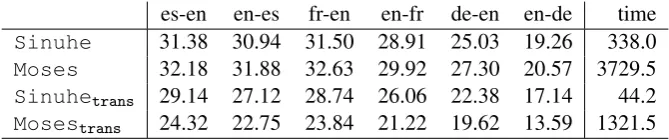
Table 1: Left: The translation quality of the SMT systems as measured by the BLEU score. Translations were detokenized but not recased before evaluating their quality against lowercased reference translations by themteval-v11b.plscript. Right: Average total translation time in seconds.
the bilingual corpora. In the GigaFrEn experi-ments we used the provided monolingual news do-main data. All data was tokenized and lowercased using the tools in theMosesdistribution.
We experimented with four translation sys-tems: Sinuhetrans, Sinuhe, Mosestrans, and
Moses. Sinuhetrans uses only the translation
model in producing translations (see Section 3.5), while the full system Sinuhe uses also a lan-guage model and some additional features (see Section 3.6). As a baseline, we used theMoses translation system, which is known to be very competitive on the Europarl translation tasks as evidenced by the University of Edinburgh entries in the translation challenge (Callison-Burch et al., 2008). The other comparison point Mosestrans
was obtained fromMosesby disabling distortions and setting setting the weights of all features ex-cept the forward translation model to0. By com-paringSinuhetransandMosestrans, we hope to
indirectly compare the performance of the under-lying translation models. A more direct compar-ison was not possible as it is not feasible to nor-malize the “probabilities” predicted by theMoses translation model.
4.1.1 Training the models
We trained Moses exactly as suggested in (Callison-Burch et al., 2008), except that we used the -unk option for SRILM in training the language models (both for Sinuhe and Moses). The translation model for Sinuhe (and Sinuhetrans) was built from the phrases
extracted byMoses as described in Section 3.1. We chose α = 1.0 and set batch size to 1. The learning rate was initially set to0.1, and decayed proportional to 1/t after 2M or 100M iterations of training for Europarl and GigaFrEn tasks, respectively. These choices may not be optimal as we did not experiment with other choices yet. In case of Europarl, training was run for
70-100M iterations using the Berkeley DB based distribution strategy (4 CPU cores per language pair). This took 10 days. For GigaFrEn, we used the client-server architecture, and trained the model for 620M stochastic gradient iterations on about 200 CPUs. This took 2 days, which is a lot less than the time needed to run (parallel) Giza on this data. The number of biphrase features in Sinuhe’s model was 2-4 million on the Europarl tasks, and about 95 million on the GigaFrEn task.
The decoder parameters for Sinuhe were tuned on the development sets by amoeba, and for Mosesby MERT. As both amoeba and MERT try to solve the same optimization problem, we be-lieve the difference in optimization methods has little influence on the results.
4.1.2 Translation results
Europarl tasks The systems were tested on the 2000 sentence Europarl domain develop-ment test sets provided for the shared translation task (Callison-Burch et al., 2008). The resulting BLEU scores and total translation times averaged over the datasets are reported in Table 1. While Moses has the highest BLEU score for all the language pairs, the BLEU score for Sinuhe is worse by only at most 1.31 BLEU points except on the de-en task, where the difference is 2.27. Sinuhetrans is clearly inferior to Sinuhe but
equally clearly superior toMosestrans.
It takes less than a minute to translate the development test set by the fastest system Sinuhetrans. The slowest systemMosesneeds
around an hour for the same task. Memory usage follows a similar pattern. For example,Sinuhe requires roughly one tenth of the memory used by Moses. Thus, in terms of resource usage, Sinuhetrans and Sinuhe seem clearly
are so clear that the general pattern would proba-bly remain the same. For example, Moseswith no distortion is still clearly slower thanSinuhe.
GigaFrEn task The fr-en model was tested on the 2525 sentence news domain test data used in the preliminary evaluation of the translation chal-lenge results. The BLEU scores forSinuheand Moses were 26.32 and 26.98, respectively. The total translation time was 13m 50s withSinuhe, whereasMosesneeded 82m 28s. Thus, the pat-tern that was observed on Europarl tasks is re-peated here: The translation quality ofMosesis slightly better, butSinuheis significantly faster. Surprisingly, bothSinuheandMosesfare well in comparison to the participants of the actual challenge: According to the preliminary results on the same test data we used (Koehn, 2009), theMosesbaseline would have been beaten only by Google, and Sinuhe would have been sixth among the 23 participating systems with a differ-ence of only 0.57 BLEU points to the second best entry. A partial explanation for the good relative performance could be that the challenge partici-pants had only a week to train their models on the full version of GigaFrEn data, so they may not have had time to take full advantage of it. On the other hand, many of the top ranked systems relied on external resources that were not available for us.
Based on an informal human evaluation of the outputs ofSinuheandMoses, it looks like the translations of Sinuhe are slightly more accu-rate in conveying the meaning of the original sen-tences, but especially the translations of long rare expressions (e.g., multi-word names of institu-tions) are less fluent. This hints that the parame-ters for (rare) biphrases may have been regularized too heavily — it looks likeSinuheis underfitting rather than overfitting. We will conduct more ex-periments to see how much the translation quality can be improved by a better choice ofαor by us-ing a different prior for regularization. Of course, there is room for tuning elsewhere, too. For exam-ple, it would be a surprise if the phrase extraction pipeline that has been optimized forMoseswould be optimal forSinuhe.
5 Conclusions
In this paper, we have shown that phrase-based SMT can be viewed as an instance of structural prediction. The word alignment and phrase
ex-traction heuristics serve as a strategy for feature extraction, and the translation task can be mod-elled as a structural prediction problems over these features. Our methods scale to large corpora and are fast at predicting translations. While speed is not the primary goal, the faster translation times may be a key to success in applications where the amount of text that needs to be translated is large. In terms of BLEU scores, the results do not im-prove the state-of-the-art so far. However, fine-tuning the standard phrase-based approach over the years has increased its performance signifi-cantly, and we see no reason why the same would not happen with the proposed approach, especially if the model is augmented with additional features like gapped biphrases and biphrases over POS tags.
The fact that our translation model is a prop-erly normalized conditional probability distribu-tion opens up many new possibilities. For in-stance, instead of predicting translations, it is pos-sible to efficiently compute the expected num-ber of times each word would appear in them. Such output might be useful, e.g., if the transla-tions are to be post-processed by models relying on bag-of-words representation. Another research direction we are currently looking into is train-ing the proposed translation model in the reverse direction, and then predicting translations using the noisy channel approach, i.e., by maximizing P(x|y)P(y). The key difference to previous work here is that sinceP(x|y)is properly normalized, the noisy channel approach would not in our case suffer from the potentially negative effects caused by ignoring the normalizer that depends ony. Be-sides being a viable (though computationally de-manding) alternative criterion for predicting trans-lations, the noisy channel approach could easily be used for, e.g., rerankingn-best lists and for system combination.
Acknowledgments
References
Phil Blunsom and Miles Osborne. 2008. Probabilistic inference for machine translation. InEMNLP. Phil Blunsom, Trevor Cohn, and Miles Osborne. 2008.
A discriminative latent variable model for statistical machine translation. InACL.
Chris Callison-Burch, Philipp Koehn, Christof Monz, Josh Schroeder, and Cameron Shaw Fordyce. 2008. ACL 2008 third workshop on statistical
ma-chine translation. http://www.statmt.org/
wmt08.
Chris Callison-Burch, Philipp Koehn, Christof Monz, and Josh Schroeder. 2009. EACL 2009 fourth
workshop on statistical machine translation. http:
//www.statmt.org/wmt09.
Stanley Chen and Ronald Rosenfeld. 2000. A
survey of smoothing techniques for ME models.
IEEE Transactions Speech and Audio Processing, 8(1):37–50.
John DeNero and Dan Klein. 2008. The complexity of
phrase alignment problems. InACL.
John DeNero, Dan Gillick, James Zhang, and Dan Klein. 2006. Why generative phrase models
un-derperform surface heuristics. InWorkshop on SMT
at NAACL.
John DeNero, Alex Bouchard, and Dan Klein. 2008. Sampling alignment structure under a bayesian
translation model. InEMNLP.
Matti K¨a¨ari¨ainen. 2009. Sinuhe source code
dis-tribution (v1.2). Website. http://www.cs.
helsinki.fi/u/mtkaaria/sinuhe.
Philipp Koehn, Franz Josef Och, and Daniel Marcu. 2003. Statistical phrase-based translation. In HLT-NAACL.
Philipp Koehn, Hieu Hoang, Alexandra Birch, and Chris Callison-Burch et al. 2007. Moses: Open source toolkit for statistical machine translation. In
ACL.
Philipp Koehn. 2009. BLEU/NIST scores for
sub-missions. http://groups.google.com/
group/WMT09/browse thread/thread/
bfbce7b219648a4c.
John Lafferty, Andrew McCallum, and Fernando Pereira. 2001. Conditional random fields: Prob-abilistic models for segmenting and labeling
se-quence data. InICML.
Percy Liang, Alexandre Bouchard-Cote, Dan Klein, and Ben Taskar. 2006. An end-to-end discrimina-tive approach to machine translation. InACL. Daniel Marcu and William Wong. 2002. A
phrase-based, joint probability model for statistical machine translation. InEMNLP.
Franz Josef Och and Hermann Ney. 2003. A sys-tematic comparison of various statistical alignment
models. Computational Linguistics, 29:2003.
Franz Josef Och, Christoph Tillmann, and Hermann Ney. 1999. Improved alignment models for
statisti-cal machine translation. InEMNLP, pages 20–28.
Cristoph Tillmann and Tong Zhang. 2007. A block bi-gram prediction model for statistical machine
trans-lation. ACM Transacions on Speech and Language
Processing, 4(3).
S. V. N. Vishwanathan, Nicol N. Schraudolph, Mark W. Schmidt, and Kevin P. Murphy. 2006. Accelerated training of conditional random fields with stochastic