• No results found

Catalytic Residues

N/A
N/A
Protected

Academic year: 2020

Share "Catalytic Residues"

Copied!
6
0
0

Loading.... (view fulltext now)

Full text

(1)

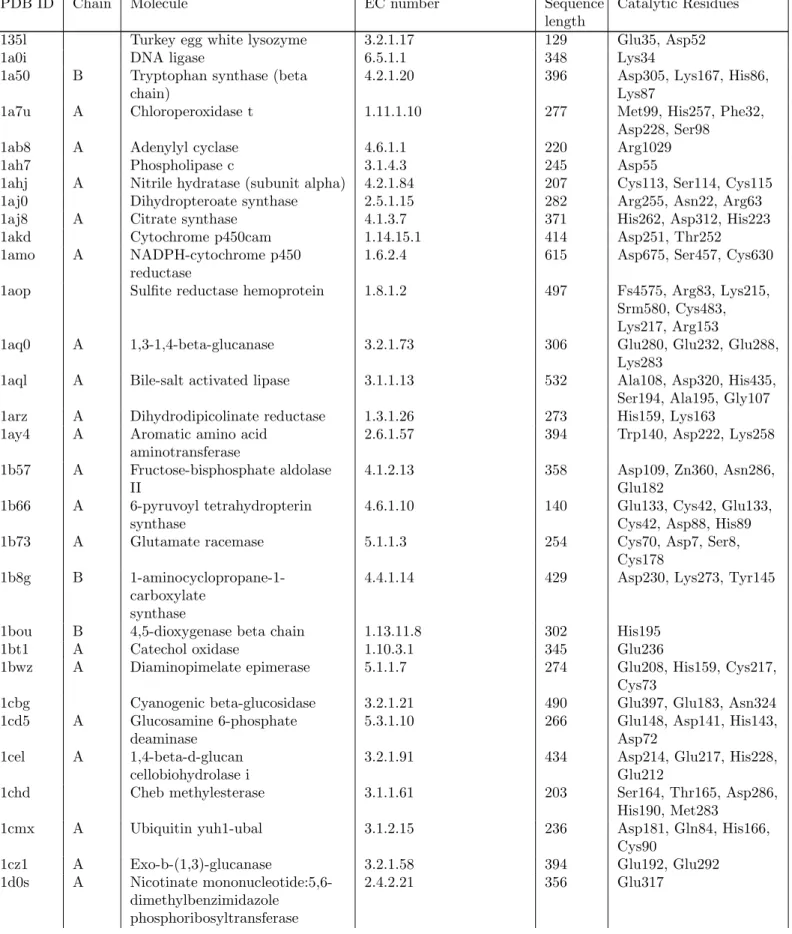
Table S1: ResBoost Dataset.

PDB ID Chain Molecule EC number Sequence

length

Catalytic Residues

135l Turkey egg white lysozyme 3.2.1.17 129 Glu35, Asp52

1a0i DNA ligase 6.5.1.1 348 Lys34

1a50 B Tryptophan synthase (beta chain)

4.2.1.20 396 Asp305, Lys167, His86,

Lys87

1a7u A Chloroperoxidase t 1.11.1.10 277 Met99, His257, Phe32,

Asp228, Ser98

1ab8 A Adenylyl cyclase 4.6.1.1 220 Arg1029

1ah7 Phospholipase c 3.1.4.3 245 Asp55

1ahj A Nitrile hydratase (subunit alpha) 4.2.1.84 207 Cys113, Ser114, Cys115

1aj0 Dihydropteroate synthase 2.5.1.15 282 Arg255, Asn22, Arg63

1aj8 A Citrate synthase 4.1.3.7 371 His262, Asp312, His223

1akd Cytochrome p450cam 1.14.15.1 414 Asp251, Thr252

1amo A NADPH-cytochrome p450 reductase

1.6.2.4 615 Asp675, Ser457, Cys630

1aop Sulfite reductase hemoprotein 1.8.1.2 497 Fs4575, Arg83, Lys215,

Srm580, Cys483, Lys217, Arg153

1aq0 A 1,3-1,4-beta-glucanase 3.2.1.73 306 Glu280, Glu232, Glu288,

Lys283

1aql A Bile-salt activated lipase 3.1.1.13 532 Ala108, Asp320, His435,

Ser194, Ala195, Gly107

1arz A Dihydrodipicolinate reductase 1.3.1.26 273 His159, Lys163

1ay4 A Aromatic amino acid aminotransferase

2.6.1.57 394 Trp140, Asp222, Lys258

1b57 A Fructose-bisphosphate aldolase II

4.1.2.13 358 Asp109, Zn360, Asn286,

Glu182 1b66 A 6-pyruvoyl tetrahydropterin

synthase

4.6.1.10 140 Glu133, Cys42, Glu133,

Cys42, Asp88, His89

1b73 A Glutamate racemase 5.1.1.3 254 Cys70, Asp7, Ser8,

Cys178 1b8g B 1-aminocyclopropane-1-

carboxylate synthase

4.4.1.14 429 Asp230, Lys273, Tyr145

1bou B 4,5-dioxygenase beta chain 1.13.11.8 302 His195

1bt1 A Catechol oxidase 1.10.3.1 345 Glu236

1bwz A Diaminopimelate epimerase 5.1.1.7 274 Glu208, His159, Cys217,

Cys73

1cbg Cyanogenic beta-glucosidase 3.2.1.21 490 Glu397, Glu183, Asn324

1cd5 A Glucosamine 6-phosphate deaminase

5.3.1.10 266 Glu148, Asp141, His143,

Asp72 1cel A 1,4-beta-d-glucan

cellobiohydrolase i

3.2.1.91 434 Asp214, Glu217, His228,

Glu212

1chd Cheb methylesterase 3.1.1.61 203 Ser164, Thr165, Asp286,

His190, Met283

1cmx A Ubiquitin yuh1-ubal 3.1.2.15 236 Asp181, Gln84, His166,

Cys90

1cz1 A Exo-b-(1,3)-glucanase 3.2.1.58 394 Glu192, Glu292

1d0s A Nicotinate mononucleotide:5,6- dimethylbenzimidazole

phosphoribosyltransferase

2.4.2.21 356 Glu317

(2)

1d2r A Tryptophanyl tRNA synthetase 6.1.1.2 326 Lys192, Lys195

1d3g A Dihydroorotate dehydrogenase 1.3.3.1 367 Phe149, Lys255, Ser215,

Thr218

1d6o A Fk506-binding protein 5.2.1.8 107 Asp37, Ile56, Tyr82

1d7r A 2,2-dialkylglycine decarboxylase (pyruvate)

4.1.1.64 433 Lys272, Asp243, Trp138

1daa A D-amino acid aminotransferase 2.6.1.21 282 Leu201, Glu177, Lys145

1dbt A Orotidine 5’-phosphate decarboxylase

4.1.1.23 239 Asp60, Lys62

1dii A P-cresol methylhydroxylase 1.17.99.1 521 Tyr473, Arg474, Glu427,

Tyr95, His436, Glu380

1do8 A Malic enzyme 1.1.1.39 564 Asp278, Lys183, Tyr112

1ecl Escherichia coli topoisomerase i 5.99.1.2 597 Tyr319, Asp111, Glu9,

His365

1ecx A Aminotransferase No 384 His99, Asp177, Lys203

1ef0 A PI-Scei endonuclease 3.6.1.34 462 Cys455, Ala1, Asn76,

Gly433, Thr78, Ile434, His79, Ala454

1exp Beta-1,4-d-glycanase cex-cd 3.2.1.91, 312 His205, Glu127, Glu233,

Asp235

1ey2 A Homogentisate 1,2-dioxygenase 1.13.11.5 471 His365, His292

1eyp A Chalcone-flavonone isomerase 1 5.5.1.6 222 Thr190, Asn113, Thr48,

Tyr106 1f75 A Undecaprenyl pyrophosphate

synthetase

2.5.1.31 249 Arg197, Arg203, Arg33,

Arg42

1f8m A Isocitrate lyase 4.1.3.1 429 His180, Cys191, Arg228

1fcb A Flavocytochrome b2 1.1.2.3 511 Tyr254, Arg376, Tyr143,

Asp282, His373

1fdy A N-acetylneuraminate lyase 4.1.3.3 297 Lys165, Ser47, Thr48

1fps Farnesyl diphosphate synthase 2.5.1.10 348 Phe253, Arg126

1geq B Tryptophan synthase alpha-subunit

EC 248 Glu36, Asp47, Tyr161

1get B Glutathione reductase 1.6.4.2 450 His439, Glu444, Glu181,

Cys47, Tyr177, Lys50, Cys42

1gim Adenylosuccinate synthetase 6.3.4.4 431 Asp13, Gln224, His41

1grc A Glycinamide ribonucleotide transformylase

2.1.2.2 212 His108, Ser135, Asp144,

Asn106

1hdh A Arylsulfatase 3.1.6.1 536 Fgl51, Lys375, Arg55,

Ca1528, Lys113, His211, Asp317, His115

1ir3 A Insulin receptor 2.7.1.112 306 Arg1136, Asp1132

1jms A Terminal

deoxynucleotidyltransferase

2.7.7.31 381 Mg701, Asp434

1kas Beta-ketoacyl acp synthase II 2.3.1.41 412 Phe400, His303, His340,

Cys163

1kc7 A Pyruvate phosphate dikinase 2.7.9.1 873 His455, Cys831

1l8t A Aminoglycoside

3’-phosphotransferase

2.7.1.95 263 Lys44, Asp190

1lnh Lipoxygenase-3 1.13.11.12 857 Asn713

1lxa UDP n-acetylglucosamine o-acyltransferase

2.3.1.129 262 His125

1m6k A Beta-lactamase oxa-1 3.5.2.6 251 Ser67, Kcx70

(3)

1mfp A Enoyl-[acyl-carrier-protein]

reductase [nadh]

1.3.1.9 262 Tyr156, Lys163

1mhl D Myeloperoxidase 1.11.1.7 466 Arg239

1mlv B Ribulose-1,5 biphosphate carboxylase/oxygenase large subunit n-methyltransferase

2.1.1.127 444 Tyr287

1mrq A Aldo-keto reductase family 1 member c1

1.1.1.149 323 His117, Lys84, Tyr55,

Asp50 1nba A N-carbamoylsarcosine

amidohydrolase

3.5.1.59 264 Ala172, Asp51, Thr173,

Lys144, Cys177

1nln A Adenain 3.4.22.39 204 His54, Glu71, Cys122,

Gln115

1oe8 B Glutathione s-transferase 2.5.1.18 211 Tyr10

1og1 A T-cell

ecto-ADP-ribosyltransferase 2

2.4.2.31 226 Glu189, Glu159,

Arg184, Ser147 1opm A Peptidylglycine

alpha-hydroxylating monooxygenase

1.14.17.3 310 His108, His242, Gln170

1oyg A Levansucrase 2.4.1.10 447 Glu342, Asp247, Asp86

1p4r A Bifunctional purine biosynthesis protein PURH

2.1.2.3, 592 Asn431, His592, Lys266,

His267, Ile126, Gly127, Tyr104, Lys137, Lys66 1pja A Palmitoyl-protein thioesterase 2

precursor

3.1.2.22 302 Leu45, Ser111, Gln112,

His283, Asp228

1pmi Phosphomannose isomerase 5.3.1.8 440 Glu294, Arg304, Gln111

1pnl B Penicillin amidohydrolase 3.5.1.11 557 Ala69, Asn241, Ser1

1ps9 A 2,4-dienoyl-coa reductase 1.3.1.34 671 Tyr166, His252

1q91 A 5(3)-deoxyribonucleotidase 3.1.3.5 197 Asp43, Asp41

1qb4 A Phosphoenolpyruvate carboxylase

4.1.1.31 883 Arg581, Arg713, Arg396

1qba Chitobiase 3.2.1.52 858 Glu540, Asp539

1qcn B Fumarylacetoacetate hydrolase 3.7.1.2 421 Arg737, His633, Gln740,

Glu864, Lys753 1qd6 C Outer membrane phospholipase

(ompla)

3.1.1.32 240 His142, Ser144, Gly146

1qdl A Anthranilate synthase (TrpE-subunit)

4.1.3.27 422 His306, His306

1qh9 A 2-haloacid dehalogenase 3.8.1.2 232 Asp180, Ser118, Arg41,

Asp10 1qmh B RNA 3’-terminal phosphate

cyclase

6.5.1.4 347 His309

1qum A Endonuclease iv 3.1.21.2 285 Glu261

1rbn Ribonuclease a 3.1.27.5 124 His12, His119, Phe120,

Lys41

1sme A Plasmepsin II 3.4.23.39 329 Asp214, Ser37, Thr217,

Asp34

1std Scytalone dehydratase 4.2.1.94 172 His110, His85, Tyr30,

Asp31, Tyr50

1tph 1 Triosephosphate isomerase 5.3.1.1 247 Asn11, Glu165, Lys13,

His95, Gly171

1trk A Transketolase 2.2.1.1 680 His263, His30

1uag UDP-n-acetylmuramoyl-l- alanine/:d-glutamate ligase

6.3.2.9 437 His183, Asn138, Lys115

(4)

1uqt A Alpha,alpha-trehalose-phosphate synthase

2.4.1.15 482 Asp361, His154

1xik B Protein r2 of ribonucleotide reductase

1.17.4.1 375 Tyr122

1yve L Acetohydroxy acid isomeroreductase

1.1.1.86 524 Glu496

1zio Adenylate kinase 2.7.4.3 217 Lys13, Arg127, Arg160,

Asp162, Arg171, Asp163

2dhn 7,8-dihydroneopterin aldolase 4.1.2.25 121 Lys100, Glu22

2ts1 Tyrosyl-tRNA synthetase 6.1.1.1 419 Lys230, Arg86, Lys233,

Lys82

5enl Enolase 4.2.1.11 436 Lys345, Glu168, Glu211,

His373

7odc A Ornithine decarboxylase 4.1.1.17 424 His197, Lys69, Glu274

(5)

ResBoost additional base classifiers

ConSurf.

ConSurf, like ET, uses ideas from evolution to identify residues of functional importance. Based on the Rate4Site tool, ConSurf estimates the rate of evolution of each residue of the protein from the sequence and phylogenetic information, and then maps these rates onto the molecular surface of the protein to help identify patches that may be functionally important [1, 2].

We obtained ConSurf scores from version 3.0 [2] by specifying the PDB ID and chain and using all the default settings (including ConSurf’s pre-computed multiple sequence alignments based on MUSCLE [3] and trees based on the neighbor joining algorithm [4]). If the protein chains had less than the required number of 5 unique PSI-BLAST hits, we changed the default ConSurf settings to use UniProt instead of the standard Swiss-Prot (this was required for only 3 of the 100 enzymes in our dataset). For consistency across enzymes, we normalized ConSurf scores so the highest scoring residue is 1 and the lowest scoring entry is 0 for each enzyme.

Solvent accessibility.

Catalytic residues must be at least somewhat solvent accessible in order to perform their biochemical function. We obtain solvent accessibility scores using DSSP [5], which is available from the PDB [6]. DSSP provides the surface area a

i

that is in contact with the solvent for each residue x

i

. Given a threshold A, the solvent accessibility threshold classifier classifies a residue i as TRUE if a

i

≥ A and FALSE otherwise.

The lack of solvent accessibility as measured by DSSP does not imply that a residue cannot be catalytic. Due to the complexity of enzyme interactions and the limitations of DSSP, some residues that are labeled as not solvent accessible in a static solved protein structure may in fact contact atoms in the solvent. This was shown to be the case for some catalytic residues in the CSA [7].

Secondary structure.

Catalytic residues have been observed in all secondary structures of enzymes. However, the proportion of residues that are catalytic in these secondary structures is not the same across all secondary structures. In particular, residues on alpha helices are somewhat less likely to be catalytic than residues on turns, loops, and coils [7]. Using DSSP [5], we classified each residue as being in an alpha helix, a beta sheet, or coil/other. We then defined one base classifier for each secondary structure type that classifies a residue as TRUE if the residue is in that secondary structure and FALSE otherwise.

Catalytic propensity.

Bartlett et al. measured the frequency of each amino acid type for all protein residues in the CSA and compared this with the frequency of each amino acid type among the catalytic residues in the database [7]. The frequencies provided quantitative support for an intuition that many biologists already had: nonpolar amino acids such as alanine and valine are rarely catalytic while polar amino acids such as histidine and glutamine are often catalytic.

We considered two types of catalytic propensity, side-chain and main-chain. For each type, we built a table of catalytic propensities [7] and assigned each residue x

i

a catalytic propensity value c

i

based on its amino acid. Given a threshold C, each catalytic propensity threshold classifier classifies a residue x

i

as TRUE if c

i

≥ C and FALSE otherwise.

Residue charge.

As in Bartlett et al. [7], we classified residues of type H, R, K, E, and D as charged. We defined a base classifier for charge that classifies a residue as TRUE if the residue is charged and FALSE otherwise.

Residue polarity.

As in Bartlett et al. [7], we classified residues of type Q, T, S, N, C, Y, and W as polar. We defined a base classifier for

polarity that classifies a residue as TRUE if the residue is polar and FALSE otherwise.

(6)

References

[1] Glaser F, Pupko T, Paz I, Bell RE, Bechor-Shental D, Martz E, Ben-Tal N: ConSurf: identification of functional regions in proteins by surface-mapping of phylogenetic information. Bioinformatics 2003, 19:163–164.

[2] Landau M, Mayrose I, Rosenberg Y, Glaser F, Martz E, Pupko T, Ben-Tal N: ConSurf 2005: the projection of evolutionary conservation scores of residues on protein structures. Nucleic Acids Res. 2005, 33:W299–W302.

[3] Edgar RC: MUSCLE: multiple sequence alignment with high accuracy and high throughput. Nucleic Acids Research 2004, 32(5):1792–1797.

[4] Saitou N, Nei M: The neighbor-joining method: a new method for reconstructing phylogenetic trees. Molecular Biology and Evolution 1987, 4(4):406–425.

[5] Kabsch W, Sander C: Dictionary of Protein Secondary Structure: Pattern Recognition of Hydrogen-Bonded and Geometrical Features. Biopolymers 1983, 22:2577–2637.

[6] Berman H, Westbrook J, Feng Z, Gilliland G, Bhat T, Weissig H, Shindyalov I, Bourne P: The Protein Data Bank.

Nucleic Acids Res. 2000, 28:235–242.

[7] Bartlett GJ, Porter CT, Borkakoti N, Thornton JM: Analysis of catalytic residues in enzyme active sites. J. Mol.

Biol. 2002, 324:105–121.

Figure

Table S1: ResBoost Dataset.

References

Related documents

• Phua KH, Towards a Comparative Analysis of Health Systems Reforms in the Asia-Pacific Region, Asia-Pacific Journal of Public Health 14(1): 9-16, 2002. • Phua KH, The

Shares of Big effectively transferred to Small 40 Multiply by: Fair value per share of Big’s shares 480 Fair value of consideration effectively transferred 19,200 Goodwill (gain

In weighing the evidence, the Panel took into account that consumption of non-digestible carbohydrates results in reduced post-prandial blood glucose (and

This paper produces annual aggregate and industry productivity series for the market sector of the New Zealand economy for the period 1988 to 2002, using index number techniques and

craniostenosis, meaning a structured or narrowed skull, but was convinced by Sear 47 to instead call this entity Craniosynostosis, the premature closure of cranial sutures, has

5 From DWS to Prediction •Reporting •Case Mgt •Return Scoring •Enforcement Historical Returns •Current Returns •Collections •Case Management.. DWS – Existing

Tissue damage, typically to the feet or hands that occurs when exposure to cold damages beds of capillary or small blood vessels in the skin. Chilblains Signs

Another problem with adaptive algorithms applied to ad-hoc networks arises when changes in the network occur too frequently to allow routing updates to propagate throughout all