This article is published under the terms of the Creative Commons Attribution License 4.0 Author(s) retain the copyright of this article. Publication rights with Alkhaer Publications. Published at: http://www.ijsciences.com/pub/issue/2015-06/
Article Number: V4201506707; Online ISSN: 2305-3925; Print ISSN: 2410-4477
Y. Ameyaw
(Correspondence)
[email protected]
+Impact of Problem Game Learning (PGL) on
College Student’s Performance in Hybridization
of Atomic Orbitals
Y. Ameyaw
1
, L. Sarpong
1
1Biology Education Department, Faculty of Science Education, University of Education, P. O. Box 25, Winneba,
C/R, Ghana – W/Africa
Abstract: This study is an inquisition to the outcome of Problem Game Learning using the Five Cores (PGL5C) of
learning approach on Pre-service Teacher’s understanding in Atomic Orbital Hybridization at St. Joseph College of Education, Bechem in the Tano District of the Brong Ahafo Region in Ghana. The concepts were explained using either Conventional Activity-Based Learning (ABL) or the PGL5C. The objective was to find out whether the PGL5C approach could enhance students’ academic achievement better than the ABL approach that is mostly used as activity method of learning by some teachers. A design involving two cohorts assigned as Group A and B with a total population of 117 was used for the study. Group ‘A’ was the quasi-experimental group upon which the PGL5C approach was applied in teaching Atomic Orbital Hybridization whereas group ‘B’ was used as the control group that was taught using the Conventional ABL approach. Data gathered from both pre-interventional and post interventional test were analyzed using Microsoft Office Excel, 2010 version. The pre-interventional test revealed that both groups lacked conceptual understanding of the subject matter even though they had been taught before by their teachers. The outcome of the analysis conducted on the post-interventional scores of the two cohorts (Experimental and Control groups) revealed that the experimental group achieved higher conceptual understanding than the control group. Hence, the PGL5C is a good teaching and learning approach for facilitating lessons in science, particularly in Chemistry.
Keywords: PGL5C, Competition, Collaboration, Communication, Critical thinking, Creativity, Activity-Based
Learning, learning Outcome,Evaluation Score, Total Number of Evaluation Scores and Winning Score
Introduction
Researchers of Science Education and many Educational psychologists as well as learning theorists are of the concern that learning environment influences students’ achievement (Ausubel, 1968). Most Researchers in recent times advocate for teaching approaches where learners are engaged with performing a task. According to Abimbola (1987), the current research pattern has been directed towards making exploration on how learners interrelate with their ambience, accumulate information, retrieve and use this same information in a way that will be useful to the society. According to findings from modern research, there are a significant number of students who find it difficult to comprehend and assimilate Chemistry concepts been taught by their teachers (Essumang & Bentum, 2012). Similarly, there has been series of documental evidence on science student’s low achievement in Chemistry, particularly, students' misconceptions of the Bond Angles and their difficulties in understanding isotopes and allotropes (Schmidt, Baumgartner & Eybe, 2003).
This situation has brought about poor student’s achievement in science, and as a result prompted governments, educational authorities, and individuals to find immediate remedy (Akpan, 1996). While some researchers are working assiduously to remedy the canker, others like Okebukola (1997) has linked poor students’ academic achievement to many factors including poor teacher preparation resulting in poor teaching skills among science teachers. Some of the findings of such research works noted several factors that accounts for students’ difficulty in understanding chemistry concepts as: learning impediments due to incorrect explanations to three dimensional learning, low quality, missing or fragmented content knowledge (Taber, 2001); learners’ limited mental working space (Johnstone, 1991), a low visuo-spatial thinking ability (Wu, 2004), insufficient understanding for the role of models (Taber, 2002a), and students’ common sense reasoning (Talanquer, 2011).
http://www.ijSciences.com Volume 4 – June 2015 (06)
11
the problems associated with students’ learning,researchers in science education have offered numerous research-based findings that offer new and varied perspectives to assist in changing chemistry instruction. For instance, according to Niaz, Agulera, Maza and Liendo (2002), developing curriculum that reflects the historical development, arguments, and thinking in chemistry concerning Molecular Geometry is one aspect, and is considered to be an approach that can facilitate students’ understanding of chemistry as a way of thinking over time.
Also, according to Justi and Gilbert (2002), a complementary view comes from other researchers who suggest that models and understanding modelling can provide essential perspectives on the conceptual development of chemistry as well as the scope and limitations for all models. Justi and Gilbert (2002) advocate that student's have opportunities to develop and test their own models.
Others researchers such as Ross, Pauline, Tronson, Deidre, Ritchie and Raymond (2008), advocate the use of role play to increase students’ conceptual understanding in science. In the same way, other science education researchers also advocate for learning process that could engage learners to learn as they perform task through a learning process called Activity-based learning (ABL) (Shah & Rahat, 2014). However, it appears that the views suggested by Ross et. al., (2008) were of more expert directed whereas that of Shah and Rahat (2014) cannot encourage learners to work within a confined time frame. According to Shah and Rahat (2014), the prerequisite for ABL approach is based on doing experiments or activities. They also emphasized that the ABL allows the learner to study according to his / her own ability and skills. Paradoxically, its focus as projected by Shah and Rahat (2014) even though is on the learner, it also suggests that the ABL does not promote team work spirit; neither does it encourage learners to be good competitors who can manage time effectively. In this ABL approach, learners go through a given task and come out with a result which could either be a desirable or otherwise. However, learners in question cannot be sure of the correctness in what they have done until an expert (the teacher) pass judgment on what the student has done. The traditional activity based learning projected by Shah and Rahat (2014), has therefore been identified by our observation to be handicapped since the students have no standards to compare their result with until it is evaluated by the expert (the teacher).
Moreover, nothing pushes (stimulates or motivates) the learner or learners to work faster and at the same time think of achieving the desirable goal. As a result, a quest for more child centered approach
which can overcome such shortcomings has prompted us to find out the effectiveness of Problem Game Learning through Competition, Collaboration, Critical thinking, Creativity and Communication (PGL5C) on College students’ performance in Hybridization of atomic orbitals based on the following Null hypotheses:
H01. There is no significant difference between
the academic performance of students who received instructions on Hybridization of atomic orbitals through PGL5C approach and those who received instructions on the concept through the conventional Activity-Based Learning (ABL).
H02. PGL5C has no significant effect on College
students’ achievement in Hybridization of Atomic orbitals
Methodology
The study was an action research design which used employed the quasi-experiment design to gather data from Level 100 Pre-service teachers who studied a course in atomic orbital hybridization. Action research is the type of research which aims at identifying problems in the classroom and secure remedy to that situation (Best & Kahn, 2006). It was therefore appropriate for the study to use action research, since the problem at stake had to do with students and their classroom learning.
http://www.ijSciences.com Volume 4 – June 2015 (06)
12
the PGL5C whereas members in group B carried outtheir task through the ABL approach. Before engaging the two cohorts with learning the tasks involving the use of ABL and PBL5C, a pre-test was conducted to determine whether students in each group has similar background knowledge and ability levels in the Hybridization of atomic orbitals. The mean scores obtained showed no significant difference between the ability levels of the two classes. It was therefore hypothesized that introduction of the two learning approach could bring a significant difference in college students performance after going through the topic as postulated by Cambell and Stanley (1963).
Group A: This group was used as the experimental group. As a result, members in the group received instruction through the PGL5C approach, which is an alternative way of learning designed by the researchers. Instructions based upon the learning and the objectives of the activities together with the rules for scoring were given to the learners on how to come out with desirable outcome(s), and the activities were also performed within a stipulated time (in this case, it was one hour). Instructional guide was used to evaluate students’ learning
outcomes. Group members were given the
opportunity to observe and score the learning outcomes of other group members and present their scores for PGL5C calculations and discussions. This stage of the PGL5C is called summative evaluation stage. During the summative evaluation stage, learners were allowed to score the learning outcome of the task performed by their learning competitors and presented their scores for tabulation and calculation using the formulae: WS = WTF + [∑ES/TNES]. The following symbols used in the calculation: WTF, ∑ES, TNES and WS had their respective meanings as Working Time Fraction, Total Evaluation Score, Total Number of Evaluation Scores and Winning Score. The Working Time Fraction is calculated as the total time assigned for the exercise divided by the time used to accomplish the task. The Winning Score value is a figure that determines the position of each competitor in the game. Each group was provided with stop watch which was set to run on the teacher’s bench for monitoring on when members would complete the given task.
Group B: The Traditional Activity Based Learning Approach.
This group received teaching instruction on Hybridization of atomic orbitals through the traditional Activity Based Learning which has been described by some authorities as learner-centred approach (Shah & Rahat, 2004). In this method, the learners were given activity sheets with instructions on what to do. Materials needed to carry out each activity on learning of Hybridization of atomic
orbitals were provided to students in their groups. The group members were given time frame to work within and submit their work to the teacher for marking and discussion. The principal focus was getting students involved in learning by doing as indicated by Shah and Rahat (2004).
Validity of the Instrument
The test items used for the exercises were validated by comparing what they were measuring to the objectives and the aims of the Chemistry syllabus for Colleges of Education. Moreover, the instruments were also examined and validated by tutors of the College who are appointed College Examiners by the institute of Education, University of Cape Coast. Their inputs were used to modify mistakes that might influence the results of the test items. The test items were also subjected to item analysis after conducting a pilot-test in the College of Distance Learning, University of Cape Coast (CoDE, UCC) at St. Margaret Mary’s Centre. The review made by the examiners and the pilot testing helped in the review of some items and modifications of the instruments before administering them.
Reliability of the Instrument
Internal consistencies of the instrument were also determined through a pilot-test in the College of Distance Learning, University of Cape Coast at St. Margaret Mary’s Centre. The CoDE students were used for the pilot-testing because their modules also have topics similar in content to that of the target group. Besides, they are all pursuing a course that lead to the award of Certificate in Diploma in Basic Education, and therefore belong to the same category. The internal consistencies of both pre-test and pilot test were determined and the reliability coefficients computed using SPSS version 16.0. The pre-test and the post-test yielded alpha values of 0.74 and 0.80 respectively. These values have been described by George and Mallery as good estimates (George & Mallery, 2003).
Data Collecting Instruments
The instruments used for data collection were pre-test, post-test items and summative Evaluation Scores from students’ group.
Pre-test: The pre-test was labeled students teacher’s conceptual knowledge in Hybridization of atomic orbitals within a given molecule. The test items which were given to students in all the two cohorts contained 25 test items that tested students-teachers’ previous knowledge on their basic conceptions about atomic orbital hybridization.
http://www.ijSciences.com Volume 4 – June 2015 (06)
13
structured to determined the extent to which theinterventions helped the respective students to comprehend the concept been taught. The data gathered were analyzed and used in responding to the research hypotheses.
Data Analysis Procedure
The scores gathered from the pre-test and post-interventional test exercises were processed with Microsoft Office Excel, 2010 version. Again, the performances of the two cohorts were compared using analysis of variance; specifically, one-way ANOVA. The aim of using one-way ANOVA was to determine whether there was a significance difference between the mean scores of the two cohorts. The result obtained was used as evidence in supporting implications made from the study. Moreover, to determined the impact of PGL5C on the experimental
group, the summative evaluation scores of the experimental group were subjected to PGL5C calculation to determine the extent of closeness of the degree of spread of their scores and how close such scores were, compared to the overall rating score of 50. The following formulae was used to that respect; WS = WTF + [∑ES/TNES]; where, WTF, ∑ES, TNES and WS has their respective meanings as Working Time Factor, Total Evaluation Score, Total Number of Evaluation Scores and Winning Score.
Results
The statistical analysis that were used for making deductions and testing hypotheses as well as interpreting the results that provide responses to the research questions have all being presented in this section.
Pre-test scores of students
The mean scores of the pre-test conducted for the two groups before introducing the treatments were compared using descriptive statistics as displayed in Table 1.
At the confidence level of 95.0%, it was observed that though the standard deviation scores for the two cohorts varied slightly, their mean scores were similar (22.7). This indicates that the two groups had similar conceptual understanding and for that matter there were not differences in the ability levels of the two groups before the application of the interventions. Moreover, the values of their Modal scores and the range for the two groups were also similar signifying no significant difference between the degrees of spread of the two set of scores. These imply that before administering the lessons with the two approaches (PGL5C and ABL), the learners had no significant differences in conceptual understanding of atomic orbital hybridization.
HO1: “There is no significant difference between
the academic performances of students who received instructions on Hybridization of atomic orbitals through PGL5C approach and those who received instructions on the concept through the conventional teaching approach”.
In order to respond to the Null hypothesis one (H01),
the post-interventional test scores of both the experimental group and the control groups were also analyzed as presented in Table 2.
Pre-Test Score For Control Group
Pre-Test Score Experimental Group
Mean 22.65306122 Mean 22.65306122
Standard Error 1.478171967 Standard Error 1.474428005
Median 21 Median 21
Mode 19 Mode 19
Standard Deviation 10.34720377 Standard Deviation 10.32099604
Sample Variance 107.0646259 Sample Variance 106.5229592
Confidence Level (95.0%) 2.972063935
Confidence Level
(95.0%) 2.964536195
http://www.ijSciences.com Volume 4 – June 2015 (06)
14
According to Table 2, the mean score of the post-interventional exercise for the experimental group was77.6 whereas that of the post-interventional exercise for the control group was 36.9. Also, the values for the two
standard deviations were 10.38 for the control group and 10.64 for the experimental group as indicated in the Table 2.
Again, the information presented in Table 2 indicates that the score range for the control group was 43 with maximum and minimum values been 53 and 10 respectively. However, score range for the experimental group was 38 with maximum and minimum values of 96 and 58 respectively. This indicates a significant difference between the post-test scores of the two cohorts (Control and Experimental groups). Therefore, the null hypothesis is rejected.
This means, the there is a significant difference between the academic performances of students
who received instructions on Hybridization of atomic orbitals through PGL5C approach and those who received instructions on the concept
through the Traditional ABL approach.
H02. “PGL5C has no significant effect on College
students’ achievement in Hybridization of Atomic orbitals”.
In order to test the null hypothesis two (H02), the
scores of the individual group members within the experimental group were also subjected to PGL5C (Problem Game Learning through Collaboration, Competition, Critical Thinking, Creativity and Communication) calculation using the PGL5C formulae.
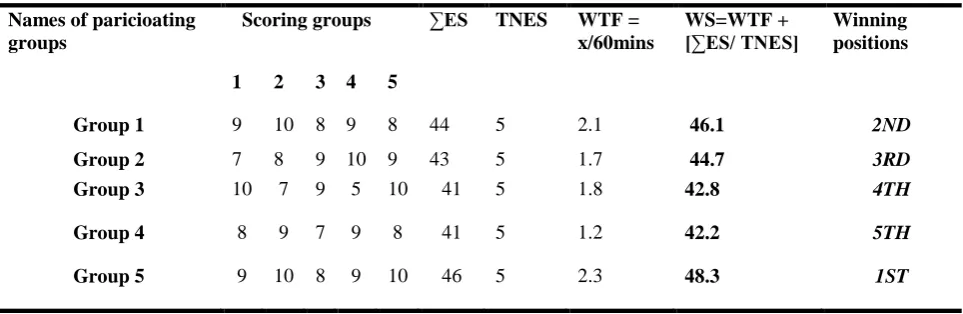
This was done to determine whether the use of PGL5C has influence on College student’s achievement in the learning of atomic orbital hybridization. The results obtained from the subgroups within the experimental group after scoring their learning competitors’ presentations have been illustrated in Tables 3 and 4.
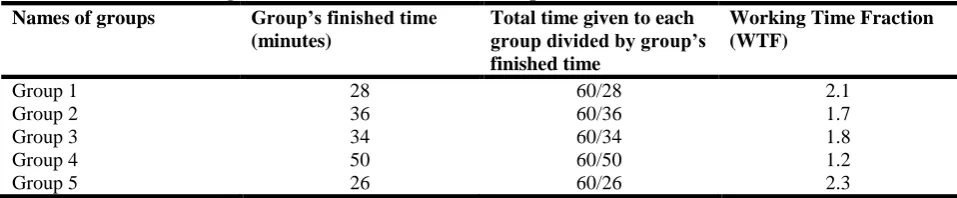
Table 3: Working Time Fraction Table for the Groups
Names of groups Group’s finished time
(minutes)
Total time given to each group divided by group’s finished time
Working Time Fraction (WTF)
Group 1 28 60/28 2.1
Group 2 36 60/36 1.7
Group 3 34 60/34 1.8
Group 4 50 60/50 1.2
Group 5 26 60/26 2.3
According to Table 3, Group 1used 28 minutes to accomplished the task and this gave them a WTF of 2.1, Group 2 had a WTF of 1.7 because they used 36 minutes to finish the given exercise. Again, in Table 3 the Group 3 finished the given task within 34
minutes with a WTF of 1.8 whereas the Group 4 spent 50 minutes to accomplish their task and so had a WTF of 1.2. Finally, in Table 3 Group 5 spent 26 minutes to achieve their result and this gave them a WTF of 2.3.
Post-Test Scores For Control Group (X) Post-Test Scores For Experimental Group(Y)
Mean 36.91836735 Mean 77.55102
Standard Error 1.482562114 Standard Error 1.520009
Median 38 Median 77
Mode 45 Mode 79
Standard Deviation 10.3779348 Standard Deviation 10.64006
Sample Variance 107.7015306 Sample Variance 113.2109
Confidence Level (95.0%) 2.980890916 Confidence Level (95.0%) 3.056182
http://www.ijSciences.com Volume 4 – June 2015 (06)
15
Table 4: PGL5C Score table for the Experimental GroupThe information presented in Table 4 indicates that group 1 had the WS value of 46.1 declaring them as second winners to group 5 who had WS value of 48.3; group 2 occupied the third position with WS value of 44.7.
The table 4 has also presented the WS value for group 3 as 42.8 declaring group 3 as the fourth winning group whereas group 4 was declared 5th with WS value of 42.2. Group 5 was declared as winning group had WS value of 48.3.
Discussion
The scores obtained from the post interventional test showed a significant difference between the performances of the two cohorts. For instance, in Table 2 the mean score of the post-interventional exercise for the experimental group was 77.6 whereas that of post-interventional exercise for the control group was 36.9. These two mean score values suggest a higher performance in the experimental group. The mean score value of the experimental group (77.6) is at least two times 36.9, which is the mean score for the control group.
Also, the range values for the two groups, which were 43 for the control group and 38 for the experimental group in Table 2 indicates that the degree of spread of the scores in the experimental group was smaller than that of the control group. In order words, the post-interventional scores of students in the experimental group were closer to each other compared to that of the control group, and this implies that the interventional strategies for the experimental group (PGL5C) was more effective than the traditional ABL strategy used for the control group.
Again, the minimum score value for the experimental group was also higher than the maximum score value of the control group as indicated in Table 2. This also confirms to the fact that the PGL5C used in teaching students in the experimental group enhanced their performance and therefore the good achievement scores. This is even evidenced in the PGL5C calculation table (Table 3) where students in the experimental group had close scores which were
closer to the total grading mark of 50. Besides, the group reports of the PBL5C activity given by the individual groups in the experimental group revealed that the PGL5C approach had impacted on students’ achievement scores. The students in the experimental group indicated that they were able to evaluate their own models and those models designed by the other group.
According to Burns (2007), students’ correct answers are not sufficient for judging their understanding unless they include explanations of how they reason. Therefore, having students share their verbal explanations during the presentation stage of the PGL5C approach helped develop conceptual understanding of the students in the experimental group and this also in agreement with a study conducted by Ketterline-Geller, Jungjohann, Chard and Baker, (2007).
Moreover, according to Blooms taxonomy, the highest and the most difficult level of the cognitive domain is evaluation (Bloom, 1985). Therefore, been able to evaluate Visuo-spatial models on atomic orbital hybridization designed by other groups clearly indicates high understanding of the concepts been taught, and that reflected in the high achievement scores obtained by the experimental group. It justified their conceptual understanding and performance through the use of PGL5C approach.
Furthermore, the differences in performance between the two cohorts may be attributed to many other reasons. For instance, the learning task which is bound by time motivated the learners to work faster and at the same time aimed at obtaining/achieving accurate information, that is the competition nature of PGL5C. Thus, learners are given specific time frame to work within after which they are asked to stop work and do summative evaluation. During the summative evaluation stage, each competitor is
Names of paricioating groups
Scoring groups ∑ES TNES WTF =
x/60mins
WS=WTF + [∑ES/ TNES]
Winning positions
1 2 3 4 5
Group 1 9 10 8 9 8 44 5 2.1 46.1 2ND
Group 2 7 8 9 10 9 43 5 1.7 44.7 3RD
Group 3 10 7 9 5 10 41 5 1.8 42.8 4TH
Group 4 8 9 7 9 8 41 5 1.2 42.2 5TH
http://www.ijSciences.com Volume 4 – June 2015 (06)
16
allowed to do own work scoring (scoring his/her/theirgroup work), and then move from station to station to see what has been done by other individuals or groups (Competitors), which the learner (s) could not do or think she/he/they did better than that and record it for whole class discussion.
Since learning is in the form of competition, learners are motivated to present desirable outcomes in order to be rated the best in the learning game (PGL5C contest). Moreover, the time bound nature of the PGL5C learning approach encourages learners to be good time managers. Furthermore, as learners evaluate their own work and that of others, it develops in them the spirit of sincerity and tolerance as well as good sense of judgment among learners, which eventually make them good team players multi-cultural working environment.
Generally, the PGL5C learning approach enhances communication skills of learners since opportunity is offered to learners to communicate ideas within groups and among groups or with individuals. It builds sense of belongingness among learners especially, when their views are accepted within the smaller group discussion or whole class discussions, learners also learn how to criticize opinions without attacking personalities and accept criticism as they collaborate.
Conclusion
The aim of this study was to determine to impact of the PGL5C approach on Pre-Service teacher’s achievement in Hybridization of Atomic Orbitals. The findings of the studies have revealed that the PGL5C improved the academic achievement of the students. The findings also revealed that although the academic achievement of students is influenced by Teaching-learning approach used by teachers, the Traditional Activity-Based Learning has marginal positive impact on students’ academic achievement. Therefore, the traditional Activity Based Learning should be used less frequently as teachers adjust themselves to the use of PGL5C approach which gives learners opportunity to compete in the study environment and also take part in the assessment process. Finally, in the PGL5C approach, learners see science as game, students play and as a puzzle that should be unearthed rather than been threatened.
Recommendation
It is recommended that science teachers should embrace the use of the PGL5C approach as commended by the researchers. Moreover, teachers should look for learning approaches that involve students as active learners and at the same time learning evaluators, who have the mandate to assess their own performance and that of the colleague learners. Finally, it is recommended that any
teaching/learning approach adopted by science teachers should encourage competition among learners as they try to answer puzzles that make them critical thinkers as well as good communicators, who can analyze, criticize and defend presented task.
Acknowledgements
The authors thank the management, staff and students of St. Joseph College of Education, Bechem for granting us the permission to conduct this study.
References
1) Abimbola, I.O. (1987). Cognitive science and its implications for science curriculum and instruction. Journal of Applied Research in Education, 1(1), 38-46.
2) Akpan, B. B. (1996). Towards a reduction in the contents of our primary and secondary science curricula. Journal of the Science Teachers Association of Nigeria, 31(1&2), 1-5. 3) Ausubel, D. (1968). Educational psychology: A cognitive
view (Holt, Rinehart, & Winston). http://dx.doi.org/10.3102/00028312006002287
4) Best, J. W & Kahn, J .V. (2006). Research in Education, New Delhi: Prentice-Hall of India Pvt. Ltd.
5) Bloom, B. S. (1985). Developing talent in young people.
New York: Ballantine Books.
6) Burns, M. (2007). Nine ways to catch kids up [Electronic version]. Educational Leadership, 65 (3), 16-21.
7) Campbell, D. & Stanley, J. (1963). Experimental and quasi-experimental designs for research. Chicago, IL: Rand-McNally http://dx.doi.org/10.1177/001316446702700247 8) Essumang, K. D. & Bentum, J. K. (2012). Man and His
Environment. Cape Coast: Yaci Press LTD.
9) George, D., & Mallery, P. (2003). SPSS for Windows step by step: A simple guide and reference.11.0 update (4 th ed.).Boston: Allyn &Bacon
10) Gray, J. A. (1981). “A Biological Basis for Sex Differences in Achievement in Science?” In Kelly, A. (Ed.). The missing Half. Manchester University Press.
11) Johnstone, A. H. (1991). "Why is Sience difficult to learn? Things are seldom what they seem". Journal of Computer Assisted Learning , 7 (2), 75-83. http://dx.doi.org/10.1111/j.1365-2729.1991.tb00230.x 12) Justi, R. & Gilbert, J. K. (2002). Modelling teachers' voews
on the nature of modelling, and implications for education of modellers. International Journal of science Education ,24
(4). http://dx.doi.org/10.1080/09500690110110142
13) Ketterline-Geller, L. R., Jungjohann, K., Chard, D. J., & Baker, S. (2007). From arithmetic to algebra [Electronic version]. Educational Leadership, 65 (3), 66-71.
14) Okebukola, P. A. O. (1997). The state of science education in Nigeria. Paper presented at the ELLSA-British Council Primary Science Forum, Kaduna, Nigeria.
15) Niaz, M., Aguilera, D., Maza, A ., & Liendo, G. (2002). Arguments, Contradictions, Resistances, and Conceptual Change in Students' Understanding of Atomic Structure.
Science education , 86, 505-525. http://dx.doi.org/10.1002/sce.10035
16) Ross, Pauline M., Tronson, D., Deidre A., Ritchie, R., Raymond J. (2008). Increasing Conceptual Understanding of Glycolysis & the Krebs cycle Using Role-Play. The American Biology Teacher, 70 (3 ). http://dx.doi.org/10.1662/0002-7685(2008)70[163:icuogt]2.0.co;2
http://www.ijSciences.com Volume 4 – June 2015 (06)
17
18) Shah I. & Rahat T. (2014). Effect of Activity Based Teaching Method in Science. International Journal of Humanities and Management Sciences, 2 (1).
19) Shuttleworth, K. (2008). Quasi-Experimental Experimental Design. Retrieved April 11, 2011, from Experimental Resource:http://www.experiment-resoiurces.com/quasi-experimental-design.htm
20) Taber, K. (2001b). The Mismatch between the assumed prior knowledge and the learners' conceptions: a typology of learning impediments. Educational Studies, 27 (2), 159-171. http://dx.doi.org/10.1080/03055690125159
21) Taber, K. (2002). Chemical misconception-prevention, diagnosis and cure. London: Royal Society of Chemistry. 22) Talanquer, V. (2011). Macro, Submicro, and simbolic: The
many faces of the Chemistry "triplet". International Journal of Science Education , 33 (2), 179-195. http://dx.doi.org/10.1080/09500690903386435