30 | http://mojes.um.edu.my/ EISSN: 2289-3024 MALAYSIAN ONLINE JOURNAL OF EDUCATIONAL SCIENCES JULY 2018, 6 (3)
INTRODUCTION
Writing anxiety can be defined as the fear of the writing process that supersedes the potential gain from the ability to write (Thompson, 1980). Native, L2 (Second Language) and FL (Foreign Language) learners alike have all experienced writing anxiety, one way or another, during their writing activities.
Writing activities can be difficult, especially when students are expected to work individually, put under a time constraint and evaluated based on their writing. These deprive the students of the opportunity to revise and proofread their writing and they have to make do with what they have written in a short amount of time. Over the years, learners may find writing to be vexing, and develop an anxiety towards any activity that potentially requires some amount of writing (Daly & Miller, 1975).
A similar case is observed in Malaysia in most language writing classes regardless of level of education where writing activities centre on the objective of having the written product, rather than the process of writing itself. In a study by Rezaei and Jafari (2014), for instance, students reported that writing activity in class is treated as a means to get good marks. Furthermore, the study also found that teachers are seen as authoritative figures and the purpose of writing has shifted from being learner-centred to teacher-centred, while the objective of writing is to please the teacher. This is in contrast with the process approach, where students should be given a chance to revise and edit their writing before THE EFFECT OF E-FEEDBACK VIA WIKIS ON ESL STUDENTS’ L2 WRITING ANXIETY LEVEL
Halimatussaadiah Iksan *Huzaina Abdul Halim
Faculty of Education University of Malaya, Malaysia
ABSTRACT
This study explores the effect of feedback on ESL students’ L2 writing anxiety level. The study was conducted using a quantitative method, specifically using experimental research where students are divided into 2 groups, the control and experimental group. 30 students were randomly chosen to be involved in the study, equally distributed in the 2 Groups. Over a span of 12 weeks, students in both groups completed 4 writing tasks in triads. Students in the control group are given feedback traditionally using face-to-face interaction while students in the experimental group used wiki as their e-feedback. To measure students’ writing anxiety, an instrument called SLWAI (Second Language Writing Anxiety Inventory) were given twice to both groups, once at the beginning of the semester and once at the end. The study found that students experienced low L2 writing anxiety, and while both face-to-face feedback and e-feedbacks are effective in lowering students’ anxiety level, e-feedback proved to be more effective in lowering students’ L2 writing anxiety level.
31 | http://mojes.um.edu.my/ EISSN: 2289-3024 MALAYSIAN ONLINE JOURNAL OF EDUCATIONAL SCIENCES JULY 2018, 6 (3)
submitting the final product (Graham & Perin, 2007). As a result, learners suffer ‘distress associated with writing’ and develop a strong distaste for the process (Madigan et al, 1996).
Some instructors recognise the need for collaborative writing where students are given more opportunities to assist each other in a process called scaffolding, as L2 learners are encouraged to pool their resources, co-construct new grammatical and lexical knowledge and solve problems collaboratively during peer feedback (Dobao, 2012; Kim & McDonough, 2008; Shehadeh, 2011; Storch, 2005; Storch & Wigglesworth, 2007; Swain & Lapkin, 1998). However, traditional peer feedback can also be problematic as some students may not be able to participate well in face-to-face interaction. For instance, face-to face interaction may induce anxiety as students may not be as honest as they would like in fear of judgments by their peers (Guardado & Shi, 2007).
Having online peer feedback or e-feedback is found to be more beneficial as it is able to overcome some of the obstacles that learners face in traditional peer feedback. For instance, peer feedback in forum or online discussion boards provides a less threatening environment, which in turn encourages more participation compared to traditional face- to- face feedback (Braine, 2004). ESL students are less intimidated to provide feedback in English with peers who share the same mother tongue (Jones et al., 2006). Hence, they are able to participate more during peer feedback sessions and get more information on how to improve their writing.
Though research pertaining to the role of online peer feedback in collaborative writing and its effects on ESL students’ writing performance are abundant, studies relating the effect of e-feedback in collaborative writing on students’ writing anxiety are still very much wanting in nature.
The principle aims of this research are to answer the following research questions:
1. To find out the students’ writing anxiety level
2. To find out the effects of traditional feedback and e-feedback via Wiki on ESL students’ writing anxiety level
3. To investigate the difference (if any) of the use of traditional feedback and e-feedback on the students’ writing anxiety level.
To answer these questions, the research proceeds under the following hypotheses: 1. Null Hypothesis:
H0: µ1=µ2
a)
There is no significant difference between the intra-groups’ pre-test and post-test mean scores of writing anxiety for both groups using e-feedback (experimental group) and traditional feedback (control group).b)
There is no significant difference between the inter-groups’ mean scores of writing anxiety among students using (experimental group) and traditional feedback (control group).2. Alternative Hypothesis
H1: µ1≠µ2
a) There is a significant difference between the intra-groups’ pre-test and post-test mean scores of writing anxiety for both groups using e-feedback (experiment group) and traditional feedback (control group).
32 | http://mojes.um.edu.my/ EISSN: 2289-3024 MALAYSIAN ONLINE JOURNAL OF EDUCATIONAL SCIENCES JULY 2018, 6 (3)
LITERATURE REVIEW
Writing Anxiety
Dysthe (2007) states that writing “involves much more than being able to communicate what you already know”. Thompson (1980) defines writing anxiety as the feeling of apprehension towards any activities involving writing that surpasses the possible achievement that could be gained from the learners’ capacity to write.
Various research over the years have proven that there is a consistent finding that FL and L2 writing anxiety have adverse effects on learners’ ability and performance in writing in FL and L2 (Qashoa, 2014; Reio et al., 2014; Choi, 2013; Woodrow, 2011). Students find writing activities to be worrisome and associate negative feelings with the events. For example, a study done by Woodrow (2011) found that there is a negative relationship between ESL writing anxiety and students’ performance in writing, which means that students with high apprehension score worse in a written task. This is supported by Martinez, Kock and Cass (2011) where it is found that students with higher GPA reported a lower level of writing anxiety compared to students with lower GPA.
From a psychodynamic perspective, Houp (2009) posits that writing anxiety may stem from student’s early experiences, referring to a case study of Lana, where her sociocultural background plays a huge significance on her written products. Research by Elias, Akmaliah & Mahyuddin (2005), on the contrary, suggests that rather than focusing on the topic of writing activity, writing anxiety may not be related to content, but rather due to excessive emphasis on superficial errors in spelling and grammar. This is supported by the findings of Zhang (2011) and later Rezaei and Jafari (2014) where it was found that students fear writing activities due to linguistic difficulty.
In the case of writing anxiety among adolescents, research has found that the adolescent population has suffered from a serious lack of attention to its writing needs in L2 (Harklau, 2001; Wald 1987). However, in the past few years, L2 writing anxiety has gained considerable interest among researchers in an Asian setting, such as studies done by Cheng (2004) among Chinese ESL students, Qashoa (2014) among students in the UAE and by Choi (2013) among students in Korea. However, from various research done from demographically diverse locations, it can be concluded that they share a similarity where all studies have shown consistently pessimistic findings of the overall predicament of adolescent L2 learners and writers.
This is mainly related to the fact that adolescent stage is a period of life when many learners are likely to be at the peak of their sensitivity regarding issues about their identities (Harklau, 2001) and peer relations (Heller, Calderon and Medrich, 2003). It is a phase where teenagers no longer look primarily to parents for social and psychological support, like children usually do, but are not mature enough to have a clear sense of individual identity to use in handling daily problems and conflicts, like adults usually do.
In the literature concerning factors affecting L2 learners’ writing anxiety, sources of writing anxiety have been detected to stem from an individual’s writing ability, the degree of preparation to complete the writing task, the fear of being assessed and judged on the basis of writing tasks, and the mixed messages students receive from their teachers (Qashoa, 2014; Rezaei & Jafari, 2014; Choi, 2013). These sources are of high importance to achieve a better understanding of writing anxiety. It is a possibility stated in the literature that students who suffer from writing anxiety are not skilful writers and their anxiety level reflects their awareness of this problem. These students may avoid writing and writing instruction, thus neglecting chances to improve their writing skills.
33 | http://mojes.um.edu.my/ EISSN: 2289-3024 MALAYSIAN ONLINE JOURNAL OF EDUCATIONAL SCIENCES JULY 2018, 6 (3)
situations that led to writing anxiety and apprehension. These five factors are conspicuousness, high evaluation, ambiguity, novelty, and a history of poor experiences in a similar situation (Daly and Hailey, 1984). This research also found that highly apprehensive writers tend to react more anxiously that those with low writing apprehension levels.
From research by Blanton (1987), she added that ESL learner’s writing anxiety can also be caused by the fact that they treat every act of writing as a test, thus denying themselves the psychological and intellectual “space” to work with the written language. Similarly, in a study among Iranian L2 learners, Rezaei and Jafari (2014) found that students’ writing do not reflect their voices, but rather as a means to get good marks. In their case, the students treat their teacher as an authoritative figure as they are in charge of assessing the written product. Thus, satisfying their perceived expectation of the teacher is more important than writing based on their personal opinion.
This could be contributed to the fact that most writing activities done in school setting did little to allow the students the opportunity to make amendments to their written text (Graham and Perin, 2007). This is in contrast with other writing approach that allows for amendments like the Process Approach of writing, and writing process involves multiple stages like 1) Prewriting 2) Drafting 3) Revising 4) Editing 5) Publishing (Li et al, 2012; Lam, 2007). These stages are important as they help students to select subjects, collect information, organize their thoughts, compose and revise their written work (Li et al, 2012; Gage, 1986). Not being able to make changes may affect the students’ confidence in writing thus contributing to their increasing level of anxiety while writing in English.
From the various aforementioned studies found on writing anxiety, it can be concluded that there are many factors involved contributing to ESL learners’ aversion and negative experience towards the L2 writing process. Even though some research provide contradicting results, all agree that writing anxiety poses debilitating effects on students’ writing performance, academic results and confidence in the process itself, among others. Thus, the need for effective strategies to ease students’ negative perception and experience in a writing class cannot be undermined as instructors and learners alike need to find ways to ensure better and less threatening environment can be achieved in a writing class.
Collaborative Writing
Through the lens of sociocultural theory, learning is treated as a socially-situated activity. Vygotsky (1978) suggests that higher cognitive functions appear first on the social, intermental plane, followed by the psychological intramental plane. Here, learners, or novices co-construct knowledge and learn from more capable individuals, or experts, such as instructors or more competent peers. More recent research in the field posit that since no two learners are the same, they are able to interchange between the role of both novices and experts (Storch, 2002; Ohta 2000, 2001; Swain & Lapkin, 1998); and by pooling their resources and knowledge together, they are able to achieve a level of performance beyond their individual level of competence (Ohta, 2001).
Numerous studies have proven that collaborative writing is beneficial to the students’ writing. For instance, Yarrow & Topping (2001) found that it contributes to the overall improvement of the written product as it allows the exchange of thoughts and ideas between peers (Topping, Smith, Swanson & Elliot, 2000) and it enables a learner to be involved in reflection, critical thinking, shared understanding, long term retention of the learned material (Phielix, Prins & Kirshner, 2010; Storch, 2005).
34 | http://mojes.um.edu.my/ EISSN: 2289-3024 MALAYSIAN ONLINE JOURNAL OF EDUCATIONAL SCIENCES JULY 2018, 6 (3)
As learners collaborate to solve grammatical and lexical difficulties, collaborative dialogue found in LREs constitutes an example of languaging, which is “a means to mediate cognition” (Swain & Watanabe, 2012, p.96). A close analysis on the LREs found that students are able to reach correct solutions to their language- related problems and co-construct new knowledge together with their peers or members in a small group (Storch, 2007; Leeser, 2004; Williams, 2001; Swain & Lapkin, 1998, 2002). However, a study by Dobao and Blum (2013) found that compared to individual and ESL learners working in dyads, ESL learners working in groups prove to be the most effective as they are able to engage in more LREs and have a higher percentage of correctly resolved LREs compared to the others. Thus, their written product is also observed to be more accurate compared to the rest.
In relation to writing anxiety, since collaborative writing and the use of LREs provide an environment where learners can help each other to co-create and provide opportunities for languaging (Swain & Watanabe, 2012), this could help learners who suffer difficulty in their vocabulary or grammar. This in turn may help learners who find these language barriers as a source for their writing anxiety to be able overcome their fear and work with their peers to write in groups.
Peer Feedback and Online Peer Feedback
The benefits of peer feedback are well documented through several research (Choi, 2013; Dobao and Blum, 2013; Dobao, 2012; Yang, 2010). For instance, in a study involving 75 university students, Choi (2013) found that in comparison between the group that only has teacher feedback and the group that has an integration of teacher-peer-feedback, the latter group shows significantly better improvement in their composition skills. On the other hand, though results from Dobao and Blum (2013) show contradictory results, most students benefit from the comments made by their friends and use them to improve their vocabulary and grammar correction. A study by Yang (2010) revealed that among 95 undergraduate students involved in the study, students found that peer reviews help them more compared to self-review. Peer reviews help them in seeing their written product from others’ perspective thus motivating macro-level amendments in tem of drafting, organization and style compared to self-review which results in microlevel amendments in grammar correction.
With the advent of the internet and Web 2.0, more and more researchers are interested on the effects of online peer-feedback as compared to the face-to-face interaction in traditional peer-feedback. It was found that online feedback or e-feedback is more advantageous as learners are able to solve language-related problems through interaction, negotiation, arguments or by presenting ideas that are not face-to-face, and learners are encouraged to participate in an interaction between peers online (Woo & Reeves, 2007). Similarly, from an observation by DiGiovanni & Nagaswami (2001), students in precollege writing class participating in online peer feedback are comfortable and remained on task. Findings from other research also support this as e-feedback provides interactive textual exchange and greater student participation (Jones et al., 2006; Strenski, Feagin & Singer, 2005; Tuzi, 2004).
In term of revision, a study by Jones et al. (2006) found that online feedback in forums generated more response on global concerns on content and the process of writing compared to traditional mode which focuses on textual issue such as grammar, style and vocabulary. Other research produce findings where students not only benefit from content editing, but also word choice whereby they suggest that peer e-feedback using Microsoft Word or other programs designed specifically for writing produced more concrete and revision-oriented comments than traditional oral or dissertation-based feedback (Liu & Sadler, 2003; Hewett, 2000). In a similar vein, Tuzi (2004) in his study also found that online context provide learners with more flexibility in macro-level revisions as they are allowed to add in new information and amend structures at clause, sentence and paragraph level.
35 | http://mojes.um.edu.my/ EISSN: 2289-3024 MALAYSIAN ONLINE JOURNAL OF EDUCATIONAL SCIENCES JULY 2018, 6 (3)
In an online context, being deprived of cues like facial and body gestures typically present in traditional face-to-face feedback demands learners to learn how to be sensitive to the audience’s needs and follow a clear and informative style when they are writing their feedback (Breuch & Racine, 2000). This enables learners to write balanced comments with an increased awareness. Furthermore, with the anonymity that forum provides, students are able to make critical comments on each other’s writings (Guardado & Shi, 2007).
RESEARCH METHODOLOGY
Research Design
This study employs a quantitative research design. The present study involves 30 ESL university students in a local university in Malaysia equally divided into 2 groups, namely control and experimental group. At the beginning of the semester, students from both groups were briefed on the objective of the research and the tasks that they would have to complete throughout the research period. To ensure the quality and effectiveness of the feedback, students need to have a proper training before giving feedbacks to others. This will help them to be more mindful of the types of feedback they will produce, and how to use the feedbacks to improve their composition (Yang, 2010). To gauge students’ L2 writing anxiety level at the time, an instrument called the SLWAI (Second Language Writing Anxiety Inventory) by Cheng (2004) was distributed. The inventory consists of 22 items and is chosen because compared to other instruments to test L2 writing anxiety, this one has the best internal consistency of Cronbach alpha coefficient of .91 (Cheng, 2004). The score from the test is considered as a pre-test, or a benchmark upon which the effectiveness of the treatment is based.
Over a span of a semester (3 months or 12 weeks), students from both groups were given similar writing tasks involving 4 different types of essays (see Appendix B-D) in compliant with the university’s course requirement. Both groups were given 10 days for the completion of each writing task, where 3 days were used for the planning and composing of the essay by the members of the group and another 7 days for the feedback by the peers. Students worked collaboratively in a triad.
Participants in the control group completed all the writing stages (planning, discussing, composing the essay and proofreading intra-group) in class and retrieve feedbacks from their peers in the classroom. On the contrary, participants in the experimental group discussed and plan their work in class, but publish their works asynchronously online using Wikispace as a medium. The peers in the latter group then posted their feedback on each of the group’s page. Throughout the process, the tutor acts as a facilitator to monitor exchanges both in class and in online environment to ensure active participation by students; and gives feedback when the situation demands for it.
At the end of the semester, a post-test of the same SLWAI instrument is again distributed to students from both groups. The results of both pre-test and post-test are then compared to answer the abovementioned research questions.
DATA ANALYSIS
Data analysis for this study is divided into 2 stages, using SPSS software (Statistical Package for Social Science), as per recommended by Field & Hole (2003). The first stage uses descriptive statistics using mean and standard deviation to answer research question 1.
36 | http://mojes.um.edu.my/ EISSN: 2289-3024 MALAYSIAN ONLINE JOURNAL OF EDUCATIONAL SCIENCES JULY 2018, 6 (3)
Descriptive Statistics
(RQ1): Students’ writing anxiety level for both experimental and control group.
Table1
L2 Writing Anxiety for Control Group and Experimental Group
Writing Anxiety Level Subsections n M
SD
Cognitive 15 3.58 .6
Control Group Somatic 15 3.13 .47
Avoidance Behaviour 15 2.46 .48
Overall Mean 15 3.08 .43
Experimental Group Cognitive 15 3.14 .47
Somatic 15 2.90 .86
Avoidance Behaviour 15 2.50 .78
Overall Mean 15 2.86 .59
Note. The maximum mean score is 5
In analysing the data to know the level of L2 writing anxiety among the students, the items are divided into three subsections as posited by Cheng (2004), namely cognitive (item 1, 3, 7, 9, 14, 17, 20, 21), somatic (item 2, 6, 8, 11, 13, 15, 19) and avoidance behaviour (item 4, 5, 10, 12, 16, 18, 22).
From the control group, the highest form of anxiety experienced by students is cognitive anxiety (M= 3.58, SD= 0.6) followed by Somatic anxiety (M=3.13, SD=0.47), while the lowest of the three subsections is Avoidance Behaviour (M=2.46, SD=0.48)
In total, the mean of overall L2 writing anxiety for students in the control group is 3.08 with standard deviation of 0.43; which reflects that students have moderately low writing anxiety level.
On the other hand, the highest form of anxiety experienced by students in the experimental group is cognitive anxiety (M= 3.14, SD= 0.47) followed by Somatic anxiety (M=2.9, SD=0.86), while the lowest of the three subsections is Avoidance Behaviour (M=2.50, SD=0.78).
Overall, students’ writing anxiety falls on the average of 2.86 with standard deviation of .59; which means that similar to the control group, students have moderately low writing anxiety level. Comparing between the two groups, students in the control group has a slightly higher writing anxiety level.
Inferential statistics
(RQ2): Effect of traditional feedback and e-feedback via Wiki on ESL students’ writing anxiety level
The hypotheses for paired t-test are as below:
1. Null Hypothesis:
H0: µ1=µ2
37 | http://mojes.um.edu.my/ EISSN: 2289-3024 MALAYSIAN ONLINE JOURNAL OF EDUCATIONAL SCIENCES JULY 2018, 6 (3)
2. Alternative Hypothesis
H1: µ1≠µ2
a.
There is a significant difference between the pre-test and post-test mean scores of writing anxiety for both groups using e-feedback (experimental group) and traditional feedback (control group).Table 2
Descriptive statistics and Paired Sample T-test Result for Control and Experimental Group Pre-test Post-test 95% CI for Mean Difference
Group M SD M SD n r t df
Control 77.13 12.22 70.27 14.06 15 4.79, 8.95 .97* 7.08* 14 Experimental 78.6 16.63 65.33 16.08 15 10.51, 16.02 .95* 10.32* 14 * p = .000
A paired sample t-test was conducted to evaluate the impact of e-feedback (through traditional and wikis for control and experimental group, respectively) on students' writing anxiety level.
For control group, there was a statistically significant decrease in students’ scores from Pre-test (M= 77.13, SD= 12.22) to Post-test (M= 70.27, SD= 14.06), t (14) = 7.08, p< .05 (two-tailed). The mean decrease in writing anxiety scores was 6.86 with a 100% confidence interval ranging from 4.79 to 8.95.
For experimental group, there was a statistically significant decrease in students’ scores from Pre-test (M= 78.6, SD=16.63) to Post-test (M=65.33, SD=16.08), t (14) =10.32, p< .05 (two-tailed). The mean decrease in writing anxiety scores was 13.27 with a 100% confidence interval ranging from 10.51 to 16.02.
These results reject the null hypotheses, thus it can be concluded that the use of feedback, be it traditional or through wikis, does have an effect in students’ writing anxiety level. Specifically, this study suggests that when students are given a chance to give and receive feedbacks (through any of the two mediums aforementioned); to and from their peers, their writing anxiety level decreases.
(RQ3): Is there any difference between the use of traditional feedback and e-feedback on the students’ writing anxiety level?
The hypotheses for ANCOVA are as below: 1. Null Hypothesis:
H0: µ1=µ2
a. There is no significant difference between the mean scores of writing anxiety among students using (experimental group) and traditional feedback (control group).
2. Alternative Hypothesis:
H1: µ1≠µ2
38 | http://mojes.um.edu.my/ EISSN: 2289-3024 MALAYSIAN ONLINE JOURNAL OF EDUCATIONAL SCIENCES JULY 2018, 6 (3)
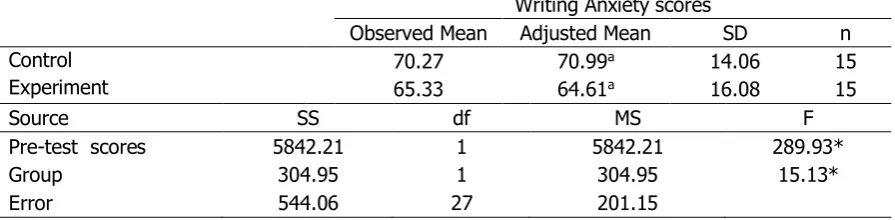
Table 3
ANCOVA Results and Descriptive Statistics for Writing Anxiety Scores by Pre-test result and Group Writing Anxiety scores
Observed Mean Adjusted Mean SD n
Control 70.27 70.99a 14.06 15
Experiment 65.33 64.61a 16.08 15
Source SS df MS F
Pre-test scores 5842.21 1 5842.21 289.93*
Group 304.95 1 304.95 15.13*
Error 544.06 27 201.15
Note. R2 = .92, Adj. R2 = .91.
a. Covariates appearing in the model are evaluated at the following values: Pre-test = 77.8668. * p =.001
An ANCOVA test was conducted to determine whether there is any statistically significant difference between the two types of feedbacks on students’ L2 writing anxiety by controlling the pre-test scores (between subjects factor: group (control, experiment); covariate: pre-test scores). The results found that there is a statistically significant difference between the two on students’ L2 writing anxiety level after controlling for the pre-test scores, F(1, 27)=15.13, p=.001.
Both the observed and adjusted means show that students in the experiment group experienced less L2 writing anxiety compared to those in the control group. All results reject the null hypothesis and show that even though both feedback types are able to lower students’ L2 writing anxiety level, e-feedback is comparatively better in doing so than traditional e-feedback.
DISCUSSION
The current study acknowledges the use of feedback in a collaborative setting to help lower students’ L2 writing anxiety level. This answers the gap whereby there is no present study yet that caters to the strategy of lowering students’ L2 writing anxiety through the use of feedback. Though there are studies (Choi, 2013; Dobao and Blum, 2013; Dobao, 2012, Yang, 2010) on how feedback is important to draw students’ attention on necessary amendments needed, studies on how these specifically affect students’ writing anxiety is still inadequate. Thus, this study modestly adds to the existing literature that the use of feedback in a collaborative setting to help lowers students’ L2 writing anxiety level. Comparing between traditional feedback (where learners receive response through face-to-face interaction) with that of e-feedback (where learners receive response asynchronously through online medium, in this case, Wikispace), it was found that the use of e-feedback is more beneficial to help lessens students’ writing anxiety.
This finding can be further implemented in educational setting. Though technology has come a long way to accommodate people in a lot of daily activities, assessment method and educational reform are still very much wanting to keep up with the present advancement. Language learning still follows the existing literature and teachers and learners alike cannot escape from having writing tasks and assessment as part of their curricula in school. As writing contributes to a huge percentage of students’ grade, it can be deduced that the issue of students experiencing L2 writing anxiety will persist. Hence, since writing activities remain significant in assessing students’ language performance in the foreseeable future, the best that teachers can do is to use the technology to assist students in their writing tasks.
39 | http://mojes.um.edu.my/ EISSN: 2289-3024 MALAYSIAN ONLINE JOURNAL OF EDUCATIONAL SCIENCES JULY 2018, 6 (3)
autocorrect function that checks students’ spelling and sentence structure, students can focus more on the content of the essay itself rather than the language technicality. This is further supported by Jones et al. (2006) that found online feedback in forums generated more response on global concerns on content and the process of writing compared to traditional mode which focuses on textual issue such as grammar, style and vocabulary.
For learners, since online writing allows them to asynchronously edit their work whenever and wherever they are, granted that they are logged on to the site, it should come as a huge consideration. Since online writing provides anonymity, flexibility and more autonomy for the learners to co-create their contents (Leuf and Cunnigham, 2001; Choy and Ng, 2007), students will no longer have to be heavily reliant on instructors to enhance their writing skill. Furthermore, since online collaborative writing allows the students to benefit from e-feedbacks from their peers and rewrite their composition, learner with apprehension of writing under time constraint and writing individually do not have to worry.
CONCLUSION
The research has demonstrated that when students are given an opportunity to compose in a group where they are able to utilise their peer’s feedbacks to improve their writing, students are able to flourish. We are able to observe a more active participation during the process of composition and students are observed to be more mindful in giving and receiving feedback to and from their peers. In this sense, both mediums used-be it through traditional face-to-face interaction, or through the use of wikis- have proven to be effective in lowering students’ feelings of anxiety. Even though students who benefitted from e-feedback through wikis have shown lower writing anxiety in their post –test results, teachers may consider either one of the methods during writing class as feedbacks encouraged a more productive lesson and students are able to utilise responses not only from their teacher, but also their friends to enhance their written products. Furthermore, since feedbacks allow learners to actively get assistance from others, it could help lower their feelings of isolation thus lowering their personal feelings of aversion that they may have towards the writing process.
However, since this study only evaluates data from quantitative measure, the precise reasons and mechanism in which feedback and e-feedback are able to lower students’ L2 writing anxiety cannot be explicitly explained. As such, perhaps future research could explore on this topic not only through quantitative lens, but also via qualitative measures so as richer data could be gleaned.
REFERENCE
Blanton, L. L. (1987). Reshaping ESL students' perceptions of writing. ELT Journal, 41, 112- 118. Braine, G. (2004). Teaching second and foreign language writing on local area networks (LANs). In
Sandra Fotos & Charles M. Browne (Eds.), New perspectives on CALL for second language classrooms (pp. 93–108). NJ: Lawrence Erlbaum.
Breuch, Lee-Ann M.K,& Racine, S. J. (2000). Developing sound tutor training for online writing centers: Creating productive peer reviewers. Computers and Composition, 17, 245- 263.
Cheng, Y.-S. (2004). A measure of second language writing anxiety: Scale development and preliminary validation. Journal of Second Language Writing, 13, 313-335.
Choi, J. (2013). Do peer feedback affect L2 writers’ L2 learning, composition skills, metacognitive knowledge, and L2 writing anxiety? English Teaching, 68(3), 187- 213.
Choy, S. O. & Ng, K. C. (2007). Implementing wiki software for supplementing online learning. Australasian Journal of Educational Technology, 23(2), 209-226.
http://www.ascilite.org.au/ajet/ajet23/choy.html
Daly, J. A. and Hailey, J. L.(1984).Putting the situation into writing research: State and disposition as parameters of writing apprehension. In R. Beach and L. Bridwell (Eds.), New Directions in Composition Research. New York: The Guilford Press.
40 | http://mojes.um.edu.my/ EISSN: 2289-3024 MALAYSIAN ONLINE JOURNAL OF EDUCATIONAL SCIENCES JULY 2018, 6 (3)
DiGiovanni, Elaine,& Nagaswami, Girija. (2001). Online peer review: An alternative to face to-face? ELT Journal, 53, 263–272.
Dobao, A.F. & Blum, A. (2013). Collaborative writing in pairs and small groups: Learners’ attitudes and perceptions. System. 41, 365- 378
Dobao, A.F. (2012). Collaborative writing tasks in the L2 classroom: Comparing group, pair, and individual work. Journal of Second Language Writing. 21, 40-58.
Dysthe, O. (2007). How a reform affects writing in higher education. Studies in Higher Education, 32, 237–253. doi:10.1080/03075070701267285
Elias, H., Akmaliah, Z. L. P., & Mahyuddin, R. (2005). Competencies needed by teachers. Implications for best teaching practices. Universiti Putra Malaysia Press. Malaysia. Selangor. Serdang
Field, A. P., & Hole, G. (2003). How to design and report experiments. London: Sage Publications. Gage, N. (1986). Why write? In A. N. Petrovsky & D. Bartholomae (Eds.), The teaching of writing.
(Eighty-fifth yearbook of the National Society for the Study of Education). Chicago: University of Chicago Press
Graham, S., & Perin, D. (2007). Writing Next: Effective strategies to improve writing of adolescents in middle and high schools. New York:Carnegie Corporation of New York.
Guardado, M. & Shi, L. (2007). ESL students’ experiences of online peer feedback. Computers and Composition. 24, 443-461.
Harklau, L. (2001). From high school to college: Student perspectives on literacy practices. Journal of Literacy Research, 33(1), 33–70.
Heller, R., Calderon, S. & Medrich, E. (2003). Academic achievement in the middle grades: what does research tell us? a review of the literature. Retrieved from http://eric.ed.gov/?id=ED478009 Hewett, B. L. (2000). Characteristics of interactive oral and computer-mediated peer group talk and its
influence on revision. Computers and Composition, 17, 265–288.
Houp, G. W. (2009). Lana’s story: Re-storying literacy education. Journal of Adolescent & Adult Literacy, 52(8), 698-707. http://dx.doi.org/10.1598/JAAL.52.8.5
Jones, R. H., Garralda, A. Li. , D. C. S., & Lock, G. (2006). Interactional dynamics in online and face-to-face peer-tutoring sessions for second language writers. Journal of Second Language Writing, 15, 1–23.
Kim, Y., & McDonough, K. (2008). The effect of interlocutor proficiency on the collaborative dialogue between Korean as a second language learners. Language Teaching Research, 12, 211–234. Lam, A. S. L. (2007). The multi-agent model of language choice: National planning and individual volition
in China. Cambridge Journal of Education, 37(1), 67–87.
Lapkin, S., Swain, M., & Smith, M. (2002). Reformulation and the learning of French pronominal verbs in a Canadian French immersion context. The Modern Language Journal, 86, 485–507. Leuf, B., & Cunningham, W. (2001). The WIKI WAY. Quick Collaboration on the Web:
Addison- Wesley.
Li, X., Chu, S.K.W. & Ki, W.W. (2014). The effects of a wiki-based collaborative process writing pedagogy on writing ability and writing attitudes among upper primary school students in Mainland China. Computers and Education, 77, 151-169.
Liu, J, & Sadler, R W. (2003). The effect and affect of peer review in electronic versus traditional modes on L2 writing. Journal of English for Academic Purposes, 2, 193–227.
Madigan, R., Linton, P., & Johnson, S. (1996). The paradox of writing apprehension. In L. W. Gregg & E. R. Steinberg (Eds.), Cognitive processes in writing (pp. 295-307). Hillsdale, NJ: Lawrence Erlbaum.
Martinez, C., Kock, N., & Cass, J. (2011). Pain and pleasure in short essay writing: Factors predicting university students writing anxiety and writing self-efficacy. Journal of Adolescent & Adult Literacy, 54(5), 351-360.
Matsumura, S, & Hann, G. (2004). Computer anxiety and students’ preferred feedback methods in EFL writing. Modern Language Journal, 88, 403–415.
Ohta, A. S. (2001). Second language acquisition processes in the classroom: Learning Japanese. Mahwah, NJ: Lawrence Erlbaum.
41 | http://mojes.um.edu.my/ EISSN: 2289-3024 MALAYSIAN ONLINE JOURNAL OF EDUCATIONAL SCIENCES JULY 2018, 6 (3)
Qashoa, SHH. (2014). English writing anxiety: alleviating strategies. Procedia. DOI: doi:10.1016/j.sbspro.2014.05.288
Reio, J.S. Alexander, P. A.; Reio, T. G.; Newman,I (2014). Do students’ beliefs about writing relate to their writing self-efficacy, apprehension, and performance. Elsevier. Learning and Instruction 33. 1-11.
Rezaei, M & Jafari, M. (2014). Investigating the levels, types, and causes of writing anxiety among Iranian EFL students: a mixed method design. Procedia. DOI: doi:10.1016/j.sbspro.2014.03.577 Shehadeh, A., 2011. Effects and student perceptions of collaborative writing in L2. Journal of Second
Language Writing 20, 286-305.
Storch, N. (2002). Patterns of interaction in ESL pair work. Language Learning, 52, 119–158.
Storch, N. (2005). Collaborative writing: Product, process and students’ reflections. Journal of Second Language Writing, 14, 153–173
Storch, N., Wigglesworth, G. (2007). Writing tasks: comparing individual and collaborative writing. In: Garcı´a Mayo, M.P. (Ed.), Investigating Tasks in Formal Language Learning. Multilingual Matters, London, pp. 157e177.
Strenski, E., Feagin, C. O., & Singer, J. A. (2005). Email small group peer review revisited. Computers and Composition, 22 (2), 191-208
Swain, M., Brooks, L., & Tocalli-Beller, A. (2002). Peer–peer dialogue as means of second language learning. Annual Review of Applied Linguistics, 22, 171–185.
Swain, M., & Lapkin, S. (1998). Interaction and second language learning: Two adolescent French immersion students working together. The Modern Language Journal, 82, 320–337
Swain, M., & Watanabe, Y. (2012). Languaging: Collaborative dialogue as a source of second language learning. In C. Chapelle (Ed.), The encyclopedia of applied linguistics. Oxford: Wiley-Blackwell, in press.
Thompson, M. O. (1980). Classroom techniques for reducing writing anxiety: A study of several cases. Dissertation presented at the annual conference on College Composition and Communication, Washington, D.C. (ERIC Document Reproduction Service No. ED 188 661).
Topping, K.; Smith E.; Swanson, I. and Elliot, A. (2000). Formative peer assessment of academic writing between postgraduate students. Assessment and Evaluation inHigher Education, 25(2):149-169. Tuzi, F. (2004). The impact of e-feedback on the revisions of L2 writers in an academic writing course.
Computers and Composition, 21, 217–235.
Vygotsky, L. S. (1978). Mind in society: The development of higher psychological processes. Cambridge, MA: Harvard University Press.
Wald, B. (1987). The Development of Writing Skills among Hispanic High School Students. In S. Goldman & H. Trueba (Eds.), Becoming literate in English as a second language (pp. 155-185). Norwood, NJ: Ablex
Woo, Y., & Reeves, T. C. (2007). Meaningful interaction in web-based learning: A social constructivist interpretation. The Internet and Higher Education, 10, 15–25. doi:10.1016/ j.iheduc.2006.10.005 Woodrow, L. (2011). College English writing affect: Self-efficacy and anxiety. System.
DOI:doi:10.1016/j.system.2011.10.017
Yang, Y.F. (2010). A reciprocal peer review system to support college students’ writing. British Journal of Educational Technology
Yarrow, F., & Topping, K. (2001). Collaborative writing: The effects of metacognitive prompting and structured peer interaction. British Journal of Educational Psychology, 71, 261-282. doi: 10.1348/000709901158514
42 | http://mojes.um.edu.my/ EISSN: 2289-3024 MALAYSIAN ONLINE JOURNAL OF EDUCATIONAL SCIENCES JULY 2018, 6 (3)
43 | http://mojes.um.edu.my/ EISSN: 2289-3024 MALAYSIAN ONLINE JOURNAL OF EDUCATIONAL SCIENCES JULY 2018, 6 (3)
SECTION B: Second Language Writing Anxiety Inventory (SLWAI) by Cheng (2004)
Read the statements below very carefully. Tick (/) one choice of answer for each statement. As the findings of this test are going to be used in for research, I kindly request you be honest while answering the questions. Rest assured that your response is confidential and please do not leave any question unanswered.
1 2 3 4 5
I strongly disagree I disagree I have no strong
feelings either way I agree I strongly agree
SD
1 D 2 NF 3 A 4 SA 5 1. While writing in English, I am not nervous at all.
2. I feel my heart pounding when I write English compositions under time constraint
3. While writing English compositions, I feel worried and uneasy if I know they will be evaluated.
4. I often choose to write down my thoughts in English.
5. I usually do my best to avoid writing English compositions. 6. My mind often goes blank when I start to work on an English
composition.
7. I don’t worry that my English compositions are a lot worse than others. 8. I tremble or perspire when I write English compositions under time
pressure.
9. If my English composition is to be evaluated, I would worry about getting a very poor grade.
10. I do my best to avoid situations in which I have to write in English. 11. My thoughts become jumbled when I write English compositions under
time constraint.
12. Unless I have no choice, I would not use English to write compositions. 13. I often feel panic when I write English compositions under time
constraint.
14. I am afraid that the other students would deride my English composition if they read it.
15. I freeze up when unexpectedly asked to write English compositions. 16. I would do my best to excuse myself if asked to write English
compositions.
17. I don’t worry at all about what other people would think of my English compositions.
18. I usually seek every possible chance to write English compositions outside of class.
19. I usually feel my whole body rigid and tense when write English compositions.
20. I am afraid of my English composition being chosen as a sample for discussion in class
21. I am not afraid at all that my English compositions would be rated as very poor.
44 | http://mojes.um.edu.my/ EISSN: 2289-3024 MALAYSIAN ONLINE JOURNAL OF EDUCATIONAL SCIENCES JULY 2018, 6 (3)
APPENDIX B: WRITING TASKS
Topic Writing Tasks
Short story:
“My Friend Luke” by Fernando Sorrentino Narrative Essay:
The short story “My Friend Luke” by Fernando Sorrentino follows the character of “Luke” who is emasculated in his daily life and how the only empowering moment in his life is when he is on the bus ride. Pick one theme in the short story and create a new story on the theme. With your group members, compose an essay of about 350 words.
Poem:
“Caged Bird” by Maya Angelou Opinion Essay:
In the poem, Angelou wrote about the theme of “racism” and “discrimination”, and the crippling effects they bring to the society. In your opinion, why does racism exist and even still practiced by Some people? With your group members,
compose an essay of about 350 words.
Short story:
“The Secret Life of Walter Mitty” by James Thurber
Argumentative Essay:
From the short story of “The Secret Life of Walter Mitty”, the readers are exposed on the
multifaceted nature of human beings. What is the ideal man like? Argue whether Walter fit or deviate from these “ideal” male qualities? With your group members, compose an essay of about 350 words.
Poem:
“All the World’s a Stage” by William Shakespeare
Compare and Contrast Essay:
In this poem, Shakespeare highlights the seven stages of life and how one differs in
characteristics in each stage. Compare and Contrast these stages with the current life stages. Are there any marked similarities and
45 | http://mojes.um.edu.my/ EISSN: 2289-3024 MALAYSIAN ONLINE JOURNAL OF EDUCATIONAL SCIENCES JULY 2018, 6 (3)
APPENDIX C:
NARRATIVE ESSAY: PEER EVALUATION FORM:
3 2 1 0
INTRODUCTION
Background/History Thesis Statement
Well-developed introduction engages the reader and creates interest.
Thesis is clear and focused.
Introduction creates interest.
Thesis clearly states the position.
Introduction is satisfactory
Thesis states the position.
Background
details are a random collection of information, unclear, or not related to the topic.
Thesis is vague or unclear, or no thesis present.
CONCLUSION Conclusion is
interesting and reflects the thesis closely.
Conclusion
effectively reflects the topic.
Conclusion is recognizable and ties up almost all loose ends.
Conclusion has no relevance to the topic.
Does the introductory paragraph provide the background of the story?
Is the last line in the conclusion and introduction related? Does it include the lesson learned and refer to the narrated incident? SUGGESTIONS: MAIN POINTS Body Paragraphs The narrative is developed with a consistent and effective point-of-view, showing the story in detail.
Use of
dialogues and imageries to help readers visualise the narration.
The narrative shows events from the
author's point of view using some details.
Use of some
imagery to help narration
The narrative shows the events, but may lack details.
Lacking of imagery to help narration.
The narrative is undeveloped, and tells rather than shows, the story.
No imagery
used, or most imagery used are out of place and adds to confusion.
Is there a discussion of who or what influenced the writer's ethical development? Does the narrative fully explain the incident from the writer's point of view? Does the narrative show, not tell, the story as it unfolds?
46 | http://mojes.um.edu.my/ EISSN: 2289-3024 MALAYSIAN ONLINE JOURNAL OF EDUCATIONAL SCIENCES JULY 2018, 6 (3)
ORGANIZATION
Structure Transitions
Logical progression of ideas with a clear structure that enhances the thesis. Transitions are skillfully used to move from one idea to the next.
Logical progression of ideas.
Transitions are present equally throughout essay. Organization is clear. Transitions are present. No discernable organization. Transitions are not present.
Does the narrative use a consistent chronological progression? Can you identify transitions between ideas within the paragraphs? SUGGESTIONS: STYLE Sentence flow, variety Diction
Writing is smooth, skillful, coherent. Sentences are strong and expressive with varied structure.
Diction is consistent and words well chosen.
Writing is clear and
sentences have varied
structure.
Diction is consistent.
Writing is clear, but sentences may lack variety.
Diction is appropriate.
Writing is confusing, hard to follow. Contains fragments and/or run-on sentences. Inappropriate diction.
Is there variety in sentence structures? Does the writing flow smoothly and clearly? Is the word choice appropriate? Highlight any slang or colloquialisms.
SUGGESTIONS: MECHANICS Spelling, punctuation, capitalization Punctuation, spelling, capitalization are correct.
No errors.
Punctuation, spelling, capitalization are generally correct, with few errors. (1-2)
A few errors in punctuation, spelling, capitalization. (3-4) Distracting errors in punctuation, spelling, capitalization.
47 | http://mojes.um.edu.my/ EISSN: 2289-3024 MALAYSIAN ONLINE JOURNAL OF EDUCATIONAL SCIENCES JULY 2018, 6 (3)
APPENDIX D:
ESSAY GUIDELINE
3 2 1 0
INTRODUCTION Background/History Thesis Statement
Concise Title Well-developed
introduction engages the reader and creates interest. Thesis clearly
states the objective of essay and the 3 main points succinctly.
Concise Title Introduction
creates interest. Thesis states the
objective of essay and the 3 main points succinctly in separate sentences
Title is present, but may be confusing
Introduction is satisfactory Thesis states the
objective of the essay but did not include the 3 main points.
No Title
Background details are a random collection of information, unclear, or not related to the topic. Thesis is vague or
unclear, or no thesis present.
CONCLUSION Strong concluding statement that begs readers to think further Restatement of
thesis statement reflects the thesis closely
Clear concluding statement
Clear restatement of thesis statement
Conclusion is recognizable and ties up almost all loose ends
Conclusion has no relevance to the topic or presence of introduction of new ideas in the concluding paragraph.
Does the introductory paragraph make you as a reader interested to read further? Does the thesis statement tell you the overview of the essay?
Is the last line in the conclusion and introduction related?
SUGGESTIONS:
MAIN POINTS
Body Paragraphs
Clear and well written Topic Sentences. Supporting
details are well
elaborated, closely relevant with the topic sentence. Evidence
from text and
sufficient analysis are given.
Topic
Sentences are present. Supporting
details are elaborated with relation to the topic sentence. Lacking of
textual
evidence and analysis
Some form of topic
sentence can be seen. Supporting
details are not well elaborated Lacking
textual evidence with some
attempt at analysis
No topic sentence, Lacking supporting
48 | http://mojes.um.edu.my/ EISSN: 2289-3024 MALAYSIAN ONLINE JOURNAL OF EDUCATIONAL SCIENCES JULY 2018, 6 (3)
Can you locate topic sentences in each paragraph easily? Are the writers able to treat the topic maturely?
SUGGESTIONS: ORGANIZATION Structure Transitions Logical progression of ideas with a clear structure that enhances the thesis. Transitions
are skillfully used to move from one idea to the next.
Logical
progression of ideas.
Transitions are present equally throughout essay. Organization is clear. Transitions are present.
No discernable organization.
Transitions are not present.
Is there a seamless transition from one point to the next? SUGGESTIONS:
STYLE
Sentence flow, variety
Diction
Writing is smooth, skilful, and coherent. Sentences
are strong and
expressive with varied structure. Diction is
consistent and words well chosen.
Writing is clear and
sentences have varied
structure. Diction is
consistent.
Writing is clear, but sentences may lack variety. Diction is
appropriate.
Writing is confusing, hard to follow. Contains fragments
and/or run-on sentences.
Inappropriate diction.
Is there variety in sentence structures? Does the writing flow smoothly and clearly? Is the word choice appropriate? Do the writers use sophisticated word choices?
SUGGESTIONS: MECHANICS Spelling, punctuation, capitalization Punctuation, spelling, capitalization are correct. No errors.
Punctuation, spelling, capitalization are generally correct, with few errors. (1-2)
A few errors in
punctuation, spelling, capitalization. (3-4)
Distracting errors in punctuation,
spelling, capitalization.