R E S E A R C H A R T I C L E
Open Access
Using a single question to assess physical activity
in older adults: a reliability and validity study
Dawn P Gill
1*, Gareth R Jones
2, Guangyong Zou
3,4and Mark Speechley
3Abstract
Background:Single-item physical activity questions provide a quick approximation of physical activity levels. While recall questionnaires provide a more detailed picture of an individual’s level of physical activity, single-item
questions may be more appropriate in certain situations. The aim of this study was to evaluate two single-item physical activity questions (one absolute question and one relative question) for test-retest reliability, convergent validity, and discriminant validity, in a sample of older adults.
Methods:Data was obtained from the Project to Prevent Falls in Veterans, a fall risk-factor screening and modification trial. One question measured absolute physical activity (seldom, moderately, vigorously active) and one measured relative physical activity (more, about as, less active than peers). Test-retest reliability was examined using weighted Kappa statistics () in a sample of 43 subjects. Validity was assessed using correlation coefficients (r) in participants who received clinical assessments (n = 159).
Results:The absolute physical activity question was more reliable than the relative physical activity question (= 0.75 vs.= 0.56). Convergent validity, however, was stronger for the relative physical activity question (r = 0.28 to 0.57 vs.r = 0.10 to 0.33). Discriminant validity was similar for both questions. For the relative physical activity question, there was moderate agreement when this question was re-administered seven days later, fair to moderate/good associations when compared with indicators of physical function, and little to no associations when compared with measures hypothesized to be theoretically not related to physical activity.
Conclusions:The relative physical activity question had the best combination of test-retest reliability, convergent validity and discriminant validity. In studies requiring a measure of physical activity, where physical activity is not the primary focus and more detailed measures are not feasible, a single question may be an acceptable alternative.
Keywords:Physical activity, self-report, single-item measure, assessment, validity, reliability, older adults
Background
When selecting measures for a study, investigators usually need to strike a balance among several factors such as required sample size, the level of detail needed, the resources available, and the burden posed by their mea-surement protocol on research participants. In particular, for a given research budget, there is typically a trade-off between measurement detail and sample size [1].
Each of these issues is present in the study of physical activity (PA) in older adults. Regular PA assists with maintaining independence and preventing disability
among older adults and it is associated with a decreased risk of morbidity and all-cause mortality [2]. PA is
defined as “any bodily movement produced by skeletal
muscles that results in energy expenditure” [3]. PA is a complex behavioral construct that can be categorized and quantified in many ways. For example, PA can be broken down into routine activities such as housework, and those done for exercise, such as swimming. Each specific type of PA can be quantified in terms of fre-quency, intensity, and duration [4].
These complexities are reflected in the many methods used to measure PA or related energy expenditure in older adults [4-7]. Measurement of PA can be categor-ized into direct and indirect methods. Direct methods are defined as those that measure movement as it
* Correspondence: [email protected]
1
National Alzheimer’s Coordinating Center, Department of Epidemiology, University of Washington, Seattle, WA, USA
Full list of author information is available at the end of the article
occurs and indirect methods provide indicators of PA and energy expenditure [5]. Examples of direct methods include motion sensors, such as pedometers, acceler-ometers, and Global Positioning Systems, whereas indir-ect methods include daily PA records or log books and self-report questionnaires.
There are a number of recall questionnaires that have been used in older adult populations, with varying degrees of evidence for reliability and validity [8]. While these questionnaires provide a more detailed picture of an individual’s PA, global questionnaires or single-item questions may be favored in certain situations. When investigators have a choice of questions, they might compare the evidence of validity and reliability in mak-ing their selection. Reliability and validity results from existing single-item PA questions [9-12] indicate a need to evaluate additional single-item questions as possible measures of PA under certain conditions (i.e., when PA is not the primary focus of a study but a quick approxi-mation of activity levels is of interest as a covariate or possible confounding factor, when the sample size is large, when resources are limited, and when more com-plex methods would add to respondent burden).
Similar research has been done with general health measures. A previous study found that two single-item general self-rated health measures showed good mea-surement properties when compared to a multi-item instrument, thus providing a less burdensome alternative [13]. In that study, researchers compared“standard”and “comparative” versions of general self-rated health mea-sures, where the comparative version referred to a ques-tion that had respondents compare their general health to a reference group. Findings indicated that both ques-tions represented reasonably similar assessments of health. Another study in this area, which compared three different single-item questions of self-rated health (two“standard”questions and one “comparative” ques-tion) found similar results [14].
In a previously completed fall risk factor modification trial, two single-item questions of PA were included, both intended to easily classify activity levels of partici-pants. Similar to the self-rated health literature, one
question was a“standard”measure and one was a
“com-parative” measure. Specifically, one question measured
absolute PA (seldom, moderately, vigorously active) and the other measured relative PA (more, about as, less active than peers). Using the self-rated health literature as a model, since both PA questions have the same intent (i.e., to quickly classify PA levels), it is of interest to determine if properties of reliability and validity are similar between these questions and whether they could be used interchangeably. Thus, the aim of this study was to evaluate the test-retest reliability, convergent validity and discriminant validity of an absolute PA question
and a relative PA question, in a sample of community-dwelling older adults.
Results
The characteristics of participants who took part in the reliability sub-study are described in detail elsewhere [15]. Briefly, the mean age was 79 (standard deviation (SD) 2.9) years and approximately one-half were male.
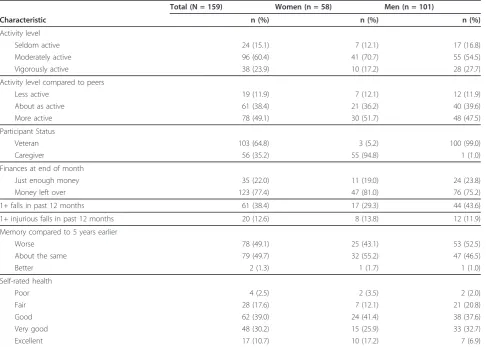
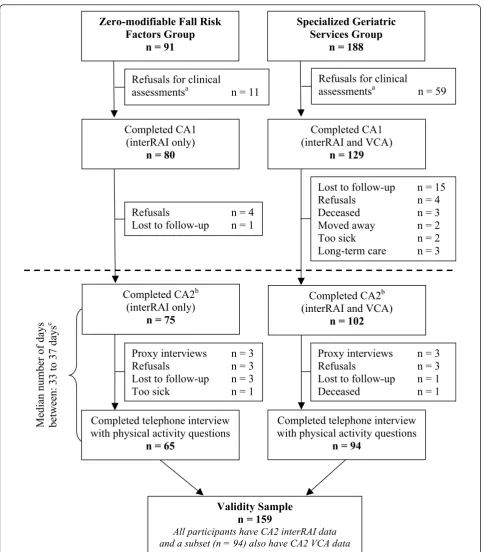
For the validity sample, the mean age was 80 (SD 3.9) years, and close to two-thirds were males. Other charac-teristics of participants included in the validity sample are presented in Table 1. About 20% self-reported fair or poor health, 38% reported one or more falls in the past 12 months, 49% reported that their memory was worse than five years ago, 15% reported being seldom active and 12% reported that they were less active com-pared to their peers. In comparison to women, men were older (mean age 81 years, SD 3.5), and a slightly higher percentage reported fair or poor health, one or more falls in the past month and worse memory com-pared to five years earlier. Men and women provided similar responses in regard to their PA compared to their peers. The median time between administration of validation measures and PA questions ranged between 33 days for the subset of participants who had been administered both the earlier version of the interRAI Community Health Assessment (interRAI) and Veterans’ Comprehensive Assessment (VCA), and 37 days when considering all participants in the validation sample (also see Figure 1).
Results indicated that the absolute PA question had better test-retest reliability than the relative PA ques-tion. The weighted kappa value for absolute PA was 0.75 (95% confidence interval (CI): 0.60 to 0.91) whereas for relative PA, the weighted kappa value was 0.56 (95% CI: 0.30 to 0.82). For the absolute PA question, the weighted kappa value indicated substantial agreement whereas for relative PA, the weighted kappa value indi-cated agreement in the moderate range.
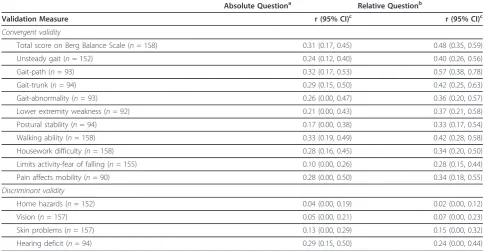
assessment, limiting PA due to fear of falling, and all of the gait measures (unsteady gait, gait-path, gait-trunk, and gait abnormality) had stronger positive correlations with relative PA, compared to absolute PA.
For discriminant validity, the magnitude of correlation coefficients was similar between absolute PA and rela-tive PA. For absolute PA, correlations with discriminant validation measures ranged from 0.04 (95% CI: 0.00 to 0.19) to 0.29 (95% CI: 0.15 to 0.50) and for relative PA, correlations ranged from 0.02 (95% CI: 0.00 to 0.12) to 0.24 (95% CI: 0.00 to 0.44). In general, comparisons of discriminant validity measures and PA questions led to correlations that indicated little to no association.
Discussion
The absolute PA question had better test-retest reliabil-ity than the relative PA question. Paradoxically, evidence for convergent validity was stronger for relative PA compared to absolute PA. For both questions, results indicated evidence for discriminant validity. The relative
PA question had the best combination of test-retest reliability, convergent validity and discriminant validity. Specifically, there was moderate agreement when this question was re-administered seven days later, fair to moderate or good associations when compared with indicators of physical function, and little to no associa-tions when compared with measures hypothesized to be
theoretically not related to PA. Although we were unable to evaluate the five-level form of the relative PA question, a previous study examining the validity of a similar question from the National Health Interview Survey (NHIS) found that very little was gained with the 5-level question compared to the 3-level question [12].
Indicators of physical function, often referred to as
indirectmeasures of PA, have not been commonly used to evaluate the convergent validity of single-item PA questions in older adults, despite recommendations for their use [16,17]. One study, evaluating two different PA questions in older adults, examined convergent validity against indicators of health (i.e., health conditions such Table 1 Participant characteristics (validity sample)a
Total (N = 159) Women (n = 58) Men (n = 101)
Characteristic n (%) n (%) n (%)
Activity level
Seldom active 24 (15.1) 7 (12.1) 17 (16.8)
Moderately active 96 (60.4) 41 (70.7) 55 (54.5)
Vigorously active 38 (23.9) 10 (17.2) 28 (27.7)
Activity level compared to peers
Less active 19 (11.9) 7 (12.1) 12 (11.9)
About as active 61 (38.4) 21 (36.2) 40 (39.6)
More active 78 (49.1) 30 (51.7) 48 (47.5)
Participant Status
Veteran 103 (64.8) 3 (5.2) 100 (99.0)
Caregiver 56 (35.2) 55 (94.8) 1 (1.0)
Finances at end of month
Just enough money 35 (22.0) 11 (19.0) 24 (23.8)
Money left over 123 (77.4) 47 (81.0) 76 (75.2)
1+ falls in past 12 months 61 (38.4) 17 (29.3) 44 (43.6)
1+ injurious falls in past 12 months 20 (12.6) 8 (13.8) 12 (11.9)
Memory compared to 5 years earlier
Worse 78 (49.1) 25 (43.1) 53 (52.5)
About the same 79 (49.7) 32 (55.2) 47 (46.5)
Better 2 (1.3) 1 (1.7) 1 (1.0)
Self-rated health
Poor 4 (2.5) 2 (3.5) 2 (2.0)
Fair 28 (17.6) 7 (12.1) 21 (20.8)
Good 62 (39.0) 24 (41.4) 38 (37.6)
Very good 48 (30.2) 15 (25.9) 33 (32.7)
Excellent 17 (10.7) 10 (17.2) 7 (6.9)
a
All participants included had a second clinical assessment (CA2) and were evaluated with the earlier version of the interRAI Community Health Assessment (interRAI). A subset (n = 94) receiving a CA2 were also evaluated with the Veterans’Comprehensive Assessment (VCA)
Lost to follow-up
n = 15
Refusals
n = 4
Deceased
n = 3
Moved away
n = 2
Too sick
n = 2
Long-term care
n = 3
Completed CA1
(interRAI and VCA)
n = 129
Refusals
n = 4
Lost to follow-up
n = 1
Completed CA1
(interRAI only)
n = 80
Median number of days
between: 33 to 37 days
cValidity Sample
n = 159
All participants have CA2 interRAI data and a subset (n = 94) also have CA2 VCA data
Proxy interviews
n = 3
Refusals
n = 3
Lost to follow-up
n = 1
Deceased
n = 1
Completed CA2
b(interRAI and VCA)
n = 102
Completed telephone interview
with physical activity questions
n = 94
Proxy interviews
n = 3
Refusals
n = 3
Lost to follow-up
n = 3
Too sick
n = 1
Completed CA2
b(interRAI only)
n = 75
Completed telephone interview
with physical activity questions
n = 65
Zero-modifiable Fall Risk
Factors Group
n = 91
Refusals for clinical
assessments
an = 11
Specialized Geriatric
Services Group
n = 188
Refusals for clinical
assessments
an = 59
as heart attack, stroke, and diabetes). This study did not report any type of validity coefficients, making compari-sons with our findings difficult [9].
Two other studies that evaluated an additional four PA questions in populations of older adults, examined validity by comparing questions with summary measures from PA recall questionnaires. In the first study, a PA question designed to be used as a screening question in primary care was evaluated in a population of older
women [11]. This question, “As a rule, do you do at
least half an hour of moderate or vigorous exercise (such as walking or sport) on five or more days of the
week?”, was compared to two summary scores from the
New Zealand Physical Activity Questionnaire - Long
Form. Results indicated moderate agreement ( = 0.46
to 0.56). In the second study, three PA questions from the NHIS (job-related activity, main daily activity, and activity compared to peers) were compared with sum-mary measures from a detailed PA question set [12].
The main daily activity question asked, “How much
hard physical work is required in your main daily activ-ity? Would you say a great deal, a moderate amount, a little, or none?” The activity compared to peers
ques-tion, “Would you say that you are physically more
active, less active, or about as active compared to other
persons you age?”, was also expanded to a 5-level
question with the following response options: a lot
more, a little more, about the same, a little less, a lot less. For participants 65 years of age or older, correlation coefficients ranged from 0.17 to 0.21 for the main daily activity question and from 0.24 to 0.28 for the activity compared to peers question. The validity results from the present study, in particular for the relative PA ques-tion, have been similar or better than previous studies of single-item PA questions in older adults.
At least two studies have evaluated test-retest reliabil-ity of single-item PA questions in older populations. In the first study, researchers found intraclass correlation coefficients (ICCs) ranging from 0.75 to 0.80 for two PA questions that asked regular exercisers about their fre-quency and intensity of activity [9]. Another study eval-uated the test-retest reliability of three different PA questions (work PA, strenuous PA, and moderate PA) in a sample of participants from the Canadian Mulitcentre Osteoporosis Study [10]. The kappa statistic was 0.57 (0.47 to 0.68) for the strenuous PA question and 0.30 (0.23 to 0.37) for the moderate PA question.
Reliability results achieved in the present study for the relative PA question were similar or better than those reported by Nadalin et al. [10] but worse than those reported by Davis et al. [9]. Comparing the results in the present study to those reported by Davis et al. [9] is Table 2 Convergent and discriminant validity results for PA questions
Absolute Questiona Relative Questionb
Validation Measure r (95% CI)c r (95% CI)c
Convergent validity
Total score on Berg Balance Scale (n= 158) 0.31 (0.17, 0.45) 0.48 (0.35, 0.59)
Unsteady gait (n= 152) 0.24 (0.12, 0.40) 0.40 (0.26, 0.56)
Gait-path (n= 93) 0.32 (0.17, 0.53) 0.57 (0.38, 0.78)
Gait-trunk (n= 94) 0.29 (0.15, 0.50) 0.42 (0.25, 0.63)
Gait-abnormality (n= 93) 0.26 (0.00, 0.47) 0.36 (0.20, 0.57)
Lower extremity weakness (n= 92) 0.21 (0.00, 0.43) 0.37 (0.21, 0.58)
Postural stability (n= 94) 0.17 (0.00, 0.38) 0.33 (0.17, 0.54)
Walking ability (n= 158) 0.33 (0.19, 0.49) 0.42 (0.28, 0.58)
Housework difficulty(n= 158) 0.28 (0.16, 0.45) 0.34 (0.20, 0.50)
Limits activity-fear of falling (n= 155) 0.10 (0.00, 0.26) 0.28 (0.15, 0.44) Pain affects mobility (n= 90) 0.28 (0.00, 0.50) 0.34 (0.18, 0.55)
Discriminant validity
Home hazards (n= 152) 0.04 (0.00, 0.19) 0.02 (0.00, 0.12)
Vision (n= 157) 0.05 (0.00, 0.21) 0.07 (0.00, 0.23)
Skin problems (n= 157) 0.13 (0.00, 0.29) 0.15 (0.00, 0.32)
Hearing deficit (n= 94) 0.29 (0.15, 0.50) 0.24 (0.00, 0.44)
a
Response categories: i) seldom active; ii) moderately active; or iii) vigorously active.
b
Response categories: i) less active; ii) about as active; or iii) more active.
c
Specific type of correlation coefficient (r): Spearman’s rho (total score on Berg Balance Scale) and Cramer’s V (all other validation measures) Validation measures and PA questions were ordered so that higher scores indicated better functioning or higher PA levels.
also problematic, since the PA questions evaluated in that study were only posed to participants who had already reported engaging in regular exercise.
Indicators of physical function have been used to eval-uate the convergent validity of many PA recall question-naires designed for older adults. For a number of the most well-known questionnaires, evidence for conver-gent validity is not substantially stronger than that obtained in this study; in fact, in some instances, the relative PA question evaluated in this study, performed better. For example, correlations between summary scores from the Community Healthy Activities Model Program for Seniors (CHAMPS) Physical Activity Ques-tionnaire and various measures of physical functioning ranged between 0.10 and 0.54 [16,18-20]. For the CHAMPS Physical Activity Questionnaire and the Yale Physical Activity Survey, test-retest reliability was evalu-ated over a similar interval to this study (one to two weeks), and ICCs ranged from 0.55 to 0.79 [18,19,21].
The intent of both the absolute and the relative PA questions was to quickly and easily classify older adults by their activity level. Since specific details related to fre-quency, duration and intensity are not referenced within the relative PA question, this question will remain accu-rate for assessment even when PA recommendations for older adults are revised, such as was done in the United States in 2007 [22] and in Canada in 2011[23]. The relative PA question may also be less prone to recall errors, com-pared to the absolute PA question, since participants do not need to remember the duration or frequency of their typically performed activities.
It is known that in general, people tend to over-report PA levels [24]. In the self-reported health literature, it was noted that with increasing age, people tended to overesti-mate their health when comparing themselves to others or alternatively, they underestimated the health of others [14]. Thus, it is plausible that the participants in this study may have overestimated their PA, and perhaps to a greater extent when responding to the relative PA question. This should be kept in mind when interpreting the results of this study and when considering the merits of measuring PA using an absolute or a relative question.
Other limitations exist for the present study. Partici-pants included in this study were Canadian veterans of World War II or the Korean War and their caregivers, a highly selected group of older adults. In addition, some of the validation measures were only available on parti-cipants in the study who had reported at least one mod-ifiable fall risk factor. The Project to Prevent Falls in Veterans (PPFV) began as a randomly selected sample; however, only 13% of the original participants were included as part of the risk factor modification trial and a smaller percentage completed the second clinical assessment and the final telephone interview. As a
result, it is likely that the participants included in this study are different than the general population of older Canadian veterans and their caregivers. Caution should be taken in generalizing results from our study to popu-lations that may differ clinically and demographically.
The present analyses were done because we had data that allowed us to do these comparisons, but were not part of a validation study planned a priori. It is therefore possible that the modest validity correlations achieved may be partially due to the measures selected for valida-tion. Since there is no widely accepted criterion of PA [24], we chose to evaluate the convergent validity of two single-item PA questions, by comparing them with indi-cators of physical functioning. We recognize, however, that capacity to perform PA does not equal actual per-formance. As a result, correlation coefficients indicating more than a moderate association may not be possible when using indicators of physical functioning as valida-tion measures. A related limitavalida-tion is that while some of the indicators of physical function were objectively sured performance-based outcomes, others were mea-sures of self-reported functional ability. Self-reported measures can be affected by factors such as cognitive impairment and guessing among older populations [25]. Additionally, it would have been preferable if the indica-tors of physical functioning were measured at the same time as the PA questions. Even so, we hypothesize that any resulting bias is likely toward the null, indicating that correlations may have been stronger if these mea-sures had been conducted closer in time.
Conclusions
In large sample research, there is a trade-off between the intensity of measurement of a single variable and the comprehensiveness of all variables. In this study, a relative PA question had the best combination of test-retest reliability, convergent validity and discriminant validity. The magnitude of the reliability and validity coefficients achieved for this question are similar, and in some cases better, than those previously reported for other single-item PA questions evaluated in older adults. Reliability and validity results of many recall question-naires for older adults have also not substantially exceeded the results obtained in this study. This simple PA question may be useful in studies of older adults where PA is not the primary focus, but a brief classifica-tion of activity levels is needed.
questionnaires or other direct measures of PA when resources are available or when study objectives require more comprehensive measures. In summary, this simple PA question may provide an alternative to researchers when lengthy PA measures, which increase both cost and participant burden, are not possible or necessary.
Methods Participants
We used data from the PPFV, a fall risk-factor screening and modification trial. The PPFV was approved by the Research Ethics Board for Health Sciences Research Involving Human Subjects at the University of Western Ontario. Written informed consent was obtained from all participants.
In 2002, the PPFV began with screening question-naires mailed to 3,000 addresses of older adults living in central or southwest Ontario, sampled randomly from the client list of Veterans Affairs Canada. To be eligible, persons had to be: i) a Canadian veteran of World War
II or the Korean War or someone providing care for
this individual; ii) living independently; and iii) able to understand and provide responses to a screening ques-tionnaire. Caregivers were not proxy respondents for veterans but were recruited as full participants in the study. Questionnaires were received from 1,913 veterans and 1,398 caregivers, which corresponded to a 70% response rate for veterans. The response rate for care-givers could not be calculated since the number of veterans who had a caregiver was unknown.
Participants from the London and Windsor regions were eligible to enroll in a one-year risk factor modifica-tion effectiveness trial. In total, there were 348 partici-pants who consented to be re-contacted and who had self-reported at least one modifiable risk factor for fall-ing. These participants were randomized to either the
Specialized Geriatric Services(SGS) group (n = 188) or the Family Physiciangroup (n = 160). Participants in the SGS group made two in-person visits where they received comprehensive clinical assessments; the first clinical assessment was conducted at the start of the trial (CA1) and the second clinical assessment was con-ducted at the conclusion of the trial (CA2). The SGS group was evaluated with the interRAI [26] and an assessment tool developed specifically for the PPFV, the
VCA (see Figure 1). Because participants in the Family
Physician group did not receive geriatric assessments, they were not included in the present analyses.
The main analysis of the PPFV revealed no significant differences between randomized groups in regard to falls or injurious falls. Accordingly, data from the PPFV were analyzed as a prospective cohort study. Participants with no reported modifiable risk factors for falling (Zero-Mod group) formed an open study arm (n = 91).
Most participants in this group also received CA1 and CA2; however, only the interRAI was administered to these participants. At the end of the trial, a telephone interview including two PA questions was administered to all study groups. This telephone interview was com-pleted as soon as possible after CA2. Participants in the SGS and Zero-Mod groups, who completed both a CA2 and the telephone interview, made up the validity sam-ple (n = 159). Additional details related to the formation of the validity sample are outlined in Figure 1.
A reliability sub-study of items in the telephone inter-view was conducted in a convenience sample from the PPFV. This sub-study evaluated test-retest reliability, which refers to agreement among measurements on the same participants at different time points [27]. Partici-pants who completed the telephone interview were asked if they would be willing to be re-interviewed seven days later, by the same interviewer. This process continued until the target sample size for the reliability sub-study was achieved (n = 43). Additional details on the PFFV have been presented elsewhere [28,29].
Self-report PA measures
The absolute PA question was developed for the PPFV. This question,“What best describes your activity level?” had three response options:vigorously active for at least 30 min, 3 times per week; moderately active at least 3 times per week; or seldom active, preferring sedentary activ-ities. Participants were asked to select the response option that best described their typical activity level. The relative PA question is similar to two questions included in the 1985 NHIS in the United States [12,30]. This question, “Compared to other people your own age, do you think you are . . .“had five response options:much more active, more active, about as active, less active, or much less active. Due to small numbers in the two most extreme categories, this question was re-coded as follows:much more activeandmore activewere collapsed tomore active, about as activeremained unchanged, andless activeand
much less activewere collapsed intoless active.
Validation measures
preventive health measures, nutrition/hydration, skin condition, environmental/home safety, service utiliza-tion, and medications. An additional section provided assessment of risk factors for falling.
The VCA tool was developed under the guidance of a geriatrician and a physical therapist specializing in geria-tric assessments. This instrument was designed to be administered by trained geriatric health care profes-sionals to capture information related to fall risk, includ-ing: home environment risk, chronic disease, health status indicators, sensory function, mobility, continence, cognition, pain, footwear, blood pressure, balance, strength, range of motion, gait and medications.
Convergent validity is present if two measures believed to reflect the same underlying phenomenon correlate strongly [33]. Eleven indicators of physical function from the interRAI and VCA were selected as convergent
validity measures. Seven of these indicators are objective performance-based measures of physical function and four are self-report measures of functional ability. PA questions and indicators of physical function were ordered such that higher scores indicated higher PA levels or better functioning. We hypothesized a priori that evidence for convergent validity would exist if PA questions positively correlated with indicators of physi-cal function.
Discriminant validity indicates that two measures believed to assess different characteristics will have little or no relationship [33]. Measures hypothesized to be
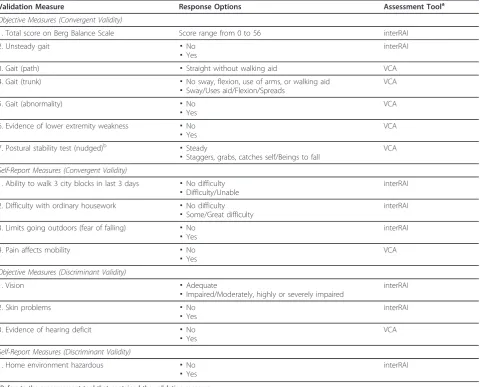
theoretically notrelated to PA were selected as discrimi-nant validity measures, and we hypothesized correlations close to zero. Three objectively measured items and one self-report item from the geriatric assessments were selected for evaluation. See Table 3 for an overview of
Table 3 Convergent and discriminant validation measures
Validation Measure Response Options Assessment Toola
Objective Measures (Convergent Validity)
1. Total score on Berg Balance Scale Score range from 0 to 56 interRAI
2. Unsteady gait ▪No
▪Yes
interRAI
3. Gait (path) ▪Straight without walking aid VCA
4. Gait (trunk) ▪No sway, flexion, use of arms, or walking aid ▪Sway/Uses aid/Flexion/Spreads
VCA
5. Gait (abnormality) ▪No
▪Yes
VCA
6. Evidence of lower extremity weakness ▪No ▪Yes
VCA
7. Postural stability test (nudged)b
▪Steady
▪Staggers, grabs, catches self/Beings to fall
VCA
Self-Report Measures (Convergent Validity)
1. Ability to walk 3 city blocks in last 3 days ▪No difficulty ▪Difficulty/Unable
interRAI
2. Difficulty with ordinary housework ▪No difficulty ▪Some/Great difficulty
interRAI
3. Limits going outdoors (fear of falling) ▪No ▪Yes
interRAI
4. Pain affects mobility ▪No ▪Yes
VCA
Objective Measures (Discriminant Validity)
1. Vision ▪Adequate
▪Impaired/Moderately, highly or severely impaired
interRAI
2. Skin problems ▪No
▪Yes
interRAI
3. Evidence of hearing deficit ▪No ▪Yes
VCA
Self-Report Measures (Discriminant Validity)
1. Home environment hazardous ▪No ▪Yes
interRAI
a
Refers to the measurement tool that contained the validation measure
b
Item from the Tinetti Balance Assessment Tool
validation measures and corresponding response options.
Statistical analyses
Test-retest reliability was assessed using the weighted kappa statistic along with 95% CIs [34]. Guidelines adopted for interpreting the strength of agreement for kappa values were as follows: less than 0.41 represents poor to fair agreement, 0.41 to 0.6 represents moderate agreement, 0.61 to 0.8 represents substantial agreement, and 0.81 to 1 represents almost perfect agreement [35].
Convergent and discriminant validity was assessed by correlation coefficients. Spearman’s rho was used when the PA questions were compared with continuous dation measures whereas Cramer’s v was used for vali-dation measures that were categorical. For the Spearman’s rho correlations, the Fisher z transformation was used to obtain 95% CIs [36]. Qualitative descriptors adopted for interpreting correlation coefficients were as follows: 0 to 0.25 represents little or no association, 0.26 to 0.5 represents a fair association, 0.51 to 0.75 repre-sents moderate to good association, and greater than 0.75 represents good to excellent association [33]. All statistical analyses were performed using SAS v. 9.1.3 (SAS Institute Inc., Cary, NC, 2003).
Abbreviations
CA1: First clinical assessment; CA2: Second clinical assessment; CI: Confidence interval; ICC: Intraclass correlation coefficient; InterRAI: interRAI Community Health Assessment (earlier version); MDS-HC: Minimum Data Set for Home Care; NHIS: National Health Interview Survey; PA: Physical activity; PPFV: Project to Prevent Falls in Veterans; SD: Standard deviation; SGS: Specialized Geriatric Services; VCA: Veterans’Comprehensive Assessment; Zero-Mod: Zero modifiable risk factors for falling.
Acknowledgements
Funding provided by the Ontario Neurotrauma Foundation (Gill & Speechley) and Veterans Affairs Canada-Health Canada Falls Prevention Initiative (Speechley, Project # 6793-06 2000/16009). Guangyong Zou is a recipient of the Early Researcher Award, Ontario Ministry of Research and Innovation, Canada. The authors would like to sincerely thank the Canadian Centre for Activity and Aging, Shannon Belfry, Krista Bray Jenkyn and Sue Muir for their contributions to the Project to Prevent Falls in Veterans. The authors would also like to thank the referees of this manuscript who provided extremely helpful comments. The authors gratefully acknowledge the individuals who participated in this study.
Author details
1National Alzheimer’s Coordinating Center, Department of Epidemiology,
University of Washington, Seattle, WA, USA.2School of Health and Exercise Sciences, University of British Columbia, Kelowna, BC, Canada.3Department
of Epidemiology and Biostatistics, Schulich School of Medicine and Dentistry, University of Western Ontario, London, ON, Canada.4Robarts Clinical Trials of
Robarts Research Institute, Schulich School of Medicine and Dentistry, University of Western Ontario, London, ON, Canada.
Authors’contributions
DPG conceived of the study, participated in the design of the study, performed the statistical analysis and drafted the manuscript. GRJ participated in the design of the study and helped to draft the manuscript. GZ helped with the statistical analysis and helped to draft the manuscript. MS conceived the study, participated in the design and coordination of the
study and helped to draft the manuscript. All authors read and approved the final manuscript.
Competing interests
The authors (DPG, GRJ, GZ, MS) declare that they have no competing interests.
Received: 12 September 2011 Accepted: 28 February 2012 Published: 28 February 2012
References
1. Shi L:Health Services Research Methods.2 edition. Clifton Park, NY: Thomson/Delmar Learning; 2008.
2. Paterson DH, Jones GR, Rice CL:Ageing and physical activity: evidence to develop exercise recommendations for older adults.Appl Physiol Nutr
Metab2007,32(Suppl 2E):S69-S108.
3. Caspersen CJ, Powell KE, Christenson GM:Physical activity, exercise, and physical fitness: definitions and distinctions for health-related research.
Public Health Rep1985,100:126-131.
4. Warren JM, Ekelund U, Besson H, Mezzani A, Geladas N, Vanhees L: Assessment of physical activity-a review of methodologies with reference to epidemiological research: a report of the exercise physiology section of the European Association of Cardiovascular Prevention and Rehabilitation.Eur J Cardiovasc Prev Rehabil2010, 17:127-139.
5. Ainsworth BE:How do I measure physical activity in my patients? Questionnaires and objective methods.Br J Sports Med2009,43:6-9. 6. Lagerros YT, Lagiou P:Assessment of physical activity and energy
expenditure in epidemiological research of chronic diseases.Eur J
Epidemiol2007,22:353-362.
7. Westerterp KR:Assessment of physical activity: a critical appraisal.Euro J
Appl Physiol2009,105:823-828.
8. Forsen L, Loland NW, Vuillemin A, Chinapaw MJ, van Poppel MN, Mokkink LB, van Mechelen W, Terwee CB:Self-administered physical activity questionnaires for the elderly: a systematic review of measurement properties.Sports Med2010,40:601-623.
9. Davis HS, MacPherson K, Merry HR, Wentzel C, Rockwood K:Reliability and validity of questions about exercise in the Canadian Study of Health and Aging.Int Psychogeriatr2001,13(Suppl 1):177-182.
10. Nadalin V, Bentvelsen K, Kreiger N:Reliability of self-reports: data from the Canadian Multi-Centre Osteoporosis Study (CaMos).Chronic Dis Can2004, 25:28-31.
11. Rose SB, Elley CR, Lawton BA, Dowell AC:A single question reliably identifies physically inactive women in primary care.N Z Med J2008, 121:1-7.
12. Weiss TW, Slater CH, Green LW, Kennedy VC, Albright DL, Wun CC:The validity of single-item, self-assessment questions as measures of adult physical activity.J Clin Epidemiol1990,43:1123-1129.
13. DeSalvo KB, Fisher WP, Tran K, Bloser N, Merrill W, Peabody J:Assessing measurement properties of two single-item general health measures.
Qual Life Res2006,15:191-201.
14. Eriksson I, Unden AL, Elofsson S:Self-rated health. Comparisons between three different measures. Results from a population study.Int J Epidemiol
2001,30:326-333.
15. Gill DP, Jones GR, Zou GY, Speechley M:The Phone-FITT: a brief physical activity interview for older adults.J Aging Phys Act2008,16:292-315. 16. Moore DS, Ellis R, Allen PD, Cherry KE, Monroe PA, O’Neil CE, Wood RH:
Construct validation of physical activity surveys in culturally diverse older adults: a comparison of four commonly used questionnaires.Res Q
Exerc Sport2008,79:42-50.
17. Rikli RE:Reliability, validity, and methodological issues in assessing physical activity in older adults.Res Q Exerc Sport2000,71:S89-S96. 18. Cyarto EV, Marshall AL, Dickinson RK, Brown WJ:Measurement properties
of the CHAMPS physical activity questionnaire in a sample of older Australians.J Sci Med Sport2006,9:319-326.
19. Harada ND, Chiu V, King AC, Stewart AL:An evaluation of three self-report physical activity instruments for older adults.Med Sci Sports Exerc2001, 33:962-970.
21. Schuler PB, Richardson MT, Ochoa P, Wang MQ:Accuracy and repeatability of the Yale Physical Activity Survey in assessing physical activity of older adults.Percept Mot Skills2001,93:163-177.
22. Nelson ME, Rejeski WJ, Blair SN, Duncan PW, Judge JO, King AC, Macera CA, Castaneda-Sceppa C:Physical activity and public health in older adults: recommendation from the American College of Sports Medicine and the American Heart Association.Med Sci Sports Exerc2007,39:1435-1445. 23. Tremblay MS, Warburton DE, Janssen I, Paterson DH, Latimer AE, Rhodes RE,
Kho ME, Hicks A, Leblanc AG, Zehr L, Murumets K, Duggan M:New Canadian physical activity guidelines.Appl Physiol Nutr Metab2011, 36:36-58.
24. Shephard RJ:Limits to the measurement of habitual physical activity by questionnaires.Br J Sports Med2003,37:197-206.
25. DiPietro L:The epidemiology of physical activity and physical function in older people.Med Sci Sports Exerc1996,28:596-600.
26. interRAI Community Health Assessment.[http://www.interrai.org]. 27. Koepsell TD, Weiss NS:Epidemiologic Methods: Studying the Occurrence of
IllnessNew York: Oxford University Press; 2003.
28. Gill DP, Zou GY, Jones GR, Speechley M:Injurious falls are associated with lower household but higher recreational physical activities in community-dwelling older male veterans.Gerontology2008,54:106-115. 29. Speechley M, Belfry S, Borrie MJ, Bray Jenkyn K, Crilly R, Gill DP, McLean S,
Stolee P, Vandervoort AA, Jones GR:Risk factors for falling among community-dwelling veterans and their caregivers.Can J Aging2005, 24:261-274.
30. National Health Interview Survey.[http://www.cdc.gov/nchs/nhis.htm]. 31. Landi F, Tua E, Onder G, Carrara B, Sgadari A, Rinaldi C, Gambassi G,
Lattanzio F, Bernabei R:Minimum data set for home care: a valid instrument to assess frail older people living in the community.Med Care2000,38:1184-1190.
32. Morris JN, Fries BE, Steel K, Ikegami N, Bernabei R, Carpenter GI, Gilgen R, Hirdes JP, Topinkova E:Comprehensive clinical assessment in community setting: applicability of the MDS-HC.J Am Geriatr Soc1997,45:1017-1024. 33. Portney LG, Watkins MP:Foundations of Clinical Research: Applications to
PracticeUpper Saddle River, NJ: Prentice Hall, Inc; 2000.
34. Fleiss JL, Cohen J:The equivalence of weighted kappa and the intraclass correlation coefficient as measures of reliability.Educ Psychol Meas1973, 33:613-619.
35. Landis JR, Koch GG:The measurement of observer agreement for categorical data.Biometrics1977,33:159-174.
36. Fisher RA:Frequency distribution of the values of the correlation coefficient in samples of an infinitely large population.Biometrika1915, 10:507-521.
Pre-publication history
The pre-publication history for this paper can be accessed here: http://www.biomedcentral.com/1471-2288/12/20/prepub
doi:10.1186/1471-2288-12-20
Cite this article as:Gillet al.:Using a single question to assess physical
activity in older adults: a reliability and validity study.BMC Medical Research Methodology201212:20.
Submit your next manuscript to BioMed Central and take full advantage of:
• Convenient online submission
• Thorough peer review
• No space constraints or color figure charges
• Immediate publication on acceptance
• Inclusion in PubMed, CAS, Scopus and Google Scholar
• Research which is freely available for redistribution